Analytical modeling of address allocation protocols
in wireless
ad hoc
networks
I
Ahmad Radaideh, John N. Daigle
*University of Mississippi, University, MS 38677, USA
Abstract
Detailed descriptions of Internet Protocol Address Assignment (IPAA) and Mobile Ad Hoc Network Configuration (MANETconf) are presented and state diagrams for their behavior are constructed. Formulae for the expected latency and communication overhead of the IPAA protocol are derived, with the results being given as functions of the number of nodes in the network with message loss rate, contention window size, coverage ratio, and the counter threshold as parameters. Simulation is used to validate the analytical results and also to compare performance of the two protocols. The results show that the latency and communication overhead for MANETconf are significantly higher than the measures of the IPAA protocol. Results of extensive sensitivity analyses for the IPAA protocol are also presented.
Keywords: address assignment protocols, mobilead hocnetworks, performance evaluation Received on 27 December 2010
Copyright 2011 Radaideh and Daigle, licensed to ICST. This is an open access article distributed under the terms of the Creative Commons Attribution licence (http://creativecommons.org/licenses/by/3.0/), which permits unlimited use, distribution and reproduction in any medium so long as the original work is properly cited.
doi: 10.4108/icst.trans.mca.2011.e3
1. Introduction
In this paper, detailed descriptions for two dynamic and distributed protocols proposed for address allocation in wirelessad hocnetworks are presented, and analytical der-ivations for the expectations of performance measures— latency and communication overhead—for one of these protocols are carried out. Latency is the amount of time required for a newly joining node to obtain a network address, and communication overhead represents the number of messages sent during the allocation process. Expected values of the performance measures as a func-tion of the number of network nodes at the time the new node joins the network are given. Analytical and sim-ulation results are presented to show the effect of changes in message loss rate, coverage ratio, and the contention window size on the performance measures.
A Mobile Ad Hoc Network (MANET) has neither per-manent infrastructure, nor centralized servers, nor con-nectivity to external networks. It consists of end systems, or nodes, that communicate with each other over a wireless medium. A node has a limited transmission range due to its limited power and it communicates directly with nodes within its transmission range. The MANET topology changes dynamically; nodes are free to move within the network, join, and leave at any time. Each node in the network runs a routing protocol so that a message from a source node can be transmitted to a des-tination node even if that node is outside the source’s transmission range.
Address configuration can be performed using address mapping, static configuration, or dynamic configuration approaches. Address mapping uses a mapping function to derive a network address from a hardware interface identi-fier (MAC address) as in [1]. However, MANET nodes are not restricted to using 48-bit MAC addresses. Also the mapping is not guaranteed to be unique in IPv4 networks which use shorter 32-bit network addresses. The static configuration approach needs a user interaction and knowledge of the network’s current configuration, I
A preliminary version of this paper was presented at ICST ADOC-NETS 2010, Victoria, BC.
*Corresponding author. Email:[email protected]
which is not practical for a dynamic topology network. In the dynamic approach, a dynamic configuration protocol is used to assign a network address. Configuration proto-cols such as the Dynamic Host Configuration Protocol (DHCP) [2], which run on centralized machines, cannot be extended to MANETs because of their distributed and dynamic nature. Hence, a distributed dynamic configura-tion protocol is required for a MANET.
Some characteristics that need to be taken into account when designing address configuration protocols include multi-hop communication, dynamic topology, and net-work merging and partitioning [3]. Some proposed solu-tions for the address allocation problem in MANETs use the duplicate address detection (DAD) mechanism to ver-ify the uniqueness of a network address throughout the network. Others use the binary-split idea [4] to distribute the address block among network nodes so that each node has a disjoint subset of network addresses and there-fore DAD is avoided. Most of these mechanisms are clas-sified in [5] based on the following factors: network scenario (stand-alone or connected to Internet), routing protocols’ dependency, address uniqueness (DAD or non-DAD), distributed or centralized address allocation, and MANET characteristics support.
Perkins [6] configures by first choosing a random address then performing a DAD procedure within the MANET. To perform the uniqueness check, the node sends an address request (AREQ) message including the randomly selected address. This message is broadcasted to all nodes in the network. The source address of the AREQ is another temporary IP address used only for sending this message. It has a different non-overlapping prefix than the prefix of the address selected for allocation and it is selected randomly so that the duplicate probabil-ity is very low. An address reply (AREP) message is sent only if the address of the receiving node matches the address in the AREQ message. The new node concludes that the selected address is unique if there is no AREP message received after sending the AREQ a finite number of retries denoted as REQUEST_RETRIES. Since the protocol performs DAD only when assigning an IP address to a new node, the proposed protocol lacks sup-port for partitioning and merging in MANET.
Jeong [7] proposes a protocol with two address detec-tion mechanisms. A strong DAD, based on the protocol proposed in [6], is performed in the initial phase to verify the uniqueness of the randomly selected address and a weak DAD, based on [8], which is always executed in order to prevent address conflicts with existing nodes. The weak DAD uses the concept of a virtual address, which is a combination of an address and a key. The key, which is assumed to be unique in the network, is appended to the address in the routing messages as well as the rout-ing table. The weak DAD identifies duplicate addresses by monitoring routing information and reports the address duplication by sending out an error (AERR) message to
one of the conflicting nodes to change its address. This protocol monitors and changes the routing messages and therefore is considered routing protocol dependent.
A passive DAD approach [9] has been adopted in some proposed solutions for dynamic address configuration, such as in [10] and [11]. Passive DAD enables nodes to detect duplicate addresses in the network by analyzing received routing protocol messages. One way to detect address conflicts is based on the sequence number of a link-state routing message. The sequence number is always incremented and used to distinguish fresh from old routing information. Given that two messages with the same sequence number and source address are copies of the same message, a node may detect an address conflict if it receives a message with its own address as source address and a sequence number higher than its own coun-ter. Other ways to detect address conflicts are based on locality and neighborhood and they are all based on ana-lyzing routing information, which makes these solutions routing protocol dependent.
Zhou et al. [12] proposed a mechanism based on a stateful function,f(n), to derive addresses with low prob-ability of address duplication and therefore it avoids the use of DAD. The initial state off(n) is a seed that generates a sequence of unique numbers that can be used as network addresses. The function has to be designed carefully such that the interval between two occurrences of the same number in the generated sequence is extremely long and the probability of generating the same number in finite number of sequences initiated by different seeds is extre-mely low. A proposed solution based on the stateful func-tionf(n) works as follows: The first node in the network, say A, chooses a random number as its address and uses a random or default state value as a seed of itsf(n). When a new node, say B, joins the network and asks node A for an address, A generates an address using its state function and new state value and assigns them to B. Node A updates its state value accordingly. Node B uses the generated address as its address and the state value as a seed for its function so it can assign address to other nodes. The main concern about this protocol is designing anf(n) that satisfies the properties mentioned above, which is considered a hard mathematical problem. Additional approaches based on genetic algorithms and a quadratic residue approach are presented in [13] and [14], respectively.
to find a neighbor, it concludes it is the first node in the network and performs address configuration for itself. The proposed protocol handles network partitioning and merging by performing address recovery and dupli-cate detection procedures.
Mohsin and Parakash [16] propose the IPAA protocol which is based on a dynamic configuration of addresses using the concept of binary split. The protocol is classified as a proactive approach because each node can indepen-dently assign a unique address to a new node without consulting any other node in the MANET. Each node in the network has a disjoint subset of the address space. When a new node joins the network, it tries to find a neighbor node that can perform an address configuration on its behalf. If a neighbor is found, the new node asks that neighbor for an address allocation. The neighbor splits its available address space into two halves and sends one half to the new node. The new node then assigns itself the first IP address in the received address space and keeps the rest with itself to configure other nodes in the future. If the new node could not find a neighbor, it concludes it is the first node in the network. So, it assigns itself the first address in the address space and keeps the rest of the address space for itself. The protocol handles network partitioning and merging as well as address recovery due to node departures. A very similar approach to IPAA, which is based on the binary-split idea, is proposed in Tayal and Patnaik [17].
The main contributions in this work are building state diagrams that represent the behavior of the two address allocation protocols proposed in [15] and [16], deriving analytical formulations for the expectations of latency and communication overhead for the protocol in [16], and presenting analytical and simulation results for the performance measures of that protocol for different num-bers of existing nodes in the network. The protocol in [15] represents the DAD-based allocation schemes with an advantage of selecting a network address based on state information a node maintains to enhance the protocol performance1. The second protocol, which is proposed in [16], performs address allocation through local com-munications with neighbor nodes and that is achieved through distributing the address space among network nodes based on the binary-split idea.
The paper is organized as follows. In Section 2, detailed descriptions of the proposed address allocation protocols in [15] and [16] are presented. For each protocol, two state diagrams are derived based on the protocol specifica-tions. The state diagrams give a complete picture of the protocol behavior, messages, timers, and handshakes. One diagram shows the state of the new node during the address allocation process while the other one shows
the state of an existing node that performs the address allocation for the new node. In Section 3, analytical for-mulas for latency and communication overhead for the protocol in [16] are derived. The analytical formulas rep-resent the expected values of the performance measures as a function of the number of nodes in the network and with message loss rate, contention window size, coverage ratio, and counter threshold as parameters. Section 4 pre-sents the analytical as well as the simulation results for dif-ferent values of the message loss rate, contention window size, and the coverage ratio. Section 5 concludes the paper and suggests future research.
2. Detailed descriptions of two address
allocation protocols
This section presents detailed descriptions of MANET conf [15] and IPAA [16] in separate subsections. Both protocols are designed with the following network oper-ating characteristics in mind. Nodes are free to move in the network, join, and leave at any time. Address alloca-tion and maintenance are the responsibility of existing nodes in the network and have to be performed when the topology changes to maintain uniqueness of allocated addresses. The MANET is configured as a private IPv4 network in which the participating nodes are configured in advance to use a specific private address block. At any given time a group of connected nodes forms a network partition that has a universal unique identifier (UUID). As time evolves, a partition could either split or merge with another partition; the UUID is the key to managing the partitions. The nodes in MANET communicate with each other using IP datagrams. Communication between distant nodes in a partition is carried over intermediate nodes running anad hocrouting protocol.
2.1. MANETconf protocol
In MANETconf protocol, previously configured nodes in the network manage address allocation for newly joining nodes. A newly joining node, arequester, chooses one of its configured neighbors, an initiator, to perform the address allocation on its behalf. The initiator first selects a candidate address and then broadcasts a message to all nodes in its partition to verify the uniqueness of the selected address. If verification is successful, the initiator allocates the address to the requester and informs all other nodes of the address assignment. Otherwise, the initiator repeats this address selection-verification mechanism for a finite number of times before giving up.
The protocol performs maintenance operations that clean up addresses of departed nodes due to node crashes or network partitioning, resolves address conflicts after network merging, maintains correct allocation information in each node using a soft state mechanism (i.e. timers), and resolves concurrent allocation conflicts using a priority
1The protocol proposed in [18] is compared to MANETconf via
mechanism based on the initiator address. New node address allocation and network partitioning and merging are described in separate subsections below.
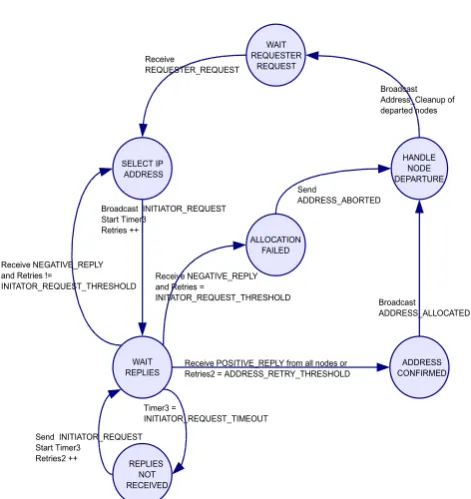
New node address allocation. Figures 1 and 2 show the state diagrams of the address allocation process for a requester and an initiator nodes, respectively. The reques-ter broadcasts a NEIGHBOR_QUERY message. If at least one NEIGHBOR_REPLY message to this query is received within a timeout value of NEIGHBOR_ REPLY_TIMEOUT, the requester selects one of the responders as an initiator; otherwise, the requester retries until NEIGHBOR_QUERY_THRESHOLD is reached and then allocates an address and forms its own partition.
When the REQUESTER_REQUEST message is received, the initiator starts the address allocation process. As stated above, address allocation is a two-phase process that starts by selecting an address and verifying its unique-ness over the network partition and then confirms the allocation of the unique address to the requester. In order to minimize the conflict probability, each configured node maintains state information of address allocation in two data sets. AnAllocatedset which lists all allocated addresses, and an Allocate_Pending set which lists the addresses that are being allocated to newly joining nodes. Each entry in Allocate_Pending shows the address being allocated and the initiator node performing the allocation
process to that address. A soft state maintenance to Allo-cate_Pending set is considered where each entry is auto-matically deleted after it times out.
The initiator selects an address that is neither in its Allocated nor Allocate_Pending sets. It inserts the alloca-tion informaalloca-tion {selected address, initiator address} to its Allocate_Pending set and broadcasts an INITIA-TOR_REQUEST message to all nodes in its partition to verify the address uniqueness. Address uniqueness is successfully verified when all nodes that are listed in the initiator Allocated set send a POSITIVE_REPLY message back to the initiator. This message verifies that the address is unique based on the state information of the replied node. If positive replies from all nodes have been received, the initiator sends the selected address in an ADDRESS_ALLOCATED message to all nodes in the partition including the requester. Each node inserts the allocated address in its Allocated set and deletes the address from its Allocate_Pending set.
Due to message losses, node departure, or mobility some replies may not be received. If all received replies are positive, the initiator verifies the selected address again by sending INITIATOR_REQUEST to nodes that did not reply to the previous request for ADDRESS_ RETRY_THRESHOLD number of times. The address is considered unique if no negative reply has been received. The nodes that have not replied to the initiator request are considered departed nodes and their addresses are cleaned up.
The uniqueness verification of the selected address fails when a node finds the address in its Allocated set. It also fails if the address found in a node Allocate_Pending set is WAIT
INITIATOR REPLY Send REQUESTER_REQUEST Start Timer2
Receive
ADDRESS_ALLOCATED Receive
ADDRESS_ABORTED
ABORTED
WAIT NEIGBOR
REPLY FIND NEIGHBOR
Broadcast NEIGHBOR_QUERY Start Timer1 Retries ++
Receive NEIGHBOR_REPLY
Timer1 =
NEIGHBOR_REPLY_TIMEOUT and Retries =
NEIGHBOR_QUERY_THRESHOLD Timer2 =
INITIATOR_REPLY_TIMEOUT Retries !=
NEIGHBOR_QUERY_THRESHOLD
NEIGHBOR REPLIED
SELF CONFIGURE Timer1 =
NEIGHBOR_REPLY_TIMEOUT Retries !=
NEIGHBOR_QUERY_THRESHOLD
Timer2 =
INITIATOR_REPLY_TIMEOUT and Retries =
NEIGHBOR_QUERY_THRESHOLD
INITIATOR CONFIGURE
Figure 1. State diagram of a requester node during the address allocation process of MANETconf protocol.
WAIT REQUESTER
REQUEST Receive
REQUESTER_REQUEST
Broadcast INITIATOR_REQUEST Start Timer3
Retries ++
WAIT REPLIES
REPLIES NOT RECEIVED
ADDRESS CONFIRMED Receive POSITIVE_REPLY from all nodes or
Retries2 = ADDRESS_RETRY_THRESHOLD Receive NEGATIVE_REPLY
and Retries =
INITATOR_REQUEST_THRESHOLD
Broadcast ADDRESS_ALLOCATED Receive NEGATIVE_REPLY
and Retries !=
INITATOR_REQUEST_THRESHOLD SELECT IP
ADDRESS
ALLOCATION FAILED
Send ADDRESS_ABORTED
Timer3 =
INITIATOR_REQUEST_TIMEOUT Send INITIATOR_REQUEST
Start Timer3 Retries2 ++
HANDLE NODE DEPARTURE Broadcast Address_Cleanup of departed nodes
being allocated by a higher priority initiator. A node reports the failure by sending a NEGATIVE_REPLY message back to the initiator. If at least one negative reply has been received before INITIATOR_REQUEST_ TIMEOUT, the initiator selects another address and repeats the allocation process again for INITIA-TOR_REQUEST_THRESHOLD times. If all trials have failed, the initiator sends an ADDRESS_ABORTED mes-sage to the requester indicating that all address allocation retries have failed. Receiving an ADDRESS_ABORTED message or no messages at all within the timeout period of INITIATOR_REPLY_TIMEOUT, the requester searches for another initiator for a maximum number of trails equal to NEIGHBOR_QUERY_THRESHOLD to perform the allocation process again.
Network partitioning and merging. The topology of a MANET changes dynamically due to node movement. The network may split into two or more partitions and partitions may also merge together to form a bigger par-tition. Address maintenance has to take place after these operations to solve address leak and duplicate problems.
In a MANET, each partition has a UUID, which is the lowest IP address of the partition. A newly joining node is provided with its partition UUID as well as its own IP address during its address allocation process, whereas a node that configured itself sets its partition’s UUID to its own IP address.
When a group of nodes splits into two separate parti-tions due to nodes movement, nodes in both partiparti-tions will detect departure of other nodes during the address allocation process of a newly joining node. When a parti-tion detects the partiparti-tioning event, address cleanup proce-dure is performed. The node that detects the partitioning event manages address cleanup of departed nodes, so it broadcasts an ADDRESS_CLEANUP message to all other nodes in its partition. A node that receives the address cleanup message deletes the addresses listed in the message from its Allocated set. Since the UUID is determined by the lowest address in the partition, one of the partitions has to be assigned a new UUID. In a par-tition that the lowest address has been deleted, each node selects the lowest remaining address allocated in that par-tition to be the new UUID.
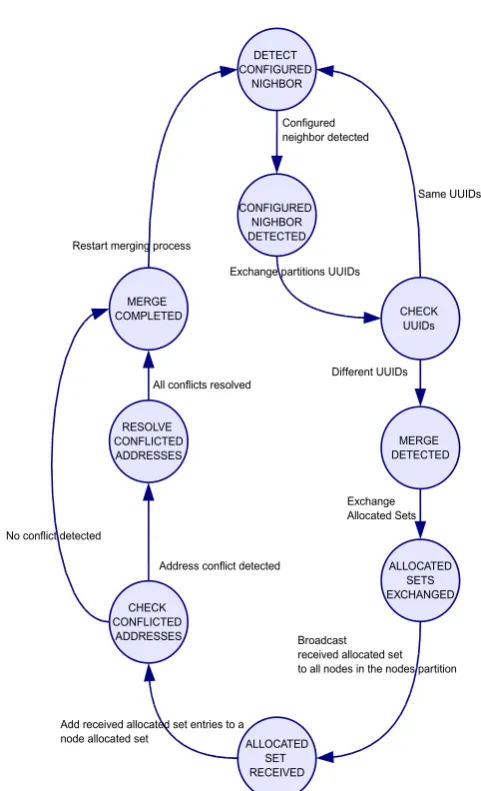
Figure 3 shows the state diagram of the partitions merging process. When two nodesi andjfrom two dif-ferent partitions get close to each other, they exchange their partition identifiers. If the received partitions identi-fier is different from a node partitions identiidenti-fier then a node detects the merging of two partitions. Both iand
jwill detect merging of their partitions in that case. After detecting the merging event, bothiandjexchange their Allocated sets. Each one of them broadcasts the Allocated set of the other to all nodes in its partition. Each node in both partitions takes the union of its Allocated set and the received Allocated set.
If the received Allocated set contains a node address, then there is a node in the other partition that has the same address. Those two nodes are called conflicting nodes. One of the conflicting nodes has to give up the conflicting address and ask existing neighbors for a unique address. The address allocation process has to be performed for each conflicting address and this time a global agreement on the selected address has to be granted from all nodes in both merged partitions. Nodes in one partition have to update their UUID to the lowest allocated address in both partitions. The merging of two partitions is completed when address conflict has been resolved.
2.2. IPAA protocol
The IPAA protocol presents a distributed dynamic address allocation protocol for a stand-alone MANET. The proto-col avoids the DAD process by employing a proactive approach using the binary-split idea. The binary-split idea
CONFIGURED NIGHBOR DETECTED
Exchange partitions UUIDs
CHECK UUIDs
Same UUIDs
MERGE DETECTED Different UUIDs
ALLOCATED SETS EXCHANGED Exchange Allocated Sets
ALLOCATED SET RECEIVED
Broadcast received allocated set to all nodes in the nodes partition CHECK
CONFLICTED ADDRESSES
Add received allocated set entries to a node allocated set
RESOLVE CONFLICTED ADDRESSES MERGE COMPLETED
Address conflict detected All conflicts resolved
No conflict detected
Restart merging process
DETECT CONFIGURED
NIGHBOR
Configured neighbor detected
is that each node has a disjoint subset of the address block and it can independently allocate a unique address and hand half of its address space to a newly joining node with-out getting an agreement from every other node in its partition.
When a new partition is formed, the only node in that partition reserves the complete address block and assigns itself the first address in that block. A newly joining node, a requester (or client), asks an existing neighbor node, an initiator (or server), for a network address. The server divides its address space into two halves and gives one half to the requester. The requester assigns itself the first address from the received address space and keeps the rest of it to serve other nodes in the future. If the initiator has no space left, it borrows an address space from an existing node and forwards it to the requester. This procedure avoids flooding the entire partition to verify the unique-ness of the selected address as DAD-based protocols do. Maintaining the complete Address_Block is the key issue in this protocol. The protocol performs maintenance procedures to avoid address leak and conflict problems. The address leak problem happens when a node abruptly departs the network or moves out its partition without returning its address space. Without cleaning up departed nodes addresses, these addresses will be considered allo-cated to existing nodes and cannot be alloallo-cated to newly joining nodes. Nodes keep track of allocated address blocks to resolve the address leak problem. Graceful departure is provided where nodes that want to leave the network return their address blocks and confirm their departure. Address conflict problems could happen when two partitions merge together since each partition reserves the entire address block for itself. Nodes with the same address in both partitions are allocated the same address space when configured. The conflicting node that has a bigger address space should give up its allocated space and ask other nodes for new allocation.
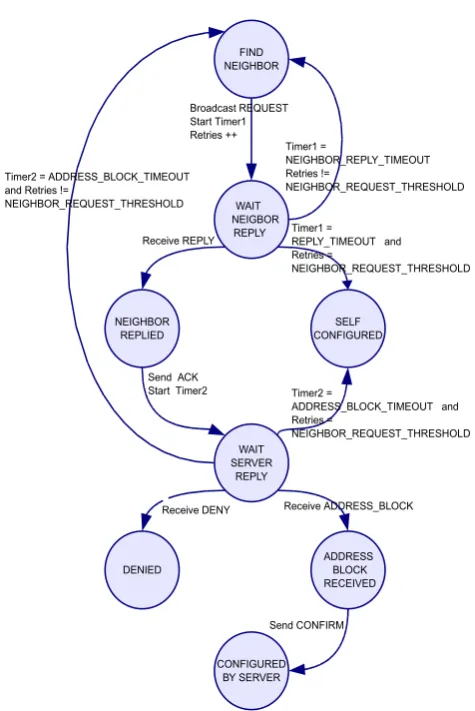
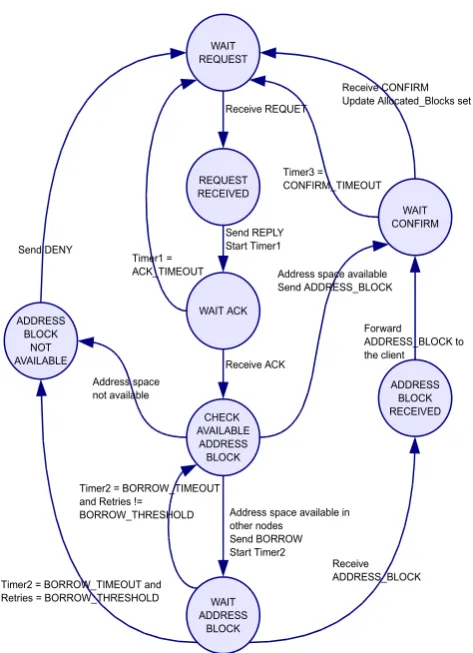
New node address allocation. Figures 4 and 5 show the state diagrams of a client and a server nodes during address allocation process, respectively. When a client joins the network it broadcasts a one-hop REQUEST message. A neighbor replies with a REPLY message to the client. The client selects one of its existing neighbors that replied to its request message to be its server. The cli-ent sends an acknowledgemcli-ent (ACK) message to the selected server asking for a unique address. When receiv-ing the ACK message, the server starts the allocation pro-cess for the requested client. Neighbors are expected to reply to the client request within REPLY_TIMEOUT amount of time. If the timer expires without receiving any reply, the client repeats searching for neighbors for NEIGHBOR_ REQUEST_THRESHOLD number of times. If all trials have failed, the client reserves the entire address block for itself, allocates itself the first address in that block, and sets a UUID for that partition.
If reply messages have been received, the client selects one of its neighbors to perform the address allocation pro-cess by sending an ACK message and starting a timer with a timeout value ADDRESS_BLOCK_TIMEOUT. When a node receives the ACK message, it divides its available address space into two disjoint subsets and sends one sub-set to the client in the ADDRESS_BLOCK message. The client receives the ADDRESS_BLOCK and the partition UUID, configures itself the first address in that block, and keeps the rest of its address space to configure newly joining nodes in the future. The client confirms a successful address allocation by sending CONFIRM message back to the server. If the client timer expires before receiving the ADDRESS_BLOCK message, the client considers that the server is no longer existing and searches for another ser-ver to perform the address allocation process again up to NEIGHBOR_REQUEST_THRESHOLD number of times. If the ADDRESS_BLOCK message has not been received in all trials, the client performs self-allocation to configure itself an address as described above.
In case the selected server has no available addresses to serve the client, the server searches for an existing node in
WAIT SERVER
REPLY Send ACK
Start Timer2
Receive ADDRESS_BLOCK Receive DENY
DENIED
WAIT NEIGBOR REPLY
FIND NEIGHBOR
Broadcast REQUEST Start Timer1 Retries ++
Receive REPLY
Timer1 =
REPLY_TIMEOUT and Retries =
NEIGHBOR_REQUEST_THRESHOLD Timer2 = ADDRESS_BLOCK_TIMEOUT
and Retries !=
NEIGHBOR_REQUEST_THRESHOLD
NEIGHBOR REPLIED
SELF CONFIGURED Timer1 =
NEIGHBOR_REPLY_TIMEOUT Retries !=
NEIGHBOR_REQUEST_THRESHOLD
Timer2 =
ADDRESS_BLOCK_TIMEOUT and Retries =
NEIGHBOR_REQUEST_THRESHOLD
ADDRESS BLOCK RECEIVED
CONFIGURED BY SERVER
Send CONFIRM
the partition that has an available address. For this purpose, each node maintains state information about the allocated address blocks in Allocated_Blocks data set. The Allo-cated_Blocks set lists the configured nodes in the partition with their available Address_Blocks. The server selects the node with the largest available Address_ Block and sends it a BORROW message requesting half of its available space. Once the ADDRESS_BLOCK message is received from the requested node, the server forwards the message to the client. If all nodes in the server Allocated_Blocks set have no available address space, the server sends a deny (DENY) message to the client indicating that addresses are not available in this partition.
Nodes could depart the network or move out their par-titions at any time. If a node does not respond to the BORROW message within a timeout period of BOR-ROW_TIMEOUT, the server sends the borrow message to the node that has the second largest address space. The borrow process is repeated up to BORROW_THRESH-OLD number of times. If all trials have failed or no address space is available in the rest of the partition nodes, the server sends DENY message to the client indicating that addresses are not available in this partition.
Network partitioning and merging. Nodes may depart the network or move out of their partitions at any time. Depar-ture of a node leads to address leak problem where the nodes address block will not be used by other existing nodes. Each node is responsible for cleaning up the Address_Block of its missing buddy node. To achieve this, the Allocated_Blocks set in each node has to be updated regularly. Each node in the partition broadcasts its Allo-cated_Blocks set to every other node in the partition. A node updates its Allocated_Blocks set when receiving other nodes’ sets to keep its information up to date.
Since the state information a node has is assumed up to date, each node looks up its Allocated_Blocks set from time to time to check the existence of its buddy node. If the buddy node is missing from the set, a node claims that its buddy has departed the network. Therefore, it merges its buddy node Address_Block with its block. Each partition has a UUID to be identified from other existing partitions. Partitioning is detected if the node with the lowest address is missing. When detecting the partitioning event, each node sets the partition UUID to the lowest address currently allocated to a node in their partition.
It is possible that a partition merges with another par-tition in the network. The merging process performed in this protocol is similar to the process described in
Figure 3. When two configured nodes get close to each other, they exchange their partition UUIDs. If the nodes UUIDs are different, a merging event is detected. Those nodes that detect the merging event exchange their Allocated_Blocks sets. Each node broadcasts the other nodes’ set to all nodes in its partition. When a node receives the Allocated_Blocks set, it searches the set to check if a node with the same address exists in the other partition. If an address conflict is detected, one of the two nodes with a larger address space gives up its address space and asks existing nodes for a new allocation. Merg-ing of two partitions ends when all address conflicts are resolved. The partition UUID maintained by each node is updated to the lowest address allocated in the resulting partition.
3. Analytical modeling of address
allocation protocols
In this section, we derive analytical expressions of the expected values of latency and communication overhead that are used to evaluate the performance of IPAA [16]. The main objective of such analytical derivations is to obtain mathematical formulations that can clarify the impact of network characteristics and the number of exist-ing nodes in the network on the performance measures of the address allocation process under consideration. The network characteristics that have an impact on the perfor-mance measures are the network area, the node’s coverage
WAIT REQUEST
Receive REQUET
CHECK AVAILABLE
ADDRESS BLOCK REQUEST RECEIVED
WAIT ACK Send REPLY Start Timer1 Timer1 =
ACK_TIMEOUT
Receive ACK
WAIT CONFIRM Address space available Send ADDRESS_BLOCK
Receive CONFIRM Update Allocated_Blocks set
ADDRESS BLOCK
NOT AVAILABLE
Send DENY
WAIT ADDRESS
BLOCK
ADDRESS BLOCK RECEIVED
Address space available in other nodes
Send BORROW Start Timer2
Receive ADDRESS_BLOCK Timer2 = BORROW_TIMEOUT
and Retries != BORROW_THRESHOLD
Timer2 = BORROW_TIMEOUT and Retries = BORROW_THRESHOLD
Forward ADDRESS_BLOCK to the client Address space
not available
Timer3 = CONFIRM_TIMEOUT
area, collisions, and message loss rate. The derived formu-las also show the impact of the protocol parameters which are the timeout values and the counter values on the perfor-mance measures of the selected protocol.
The derivations of the expected latency and communi-cation overhead are first carried out for small number of existing nodes in the network and then generalized for an arbitrary number of nodes. Section 3.1 presents the network model under consideration. It defines the net-work boundary, the node’s coverage area, the message loss as well as collision for the incoming traffic at the new node. In Section 3.2, derivations for the expected latency and communication overhead are conducted.
3.1. The network model
LetArepresent the total area of the network. Each node in the network is located at a random position and nodes are assumed to be uniformly distributed over the network area. Nodes are assumed to have a coverage area of Ax.
Letn~denote the number of existing nodes in the network at the time a new node wishes to join. Letx~i indicate the
presence of nodei, i= 1, 2, . . ., n, within the transmis-sion range of the new node; that is,x~i ¼1 is a neighbor
of the newly entering node andx~i¼0 otherwise.
Since the existing nodes are uniformly distributed over the network area independent of the placement of all other nodes,x~i,i= 1, 2,. . .,n, is a set of identical,
inde-pendent, Bernoulli trials with success probability Ax
A.
Thus, the number of existing nodes that are within the transmission range of the new node, denoted as x~, is a binomial random variable with parameters n;Ax
A
and
E½x~jn~¼n ¼n Pfx~i¼1jn~¼ng ¼n
Ax
A : ð1Þ
The new node communicates with a neighbor node over a wireless channel. A bad channel condition results in a low signal to interference plus noise ratio (SINR) for the received message and the message is considered lost if its SINR is below a given threshold. Assume that the wireless channel between the new node and a neigh-bor node has a message loss rate equal toe. To avoid col-lision, each node in the network has a contention window of sizeW. A node that has data to send chooses a random slot number uniformly from {1, 2,. . ., W} and sends its data in that selected slot. Collision in a given slot could happen if two or more nodes transmit in the same slot despite the SINR value of their messages. A message is received successfully if it does not collide with other mes-sages in the transmission slot and has a good SINR value.
3.2. Expectations of the performance measures
The amount of time for the new node to be configured with a network address is denoted as~l and the number of messages sent during the address allocation process is
denoted as ~c. The derivations for the expected values of latency and communication overhead for a given number of nodes,~ljn~¼nand~cjn~¼n, respectively, are first con-structed for the case n~¼0 and then generalized to an arbitrary number of nodes n~¼n.
The n˜¼0 case. In this case the new node is the only node in the network. The new node starts by broadcast-ing a REQUEST message in order to be allocated by an address through local communication with its neighbors. Since there are no nodes in the neighborhood, the timer for receiving the REPLY message will reach the timeout valueTNR without receiving any REPLY message. Since
no REPLY messages have been received during the first timeout period, the new node sends another REQUEST message and again waits for timeout. The new node will repeat sending the REQUEST message and waiting for timeout for a maximum ofKNRtrials. After the last
time-out period, the new node considers itself the first node in the network and performs address configuration itself. It allocates the entire address space for itself and assigns itself the first address in that space.
The expected latency for a new node to be allocated a network address in this case, denoted as E~ljn~¼0, is the sum of the timeout value for all trials. The timeout value for each trial is TNRand the maximum number of
trials isKNR. Therefore,
El~jn~¼0¼E~ljx~¼0¼KNRTNR: ð2Þ
The expected communication overhead in this case, which is denoted as E½~cjn~¼0, is the number of REQUEST messages sent by the new node. The new node sends one REQUEST message in each trial for a maximum number of KNR without getting any replies.
Therefore,
E½~cjn~¼0 ¼E½c~jx~¼0 ¼KNR: ð3Þ
General formulas forn˜¼n. In this section we derive gen-eral formulas for the expectations of latency and commu-nication overhead for the address allocation protocol presented in [12]. The latency, as defined earlier, is the amount of time required for a new node to be allocated a network address, and the communication overhead is the number of messages sent during the address alloca-tion process. Here, we derive expectaalloca-tions for the latency and communication overhead given that the number of nodes in the network isn~¼n.
E~ljn~¼n¼X
n
x¼0
El~jx~¼xPfx~¼xjn~¼ng ð4Þ
and
E½~cjn~¼n ¼X
n
x¼0
E½~cjx~¼xPfx~¼xjn~¼ng: ð5Þ
Recall thatx~is a binomial random variable with param-eters n;Ax
A
. Thus,
Pfx~¼xjn~¼ng ¼ n
x Ax
A
x
1Ax
A
nx
: ð6Þ
For the special case when there is no node within the transmission range of the new node, that is (x~¼0Þ, the expected latency and communication overhead as derived in(2)and(3)are given by
E½~ljx~¼0 ¼KNRTNRandE½c~jx~¼0 ¼KNR: ð7Þ
For all other cases, where x~>0, the expectations for the latency and communication overhead for a given number of neighbors are calculated from their condi-tional values on the number of trials, denoted by j~, required to successfully allocate a network address to the new node. Conditioning on the value of~jyields
E½~ljx~¼x ¼X
KNR
j¼1
E½~ljx~¼x;~j¼j
Pf~j¼jjx~¼xg þE½~ljx~¼x;~j>KNR
Pf~j>KNRjx~¼xg;
ð8Þ and
E½~cjx~¼x ¼X
KNR
j¼1
E½c~jx~¼x;j~¼j
Pfj~¼jjx~¼xg þE½~cjx~¼x;~j>KNR
Pfj~>KNRjx~¼xg:
ð9Þ
The kth trial is successful if an ADDRESS_BLOCK message is received from a neighbor node in response to the ACK message. The ADDRESS_BLOCK message contains a disjoint subset of the address space where the new node selects the first address from that space for itself and keeps the rest for serving other joining nodes in future. Assuming that successive trials are independent and identical, the probability that a successful address allocation occurs on thekth trial is given by
Pfj~¼jjx~¼xg ¼ ðPfa~¼0jx~¼xgÞj1Pfa~¼1jx~¼xg; ð10Þ
wherea~is the indicator random variable for the event of a successful allocation. As discussed earlier in previous sec-tions, the trial fails if the ADDRESS_BLOCK message is
not received when at least one REPLY message is received or when no REPLY message is received. Define ~s as the indicator random variable for the event of the reception of at least one reply message from a neighbor node and that message is transmitted with no other messages in a slot and has a good SINR value. Then, the probability of a failed trial in the presence ofxneighbors is given by
Pfa~¼0jx~¼xg ¼Pfa~¼0jx~¼x;~s¼0gPfs~¼0jx~¼xg þPfa~¼0jx~¼x;~s¼1gPf~s¼1jx~¼xg ¼Pf~s¼0jx~¼xg þðeþð1eÞeÞ
Pf~s¼1jx~¼xg:
ð11Þ
The failure to receive a REPLY message is due either to loss of the REQUEST message in transmission channels between the new node and all neighbor nodes or due to loss of the responders’ REPLY messages due to either collisions or external noise. Each neighbor node that received a REQUEST message will send its reply in a ran-domly chosen slot from the range (1, 2,. . .,W), whereW
denotes the contention window size. A REPLY message is received successfully if it is transmitted with no other mes-sages in the same slot and has a good SINR value. Define
~
r to be the number of responders that received a REQUEST message andr~i to be the number of
respond-ers that responded in slot numberi. Then the probability of receiving at least one REPLY message successfully given that there arexneighbors is given by
Pf~s¼1jx~¼xg ¼X
x
r¼1
P [
W
i¼1
fr~i¼1gj~r¼r
( )
Pfr~¼rjx~¼xg:
ð12Þ
The first term of the equation represents the probabil-ity that at least one transmission slot has exactly one REPLY message and that message has a good SINR value. The second term represents the probability that ~r neigh-bors received the REQUEST message out of the total number of neighbors. Since message transmissions are assumed to have identical failure probabilities of e and messages are transmitted independently, ~r is a binomial random variable with parameters (x, (1e)). The prob-ability that r nodes will receive the message out of the total number ofx neighbors is given by
Pfr~¼rjx~¼xg ¼ x
r ð1eÞ
r
exr: ð13Þ
The probability that at least one slot has exactly one reply message given that there are r responders is equal to2
2This is simply the probability of the union of arbitrary events as
P [
W
i¼1
fr~i¼1g jr~¼r
( )
¼X
i
Pfr~i¼1jr~¼rg
X
i<j
P ~ri¼1;r~j ¼1j~r¼r
þ X
i<j<k
P r~i¼1;r~j ¼1;r~k ¼1jr~¼r
. . .
þ ð1ÞWþ1P r~i¼1;r~j ¼1;r~k¼1; ;r~W ¼1j~r¼r
:
ð14Þ
The first term of (14) represents the probability that slot i has exactly one message, in other words, exactly one responder transmitted the message in slot number i
and that message when received had a good SINR value. That is
Pfr~i¼1jr~¼rg ¼
r
1 1
W 1
1
W
r1
ð1eÞ: ð15Þ
The other terms of(14)represent joint probabilities of having more than one slot with exactly one message. Note that the sum of the slots that have exactly one reply message,~ri¼1, is equal to the total number of repliesr.
That is the probability in the second term of the equation evaluates to zero if the number of replies is less than two. In general, the joint probability of having exactly one reply in each of the slots i, j, . . ., z where the
~
riþr~jþ þr~z ¼h is equal to zero for h > r and for
theh rcase it is calculated as
P r~i1 ¼1; ;r~zh ¼1j~r¼r
¼ r
h !
h!ðW hÞ
rh
ðWÞr ð1eÞ
h
: ð16Þ
Substituting this result in (14) and performing some algebra yield
P [
W
i¼1
fr~i¼1g jr~¼r
( )
¼ X
minfr;Wg
h¼1
ð1Þhþ1 W
h !
r
h !
h!ðW hÞ
rh
Wr ð1eÞ h
:
ð17Þ
Now, we consider the conditional expectations of the latency and communication overhead on the number of trials required for the new node to be allocated a network address. Recall that~jrepresents the number of trials that has been performed, the expected latency when the address allocation succeeded on the kth trial, where
jKNR is the sum of the timeouts for the first (k1)
failed trials plus the timeout of receiving a REPLY mes-sage and the timeout of receiving the ADDRESS_ BLOCK message in the last successful trial. The latency for a failed trial is the sum of the timeout to receive the REPLY message plus the timeout to receive the ADDRESS_BLOCK message if at least one reply is suc-cessfully received. That is
E~ljx~¼x;j~¼j¼ðj1ÞðTNRþPf~s ¼1jx~¼xgTARÞ
þTARþTAR ¼jTNR
þTARð1þðj1ÞPfs~¼1jx~¼xgÞ;
ð18Þ
where Pf~s ¼1jx~¼xg is presented in(12).
The expected communication overhead for a successful address allocation on thekth trial is the sum of messages sent during the first (k1) trials and they are one REQUEST message, the expected number of REPLY messages, and one ACK message that is sent if at least one reply is received correctly. In the last trial, the new node sent a REQUEST and received at least one REPLY so it sent out an ACK message to one of the responders and received an ADDRESS_BLOCK message that con-tains a portion of the address space. Therefore, the expected communication overhead is equal to
E½~cjx~¼x;~j¼j ¼ ðj1Þ ð1þE½r~jx~¼x þPf~s ¼1jx~¼xgÞ þ ð1þE½r~jx~¼x þ2Þ ¼jð1þE½r~jx~¼xÞ
þ ðj1ÞPf~s¼1jx~¼xg þ2: ð19Þ
In the case where all trials have failed, that isj>KNR,
the expected latency and communication overhead are given by
E½~ljx~¼x;~j>KNR
¼KNRðTNRþPf~s¼1jx~¼xgTARÞ ð20Þ
and
E½~cjx~¼x;~j>KNR ¼KNRð1þE½r~jx~
¼x þPf~s ¼1jx~¼xgÞ: ð21Þ
Substituting (10), (18), (19), (20), and (21) into(8)
and (9)gives
E½~ljx~¼x ¼X
KNR
j¼1
jTNRþTARð1þ ðj1Þ
Pf~s ¼1jx~¼xgÞ ðPfa~¼0jx~¼xgÞj1 Pfa~¼1jx~¼xg þKNR
ðTNRþPf~s ¼1jx~¼xgTARÞ
ðPfa~¼0jx~¼xgÞKNR;
E½c~jx~¼x ¼X
KNR
j¼1
jð1þE½r~jx~¼xÞ þ ðj1Þ ð
Pf~s ¼1jx~¼xg þ2Þ ðPfa~¼0jx~¼xgÞj1 Pfa~¼1jx~¼xg þKNRð1þE½~rjx~¼x
þPf~s¼1jx~¼xgÞ ðPfa~¼0jx~¼xgÞKNR; ð23Þ
wherePfa~¼0jx~¼xgis from(11)and Pf~s ¼1jx~¼xg is from(12).
4. Numerical results
In this section, we present numerical results for latency and communication overhead based on analysis and sim-ulation, and in addition, we consider the sensitivity of these measures to message loss rate, contention window size, and coverage ratio. In Section 4.1, a description of the simulation carried out for the IPAA and MANETconf protocols is presented. Then, Section 4.2 presents a com-parison of the IPAA and MANETconf protocols. Sec-tion 4.3 presents the analytical and simulaSec-tion results, which show good agreement, for the IPAA protocol as functions of network size with different parameter values. A summary of results is deferred to Section 5.
4.1. Simulation description
The network dimensions are set to 100 m·100 m. Each node is placed at a uniformly distributed location within the network area. Results are collected for node popula-tions from 0 to 50. For a given number of nodes in the network, the number of nodes within the transmission range of the new node depends on its coverage area. Results are collected for coverage ratios of 10%, 15%, and 20%. Each message sent from one node to another is subject to loss with ratee; loss rates examined were 0, 0.1, and 0.2. Contention window sizes, W, considered were 10, 20, and 30. For the IPAA protocol, the timeout value to find a neighbor TNR was set to 0.2 s and the
timeout to receive the Address_Block message TAR was
set to 0.02 s, and KNR was varied from 3 to 5 to show
the effect of the counter threshold on the performance measures of the protocol. For MANETconf protocol
TNR was set to 0.2 s and TAR was set to 2 s, and KNR
was set to 3 and KAR was set to 5.
The simulation results presented are the average values of 10000 simulation runs. For large number of simulation runs, the sample mean of a performance measure for any network size follows the normal distribution Nðl;psffiffinÞ, wherelis the true population mean,sis the sample stan-dard deviation, andnis the sample size. Throughout sim-ulation, we have found that the maximum value of the sample standard deviation is 0.002 for latency samples and it is 0.1 for communication overhead samples for all values of network size. The 95% confidence interval, that
is likely to include the true population mean of a perfor-mance measure, is equal toða1:96 sffiffi
n
p Þ, wherea repre-sents the sample mean for the performance measure. Therefore, the 95% confidence interval for latency sam-ples is ðx3:92105;xþ3:92105Þand for com-munication overhead it isðy0:002;yþ0:002Þ.
4.2. IPAA versus MANETconf protocol
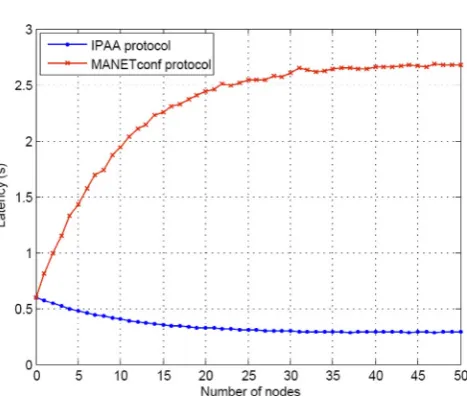
Figure 6 compares the latency of IPAA protocol to the latency of the MANETconf protocol. In MANETconf, the initiator node selects an address and performs DAD process throughout the network. Therefore, the latency of the allocation process increases as the number of nodes in the network increases. In IPAA, the address allocation process is carried out by an existing neighbor or it may be carried out by the new node itself in case no neighbor exists. For large number of nodes, the probability of find-ing a node within the transmission range of the new node is high so that address allocation can be carried out by a neighbor node and therefore it decreases as the number of nodes increases.
Figure 7 presents the communication overhead for IPAA and MANETconf protocols. Since MANETconf performs the DAD process throughout the network, the number of messages sent increases as the number of nodes increases. The IPAA protocol performs address allocation through local communications with neighbor nodes only. Therefore, the number of messages sent is less than that for the MANETconf protocol.
4.3. Analytical and simulation results for the
performance measures of the IPAA protocol
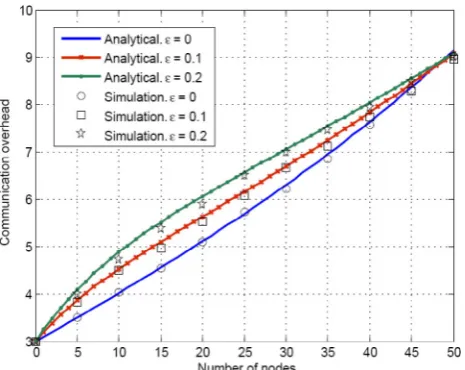
Figures 8and9represent the latency and communication overhead at loss rates e = {0, 0.1, 0.2}. The contention
window size is set toW= 30,KNRis set to 3, and the
cov-erage ratio is set toAx
A ¼10%. The results show that the
latency increases as the loss rate increases since a loss of the protocol messages may result in a failed trial and force the new node to start the process again. For a relatively small number of nodes in the network, the communica-tion overhead increases as the loss rate increases since there exist a small number of neighbor nodes within the transmission range of the new node so the probability of loss of the protocol message is high. For a large number of neighbors, the probability of loss for all mes-sages is lower and the number of mesmes-sages becomes closer to the case where no loss is assumed.
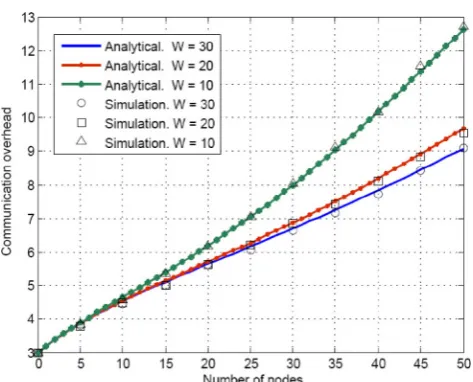
Figures 10 and 11 show the effect of the contention window size W on the latency and the communication
overhead, respectively, when e = 0.1, Ax
A ¼10%, and
KNR= 3. The window size has a greater effect on latency
and communication overhead for a large number of nodes since the collision probability increases as the num-ber of nodes increases. For a given large numnum-ber of nodes, decreasing the window size results in more collisions for the incoming reply messages at the new node which may result in a failed allocation trial. More failed trials result in more latency and more communication overhead as shown in the figures.
Numerous additional analytical and simulation results were carried out and are given in [20]. Also analyzed were the effect of the coverage ratioAx
A on the latency and
com-munication overhead, effect of the protocol parameter
KNR on the latency and communication overhead, and
effect of the loss ratio on the number of neighbor alloca-tions. In all cases analytical and simulation results showed close agreement.
Figure 7. Communication overhead of the IPAA and MANET-conf protocols as a function of network size.
Figure 8. Latency of the IPAA protocol as a function of network size with message loss rate as a parameter.
Figure 9. Communication overhead of the IPAA protocol as a function of network size with message loss rate as a parameter.
5. Conclusions
Detailed descriptions for two address allocation protocols in wirelessad hocnetwork were presented. One of the pro-tocols, the MANETconf protocol of [15], represents the DAD-based address allocation scheme and the other, the IPAA protocol of [16], represents the neighbor-based scheme. State machines that show the protocols’ behavior are constructed for the two protocols mentioned above. The state machine gives a complete picture of the states, handshakes, timers, and types of messages for a protocol. For IPAA, analytical formulas for the expectation of latency and communication overhead are carried out as a function of the number of nodes in the network with message loss rate, contention window size, coverage ratio, and the counter threshold as parameters. Latency is the amount of time required for a new node to be allocated a network address, and communications overhead is the number of messages sent during the address allocation process.
Extensive numerical results were collected. The results show that the latency and communication overhead for MANETconf are higher than those measures for the IPAA protocol and that is due to performing the DAD process in MANETconf throughout the network. In IPAA, address allocation is performed through local communication between the new node and neighbor nodes and therefore its latency and communication overhead are low. It has been shown that the latency and communication overhead of the allocation process for the IPAA protocol increase as the message loss rate increases. Loss of REPLY or ADDRESS_BLOCK messages may result in a failed trial and requires the new node to repeat the allocation process again. The contention window size has an effect on the performance measures for relatively large number of nodes in the network. As the number of nodes in the network increases, the number of neighbor nodes increases and
therefore the probability of collision increases which may result in a failed trial and forces the new node to perform the allocation process again. Additional numerical results given in [20] show that increasing the coverage ratio has basically the same effect as increasing the number of nodes within the transmission range of the new node which leads to high collision probability as mentioned above. Numer-ical results presented in [20] also show that for loss rate equal to 0.1, contention window size of 30, and coverage ratio of 10%, address allocation is carried out by neighbor nodes for almost 95% of the time when the number of nodes in the network is more than 30.
The address allocation problem for ad hocnetworks is still unsolved. The work done in this paper provides understanding of the nature of the problem and the way to evaluate the performance of an allocation protocol. The objective of future research will be to contribute to the solution of the address allocation problem in ad hoc
networks. What is needed is a protocol that handles all types of exceptions such as message losses, node depar-tures, network partitioning, and merging. An address allo-cation protocol for anad hocnetwork has to be a dynamic and distributed protocol that guarantees address unique-ness for each node in the network and scalable to large net-works. Scalability means that the protocol should perform well as the network size increases. The protocol should perform the address allocation for a node with minimum communication overhead and in a timely fashion. Besides the verbal description of the protocol, state machines that show the protocol states, handshakes, types of messages, and timers should be constructed. For completeness, the performance of the protocol should be analyzed and com-pared to the performance of existing protocols.
References
[1] THOMSON, S. and NARTEN, T. (1998) Ipv6 stateless address
autoconfiguration, RFC 2462, IETF Zeroconf Working Group.
[2] DROMS, R. (1997) Dynamic host configuration protocol,
RFC 2131, IETF Network Working Group.
[3] BACCELLI, E. (2007, September) Address
autoconfigura-tion for MANET: terminology and problem statement, IETF draft-ietfautoconf-statement-02.
[4] KNOWLTON, K.C. (1965) A fast storage allocator.
Com-mun. ACM8(10): 623–624.
[5] BERNARDOS, C., CALDERON, C. and MOUSTAFA, H. (2008,
April) Survey of IP address autoconfiguration mechanisms for MANETS, IETF draft-bernardos-manet-autoconf-survey-03.
[6] PERKINS, C. (2001, November) IP address
autoconfigura-tion for ad hoc networks, IETF draft-perkins-manet-autoconf-01.
[7] JEONG, J. (2006, January) Ad hoc IP address
autoconfi-guration, IETF draft-jeong-adhoc-ip-addr-autoconf-06. [8] VAIDYA, N. (2002) Weak duplicate address detection in
mobile ad hoc networks. In Proceedings of ACMMOBI-HOC(Lausanne).
[9] WENIGER, K. (2003, March) Passive duplicate address
detection in mobile ad hoc networks. In Proceedings of
IEEE WCNC, IEEE(New York: IEEE Press).
[10] MASE, K. and ADJIH, C. (2006, April) No overhead
autoconfiguration OLSR, IETF draft-mase-manet-auto-conf-noaolsr-01.
[11] WENIGER, K. (2005) PACMAN: passive autoconfiguration
for mobile ad hoc networks.IEEE J. Sel. Areas Commun. 23(3): 507–519.
[12] ZHOU, H., NI, L. and MUTKA, M. (2003) Prophet address
allocation for large scale MANETs. InProceedings of IEEE
INFOCOM(New York: IEEE INFOCOM).
[13] YONG, L., PING, Z. and JIAXIONG, L. (2009) Dynamic
address allocation protocols for mobile ad hoc networks based on genetic algorithm. In Proceedings of 5th International Conference on Wireless Communications,
Networking and Mobile Computing (WiCOM)
(Piscat-away, NJ: IEEE Press).
[14] CHU, X., SUN, Y., XU, K., SAKANDER, Z. and LIU, J. (2008)
Quadratic residue based address allocation for mobile ad hoc networks. In Proceedings of IEEE ICC (Beijing, China), 2343–2347.
[15] NESARGI, S. and PARAKASH, R. (2002) MANETconf:
configuration of hosts in a mobile ad hoc network. In
Proceedings of IEEE INFOCOM, IEEE(New York: IEEE
Press).
[16] MOHSIN, M. and PARAKASH, R. (2002) IP address
assign-ment in a mobile ad hoc network. InProceedings of IEEE
MILCOM(New York: IEEE Press).
[17] TAYAL, A.P. and PATNAIK, L.M. (2004) An address
assignment for the automatic configuration of mobile ad hoc networks.Pers. Ubiquitous Comput.8(1): 47–54. [18] XU, T. and WU, J. (2007) Quorum based IP address
autoconfiguration in mobile ad hoc networks. InICDCSW
’07: Proceedings of the 27th International Conference on
Distributed Computing Systems Workshops (Washington,
DC: IEEE Computer Society), 1.
[19] ROSS, S.M. (2008) Introduction to probability models
(Academic Press), 9th ed.
[20] RADAIDEH, A.M. (2008, December) Analytical modeling