A DECREE OF CITIZENSHIP
66. Fragment of Pentelic marble, broken on all sides, found on June 7, 1937 in a Byzantine well on the north slope of the Acropolis in Section OA.
Height, 0. 14 in.; width, 0. 1315 in.; thickness, 0.07 m. Height of letters, 0.012 m.
Inv. No. I 4954. . _ ji a
The chequer-unit measures approxinmately 0.022 m. across and 0.02 m. down; cf. Austin, Stoichedon Style, p. 34.
This fragment contains a portion of the prescript of the
inscription published as I.G., 112, 25. The length of the lacuna No 66 Fragment t
between these two known fragments cannot be determined. Cf. I.G., II>, 25
J.G., JJ2, 25
After 389 B.C. ETOIX. 18
[VE8o{ev 'r' 80o]X^t Ka[t r] a
[CL auo@ Oiv'Js LEp[vT]
7
[ avEvE, . ..7. . .. ]q H If[ pa ]
[tEvs E3ypani*ar] E [yE, V ..]
lacuna -_____----A]
[P]X[t4T?0V] TON[V] O-Lo[v Ka] b
1TiTrapXov 'AOqrjvaio L 3v] at av8payaOta E'v [EKa]
10 m3Rs es AOqivaios, K[at Xv]
X?)v Kat - at [4par]
piav X4roOat, t 'vr[' av] /3o'XwvTat. Ka | ] ava [ ypa6]
at avTog ErTV)AX)[t XtOi]
15 vqt -roy ypa.[taTEa T7)-] ,o Xr Ev aLK [poii07AtE, es]
8E ni)v av[aypasMv 80va]
t Tov ra [/LLaV EL'KOGt 8p]
aX,a [S i] .
The date of this inscription has been most recently discussed by Dinsmoor (A.J.A., XXXVI, 1932, pp. 157-160), who assigns it to the period ca. 376 B.C.
Dinsmoor's investigations were concerned with the formula which names the official who paid for inscribing stelai and with the earliest occurrence of the phrase Ev
aKpo7roXEL; unfortunately definite dates can be assigned to few inscriptions from the
American School of Classical Studies at Athens is collaborating with JSTOR to digitize, preserve, and extend access to
Hesperia
first quarter of the fourth century. The honors granted to the Thasians Archip-
pos and Hipparchos refer to the cam-
paign of Thrasyboulos against Thasos in 390/89. It is usually assumed that these honors were voted shortly after the over- throw of the Spartan garrison,1 but Dinsmoor (loc. cit., p. 159, note 6) be- lieves that they were deferred until after the foundation of the Second Athenian League in 377, when Chabrias was re- cruiting in the northern Aegean.
No. 66. Fragment b. I.G., II2, 25
SOSIBIOS AND PYRRHOS
67. Fragment of Pentelic marble, broken on all sides, found by a truck-driver on February 26, 1937 in a lot at the corner of Odos Athenas and Odos Bysses. The right side and probably the bottom surface were reworked in later times.
Height, 0.61 m.; width, 0.165 m.; thickness, 0.122 m.
Height of letters, (lines 1-7) 0.012 m.; (lines 8 f.) 0.009 m. Inv. No. I 4564.
I.G., II?, 1141
376/5 B.C. NON-YTOIX.
Traces Traces
of of
wreath wreath
'Eg oiv KE'Kpo-ra Xab 'AO'qva'acv ovo,ua [LEt
Kat Xcpav llaXX&a` 7I 'KrKToYE &.UWL 'A [HO7qvIV] ov Es IcWOctL/3o Kat Ilv'po /uE'Iova Ov7r [cov]
4vX')v KEKPOMMflJV 'Pyco E'8pac_E ayaOa.
vacat 0.135m.
5 "E8ofEV Tr)l KEKpO7TF vXAl7) VTri Xaptaav8p[o apXovios] -F!) KVptac ayopat KpV/887pv 4rJ4utaevk&wv rc^v [4vXErAY]
Elv aKpOVoXEt vacat
vacat 0.075 m.
_
-~~~~~~~~~~~~~~~~~~~~~~~~~~~~~~0'Ovicrup K-qfLoo-o&tpo MEXtrEV4 ET [Ev aya0O"l rVx ] , lluJppov ErawvEcua OTt
aya0os1
yEy Evmra [t ITEpL Tnp 4VXv'V Ka' rc KOLV a rqTg pvj K l[ocTTEcTfxXat VI TO
aperriq EVEKar?
10 Xpvain O-TEX aL aiTo ITE [ vaKo ov |pa-j cj T EbavXTcL [aSE KaU SwcriI3OV
The Agora fragment, being the rightmost piece, contains a portion of I.G., II,
1141 which has hitherto been known only from Fourmont's copy, Iublished by B6ckh in 1828 (C.I.G., I, 85). Within the interval between the study of the stone by the Abbe Fourmont in 1728-30 and that by L. Stephani in 1850 (Titulorun Graecorum particuila, V, pp. 5-6), the stone was broken, and Stephani was able to recover only the left fragment which now bears the Epigraphical Museum nunmber 7741. The greater part of lines 8-10 is still missing, and in the above text all readings which now depend solely upon Fourmont's transcription have been underlined.
In line 8, B6ckh and subsequent editors completed Fourmont's reading of two vertical strokes with the word [E'VELS , but these now appear as an iota and lpart of an eta. The accusative form HIppov is on the stone, and the restoration e7rawEoat vEmTo7
ayayos av&wp, or some similar phrase,2 may be suggested for the lacuna at the end of line 8. The nunmber of letters for lines 8 ff. may be estimated from measurements based on the assumption that the two crowns inscribed above line 1 were symmetrically arranged on the stone. This gives an unpreserved space of approximately 0.23m. at the original right edge of the inscription. The distance from the letter eta in line 8 to the original left edge is 0.43 m. As eight letters of this line occupy a horizontal space of 0.09 mI., it may be computed that to the left of the eta there' was space for approxi- mately 38 letters, and to the right of the nt, the rightmost preserved letter, space
for approximately 19 letters. The new restoration [ayaGq^t rvX]jt- exactly fits the
lacuna of line 8. In lines 9 and 10 Bockh's unusual position for oTrE4avcoo-ca after
Xpvo-'t arTEavwt has been avoided. Koehler's suggestion (ad I.G., II, 555) that no
praise was extended to Sosibios in the body of the decree and that Sosibios was men- tioned in the epigram (line 3) solely because he must have been the father of Pyrrhos
may be rejected in view of the position of the verb o-rEOav&cvocrat in line 10 and the
presence of two crowns on the stone. Onetor (P.A., 11470) was a member of the family which provided the well-known priest of Asklepios in 294/3. For the Kekropion on the acropolis (line 7), see especially A. B. Cook, Zeus, III, p. 771 (with biblio- graphy), and Busolt-Swoboda, Griechische Staatsktnde, II, p. 974.
PHILOKLES AND EUKLES
68. Fragment of Pentelic marble, broken on all sides, found on February 10, 1938 in a fill in Section AA.
Height, 0.55 m.; width, 0.086 m.; thickness, 0.034 n.
Height of letters, ca. 0.0055 m.3
Inv. No. I 5207.
This fragment contains a portion of lines 14-20 of J.G., 12, 145.
I.G., 112, 145, lines 14-20
Before 358/7 B.C. YTOIX. 36
[EV -q7J(L] (TO [at T71 30o]Xvjt, EITEt8[n'] acrvp ayaO`s v
15 [7[v Ev'KX>3A 6 oa [-rrp o 4L]XoKXE'ov9 7Ep r [o] &30to v
[v rOv 'AOG] va7aiCOv Ka i r] 'y Ka0o8ov ToV 8a,o, 6pnjq
[L'orHal] T7wt 8{oXrt -[ov']s iTpoASpovg Olt av TvyXav
[wa-tr 7-po]E8pEvovr[ES] E'i7 T7 7Tp6T-T7)V EKKX7/a-a
[v XP7/uart] a-at rEp [Z (D] tXOKXE'0V rov EViKXE'OVg
20 [Kat EIEL87/ & p' [cX,.
X]
t] UO () Kat KOO-/.tOg 80KEl EtvaThe new piece confirms the restorations in the cditio miiiinor with the exception of those in
line 15 where [71v EvKX] s 6 ra [rTjp 6 D] tXoKXcAov9 must be substituted for [EyEVETO o iwarr7p To
5 (D~~~~~~~~~~ tXoKXE'ov'g. In line 20 the restoration of
Xpw4a-t- tuog has been retained, although the part of the
preserved upright stroke in the twelfth letter space would best fit an iota.4
The document must be dated bef ore the
LL reform of the cycles during 356/5; for the
No. 68. Agora Tnv. No. I 5207 secretaries from Hippothontis are known there-
after. In the period of an allotted cycle of the
annual secretary immediately preceding 355/4,6 the latest unoccupied year is 359/8.
3The height of the letters is incorrectly recorded in the editio minor as 0.004 m.
4 If an iota is read, I can only suggest some adjective with the intensive prefix apt- or Ept- (usually poetic). See, e. g., api&1Xko', apitv,Aos, aphL'"o', and 4' y?qpv,. The latter might be especially
suitable when applied to a herald, for Hesychios defines the word as puEyaXo'4OYvos. 5 See Pritchett and Meritt, Chronology of Hellenistic Athens, pp. 41-42.
6Kirchner (I.G., II2, Indices, p. 7) believes that the annual secretaryship began in 363/2;
THE YEAR OF APOLLODOROS
69. Fragment of Hymettian marble found on February 20, 1939 in a marble dump during the demolition of houses in Section EE. The rough-picked back and a small part of the left edge are preserved.
Height, 0.18 m.; width, 0.29 in.; thickness, 0.095 m. Height of letters, 0.007 m.
Inv. No. I 5655.
The vertical space occupied by five lines and the horizontal space of five letters both measure 0.062 m.
No. 69
319/8 B.C. !TOIX. 3D
['EiT' 'A-goXXoUctpov a'pXovrog, avaypaE'co] [ s 8E EvKa'8 ] ov 'Av [ aK] aE'co [s, E'r't3 OTIvEZ] [8o0 8EKaT ] 7, s lrpvraVEL a S I *KLpOOOpL']
[vo0 EVE] ? Kat vEat, 7rEv1Tr [EL Kat TptaKO]
5 [rEt T7V] s wTpvraVEL'ag EK KXq0(rTat T rO'v rpo]
[EApcv.V ] 7ITEVJ7/kL+EV 'E7rT . . . . . .
Kat UvlTr] pOE8pO ILt . ... ...
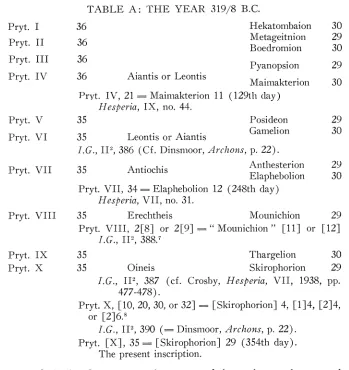
Skirophorion is the only one of the months with thirteen letters in the genitive case which requirements of the calendar permit to be restored in lines 3-4. Crosby
(lHesperia, VII, 1938, p. 478) has already demonstrated by her new readings of I.G., 112, 387 that Oineis held the tenth prytany, and this tribal name exactly fits the lacuna between the preserved portions of lines 2 and 3.
There are now known seven decrees which provide data for the calendar of this year, which may be reconstructed as follows:
TABLE A: THE YEAR 319/8 B.C.
Pryt. I 36 Hekatombaion 30
Pryt. II 36 Metageitnion 29
Boedromnion 30
Pryt. III 36 Pyanopsion 29
Pryt. IV 36 Aiantis or Leontis Maimakterion 30
Pryt. IV, 21 = Maimakterion 11 (129ti (lay) lesperia, IX, no. 44.
Pryt. V 35 Posideon 29
Pryt. VI 35 Leontis or Aiantis Gamelion 30
I.G., 112, 386 (Cf. Dinsmoor, Archons, p. 22).
Pryt. VII 35 Antiochis Alathesterion 29
Pryt. VII, 34 = Elaphebolion 12 (248th day)
Hesperia, VII, no. 31.
Pryt. VIII 35 Erechtheis Mounichion 29
Pryt. VIII, 2[8] or 2[9] " Mounichion" [11] Or [12]
I.G., II2, 388.7
Pryt. IX 35 Thargelion 30
Pryt. X 35 Oineis Skirophorion 29
I.G., IF2, 387 (cf. Crosby, Hesperia, VII, 1938, pp. 477-478).
Pryt. X, [10, 20, 30, or 32] [Skirophorion] 4, [1]4, [2]4, or [2]6.8
I.G., I12, 390 (= Dinsmoor, Archons, p. 22). Pryt. [X], 35 = [Skirophorion] 29 (354th day).
The present inscription.
The use of 8E in line 2 to connect the names of the archon and anagrapheus when they appear side by side in the genitive case is already thrice attested.! For the loss
7Elaphebolion was inscribed by error for Mounichion. Cf. Dinsmoor, List, p. 34, note 62.
8 These are the four possibilities which may be restored for the day of the month in lines 4-5,
where the word TE ITpa] t [- - is certain. For the use of forward or backward count with ET3 'EtKaLLa in this period, see Pritchett and Meritt, Chronology, p. 3, note 12.
91.G., II2, 385, 389, and 649 (= Dinsmoor, Archons, p. 7). Cf. Pritchett and Meritt,
of the iota in 'AvaKaEv'S (line 2), compare Meisterhans, Granm1matik3, p. 32. The
mention of the symproedroi (line 7) adds another to the examples collected by Pritchett and Meritt (Chroniology, pp. 2-7) in which this formula appears in in- scriptions dated before 318/7.
TITLES OF OFFICIALS 70. Fragment of Pentelic marble,
found on November 8, 1937 during the demolition of a house in Section AA. The original right side and back are preserved.
Height, 0.155 in.; width, 0.191 mn.; thickness, 0.128 m.
Height of letters, 0.006 m. Inv. No. I15036.
The chequer-unit measures approxi- mately 0.012mn. (across) by 0.01 15M.
(down).
No. 70
307-301 B.C. YTOIX. 32
[---?> El'v[a]
[ 8' av'Tovi 'AO-qvatovs Kat rovg EK] yovovs [avTrV Kat ypaqiau-0at 4Xvj^1] Kat O7)jLLOV Ka [i Oparpkag i5s av 3oviX&wra]? KaTm 70ov vo,uL 5 [ov avaypac/at &Ei TO& r) 4n] +:to-yua Tov ypa
[ZqiarE'a rovi 877,uov Ev or7TX],E& XLOW'VEL Kat
[roTr3oat Ev aKpOIroXEt, Ets] 8EN 7)1v avaypab
[)v Tris crr)AXRs 8oivat rov] Tca/uaV TO3 8'
[ov ) AX vA 8 paX,/ds EK TWV EL]S 1 T KaT CLTC
10 [aopara avaXtorKoJEV&)V TCr8 o]u -v To
[ITPVTa6vEts TOV9 'TpvTavEVov] rag EL" T7)Jv
[ITp0T7)V EKKX7)O4aV 8ovvac ITEPL a] v [rTV] TT)
[v 7f34V Kat T?IV 8oKtquactLav aVVTOl TO vs
[0E0roVJO0E'Tas EtOaayayEtv ( ?)]
this fragmentary decree of citizenship gives the terminus post qutem as 307/6;10
reference to the treasurer of the demos (lines 8-9) gives the ter"minus ante quem as 301. This latter terminal date has been a subject for much recent discussion, and some points are still in need of clarification. Kahrstedt (Untersuchungen gur Magis- tratur it A then, pp. 12-15), assigning new dates to several documents, came to 305/4 as the last year of the treasurer of the demos, 304/3 as the first year of the new officer of administration. This determination was subsequently criticized by Ferguson
(A.J.P., LIX, 1938, pp. 230-231), Meritt (Hesperia, IX, 1940, p. 72; X, 1941, ). 56), and Pritchett (Hesperia, IX, 1940, pp. 108-111). Kahrstedt (Hermes, LXXV, 1940, pp. 332-334) now admits that the names of the two officials occur simultaneously within the period 307-301, but states that the two financial officers
could not have made payments from the contingent fund of the demos (EK iT-V KWaTa
)to-,uaTa aPvaXtKoKUEvWv rwCt 8r ,ucot). He accordingly posits for the officer of ad-
ministration a special war-fund, distinct from the urpaucorKa6, and states that pay- ments for stelai might be made from either the contingent fund or the new war-fund. In the only one of the critical years in which the theory may be tested (30211), it is known that both officials did make payments from the same fund: Hesperia, IX, 1940, no. 20 and I.G., I12, 505, dated in the fourth and twelfth prytanies of this year, have the treasurer of the demos making payments from the contingent fund, but I.G., II2, 500, dated in the eighth prytany, has the single officer of the administration.'2 Further-
10 So Kirchner, I.G., IJJ, Indices, p. 47. Thlis official is the same as the
ypa/AaTEVpa KaTa 7rpv- TavEtav. He is not to be confused with the ypauuaTrEV TOt /J(OtL, mentioned in I.G., II2, 223A, 1700,
and Hesperia, X, no. 11, whose title was iimore commiiiionly given as ypapyaTrEi Ti-g /0ovXA Kat TOy
8',uov. See Fergusoln, Athenian Secretaries, pp 65-70. Laqueur's argumelnt (Epigraphische Unter- suchungen, pp. 52-53) that the clause referring to the ypapyaTrEvi TUO aryWo in II2, 223A, line 10, must be an interpolation into the probouleuimia frolmi the separate decree of the demos is based on a misunderstandinig of the functions of this official; see Aristotle, 'AO. 11oA., 54, 5, and compare Billheiimier, A.J.A., XLII, 1938, p. 463.
"For the period after 302/1, it appears that the Ta/utda T0o! 8&tOV was continued by the single
officer, or plural board, of administration (Fergusoni, A.J.P., LIX, 1938, p. 231), according to Macedonian domination or political freedom of Athens. After 229, when both o and ol 'r't T &tOLK 6hEt appear in the publication formulae, Dow has observed (Prytaneis, pp. 12-13) that o EWLt Ti- &OLK 'UE is invariable in decrees of the prytaneis. Ferguson's suggestion (in a note in Prytaneis,
p. 13) that one miian, called o 6r't Tjj &toLK rE, served for each prytany with the twelve or thirteen
collectively serving for the entire year s-eems very probable.
12 Cf. Kahrstedt, op. cit., p. 333, who admits that in this one year payments mllust have been made
by two officials from the same treasury. He believes that 302/1 was a transitional time in which the contingent fund and the special war-purse were miierged. But when a temporary amalgamation of treasuries did occur within the turbulent period 304/301, we know that payment was specifically designated as being EK TrV KOLVmV XpaT (I., 2, 558: dated at the close of the Four Years' War
more, it must be reaffirmed that the hypothesis on which Kahrstedt's new theory of a special purse for the officer of administration rests, namely, that no treasury can have two paymasters, is incorrect: '3 for within this same period paynments were made
from the contingent fund by another official, the treasurer of the military funds; cf. Schweigert, Hesperia, IX, 1940, pp. 349 and 351.1' It has rightly been said that in ancient times " we are confronted with a system of accounting which nowhere and in no single ledger was complete; " hence the need of strict audits."'
The earliest example of the restrictive phrase Kama rowv vo,uov in the formula of citizenship occurs in 331/10,16 or in 334/3 according to Schweigert's new date for I.G., II2, 405 (Hesperia, IX, 1940, pp. 339-340). The provision for the introduction of judicial scrutiny by the thesmothetai, if correctly restored in lines 13-14, occurs in I12, 398 (ca. 320 19),'7 again in II) 496 + 507 (30312), and frequently there- after.'8 As regards letter-forms, the phi in the form of a cross is common in the period 340-285 (Kirchner, [magiics, pp. 19-20), especially between 310 and 300,'
" Cf. Ferguson, loc. cit., pp. 230-231.
14 In addition, Kahrstedt in his recent article is muisinformiied on two points. His statement (p. 332) that the documenit from the Agora published as Hesperia, IX, 1940, no. 20 disproved his 304 demarcation-date is only partly correct; his tlheory was already in conflict with the evidence of I.G., II2, 493 + 518, 505, etc. (see Pritchett, HIesperia, IX, 1940, p. 110). Another statement
(p. 333) that Pritchett had both the treasurer of the dcemos and the single officer of administration making payments in I.G., II2, 493 + 518 and 496 + 507 (303/2) from the samne fund is a mis-
quotation: the statement is correct as originally written (p. 110), "within the three year period 304/3-302/1 B.C., both financial officials are instructed to make payments from the same fund."
lo Francotte, Les finances des cites grecques, p. 149. Cf. Andreades, History of Greek Public
Finance, I, English translation, p. 371.
16 See Billheimer, Naturalization in Atheniani Law anid Practice, p. 15. Wilhellm (Wienter Studien, XXIX, 1907, p. 1, and Attische Urkunden, II, pp. 9-23) has noted in accord with I.G.,
II2, 373, lines 29-31, that aliens were prohibited from acquiring land in border demes; Thalheim
(in Pauly-Wissowa, R.E., s.v. vf'yKT-qL', col. 2584) and Ferguson (Hellenistic Athens, p. 245, note 6) refer the phrase to this restrictive prohibition. Johnson (A.J.A., XVIII, 1914, pp. 174- 177) attributes it to restrictions concerning enrolment in certain phratries. The plhrase Uv ot vo4Lot Xkcyovotv occurs in JJ2, 222 (ca. 344/3 B.C.), and the preferable interpretation seems to be that the
restrictions refer to provisions in the decree of Demiiophilos (346/5) regulating citizenship (see Diller, Race Mixture Anmong the Greeks, p. 113, and Busolt-Swoboda, Gr. Staatsk., p. 947), or, more correctly, to the enabling laws governing Demophilos' decree (Gomme, Essays in Greek History and Literature, pp. 68, 86; cf. however, Atkinson, Athenian Legislative Procedure, pp. 15-38). It is to be noted that the absence of this restrictive phrase does not prove the abrogation of the legal procedure. Thus in the period of oligarchy in 321-318, the phrase accomipanies some decrees of citizenship, but is omiiitted in 12, 394. Similarly, II2, 553 may be compared with otlher
decrees of the period 307-301. For this reason, one mlust question Johnson's redating of II2, 511 (Cl. Phil., IX, 1914, p. 428).
17For II2, 336, see ilhelm, th. Mitt., XXXIX, 1914, p. 266. For the legal procedure, see Busolt-Swoboda, op. cit., p. 946, and Lipsius, Das Attische Recht, pp. 284-285. Cf. Kahrstedt, Staatsgebiet, p. 81, and Gomme, Essays, pp. 73-75, 86.
18 See 1.G.,
II2, Indices, p. 61, and Johnson, A.J.A., XVIII, 1914, p. 178.
and the very broad sigma is common during the late fourth and early third centuries.
PRYTANEIS OF DEMETRIAS
71. Two joining fragments of Hymettian marble, preserving the original right side and rough-picked back. The larger fragment was found on April 18, 1934 in a Roman wall in Section B.20 The other fragment was found in a late fill in the same Section on April 25, 1934. Its surface was blackened by a modern cesspool near which it was found.
Height (as joined), 0.30 in.; width, 0.235 m.; thickness, 0.20 m.
Height of letters, ca. 0.006 m.
Inv. Nos. 1 1804 (the larger fragment) and 1870.
DEMETRIAS Middle of third century B.C.
['ApkirT] apXog 'Apwo
[... ] Ea XatpEo- L
[ . .4 .1 ... ] VlKOS T
. 1. vXas 'Avrt 5 ['AXIKLa]Xo 'AXKx
[MJEXLtrELS ?] [X] aporiT8q 'EpYOK
MEVEKX '1 OEOObt
'Apto-ro4ov 'Avrt 10 'Epyobchv JIEpoq0
L'XtTrog ALOKXE 11OXV"EVKT0 IIHEP
[A] VKOcfpwV
15 ef O't'ov
['Ear] tiVKOg raXVK [CItrtro ] rotkaat
[_ca.--_] 09 MEV
vacat
The information which this prytany inscription supplies concerning the demes of Demetrias has already been incorporated in the article on the Mlacedonian tribes published in A.J.P., LXI, 1940, pp. 186-193. Chief interest lies in the confirmation of Mleritt's assignment of the deme Daidalidai to the tribe Demetrias.2'
20 Homer Thotmpson (Hesperia, VI, 1937, p. 168) has made reference to this inscription in his discussion of the topographical significance of the wall in which it was found.
No. 71
The names at the top of the last column may very tentatively be assigned to Melite. This large deme of Demetrias requires more than six representatives in the Boule, and the unusual name Charopides (line 7) is known for another member of this deme (P.A., 15533). The name Ergophon (line 10) appears to be new in Greek prosopography.
ZENIS OF PROBALINTHOS
Height, 0.095 m.; width, 0.105 n.;
thickness, 0.025 nm. Height of letters, 0.005 m. Inv. No. I 4678.
ca. 200 B. C. B I3ovX[?)]
Z7'3VLV
llpo/3aXt'
OTLOV
The accusative f ormi Z-vwv is also attested from Xenophon, HG, III, A, 10, where the genitive form Z'4vtog is l)reserved. Other examples cited by
Pape-Benseler show a dental stem with No. 72
genitive ZIvL8og.22 See Kiihner-Blass,
Gr. Gramii., I, p. 421, note 7, and Schwyzer, Gr. Gr-aini., I, pp. 462-465.
This inscription appears to cite the same man who is crowned in a small frag- nment published as Prvtawleis, no. 42. A possible restoration for the latter is:
3[ovX'i] Z73 [vtv] ! HP[o8aXt] [o-tov]. Dow read an epsilon as the second letter in line 3, but it is clear on his photograph that rho is equally possible. In both instances, the citation is the leftmost one from one of the two rows beneath the register of prytaneis. Although variations in the arrangement of the various citations on the stone are many,23 the leftmost position in the first row in this period was usually occupied by the priest of the eponvntos. 4 In this case the documents must be dated in different years. A similar position in the second row would probably be for the sixth official in order of mention, hence for the undersecretary.)' The two inscriptions
m1ust then be assigned to the same year.26
PRYTANY DECREE
73. Fragment of Hymettian marble, found on June 11, 1937 in a late Ronman wall at the north end of Section S. The original left side and top, with akroterion,
are preserved.
22 Wirterlbuch der griechischen Eigennamien, s. v.
23 See, e. g., Dow, Prytaneis, p. 19, and Pritchett and Meritt, Chronology, p. 112. 24 See Prytaneis, nos. 40, 48, 61 ( ?), and 64.
25 See Dow, op. cit., p. 16.
Height, 0.319 m.; width, 0.229 m.;
thickness, 0.146 m.
Height of letters, ca. 0.007 m.
.v. No. I 4966.
f~~~~~~~~~~~~~~ ~ .; ... ... . ...
NTo. 73
196/5 B.C. ca. 52
'EI7T XaptKXE'OV19 apX(ov1' rog EI,TI.- EKgaT-qg EVO 7TpvraV/Etag]
t A1o-Xp<K'>av Ei'atvE'ov 'Pa [/.wovo(-tog Eypa/4L/.aTEVEV' &7Lov 74-Lo701.ara]~
eapy-qXtu'vo9g Oy8OEt /.E [T' ElKa'8ag 6'y&0Et Kat ElKOOTTE't r-'gj iTpv-raVEtalc]
EKKXV)O-L'a KVPLa r' ot 6 [EaTp&Jt 7-i Tco 7PO' E7VEI~J7)4aEV - ~-
i00V;4S'!;tiS:~~~~~~~~~~~~~~~~~~~~~~~a 4''1 7:
5KaXXLKXE'ovg Kov6vX~ [OEV Ka't 0-V/LITpOE8pOV Ca Xo]
t:: '22:;i _ i _ l E-,_m_,. ,',~ ~ ~ ~ ~ ~ ~ ~ ~ ~ ~ ~~~~c.
XapyE2iN JIiTEV iiv 7TpvTaVE:' [iTE'p cbu v achTayyE'XXovuw ot T - -] ip
T; Ovoi [v clv g'Ovov rd ip 7( 01v EHKKXqgt, 0.319 mE width, 0.229 llpo] o-TraT7)ptCOt KaL[?]
The archon Charikies, whose name dates this prytany decree, is already assigned
to the year 196/5. The year was intercalary, and Thargelion 23 (backward count
in a futll month), being the 348th day of the year, is to be equated wvith Prytany XI, 28. This is in accord with Meritt's conclusions concerning the calendar of this year as l)ublished in Hespcria, V, 1936, pp. 424-425.
the omission of a letter than the insertion of an extra one,27 it seems preferable to make the correction in the newv document.
PRYTANEIS OF KEKROPIS
r _
~~~~~~~~~~~~~~~~~~~~~~~~~~~~~~~~~~~~~~~~~~~~... _..-.w... .. ... 74. Fragment of Pentelic marble, found on Janu- I
ary 29, 1937 in a modern retaining wall in Section $. The original right side is preserved.
Height, 0.397 ni.; width, 0.161 i.; thickness, 0. 107 m.
Height of letters, 0.006 m.-0.007 m.
Inv. No. I 4462. -
Syllabification at the end of lines is not always observed in this inscription.
. ... . .. . . ;i-...:
No. 74
KEKROPIS
184/3 B.C. 41-46
?E--- - -V TEt ITpvTaVEtaC KaXcso K] CU ai il [ o]
[rTyuos, EITE1UEXYA)-roav E/V KaiL r7s ovAAvXoy3' 8r /3o] vX Ka' To ^ cs , \ ^ ,, \ \ e , t ,
T71, 71
,
T
v &r4ov Ka trciv aAXXcov a&lavTcov Jov aviroZS vpoo-Earro] v ot TE v
11 0 ^ 8 IP V 3 /
[o'po Kat ra fto-aTra roV &LEL0v, E1TaLvEcaL r ovs IgrpVTaVE
5 [ls T7 KEKPo7Ti8o0 Kai UrTEcfavlorat XPV-cot o-TE?J]av ar KaTaTo [V]
[vo,uov E1XTE/3E&as EVEKEV T19 1TpOS TOVS OEO3VS] Kai () X OTt/Ita [S]
[777S Ets 17'V / X3oVX7lV Kai TWV 8^&VLO' ro'V 'AOq ] vaicov ciavaypa [at 8E T6o8 rEo n 77to-a rov YypaLLaTEaT r] o'v KaTa 7VTapvTal [Ei]
aVl EV -TV)AXEl XtOLVEL Kat (TT7qaaL EVl] TC^Ot ITpVTaVLK&^) [t Eis]
27 For examples of the insertion and omission of iota in Attic inscriptions, see Lademann
10 [8E TIpV JvaypafriV Kat Trrv aYva0EoCv rn1 0wi XiS /LEpUiT [at]
\ , \ ^ c / ' ' ~~'9 I '9
TOv EITt TEt &OltKlEt TO 7EVO/EVOV avaA (/a.
vacat
[7 /ovAr) [o 0i)9 7}8l0vXr
[r?0 a,i] [rovi)s pv] 20 [T] 6vypak
[av norlnen] [TaVE9] [] aTrEa 'Ao-
15 [demoticurn] [K] X'qrt&V
Xv'rra
[XI A]TTtOP
25 ['Err apXo-vrog C EITC 7m7]g s1aYgtoviO8o [&(o]
[8EKa'TY)g rrpvTaVEtag 72l _aC a& OeEY8OV 'P [ ]
[vovo-tosg Eypa/auTEVEV f3OVXY/ lIqctO7L+aT]a 'KtPOkOPl-'O [VO[ I [ ?- a. 20
T7js TrpvTavE] Las /3ovX E /308o [V]
[XEVT-qPCptC Ti-V TrpOE8pow E1TEq7r4JflEV AtO] IVvo(Ttog AvTtlraTp [ov]
30 8[TptKOP1CrO-t Kal O-VfJ4TpOlp E'8OeEV TEL] /0ovXE V AiSo-av [poS]
[
~~ca. 17 ^1 1 ~?_____ C..17____ EtTrEY ETreItO ot] TrprvaTVEt1 TI11s
[KEKPO7Tir8O Kai Ot aECLotTOt E11TatVEo-aVTE9 K]at 0-TEIJavo. 'io-av]
I[TEs alTo(a0voV-tV TE /3oVXAE TWov TaLiaP ov ELO EovTO ] Ef Eav Tmzw]
r ~~~~ca. 25/
TaS TE OvjO-ta[ s TEOVKE']
35 [vat ??? ]
This document supplies part of the name of a new secretary. The first letter
of the demotic is read as rho. Schweigert, while in Athens, provided a transcription
in which the letter was so read by him. Part of the upright stroke is clearly visible
on the squeeze, and to the right are two dots which might be the loop of the rho,
as is characteristic in this inscription. In this case the demotic must be restored as
'P [auvovotosj, and the length of the name, as well as other considerations, pre-
vents any identification with another secretary of this period [A] tovv-0'8&(pog
(t [.. . ], who appears in the archaistic stoichedon inscription i)ub-
lished as Prytacneis, no. 79.28 The name Philoxenides is well attested for the deme
Rhamnous (X). One Philoxenides of Rhamnous is known to have been a councillor
in the very early years of the second century (Pr ytanteis, no. 48, line 66) ; another,
possibly his nephew, was councillor in 166/5 (Prytanteis, no. 73, line 30; cf. I.G.,
112, 1939, line 56). The secretary of the present inscription may have been a son of
the former.
The distinctive script, characterized by the omission of many horizontal strokes
and by the two-dot omicron, belongs to the period between 185 and 155 B.C.,29 and
it is within this period that a date for the new text must be sought. The length of
the lacuna in line 11 requires the restoration of the Single Officer of Administration
as paymaster, thereby positing a date before 169/8.30 The inscription must be assigned
to one of the two years for which a secretaryship from the tenth tribe, Aiantis, is available, namely 184/3 or 172/1 B.C. The archon for the latter year is known to
have been Sosigenes (Pritchett and Meritt, op. cit., p. xxviii), but a name of nine letter-spaces in the genitive appears rather short for the lacuna of line 25; so the document is assigned to the year 184/3.
For a stemma of the family to which the chairman of the proedroi (lines 29-30) possibly belonged, see Sundwall, NTachtrdge, p. 38.
THE ARCHON ALEXANDROS
75. Fragment of Hymettian marble with pedimental top, found on October 1, 1934 during the destruction of a house in Section N. The original left side and part of the back are preserved.
No. 75
Height (at left edge), 0.20 m.; width, 0.24 m.; thickness, 0.12 m. (of stele proper, 0.075 i.).
Height of letters, 0.006 m. Inv. No. I 2115.
173/2 ( ?) B.C. ca. 40
'E7t- 'AXEca'v8pov [aPXOpTovSos EWL T7 ca.____ o ~~~~~~~t
~~~ca. 27 )
qTpvTavEtaS E t - - --.-7e
7/paLarEvEv * [-_ _ _ _ _ _ __ ca. 25
ITTEL Kat ECK [oo-rd T?S 1rpVTapvaEtas* EKKX?0Wta E/D IHE]
5
pacE- - [v iTpofEipv E'rE 44EV? r ? ?[evi] at [aras (?) Kat cGrV/irpOE8pOL E'80oEv rE't 3OVXEt Kac]
The archon Alexandros is here attested for the first time in inscriptions. He is known from Apollodoros (fragment 47) to have been later than Eupolemos (185/4) and earlier than Xenokles (168/7); so he has been tentatively assigned to the inter- calary year 17312."' Other available years within this period are 181/0 and 170/69, both of which are ordinary. Restorations in line 3 for either an intercalary or an ordinary year are possible.
TECHNON OF PHEGAIA
76. Fragment of Hymettian marble, found on March 10, 1937 in the xvall
of a house in Section II. The original back, left side, and a small portion of the right side are preserved.
Height, 0.35 n.; width, 0.45 m.; thickness, 0.135 m.
Height of letters, 0.005 m.
Inv. No. I 4594.
ca. 155 B.C.
' 8ovXA
TE'XVvc1va iP-qyatEa
This fragment preserves a citation in honor of the flautist, Technon son of Leon of Phegaia, whose floruit miay be placed ca. 155 B.C., for he is cited in Hesperia,
3' Dinsmoor, Athemian Airchon List, p. 189, and Pritchett and Meritt, Chronology, p. xxviii.
IX, 1940, no. 25 (165-150 B.C.), and in Prytanieis, nos. 82 and 84 (155/4 B.C.).32 There is a striking similarity between the physical features of the new fragment and those of Prytanteis, no. 84, for both stelai have the same original thickness and width,33
i .i ... . . .
No. 76
and both inscriptions require five citations below the register, arranged in rows of three and two, instead of the usual six.34 However, the two inscriptions are not from the samie monument, for there is a narrow carefully cut band along the edge of the
32 Cf. Dow, Prytaneis, p. 18.
33 The slightly larger width of the present fragment (0.02 m.) allows for the broadening of the
stele near the base. It is unusual to find two stelai of the same size and it may be that these were ordered from the workshop at the same time. For similar examples see Dinsmoor, A.J.A., XXVII,
1923, pp. 318-321, and Dow, A.J.A., XL, 1936, pp. 67-68.
left face of the Agora fragment which does not appear on the corresponding surface of Prytaneis, no. 84. In addition, the script of the new piece, having a rounded phi and an epsilon with short middle horizontal, differs slightly from either of the two scripts employed in the previously published inscription.
PRYTANEIS OF ATTALIS 77. Fragment of Hymettian marble, found on February 3, 1937 in the debris of a house in Section II. The original left side, which is tooth-dressed, is preserved.
Height, 0.22 m.; width, 0.095 m.; thickness,
0.097 m.
Height of letters, 0.006 m. Inv. No. I 4476.
This fragment (c) is a part of I.G., II, 977, which has subsequently been republished by Dow as Prytanieis, no. 88. New restorations for lines 1-3 have been offered by Pritchett and Meritt.35 The lines are here numbered consecutively with those of i.G., 11, 977.
No. 77
ATTALIS
131/0 B.C. . 57
c [E'80o]ev ca.E0V_
mL
/3ovX7) kEU7TEV _ EITEL87) Ot TpvTaVEL;] T7) p] 'ArTraXt O[OS Ka' Ot aoEurtol E17TatVEocaVTE Kat orTExOavwtoavTEg aTo ][at'] vovO-w TE [Z J3ovXE' Tr'v Ta/tav ov ELXovro
Ee
Eavr`v 'ATroXXAA)vtov (?) 'AIroX][X]tvtov 1ovv[LEa Kat 7o7v ypax/LJa_TEa Ca. 19 lpo,8aXAi(r(]
25 [o] v as TE Ovo [ia TEOVKEvat7 Tao-ag Ta KcLK7)KovcTLas EV TEL 7rpvTaVEtaC i7TEip] rn E1fl.E/LE^uX f3ovX jc Ka[t roV 87)/.LOV Kat 7Taai8&V Ka"' yvva&KcOv, 'a-OaL &E] KaL TI oAXXa [v a aarvraTV KaX(s KaW ?fLXoTqucs t L Vo 07rc1 OVV Kat 7) 3 7o ) ai]
ayaOEt rTVXEC [E80oXtat ret 3OVXE't &TrawE'cat rov rapu'av 'AroXAXcJov (?)]
30 'A1ToXXwvt'ov [lovvtE'a Kat rov ypapk,UarEa caa9 ? ?
llpo/3aXio-cov, E[7TacvEac 8E Kac rov ypa,uaTEa rT4, /3ovXs Kat roi 8tfov Av]
rLkaxov 'AO'q[?Ka\ rTov vIToypa/paTEa ?--- -
[K]ac iTOV K pVK[a Ti- ,83ovX '1 Kac ToV 8&mv ____c6 Kat Tov]
EpE'a ToV E7TV [VUlOV ?KaU Tov avJXT7Pv -- ]--
35 [... ]vrov AEvK[ovoE'a Kac TOv TrauLcav r7vs ovX'3 ___ ca. 17 ]
[Ka\] Tov abvny [paE'a ?Kat moTravcOo-at OaXXov OTE7fdLvWL Jit]
[Eo-Tt 7Ta]rpcov v a [vaypafac 8E-]
This prytany decree contained praise for all nine officials.36 The name of the priest occurs in the sixth position. In all hitherto known inscriptions of the second century, this official had appeared in the third position.37
Lines 23-25: The treasurer and secretary of the prytaneis are paired together for special praise, as in other prytany decrees.38 The treasurer, if his name is cor- rectly restored, was kosmetes of the epheboi in 128/7."9
Line 26: For the restoration of the beneficiaries of the sacrifices, see Prvtaneis,
no. 48 and Dow, op. cit., p. 10, note 2.
Line 28: This same formula is now to be restored in Prytaneis, no. 95, line 8, and no. 96, lines 38-39. For the restoration of vroLE'VELV, compare Roussel, B.C.H.,
LVIII, 1934, p. 96, note 1; Hesperia, V, 1936, no. 15, lines 11-12; Dittenberger, Syll.3, 495, line 159, and 647, line 42; I.G., IV', 1, no. 66, line 41; and Inschriften von, Priene, no. 112, line 22. The word v'ro [TEXov3o-t] may also be a possible restoration.
W. KENDRICK PRITCHETT 36 Cf. Prytaneis, no. 86 (155/4).
37 See Dow, Prytaneis, p. 15, and above, 1). 275. For a possible exception, see Pritchett and Meritt, op. cit., p. 116.
38 Prytaneis, nos. 10, 30, 36, 95, and 96.