Formation of effective multi-stakeholder Platforms: Lessons from coffee innovation
platforms in Uganda
D. B. MAGALA1, 2, M. N. MANGHENI1 and R.MIIRO1
1Department of Extension and Innovation studies, College of Agricultural and Environmental Sciences, Makerere University, P. O. Box 7062, Kampala, Uganda
2Mukono Zonal Agricultural Research and Development Institute, P.O. Box 164, Mukono, Uganda Corresponding author: [email protected]
This article is licensed under a Creative Commons license, Attribution 4.0 International (CC BY 4.0)
ABSTRACT
Agricultural innovation systems’ thinking has been adopted in agricultural research and
development to harness the actor innovative capabilities, knowledge enhancement and social transformation. Hence there is growing recognition of the viability of Innovation platforms (IPs) as an approach to stimulating development of agricultural enterprises due to their emphasis on value chain development, networking and partnerships. However, despite the key role of the formation process in realization of desired outcomes, there is insufficient knowledge on how to form vibrant agricultural innovation platforms under diverse contexts. This study sought to examine the gaps and draw lessons for effective IP formation using the case of the coffee IPs in the four districts of Luwero, Ntungamo, Bushenyi and Rakai in Uganda. Data were collected through key informant interviews with 32 actors of the coffee steering committees and from document review. Qualitative data analysis was conducted using content and thematic analysis. Gaps identified in the IP formation processes included exclusion of some key stakeholders, unclear management and financing mechanisms, and weak governance structures at lower levels. To enhance legitimacy of innovation platforms, the study recommends a formation operational model with four main components of actor identification and mobilization, visioning and strategy formulation process, IP culture and development of governance structures.
Key words: Coffee, innovation, multi- stakeholder platform, Uganda, value-chain development
RÉSUMÉ
Des réflexions sur les systèmes d’innovation agricole ont été proposées dans les domaines de la
recherche et du développement agricoles pour un meilleur usage des capacités innovantes des acteurs, le renforcement des connaissances et la transformation sociale. Ainsi, la viabilité des
plateformes d’innovation (PI) est de plus en plus reconnue, comme une approche visant à stimuler le développement des entreprises agricoles, car elles mettent l’accent sur le développement des
chaînes de valeur, le réseautage et les partenariats. Cependant, malgré le rôle clé du processus de formation dans la réalisation des résultats escomptés, les connaissances sur les modalités
de création des plates-formes d’innovation agricole dynamiques dans divers contextes sont
limitées. Cette étude a examiné les lacunes et tiré des leçons pour une meilleure formation
sur les PI, avec un cas d’étude sur les PI du café dans quatre districts en Ouganda (Luwero, Ntungamo, Bushenyi et Rakai). Les données ont été collectées à travers des entretiens avec 32
acteurs des comités directeurs du café et une revue des documents. Une analyse du contenu et
des thématiques a été effectuée. Les lacunes identifiées dans les processus de création des PI comprenaient l’exclusion de certains acteurs clés, des mécanismes de gestion et de financement
peu clairs et des structures de gouvernance faibles aux niveaux inférieurs. Pour renforcer la
légitimité des PI, l’étude recommande un modèle opérationnel de formation comportant quatre
composantes principales: identification des acteurs et mobilisation, processus de formulation et de vision, culture de la propriété intellectuelle et développement de structures de gouvernance.
Received: 15 August 2017 Accepted: 5 December 2017 Cite as:Magala, D.B., Mangheni, M.N. and Miiro, R. 2018. Formation
of effective multi-stakeholder Platforms: Lessons from coffee innovation
INTRODUCTION
Agricultural innovation systems (AIS) thinking has been adopted in agricultural research and development for its ability to harness the
innovation capacity of agricultural systems’
actors as they work on collectively defined needs (Spielman et al., 2009; Hounkonnou et al.,
2012). Innovation is influenced by diverse and creative actors with the ability to collaborate, articulate a common vision and embrace the spirit of teamwork (Nederlof and Pyburn, 2012). Their actions are dependent on the actions and decision of others hence the need for constant collaboration through new innovative approaches and multi-stakeholder processes (Walters, 2013; Brouwer et al., 2015). Research and development agencies consider innovation platforms as a significant improvement over the linear and less inclusive traditional agricultural research and extension approaches (Mulema and Mazur, 2015). Innovation platforms
(IPs) are thus defined as “Networks of diverse
stakeholders who cooperate, interact to develop a shared vision and identify solutions to a common problem as a group or individual
members” (FARA, 2007; Nederlof et al., 2011).
Recent studies reveal that IPs are perceived as governance mechanisms for enhancing multi-stakeholder interaction and learning, capacity development and coordination and community linkages (Mayanja et al., 2012; Kilelu et al.,
2013; Cullen et al., 2014). Their functioning however depends on their organization, stakeholder representation, facilitation and institutional embedding capacity (Nederlof
et al., 2011; Boorgard et al., 2013). Steps in
the formation of viable-stakeholder platforms include; consultation and scoping, visioning and stakeholder analysis, adaptive planning and developing action plans (Hall, 2007; Brouwer et al., 2015). In Uganda, the IPs were recognized as a viable approach to stimulate development of agricultural enterprises including coffee due to its emphasis on value chain development,
networking and partnerships (Rajalahti et al.,
2008; MAAIF, 2010; Pyburn and Woodhill, 2014).
Study context. Coffee is one of Uganda’s key
economic agricultural enterprises, contributing 20% of the total export revenue (MAAIF, 2013). The economic and institutional reforms in the early 1990s attracted several actors into coffee production and marketing which necessitated changes in institutions, processes and structures in the coffee sector. The coffee sub-sector is fully liberalized with a strong government commitment to its growth which offers several investment opportunities at national and international levels (UCDA, 2013). The coffee value chain is characterized by small scale traders (aggregators), farmer groups, middlemen (processors and merchants), and small and large coffee exporters (UCDA, 2013). In the public domain, the services to the coffee sub-sector are segmented among Uganda Coffee Development Authority (UCDA) for regulation, National Agriculture Research Organisation (NARO) for research and Directorate of Agricultural Extension Services (DAES) through local government production departments for extension services. All the three institutions are under the Ministry of Agriculture, Animal Industry and Fisheries (MAAIF, 2013). However, there are weak institutional linkages among the organisations which lead to inefficiencies in the agricultural extension system (ibid, 2013). The decentralization policy legalized by the Local Government Act of 1997, led to devolution of powers and responsibilities from central to local
levels. Consequently, provision of agricultural
extension services continues to be a decentralized function for better service delivery to the poor (Bashaasha et al., 2011; MAAIF, 2016).
The operations of coffee actors along the value chain are expected to be guided and regulated by the National Coffee Policy (2013) whose vision is
and sustainable coffee sub sector. The sub-sector supports about 3.5 million families across the value chain of whom 39% are small holder farmers (UCDA, 2014). However, its production has stagnated at three million bags per year for over four decades due technological and non-technological constraints which prompted actors to seek solutions through initiation of the coffee innovation platforms in 2008 (UCDA, 2012; MAAIF, 2013). Such challenges still exist and
include inadequate extension services, limited
knowledge sharing, low adaptation of improved agricultural technologies and weak institutional capacities among diverse actors where less than 15% of the farmers belong to associations, cooperatives or organizations (UCDA, 2014).
In an effort to revitalize Uganda’s coffee
sub-sector, Café Africa, a Swiss non-profit organization ((http://cafeafrica.org) in collaboration with Uganda Coffee Development Authority (UCDA) launched a national campaign in 2008 to improve coffee production and marketing in Uganda. A key component of the national campaign was the establishment of the twenty1 innovation platforms (IPs) to fill the void resulting from the collapse of the cooperatives and parastatal bodies in the coffee sub-sector (Café Africa, 2009). The objectives of the platforms were to promote the adoption of improved coffee varieties and recommend agronomic practices, re-introduce and promote collective activities, strengthen the coffee value chain as well as advocate for increased investment in the sub-sector (Café Africa, 2009). The district coffee innovation platforms are governed by the National Coffee Steering Committee comprised of 13 coffee organizations. Café Africa as a member of the national steering committee was assigned the responsibility of overseeing the formation of the IPs and their operations. Each of these district level IPs comprised of different actors in the coffee sub-sector including producers, nursery operators, processors, exporters, researchers
and extension workers at district level. Each district IP had a structure referred to as district coffee steering committee composed of an elected chairperson, a secretary, a treasurer and committee members. The IPs were expected to foster knowledge sharing and learning thereby contributing to better functioning and overall performance of the coffee sub-sector. However, these desired goals are yet to be achieved (MAAIF, 2013). This situation could be attributed to challenges that normally plague IPs in fostering and managing interactions among actors (Kilelu et al., 2013). Such challenges are related to the choice of the right partners, accountability, transparency and intangible results, which make it difficult to demonstrate benefits and to justify future funding of IPs (Kibwika et al., 2009; Agrawala et al., 2011).
Studies on innovation platforms have focused on collaborative learning, power dynamics, facilitation and brokering (Woodhill and van der Vugt, 2011; Buchanan et al., 2013; Cullen et al., 2014). Consequently, little is
still known on critical processes for forming vibrant agricultural innovation platforms under diverse contexts. The formation process of the IPs largely influences their implementation and eventual realization of desired outputs and outcomes. This study sought to examine the gaps and draw lessons for effective IP formation processes using the case of the coffee IPs in the four districts of Luwero, Ntungamo, Bushenyi and Rakai in Uganda.
Analytical framework. This study is anchored in the Social Exchange Theory (SET). The theory of social exchange postulates that individuals will make decisions based on certain outcomes and that costs are the negative
consequences of a decision, such as time, money
and energy and rewards are the positive results of social exchanges (Cook et al., 2013). Blau
(1964) defines “Social exchange as voluntary
actions of individuals that are motivated by the
returns they are expected to bring and typically
do in fact bring from other”. Cropanzano and
Mitchell (2005), summarize the key tenets of the social exchange theory as (i) rules and norms guiding the processes, (ii) rules of exchange, (iii) benefits, and (iv) relationships from the exchange process. This study however used three key tenets of the SET that is rules and norms guiding the processes, rules of exchange and potential benefits members accrue from participating in the platform. In this study we refer to rules of exchange as the guidelines used during the formation process and form the basis for relationships that evolve over time into trust, loyalty and commitment. Benefits refer to the expectations of actors for participating in the IPs. It is assumed that actors who participate in IP formation processes realize more benefits than the actors who do not participate. Participation refers to representative attendance to IP meetings and how they mobilized actors at lower level to engage in IP activities. This was the most appropriate measure because formation processes had already occurred and it was impossible to observe how actors engaged in the process.
Social Exchange Theory has been used in analyzing relationships and exchanges between an individual and employer (Cropazano et al., 2002), in studies on interest groups between an entrepreneur and customer (Salisbury, 1969) and in analyzing social behavior in collective action (Mulema and Mazur, 2015). All these studies emphasize the value of benefits and role of interdependence in strengthening human relationships. Mulema (2012) used the social capital theory to examine how IP organizational structures foster information and knowledge exchange. Cropazano et al. (2002) however recommends further studies on rules of exchange since they are deciding factors for individuals to engage in a particular type of exchange relationship. Hence there is need to examine how the rules guiding the formation
processes affect actor participation in the IP initial activities.
The purpose of the study was to propose a model for establishing viable multi-stakeholder platforms that enable effective participation of actors in the IP initial activities. Specifically the study examined the processes in the formation of Coffee IPs and how these processes influence the participation of actors in the initial IP activities.
METHODOLOGY
This study used the constructivist paradigm in order to understand the formation processes basing on individual perspectives and experiences of diverse actors involved in the
process (Baxter and Jack, 2008). A qualitative
multiple case study research design (Yin, 2003) was appropriate because it enabled an in-depth
inquiry into how the innovation platforms
average hectarage of 0.33 ha per household (UCDA, 2013).
The study sample was purposively selected from the current lists of the members of the district steering committees as at November 2014. The lists were provided by the chairpersons and regional coffee coordinators of the four coffee IPs of Luwero, Ntungamo, Bushenyi and Rakai. The total sample size was 32 respondents. Twenty seven (27) respondents were selected from 67 members of the District Steering Committees and four respondents were selected as members of the National Coffee Steering Committee. Café Africa consultant was purposively selected based on her experience of working with the coffee IPs during the formation process. The criteria used to select the respondents included (1) position held in the platform, (ii) involvement in the platform activities, and (iii)
knowledge of IP formation. Sixty –six percent
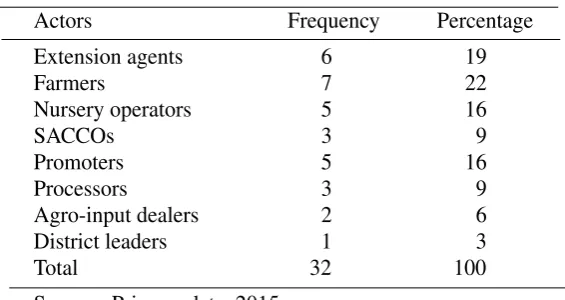
(n=21) of the respondents were men and thirty- four percent (n=11) were women. In Table 1 the respondents were categorized as farmers (22%), government extension agents (19%), nursery operators (16%), SACCOs (9%), promoters (16%), processors (9%), and agro- input dealers (6%) and district leaders (3%). The gender disparity in the IPs may be attributed to the fact that coffee production in Uganda is mainly dominated by men.
Data were collected between November 2014 - March 2015 with an average of three field visits per district in the four IPs of Luwero, Ntungamo, Bushenyi and Rakai districts. The primary data collection tool was an interview guide with each interview lasting about an hour and was audio recorded. The interviews captured information
on the expected objectives of the IPs, goal of IPs, the actors involved, actor roles and tasks and the engagement processes. Data were also collected through document reviews which included inception workshop reports, consolidated action plans for the IPs, committee reports and the National Coffee Policy of 2013. Secondary data were used to validate primary data obtained from the key informant interviews. Interview guides were pre-tested with three members of Mukono coffee district platforms who were not part of the respondents and later revised to include local terms as understood by the community.
Data were analyzed by content and thematic analysis using the model by Braun and Clarke (2006). Field notes and recorded interviews were translated and transcribed from local dialects (Luganda and Runyankole) to English. Codes were derived using the inductive approach as suggested by Merriam and Tisdell (2009) by attaching meaning to individual
narratives basing on the researcher’s perception
and experience. The steps followed included (1) conducting the interviews and transcribing the data, (2) familiarizing oneself with the data, (3) generating initial codes, (4) searching for and reviewing themes, and (5) defining and naming themes. Participation was analyzed by measuring the initial activities IP actors participated in. The activities included monthly planning and
review meetings, identification of actors’ needs
Table 1. Respondents by category
Actors Frequency Percentage
Extension agents 6 19
Farmers 7 22
Nursery operators 5 16
SACCOs 3 9
Promoters 5 16
Processors 3 9
Agro-input dealers 2 6
District leaders 1 3
Total 32 100 Source: Primary data, 2015
Table 2. Thematic and axial categories generated
Thematic categories Axial codes
Participation in IP formation activities 1. Attendance to IP meetings
2. Mobilization of actors at lower levels Identification and mobilization 1. Actors involved
2. Promoters of IPs
3. Methods of identification
Visioning and strategy formation 1. Goal formation
2. Setting of objectives
3. Action plan
4. Implementation process
5. Financing mechanisms
Perceived benefits 1. Access to markets linkages
2. Access to inputs
3. Access to information
4. Linkages to other stakeholders
5. Form associations
Formation of IP steering committees 1. Selection of leaders
2. Formulation of TORs
3. The IP Governance structure
Gaps 1. Exclusion of some actors
2. Lack of involvement of district actors at the planning stage of IP formation
RESULTS AND DISCUSSION
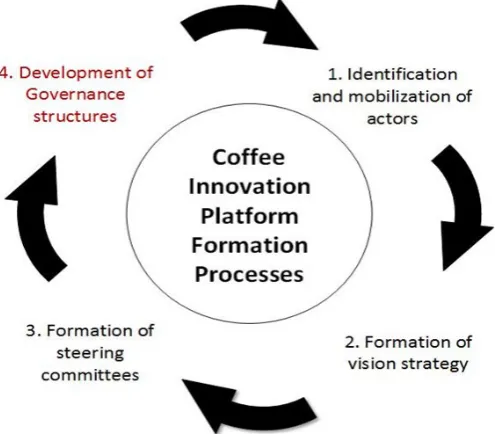
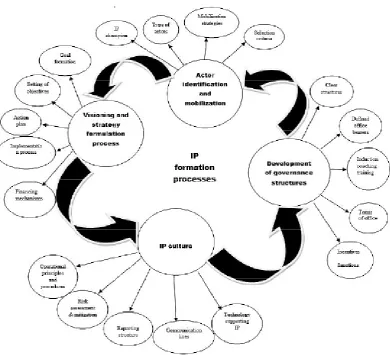
Formation process of the coffee innovation platforms. The formation processes of the coffee IPs consisted of three stages implemented in a cyclic process. These included; identification and mobilization of actors, formation of the visioning strategy and formation of the steering committee (Figure 1). The formation processes were guided by a terms of reference referred to as
“Rules of exchange (RoE)” and pre-determined
by Café Africa. According to the SET (Cook et al., 2013), The RoE included the goal of forming the IPs, the objectives, composition of the actors and role of committee members. Café Africa as a member of the national steering committee was assigned the responsibility of sensitizing and guiding the actors in the formation of the IPs and their operations. The entire process was collapsed into a one meeting event, which had implications on the success of the coffee IP. Success of the IPs was analysed in terms of diversity of actors, attendance to meetings and their ability to mobilize and organize their constituent members to engage in IP activities. The participation of actors in initial IP activities are discussed in the three stages of the formation
processes.
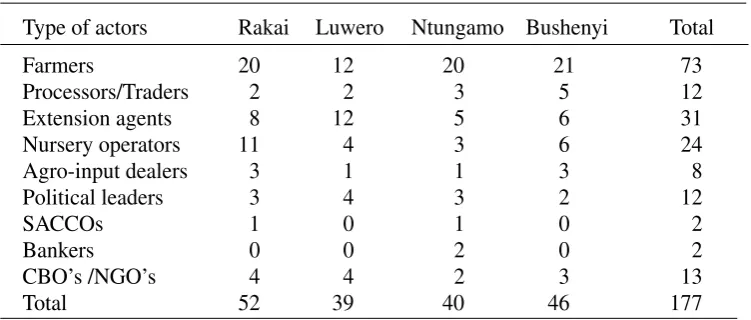
Identification and mobilization of diverse actors for the coffee IPs. The entry point for Café Africa in the districts was through district coffee coordinators and district production officers as innovation intermediaries who assisted in identification of the actors within the coffee value chain. Across districts, the innovation intermediaries mobilized the actors using formal invitation letters. Interviews and coffee IP reports indicated that the actors invited for the meeting composed of farmers, coffee processors, extension agents, coffee nursery operators, agro-input dealers, local council chairpersons and bankers (Table 3). Other actors who participated in the identification process were the extension agents and nursery operators. One of the strategies Café Africa used in the identification process and later activities was of involvement LCV chairpersons, secretaries for production and internal security officers as local administration and political leaders. The choice of actors was largely influenced by the nature, mandate, knowledge and experience of the various stakeholders.
Mobilization activities were mainly done to organize smallholder farmers. Even though some of the coffee actors suggest that the platforms have not been successful, in some of the platforms, mobilization activities yielded positive results. In Rakai, since the chairperson was a farmer representative he used his personal experience and leader position to link up with the chairpersons of coffee farmer cooperative societies in greater Rakai. Some respondents noted that;
“I wouldn’t say that we have been successful
as a platform but at district level we mobilized coffee farmers to form small groups then high level organizations within their locality to increase on their bargaining power. At least we have nurtured five coffee cooperatives who have linked up with other service providers. These are mainly Kasaali and Luanda coffee farmers’ associations.” (Male member, Rakai district, 17th December 2014) “….Our role was to mobilize platform representatives at sub-county and parish level and advise them but were only relying on existing ones. The platform had only farmers, there was no effort to mobilize processors, the nursery operators would have formed platform where members would discuss
a given problem” (Female member, Luwero,
26th November 2014).
It can be noted that members participated in these activities by volunteering to in order to implement certain tasks, but due to financial
constraints, members’ participation was
sometimes limited. Mulema and Mazur (2016) noted that community members are more likely to participate in collective action if they are relatively certain that participation will generate the anticipated benefits. In Rakai district, the representative for nursery operators was able to mobilize his fellow nursery operators to form an association of 30 members within three months of IP formation. After the inception meeting, the representative as an extension agent and nursery operator with his business experience of 15 years worked hand in hand with the regional coffee extension officer to form an association for district nursery operators as narrated by some respondents;
“…We started with about 11 nursery operators, and I was elected as the chairperson and the numbers increased to 30. We started the association by inspecting all existing coffee nurseries. Members drafted a constitution in collaboration with UCDA and DAO, to easily
supply certified coffee seedlings (Male member,
16th December 2014).
Rakai Nursery Operators’ Association easily
linked with people in authority, therefore Table 3. Attendance in the initial meetings by category and district
Type of actors Rakai Luwero Ntungamo Bushenyi Total Farmers 20 12 20 21 73
Processors/Traders 2 2 3 5 12 Extension agents 8 12 5 6 31 Nursery operators 11 4 3 6 24 Agro-input dealers 3 1 1 3 8 Political leaders 3 4 3 2 12
SACCOs 1 0 1 0 2
Bankers 0 0 2 0 2
CBO’s /NGO’s 4 4 2 3 13
improving service delivery. In Uganda, Sseguya
et al. (2015) support these findings; they
suggest that farmers participate best in groups where material benefits are realized and that groups successful in achieving objectives tend to establish networks with other stakeholders. Some critical actors to IP formation processes who did not have offices at the district like the exporters and the bankers except in Ntungamo district were difficult to engage during the initial formation stages of the IPs and yet these actors are essential to the strengthening of commodity value chains through support and market services (Nederlof et al., 2011). This finding is corroborated with other studies where critical actors in the value chain have often been excluded during IP formation process due to their lack of activities in designated geographical locations (Nederlof et al., 2011; Adekunle et al., 2012). Identification and mobilization was thus necessary to enable actors to participate in the inception meetings to identify a shared vision.
Visioning and strategy formulation process.
In the second stage of the formation process, with the guidance of the consultant hired by Café Africa, actors participated in the development of the visioning and strategy formulation through a participatory method that included visual presentations and discussions on the concept of IPs. Participants also brainstormed on the
pre-determined objectives and activities by Café Africa and development of action plans, which were later constituted into generic district action plans. Information from the inception reports (2008) revealed that the same goal and objectives outlined in rules of exchange (RoE) were presented to the IP actors. The plans outlined proposed action points, outcomes and partner organizations. Initial discussions during the
meetings were to identify of actors’ needs and
interests, identify management and financing strategies and to mobilize actors at lower levels to form and strengthen local institutions though these outputs were not realized then. Some members, said that;
“One of activities was to mobilize actors to understand the platform, lobby for investment because the platform had no funds, people just volunteered because there was no sure sources to carry out the activities. The platform was supposed to move up to sub-county level but sustaining them was not easy because people
needed compensation for their time” (Male
member, Rakai district, 17 December 2014).
As the actors joined the platforms, they anticipated returns in form of benefits. In order to engage into strong relationships, they anticipated the benefits to outweigh the costs in terms of time, effort and money.
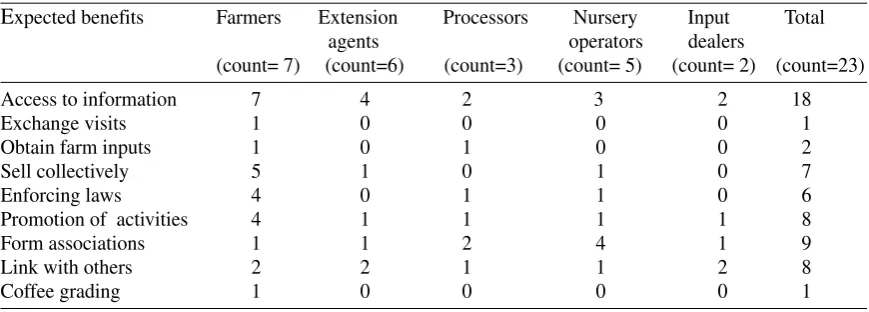
Table 4. Expected benefits by actor category
Expected benefits Farmers Extension Processors Nursery Input Total agents operators dealers
(count= 7) (count=6) (count=3) (count= 5) (count= 2) (count=23) Access to information 7 4 2 3 2 18 Exchange visits 1 0 0 0 0 1 Obtain farm inputs 1 0 1 0 0 2 Sell collectively 5 1 0 1 0 7 Enforcing laws 4 0 1 1 0 6 Promotion of activities 4 1 1 1 1 8 Form associations 1 1 2 4 1 9 Link with others 2 2 1 1 2 8 Coffee grading 1 0 0 0 0 1 Source: Primary data, 2015
In line with the SET (Cook et al., 2013), most actors expected intrinsic benefits from participating in the IPs through information sharing, linkages with other actors, business promotion and institutional development (see Table 4). All actors expected these platforms to provide avenues for information sharing and learning while farmers expected the IPs to address their marketing challenge by organizing
them for bulk marketing and quality assurance.
On the other hand, coffee processors and nursery operators expected the platforms to support them in institutional development that
would enable them to acquire processing and post-harvest equipment which they were unable to acquire individually as reported by one of the
processors;
“…We expected the platform to assist the processors to have raised drying facilities, provide information on prices then inform others
and to mobilize farmers to sell in groups” (Male
member, (Rakai district, 16th December 2014).
In Luwero the failure of the IP to achieve their expectations demoralized active nursery operators as reported by one of the actors;
“I represent nursery operators and we were
expected to form an association to unite us. We had a meeting to decide if we need an association. We expected the platform to hold meetings at least once every month. But this
never happened so due to lack of meetings as nursery operators, we never shared our needs on
the platform” (Male member, Luwero district,
27th November 2014).
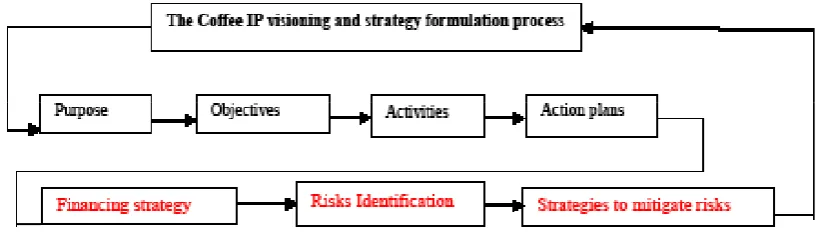
In New Zealand and Netherlands, Klerkx and Leeuwis (2009) and Botha et al. (2014) suggest that divergence between initiator preferences and stakeholder needs have important implications for the representation of different types of market chain actors. Brouwer et al. (2015) suggest that, for a successful IP visioning and strategy formulation, seven processes have to be conducted and should include the development of the financing strategy, risk identification and strategies to mitigate the risks as illustrated in Figure 2. The involvement of the coffee actors would ensure most stakeholders participated in critical stages of the IP formation processes.
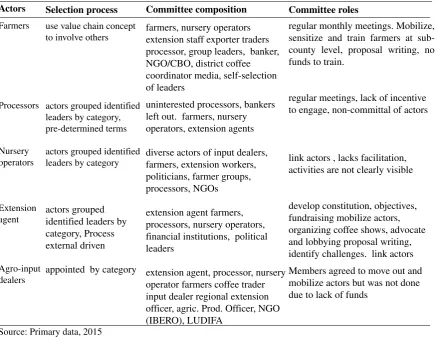
identified and nominated representative(s) to the district steering committee. Members of the constituted district steering committee then proceeded to select the executive leaders who were comprised of the chairperson, secretary, treasurer and committee members. The different actor categories were farmers, extension agents, nursery operators, NGOs/CBOs, processors, traders, agro-input dealers, regional coordinators, district leaders and bankers. Even though some categories of actors did not meet the stipulated number of members to the sub committees, selection of the sub committees established the foundation for the governance of the IPs.
The criteria for selection of the IP leaders were not clear but actors based their selection on
leaders’ experience in community development
work and local leadership positions. As determined and explained by Café Africa, the roles of the selected committee members were strategic action planning, technical management and process management. Other roles were fundraising, networking and information sharing, lobbying and advocacy, and monitoring and evaluation at district level. It was assumed that by virtue of their leadership positions and experiences, the committee members would steer the platform activities, but the leaders lacked clear guidance on how innovation platforms operate and how to command compliance and cooperation from the actors. This negatively influenced the governance of the coffee IPs as committee members needed guidance and facilitation to be able to perform their roles as narrated by some respondents; “...
We were not assigned roles and it was voluntary
Table 5. Selection of leaders, committee composition and expected roles for Coffee IPs Actors
Farmers
Processors
Nursery operators
Extension agent
Agro-input dealers
Selection process use value chain concept to involve others
actors grouped identified leaders by category, pre-determined terms
actors grouped identified leaders by category
actors grouped identified leaders by category, Process external driven
appointed by category
Committee composition farmers, nursery operators extension staff exporter traders processor, group leaders, banker, NGO/CBO, district coffee coordinator media, self-selection of leaders
uninterested processors, bankers left out. farmers, nursery operators, extension agents diverse actors of input dealers, farmers, extension workers, politicians, farmer groups, processors, NGOs extension agent farmers, processors, nursery operators, financial institutions, political leaders
extension agent, processor, nursery operator farmers coffee trader input dealer regional extension officer, agric. Prod. Officer, NGO (IBERO), LUDIFA
Committee roles
regular monthly meetings. Mobilize, sensitize and train farmers at sub-county level, proposal writing, no funds to train.
regular meetings, lack of incentive to engage, non-committal of actors
link actors , lacks facilitation, activities are not clearly visible
develop constitution, objectives, fundraising mobilize actors, organizing coffee shows, advocate and lobbying proposal writing, identify challenges. link actors Members agreed to move out and mobilize actors but was not done due to lack of funds
we were supposed to make follow up visits and mobilize actors but even nearby we did not. So it was a general weakness, we were still waiting
for Café Africa to guide us” (Female member,
Luwero district, 26th November 2014). “…The
problem was in the way it started. The idea was introduced at a fast pace. They were no clear action plans because the roles were not clearly explained that’s why the committees believed
coffee shows were the main activity” (Female
member, Bushenyi district, 13th March 2015).
One of the critical stages that was missed during the IP formation processes was development of proper governance structures beyond the interim steering committees which affected implementation of planned activities. Yet, governance structures are perceived to be critical for successful implementation of organizational activities (Kiskel, 2011).
GAPS, LESSONS LEARNT AND IMPLICATIONS
1. The success of IPs could be attributed to the diversity of the actors, their attendance to meetings and experiences to mobilize their members to engage in the platform activities. This is so because across districts, the meetings pooled representatives from the public and private sector.
2. While opening spaces for dialogue through invitation is necessary, it is by no means sufficient to ensure effective participation. A lot depends on how people take up and make use of what is on offer, as well as supportive processes that enhance capacity building and empowerment of the actors to engage in decision-making processes. Lack of involvement of the critical local stakeholders by the promoter in developing the terms of reference, which in this case was
referred to as “Rules of Exchange” meant that
the formation process of the Coffee IPs was a top-down approach and this affected ownership of the IPs.
3. The roles of private sector actors like the traders, bankers and exporters in the IP activities
were not clearly defined from the initial stages yet these are critical actors in any commodity value chain. From the findings, only Ntungamo district Coffee IP had the bank as one of its stakeholders at the initial formation stages. This affects the initial engagement, interactions and mobilization of the market orientated actors in the IP activities.
4. During the strategy and visioning process, among the stages that were missed out were the financing strategy, risk identification and strategies to mitigate the risks. This affected the performance of the IPs as members were not clear on where the financing of the IP activities would come from and how to deal with complex conditions in collective action. Apart from supporting the actors to realize a shared goal, Café Africa should have engaged the stakeholders in developing mechanisms for achieving their goal in terms pooling financial resources and dealing with uncertainties at formation stage.
5. In Policy, although efforts were made to involve the local district administrators and politicians, their roles in the IP formation process were not clear and how they would link with the higher government authorities, research institutions and Universities were not well articulated.
6. In terms of Governance of the IPs, steering committees were formed at the district level and the lower governance structures were omitted. Lack of structures at the lower level meant a weak direct linkages with the nursery operators, the producers and buyers and other pertinent stakeholders. Therefore, it is not only about identifying actors at higher hierarchy but
engagement of actors require clear and defined
organized structures at the grassroots.
mobilization, visioning and strategy formulation process, and IP culture and development of governance structures (Figure 3). Each component having its unit of sub-components (Figure 3).
The proposed formation operating model is a mechanism that can be used by an IP and its members to define the interaction points, translate elements of the policies or by- laws into practice and define the roles and responsibilities of each individual member of the IP. The model can also assist the IPs in assessing its current state
and establish how their governance structures would be. Each of the components elaborated in the model consists of a sub- component that can structure IPs into making informed decisions and define the actions to be taken in governance
of IPs. IP performance requires institutional
change and political will, commitment and active participation of the actors. Therefore, concerted mechanisms need to be in-built to support collective action; such processes take investment, time and persistence and may not be realized in a one event participatory workshop.
CONCLUSIONS
This study examined the processes in the formation of Coffee IPs in four districts in Uganda and examined how the processes influenced the participation of actors in the initial activities of the innovation platforms. The gaps in the IP formation processes were exclusion of some key stakeholders, unclear management and financing mechanisms, and weak governance structures at lower levels. These gaps affected engagement of actors in initial activities of the coffee IPs. The study suggests a formation operational model with four main components, actor identification and mobilization, visioning and strategy formulation process, IP culture, and development of governance structures. The model is suggested based on the weaknesses and missing links observed during the coffee IP formation. Since the coffee IPs deal with a highly competitive and demanded commodity at international level, strong governance structures must be in place with emphasis at farmer level. The aspects of actor participation in relation to involvement and influence are
some of the gaps that require more empirical
evidence; action research is recommended to examine the formation process as it unfolds to understand who participates, why and how their actions influence the decision-making processes in practice. Future research should look at the mechanisms of IP governance and their implementation for successful IP formation.
ACKNOWLEDGMENT
This research was supported by the Agricultural Technology and Agri-business Advisory Services (ATAAS) project funded by World Bank. The authors acknowledge the National Agricultural Research Organization (NARO) for the time and support accorded to this research. We also thank the study participants for their valuable time and insights during the interviews.
STATEMENT OF NO-CONFLICT OF INTEREST
The authors declare that there is no conflict of
interest in this paper.
REFERENCES
Adekunle, A. A., Ellis-Jones, J., Ajibefun, I., Nyikal, R. A., Bangali, S., Fatunbi, A. O. and Angé, A. 2012. Agricultural innovation in Sub-Saharan Africa: Experiences from
multiple stakeholder approaches. Accra, Ghana: Forum for Agricultural Research in Africa (FARA).
Agrawala, S., Carraro, M., Kingsmill, N., Lanzi, E., Mulan, M. and Prudent-Richard,
G. 2011. Private sector engagement in adaptation to climate change. OECD
Environment Working Papers 39: 0_1.
Bashaasha, B., Mangheni, M. N. and Nkonya, E. 2011. Decentralization and rural service delivery in Uganda. International Food Policy Research Institute (IFPRI).
Baxter, P. and Jack, S. 2008. Qualitative case study methodology: Study design and implementation for novice researchers. The
Qualitative Report 13(4): 544-559. Retrieved from http://nsuworks.nova.edu/tqr/vol13/iss
4/2.
Blau, P. M. 1964. Exchange and power in social life. New York: Wiley.
Braun, V. and Clarke, V. 2006. Using thematic analysis in psychology. Qualitative Research
in Psychology 3 (2): 77–101.
Boogaard, B. K., Schut, M., Klerkx, L., Leeuwis, C., Duncan, A. J. and Cullen, B. 2013. Critical issues for reflection when designing and implementing Research for Development in Innovation Platforms. Wageningen, The Netherlands: Wageningen University and Research Centre.
Botha, N., Klerkx, L., Small, B. and Turner, J. 2014. Lessons on transdisciplinary research
in a co-innovation programme in the New Zealand agricultural sector. Outlook on
Agriculture 43 (3): 219–223.
stakeholder partnerships. Wageningen: Centre of Development Innovation. Wageningen University and Research.
Buchanan, K., Brouwer, H., Klerkx, L., Schaap, M., Brouwers, J. and Le Borgne, E. 2013. Editorial. Facilitating multi-stakeholder processes: balancing internal dynamics and institutional politics. Knowledge Mangement
for Development Journal 9 (3): 3-10.
Café Africa. 2008. Coffee stakeholder
inception reports and action plans – Luwero,
Rakai, Bushenyi and Ntungamo. Unpublished. Café Africa and UCDA. 2009. Terms of
Reference for District Coffee Steering Committees. Unpublished.
Cook, K. S. and Rice, E. 2003. Social exchange theory. pp. 53-76. In: Delamater, J. (Ed.). Handbook of Social Psychology. New York, NY, US: Kluwer Academic/Plenum Publishers.
Cook, K. S., Cheshire, C., Rice, E. R. and Nakagawa, S. 2013. Social exchange theory.
pp. 61-88. In: Handbook of Social Psychology. Springer, Netherlands.
Cornwall, A. 2008. Unpacking participation: models, meanings and practices. Community
Development Journal 43 (3): 269-283.
Cropanzano, R. and Mitchell, M. S. 2005. Social exchange theory: An interdisciplinary review. Journal of Management 31(6): 874- 900.
Cropanzano, R., Prehar, C. A. and Chen, P. Y. 2002. Using social exchange theory to distinguish procedural from interactional justice. Group and Organization Management
27 (3): 324-351.
Cullen, B., Tucker, J., Snyder, K., Lema, Z. and Duncan, A. 2014. An analysis of power
dynamics within innovation platforms for natural resource management. Innovation
and Development 4 (2): 259-275.
Devaux, A., Torero, M., Donovan, J. and Horton, D. E. (Eds.). 2016. Innovation for inclusive value-chain development: Successes and challenges. International Food Policy
Research Institute. 532pp.
Forum for Agricultural Resaerch in Africa
(FARA). 2007. Securing the future for Africa’s
children. Research plan and program for impact assessment. FARA, Accra.
Hall, A. 2007. The origins and implications of using innovation systems perspectives in the design and implementation of agricultural research Projects: Some personal observations in UNU-MERIT Working Paper 2007-013. Maastricht, The Netherlands: United Nations University.
Hall, A. and Clark, N. 2010. What do complex adaptive systems look like and what are the implications for innovation policy? Journal of
International Development 22 (3): 308-324.
Hounkonnou, D., Kossou, D., Kuyper, T. W., Leeuwis, C., Nederlof, E. S., Röling, N., Sakyi-Dawson, O., Traoré, M. and Van Huis, A. 2012. An innovation systems approach to institutional change: smallholder development in West Africa. Agricultural Systems 108 (5):
74–83.
Kiskel, J. 2011. Governance Models: Defined Cognizant 20-20 insights, https://www.cogniz
Model-Defined.pdf, downloaded on 16th June 2017.
Kilelu, C. W., Klerkx, L. and Leeuwis, C. 2013. Unravelling the role of innovation platforms
in supporting co-evolution of innovation: contributions and tensions in a smallholder dairy development programme. Agricultural
Systems 118: 65-77.
Kibwika, P., Wals, A. E. and Nassuna-Musoke, M.G. 2009. Competence challenges of
demand-led agricultural research and extension in Uganda. Journal of Agricultural
Education and Extension 15 (1): 5-19.
Klerkx, L. and Leeuwis, C. 2009. Establishment and embedding of innovation brokers at different innovation system levels: Insights
from the Dutch agricultural sector.
Technological Forecasting and Social
Luwero DLG. 2009. Luwero District Statistical Abstract for 2008/2009. Luwero district, Uganda
Mayanja, S., Akello, B., Horton, D., Kisauzi, D. and Magala, D. 2012. Value chain development in Uganda: Lessons learned from the application of the participatory market chain approach. BANWA Archives
2004-2013. 9 (1): 64-96.
Merriam, S. and Tisdell, E. T. 2009. Qualitative Research: A guide to design and implementation. San Fransisco: John Willey & Sons.
Ministry of Agriculture, Animal Industry and Fisheries (MAAIF). 2010. National
Development Plan- 2010/11-2014/15. MAAIF, Entebbe.
Ministry of Agriculture, Animal Industry and Fisheries (MAAIF). 2013. The National Coffee Policy. MAAIF, Entebbe.
Ministry of Agriculture, Animal Industry and Fisheries (MAAIF). 2016. The National Agricultural Extension Policy. 48 pp. Kampala: Government of Uganda. Mulema, A. A. 2012. Organization of
innovation platforms for Agricultural Research and Development in the Great Lakes Region of Africa. Doctoral Dissertation, Iowa State University.
Mulema, A. A. and Mazur, R. E. 2016. Motivation and participation in
stakeholder innovation platforms in the Great Lakes Region of Africa. Community
Development Journal 51 (2): 212-228.
Nederlof, S. and Wongtschowski, M. 2011. Putting heads together: agricultural innovation platforms in practice. van der Lee, F. (Ed.). KIT Publishers, KIT Development, Policy and Practice.
Nederlof, E.S. and Pyburn, R. 2012. One finger cannot lift a rock: Facilitating innovation platforms to trigger institutional change in West Africa. KIT Publishers, Amsterdam.
Pyburn, R. and Wood hill, J. (Eds.). 2014.
Dynamics of Rural Innovation – A primer
for emerging professionals. LM Publishers, Arnhem.
Rajalahti, R., Janssen, W. and Pehu, E. 2008. Agricultural innovation systems: From diagnostics toward operational practices. Agriculture and Rural Development Department. World Bank.
Rakai District Local Government. 2014. Rakai District Development Plan- 2015/16-2019/2020, 202 pp. Kampala: Government of Uganda. Salisbury, R. H. 1969. An exchange theory of interest groups. Midwest Journal of Political
Science 13 (1):1-32.
Sseguya, H., Mazur, R. E., Wells, B. and Matsiko, F. 2015. Quality of participation in community groups in Kamuli District, Uganda: implications for policy and practice. Community Development 46 (1): 14-25. Spielman, D.J., Ekboir, J. and Davis, K. 2009. The art and science of innovation systems
inquiry: applications to sub-Saharan African
agriculture. Technolology in Society 31 (4):
399–405.
Uganda Bureau of Statistics. 2015. Statistical Abstract, 2015. UBOS, Kampala.
UCDA 2012. Uganda Coffee Development Authority Annual Report. UCDA, Kampala. UCDA 2014. Uganda National Coffee Strategy
2040 Plan for 2014/15 – 2019/20. UCDA,
Kampala.
Walters, H. 2013. Changing our ways: making sense of complex multi-stakeholder systems
change by using the four quadrant model.
Knowledge Management for Development
Journal 9 (3): 153-166.
Woodhill, A.J. and van Vugt, S.M. 2011. Facilitating MSPs: a sustainable way of changing power relations?. pp. 36-56. In: Guidebook for MSP Facilitation. Deutsche Gesellschaft für Internationale Zusammen arbeit (GIZ) GmbH.