© Global Society of Scientific Research and Researchers
http://ijcjournal.org/
Developing a Java-based Genetic Algorithm to Solve the
Travelling Salesman Problem
Bashir Salisu Abubakar
*Department of Computer Science, Faculty Computing and Mathematical Science, Kano University of Science
and Technology, Wudil, Kano Nigeria
Email: [email protected]
Abstract
In this paper, software was developed to solve the travelling salesman problem. The Travelling Salesman
Problem is a computational optimization problem that requires a lot of time to solve using brute force algorithm.
The research aims at developing java-based software that provides an optimum solution to the Travelling
Salesman Problem using the concepts of genetic algorithm within reasonable time frame.
Keywords: Genetic Algorithm; Travelling Salesman Problem; Initial Population; Mutation; Crossover.
1.Introduction
The Travelling Salesman Problem (TSP) is a well-known example of a classical combinatorial optimization
problem. The TSP is about finding the shortest possible path; given N number of cities where N must be greater
than two (N > 2). The salesperson only visits a city exactly once and then moves on to the next city. After
visiting all the cities, the salesman returns to the starting city. One of the factors to consider when optimizing the
TSP is the order in which the cities are visited. The TSP is a relatively old problem. This idea came into place
when Euler in 1759 developed an interest in solving the knight tour problem [16]. The term travelling salesman
was first used in 1832 in a book written by a German salesman B.F. Voigt [16]. Planning a tour for the salesman
is an expensive job when using brute force to solve the problem. If there are N cities to visit, then the number of
possible paths is (N - 1) / 2. Assuming n = 6, then the number of tours for the salesman is 60 and he might solve
it within one or two days, but what if N is 20, then the number of tours is approximately 6 X 10¹⁶ which might
take him years to solved. Genetic algorithms (GA) come into play when N is bigger. GA solves this kind of
problem within a short period and with an optimum result.
---
The TSP has occupied the thoughts of numerous researchers. Some of the reasons include the following; it has a
wide area of application, it is NP-hard in nature, which makes it easy to define, but difficult to solve. Last, a
method that will yield a better result has not yet been found.GA is search method that mimics the principles of
natural evolution (such as selection, recombination, inheritance, and mutation) to find an exact or approximate
solution to a complex optimization or search problem. The concept is better used in problems that involve
discrete optimization or where conventional optimization techniques cannot yield a better solution that is
non-differentiable or presents too many nonlinearly related parameters [2]. The search technique can be divided
categorically into three different phrases: evaluation of the fitness of each phenotype, selection of a parent
phenotype based on principles, and applications of genetic operators to the parent phenotype [1]. GA is used in
numerous research fields such as engineering, economics, manufacturing, medicine, computational science, and
bioinformatics to solve complex problems. In the mid-1970s Holland and his student at the University of
Michigan proposed the GA, which started from cellular automata. He described the idea in his book titled
Adaption of Natural and Artificial System (1975) [3]. GA became famous with the book written by David
Goldberg in 1989 [15]. The first international conference on GA held in Pittsburgh, Pennsylvania in the
mid-1980s changed the perspective of the algorithm from theoretical to practical [3]. The algorithm was developed
with the intention of optimizing a numerical function and learning tasks. In the GA, the search space consists of
phenotypes, which are the sets of possible solutions to the problem. A phenotype is the set of physical
characteristics (traits) of an individual. GA operates on phenotypes [2]. A genotype is the genetic material of a
phenotype that is inheritable.
2.Related Work
Many systems exist that solve the TSP using the genetic algorithm concepts. One of them is the work of Lee
[13], “Applying a genetic algorithm to the traveling salesman problem." The system uses the genetic algorithm
concept to solve the TSP. He uses the generational replacement selection method as his selection criteria and
swap mutation as his mutation process. The major problem of the work is a pure Java code, not in the form of a
graphical user interface (GUI), and all the genetic algorithm parameters are hard coded and the cities coordinate.
Last, only students with a Java running environment can work with it because is not developed in a form of
software that can be installed on any computer. Jeff Heaton [20] in Chapter 8 of his textbook entitled
Introduction to Neutral Networks with Java solves the same problem using the genetic algorithm concept. The
software starts by generating random genotypes, which are converted to phenotypes. A population of
phenotypes is formed, and each phenotype in the population is evaluated. The best phenotypes are selected for
reproduction in order to form a new population. Mutation is used in the new population to introduce diversity
into the population. The software will continue to run until it finds the same phenotype for selection 100 times
consequently. The major problem to this software is the lack of GUI (it is just a Java code), and random
generation of city coordinates (not allowing the user to specify the coordinates). In addition, the parameters are
hard coded, and the termination conduction is weak. The project will address the problems of the reviewed
software. First, the TSP will be implemented with modified operators to suit the problem instead of a simple
genetic algorithm in Java. Second, the problem of hard coded parameters will be solved by asking the user to
input values from the interface of the application. Third, the problem of randomly generating the genotype will
problem of selection criteria will be solved by implementing the selection criteria using appropriate methods,
and a friendly user interface will be designed. Last, the problem of a weak terminating condition will be solved
by asking the user to enter the number of iterations, and if a premature converge occurs before the number is
reached, the application will stop.
3.Methodology
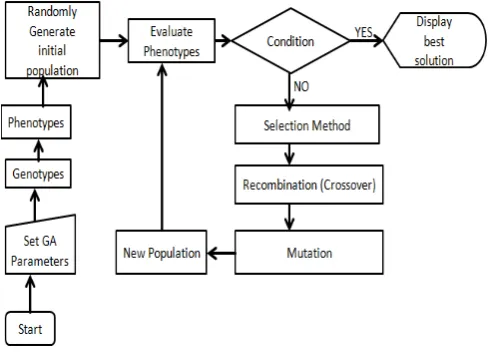
In this paper the concepts of GA will be used to develop software that will find the optimum solution to the
TSP. GA is a technique that mimics natural selection and evolution to find a solution to a harder optimization
problem, by explicitly using Charles Darwin’s principle of survival of the fittest. GA usually starts with
generating random genotypes. The genotypes are then converted to phenotypes. The phenotypes will be grouped
together to form an initial population. Each phenotype in the initial population is assigned a numerical score.
Phenotypes with better numerical scores are selected and paired together to produce offspring. The phenotypes
that are paired are called parents, and the product of their pairing is called offspring. This offspring will form a
new population, and the genetic materials of each offspring are altered to introduce diversity in the new
population. Reaching a terminating condition will stop the algorithm otherwise the algorithm will continue to
repeat itself. The general algorithm for a GA:
• [Initial Population] An arbitrary set of phenotypes that are randomly selected out of all possible
solutions to form an initial population.
• [Fitness] An evaluation of the fitness level of each phenotype present in the population
• [Selection] Select two phenotypes randomly from the initial population on the basis of fitness.
• [Crossover] Mate the two selected parent phenotypes in step three to form a new offspring.
• [Mutation] applied to the offspring
• Stages three, four, and five are repeated until all the phenotypes are selected for pairing.
• [Check] if termination condition is met, stop and return the best solution. Otherwise replace the
population with the offspring and go to step two.
4.Implementation
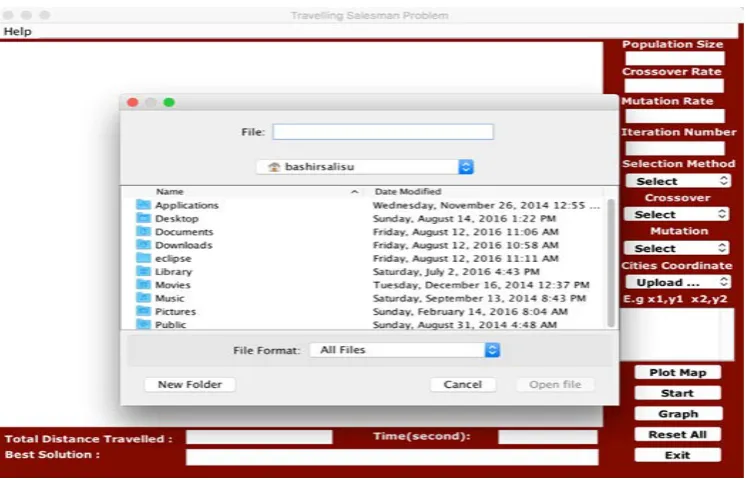
When the application is run, a GUI is shown to the user. This interface enables the user to enter the population,
crossover rate, mutation rate, selection method, crossover method, mutation method and coordinates. This
application implemented the tournament and the proportionate selections, so theuser decides which one to use.
The application also implemented three different crossover operators and two mutation operators. The
application implements two different methods of entering the coordinates. The method provides the coordinates
by either typing them in the text area or uploading them from a text file. If any file format apart from the text
file is chosen, an error message is displayed.
After the user provides all the parameter values, the user clicks on the start button. The city coordinates input by
the user are transformed into cities (genotypes) and this transformation is done in the City.Java class. Then a method called distanceBetweenCities(City city) is used to determine how far it is between two cities. Next, the cities are transformed into tours (phenotype) in the Tour.Java class. A method called totalDistance() calculates the total distance of each tour. Then, the fitness of the tour is evaluated, which is inversely proportionally to the
total distance and is done by a method called getFitness(). Next, the tours with the best fitness score are selected for crossover. This selection is handled by the either the tournament (Population) or the proportionate
(Population) methods, which depends on the user’s choice. The selected tour (phenotype) will undergo the
crossover process by one of the crossover methods, which will return offspring. Diversity is introduced into the
new population of the offspring by the swapMutation(mutation Rate, tour) method or the
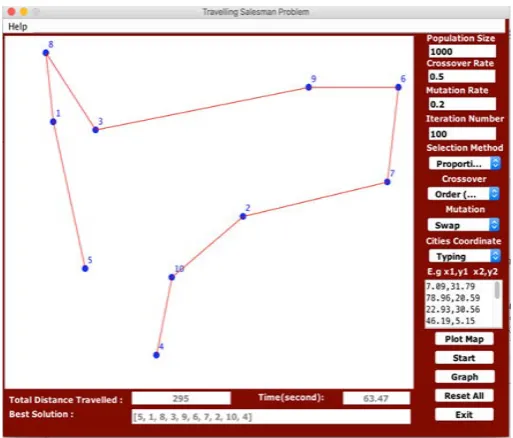
insertionMutation(mutation Rate, tour) method, which depends on the user’s choice. Then, the program displays the cities as dots in the map. As the process is repeated, the red line between the blue cities updates.
The final output of the software is the shortest possible path as the best solution and total distance travelled,
which will be displayed to the user. The figure below shows the implemented software.
5.Testing
To test the software after fully implemented, the coordinates (that’s longitude and latitude) of 10 countries in the
world are used. Table below shows the cities with their respective coordinates.
Table 1: Cities with their Coordinate
S/N CITY LONGITUDE LATITUDE
1 Morocco 7.09 31.79
2 India 78.96 20.59
3 South Africa 22.93 30.56
4 Somalia 46.19 5.15
5 Chad 18.73 15.45
6 Japan 138.25 36.20
7 Australia 133.77 25.27
8 Spain 3.75 40.46
9 China 104.19 35.86
10 Brazil 51.92 14.23
5.1 Result
The result of this test shows that the shortest possible path to visit each of the ten (10) countries once is [5, 1, 8,
3, 9, 6, 7, 2, 10, 4] which corresponds to the countries as: Chad, to Morocco, to Spain, to South African, to
China, to Japan, to Australia, to India, to Brazil, to Somalia.
6.Recommendation
To make improvements to the software system, some work will be necessary in order to make the application
more flexible for researchers or students to understand the concepts of the genetic algorithm. The future tasks
involve implementation of more selection criteria and a different crossover method. This will make the
application more usable. Also, the transformation of the software into an android or iPhone application will be
of good future use. Since almost everyone works with a phone, this will encourage the students to play more
with it.
7.Conclusion
This research paper presented software that solves the travelling salesman problem using the concept of genetic
algorithm using java-programming language. The application produced an optimum solution to the different sets
of problems.
References
[1]. Jean-Yves, P. (1996) ‘Genetic algorithms for the travelling salesman problem’, Annals of Operations
Research. 63(3), pp 337-370
[2]. Dario, F. and Claudio M. (2008) Bio-Inspired Artificial Intelligence. London: The MIT Press
Cambridge, Massachusetts.
[3]. Holland, J. H., Adaptation in Natural and Artificial Systems, University of Michigan Press, Ann Arbor,
MI, USA,1975.
[4]. ‘Genetic Algorithm’ (2014) Wikipedia. Available at: http://en.wikipedia.org/wiki/Genetic_algorithm
(accessed on 24/06/2014)
[5]. Sivanandan, S.N., and Deepa, S.N. (2008) Introduction to Genetic Algorithms, Springer
[6]. Pedro A. and Dean F. (2007) Initial Population for Genetic Algorithm: A metric Approach: School of
computer science, University of Oklahoma, Norman. USA. Available at:
http://www.cameron.edu/~pdiaz-go/GAsPopMetric.pdf (accessed 12/08/2014)
[7]. Uniform crossover (2014) Wikipedia. Available at:
http://en.wikipedia.org/wiki/Crossover_(genetic_algorithm) (accessed on 26/06/2014)
[8]. Proportionate Selection (2014) Wikipedia. Available at:
http://en.wikipedia.org/wiki/Fitness_proportionate_selection(accessed on 27/06/2014)
[9]. Khalid J., and Mohammed M.,(2013) ‘Selection Methods for Genetic Algorithms’ int. J. Emerg. Sci.
3(4), pp.333-334. Available at: http://ijes.info/3/4/42543401.pdf
[10]. Goldberg E., and Lingle R., ‘Alleles, loci, and travelling salesman problem’. InProc. Of the
International Conference on Genetic Algorithms and Their Applications, pp. 154-159, Pittsburgh, PA,
1985.
[11]. Oliver, I.M., and Smith, D.J., and Holland, J.R.C. ‘A study of permutation crossover operation on
travelling salesman problem’. Proceedings of the second International Conference on Genetic
[12]. Noraini M., and John G., (2011) ‘Genetic Algorithm performance with Different Selection Strategies in
Solving TSP’, Proceedings of the World Congress on Engineering. Vol II, London, U.K. Available at:
http://www.iaeng.org/publication/WCE2011/WCE2011_pp1134-1139.pdf (accessed 28/06/2014)
[13]. Lee (2012) Applying a genetic algorithm to the traveling salesman problem
http://www.theprojectspot.com/tutorial-post/applying-a-genetic-algorithm-to-the-travelling-salesman-problem/5 (accessed 28/06/2014)
[14]. Goldberg, D. E., Genetic Algorithms in Search, Optimization, and Machine Learning,
Addison-Wesley, New York, NY, 1989.
[15]. Zbigniew, M., (1994) Genetic Algorithms + Data Structures = Evolution Programs. Springer-Verlag,
2nd edition, 1994.
[16]. Rajesh, M., Surya, P. S., and Murari, L. M., (2010) Travelling Salesman Problem :An Overview of
Applications, Formulations, and Solution Approaches; Department of Management Studies, Indian
Institute of Technology Delhi, New Delhi, Available at: http://cdn.intechopen.com/pdfs-wm/12736.pdf
(accessed 12/08/2014)
[17]. Zhifeng, H., Huang, H., and Cai, R., (2008) Bio-inspired Algorithms for TSP and Generalized TSP.
Travelling Salesman Problem. Shanghai, China. Available at: http://cdn.intechweb.org/pdfs/4606.pdf
(accessed 20/08/2014)
[18]. Kumar R., Gopal G., (2013) ‘Novel Crossover Operator for Genetic Algorithm for Permutation
Problems’, International Journal of Soft Computing and Engineering 3(2) pp. 2231-2307
[19]. MATLAB www.matlab.com
[20]. Heaton, J., 2005. Introduction to Neutral Network with Java. (1st ed). U.S.A: Heaton Research, Inc.
[21]. Deitel, P. and Deitel, H., (2013) Java: How to Program. (9th ed). New Jersey, U.S.A: Pearson
Education, Inc.
[22]. Cornell and Horstmann (2008) Core Java, volume I/II (8th ed). U.S,A :Prentice Hall
[23]. Lewis, J. and Loftus, W., (2007). Java Software Solution: foundations of program design. (5th ed).
U.S.A: Addison Wesley
[24]. Noraini, M and John G., (2011) ‘Genetic Algorithm Performance with Different Selection Strategies in
solving TSP’. Proceedings of the World Congress on Engineering Vol II, London, U.K
[25]. Srinivas, M., and Patnaik, L.M., (1994) ‘Adaptive Probabilities of Crossover and Mutation in Genetic