Available Online at www.ijcsmc.com
International Journal of Computer Science and Mobile Computing
A Monthly Journal of Computer Science and Information Technology
ISSN 2320–088X
IMPACT FACTOR: 6.017
IJCSMC, Vol. 6, Issue. 4, April 2017, pg.274 – 283
A Technical Paper on Quantum
Watermarking Techniques Based on
DWT-DCT and DWT-DCT-DWT Using PN Sequence
Taniya Panjiyar
1, Neha Sharma
2, Yogendra Katiyar
3Department of Electronics & Communication Engineering
Regional College for Education Research & Technology, Jaipur
[email protected], [email protected], [email protected]
Abstract— Computational methods derived from digital signal processing are playing an vital role in the safety
and copyrights of audio, video, and visual arts. In context of the quantum computing, the equivalent algorithms
are becoming a new and innovative research direction in today’s high-technology era. The nature of quantum
computer let us assures the security of quantum information, so a more secure and well-organized quantum
watermarking algorithm is in demand. Quantum watermarking is the process that embeds the invisible quantum
info into quantum multimedia signal for copyright safety. Unlike from the bulk of traditional algorithms, we set
forward innovative algorithms that apply a quantum or a pseudo quantum watermarking in wavelet region.
Guaranteed by the Heisenberg uncertainty principle and quantum no-duplicating standard, the protection of
quantum watermark can turn up at a very high-level standard. In other way we can say that, these watermarking
algorithms can hit nearly all attackers, no matter by means of classical computer or quantum computer.
Keywords – "Discrete Cosine Transform(DCT)","Frequency Domain"," PN Sequence", "Discrete Wavelet
I. INTRODUCTION
The idea of a watermark is to make safe the authentication of a multimedia information or visual art work. There are always some unauthorized people that want to hit or destroy the watermark by all means likely possible. So it‟s
significant to look after the product sand art works from being derivative or stolen. The most significant indicators
of watermarked pictures are the protection and strength. A watermark with bad toughness can be attacked or
damaged with no trouble, that will makes it worthless. Traditional digital watermarking algorithms which is based
on the Principle Component Analysis (PCA) and wavelet transforms, separately or joint, are used broadly on
classical computers, for example in [1]-[3].Also, some algorithms are joint in other ways, such as Discrete Cosine
Transform, Discrete Wavelet Transform, and Principle Component Analysis[4],[5].Of course, these algorithms have
good security and robustness on classical computers. On the other hand, with the growth of quantum computer,
traditional watermarking algorithms may not be at all times secure particularly when facing attacking from (future)
quantum computers. Fortunately enough, we can resolve this trouble by the method of quantum watermarking.
Different from most traditional algorithms, we suggested a new algorithm which applies quantum watermarking
using PN sequence by combining the two methods of Discrete cosine transform and Discrete wavelet transform(as
DCT-DWT),and another method as a combination of Discrete wavelet transform and Discrete cosine transform(or
we can called as DWT-DCT).And in the proposed methodology which will be used for quantum watermarking
algorithm can reach a high-level standard for security. In other terms, the watermarking algorithm which we are
using can defeat almost all attackers, no matter by means of classical computer or quantum computer. Even though
it still produces pseudo random numbers and the calculation speed is believed to be much slower than on a quantum
computer, the results appear incredible. As well, our algorithm can get relieve of the difficulty that may happen
when applying earlier algorithm on classical computers: the computation is too complex. As far as we know, our
attacking experiments showed that our method is much secured with better robustness as compared to existing
algorithms.
II. WATERMARKING BASIC PRINCIPLE
The basic scheme in watermarking is to attach a watermark signal to the host information to be watermarked such
that the watermark signal is unobtrusive and safe in the signal fusion however can partially or completely be
recovered from the signal mixture afterward on if the right cryptographically safe key required for recovery is taken.
To make sure imperceptibility of the change caused by watermark embedded, a perceptibility condition of some
kind is used. As a consequence of the needed imperceptibility, the individual samples (e.g., pixels or transform
coefficients) that are taken for watermark embedding can only be changed by an quantity somewhat small to their
average amplitude.
To make sure robustness regardless of the small allowed change, the watermark data is usually redundantly dispersed over no of samples (e.g., pixels) of the host data, therefore providing a “holographic” toughness, which
Fig.1.Basic Digital watermarking methodology [6]
Fig.2. Basic Digital watermarking recovery scheme [6]
III. DISCRETE WAVELET TRANSFORM
A. Wavelet
Wavelet is a bounded energy function that has exactly a zero mean as well as it has normalized too. A family unit
of wavelets can be obtained by scaling and to convert it. In order for the wavelet transformation to be computed by
means of computers the data/information have got to be discretized compulsory. A continuous signal having data
has to be sampled and tested so that a value is recorded following to a discrete time gap. If the sampling of the data
is carried out at Nyquist rate, no information would be misplaced. Subsequent to sampling the discrete wavelet
sequence could be taken. On the other way, this can still be very slow to compute. The cause is that the data
available through estimate of wavelet sequence is still extremely redundant and the result needs a large amount of
calculation time. In order to create the wavelet computationally easy, a discrete algorithm is required. The Discrete
Wavelet Transform (DWT) gives sufficient information both for investigation and synthesis of the original
information with a important decline in the computation time. In adding up, DWT is significantly easier to
implement in contrast to the CWT [7].
The DWT of a 1-D (one dimension) information x is computed by passing it throughout a sequence of filters. First
of all in the initial stage the samples x[k] are allowed and accepted through a low-pass filter with an impulse response „g‟ which gives outcomes in a convolution of the both. The data is too decomposed at the same time by
means of a high-pass filter with impulse response h. The consequences will again give the detail coefficients (from
the high-pass filter) and as well as approximation coefficients (from the low-pass filter)which is shown in Figure 3
Fig.3. Basic block diagram of filter analysis [7]
It is significant that the two filters are linked to each other and they are called as a Quadrature Mirror Filter (QMF).
Though, since half the frequencies of the data have now been detached, half the samples can be useless according to
Nyquist rule. The filter outcomes are then down sampled by a part of 2. This breakdown is cyclic to supplementary
amplify the frequency resolution and the approximation coefficients are decomposed with high as well as low pass
filters and after that next process is down sampled. DWT is one of the popular method for sub-band picture coding.
It decomposes the original picture iteratively into a group of transform coefficients and these coefficients are known
as sub-bands. DWT sub-band decomposition of picture separate image info into high as well as low frequency bands
by means of high-pass and low-pass filter subsequent by down sampling to get rid of redundant data. Decoding
process on the other hand has up-sampling process so that it adjust dimensionality as well as recombining info from
different bands. For a two-dimensional signal for instance picture, first level decomposition will provide
consequence into four elements which is shown below in Figure 4.
Fig.4. One-level sub-band decomposition [7]
Application of DWT to an picture involves fusion of the filters (mixture of the scaling function and the wavelet
function) to create unique sub-bands. The LL (low-low or rough calculation) sub-band is formed by low- pass
filtering all along the rows and columns, and it is generally referred to as a coarse picture estimation. The LH
(low-high or vertical details) sub-band is created by low pass filtering all along the length of rows and (low-high pass filtering
all along the columns, consequently capture the horizontal ends. The HL (high-low or horizontal details) sub-band is
formed by high-pass filtering all along the length of rows as well as low pass filtering the length of the columns, as a
bands are believed to be the band-pass sub-bands and the LH, HL, and HH all the three sub-bands together are
known as the detail sub-bands [8]. The four sub-bands are shown in Figure 5.
Fig.5. Pyramid Structure of Three level DWT [7] B. Haar Wavelet
The Haar wavelet make uses a rectangular window to check the time succession so as to the first pass over the time
succession that make uses a window size of two that is doubled at each and every step until the window comprise of
the complete time succession. Every pass over the time sequence produces a new time sequence and a group of
coefficients. The new time series is the normal of the prior time sequence over the sampling window. The
coefficients represent the normal alter in the sample window. There are a large range of well-known wavelet
algorithms, taking together with Daubechies wavelets, Mexican Hat wavelets and Morlet wavelets. These wavelet
algorithms have the benefit of superior resolution for easily altering time sequence. Other than they have the
drawback of being more computationally difficult than the Haar wavelets. In adding together, the Haar wavelet
transform is quick, memory efficient and accurately reversible exclusive of the edge effects which are there in other
wavelet transforms.
IV. DISCRETE COSINE TRANSFORM
A signal is transformed into elementary frequency elements which has to be represented as the summation of
sinusoids in various magnitudes and frequencies of an picture illustration. For instance the different process like
signal processing, image compression, processing of an image, etc. are a range of applications that can be produced
by the help of this transform [9,10,11,12]. An picture which is to be processed with Discrete cosine transform low-,
Significant and main observable areas of the image are within the low-frequency sub-bands whereas high frequency
field of the image can be removed when attacks (compression and noise for example) are used. When these center
frequency sub-band coefficients are custom-made or altered slightly, watermark is after that embed in this sub-band
so as to the watermark keeps strong when compressed and the preferred or noticeable value of the image will not be
affected or distorted simultaneously. [13,14,12]
one-dimensional DCT (1D-DCT)” given by:
1
0
(2
1)
( )
( , ) cos
2
Nx
x
u
u
f x y
N
Series of 2D-DCT is described as follows:
1 1
0 0
(2
1)
(2
1)
( , )
( ) ( )
( ) ( ) ( , ) cos
cos
2
2
0
1,
0
1
M N
u v
x
u
y
v
Z x y
u
v
u
v Z u v
M
N
x
M
y
N
Wherein (u) and (v) are defined as
1
0
( )
0
2
for u
N
u
for u
N
α (v) =
{
√
√
u and v are discrete frequency variables (x, y) pixel index.
V. LITERATURE SURVEY
Inside the area of watermarking, image watermarking mainly has attracted lot of interest in the research area. The
majority of the research work is devoted to image watermarking in comparison to audio and video. There may be 3
reason for this. Firstly, since of ready accessibility of the test images, secondly because it carry sufficient
unnecessary data to give an opportunity to embed watermarks with no trouble, and last of all, it may be assumed that
any successful image watermarking algorithm may be enhanced for the video also.
watermarking system based on combined discrete wavelet transform – discrete cosine transform – (DWT-DCT). Its
main motive is to analysis whether this process can endure attacks (its toughness) and invisibility (its
imperceptibility), acquired by letting DCT of the DWT coefficients of the LL mid-frequency sub-bands from its
band. These joint methods and their projected algorithms showed good consequences once experienced on its
imperceptibility and robustness except for when subjected to noise attack (salt and pepper). Comparative
consequences demonstrate that the projected algorithm is strong and imperceptible, giving better outcomes.
In the year 2015, Arisudan Tiwari, Anoopa Arya, Shubham Shukla [16] shares the interesting thoughts on the
development computationally well-organized and effective method and algorithm for digital watermarking by
making use of wavelets. Through their paper the MATLAB simulation has been performed for the purpose of
digital watermarking by taking an use of both the procedure DCT as well as DWT algorithms. It is noted that when
comparison is done then it is shown that the simulation time for the DCT is 1.48 seconds and for DWT it is 0.9
seconds for the identical size of picture. It is experienced on 10 images. So, it can be predictable that DWT is much
quicker than DCT.
VI. PROPOSED METHODOLOGY
Quantum watermarking is something different from the regular watermarking techniques, hence needs special
methods and techniques to handle the same, in this paper, three PN sequences are taken as a sample data and has
been embedded into a RGB color space image. A simple color image consists of the RGB color space and hence to
use them for watermarking they are needed to be separated out and processed individually.
(a) Watermark Embedding Algorithm
Step I :The very first step is to call the inputs such as the PN sequences and the Images.
Step II :secondly we need to know their data types and dimensions so as to make them system and code compatible.
Step III :The next step is to suggest and ask the user about the methodology whichever is suitable to the current
scenario may get selected form the options, the two methodologies are very different from each other but comprises
themselves into the same piece of code.
Step IV: First technique follows the DCT-DWT approach where the image is first exposed to the DCT equation and
is processed. under its influenced as explain in figure 10(b). Second approach follows the DWT-DCT approach as
shown in figure 10(c).
Fig.6. RGB Components of an Image
Step V :Let‟s talk about the first approach first, very step of this will be to check the dimensions of the image and it
and will be processed individually but under the same process. Then components will be first exposed to the DCT
operation and will generate a result shown in figure 7.
(a) (b) (c)
Fig.7. DCT Operated Images (a)Red component DCT2 (b) Green component DCT2 (c) Blue component DCT2
Step VI: After the DCT operation has been implemented the next step is to process all the DCT processed
components through DWT.
(a) (b) (c)
Fig.8. DWT Operated Images (a)Red component DWT2 (b)Red component DWT2 (c) Red component DWT2
Step VII :Afterwards the three sub bands other than the low-low frequency band will be transferred to the
embedding equations and hence the embedding will be performed, now repack the images as they were opened and
save them.
Fig.9. DCT-DWT processed Watermark image
Step VIII : Finally, A DWT-DCT process is rather an easy affair and just require three simple steps, first will be to
process the image with DWT and recombine the generated sub-bands geometrically only and then process it by DCT
(a) (b) (c)
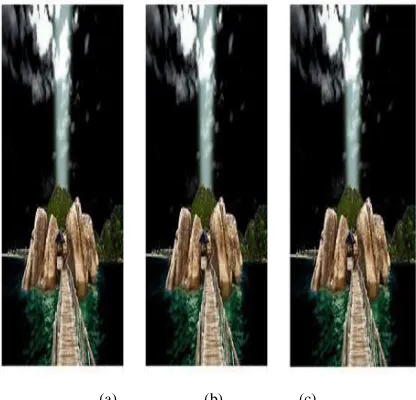
Fig.10. Final Image after processing on the image (a) Original Image (b) DCT-DWT undergone performed Image(c) DWT-DCT undergone performed Image
VII. RESULT
Result by far has been the best feature of this paper, they are overwhelming, results in terms of MSE, PSNR, JND
and SSIM are good enough and hence produces better graphs as shown below. The code has been simulated over
150 RGB Images.
TABLE I: REPRESENTATION OFRESULT OBTAINED FROM THE IMPLEMENTED ALGORITHM Parameter Our Method DWT Based DCT Based
MSE 0.954 0.9142 0.90121
PSNR(in db) 75.36dB 49.36dB 40.254dB
JND 10.256 18.3654 28.245
SSIM 0.0254 0.01247 0.01478
VIII. CONCLUSION
In this paper, we investigate the dynamic quantum watermark strategy for quantum images based on DCT-DWT and
DWT-DCT. We find that the watermarking algorithm claimed by the authors is incorrect. At last, we give a possible
improvement strategy. It should be pointed out that when we try to generalize classical watermarking idea to
quantum scenarios, we should clearly be aware of the difference between classical watermarking theory and its
quantum counterpart and cannot generalize the classical watermarking algorithm to quantum scenario directly.
REFERENCES
[1] P. Steffen, P.N. Heller, R.A. Gopinath, and C.S Burrus, “Theory of regular m-band wavelet bases,” IEEE Trans. Signal Processing, Vol. 41,pp. 3497-3511, Dec. 1993.
[2] A. K. Mostafa, A. S. Tolba, F. M. Abdelkader ,H.M. Elhind, “Video Watermarking Scheme Based on Principal Component Analysis andWavelet Transform,” Int. J. of Computer Science and Network Security, Vol.9, pp. 45-52,Aug. 2009.
[3] N.I. Yassin, N. M. Salem, and M. I. El Adawy, “Block based video watermarking scheme using wavelet transform and principle component analysis,” Int. J. of Computer Science, Vol. 9, Issue 1, pp. 296-301, Jan. 2012. [4] A. Singh, and A. Tayal, “Performance analysis of digital image watermarking using discrete wavelet transform, discrete cosine transformed singular value decomposition based on PSNR and NC,” 2012 Proc. Int. Conf. on Computing and Control Engineering, ICCCECS 730, April 2012.
[5] Tong Liu, Xuan Xu, Xiaodi Wang, “M-band Wavelet and Cosine Transform Based Watermark Algorithm Using Randomization and Principle Component Analysis” ,International Journal of Science and Engineering Investigations, vol. 2, issue 13, pp.1-4, February, 2013.
[6] Frank Hartung, Martin Kutter, "Multimedia watermarking", Proceedings of IEEE, Vol.87,pp.1085-1103,july 1999.
[7] Shivanigarg, Ranjitsingh, " An efficient method for Digital Image Watermarking based on PN sequence",
International Journal on Computer Science and Engineering, Vol. 4 ,pp.1550-1561, 09 Sep 2012
[8] Sharkas, M., ElShafie, D. and Hamdy, N., 2005. “A Dual Digital-Image Watermarking Technique”, Proceedings of IEEE WorldAcademy of Science, Engineering and Technology.
[9] P. Satyanaraya Murty and R. Kumar, “A Robust Watermarking Scheme Using Hybrid DWT-DCT-SVD Technique”, IJSNS, vol. 10, no. 10, (2010), pp. 187-192.
[10] Z. Tang. and X. Zhang, “Secure Image Encryption without Size Limitation Using Arnold Transform and Random Strategies”, Journal of Multimedia, vol. 6, no. 2, (2011) .
[11] M.F.L. Abdullah, A. A. M. Ukasha and M.F. Mohammed Elbireki, “Image Compression Technique using DCT, FFT Transform”, Presentation in National Conference on Electrical and Electronic Engineering ( NCEEE) (2012).
[12] M Farag, M Elbireki, M. F. L. Abdullah and A.A.M Ukasha, “Adopting A Robust Watermarked Image Against Cyber Security Threats Using DCT and Ramer Method”, Fifth International Conference on Intelligent Systems, Modelling and Simulation (ISMS) (2014), IEEE.
[13] D.V.N Koteswara Rao, Y..Madhuri, S.V. Rajendra Kumar, and Y.V. Suresh Babu, “Robust Image Watermarking using DCT & Wavelet Packet Denoising”, Dept. of Electronics and Communication Engineering, SACET,Chirala, International Journal of Scientific and Engineering Research Vol. 3, Issue 5, May-2012.
[14] K. Deb, M.S. Al-Seraj, M.M. Hoque and M.I.H. Sarkar, “Combined DWT-DCT Based Digital Watermarking Techniques for Copyright Protection”, IEEE Publication, 7th International Conference on Electrical and Computer Engineering (2012).
[15] Majdi Farag Mohammed El Bireki, M. F. L. Abdullah, Ali Abdrhman M. Ukasha and Ali A. Elrowayati,"Digital Image Watermarking Based On Joint (DCT-DWT) and Arnold Transform", International
Journal of Security and Its Applications Vol. 10, No. 5 (2016) pp.107-118,2016.