Research Article
Influence of hydro- and halo- priming on
germination and seedling growth of
cabbage under saline conditions
Khurram Ziaf
1, Muhammad Mahmood-ur-Rehman
1*, Muhammad
Amjad
1, Riaz Ahmad
2, Asmat Batool
1, Atta Muhammad
1, Junaid Latif
3and Qamar uz Zaman
21. Institute of Horticultural Sciences, University of Agriculture Faisalabad-Pakistan 2. Department of Agronomy, University of Agriculture Faisalabad-Pakistan
3. Institute of Soil and Environmental Science, University of Agriculture Faisalabad-Pakistan
*Corresponding author’s email: [email protected] Citation
Khurram Ziaf, Muhammad Mahmood-ur-Rehman, Muhammad Amjad, Riaz Ahmad, Asmat Batool, Atta
Muhammad, Junaid Latif and Qamar uz Zaman. Influence of hydro- and halo- priming on germination and seedling growth of cabbage under saline conditions. Pure and Applied Biology. Vol. 6, Issue 1, pp97-107.
http://dx.doi.org/10.19045/bspab.2017.60002
Received: 17/06/2016 Revised: 28/12/2016 Accepted: 06/01/2017 Online First: 11/01/2017
Abstract
A study was conducted at vegetable seed Laboratory Institute of Horticultural Sciences, University of Agriculture Faisalabad to investigate the effect of halo and hydro-priming on seed germination and seedling growth of cabbage under saline conditions. Cabbage seeds were primed with five different salts i.e. KNO3, KH2PO4, KCl, NaCl, CaNO3, and water
(Hydro-priming) for 2 hours in darkness at 24±1oC temperature. Both primed and unprimed seeds were irrigated with five different saline solutions [0 mM, 50 mM, 100 mM, 150 mM and 200 mM NaCl]. Results showed that priming treatments with KCl, KH2PO4 and KNO3 at different
concentrations gave best results in terms of final germination percentage (FGP), time taken to 50 % germination (T50), germination index (GI), mean germination time (MGT) and seedling vigour
index (SVI) as compared to unprimed seeds. However, enhanced salinity levels had harmful influence on almost all parameters under study. The present study exposed that under normal and saline conditions all priming treatments mainly KNO3 can be used to increase seed enactment in
cabbage. However, further studies are needed to investigate the effects of halo priming on growth and yield of cabbage.
Keywords: Cabbage; Germination energy; Halo priming; Salinity Introduction
Drought and salinity threatens crop
productivity all over the world. High salt concentrations in the soils all over the world causes great fall in crop production [1]. Salt affected cultivated land was approximately 5% [2]and now has increased up to 20% of agricultural land [3]. Almost 6.3 million
hectare land that is about 14% of irrigated land is salt affected in Pakistan causing up to 64% production loss [4]. Rapid and uniform seedling emergence is necessary to increase yield and quality of vegetable crops [5]. Seedling emergence is influenced by seed
quality, edaphic and environmental
and salt concentration in the soil [6]. Salt stress hinders seed emergence and seedling establishment [7]. Excessive salinity levels may cause higher ion uptake [8], which induce oxidative stress and thus may inhibit germination [9]. Furthermore, under saline
conditions carbohydrate synthesis is
deteriorated due to the reduced activity of ribulose 1,5-bisphosphate carboxylase [10]. Seed priming can effectively be used to improve seed germination and emergence rate of many crops [11]. Under adverse environmental conditions seed priming
encourages rapid and uniform seed
germination. Seed priming can be done in a variety of ways by using drinking water, hormonal and salt solutions, sand and solid matrices. Halo-priming is a pre-sowing treatment in salt solutions that permits seeds to absorb water but limits the radicle emergence. Primed grass seeds show good results for all germination parameters [12]. Cabbage is an imperative leafy vegetable used as fresh or in cooked form. It
comprises good amount of iodine,
potassium, calcium, iron, phosphorous, sulfur, potassium, vitamins (A, B1, B2, B6, K, C, E), riboflavin and folic acid [13]. In the world the annual production of cabbage and other brassica during 2013-14 was 71.8 million tonnes [14]. In Pakistan, the annual production of cabbage and brassica was 77.2
thousand tonnes during 2013-14 [15].
Usually, cabbage is cultivated by raising nursery, which is transplanted in field after about one month. But, in developed countries and even in Pakistan, some growers sow it directly in the field. The crop is regarded as salt sensitive, particularly during germination and early seedling growth. But, research work on induction of salinity tolerance in cabbage is scarce. Thermal hardening of seed has been used for induction of salinity tolerance in cabbage but, seed priming reports on cabbage are scarce.
Keeping in view the scarcity of research on use of seed priming technique in cabbage, this study was planned to induce salinity tolerance in cabbage during germination and early seedling stage. Cabbage seeds were primed by using salt solutions of calcium, potassium and sodium (KNO3, KH2PO4,
KCl, NaCl, and CaNO3) or water to find the
best seed priming treatment(s) that can induce salt tolerance in cabbage during germination and early seedling growth. Materials and methods
Petri dishes, filter papers, different salts, distilled water, seed moisture meter, aeration/air pump, incubator and cabbage seeds. Seeds of cabbage variety Golden Acre were obtained from Sidique Sons (registered) seed corporation Faisalabad. First of all, seed moisture contents were determined (7%) by placing seeds in seed moisture meter (GMK-503). Seeds were primed using distilled water and various concentrations of different salts viz., KNO3
@ 1 and 2 %, KCl @ 1, 2 and 3 %, NaCl @ 1%, KH2PO4 @ 3%, CaNO3 @ 1, 2 and 3%,
in darkness at 24±1oC. Treated (primed) seeds were re-dried in laboratory at room temperature. One hundred primed and unprimed seeds per treatment in four replicates were cultured in Petri dishes (25 seeds on each Petri dish) on double sheet of filter paper for germination test. Filter paper were moistened initially with 5 mL of distilled water with these concentrations i.e. 0 mM, 50 mM, 100 mM, 150 mM and 200 mM of NaCl and later on as per requirement. These plates were kept in
incubator at temperature 24±1°C in
darkness.
The experiment was conducted according to completely randomized design (CRD) under factorial arrangement. The recorded data were analyzed statistically using Fisher’s analysis of variance technique [16] and
treatment means were separated by
Duncan’s Multiple Range test. Results and discussion
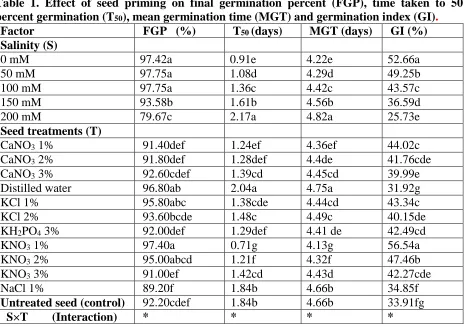
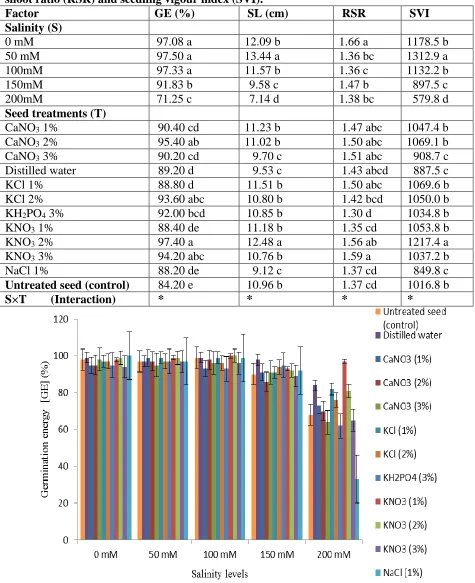
Germination and related parameters were altered by the salinity and various priming treatments. There was a gradual decline in germination percentage, germination index and germination energy with increase in salinity level (Table 1 and 2). Final
germination percentage (FGP) and
germination energy (GE) started to decline at 150 mM NaCl while reduction in GI was evident even at 50 mM NaCl concentration. Increased final germination percentage (97.75%) was recorded at 50 mM and 100 mM NaCl salinity level that was statistically similar to the final germination percentage at 0 mM salinity level (97.42%). Final
germination percentage was lowest
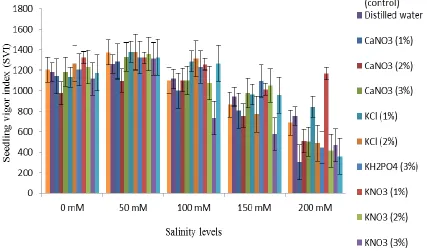
(79.67%) at highest salinity level i.e. 200 mM NaCl. Seedling length was increased slightly at 50 mM NaCl (13.44 cm) in comparison with control (12.09 cm at 0 mM NaCl concentration) but then declined with increase in salinity upto 100 mM (11.57cm) and above (150 and 200 mM). Root shoot ratio was also significantly influenced by salinity and was statistically same at all salinity levels from 50 to 200 mM NaCl concentration. Seedling vigour index was also highest at 50 mM salinity level (1312.9), statistically greater than seedling vigour index at 0 mM salinity level. Moderate salinity level (100 mM) caused reduction in seedling vigour index as compared to control but change was not statistically significant. At 150 and 200 mM there was sudden decrease in SVI (897.5 and 579.8, respectively).
When individual effect of seed treatments on seed germination and related parameters
was assessed, KNO3 (1% and 2%) showed
the best results for most of the parameters
under observation. Final germination
percentage and germination index was
maximum (97.40% and 56.53%,
respectively) for seeds primed in KNO3
(1%) solution. FGP values of KNO3 (1%
and 2%) primed seeds were at par with those for seeds primed in distilled water and KCl (1%) but germination index values were significantly higher for seeds primed in KNO3 (1%) than all other seed treatments
and control (Table 1). Germination energy was highest in seed primed with KNO3
(2%) solution that statistically at par with CaNO3 (2%), KCl (2%) and KNO3 (3%)
(Figure 1). Hydro-priming improved FGP, GI and GE over untreated seeds (control) but increased time span of seed germination (Table 1 and 2) as evidenced by higher values of T50 (2.03 days) and MGT (4.75
days) as compared to control (1.84 and 4.66
days, respectively). Our results are
confirmed by the statement of [17] that hydro and halopriming enhanced seedling
development of sorghum genotypes.
Selvarani and Umarani [18] stated that
hydro-priming enhanced germination
percentage while Varier et al. [19] obtained uniform seed emergence of hydro-primed seeds. Priming in KNO3 (1%) significantly
reduced T50 (0.71 days) and MGT (4.13
days) as compared to untreated seeds. Most priming treatments significantly increased seedling length as compared to control,
maximum by KNO3 (2%) but some
treatments (CaNO3 3%), distilled water and
NaCl (1%) decreased seedling length. Root shoot ratio was slightly increased by various priming treatments. Our results were similar to the statement of Nerson and Govers [20] who described that seeds of muskmelon primed with (2-3%) solution of KH2PO4 + KNO3 (1:1) showed imperative
rise in root shoot ratio. Seeding vigor index
primed seeds. Different seed treatments
modulated seed performance indices
(germination percentage, seedling length and vigour) to variable extent. There was not too much difference in FPG values among various priming treatments at 0, 50, 100 and 150 mM salinity levels (Figure 2).
At 200 mM NaCl concentration KNO3 (1%)
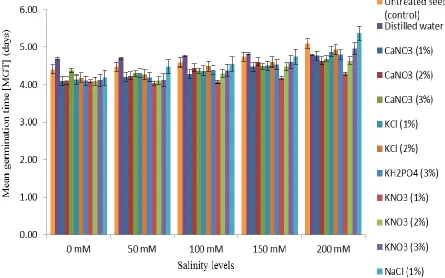
significantly increased FGP (97%) over untreated seeds, even higher than FGP values of untreated seeds at 200 mM. But NaCl (1%) showed drastic reduction in FGP (55%). All priming treatments decreased time taken to 50% germination (T50) and mean germination time (MGT)
from 0 to 150 mM salinity levels except
hydropriming, while at 200 mM salinity level seed primed in NaCl (1%) prolonged
germination time (MGT and T50) as
compared to all other seed treatments (Figure 3 and 4). Seeds primed with KNO3
(1%) significantly decreased T50 and MGT
which indicates that this priming treatment
increased uniformity of germination.
Thakur et al. [21] noticed a rapid increase in germination when seeds were primed
with KNO3 in comparison with the
untreated seeds while Ahmadvand et al. [22] observed a significant increase in emergence percentage of soybean and final germination percentage when seeds were primed with potassium nitrate.
Table 1. Effect of seed priming on final germination percent (FGP), time taken to 50
percent germination (T50), mean germination time (MGT) and germination index (GI).
Factor FGP (%) T50 (days) MGT (days) GI (%)
Salinity (S)
0 mM 97.42a 0.91e 4.22e 52.66a
50 mM 97.75a 1.08d 4.29d 49.25b
100 mM 97.75a 1.36c 4.42c 43.57c
150 mM 93.58b 1.61b 4.56b 36.59d
200 mM 79.67c 2.17a 4.82a 25.73e
Seed treatments (T)
CaNO3 1% 91.40def 1.24ef 4.36ef 44.02c
CaNO3 2% 91.80def 1.28def 4.4de 41.76cde
CaNO3 3% 92.60cdef 1.39cd 4.45cd 39.99e
Distilled water 96.80ab 2.04a 4.75a 31.92g
KCl 1% 95.80abc 1.38cde 4.44cd 43.34c
KCl 2% 93.60bcde 1.48c 4.49c 40.15de
KH2PO4 3% 92.00def 1.29def 4.41 de 42.49cd
KNO3 1% 97.40a 0.71g 4.13g 56.54a
KNO3 2% 95.00abcd 1.21f 4.32f 47.46b
KNO3 3% 91.00ef 1.42cd 4.43d 42.27cde
NaCl 1% 89.20f 1.84b 4.66b 34.85f
Untreated seed (control) 92.20cdef 1.84b 4.66b 33.91fg
Table 2. Effect of seed priming on germination energy (GE), seedling length (SL), root shoot ratio (RSR) and seedling vigour index (SVI).
Factor GE (%) SL (cm) RSR SVI
Salinity (S)
0 mM 97.08 a 12.09 b 1.66 a 1178.5 b
50 mM 97.50 a 13.44 a 1.36 bc 1312.9 a
100mM 97.33 a 11.57 b 1.36 c 1132.2 b
150mM 91.83 b 9.58 c 1.47 b 897.5 c
200mM 71.25 c 7.14 d 1.38 bc 579.8 d
Seed treatments (T)
CaNO3 1% 90.40 cd 11.23 b 1.47 abc 1047.4 b
CaNO3 2% 95.40 ab 11.02 b 1.50 abc 1069.1 b
CaNO3 3% 90.20 cd 9.70 c 1.51 abc 908.7 c
Distilled water 89.20 d 9.53 c 1.43 abcd 887.5 c
KCl 1% 88.80 d 11.51 b 1.50 abc 1069.6 b
KCl 2% 93.60 abc 10.80 b 1.42 bcd 1050.0 b
KH2PO4 3% 92.00 bcd 10.85 b 1.30 d 1034.8 b
KNO3 1% 88.40 de 11.18 b 1.35 cd 1053.8 b
KNO3 2% 97.40 a 12.48 a 1.56 ab 1217.4 a
KNO3 3% 94.20 abc 10.76 b 1.59 a 1037.2 b
NaCl 1% 88.20 de 9.12 c 1.37 cd 849.8 c
Untreated seed (control) 84.20 e 10.96 b 1.37 cd 1016.8 b
S×T (Interaction) * * * *
Figure 2. Final germination percentage of cabbage cv. Golden Acre seeds in response to various priming treatments at different salinity levels.
Figure 3. Time taken to 50% (days) germinationof cabbage cv. Golden Acre seeds in
Figure 4. Mean germination time of cabbage cv. Golden Acre seeds in response to various priming treatments at different salinity levels.
Seeds primed with KNO3 (1%) showed
maximum values for germination index (GI) at various salinity levels, even higher than germination index of untreated seeds at 0 mM salinity level (Figure 5). Seeds treated with KNO3 (1%) took minimum time for
germination at all salinity levels. Seeds primed with NaCl 1% and untreated (control) seeds exhibited more and almost same time for mean germination at 200 mM salinity level as compared to all other treatments i.e. 5.36 and 5.09 days, respectively (Figure 4). Ali and Kamel [23]
reported that seeds treated with NaCl gave
the finest germination percentage in
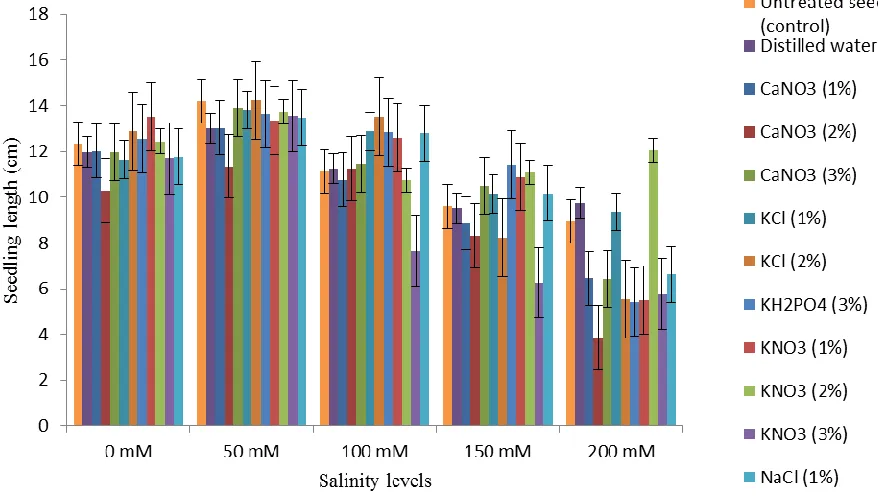
chickpea that corroborate our results of seed priming with NaCl (1%) at 0 mM (control) salinity level. Maximum seedling length at 50 and 100 mM salinity level was recorded in seeds primed with KCl 2% (Figure 6), while maximum root shoot ratio at highest salinity level (200 mM) was recorded in KNO3 (2%) primed seeds (Figure 7). Seeds
primed with KCl (1% and 2%) solution showed higher seedling vigour at 50 and 100 mM salinity level, while at 200 mM, seeds
primed in KNO3 (1%) showed maximum
Figure 5. Germination index of cabbage cv. Golden Acre seeds in response to various priming treatments at different salinity levels.
Figure 7. Root shoot ratio of cabbage cv. Golden Acre seeds in response to various priming treatments at different salinity levels.
Conclusion
In conclusion, higher salinity levels
suppressed seed germination and other parameters i.e. shoot length and root length, root shoot ratio and seedling vigor index. Almost all the treatments decreased the negative influence of salinity but to valuable extent. Highest salinity level had detrimental effect on all the parameters. Our results envisaged that all the seed priming treatments, especially KNO3 (1%), can be
improve seed germination both under normal and saline conditions.
Authors’ contributions
Conceived and designed the experiments: K
Ziaf & M Amjad, Performed the
experiments: MM Rehman, A Batool, A Muhammad & J Latif, Analyzed the data: MM Rehman & K Ziaf, Contributed reagents/ materials/ analysis tools: M Amjad, R Ahmad & Q Zaman, Wrote the paper: MM Rehman, K Ziaf & A Batool. References
1.Tester M & Davenport R (2003). Na+ tolerance and Na+ transport in higher plants. Ann Bot 91: 503-507.
2. Munns R, Hare RA, James RA & Rebetzke GJ (1999). Genetic variation for improving the salt tolerance of durum wheat. Aust J Agric Res 51: 69-74.
3. Tavili A & Biniaz M (2009). Different salt effects on the germination of
Hordeum vulgare and Hordeum
bulbosum. Pak J Nutr 8: 63-68.
4.Afzal I, Basra SMA, Ahmad N & Farooq M (2005). Optimization of hormonal priming techniques for alleviation of salinity stress in wheat (Triticum
aestivum L.). Caderno de Pesquisa
Series Biol 17: 95-109.
5.Kaur S, Gupta AK & Kaur N (2005). Seed priming increases crop yield possibly by modulating enzymes of sucrose metabolism in chickpea. J Agron Crop Sci 19: 81-87.
6.Sarlikioti V, Driever SM & Marcelis LFM
(2010). Photochemical reflectance
index as mean of monitoring early water stress. Ann Appl Biol 157: 81-89. 7. Almansouri M, Kinet JM & Lutts S
(2001). Effect of salt and osmotic stresses on germination in durum wheat
(Triticum durum Desf.). Plant Soil 231:
243-254.
8. Murillo-Amador B, Lopez-Aguilar R, Kaya C, Larrinaga-Mayoral J & Flores-Hernandez A (2002). Comparative effects of NaCl and polyethylene glycol
on germination, emergence and
seedling growth of cowpea. J Agron
Crop Sci 188: 235-247.
9. Amor NB, Hamed KB, Debez A, Grignon C & Abdelly C (2005). Physiological and antioxidant responses of perennial halophyte (Crithmum maritimum) to salinity. Plant Sci 4: 889-899.
10.El-Shihaby OA, Alla MNN, Younis ME
& Bastaway ZM (2002). Effect of kinetin on photosynthetic activity and carbohydrate content in waterlogged or sea-water treated Vigna sinensis and
Zea mays plants. Plant Biosyst 136:
227-290.
11.Parera CA & Cantliffe DJ (1994). Presowing seed priming. Hort Rev 6: 109-141.
12.Hardegree SP & Vactor SSV (2000). Germination and emergence of primed grass seeds under field and simulated field temperature regimes. Ann Bot 85: 379-390.
13.Gross J (l991). Pigments in Vegetables: Chlorophylls and Carotenoids. AVI
Book, Van, Nostrand Reinold
Publishers, New York.
14.FAO (2014a). Crop country data.
(Available online with updates at http://www.fao.org/faostat/en/#data/QC ).
15.FAO (2014b). Crop country data.
http://www.fao.org/faostat/en/#data/QC ).
16.Steel RGD, Torrie JH & Dickey D (I997). Principles and Procedures of Statistics. A Biometrical Approach. 3rd
Ed. McGraw Hill Book Co, New York.
17.Shehzad M, Ayub M, Ahmad AUH & Yaseen M (2012). Influence of priming techniques on emergence and seedling growth of forage sorghum (Sorghum
bicolor L). J Anim Plant Sci 22:
154-158.
18.Selvarani K & Umarani R (2011). Evaluation of seed priming methods to improve seed vigour of onion (Allium cepa cv. Aggregatum) and carrot
(Daucus carota). J Agric Technol 7:
857-867.
19.Varier A, Vari AK & Dadlani M (2010). The cellular basis of seed priming. Curr Sci 99: 450-456.
20.Nerson H & Govers A (1986). Salt priming of muskmelon seeds for low temperature germination. Sci Hortic 28: 8-91.
21.Thakur A, Thakur PS & Bhardwaj J
(1998). Influence of seed
osmoconditioning on germination
potential and seedling performance of bell pepper. Seed Res 25: 25-30.
22.Ahmadvand G, Soleimani F, Saadatian B & Pouya M (2012). Effect of seed priming with potassium nitrate on germination and emergence traits of two soybean cultivars under salinity stress conditions. American-Eurasian J
Agric Environ Sci 12: 769-774.
23.Ali E & Kamel SG (2009). Effects of seed priming on growth and yield of chickpea under a saline soil. Recent Res