Asian Journal of Pharmaceutical Research and Development
(An International Peer-Reviewed Journal of Pharmaceutical Research and Development)
www.ajprd.com
ISSN 2320-4850
Research Article
REVIEW: NON-INVASIVE THERAPY FOR DIABETES
MELLITUS USING SOLID LIPID NANOPARTICLE.
S. S. KAMBLE*, M. S. GAMBHIRE, K. N. GUJAR,M.H. AFSHINFAR
Department of Pharmaceutics, Sinhgad College of Pharmacy, Pune-41
Received: May 2015 Revised and Accepted: June 2015
ABSTRACT:
Oral delivery of Insulin as a non-invasive therapy for Diabetes Mellitus is still a challenge for the drug delivery technology, as it is degraded due to the presence of enzymes in the acidic environment of stomach and also its absorption through the gastrointestinal mucosa is doubtful.Advancements in nanotechnology have brought the scientist ever closer to this goal.The current review focuses on the various barriers existing in the route of oral insulin delivery and the strategies undertaken so far to overcome those by nanoparticle as potential vehicles of insulin. The oncoming years shall be interesting in the form of more oral insulin preparations actually becoming available and affordable to those thousands who are awaiting a relief from the stress and distress of daily insulin injections.
Keywords: Diabetes,GI tract, Insulin, Nanoparticle, Oral delivery.
INTRODUCTION:
ecent advances in the field of
nanotechnology have started
revolutions in the sciences. It involves the study of the control of matter on an atomic and molecular scale. The molecular level range is of ~1-100nm.Nanotechnology is expected to provide significant advances in novel drug discovery and drug delivery in the treatment of diseases like diabetes, cancer, etc. Conventional drug delivery systems have few limitations such as lack of target specificity, altered effects and diminished potency due to drug metabolism in the body, cytotoxicity of
certain anti-carcinogenic pharmacological
agents.
*Address for correspondence - S. S. Kamble *
Sinhgad College of Pharmacy, Pune-41 Email – [email protected] Telephone - +91-9970339785
These limitations are overcome by lipid nanoparticle due to their optimised physical,
chemical and biological properties.
Incorporation of drug into nanocarriers offers new prototype in drug delivery that could be used for secondary and tertiary level of targeting. There are various types of nanoarticles that are used for insulin delivery
such as polymeric biodegradable
nanoparticles: nanospheres and nanocapsules, ceramic nanoparticles, polymeric micelles, dendrimers, liposomes [1, 2].
Here we would like to focus on potential of solid lipid nanoparticle in oral insulin delivery.In 1990s,the first generation of lipid nanoparticles, called Solid Lipid Nanoparticles (SLN) were developed by Prof. Rainer H. Muller,Dr.Jorg-Stefan Lucks and Prof. Dr. Maria Gasco [3].In SLN, the oily portion of the emulsion was replaced by a solid lipid or a blend of solid lipids, thus making the lipid matrix of the SLN which is solid at room as well as body temperature [4].
DIABETES, TYPES AND ITS
ETIOLOGY:
Diabetes is a condition that occurs when the pancreas does notproduce enough insulin or when the body cannot effectively usethe insulin it produces leading to increase in blood
glucose level(hyperglycemia)[5].Diabetes
mellitus ischaracterised by excessive weight loss, increased urge for urination (polyuria), increased thirst(polydipsia) and an excessive desire to eat (polyphagia),altered metabolism of lipids, carbohydrates and proteins. Other related complications are conditions like atherosclerosis leading to heart failure, stroke,
kidney failure, blindness, lower limb
amputation, etc[1, 5, 6].
Diabetes mellitus has been classified as Type 1 or insulin dependent diabetes, Type 2 or non-insulin dependent diabetes and gestational diabetes. In Type 1 diabetes there is very little or no production of insulin due to loss of insulin producing beta cells of islets of Langerhans in the pancreas. This beta cell loss is caused by T-cell mediated autoimmune attack. Type 1 diabetes in children is called as juvenile diabetes. A person with Type 1 diabetes requires daily injections of insulin for survival. Type 2 diabetes is caused due to insulin resistance or reduced insulin sensitivity with reduced insulin secretion. This type of diabetes occurs in majority of diabetic population.In a limited population with type 2 diabetes , their condition can be manage with lifestyle control but for majority oral drugs are often required and less frequently insulin to achieve good metabolic control. Gestational diabetes mellitus occurs in women during pregnancy exhibit high blood glucose level. No specific cause has been identified but it is believed that hormones produced during pregnancy reduce a woman’s sensitivity to insulin.
INSULIN:
In 1922 Insulin was first isolated from pancreas by Banting and Best which changed the life of diabetic patients. Insulin is a protein hormone secreted by the β -cells of the islets of Langerhans in the pancreas. It is secreted in response to elevated blood glucose and amino acid levels, and promotes the efficient storage
and utilization of these fuel molecules by controlling the transport of metabolites and ions across the cell membrane. Insulin is a 51amino acids arranged into two polypeptide chains - the A and B chains - which are connected by two interchain disulphide bridges. Insulin has an isoelectric point (pI) of 5.3 and acharge of -2 to -6 in the pH range 7-11.At the lowconcentrations found in the blood stream (< 10-3 μM), insulin exists as a monomer, which isits biologically active form. Following biosynthesis, insulin is stored as crystalline zincboundhexamers in vesicles within the pancreatic β-cells from which secretion occurs inresponse to elevated blood glucose levels.
WHY ORAL INSULIN...???
In conventional delivery systems insulin is introduced by the parenteral route due to their instability and restricted permeability. Two or three injections are required for better control of diabetes and to reduce long term complications of hyperglycemia which
are retinopathy, neuropathy, and
nephropathy. Daily subcutaneous injections are a tedious treatment for the patients with insulin dependent diabetes. It also leads to
problems like patient noncompliance,
distress, extravasation of drug or blood, catheter infection and thrombosis.While the oral insulin delivery is convenient possess advantages such as easy to administer, have a lower index of intrusion, relieve the pain and distress associated with injections, high patient compliance, reduced risk of cross- infection and needle stick injuries [8, 9, 10].
Therapeutic insulin and blood
glucoseprofiles due to injected insulin differ from physiological profiles, which include
basal andglucose-responsive insulin
secretion. Subcutaneous (S.C.) injections of
identical insulindoses may lead to
considerable intra- and inter-individual differences in the current metaboliccontrol of patients with diabetes mellitus. This well-known variability of the metabolic effect ofinsulin hampers practical insulin therapy considerably [6].
phase release of insulin, early onset of action, earlier peak, and a shorter duration of action compared with subcutaneous insulin [8, 11].
Oral insulin is advantageous because it is delivered directly to the liver, which is its primary site of action, via the portal circulation, a mechanism very similar to endogenous insulin; subcutaneous insulin treatment however does not replicate the normal dynamics of endogenous insulin release, resulting in a failure to achieve a lasting glycemic control in patients [5, 6, 8,12].
Since immunogenicity has become a major issue for most biotechnology products, another advantage of oral insulin is that the gastrointestinal tract is immune tolerant
compared to other routes of drug
administration. Immunogenicity decreases in
the following order: (inhalation >
subcutaneous > intramuscular > intravenous > oral)[8].
To develop safe, nontoxic, stable, bioactive oral insulin delivery greater effort of scientists is needed. Many barriers must be explored to develop such systems.
OBSTACLES TO ORAL DELIVERY: [5,11,12,13]
The major obstacle for oral protein and peptide delivery is the highly restrictive nature of GI tract. Orally administered drug should be able to withstand the chemical and enzymatic conditions of GI tract and should be able to cross the mucus layering the enterocytes
before diffusing through the intestinal
epithelium.
Extreme pH conditions and Enzymatic barrier:[11, 12, 13]
GI pH conditions range from the acidic gastric environment (pH 1.2-3) to the slightly basic intestinal environment (pH 6.5-8). Such harsh
condition leads to degradation of drug like insulin which would lose its activity due to pH induced oxidation, hydrolysis, or deamidation.
Furthermore insulin undergo enzymatic
degradation by pepsin and proteolytic enzymes present in the GI lumen such as trypsin, chymotrypsin, elastase, carboxypeptidase as well as those associated with enterocytes
(membrane bound aminopeptidases and
cytosolic proteases such as insulin degrading enzyme.
Mucus layer:[13]
In order to absorb through the epithelial layer drug molecules in the intestine must cross the GI mucus barrier (Figure 1). Mucus is a complex hydrogel made up of proteins (mainly mucins), carbohydrates, lipids and salts, as well as other components (e.g. antibodies, cellular debris, etc.). This semi permeable mucus layer obstructs the diffusion of protein molecules from approaching the epithelial cells. This diffusion barrier is due to the molecules in mucus forming an obstructing mesh, the constant turnover of mucus in the GI tract, and the electrostatic repulsion between the negatively chargedmucus layer and anionic protein molecules.
Intestinal epithelium:[12, 13
Another major barrier to absorption of
hydrophilic drug like insulin is that they cannot diffuse across the epithelial cells
through lipid bilayer cell membranes to the blood stream. Passive diffusion via the transcellular route is limited to smalllipophilic drugs (molecular weight under 700 Da). Most proteindrugs exceed 3000 Da and hence, are difficult to be absorbed .Intercellular tight
junctions (TJs) prevent most
paracellulartransport of drugs, with the
exception of hydrophilic drug
moleculesweighing less than 200 Da. It is
virtually impossible for proteins to
Figure 1: Major barriers to oral delivery of peptide- and protein-based drugs.
Dosage form stability:[6, 12]
Protein may undergo physical and chemical degradation during formulation development. The therapeutic and pharmacological activity of protein depends on its three dimensional structure. Physical and chemical degradation leads to modification of native structure, bond cleavage can occur hence novel product may form. So if a protein needs to survive transit through stomach and intestine, knowledge and assessment of stability parameter during formulation processing is most important.
APPROACHES FOR ENHANCING THE ORAL BIOAVAILABILITY:
Absorption enhancers: [5, 6, 12, 14]
The absorption of peptides and proteins in the gastrointestinaltractcan be increased by action of absorption enhancers on transcellular and paracellular pathways. Even if the intact molecule of insulin reaches the intestine, due to the large molecular size and relatively impermeability of the mucosal membrane it might not absorbed in sufficient concentration to produce the required biological effect. One possible approach to overcome this drawback is touse penetration enhancers. A number of absorption enhancers are available that causes thesetight junctions to open transiently allowing water-soluble proteins to pass. Absorption may beenhanced when the product is formulated with acceptable safe excipients.
These substances include bile salts, surfactants, trisodium citrates, chelating agents like EDTA,labrasol .Insulin transport across
Caco-2 cells was shown to be dramatically
increased by conjugation of insulin with TAT, a cell penetrating peptide (CPP).Surfactants and fattyacids affect the transcellular pathway by altering membrane lipid organization and thus increasethe absorption of drugs consumed orally. Bile salt micelles, EDTA and trisodium citrate havebeen reported to increase the absorption of insulin. Cyclodextrins have also been used to enhancethe absorption of insulin from lower jejunal and upper ileal segments of rat small intestine.
Enzyme inhibitors:[5, 6, 12]
Insulin is degraded in the GIT by pepsin and other proteolytic enzymes. Enzyme inhibitors slowthe rate of degradation of insulin which increases the amount of insulin available for absorption.Administration of insulin via microspheres, together with the protease inhibitors likeaprotinin, trypsin inhibitors,
chymotrypsin inhibitors, Bowman –brik
trypsin inhibitorscaused greater hypoglycaemic effect than microspheres without the same.
Mucoadhesive polymeric system: [6, 14]
The term ‘mucoadhesion’ refers to the adhesion betweenpolymeric carriers and the mucosa and is exhibited by certainpolymers, which become adhesive upon hydration. Thus,the goals of mucoadhesive drug delivery systems are to extend theresidence time at the
site of drug absorption, to intensify
contactwith the mucus to increase the drug concentration gradient, toensure immediate absorption without dilution or degradation inthe luminal fluid, and to localize the drug delivery system to acertain site . Delivery systems containing mucoadhesivepolymers provide intimate contact with the mucosa, therebyreducing drug degradation between the delivery system and theabsorbing membrane.
They are controlled release systems
thatprovide the simultaneous release of both
drug and inhibitor, andallow the
immobilization of enzyme inhibitors in the deliverysystems.
Particulate carrier delivery system:[5, 14]
Most oral delivery strategies for insulin based on particulate carriers have been developed to circumvent the barriers to oral peptide delivery. They efficiently protect protein and peptide drugs against enzymatic degradation in the harsh environment of the GIT, provide high transfer of drugs across the epithelial mucosa, control the release rate, and target drug delivery to specific intestinal sites.
Liposomes: [6, 12]
These are tiny spheres formed when phospholipids are combined with water.Encapsulating insulin in liposomes results in enhanced oral absorption of insulin.
Microspheres:[6, 12]
Insulin can be encapsulated in a microcapsule or dispersed in a polymer matrix. Microspheres are prepared by emulsification using natural (gelatin or albumin) or synthetic polymers (polylactic or polyglycolic acid)
used microspheres for insulin delivery in rats. Their study showed that L-microspheres carrying insulin and aprotinin enhanced insulin absorption. Insulin-loaded alginate microspheres complexed with cyclodextrins have an absorption enhancing effect leading to increase in bioavailability studied the oral co-administration of insulin enteric microspheres with sodium N-(8-2-hydroxybenzoyl amino) caprylate (SNAC). In a recent study, Eudragit S100 microspheres on oral administration protected insulin from proteolytic degradation in the GIT and produced hypoglycemic effect. Microspheres encapsulated with chitosan phthalate polymer protect the insulin from enzymatic degradation with an insulin-loading capacity of 62% and may be a potential carrier for oral insulin delivery.
Nanoparticles:[6, 12]
Nanoparticles have been extensively studied as carriers for oral insulin delivery. The nanoparticles protect insulin against in vitro enzymatic degradation. Synthetic polymers used for nanoparticle formulation include polyalklylcyanoacrylate ,polymethacrylic acid polylactic-co-glycolic acids (PLGA) . Natural polymers used include chitosan ,alginate, gelatin, albumin and lectin. Chitosan has been the proven to have good permeation enhancing abilities via the paracellular pathway.
Chemical modification:[5, 6]
Another approach to enhance the bioavailability of insulin is to modify the chemical structure and thus increasing its stability. Alteration of the physicochemical characteristics leads to enhanced stability and resistance to intestinal degradation of oral insulin.
Targeted delivery system:[14]
The desire to deliver protein and peptide
biopharmaceuticals conveniently and
peptides to specific sites of action has been used to lower the total dose delivered and to concentrate the therapeutic dose at specific sites of pharmacological action.
ROLE OF SOLID LIPID
NANOPARICLES IN ORAL INSULIN THERAPY:[13]
Efficient transport along GI tract:
SLN formulations can potentially improve the absorption of oral insulin in the GI tract due to:
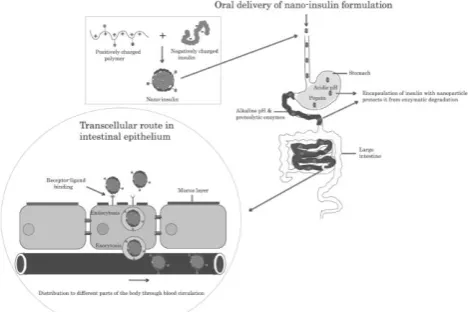
Protection against pH-related and enzymatic degradation in the GI tract by encapsulation of insulin
Within nanoparticle (NP) carriers (Fig 2), Better drug delivery close to absorption sites due to increased residence times near intestinal epithelium by mucoadhesive coating of NPs and gradual release of insulin close to the epithelial layer (Fig 2) and,
Improved transport through the GI mucus layer by way of mucuspenetrating particles or coatings.
Mucoadhesion of polymeric particles may result from one ormore of the following:
Hydrogen-bonding, Electrostatic forces, Hydrophobic interactions, Van der Waals forces, or
Entanglement of polymer chains with mucins.
Free drug molecules or drug-loaded NPs may be absorbed by theintestinal epithelium. Stable NPs made from polymers insoluble inwater (e.g. PLGA) are more likely to be absorbed intact. On the otherhand, NPs composed of less stable polyelectrolyte complexes (e.g. CS)will undergo partial dissociation without
being absorbed intact Therefore, the
bioavailability, efficacy and specificity of drugs canbe improved with the use of NPs. However, it is vital that NPs donot cause toxicity, immune reactions, inflammation, thrombosis, andare biodegradable.
Facilitated transcellular transport:
Depending on the constituent polymers, NPs can be taken up by theintestinal epithelial cells
via different mechanisms. Transcellular
transport of NPs is mainlyby
energy-dependent endocyticprocesses. These
encompassphagocytosis (largely by M cells of
Peyer’s patches), macropinocytosisand
micropinocytosis. Micropinocytosis is further
divided intoclathrin-mediated,
caveolin-mediated, as well as clathrin- and
caveolinindependentendocytosis. Among these
mechanisms, phagocytosis
andclathrin-mediated endocytosis are receptor-andclathrin-mediated.
Non-specific cellular uptake:
NP uptake by cells might involvenon-specific processes, which depend on particle diameter,
surface charge and mucoadhesivity.
Substances exhibiting mucoadhesiveproperties include chitosan (CS), poly (acrylic acid) (PAA), thiomersand their derivatives, all of
which are hydrophilic. Adhesionand
absorption of particles by intestinal epithelial cells are alsoincreased when coated with
polyvinyl alcohol (PVA) and vitamin
Esuccinylated polyethylene glycol 1000
(Vitamin E TGSP).
Specific cellular uptake:
Figure 2: An ideal approach based on a nano-insulin formulation for overcoming barriers in the oral route.
Enhanced paracellular transport:
Molecules larger than 1 nmare blocked by the intercellular tight junctions (TJs); hence, these junctional complexes must be reversibly opened by polymers and calcium chelators to allow transport between adjacent epithelial cells. These polymers include CS (cationic) and PAA (anionic), together with their derivatives, which induce a cascade of
reactions that eventually resultin TJ
disassembly. On the other hand, calcium chelators disrupt TJs via activation of protein kinase C.
POTENTIAL OF SOLID LIPID
NANOPARTICLE IN ORAL INSULIN DELIVERY:
The oral drug delivery has taken a new dimension with the increasing application of lipid as a carrier for the delivery of poorly water soluble, lipophilic drugs.Oral delivery of drugs incorporated in SLN has gained considerable interest since last two decades. As they are derived from physiologically compatible lipids, SLN represent a safe and effective alternative in comparison to the conventional polymeric nanoparticles[16]. Sarmento et al.[17] prepared insulin-loaded
cetylpalmitate solid lipid nanoparticles
anddemonstrated their potential to deliver insulin orally. The drug loading capacity in solidlipid nanoparticles was improved by enhancing insulin liposolubility.
Insulin wassolubilized into mixed reverse micelles of sodium cholate and soybean
phosphatidylcholineand transformed into SLN using a novel reverse micelle-double emulsion technique. Stearicacid and palmatic acid were used as a biocompatible lipid matrix.Even if Insulin is a hydrophilic peptide, it can be incorporated with high efficiency (about 98%) nanoparticles showing good physical stability and sustained drug release behaviour [18]. Fonte p. [19] modified the surface of thenanoparticles by chitosan to enhance their penetration through GIT. Inaddition, chitosan was able to provide stealth properties to SLN, resulting in the absence ofphagocytosis. Pharmacological availability values of 5.1– 8.3% for SLN and 17.7% forchitosan-coated SLN were reported. Lectins are proteins that bind sugar reversibly andare involved in many cell recognition and adhesion processes. They have been extensivelyadopted to target both absorptive enterocytes and M cells. Wheat germ agglutinin binds(WGA) specifically to cell membranes and is taken up into cells by receptor-mediatedendocytosis.
Zhang et al.[20] utilized the advantages of WGA and formulated SLN modified with WGA to enhance the oral delivery of insulin. Insulin-loaded SLNs or WGAmodifiedSLNs were administered orally to rats and elicited relative pharmacologicalbioavailability values
of 4.46% and 6.08% and relative
bioavailability values of 4.99% and7.11%,
respectively, in comparison with the
successfully used for the development of nanomedicines. It was also investigated for the delivery of insulin.
In the work of Yang et al. [21] insulin wasencapsulated in PLGA nanoparticles. The
administration of insulin-loaded PLGA
nanoparticles for diabetes mellitus induced a rapid decrease in blood glucose levels for up to 24 h and increased insulin levels. The loading capacity was 78.35%. To facilitate loading efficiency, the lipophilicity of the insulin was increased by complexation with sodium lauryl sulphate or sodium oleate. Insulin encapsulation efficiency reached up to 90%[22, 23].
Polylactides (PLAs) have similar properties to PLGAs but they are more hydrophobic thanPLGAs and they degrade more slowly due to their crystallinity.
Cui et al. [24] reportedenhanced insulin entrapment efficiency (up to 90%) in PLA and
PLGA nanoparticles, whereinsulin was
complexed with phosphatidylcholine (SPC) to
improve its liposolubility. Anoral
bioavailability of 7.7% relative to
subcutaneous injection was obtained.Another interesting biodegradable polyester polymer is
poly-ɛ caprolactone (PCL).Compared with
PLGA and PLA. PCL is semi‐crystalline, has superior viscoelastic properties and possesses easy formability. PCL has the advantage of generating a less acidic environment during degradation as compared with PLGA-based polymers.
Damge et al.[25, 26] preparednanoparticles from a blend of a biodegradable polyester poly (ε-caprolactone) and apolycationic non-biodegradable acrylic polymer (Eudragit® RS). These nanoparticles wereinvestigated as a carrier for the oral administration of insulin and demonstrated prolongedhypoglycaemic effect of insulin for prolonged period in both
diabetic and normal rats. Relative
bioavailability of 13% was obtained.The bioadhesive character of the cationic acrylic component was identified as main contributor to the success of the carriers. The highly efficient interaction of these insulin-loaded carriers with the intestinal mucosa is shown in
Figure 3, in comparison to insulin administered
alone. The same authors have also shown, in another interesting study, that it is possible to modulate and improve the efficacy of nanocarriers by modifying the configuration of the encapsulated insulin molecule [25, 26].
Figure3. Fluorescence microscopy images of rat intestinal epithelium following intra-ileal administration.
(A)Fluorescein isothiocyanate-labeled insulin alone and (B) encapsulated into polymeric
nanoparticles [25].
CONCLUSION:
Among the approaches developed to overcome these restrictions of oral insulin delivery, the design of nanocarriers seems to be a particularly promising approach.There is no doubt that the advances in this field are significant however challenge for developing efficient oral insulin delivery system still remains. Although literature survey shows
enhanced insulin delivery via the oral route; however, thebioavailability in humans has not exceeded 10%. The absorption of insulin is the major obstacle. Therefore, more focus should be directed on studying the very small details of absorption. There are number of factors that should be considered in design of new nanocarriers:
Particle size distribution and thereby, the specific surface area of nanocarriers to
interact with the intestinalmucosa are the critical parameters. It is suggested that the upper size limit for this functional ability depends on the nanocarrier composition and shape;
The stability of the nanostructures in the biological fluids is another determinant factor as it affects size distribution after in
vivo administration as well as the
premature delivery and/or degradation of the associated active compound;
Surface chemical composition and, thus, the lipophilicity, fluidity and surface charge may influence the stability of the nanocarrier in the biological environment and also its ability to interact with and be transported across the barrier;
The internal chemical composition,
together with hydrophilicity, rigidity and porosity may influence the stability and delivery rate of the associated peptides;
The targeting or affinity of the
nanocarriers for specific apical membrane receptors may be critical for overcoming biological barriers.
FUTURE PERSPECTIVE:
Nanotechnology will largely contribute to the dream of oral insulin delivery.There is need to generate and integrate more knowledge for the proper design of oral nanocarriers. Thus the investigators should plan to search for safer, simpler methods using biologically acceptable polymers.
REFERENCES:
1. Subramani K .et al,Recent Trends in Diabetes Treatment Using Nanotechnology,Digest Journal of Nanomaterials and Biostructures 2012; 7:1:85 – 95.
2. Patidar A et al, A review on novel lipid based nanocarriers,International journal of pharmacy and pharmaceutical sciences 2010; 2:4: 30-35.
3. Schwarz C., Mehnert W., Lucks J., Solid lipid nanoparticles (SLN) for controlled drug delivery. I. Production, characterization and sterilization, J. Controlled Release 1994; 30: 83–96.
4. Muller R., Mader K., Gohla S., Solid lipid nanoparticles (SLN) for controlled drug delivery- a review of the state of the art, European Journal of Pharmaceutics and Biopharmaceutics 2000; 50: 161-177.
5. Rekha M. R. et al, Oral delivery of therapeutic protein/peptide for diabetes – Future perspectives,
International Journal of Pharmaceutics 2013;440: 48– 62.
6. Wadher K. et al, Oral Insulin Delivery: Facts,Developments and Challenges, Scholars Research Library , Der Pharmacia Lettre, 2009; 1: 2: 121-129.
7. Maroni A. et al, Oral colon delivery of insulin with the aid of functional adjuvants, Advanced Drug Delivery Reviews 2012; 64: 540–556.
8. Amani M. Elsayed et al, Oral Delivery of Insulin: Novel Approaches, Recent Advances in Novel Drug Carrier Systems, licensee InTech 2012; 281-314. 9. KalepuS.et al, Oral lipid-based drug delivery
systems – an overview, ActapharmaceuticaSinica B, 2013; 3: 6: 361-372.
10. Das S.et al, Recent Advances in Lipid Nanoparticle
Formulations with Solid Matrix for Oral Drug Delivery, American Association of Pharmaceutical Scientists,PharmSciTech 2011; 12: 1: 62-76.
11. Mutalik M. et al, long-awaited dream of oral insulin: where did we reach? , Asian Journal of Pharmaceutical and Clinical Research 2011; 4: 2: 15-20.
12. Balsubramanian J. et al, Nanotechnology based Oral Delivery of Insulin- A Retrospect, International Journal Of Pharmacy And Analytical Research 2013; 2: 4: 144- 150.
13. Ahmad et al., Oral Nano-Insulin Therapy: Current Progress on Nanoparticle-BasedDevices for Intestinal Epithelium-Targeted Insulin Delivery, Journal of Nanomedicine and Nanotechnology 2012; S4.
14. Khafagy El-Sayed et al, Current challenges in non-invasive insulin delivery systems:A comparative review, Advanced Drug Delivery Reviews 2007; 59: 1521–1546.
15. Kinesh V.P. et al, Novel approaches for oral delivery of Insulin and current status of oral insulin products, International journal of pharmaceutical sciences and nanotechnology 2010; 3: 3: 1057-1064.
16. Chakraborty S et al, Lipid – An emerging platform for oral delivery of drugs with poor bioavailability, European Journal of Pharmaceutics and Biopharmaceutics 2009; 73: 1–15.
17. Sarmento B. et al, Oral insulin delivery by means of solid lipidnanoparticles, International Journal of Nanomedicine 2007; 2: 4: 743–749.
18. Liu J, Gong T, Wang C, Zhong Z, Zhang Z. Solid lipid nanoparticles loaded with insulin by sodium cholatephosphatidylcholine-based mixed micelles: Preparation and characterization. International Journal of Pharmaceutics 2007; 340: 153–162. 19. Fonte P, Andrade F, Araujo F, Andrade C, Neves J,
Sarmento B. Chitosan-Coated Solid Lipid Nanoparticles for Insulin Delivery, Methods Enzymol, 2012; 508: 295-314.
20. Zhang N, Ping Q, Huang, Wenfang X. Lectin-modified solid lipid nanoparticles as carriers for oral administration of insulin. International Journal of Pharmaceutics 2006; 327: 153–159.
21. Yang J, Sun H, Song C. Preparation, characterization and in vivo evaluation of pHsensitive oral insulin-loaded poly(lactic-coglycolicacid) nanoparticles. Diabetes, Obesity and Metabolism 2012; 14: 358–364.
22. Shi K, Cui F, Yamamoto H, Kawashima Y. Optimized formulation of high payload PLGA nanoparticles containing insulin-lauryl sulphate complex, Drug Dev. Ind. Pharm. 2009; 35: 177– 184.
complex-loaded PLGA nanoparticles: formulation, characterization an in vivoevaluation, J. Microencapsul. 2010; 27: 471–478.
24. Cui F, Shi K, Zhang L, Tao A, Kawashima Y. Biodegradable nanoparticles loaded with insulin– phospholipid complex for oral delivery: Preparation, in vitro characterizationand in vivo evaluation. Journal of Controlled Release 2006; 114: 2: 242–250.
25. Damge C, Maincent P, Ubrich N. Oral delivery of insulin associated to polymeric nanoparticles in diabetic rats, Journal of Controlled Release 2007; 117: 163–170.