Generic One Round Group Key Exchange in the Standard Model
M. Choudary Gorantla1
, Colin Boyd1
, Juan Manuel Gonz´alez Nieto1
, and Mark Manulis2 1
Information Security Institute, Faculty of IT, Queensland University of Technology GPO Box 2434, Brisbane, QLD 4001, Australia.
Email: [email protected],{c.boyd,j.gonzaleznieto}@qut.edu.au 2
Cryptographic Protocols Group, Department of Computer Science TUDarmstadt & CASED, Germany.
Email: [email protected]
Abstract. Minimizing complexity of group key exchange (GKE) protocols is an important milestone towards their practical deployment. An interesting approach to achieve this goal is to simplify the design of GKE protocols by using generic building blocks. In this paper we investigate the possibility of founding GKE protocols based on a primitive calledmulti key encapsulation mechanism (mKEM)and describe advantages and limitations of this approach. In particular, we show how to design a one-round GKE protocol which satisfies the classical requirement of authenticated key exchange (AKE) security, yet without forward secrecy. As a result, we obtain the first one-round GKE protocol secure in the standard model. We also conduct our analysis using recent formal models that take into account both outsider and insider attacks as well as the notion of key compromise impersonation resilience (KCIR). In contrast to previous models we show how to model both outsider and insider KCIR within the definition of mutual authentication. Our analysis additionally implies that the insider security compiler by Katz and Shin from ACM CCS 2005 can be used to achieve more than what is shown in the original work, namely both outsider and insider KCIR.
Keywords. Group Key Exchange, Key Encapsulation Mechanism, Key Compromise Impersonation
1 Introduction
Recently, AKE- and MA-security notions have been further extended by Gorantla et al. [20] considering outsider and insider key compromise impersonation resilience (KCIR). Informally, a GKE protocol with KCIR ensures that an honest party cannot be impersonated by an adversary which has access to the private keys of other parties. The notion of outsider KCIR was modelled within AKE-security and insider KCIR was embedded into MA-security [20]. However, these notions defy the natural expectation that insider KCIR should imply outsider KCIR. It also remains unclear whether the KS-compiler can be used to achieve the additional insider KCIR or not.
Key Encapsulation Mechanisms. Cramer and Shoup [16] formalised the concept of hybrid encryption which securely merges public and symmetric encryption techniques to encrypt mes-sages. In short, the public key part calledkey encapsulation mechanism (KEM)is used to generate and encrypt a random session key, while data encryption mechanism (DEM) based on symmetric techniques is used to encrypt the actual message using that session key. The KEM primitive has been further extended to multi KEM (mKEM) by Smart [24]. mKEM is useful in scenarios where a single message should be encrypted for multiple recipients.
It is evident from their properties, especially by generating a random session key, that KEMs can also be utilized for the establishment of secure shared keys. In fact, the question of constructing key establishment protocols from KEMs has been investigated in the two-party setting: Gorantla et al. [21] provided generic constructions in both the directions based on signcryption KEMs, whereas Boyd et al. [6] presented a generic one-round protocol using plain encryption KEMs. The natural question is, thus, whether mKEMs in turn can be utilized for the design of GKE protocols? The non-triviality of the problem, in contrast to what one may think after having [21, 6], is the consideration of insider attacks which are not present in the two party case.
1.1 Our Contributions
In this paper, we extend the technique of Boyd et al. [6] to the group setting and present a generic one-round GKE protocol using mKEM as a building block which we prove AKE-secure in the standard model, yet without forward secrecy. The main reason for lack of forward secrecy is that mKEMs known today are not forward secure. Since forward secrecy is a desirable goal for some applications we also discuss the modified two-round version of the protocol based on one-time mKEM and digital signatures.
We enrich KCIR notions for GKE by including a definition of outsider KCIR into MA-security. In this way we achieve the natural implication between insider and outsider KCIR. We demonstrate the usefulness of the new notion by showing that the generic transformation of Bresson et al. [12] to achieve outsider MA-security is not sufficient for outsider KCIR.
Our new definition also highlights the separation between AKE-security and KCIR. As observed by Boyd and Mathuria [8,§5.5, p.166] two-party protocols can always achieve KCIR if each party encrypts its ephemeral pubic key with the partner’s long-term public key. This holds also for the generic two-party protocol of Boyd et al.[6]. However, when we move to the group setting this observation does not hold any more with respect to AKE-security. As an example, we show that our one-round GKE protocol does not achieve AKE-security with outsider KCIR. Nevertheless, we show that our protocol still achieves MA-security with outsider KCIR. Thanks to the implication from insider KCIR to outsider KCIR we can show this by proving that our protocol when compiled with the KS-compiler achieves MA-security with insider KCIR.
Nieto [7] it would result in a GKE protocol secure under both AKE-security and MA-security with KCIR. However, we observe that the KS-compiler does not necessarily guarantee AKE-security with outsider KCIR.
1.2 Related Work
Boyd [4] presented three classes of one round key exchange protocols, which may be seen as a different paradigm to the classical Diffie-Hellman key exchange. In Class 1, the parties exchange random nonces in clear as their contributions towards the session key. A long-term shared symmetric key is then used to derive the session key. Constructing concrete GKE protocols in this class is not very interesting as the assumption that all the parties in the group initially share a common symmetric key seems unrealistic [5]. In Class 2, only one party uses confidential and authentication channels to send its nonce while all other parties send their nonces in clear. Concrete protocols in the Class 2 can be constructed using public key encryption and signature schemes. The protocol of Boyd and Gonz´alez Nieto [7] falls into this class. In Class 3, all the parties use confidential channels to send their nonces. Our proposed protocol falls into this class. A major drawback of protocols in all the three classes is that they cannot provide forward secrecy. However, a distinctive feature of Class 3 protocols is that they can be proven secure under the AKE-security notion without employing public key signatures. Hence, Class 3 protocols seem suitable to construct efficient deniable GKE protocols [3]. We do not formally explore this possibility in the current work.
Bohli et al. [2] defined contributiveness as another desired security notion for GKE protocols. This notion demands that a proper subset of insiders should not predetermine the resulting session key. Bresson and Manulis [14] strengthened this notion by considering strong corruptions where the ephemeral session state of an instance might also be revealed in addition to the long-term private key of the party. They also proposed compilers to achieve contributiveness in both weak and strong corruption models [13].
1.3 Organization
Section 2 reviews existing notions of AKE-security and MA-security with insider KCIR and also presents a new notion of MA-security with outsider KCIR. In Section 3, we describe our one-round GKE protocol based on mKEM and prove it AKE-secure without forward secrecy. Additionally, we mention how to extend this protocol with an additional round and obtain forward secrecy. In Section 4, we prove that the compiler by Katz and Shin [22] if executed with our protocol provides MA-security with outsider and insider KCIR. Section 5 gives security and efficiency comparison of existing GKE protocols. Appendix A describes the background concepts that serve as building blocks in our paper.
2 Security Model for GKE Protocols
In this section, we review existing notions of AKE-security and MA-security considered for GKE protocols. We also present our new notion of MA-security with outsider KCIR.
parties in U. Each instance of π within a party is defined as a session and each party may have multiple such sessions running concurrently.
Let πi
U be the i-th run of the protocol π at party U ∈ U. Each protocol instance at a party is identified by a unique session ID. We assume that the session ID is derived during the run of the protocol. The session ID of an instance πUi is denoted by sidiU. We assume that each party knows who the other participants are for each protocol instance. The partner ID pidi
U of an instance πiU, is a set of identities of the parties with whom πUi wishes to establish a common group key. Note thatpidiU includes the identity ofU itself.
An instance πi
U enters an accepted state when it computes a session key skUi . Note that an instance may terminate without ever entering into an accepted state. The information of whether an instance has terminated with acceptance or without acceptance is assumed to be public. Two instancesπi
U andπ j
U′ at two different partiesU andU′ respectively are consideredpartnered iff (1) both the instances have accepted, (2) sidi
U=sid j
U′ and (3)pidiU=pid j U′.
The communication network is assumed to be fully controlled by an adversary A, which sched-ules and mediates the sessions among all the parties. A is allowed to insert, delete or modify the protocol messages. If the adversary honestly forwards the protocol messages among all the partic-ipants, then all the instances are partnered and output identical session keys. Such a protocol is called a correct GKE protocol. In addition to controlling the message transmission,Ais allowed to ask the following queries.
– Execute(pid) prompts a complete execution of the protocol among the parties in pid with a unique session ID sid.A is given all the protocol messages, modelling passive attacks.
– Send(πUi ,m) sends a message m to the instance πUi . If the message is pid, the instance πiU is initiated with partner ID pid. The response ofπi
U to any Send query is returned toA. – RevealKey(πi
U) If πiU has accepted,Ais given the session key skiU established at πUi .
– Corrupt(Uj) The long-term secret keyskj of Uj is returned to A. Note that this query returns neither the session key (if computed) nor any session specific internal state.
– RevealState(πi
U) The ephemeral internal state of πUi is returned to A. We assume that the internal state is erased once πUi has accepted.
– Test(πi
U) A random bit b is secretly chosen. If b = 1, A is given κ1 =skiU established at πiU.
Otherwise, a random value κ0 chosen from the session key probability distribution is given.
Note that a Test query is allowed only once that too on an accepted instance.
Corrupted Parties, Corrupted Instances and Insiders. We call apartyU corrupted if it has been issued a Corrupt query, while a protocol instanceπiU is called corrupted if a RevealState(πUi ) query has been asked. Note that there exist uncorrupted protocol instances at corrupted parties when the session specific ephemeral secrets are not revealed. A party is called an insider in a particular protocol run if both the party and the protocol instance are corrupted or if the adversary issues aCorrupt query to the party and then impersonates it i.e. when the adversary issues a Send query on behalf of πUi with a message m not previously output by πUi .
2.1 AKE-Security
is a slightly revised notion from Katz and Yung [23], considering RevealState queries. This notion does not capture either forward secrecy or KCIR. Hence, the adversary is not allowed to corrupt any party associated with the test session. The second notion considers forward secrecy and may be seen as a stronger notion than that of Bresson and Manulis [14], where the corruption of a partyU′ is allowed after the session πUi has accepted. This differs from the notion of Bresson and Manulis, where the adversary is not allowed to issue a corrupt query until πi
U and all its partners have ac-cepted. The second notion may also be seen as a revised notion from Katz and Shin [22] considering RevealState queries. The third notion, which was recently defined by Gorantla et al. [20], considers both forward secrecy and outsider KCIR.
The basic notion of freshness (not considering forward secrecy or KCIR) [23] An instanceπi
U isfreshif the following conditions hold:
1. the instanceπUi or any of its partners has not been asked aRevealKeyafter their acceptance
2. the instanceπUi or any of its partners has not been asked aRevealStatebefore their acceptance
3. there has not been aCorrupt(U′)query for anyU′∈pidi
U(includingU′=U) The notion of freshness with forward secrecy [22, 14] An instanceπi
U isfs-freshif the following conditions hold:
1. the instanceπUi or any of its partners has not been asked aRevealKeyafter their acceptance
2. the instanceπi
U or any of its partners has not been asked aRevealStatebefore their acceptance
3. there has not been aCorrupt(U′)query for anyU′∈pidi
U(includingU′=U) beforeπ
i
U has accepted
The notion of freshness with outsider KCIR and forward secrecy [20] An instanceπUi iskcir-fs-freshif the following conditions hold:
1. the instanceπUi or any of its partners has not been asked aRevealKeyafter their acceptance
2. the instanceπi
U or any of its partners has not been asked aRevealStatebefore their acceptance
3. IfπU′j ∈pidi
Uand AaskedCorrupt(U′), then any message thatAsends to π i
U on behalf ofπ j
U′ must come from
πUj′ intended toπ i U.
Fig. 1.Notions of Freshness
Definition 1 (AKE-Security). An adversaryAAKE
against the AKE-security notion is allowed to make Execute, Send, RevealState, RevealKey and Corrupt queries in Stage 1. AAKE
makes a Test query to an instanceπi
U at the end of Stage 1 and is given a challenge keyκb as described earlier. It can continue asking queries in Stage 2. Finally,AAKE
outputs a bitb′ and wins the AKE security game if (1)b′ =band(2) the instanceπUi that was askedTestquery remainedfresh(orfs-fresh/ kcir-fs-freshcorrespondingly) till the end ofAAKE
’s execution. LetSuccAAKE be the success probability
of AAKE
in winning the AKE security game. The advantage of AAKE
in winning this game is AdvAAKE =|2·Pr[SuccAAKE]−1|. A protocol is called AKE-secure if AdvAAKE is negligible in the
security parameterk for any polynomial time AAKE
.
corruptions are allowed, it is necessary for a protocol realizing this notion to have at least (partial) forward secrecy when n−1 parties are corrupted or (full) forward secrecy. However, as evident by Gorantla et al.’s KCI attack on Al-Riyami and Paterson’s protocol [1], having forward secrecy alone is not sufficient for a GKE protocol to have AKE-security with outsider KCIR. We leave it an open problem to define AKE-security notion with outsider KCIR and partial forward secrecy and to construct a GKE protocol realizing it.
2.2 MA-Security
We present two notions of MA-security with KCIR, one in the presence of only outsiders and another in the presence of insiders. The notion of MA-security with KCIR in the presence of insiders was defined by Gorantla et al. [20], while the notion of MA-security with outsider KCIR is new. Definition 2 (MA-Security with Outsider KCIR). An adversary AMA
against the MA-security of a correct GKE protocol π is allowed to ask Execute, Send, RevealState, RevealKey and Corrupt queries. AMA
violates the MA-security of the GKE protocol if at some point during the protocol run, there exists an uncorrupted instanceπiU that has accepted with a keyskiU and another party U′ ∈pidi
U that is uncorrupted at the timeπiU accepts such that there are no insiders inpidiU and 1. there exists no instance πjU′ with (pid
j U′,sid
j
U′) = (pidiU,sidiU) or 2. there exists an instanceπjU′with (pid
j U′,sid
j
U′) = (pid i
U,sidiU) that has accepted withsk j U′ 6=sk
i U. The above definition implies that AMA
must be passive for any corrupted party inpidi
U. Note that in a protocol execution with nparties, the above definition also implies that AMA
is allowed to corrupt up to n−1 parties.
LetSuccAMA be the success probability ofAMA in winning the above security game. A protocol
is said to provide MA-security with outsider KCIR ifSuccAMA is negligible in the security parameter
kfor any polynomial time AMA.
Definition 3 (MA-Security with Insider KCIR). An adversary AMA against the MA-security of a correct GKE protocolπis allowed to askExecute, Send, RevealState, RevealKeyandCorruptqueries.
AMA
violates the MA-security of the GKE protocol if at some point during the protocol run, there exists an uncorrupted instanceπiU (although the partyU may be corrupted) that has accepted with a keyski
U and another party U′ ∈pidiU that is uncorrupted at the timeπiU accepts such that 1. there is no instance πjU′ with (pid
j U′,sid
j
U′) = (pidiU,sidiU)or 2. there is an instance πjU′ with (pid
j U′,sid
j
U′) = (pidiU,sidiU) that has accepted withsk j
U′ 6=skiU. Note that this notion implies that there can be up to n−2 insiders (i.e. exceptU and U′). Let SuccAMA be the success probability of AMA in winning the above security game. A protocol is said
to provide MA-security with insider KCIR ifSuccAMA is negligible in the security parameterkfor
any polynomial time AMA
.
3 One Round GKE protocol from mKEM
Computation
EachUi executes an mKEM with public keys{pkj|1≤j≤n;j6=i}as input and obtains the symmetric key
and encapsulation pair (Ki, Ci)
(Ki, Ci)←Encap({pkj|1≤j≤n;j6=i})
Broadcast
EachUi broadcasts the computed encapsulationCialong with its identity.
Ui→ U \ {Ui}: Ci, Ui
Key Computation
1. EachUi executes the decapsulation algorithm using its private keyskiand on each of the incoming
encap-sulationsCjand obtains the symmetric keysKj, where 1≤j≤n,j6=i.
Kj←Decap(ski, Cj) for each 1≤j≤n, j6=i
2. Each Ui then computes the session ID as the concatenation of all the outgoing and incoming messages
exchanged i.e.sid= (C1k · · · kCnkU), whereU is the set of identities of all thenusers.
3. The session keyκis then computed as
κ =fK1(sid)⊕fK2(sid)⊕ · · · ⊕fKn(sid)
wheref is a pseudo random function.
Fig. 2.A generic GKE protocol from mKEM
to all the parties at once and then apply a DEM with the session key to encrypt the actual message. Smart also defined the notion of indistinguishability under chosen ciphertext attacks (IND-CCA) for mKEM. The definition and security model for mKEM have been reviewed in Appendix A.1.
In Figure 2, we present a generic construction of GKE protocol based on mKEM. The parties can establish the group session key by executing an mKEM in parallel. LetU ={U1, U2,· · · , Un}be
the set of protocol participants. The protocol uses an mKEM scheme (KeyGen, Encap,Decap). Let (pki,ski) be the public-private key pair of the partyUi, generated using theKeyGenalgorithm. Each party starts the protocol by running the Encap algorithm and then broadcasts the encapsulation Ci to the other parties in the group. Upon receiving the encapsulations each party runs theDecap algorithm for each encapsulation intended for it and retrieves the symmetric keys. The session ID is defined as the concatenation of all the encapsulations along with the group identityU.
The session key is finally computed by each party from the symmetric key it has generated during the Encap algorithm and all the symmetric keys decapsulated. A pseudo random function (PRF) f is used to derive the session key. Note that the session key derivation in our protocol is slightly different from the approach used in Boyd et al. [6]. In Boyd et al.’s protocol a randomness extraction function is first applied to the symmetric keysKi’s before using them as seeds to a PRF to derive the session key. In our protocol, we directly use the symmetric keys generated by the IND-CCA secure mKEM as seeds tof to simplify the protocol design. As shown in the proof below this does not effect the security of the protocol.
3.1 Proof of Security
Theorem 1. The protocol in Figure 2 is AKE-secure without forward secrecy as per Definition 1 assuming the underlying mKEM is IND-CCA secure. The advantage of AAKE
AdvAAKE ≤n·
q2
s
|C|+n·qs·(AdvACCA+n·AdvAPRF)
where n ≤ N is the number of parties in the protocol, N is the number of public keys in the system, qs is the number of sessions AAKE
is allowed to activate, |C| is the size of the ciphertext space, ACCA
is a polynomial adversary against the IND-CCA security of the underlying mKEM and APRF
is a polynomial adversary adversary against the pseudo random function.
Sketch of Proof. We prove the theorem in a sequence of games. Let Si be the event that AAKE wins the AKE-security game in Gamei.
Game 0. This is the original AKE-security game as per Definition 1. We have
AdvAAKE =|2·Pr[S0]−1| (1)
Game 1. This game is the same as the previous one except that if two different sessions at user Ui output identical message Ci, then the game aborts. Let Repeat be such an event. As there are nusers in the protocol, we have
|Pr[S1]−Pr[S0]| ≤n·Pr[Repeat] (2)
As the adversary is allowed to activate at most qs number of sessions, we have
Pr[Repeat]≤ q
2
s
|C| (3)
Game 2. This is the same as the previous game except that a value t←R [1, qs] is chosen. If the Test query does not occur in thet-th session the game aborts and outputs a random value. Let E2 be the event that the guess is correct.
Pr[S2] = Pr[S2|E2] Pr[E2] + Pr[S2|¬E2] Pr[¬E2] = Pr[S1]
1 qs
+ 1 2
1− 1
qs
(4)
Game 3. This is the same as the previous game except that a value i∗ ←R [1, n] is chosen. If a session at the userUi∗ is not asked theTestquery the game aborts and outputs a random value. Let E3 be the event that the guess is correct.
Pr[S3] = Pr[S3|E3] Pr[E3] + Pr[S3|¬E3] Pr[¬E3] = Pr[S2]
1 n+
1 2
1− 1
n
(5)
Game 4. This is identical to the previous game except that, the test query asked is answered as follows: The symmetric generated by the user Ui∗ in the test instanceπtU
i∗ is replaced by a random key chosen uniformly from {0,1}k. We claim that
|Pr[S4]−Pr[S3]| ≤AdvACCA (6)
{Ui∗} from its challenger. ACCA returns the set U′ to its challenger and obtains the challenge (C∗,K0,K1) as described in Definition 4.
The Execute or Send query issued to πt
Ui∗ is answered using the challenge encapsulation C ∗
as the outgoing message. The Executeor Send queries issued to the partner instances of πUt
i∗ are answered trivially as the per the protocol specification. Note that a Corrupt query on any user in U and RevealState or RevealKey on the test instance (or its partner instances) are not allowed. RevealKey queries on all other sessions are answered using the decapsulation oracle access as part of the IND-CCA game. WhenAAKE
asks theTestquery,ACCA
selects a random bit θ and picks Kθ from the keys {K0,K1} given by the mKEM challenger. ACCA now uses
the key Kθ as a seed to the pseudo-random function f and computes the challenge key κ∗ = fK1(sid)⊕ · · · ⊕fKθ(sid)⊕ · · · ⊕fKn(sid). Note that the symmetric keys Ki for 1≤i≤n,i6=i∗
are generated by ACCA
. The keyκ∗ is returned to AAKE
. Let θ′ be the output of AAKE
. If θ′ = 1 (guess for real key), θ is returned to the mKEM challenger. Otherwise 1−θ is returned. This game is essentially AAKE
playing the IND-CCA game against the mKEM with respect to the public keys {pk1,· · · ,pkn} \ {pki∗}. Hence, the IND-CCA game can be won at least whenever AAKE
succeeds in this game.
Game 5.This is identical to the previous game except that the output of eachfKi for 1≤i≤n
is replaced by a random value chosen uniformly from {0,1}k. We have,
|Pr[S5]−Pr[S4]| ≤n·AdvAPRF (7)
By combining Equations 1 to 7, we have the desired advantage for AAKE.
3.2 Instantiating the protocol
Smart [24] presented an efficient IND-CCA secure mKEM based on ElGamal encryption scheme. However, it has been proven secure in the random oracle model. Although our generic construction does not assume random oracles, a concrete realization with this mKEM will only be secure in the random oracle model.
Smart also proposed a generic mKEM from any public key encryption scheme. This construc-tion was proven IND-CCA secure assuming that the underlying encrypconstruc-tion scheme was IND-CCA secure [24, Theorem 2]. Hence, generic mKEMs in the standard model can be constructed from public key encryption schemes which are also secure in the standard model [17, 16, 15]. This means that our protocol can be realized in the standard model by using the generic mKEM construction. However, note that the security in the standard model comes at the price of additional compu-tational efficiency and longer message size. Nevertheless, this instantiation will result in the first concrete GKE protocol which has only one round of communication.
3.3 Achieving Forward Secrecy
construction involving one-time mKEMs results in an unauthenticated GKE protocol with forward secrecy. The AKE-security of this protocol can be achieved using digital signatures similar to [23]; in particular, one can treat one-time pki as a nonce of Ui and require the additional signature of Ui onCi|pk1|. . .|pkn in the second round.
4 Achieving MA-Security with KCIR
Bresson et al. [12] proposed a generic transformation that turns an AKE-secure GKE protocol π into a protocol π′ that provides MA-security in the presence of an outsider adversary. Yet, their notion of MA-security did not consider KCIR. The transformation uses the well known technique of constructing an “authenticator” using the shared session key established in π. It works as follows: Let κi be the session key computed by Ui in protocol π. The protocol π′ requires an additional round in which each party Ui computes a message authi = H(κi, i), where H is a hash function (modelled as random oracle in the proof) and broadcasts it to all other parties. Each party verifies the incoming messages using the session key established at their end. If the verification is successful, π′ terminates with each partyUi accepting the session keyκ′i=H(κi,0).
We show that the above transformation does not necessarily guarantee MA-security with out-sider KCIR. For example, conout-sider a protocol π which does not have forward secrecy like the protocol of Boyd and Gonz´alez Nieto [7] or our one-round protocol in Figure 2. Definition 2 implies that an adversary against MA-security with outsider KCIR can issue up to n−1 Corrupt queries but must then remain passive on behalf of corrupted users. As the protocolπ does not have forward secrecy, corrupting a single partyUi is enough to obtain the session keyκi. The adversary can now easily impersonate an uncorrupted partyUj in protocol π′ by computingauthj =H(κi, j). Hence, transformations based on shared keys cannot be used to obtain MA-security with outsider KCIR.
Instead, we show that the KS-compiler [22] when applied to our protocol achieves MA-security with both outsider and insider KCIR. The KS-compiler has been reviewed in Appendix A.2. Katz and Shin [22] showed that this compiler provides AKE-security and MA-security in the presence of insiders, yet without considering KCI attacks. Here, we show that this compilation technique is also sufficient to obtain security with outsider and insider KCIR. It is easy to see that MA-security with insider KCIR implies MA-MA-security with outsider KCIR, i.e. given an adversary against MA-security with outsider KCIR, one can construct an adversary against MA-security with insider KCIR. For this reason we only need to prove that the compiled protocol guarantees MA-security with insider KCIR.
Theorem 2. If we apply the KS-compiler (in Figure 3) to our protocol in Figure 2, the resulting protocol provides MA-security with insider KCIR. The success probability of the adversary AMA
is given as
n2·AdvACMA+n·
q2s
|C|+AdvAcoll
where nis the number of parties in the protocol, qs is the number of sessions AMA is allowed to
activate,|C|is the size of the ciphertext space,ACMA
is a polynomial adversary against the unforge-ability of the signature scheme under chosen message attack and Acoll
Sketch of Proof. The proof is given in a sequence of games. LetSi be the event that AMA
wins the MA-security game in Gamei.
Game 0. This is the original MA-security game as per Definition 1. We have
SuccAMA = Pr[S0] (8)
Game 1.This game is identical to the previous game except that the simulation fails whenAMA
issues a Send query that contains a valid signature σi on the message (Ui,sidi,pidi,acki) such that the message has not been previously output by an oracleπi
U andUihas not been corrupted. Let Forgebe such an event. We have
|Pr[S1]−Pr[S0]| ≤Pr[Forge] (9)
If Forge occurs, we can use AMA to forge a signature generated by the underlying signature scheme in the KS-compiler for a given public key in a chosen message attack as follows: The given public key is assigned to a partyUi, one of thenparties in the group. All other parties are initialized as normal according to the protocol. All queries to the parties can be easily answered by following the protocol specification since all secret keys are known, except for the signing key corresponding to the given public key of the forgery attack game. In the latter, the signing oracle that is available as part of the chosen message attack can be used to simulate the answers. Note that as part of the MA with insider KCIR game, AMA
is allowed to corrupt up to n−1 parties. Hence, the probability ofAMA
not corruptingUiis
1
n. The probability ofA
MA
outputting a valid forgery on behalf of this user is also n1. HenceAdvACMA ≥
1
n2 ·Pr[Forge] i.e., we have
Pr[Forge]≤n2·AdvACMA (10)
Game 2. This game is the same as the previous one except that if two different sessions at user Ui output identical message Ci, then the game aborts. Let Repeat be such an event. As there are nusers in the protocol, we have
|Pr[S2]−Pr[S1]| ≤n·Pr[Repeat] (11)
As the adversary is allowed to activate at most qs number of sessions, we have
Pr[Repeat]≤ q
2
s
|C| (12)
Game 3. This is the same as the previous game except that the simulation fails if a collision occurs in F. LetCollision be the event.
|Pr[S3]−Pr[S2]| ≤Pr[Collision] (13)
Collision occurs when two honest parties Ui andUj compute keysski and skj such that acki=Fski(v0) =Fskj(v0) =acki but, sk
′
i =Fski(v1)6=Fskj(v1) =sk
Hence, we have
Pr[Collision]≤AdvAcoll (14)
If Game 3 does not fail, all the honest partnered parties compute the same session key. Hence, Pr[S3] = 0.
By combining Equations 8 to 14, we have the claimed advantage for AMA
.
Remark 2. Note that the protocol obtained after applying Katz and Shin’s compiler to our one-round GKE protocol still does not achieve forward secrecy. Hence, as discussed in Remark 1, it cannot achieve AKE-security with KCIR. However, from Theorem 2 it is evident that forward secrecy is not necessary for a GKE protocol to achieve MA-security with insider KCIR.
5 Conclusion
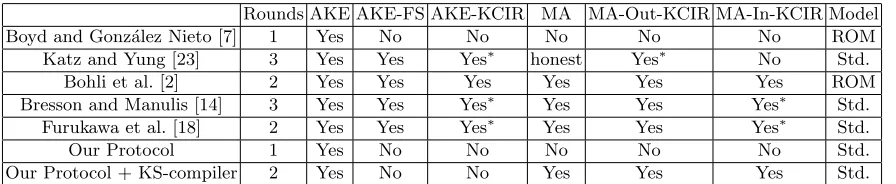
Rounds AKE AKE-FS AKE-KCIR MA MA-Out-KCIR MA-In-KCIR Model Boyd and Gonz´alez Nieto [7] 1 Yes No No No No No ROM
Katz and Yung [23] 3 Yes Yes Yes∗ honest Yes∗ No Std.
Bohli et al. [2] 2 Yes Yes Yes Yes Yes Yes ROM
Bresson and Manulis [14] 3 Yes Yes Yes∗ Yes Yes Yes∗ Std.
Furukawa et al. [18] 2 Yes Yes Yes∗ Yes Yes Yes∗ Std.
Our Protocol 1 Yes No No No No No Std.
Our Protocol + KS-compiler 2 Yes No No Yes Yes Yes Std. Table 1.Security and efficiency comparison among existing GKE protocols
Table 1 gives a comparison of the security of some of the existing GKE protocols. The column “Rounds” shows the number of communication rounds required to complete the protocol. The terms “AKE” refers to AKE-security, FS” refers to AKE-security with forward secrecy and “AKE-KCIR” refers to AKE-security with KCI resilience. Similarly “MA” refers to mutual authentication and “MA-Out-KCIR” and “MA-In-KCIR” refers to mutual authentication with outsider and insider KCIR respectively. The entry “Yes∗” says that the corresponding protocol appears to be secure under the notion but there is no formal proof. The last column in the table says whether the protocol is proven in the random oracle model or in the standard model.
GKE protocol that appears to satisfy all the desired notions of security. However, this protocol will have three rounds of communication.
Although our one-round GKE protocol cannot achieve all the security notions, it will be very useful in scenarios where communication efficiency highly desired. Unlike the previously known one-round GKE protocol, our protocol has been proven secure in the standard model. We have also discussed generic techniques with which the security of the protocol can be enhanced. However, as expected this additional security guarantee comes at the price of extra number of rounds. We leave it an open problem to construct an efficient mKEM in the standard model, which can in turn be used to construct efficient one-round GKE protocol using our approach.
References
1. Al-Riyami, S.S., Paterson, K.G.: Tripartite Authenticated Key Agreement Protocols from Pairings. In: Cryp-tography and Coding, 9th IMA International Conference. Volume 2898 of LNCS., Springer (2003) 332–359 2. Bohli, J.M., Gonzalez Vasco, M.I., Steinwandt, R.: Secure group key establishment revisited. Int. J. Inf. Sec.
6(4) (2007) 243–254
3. Bohli, J.M., Steinwandt, R.: Deniable Group Key Agreement. In: Progress in Cryptology–VIETCRYPT’06, Revised Selected Papers. Volume 4341 of LNCS., Springer (2006) 298–311
4. Boyd, C.: Towards a classification of key agreement protocols. In: The Eighth IEEE Computer Security Foun-dations Workshop–CSFW’95, IEEE Computer Society (1995) 38–43
5. Boyd, C.: On Key Agreement and Conference Key Agreement. In: Information Security and Privacy–ACISP’97. Volume 1270 of LNCS., Springer (1997) 294–302
6. Boyd, C., Cliff, Y., Gonz´alez Nieto, J.M., Paterson, K.G.: One-Round Key Exchange in the Standard Model. International Journal of Applied Cryptography1(3) (2009) 181–199
7. Boyd, C., Gonz´alez Nieto, J.M.: Round-Optimal Contributory Conference Key Agreement. In: Public Key Cryptography–PKC’03. Volume 2567 of LNCS., Springer (2003) 161–174
8. Boyd, C., Mathuria, A.: Protocols for Authentication and Key Establishment. Information Security and Cryp-tography. Springer (August 2003)
9. Bresson, E., Chevassut, O., Essiari, A., Pointcheval, D.: Mutual Authentication and Group Key Agreement for Low-Power Mobile Devices. In: Proc. of MWCN 03, World Scientific Publishing (October 2003) 5962
10. Bresson, E., Chevassut, O., Pointcheval, D.: Provably Authenticated Group Diffie-Hellman Key Exchange - The Dynamic Case. In: Advances in Cryptology–ASIACRYPT’01. Volume 2248 of LNCS., Springer (2001) 290–309 11. Bresson, E., Chevassut, O., Pointcheval, D.: Dynamic Group Diffie-Hellman Key Exchange under Standard
Assumptions. In: Advances in Cryptology–EUROCRYPT’02. Volume 2332 of LNCS., Springer (2002) 321–336 12. Bresson, E., Chevassut, O., Pointcheval, D., Quisquater, J.J.: Provably authenticated group Diffie-Hellman key
exchange. In: CCS’01: Proceedings of the 8th ACM conference on Computer and Communications Security, ACM (2001) 255–264
13. Bresson, E., Manulis, M.: Contributory Group Key Exchange in the Presence of Malicious Participants. IET Information Security2(3) (2008) 85–93
14. Bresson, E., Manulis, M.: Securing Group Key Exchange against Strong Corruptions. In: Proceedings of ACM Symposium on Information, Computer and Communications Security (ASIACCS’08), ACM Press (2008) 249–260 15. Canetti, R., Halevi, S., Katz, J.: Chosen-Ciphertext Security from Identity-Based Encryption. In: Advances in
Cryptology–EUROCRYPT’04. Volume 3027 of LNCS., Springer (2004)
16. Cramer, R., Shoup, V.: Design and analysis of practical public-key encryption schemes secure against adaptive chosen ciphertext attack. Technical report, http://shoup.net/ (2002)
17. Cramer, R., Shoup, V.: A Practical Public Key Cryptosystem Provably Secure Against Adaptive Chosen Ci-phertext Attack. In: Advances in Cryptology–CRYPTO’98. Volume 1462 of LNCS., Springer (1998)
18. Furukawa, J., Armknecht, F., Kurosawa, K.: A Universally Composable Group Key Exchange Protocol with Minimum Communication Effort. In: Security and Cryptography for Networks–SCN 2008. Volume 5229 of LNCS., Springer (2008) 392–408
19. Goldreich, O., Goldwasser, S., Micali, S.: How to construct random functions. J. ACM33(4) (1986) 792–807 20. Gorantla, M.C., Boyd, C., Gonz´alez Nieto, J.M.: Modeling Key Compromise Impersonation Attacks on Group
21. Gorantla, M.C., Boyd, C., Nieto, J.M.G.: On the connection between signcryption and one-pass key establishment. In Galbraith, S.D., ed.: IMA Int. Conf. Volume 4887 of LNCS., Springer (2007) 277–301
22. Katz, J., Shin, J.S.: Modeling insider attacks on group key-exchange protocols. In: Proceedings of the 12th ACM Conference on Computer and Communications Security–CCS’05, ACM (2005) 180–189
23. Katz, J., Yung, M.: Scalable Protocols for Authenticated Group Key Exchange. In: Advances in Cryptology– CRYPTO’03. Volume 2729 of LNCS., Springer (2003) 110–125
24. Smart, N.P.: Efficient Key Encapsulation to Multiple Parties. In: Security in Communication Networks–SCN’04. Volume 3352 of LNCS., Springer (2004) 208–219
A Preliminaries
We first review the definition and notion of security considered for mKEM and then briefly describe Katz and Shin’s compiler.
A.1 Multi KEM
An mKEM takes the public keys of nparties as input and outputs a session key K and an encap-sulation of K under all the npublic keys. It is formally specified by three algorithms as described below:
KeyGen: This is a probabilistic algorithm that takes the domain parameters as input and outputs a public-private key pair (pk,sk).
Encap: This is a probabilistic algorithm that takes the domain parameters, the public keys of n receivers (pk1, . . . ,pkn) and outputs a session key K ∈ {0,1}k and an encapsulation C of K under the public keys (pk1, . . . ,pkn).
Decap: This is a deterministic algorithm that takes the domain parameters, an encapsulation C and a private keyski as input and outputs either a keyK or⊥.
For an mKEM to be considered valid it is required that for all key pairs (pki,ski), i∈[1, n] if (K, C) =Encap({pk1,pk2, . . . ,pkn}) thenDecap(C,ski) =K for each i∈[1, n].
The IND-CCA notion of security for mKEM is defined in a similar way to the traditional KEMs as below.
Definition 4. An mKEM is IND-CCA secure if the advantage of any probabilistic polynomial time adversary in the following game is negligible in the security parameterk.
Setup: The challenger runs theKeyGenalgorithm and obtains nkey pairs (pki,ski) for 1≤i≤n. All the public keysP ={pk1,· · · ,pkn} are given to the adversary.
Phase 1: The adversary is allowed to issue decapsulation queries as below:
Decap: The adversary issues this query with input P′ ⊆ P and an encapsulation C. The challenger returns either a key K or ⊥ after executing the Decap algorithm on C using the private keys corresponding to P′. Note that if Decap on input C produces different symmetric keys for two different private keys of users in P′, then the encapsulation C is deemed invalid and the adversary is returned⊥.
Challenge: The adversary gives a set of keysP∗ ⊆ Pto the challenger. The challenger first chooses b∈ {0,1}. It then runs the Encapalgorithm usingP∗ and generates (Kb, C∗). It then setsK1−b to be a random key drawn uniformly from the key space i.e., K1−b
R
← {0,1}k. Both the keys
Phase 2: The adversary is allowed to issues queries to challenger as in Phase 1 with the following restriction: A decapsulation query on an encapsulation C′ (includes C′ = C∗) that trivially reveals the session key Kb is not allowed.3
Guess The goal of the adversary is to guess which one of the two keys {K0,K1} is encapsulated
inC∗. It finally outputs a guess bitb′ and it succeeds ifb′=b. The advantage of the adversary is given as AdvACCA =|2·Pr[b′ =b]−1|.
A.2 Katz and Shin Compiler
Katz and Shin [22] proposed a compiler that turns any AKE secure GKE protocol into a univer-sally composable GKE protocol that achieves mutual authentication in the presence of insiders. The compiler uses messages authenticated with signatures generated by long-term private keys of the parties. LetΣ= (Gen,Sign,Verify) be a public key signature scheme which is existentially unforge-able against chosen message attack, where Genis an algorithm that generates a signing key pair, Signis a signing algorithm and Verify is a verification algorithm. The compiler also uses a pseudo random function family [19] F with collision-resistance. A formal definition of collision-resistant pseudo random function family is given below.
Definition 5 ([22]). Let F = {Fk} with Fk ={F
s}s∈{0,1}k be a pseudo random function family
(PRF). We say thatF is collision-resistant PRF if there is an efficient procedureSamplesuch that the following is negligible in kfor all polynomial time adversaries A:
Prhv0 ←Sample(1k); s, s′ ← A(1k, v0) : s, s′ ∈ {0,1}k
^
s6=s′^Fs(v0) =Fs′(v0)
i
Informally, the definition requires that for all kthere exists an (efficiently computable)v0 such
that the function defined by g(x)def= Fx(v0) is collision-resistant. Katz and Shin also sketch a way
of constructing collision-resistant PRF in the standard model from any one-way permutation. Note that the above definition of collision-resistance for PRFs is different from the (standard) collision resistance considered for keyed hash functions.
In Figure 3, we present the KS-compiler. The users first compute a session key sk by executing an initial GKE protocolπ. The compiler starts by using the session key as a seed to the PRF with two publicly known strings to compute an acknowledgment message ack and a session key sk′. The messageack is then signed with the user’s signing key and the signature along with the user’s identity is broadcast to all other users, which serves as key confirmation message. If all the incoming signatures verify correctly , the compiled protocol π′ accepts sk′ as the session key; otherwise, π′ terminates without accepting.
3
LetF be a collision-resistant PRF, and assume thatv0is output bySample(1k) and publicly-known. Letv16=v0also be publicly-known.
Initialization Phase: During the initialization phase of π′, each player U
i runs Gen(1k) to generate long-term
verification/signing keys (P Ki,SKi) (in addition to any keys needed forπ).
The Protocol: Players run protocolπ. If Ui would terminate without accepting in π, then it terminates without
accepting in π′. Otherwise, if U
i would accept (in protocol π) with (sidi,pidi,ski), this player performs the
following additional steps:
1. Ui computesacki =Fski(v0) andsk′i=Fski(v1). Next,Uierases all its local state except for acki,sk′i,sidi
andpidi. Then,Uicomputes a signatureσi←SignSKi(Ui,sidi,pidi,acki) and sends the message (Ui, σi) to
all players inpidi.
2. Upon receipt of|pidi−1|messages (Uj, σj) from all other playersUj ∈pidi\ {Ui}, playerUi checks that VrfyP Kj((Uj,sidi,pidi,acki), σj) = 1 for allUj∈pidi. Assuming all verifications succeed, Ui accepts, erases
its internal state, and outputs (sidi,pidi,sk′i). If any of the verifications do not succeed,Uiterminates without
accepting (and with no output).