A Comparative Performance Analysis of
Topological Routing Protocols in VANET
KAVITA KHATKAR
CSE Deptt., MMU, Mullana, Ambala, Haryana, India1 [email protected]
http://www.mmumullana.org/
DR. NEERA BATRA2
CSE Deptt., MMU, Mullana, Ambala, Haryana, India [email protected]
http://www.mmumullana.org/
DR. RISHI PAL SINGH3
CSE Deptt., GJU S.&T. Hisar, Haryana, India [email protected] 3
http://www.gjust.ac.in/
ABSTRACT - Vehicular Ad-hoc Network has drawn the attention of various researchers all around the world in the recent years. The reason can be attributed towards its capability in solving real world problems like traffic congestion. Although quite useful, the development of such systems is inherited with some challenges. The development of efficient communication protocols is one of the major problems which need to be addressed. This paper presents a comparative analysis of three such algorithms namely; AODV, DSDV and ZRP. The algorithms are implemented using Network Simulator and their performance is compared in terms of throughput, Packet Delivery Ratio and End-to-End delay. The result shows that none of the algorithms performs best in terms of all parameters while AODV and ZRP’s performance are quite encouraging in terms of throughput and PDR.
Keywords: AODV, ZPR, VANET
I. Introduction
Nowadays most of the automobile have intra conveyance network that permits wireless communication between vehicle and electronic gadgets like good phone, Global Positioning System (GPS), Bluetooth media players. However the lay conveyance communication network continues to be not on the market. Therefore to produce lay conveyance communication VANET i.e. vehicular ad-hoc Network technologies are rising. Vehicular unexpected networks (VANETs) are designed as a set of mobile unexpected networks (MANETs) with the distinctive property that the nodes here are vehicles [1]. So node i.e. vehicle movement is restricted by road course, encompassing traffic and traffic rules. Attributable to these restrictions, VANET is supported by some fixed infrastructure that assists with some services of the VANET and provides access to stationary networks. The fixed infrastructures are deployed at essential locations like road sides, service stations, dangerous intersections or places with unsafe weather conditions. VANET is extraordinarily sort of versatile specially appointed remote systems (MANETs) Vehicular systems are considered as a novel class of remote systems. VANET is an innovation that uses moving vehicles as hubs in a system to make a portable system [2]. VANET transforms each partaking vehicle into a remote switch or hub; permitting vehicles around 100 to 300 meters of one another to interface and, thus, make a system with a wide range. As vehicles drop out of the sign range and drop out of the system, different vehicles can join in, interfacing vehicles to each other so that a versatile Internet is made It is one of the specially appointed systems genuine applications which empowers the correspondences among close-by vehicles and additionally in the middle of vehicles and close-by altered equipment's, typically depicted as roadside hardware's.
various researchers in the field of wireless networking as well as automotive industries. VANET is compared with MANET in terms high mobility.
Traffic on road is big problem today. Multiple hours and tons of fuel is wasted everyday by these vehicles jammed in traffic. This is a fact that, therefore million tons of fuel is going to wasted today due to the increase of traffic intensity. In Technology era all the vehicles themselves have an ability to compile and analyse the traffic data and communicate it to drivers in a layout which will let them to make smart decisions to the avoid congested areas. Communications between these vehicles can be obtained either through vehicle-to-vehicle communications or vehicle-to infrastructure [8]. Vehicular ad-hoc networks are mobile ad-hoc networks that give the communications between adjoining vehicles or nearby fixed equipment. Each vehicle records and flow the information such as place and speed or route that information is received from other vehicles in network. Congestion detection is one of the multiple applications of VANETs or it didn’t design to be used as means for an automated driving rather as tool to deliver information to driver which will help her/him make decisions to avoid the heavy traffic [7]. Design traffic congestion detection system which will have good influence on budget, the surroundings or society in general letting us to spend less time stuck in the traffic or more time doing any creativity. The Vehicular Ad-hoc Network has been presented in various areas, such as detecting nearest collisions and giving warning signals to aware driver. Since VANET has ability to provides a variety of services. These services are provided by VANET often based on association or among vehicles which are furnished with a relatively motion sensors and GPS units. Awareness of the specific location is vibrant to the every vehicle in VANET so it can provide an accurate data to aristocrats.
II. Literature Review
Neng-Chung Wang et al. [1] presented a greedy location-aided routing protocol for mobile ad hoc networks. In
this work, GLAR approach is used in order to improve efficiency of LAR in mobile networks. In this protocol, initially baseline is decided. Thus, it can be easy to find better routing path with this GLAR protocol.
Alberto Gordillo Muñoz et al. [2] proposed Multicast over vehicle ad-hoc networks. In this work, several
approaches are categorized and compared which provides its merits and demerits to give better result for multicast over vehicle ad-hoc network. Vehicular networks may improve the safety and efficiency of road travel but there are many challenges that still need to be overcome.
David B. Johnson [3] proposed modeling mobility for vehicular ad-hoc networks. In this work, realistic model
of node motion based on the movement of vehicles on real street maps has been presented. Our model can be used with the ns-2 network simulator. The proposed algorithm is compare with the Random Waypoint mobility model. Results show that the Random Waypoint mobility model is a good approximation for simulating the motion of vehicles on a road, but there are situations in which our new model is better suited.
Lochert, Christian, Hannes Hartenstein, Jing Tian [4] A routing strategy for vehicular ad hoc networks in
city environments has been presented In this paper we proposed 'geographic source routing' (GSR), which combines position-based routing with top logical knowledge, as a promising routing strategy for vehicular ad hoc networks in city environments. We demonstrated by a simulations study that made use of realistic vehicular traffic in a city environment that GSR outperforms topology-based approaches like DSR and AODV with respect to delivery rate and latency vehicles. Third, we study approaches that do not need a navigational system but where 'local maps', particularly for junctions, are inferred from observing transmitted packets and vehicle movement patterns.
Toutouh, Jamal, and Enrique Alba [5] in this study, the use of smart phones has analyzed, tablets, and laptops
in vehicle-to-vehicle communications by defining a test bed carried out in the city of Malaga. In our analysis we have included two different MAC/PHY specifications: the widely used IEEE 802.11g and the IEEE 802.11a. We have designed two different types of experiments: the first designed to evaluate the wireless signal strength generated by the analyzed devices, and the second, focused on characterizing the QoS of V2V communications of these devices
H. Takagi [6] et al. proposed the EDA that acts as a middleware between network level that is in charge of
VANET communications at low level, and higher level holds the back-end applications. The general structure of EDA takes beacon messages from a network layer as rough events, or the EPAs perform a CEP processing of afterward; more so, the EDA gets as input events from the data sources that state road environment.
Malhi, AvleenKaur, and ShaliniBatra et al.[7] in this paper, trust prediction model has been presented based
on the fuzzy approach . This model helps to effectively compute the trust of other vehicles for the secure path formation in VANET. The results and analysis of the trust prediction model over the standard protocols are presented using simulations
Wongdeethai, Singha, and PeeraponSiripongwutikorn. [8] Presented a RTC protocol to collect the traffic
MarwaAltayeb and ImadMahgoub et al. [9] presented A Survey of Vehicular Ad hoc Networks Routing Protocols. The objective is to give a survey of the VANETs routing mechanisms, this paper gives an overview of Vehicular ad hoc networks (VANETs) and the existing VANET routing protocols; mainly it focused on vehicle to vehicle (V2V) communication and protocols. The paper also represents the general outlines and goals of VANETs, investigates different routing schemes that have been developed for VANETs, as well as providing classifications of VANET routing protocols (focusing on two classification forms).
S. Kanhere,[10] et al. proposed an algorithm in which the evolution process of the message clustering is taken
into account. The fuzzy clustering procedure normally divided into steps. In VANETs, several aspects of the vehicle state information, which are generated by on-board sensors, like as vehicle speed s, brake frequency b, acceleration e, message creation time t, horizontal or vertical geographical coordinate (σ, ρ). This information can be indirectly reflected the road crowd situation, or it can be grouped into a one atomic message as its attributes.
Baguenaet. al. [11] proposed an adaptive any casting solution for routing in Vehicular Environments (AVE),
which is a message delivery protocol that combines geographical and topological information to dynamically adapt its behavior to network conditions. This paper focus on vehicle-to-infrastructure connectivity for cloud services, where the vehicles send the sensed information as individual and independent messages to a cloud service in the Internet. This scenario requires access to any available close-by roadside unit, thus making any casting the ideal delivery mechanism. Simulations results show that the hybrid and adaptive approach of AVE is able to improve network performance.
Antonio Fonseca , Teresa Vazao et al. [12] Applicability of position-based routing for VANET in highways
and urban environment. In the last years many routing protocols proposals have been made considering the particular VANET characteristics. From the many proposals that came up, the protocols based on the vehicles positions were found to be the most adequate to VANETs due to their resilience to handling the nodes position variation. In this study, the survey of existing position-based routing protocols has been proposed.. Afterwards, topology-based protocols are compared to position-based protocols and to the latter are identified the different used strategies and their performances are qualitatively evaluated relatively to different metrics. The different position-based routing proposals are described including a pseudo-code specification, and a comparison is made based on different perspectives. To conclude, the main constrains to urban and highway environments are characterized and the adaptability of each protocol to each of the environments is evaluated.
Yousefi, Saleh, Mahmoud SiadatMousavi [13] this paper presents a state of the art survey in networking
challenges in vehicular ad hoc network which is a promising technology for intelligent transportation system (ITS). Vehicular Ad hoc Network (VANET), a subclass of mobile Ad Hoc networks (MANETs), is a promising approach for future intelligent transportation system (ITS). These networks have no fixed infrastructure and instead rely on the vehicles themselves to provide network functionality. However, due to mobility constraints, driver behavior, and high mobility, VANETs exhibit characteristics that are dramatically different from many generic MANETs. This article provides a comprehensive study of challenges in these networks, which concentrate on the problems and proposed solutions.
Saha, Amit Kumar, and David B. Johnson[14] proposed Modeling mobility for vehicular ad-hocnetworks In
this work, presented a new, realistic model of node motion based on the movement of vehicles on real street maps. This model can be used with the ns-2 network simulator. This model has been compared with the Random Waypoint mobility model, the most widely used mobility model. Results show that, in many ways, the Random Waypoint mobility model is a good approximation for simulating the motion of vehicles on a road, but there are situations in which our new model is better suited.
Jiang, Hao, HaoGuo et al. [15] alarm message broadcast routing has been proposed in this paper. Unlike other
similar routing algorithms, REAR is relying on the real wireless channel in VANET. This proposed scheme is very reliable and efficient. The proposed method REAR uses minimum number of broadcast packets in order to propagate the alarm message. According to the theory model of wireless channel, it estimates the receipt probability of alarm messages for nodes. The contention scheme based on the receipt probability is used to select the optimized relay. In this work, two methods has been discussed one for utilizing the receipt probability and some functions for determine the contention delay. The simulation and theory analysis are confirmed that REAR has a higher reliability and uses less broadcast packets than the location-based algorithm.
Sahoo, RashmiRanjan et al. [16] In this paper, a new algorithm for selecting the most appropriate cluster head
Tee, C. A. T. H., and A. Lee et al. [17] presented a novel position-based routing protocol. The proposed method also termed as Junction-based Adaptive Reactive Routing (JARR), which will address the shortcomings of the current protocols by estimating the density of paths to be used. Packets are routed from one junction to another and the direction and position of next hops are pre-considered with different ratios depending on the estimated density of the path. Simulation works were performed to compare JARR routing protocol with an existing protocol which uses the shortest path strategy.
Harsch, Charles, Andreas Festag et al. [18] in this paper presented a scheme that secures geographic
position-based routing, which has been widely accepted as the appropriate one for VC. Moreover, the scheme currently chosen and evaluated C2C-CC and integrate security mechanisms to protect the position-based routing functionality and services (beaconing, multi-hop forwarding, and geo-location discovery), and enhance the network robustness. In this paper, defense mechanisms, has been proposed based on both cryptographic primitives and plausibility checks mitigating false position injection.
III. Proposed work
In this paper various routing techniques used in the MANET are compared. Routing in mobile ad-hoc network is classified into broadly three types: Reactive routine or real time route discovery or on demand route discovery in which AODV (Ad-hoc On Demand Vector Routing) is used. AODV obtains routes quickly for mobile nodes to the new destinations and require not maintaining any routing information to destination on active communication. It also allows mobile nodes to discover the link breakages in a timely manner.
The other one is the proactive routing protocol or table driven protocol in which DSDV (Destination Sequenced Distance Vector) is used. In DSDV every node will maintain the routing table of all the nodes it knows either directly or indirectly through other nodes. Each node has a single entry in the routing table and maintains the nodes address, sequence number and hop count value to identify the node.
The third one is the hybrid routing protocol in which ZRP (Zone Routing Protocol) is used. ZRP maintains the zone information proactively and sends the data proactively if the destination address lies in the same zone. If the zone limit is expired then the reactive approach is considered for finding the destination address. This approach helps in reducing the processing overhead for these routes.
IV. Results and discussions
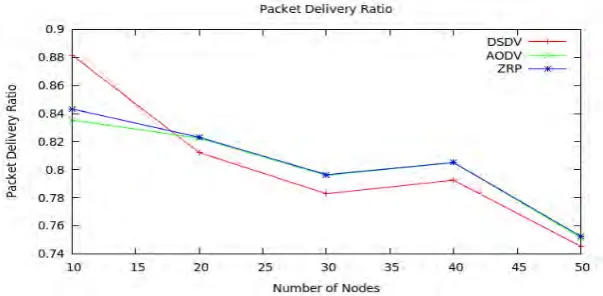
The above discussed protocols are implemented in the Vehicular Adhoc Network environment using the Network Simulator software. The performance of the considered algorithms is compared by varying network density and speed of the nodes. Figure 1 to 3 shows the graph of various performance parameters like Packet Delivery Ratio, Throughput and End to End Delay. The graph shows that as the node in the network increases the packet delivery ratio is decreased in figure 1 while in figure 2 the throughput of the network is increased and in both the cases AODV and ZRP outperforms the DSDV protocol. In figure 3 the end to end delay in case of DSDV is better as compared to the AODV and ZRP which performs similar in various aspects.
Fig 2: Throughput of the network by varying the number of nodes
Fig 3: End to End Delay of the network by varying the number of nodes
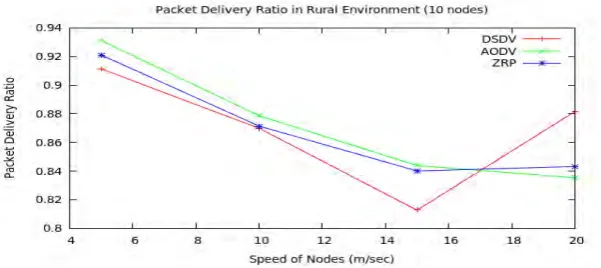
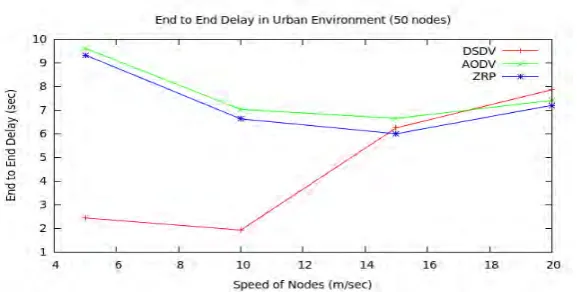
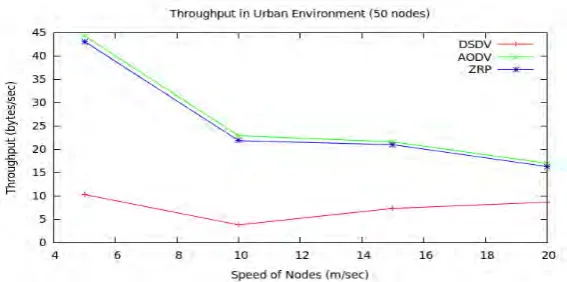
Now, the network is divided into urban and rural network. The urban network consists of higher number of nodes as compared to the rural network which has less traffic density. In urban network 50 vehicles are considered and for the rural network 10 nodes are considered. The performance of both the networks is evaluated by varying the speed of nodes in the network. Figure 4 to 9 shows the graph of various performance parameters in rural environment where 10 nodes are considered and in urban environment where 50 nodes are considered and again in this case the packet delivery ratio and the throughput of the network shows improved results for ZRP and AODV. While in case of end to end delay DSDV shows better results irrespective of the network used.
Fig 5: Throughput of the network by varying the speed of nodes
Fig 6: End to End Delay of the network by varying the speed of nodes
Fig 7: Packet Delivery Ratio by varying the speed of nodes
Fig 9: Throughput of the network by varying the speed of nodes
V. Conclusion
A comparative analysis of routing protocols was done for Vehicular Networks. Three algorithms were implemented namely; AODV, DSDV and ZRP. The algorithms were tested in VANET environment and compared for performance on the basis of Packet Delivery Ratio, End-to-End Delay and Throughput of the Network. A detailed analysis of the results was done and it was found that AODV and ZRP perform better in terms of Packet Delivery Ratio and throughput while DSDV outperforms AODV and ZRP in terms of End-to-End Delay. This encourages us to explore more techniques for the same environment in the future. Also a hybrid of these techniques can be developed for better performance in terms of all the above discussed parameters.
VI. References
[1] Wang, Neng-Chung, Jong-Shin Chen, Yung-Fa Huang, and Si-Ming Wang. "A Greedy Location-Aided Routing Protocol for Mobile Ad Hoc Networks."InWSEAS International Conference.Proceedings. Mathematics and Computers in Science and Engineering. [2] Muñoz, Alberto Gordillo. "Multicast over Vehicle Ad Hoc Networks."
[3] David B. Johnson Saha, Amit Kumar. "Modeling mobility for vehicular ad-hoc networks." In Proceedings of the 1st ACM international workshop on Vehicular ad hoc networks, pp. 91-92. ACM, 2004.
[4] Lochert, Christian, Hannes Hartenstein, Jing Tian, HolgerFussler, Dagmar Hermann, and Martin Mauve. "A routing strategy for vehicular ad hoc networks in city environments." In Intelligent Vehicles Symposium, 2003.Proceedings. IEEE, pp. 156-161. IEEE, 2003.
[5] Toutouh, Jamal, and Enrique Alba. "Light commodity devices for building vehicular ad hoc networks: An experimental study." Ad Hoc Networks 37 (2016): 499-511.
[6] H. Takagi, L. K. (1984). Optimal transmission ranges for randomly distributed packet radio terminals. IEEE Transactions on Communications, vol. 32, no. 3, (pp. 246–257).
[7] Malhi, AvleenKaur, and ShaliniBatra. "Fuzzy‐based trust prediction for effective coordination in vehicular ad hoc networks." International Journal of Communication Systems (2016).
[8] Wongdeethai, Singha, and PeeraponSiripongwutikorn. "Collecting road traffic information using vehicular ad hoc networks." EURASIP Journal on Wireless Communications and Networking 2016, no. 1 (2016): 1-15.
[9] Altayeb, Marwa, and ImadMahgoub. "A survey of vehicular ad hoc networks routing protocols." International Journal of Innovation and Applied Studies 3, no. 3 (2013): 829-846.
[10] Salil S. Kanhere, and Sanjay Jha. " Fuzzy Clustering Based Protocol For Vanet: a survey." ACM SIGMOBILE Mobile Computing and Communications Review 9, no. 2 (2005): 4-18.
[11] Baguena, Miguel, Carlos T. Calafate, Juan-Carlos Cano, and Pietro Manzoni. "An Adaptive Anycasting Solution for Crowd Sensing in Vehicular Environments." Industrial Electronics, IEEE Transactions on 62, no.
[12] (2015): 7911-7919.[12] Fonseca, António, and Teresa Vazão. "Applicability of position-based routing for VANET in highways and urban environment." Journal of Network and Computer Applications 36, no. 3 (2013): 961-973.
[13] Yousefi, Saleh, Mahmoud SiadatMousavi, and MahmoodFathy. "Vehicular ad hoc networks (VANETs): challenges and perspectives." In ITS Telecommunications Proceedings, 2006 6th International Conference on, pp. 761-766.IEEE, 2006
[14] Saha, Amit Kumar, and David B. Johnson. "Modeling mobility for vehicular ad-hoc networks." In Proceedings of the 1st ACM international workshop on Vehicular ad hoc networks, pp. 91-92. ACM, 2004.
[15] Jiang, Hao, HaoGuo, and Lijia Chen. "Reliable and efficient alarm message routing in VANET."In Distributed Computing Systems Workshops, 2008.ICDCS'08. 28th International Conference on, pp. 186-191. IEEE, 2008.
[16] Sahoo, RashmiRanjan, Reena Panda, Dhiren Kumar Behera, and MrinalKantiNaskar. "A trust based clustering with Ant Colony Routing in VANET." In Computing Communication & Networking Technologies (ICCCNT), 2012 Third International Conference on, pp. 1-8. IEEE, 2012.
[17] Tee, C. A. T. H., and A. Lee. "Adaptive reactive routing for VANET in city environments." In Pervasive Systems, Algorithms, and Networks (ISPAN), 2009 10th International Symposium on, pp. 610-614. IEEE, 2009.