Efficient Image Compression Using Symlet
Wavelet.
Sweta Km.Verma
ME Scholar, ECE NITTTR ,Chandigarh [email protected]
Dr. Rajesh Mehra
Associate Professor NITTTR Chandigarh [email protected]
Preeti Singh
ME Scholar, ECE NITTTR, Chandigarh [email protected]
Abstract
Any Image compression technique, reduces the number of bits required to represent an image to preserve its quality. Wavelet-based image compression provides considerable improvements in picture quality at higher compression ratios. This paper proposes Symlet wavelet based, two different thresholding techniques that are Global threshold and Level dependent threshold. The two thresholding techniques of image compression are compared in terms of compression ratio, decomposition level and image recovery. This reduces the size of image while maintaining good picture quality and also enhances transmission rate of data over Internet. The simulated results demonstrate that the proposed Level dependent threshold is more efficient than the Global Threshold.
Keywords: Compression Ratio, Decomposition, Global threshold, Level dependent Threshold, Symlet .
I.INTRODUCTION
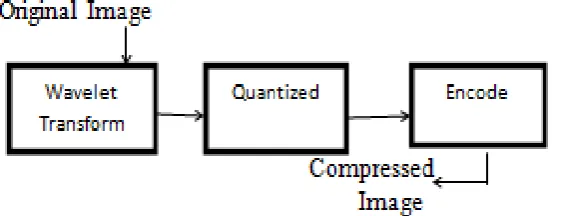
In digital era, the demand for data storage capacity and data transmission bandwidth continues to surpass the capabilities of available technologies. The idea behind image compression is to reduce redundancy and irrelevance of image data in order to be able to transmit or store data in an efficient form [1]. Image is composed of picture elements or pixels. Each pixel represents the color value or gray level for colored and black & white photos respectively. So a pixel is like a tiny dot of a particular color. By measuring the color of an image at a large number of points, we can create a digital approximation of the image from which a copy of the original image can be reconstructed. Digital Image Processing is a technique to process 2- dimensional image through computer. A digital image is obtained from real image through the process of sampling and quantization. Image processing is used in many applications like video surveillance, traffic management and medical imaging [2][3]. Compression is one of the most important applications of wavelets. An Image when passed through a wavelet transform separates in to a set of sub-bands that are compressed data. In a lossy compression scheme, the image quality are fast, flexible, and precise[4] [5]. In any data compression scheme three basic steps are involved: transformation, quantization and encoding. The basic steps for a wavelet based image compression and image de-compression are as shown in Fig.1and Fig. 2 below :
Image processing is used to modify pictures to improve them (enhancement, restoration), extract information structure (composition, image applied to an image as many times as required and thus decoding errors, and efficient at low bit.
Fig 2. Image decompression Using wavelet
II.IMAGE COMPRESSION USING WAVELET
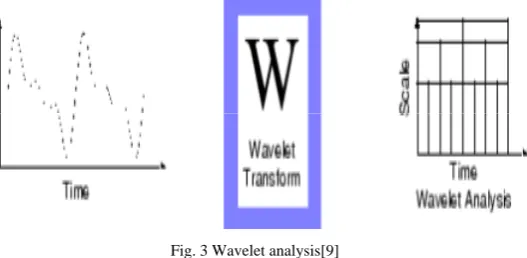
Traditionally, Fourier Transform have been utilized for signal analysis and reconstruction. However Fourier Transform does not include any local information about the original signal [6]. The Fast Fourier Transform [FFT] decomposes the signal in to an infinite length of sine and cosine functions. However, the time-domain information is lost and only spectral information in the frequency domain is provided and vice-versa. This drawback can be overcome by Short time Fourier Transform (STFT) as it represents the signal in both time and frequency domains using moving window function. A constant size window is preferred for this method and therefore it does not give multi-resolution information of the signal. However, both time and frequency domain information through variable size window is provided by wavelet transform in a simultaneous manner as the wavelet transform holds the property of multi-resolution. Scaled and shifted version of mother wavelet gives the wavelet transform [6][7].Wavelet transform is superior approach to other time- frequency analysis tools because its time scale width of the window can be stretched to match the original signal. It is suitable for non-stationary signal analysis , such as noises and transients and signal detection [8].
It also represents an image shown in fig 3 as a sum of wavelet function with different locations of scales and localization properties in the time and frequency domain.
Fig. 3 Wavelet analysis[9]
Important properties of wavelet in image compression leads to efficient implementation, and useful in avoiding dephasing in image processing. Analysis by wavelet transformation can be observed as a decomposition of the given signal of sub band, constituting a filter bank of band pass filters, with width linearly increasing as a function of frequency. This method provides a spectral analysis of the signal .Wavelet based coding is more robust under transmission and decoding errors.
Fig 4.Symlet wavelet[9]
Decomposition:-The wavelet decomposition method uses two types of filters, i.e low pass filter and high pass filter. In this decomposition, An image is first decomposed into four parts based on frequency sub bands, by critically sub sampling horizontal and vertical channels using sub band filters and named as Low-Low (LL), Low-High (LH), High-Low (HL), and High- High (HH) sub bands. To obtain the next coarser we will further decompose LL sub band. This process is repeated several times, figure 5 shows it [1] [9].
Fig 5.Three scale Wavelet Decomposition[9]
Thresholding: This is one of the most commonly used processing tools in wavelet signal processing. It is widely used in noise reduction signal and image compression, and sometimes in signal recognition. For high value of threshold, the loss of information is more and for low value of threshold loss of information is less. The selection of threshold should be low, but for the low value of threshold there is negligible compression of data. Global Threshold: There are two popular thresholding functions used for denoising signals using wavelets namely hard and soft thresholding functions[10].CR, Image decomposition by using wavelet transform and after image reconstructed by using Inverse Wavelet Transform. Wavelet is scalable as the transform process can be applied to Image.
Wavelet Denoising using Hard Thresholding In hard thresholding, elements whose absolute values are less than the threshold is set to 0.
Hard Threshold is defined as
= , | | >
0, | | < …….. ……..(1)
Wavelet Denoising using Soft thresholding
In soft thresholding, the elements whose absolute values are lower than the threshold are first set to zero. Soft Threshold is defined as
= ( ). (| | − ), | | >
, | | < ……..(2)
III.SYMLET BASED IMAGE COMPRESSION
Image Compression Performance Criteria
The performance is rated by the following two Essential criteria: the obtained compression ratio CR and the quality of the reconstructed image PSNR[10].
Compression Ratio(CR): This is used to measure the capacity of image data compression by comparing the size of the original image against compressed image.
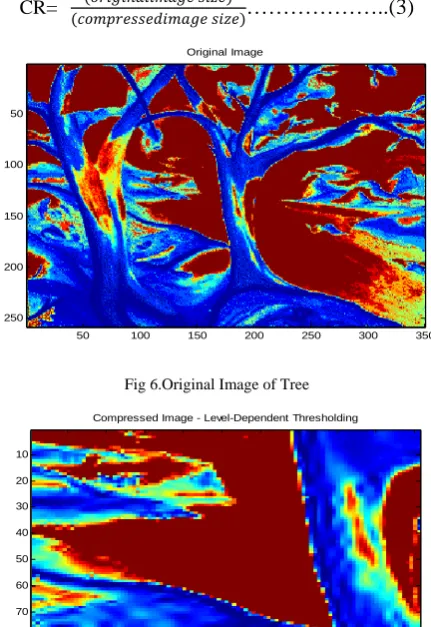
CR= (( ))………..(3)
Fig 6.Original Image of Tree
Fig 7.Compressed Image of Tree
In Fig. 6 and 7 Original image of Tree and Its compressed image are shown. Their performance analysis is shown in Table 1when decomposition level n=7.
Fig 8. Image of Woman
Original Image
50 100 150 200 250 300 350
50
100
150
200
250
Compressed Image - Level-Dependent Thresholding
10 20 30 40 50 60 70 80 90 100
10
20
30
40
50
60
70
80
90
100
Original Image
50 100 150 200 250
50
100
150
200
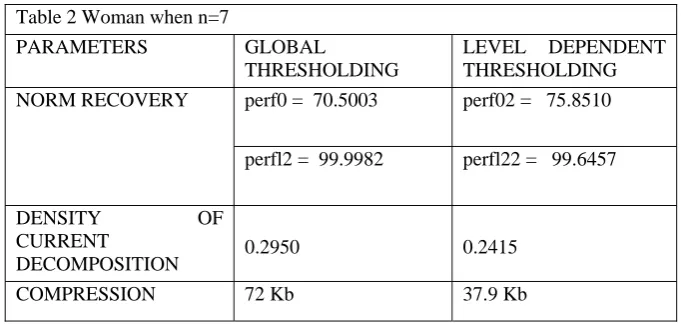
In Fig. 8, 9 and 10 Original image of Woman and Its compressed image are shown. Their performance analysis is shown in Table 2 when decomposition level n=7.
Fig.9.Image of Woman after Global Thresholding
Fig.10 Image of woman after Level Dependent thresholding
IV.RESULT ANALYSIS
Table 1.Trees when n=7
PARAMETERS GLOBAL THRESHOLDING
LEVEL DEPENDENT THRESHOLDING
NORM RECOVERY perf0 = 84.6576 perf02 = 86.4755
perfl2 = 99.8941 perfl22 = 99.3016
DENSITY OF CURRENT DECOMPOSITION
0.1534 0.1352
COMPRESSION 56 Kb 32 Kb
Table 1 shows the different performance parameter of Image compression .In this result analysis standard color image tree and its resolution is 515X 345 and apply Symlet wavelet. Results are observed in terms of CR, and Image decomposition by using wavelet transform and after image reconstructed by using Inverse Wavelet Transform. The original Image size is 56 Kb and after Level dependent thresholding Image is compressed and it becomes 32Kb.
Original Image
10 20 30 40 50 60 70 80 90 100
10
20
30
40
50
60
70
80
90
100
Compressed Image - Level-Dependent Thresholding
10 20 30 40 50 60 70 80 90 100
10
20
30
40
50
60
70
80
90
Table 2 Woman when n=7
PARAMETERS GLOBAL THRESHOLDING
LEVEL DEPENDENT THRESHOLDING
NORM RECOVERY perf0 = 70.5003 perf02 = 75.8510
perfl2 = 99.9982 perfl22 = 99.6457
DENSITY OF CURRENT
DECOMPOSITION
0.2950
0.2415
COMPRESSION 72 Kb 37.9 Kb
Table 2 shows the different performance parameter of Image compression .Standard gray image of woman and its resolution is 256X 256 and apply Symlet wavelet. Results are observed in terms of CR, and Image decomposition. The original Image size is 94 Kb and after Level dependent thresholding Image is compressed and it becomes 37.9Kb.
V.CONCLUSION
Image Compression using Symlet Wavelet when two different thresholding techniques are applied on two different images. By using level-dependent thresholding, the density of the wavelet decomposition reduced by 3% while improving the L2-norm recovery by 3% and image compressed maximum 50% which is analyze in second sample that is Image of women .In normal global thresholding, Image is not compressed as compared to Level dependent threshold.
REFRENCES
[1] Aisha Fernandes,Wilson Jeberson,”An Image Compression Technique using wavelet,”Proceedings of IEEE Techsym 2014 satellite conferrence ,pp.5-6,March 2015,
[2] Rupinder Verma, Rajesh Mehra, “Area Efficient FPGA Implementation of Sobel Edge Detector for Image Processing Applications,” International Journal of computer application,Vol. 56,October 2012,pp.7-11.
[3] Sudhir Goswami, “An Efficient Algorithm of Steganography Using JPEG Colored Image,” IEEE International Conference on Recent Advances and Innovations in Engineering (ICRAIE-2014) , March 2014. pp. 1-6.
[4] Abhishek Acharya, Rajesh Mehra, “FPGA Based Non Uniform Illumination Correction in Image Processing Applications,”Int. J. Comp. Tech. Appl., Vol 2 (2) , Jan 2011,pp. 350.
[5] Johnson, Neil F., and Sushil Jajodia. "Exploring Steganography: Seeing the Unseen." IEEE Computer Feb. 1998, pp. 26-34.
[6] Sugreev Kaur, Rajesh Mehra,”High Speed and Area Efficient 2D DWT Processor Based Image compression,” Signal & Image Processing: An International Journal (SIPIJ), Vol.1,No-2,Dece 2010,pp.22-31.
[7] Nidhi Rastogi, Rajesh Mehra,”Analysis of Savitzky-Golay Filter for Baseline Wander Cancellation in ECG Using Wavelets,” International Journal of Engineering Sciences and Emerging Technologies,Vol.6,Issue1,Aug 2013,pp. 15-23
[8] C Srisailam, Parul sharma,Sonali Suhane,”Color Image Denoising Using Wavelet Soft Thresholding,” International Journal of Emerging Technology and Advanced Engineering,Vol.4,Issue 4,July 2014,pp.475-478
[9] Michel Misiti, Yves Misiti,George Oppenheim, Matlab,”Wavelet Toolbox,”Getting Started Guide,2015.
[10] A.M. Zaid,W.M.Khedr,”Image Compression using Embedded ZeroTree Wavelet Signal and Image Processing,”An International Journal(SIPIJ),Vol 5 No-6,Dec 2014.
[11] Gautam Kumar, Sugandh Kumar,” Comparative Study of Wavelet and Wavelet Packet Transform for Denoising Telephonic Speech Signal,” International Journal of Computer Applications ,Vol. 110 – No. 15, January 2015,pp.1-8. January 2015,pp.1-8.
Dr. Rajesh Mehra is currently associated with Electronics and Communication Engineering Department of National Institute of Technical Teachers’ Training & Research, Chandigarh, India since 1996. He has received his Doctor of Philosophy in Engineering and Technology from Panjab University, Chandigarh, India in 2015. Dr. Mehra received his Master of Engineering from Panjab Univeristy, Chandigarh, India in 2008 and Bachelor of Technology from NIT, Jalandhar, India in 1994. Dr. Mehra has 20 years of academic and industry experience. He has more than 250 papers in his credit which are published in refereed International Journals and Conferences. Dr. Mehra has 55 ME thesis in his credit. He has also authored one book on PLC & SCADA. His research areas are Advanced Digital Signal Processing, VLSI Design, FPGA System Design, Embedded System Design, and Wireless & Mobile Communication. Dr. Mehra is member of IEEE and ISTE.
Ms.Preeti Singh is currently pursuing her ME degree from National Institute of Technical Teachers’ Training & Research, Chandigarh, India. She has received her bachelor degree of technology from Harcourt Butler Technological Institute,
![Fig 4.Symlet wavelet[9]](https://thumb-us.123doks.com/thumbv2/123dok_us/9669307.1494837/3.595.183.417.303.433/fig-symlet-wavelet.webp)