Effect of Titanium in Trace Level on the
Properties of Gray Cast Iron
Kandula Ankamma
Associate Professor, Department of Mechanical Engineering, MGIT, Hyderabad, Telangana, India
ABSTRACT: In the present work an effort has been made to correlate the “Effect of Titanium in trace level on the tensile strength, hardness and microstructure of gray cast iron”. Titanium in trace level has a significant effect on the properties and microstructure of gray cast iron. Titanium is deliberately added to study its effect on properties and microstructure. Titanium up to 0.05% has shown a decrease in tensile strength and hardness values, while beyond this amount the properties are slightly improved.
KEYWORDS: Trace elements, tensile strength, microstructure, hardness.
I. INTRODUCTION
Outstanding castability, good combination of mechanical and physical properties, low cost and simplicity in production made gray cast iron as an excellent founding material for many engineering components such as cylinder block, cylinder head, oil cooler cover, brake drum etc. Important mechanical properties for such castings are tensile strength, modulus of elasticity, impact strength and damping capacity. Gray cast iron is an alloy of iron, carbon, silicon, manganese, phosphorous and sulphur. In addition to these elements there are a number of trace elements present in the gray cast iron. The elements present in traces in gray cast iron have a significant effect on properties and graphitic structure. Hence it is important to understand its effects by the users and producers of such castings. Their effect on properties and graphitic structure becomes important, when trace element levels are lower or higher than the normal value. The source of trace elements into gray cast iron are from pig iron, non-ferrous metal scrap, vitreous enameled scrap, leaded steel scrap, purchased scrap containing lead or coated with lead based paint. To avoid trace element contamination in charge materials, all bought in scrap should be examined prior to the stockpiling so that undesirable charge materials can be removed. In the present work, the effect of Titanium on the mechanical properties and graphitic structure at trace level on gray cast iron are studied. Titanium is deliberately added to the gray cast iron to know its effect on the properties of gray cast iron.The experimental work was carried out at TELCO, Jamshedpur.
Gray Cast iron Composition:
On the basis of elements present in gray cast iron can be divided into three categories [1-4]. Major elements,
Minor elements and Trace elements.
Major elements: The three major elements in gray cast iron are iron, carbon and silicon.
Carbon: carbon in gray cast iron is present from 2.5 to 4% by weight. It occurs in two phases, elemental carbon in the form of graphite and combined carbon as iron carbide (Fe3C). The degree of graphitization is assessed by % Total Carbon = % Graphitic Carbon + % Combined Carbon.
Silicon: silicon is present in gray iron from 1.0 to 3.0% by weight. The important effect of silicon is its effect on graphitization. It is found that increasing silicon percentage shifts the eutectic point of the iron carbon diagram to the left. The eutectic shift is often described by the following relationship. Eutectic carbon percentage = 4.3 – 1/3 x % Si.
Phosphorus: Phosphorus is found in all gray irons. It is rarely added intentionally, but tends to come from pig iron. To some extent it increases the fluidity of iron. Phosphorus forms a low melting point phase in gray iron that is commonly referred as steadite (Fe3P). At high levels it promotes shrinkage porosity, while at low levels (below about 0.05%) it increases metal penetration and finning defect.
Sulphur and Manganese: In irons melted in acid cupola, sulphur is normally present within the range 0.08 to 0.18%, and irons produced by electric melting usually contain 0.03% to 0.08%. The influence of sulphur needs to be considered relative to its reaction with manganese in iron. Sulphur will form iron sulphide (FeS) and segregates on grain boundaries during freezing and precipitates during final stage of freezing.
TRACE ELEMENTS: Elements normally present as trace amounts in gray cast iron can have a significant effect on properties and graphitic structure. The effect on properties and structure becomes important when trace element levels are lower or higher than normal values. Trace elements normally detected in gray cast iron are Boron, Lead, Bismuth, Titanium, Nitrogen, Arsenic, Aluminium, Tin, Tellurium, Antimony, Vanadium etc [5].
Titanium: Titanium can be present in gray irons at levels ranging from 0.005 to 0.05 percent. The higher levels of titanium usually result from deliberate additions made to suppress the effect of nitrogen. Pig irons can contain up to 0.2% titanium and are normal sources of titanium in gray cast iron. The effect of nitrogen on structure and properties is of particular importance in the case of gray cast iron. Nitrogen content in gray cast iron vary between 0.001 to 0,015%. Above 0.01% nitrogen changes the graphite flakes to become shorter and thicker and develop rounded ends. This compacted form of graphite causes an increase in tensile strength, but this graphitic structure is undesirable, because it lowers the thermal shock resistance. Very high nitrogen contents can promote pearlite formation and may lead to white iron structure. The effect of nitrogen can be neutralized by the addition of nitride forming elements such as titanium and aluminium. The effect of nitrogen can be eliminated by the presence of titanium about 0.04% in gray cast iron. Titanium combines with nitrogen in the melt by forming titanium nitride (TiN) and prevents formation of compacted graphite iron. High levels of titanium promote the formation of undesirable graphite forms, such as under cooled graphite or type D graphitic structures [6-11].
II. EXPERIMENTAL DETAILS
Moulding: Moulds for tensile test samples (30 mm round) are prepared using moulding sand of the following composition. High silica sand: 200 Kg, Bentonite: 8 Kg, Yellow dextrin: 2 Kg, Iron oxide: 1 Kg and Raw linceed Oil: 6 Lit. High silica sand, Bentonite, Yellow dextrin and Iron oxide are mixed for about 30 sec, in dry condition followed by sufficient water addition and mixing for another 30 sec, finally linseed oil is added and mixed for 90 seconds. The tensile sample moulds are prepared in the wooden moulding boxes to get a sample size of about 30mm diameter and 300mm length. The moulds are baked in a gas fired oven about 3 hrs at a temperature of 200 °C. Then the moulds are cooled to room temperature by placing them in still air. The mould cavities are cleaned with high pressure air to avoid any sand and dirt inclusion in the samples.
Melting: In TELCO, Jamshedpur the melting of gray cast iron is carried out in induction melting furnaces (coreless type of mains frequency) of capacity 12 tons and power of 2400Kw. The furnace is lined with acid refractory and the coils are water cooled (the pressure of circulating cooling water is maintained at a pressure of 3.5 Kg/cm2). The tap to tap time is 2 hrs and during tapping only 5 tons of hot metal is tapped and remaining 7 tons is recycled in the next heat.
Charging Sequence: The sequence of batch charging is as below;
Charge 1: Coke = 70 Kg, Charge 2: Steel bundle = 900 Kg, Pig Iron = 500 Kg, Charge 3: Ferrosilicon = 30 kg, Charge 4: Steel (Heavy) = 1000Kg and Charge 5: Steel scrap = 1000Kg
The charge ratio of steel scrap, foundry returns and pig iron is maintained at 6:3:1.
Inoculation: 0.5% Ferrosilicon is used for inoculation. The silicon content of Fe-Si: 50%. The size of ferrosilicon granules is in the range of 2 to 3 mm. The high temperature metal is tapped into 400 Kg preheated ladle, which contains 2 Kg ferrosilicon at the bottom.
Composition of Base metal: The base metal sample composition is shown in Table 1.
Table 1: Base metal composition
Element Total Carbon Si Mn S P Cr Cu Sn % Composition by weight 3.41 2.13 0.58 0.04 0.046 0.04 0.03 0.008
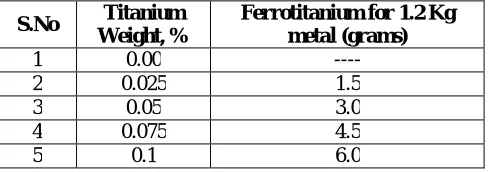
Titanium addition: Titanium is added in the form of Ferrotitanium in powder form by placing it in the bottom of the moulds. The titanium content in the ferrotitanium is taken as 25% and recovery as 80%.The estimated amount of Ferrotitanium added to the melt is as given in Table 2. The temperature of molten iron before pouring into the moulds is 1428 °C.
Table 2: Amount of Titanium addition to Base metal
S.No Titanium
Weight, %
Ferrotitanium for 1.2 Kg metal (grams)
1 0.00 ----
2 0.025 1.5
3 0.05 3.0
4 0.075 4.5
5 0.1 6.0
CASTING: The calculated quantity of trace elements to be added are placed in the bottom of moulds and the high temperature molten iron is poured into the moulds to get the test bars of dimension 30x300 mm length. Then the samples are cooled to room temperature by putting in still air. After cooling, the test bars are taken out from the moulds and are cleaned with the wire brush. Then the samples are sent to the machine shop to prepare the tensile test bars of standard dimensions as per IS: 2078-1979.
Specimen Preparation: Tensile test specimens were prepared from the tensile test bar castings for each composition. The specimens for metallography and hardness were cut from the fractured tensile test specimens.
TESTING:
Tensile strength test: This test was carried out on a Universal testing machine of 60 ton capacity in mechanical testing laboratory at TELCO, Jamshedpur. The load on the test specimen was applied steadily till fracture occurs.
Hardness test: Brinnels hardness test was carried out using a standard hardness testing machine. The steel ball diameter of the indenter is 10 mm and the load applied was 3000 Kg. hardness values are measured at three different places across the cross section of test piece and the average of three values are noted.
Metallography: The samples for photo micro graphs are prepared according to the standard procedure. Around 20 mm thick sample was taken from the fractured tensile test bars. It is polished first on a belt grinder, emery papers of varying specifications from 01 to 03 and finally on a cloth grinder to get a mirror finish to the sample. The microstructure was observed using microscope at 100X magnification without etching and with etching with 2% Nital.
III. RESULTSANDDISCUSSIONS
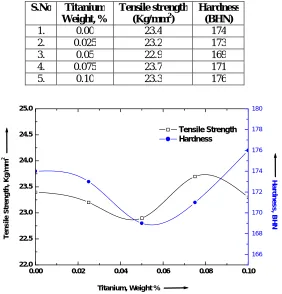
Table 3: Effect of Titanium additions on the tensile strength and hardness
S.No Titanium Weight, %
Tensile strength (Kg/mm2)
Hardness (BHN)
1. 0.00 23.4 174
2. 0.025 23.2 173
3. 0.05 22.9 169
4. 0.075 23.7 171
5. 0.10 23.3 176
Fig. 1: Effect of Titanium additions on the tensile strength and hardness
The above results are also represented in a graphical form shown in Fig. 1. With increasing additions of titanium, both the tensile strength and hardness values show decreasing trend upto 0.05% titanium addition. Beyond 0.05% titanium these values have again revealed improvement in tensile strength and hardness. The changes in the mechanical properties are mainly due to the coarse and thick flaky graphite resulting in lowering tensile strength and hardness values.
0.00 0.02 0.04 0.06 0.08 0.10
22.0 22.5 23.0 23.5 24.0 24.5 25.0 H a rd n e s s , B H N T e n s il e S tr e n g th , K g /m m 2
Titanium, Weight %
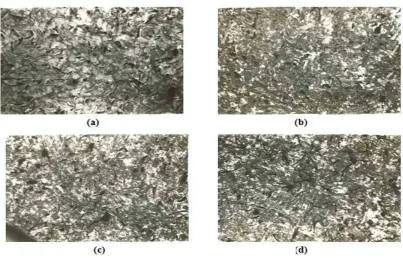
Fig.2: Effect of Titanium additions on the microstructure of Gray Cast Iron (a) Base iron (b) 0.025% Ti (c) 0.05% Ti (d) 0.075% Ti, 100X, Unetched
Fig. 2 and 3 shows the effect of titanium additions on the microstructure of gray cast iron. Microstructure of base gray cast iron consists of type A graphitic structure, with pearlitic matrix. Above change in mechanical properties can also be correlated with the microstructure. Samples containing 0.025 and 0.05% titanium shows coarse and thick graphite flakes resulting in lowering tensile strength and hardness values. Beyond this limit finer graphite flake is an indication of improved mechanical properties.
IV. CONCLUSION
Microstructure of base gray cast iron consists of type A graphitic structure, with pearlitic matrix. With increasing additions of titanium, both the tensile strength and hardness values show decreasing trend upto 0.05% titanium addition. Beyond 0.05% titanium these values have again revealed improvement in tensile strength and hardness. Socare should be taken to avoid the contamination of titanium in trace level from pig iron, non-ferrous metal scrap, vitreous enameled scrap, leaded steel scrap, purchased scrap containing lead or coated with lead based paint. To avoid trace element contamination in charge materials, all bought in scrap should be examined prior to the stockpiling so that undesirable charge materials can be removed
REFERENCES
[1] R. Elliot, “Cast iron technology”, Butterworths, 1996.
[2] Metals hand book on Casting, ASM International, Vol. 15, 9th edition, pp. 627-701, 1988.
[3] Metals hand book on Properties and selection of iron and steel and high temperature alloys, ASM International, Vol. 1, pp. 12-15, 1988.
[4] R.W. Heine, C.R. Cooper and P.C. Rosenthal, “Principles of Metal Casting”, T.M.H edition, 1996.
[5] M.J Fallon, “The effect of some trace elements in cast iron”, Indian Foundry Journal, Vol. 26, No. 6, pp. 1-12, 1980.
[6] C.E Bates and J.F Wallace, “Effect and neutralization of trace elements in gray, ductile and malleable irons”, AFS transactions, Vol. 75,
pp. 815-838, 1968.
[7] R.L Naro and J.F Wallace, “Trace elements in gray cast iron”, AFS cast metals research journal, Vol. 78, pp. 131-134, 1970.
[8] R.L Naro and J.F Wallace, “Minor elements in gray cast iron”, AFS transactions Vol. 88, pp. 229-238, 1980.
[9] R.L Naro and J.F Wallace, “Trace elements in gray cast iron”, AFS transactions, Vol. 87, pp. 311-320, 1979.
[10] C.E Bates and J.F Wallace, “Trace elements in gray cast iron”, AFS transactions, Vol. 74, pp. 513-524, 1967.
[11] R.D Schelleng, “Effect of certain elements on the form of graphite in cast iron”, AFS transactions, Vol. 74, pp. 700-708, 1967.
BIOGRAPHY