*Corresponding author, E-mail: [email protected], 1Present address: Department of Plant Physiology, Institute of Agricultural Sciences, Banaras Hindu University, Varanasi-221 005.
STARCH SYNTHASE ACTIVITY AND GRAIN GROWTH IN WHEAT CULTIVARS UNDER
ELEVATED TEMPERATURE : A COMPARISON OF RESPONSES
PRAVIN PRAKASH1, ANITA KUMARI, D.V. SINGH, RAKESH PANDEY, POONAM SHARMA-NATU AND M.C. GHILDIYAL*
Division of Plant Physiology, Indian Agricultural Research Institute, New Delhi-110 012 Received on 1 July, 2009, Revised on 28 Dec., 2009
SUMMARY
Wheat (Triticum aestivum L.) cvs. HD 2285 and C 306 (relatively tolerant) and HD 2329 and HD 2428 (susceptible type) were exposed during grain development period to 5-7oC higher temperature
in a normal glasshouse and 8oC higher than control in temperature control glasshouse of phytotron
facility. There was more severe depression in grain growth under elevated temperature in phytotron experiment and was associated with greater decrease in the activity of soluble starch synthase (SSS) in the grains. Furthermore, relatively tolerant cultivars showed less decrease compared to susceptible cultivars in grain growth and also showed less decrease in SSS activity. Such parallelism in the effect of elevated temperature on grain growth and SSS activity and relatively tolerant cultivars showing less depression, further suggests that soluble starch synthase is the key component imparting sensitivity to high temperature for grain growth in wheat. The study suggested that thermotolerance for grain growth in wheat could possibly be improved through incorporation of thermostable form of this enzyme.
Key words: Grain growth, starch synthase, thermotolerance, wheat
2001). There is a need therefore, to develop wheat varieties having tolerance to high temperature particularly during grain development.
In was reported earlier that decrease in grain growth and starch accumulation in wheat under high temperature is through a decrease in soluble starch synthase (SSS) activity (Prakash et al. 2003). This was shown in the experiments whereby plants were exposed to high temperature during grain development in glasshouse or in control vs heated open top chambers (Prakash et al. 2003, Sharma-Natu et al. 2006, Sumesh et al. 2008). This was further verified in excised grains exposed to different temperature in the lab condition (Prakash et al. 2004, Sumesh et al. 2008). In the present study effect of high temperature on grain growth and soluble starch
INTRODUCTION
synthase activity was compared when high temperature exposure was given in a normal glasshouse with that of control environment exposure in phytotron.
MATERIALS AND METHODS
Wheat (Triticum aestivum) cvs. HD 2285 and C 306 (relatively tolerant) and HD 2329 and HD 2428 (susceptible types) were grown in glazed china clay pots (50 x 25 cm) containing sandy loam soil. All recommended cultural practices were followed (Singh 1983). At anthesis, fifty per cent of total number of pots of each cultivar were transferred to a normal glasshouse to provide elevated temperature (ET) condition. Plants remained outside in the pot culture served as control (C). The maximum and minimum temperature of glasshouse and pot culture were recorded daily to assess the temperature difference. The temperature in the glasshouse was around 5-7oC higher than outside control throughout the grain development period. These wheat cultivars were also grown in temperature controlled glasshouses of phytotron in the National Phytotron Facility at Indian Agricultural research Institute, New Delhi. All the plants were grown at 21o/18oC, day and night temperature respectively upto anthesis stage. After anthesis, half of the total number of pots continued to remain at 21o/18o (control) whereas, remaining half were shifted to another glasshouse of the phytotron facility for high temperature (30o/25oC) treatment during grain development. The day temperature was maintained from 8 AM to 6 PM whereas, the night temperature was maintained from 6 PM to 8 AM. The temperature control was regulated by an automatic time sensor and thermostat and change of temperature was attained within half hour period.
Dates of ear emergence and anthesis in the main shoot (MS) were recorded on tags placed on each plant. The ears of MS of four wheat varieties were harvested at anthesis and 10, 20, 30, 40 and 50 days after anthesis (DAA). The grains were separated from ears, dried in an over till constant weight and dry weights were recorded. Soluble starch synthase was determined in the basal grains of middle spikelets of MS ear at 20 and 30 days after anthesis representing peak starch synthesis period. Grain samples were taken around 11.00 h and stored in liquid nitrogen. SSS was extracted following the
method described elsewhere (George et al. 1994). Soluble starch synthase activity was estimated by the amount of ADP formed from ADPG. ADP estimation was carried out by using a preparation of pyruvate kinase which catalyses the transfer of phosphate from phosphoenol pyruvate to ADP. Pyruvate liberated was estimated (Leloir and Goldenberg 1960). There were three replications for each determination. The data were analyzed statistically to determine CD value (Panse and Sukhatme 1967).
RESULTS AND DISCUSSION
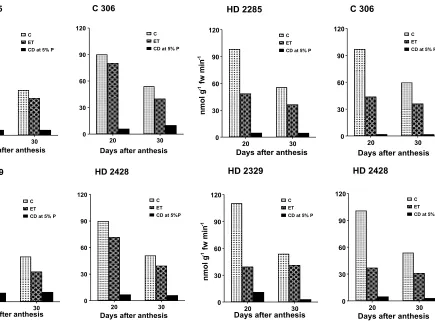
SSS activity in the grains was also found to be significantly lower under elevated temperature in glasshouse grown plants compared to control, 20 and 30 DAA in all the cultivars (Fig. 3). The decrease in SSS activity compared to control was 10.53 and 17.97 % in HD 2285, 20 and 30 DAA (Table 2). C 306 showed a depression of 10.76 and 25.97 % in SSS activity by elevated temperature 20 and 30 DAA. The decrease in SSS activity under elevated temperature was 37.48 and 33.29 % in HD 2329 and 20.19 and 22.89 % in HD 2428 at 20 and 30 DAA. It may be mentioned that relatively tolerant cultivars (HD 2285 and C 306) showed least decrease in SSS activity by elevated temperature compared to susceptible types (HD 2329 and HD 428), 20 DAA, the peak stage of starch synthesis in wheat grain. The activity of SSS was greatly reduced under
HD 2285
HD 2329
C 306
0 10 20 30 40 50 0
20 40 60
0 10 20 30 40 50
0 20 40 60
HD 2428
0 10 20 30 40 50 0
20 40 60
0 10 20 30 40 50
0 20 40 60 1000 grain w eight (g) 1000 grain w eight (g )
Days after anthesis Days after anthesis
Days after anthesis Days after anthesis
C ET CD at 5% P
C ET CD at 5% P C
ET CD at 5% P
C ET CD at 5% P
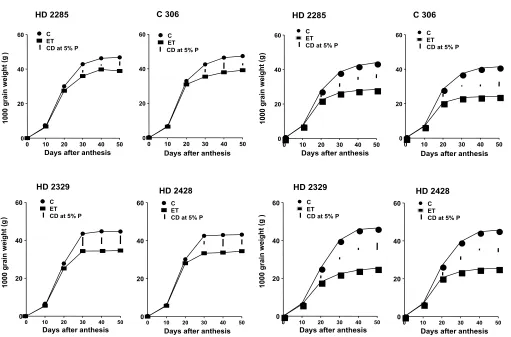
Fig. 1. Course of development of grains (1000 grain weight) of MS of wheat cultivars under control (C) and elevated temperature (ET) of glasshouse
HD 2285 HD 2329 C 306 n n n
n n n
l
l
l l
l l
0 10 20 30 40 50 0 20 40 60 n n n
n n n
l
l
l l
l l
0 10 20 30 40 50
0 20 40 60 HD 2428 n n n
n n n
l
l
l l
l l
0 10 20 30 40 50 0 20 40 60 n n n
n n n
l
l
l l
l l
0 10 20 30 40 50
0 20 40 60 1000 grain w eight (g) 1000 grain w eight (g)
Days after anthesis Days after anthesis
Days after anthesis Days after anthesis
C ET CD at 5% P
C ET CD at 5% P C
ET CD at 5% P
C ET CD at 5% P
Fig. 2. Course of development of grains (1000 grain weight) of MS of wheat cultivars under control (C) and elevated temperature (ET) in phytotron
Table 1. Per cent decrease in thousand grain weight of
MS in wheat cultivars by elevated temperature
Cultivar Days after anthesis
10 20 30 40 50
Glasshouse
HD 2285 NS NS 16.12 31.85 16.88
C 306 NS NS 16.70 18.28 17.30
HD 2329 NS NS 21.15 23.27 22.42 HD 2428 NS NS 21.61 21.57 20.14
Phytotron
elevated temperature in phytotron (Fig. 4). The decrease in SSS activity 20 DAA in phytotron experiment was between 50.48 to 64.28 % (Table 2). Under phytotron condition also, HD 2285 and C 306 considered to be relatively tolerant to high temperature, showed lesser decrease in SSS activity under elevated temperature over control compared to susceptible types HD 2329 and HD 2428, 20 DAA, the peak stage of starch synthesis in wheat grain.
In the present study, plants were exposed to 5-7oC higher temperature in glasshouse than outside grown plants, whereas, in phytotron experiment the mean temperature was 8oC higher than control during grain development period. Furthermore, in phytotron experiment elevated temperature was much harsher in the sense that given temperature was attained within half
HD 2285
HD 2329
C 306
HD 2428
20 30
0 30 60 90 120
C ET CD at 5% P
20 30
0 30 60 90 120
C ET CD at 5% P
20 30
0 30 60 90 120
C ET CD at 5% P
20 30
0 30 60 90 120
C ET CD at 5%P
nmol
g
-1fw
min
-1
nmol
g
-1fw
min
-1
Days after anthesis Days after anthesis
Days after anthesis Days after anthesis
Fig. 3. Soluble starch synthase activity (nmol g-1 fw min-1) in the developing grains of MS ear in wheat cultivars under control (C) and elevated temperature (ET) of glasshouse
HD 2285
HD 2329
C 306
HD 2428
20 30
0 30 60 90
120 C
ET CD at 5% P
20 30
0 30 60 90 120
C ET CD at 5% P
20 30
0 30 60 90 120
C ET CD at 5% P
20 30
0 30 60 90
120 C
ET CD at 5%P
nmol
g
-1fw
min
-1
nmol
g
-1fw
min
-1
Days after anthesis Days after anthesis
Days after anthesis Days after anthesis
Fig. 4. Soluble starch synthase activity (nmol g-1 fw min-1) in the developing grains of MS ear in wheat cultivars under control (C) and elevated temperature (ET) in phytotron
Table 2. Per cent decrease in soluble starch synthase
activity in the grains of MS in wheat cultivars by elevated temperature
Cultivar Days after anthesis
20 30
Glasshouse
HD 2285 10.53 17.97
C 306 10.76 25.97
HD 2329 37.48 33.29
HD 2428 20.19 22.89
Phytotron
HD 2285 50.48 34.53
C 306 54.78 39.48
HD 2329 64.28 23.33
hour and maintained at that level, as a result, the overall energy received was greater under such conditions. On the other hand mean temperatures computed in other experiment conceal large diurnal fluctuations and the maximum is not retained for a longer period. Plants were therefore, exposed to much higher temperature stress in phytotron experiment than glasshouse. The more severe depression in grain growth and SSS activity under ET in phytotron experiment is therefore understandable. The cultivar difference in susceptibility and tolerance, however, remained the same.
The more severe depression in grain growth under elevated temperature in phytotron experiment was associated with greater decrease in SSS activity in the grain. Furthermore, relatively tolerant cultivars showed lesser decrease compared to susceptible cultivars in grain growth and also showed less decrease in SSS activity. Such a parallelism in the effect of elevated temperature on grain growth and SSS activity further suggests that SSS is the key component imparting sensitivity to high temperature for grain growth in wheat. These observations are in line with the report that synthesis of starch in wheat endosperm at high temperature is predominantly controlled by the activity of SSS (Jenner et al. 1993, Hawker and Jenner 1993, Keeling et al. 1994). The higher sensitivity of this enzyme to high temperature has also been reported (Rijven 1986, Chaudhary-Mehra et al. 1994, Prakash et al. 2003, 2004). Therefore, a thermostable form of SSS has to be identified in order to improve the thermotolerance for grain growth in wheat.
Cultivar differences in thermotolerance for grain growth were observed in the present study and were also reported earlier (Prakash et al. 2003, 2004, Zahedi et al. 2003). Sumesh et al. (2008) and Sharma-Natu et al. (2009) observed that high temperature tolerance of a cultivar for grain growth was associated with higher efficiency of SSS at elevated temperature and higher content of heat shock proteins (HSP 100 and HSP 18) in the grains. HSPs are known to function as molecular chaperones that aid in refolding proteins denatured by heat and prevent them from aggregating (Vierling 1991, Boston et al. 1996, Iba 2002). It appeared that the
association of SSS activity at higher temperature with level of HSP in wheat grain could be through the protection of SSS from heat denaturation. HSP 18 was found to be induced even at moderately high temperature and its association with thermotolerance for grain growth in wheat has been reported (Sharma-Natu et al. 2009). It seems that thermotolerance for grain growth in wheat could be improved through incorporation of thermostable form of SSS and by overexpressing HSP 18, which would possible protect SSS from heat denaturation.
ACKNOWLEDGEMENTS
The authors thank Professor K.V. Prabhu for providing Phytotron facility. The financial assistance provided by Council of Scientific and Industrial Research, New Delhi, is gratefully acknowledged.
REFERENCES
Asana, R.D. and Williams, R.F. (1965). The effect of temperature stress on grain development in wheat. Aust. J. Agric. Res. 16: 1-13.
Boston, R.S., Vitanen, P.V. and Vierling, E. (1996). Molecular chaperones and protein folding in plants. Plant Mol. Biol. 32: 191-222.
Bowes, G. (1993). Facing the inevitable – plants and increasing
atmospheric CO2. Annu. Rev. Plant Physiol. Plant Mol.
Biol. 44: 309-332.
Chaudhary-Mehra, R., Shukla D.S. and Pande, P.C. (1994). Biochemical basis of high temperature tolerance in developing grains of wheat (Triticum aestivum L.). Indian J. Exp. Biol. 32: 296-298.
Chinoy, J.J. (1947). Correlation between yield of wheat and temperature during ripening of grain. Nature 159: 442-444.
George, W.S., Roshie, B. and Keeling, P.L. (1994). Heat stress during grain filling in maize: Effect on carbohydrate storage and metabolism. Aust. J. Plant Physiol. 21: 829-841.
Hawker, J.S. and Jenner, C.F. (1993). High temperature affects the activity of enzymes in the committed pathway of starch synthesis in developing wheat endosperm. Aust. J. Plant Physiol. 20: 197-209.
Howard, A. (1924). Crop Production in India. Oxford Univ. Press, London.
Iba, K. (2002). Acclimation response to temperature stress in higher plants: Approaches of gene engineering for temperature tolerance. Annu. Rev. Plant Biol. 53: 225-245.
Jenner, C.F., Siwek, K. and Hawker, J.S. (1993). The synthesis
of (14C) starch from (14C) sucrose in isolated wheat grain
is dependent upon the activity of soluble starch synthase. Aust. J. Plant Physiol. 20: 329-335.
Keeling, P.L., Banisadr, R., Barone, L., Vasserman, B.P. and Singletary, G.W. (1994). Effect of temperature on enzymes in the pathway of starch biosynthesis in developing wheat and maize grain. Aust. J. Plant Physiol. 21: 807-827.
Leloir, L.E. and Goldenberg, S.H. (1960). Synthesis of glycogen from uridine diphosphate glucose in liver. J. Biol. Chem. 235: 919-923.
McDonald, G.K., Sutton, B.G. and Ellison, F.W. (1983). The effect of time of sowing on the grain yield of irrigated wheat in the Naomi Valley, New South Wales. Aust. J. Agric. Res. 34: 229-240.
Panse, V.G. and Sukhatme, P.V. (1967). Statistical Methods for Agricultural Workers. ICAR Publication, New Delhi.
Prakash, P., Sharma-Natu, P. and Ghildiyal, M.C. (2003). High temperature effect on starch synthase activity in relation to grain growth in wheat cultivars. Indian J. Plant Physiol. (special issue) 8: 390-398.
Prakash, P., Sharma-Natu, P. and Ghildiyal, M.C. (2004). Effect of different temperature on starch synthase activity in excised grains of wheat cultivars. Indian J. Exp. Biol. 42: 227-230.
Ravi, I., Khan, F.A., Sharma-Natu, P. and Ghildiyal, M.C. (2001). Yield response of durum (Triticum durum) and
bread wheat (Triticum aestivum) varieties to CO2
enrichment. Indian J. Agric. Sci. 71: 431-436.
Rijven, A.H.G.C. (1986). Heat inactivation of starch synthase in wheat endosperm tissue. Plant Physiol. 81: 448-453.
Sharma-Natu, P., Sumesh, K.V., Lohot, V.D. and Ghildiyal, M.C. (2006). High temperature effect on grain growth in wheat cultivars: An evaluation of responses. Indian J. Plant Physiol. 11: 239-245.
Sharma-Natu, P., Sumesh, K.V. and Ghildiyal, M.C. (2009). Heat shock protein in developing grains in relation to thermotolerance for grain growth in wheat. J. Agron. Crop Sci. 195 (accepted, in press).
Singh, C. (1983). Modern Techniques of Raising Field Crops. Oxford IBH Publishers, New Delhi.
Sumesh, K.V., Sharma-Natu, P. and Ghildiyal, M.C. (2008). Starch synthase activity and heat shock protein in relation to thermal tolerance of developing wheat grains. Biol. Plant. 52: 749-753.
Vierling, E. (1991). The roles of heat stock proteins in plants. Annu. Rev. Plant Physiol. Plant Mol. Biol. 42: 579-620.
Wardlaw, I.F., Dawson, I.A. and Munibi, P. (1989). The tolerance of wheat to high temperatures during reproductive growth II. Grain development. Aust. J. Agr. Res. 40: 15-24.
Weigand, C.L. and Cuellar, J.A. (1981). Duration of grain filling and kernel weight of wheat as affected by temperature. Crop Sci. 21: 95-101.
Zahedi, M., Sharma, R. and Jenner, C.F. (2003). Effects of high temperature on grain growth and on the metabolites and enzymes in the starch synthesis pathway in the grains of two wheat cultivars differing in their responses to temperature. Funct. Plant Biol. 30: 291-300.