Conductivity and Artificial Neural
Networks applied to the evaluation of the
apparent mass diffusion coefficient in
concrete
T. Kermezli1, K. Amokrane1, A. Bensmaili2, A. Gacemi1 [email protected]
1 University Dr. Yahia Fares of Medea, Algeria. 2LGR USTHB Algeria
Abstract
The aim of this paper is the determination of the routine of chemical species in porous modeling material in transient state by means of conductivity mass balance. The experimental results and the inherent characteristics of concrete which from have given an apparent diffusion coefficient in the range of 10-11, gathered into a data base enable to us develop a neural model capable of predicting the apparent diffusion coefficient in concrete with error not exceeding 0.09%.
Keywords: Conductivity, Modeling, Artificial Neural Networks, Concrete, Diffusion coefficient.
1. Introduction
A moist environment containing aggressive agents is a source of progressive and irreversible degradation for the reinforced concrete structures. This degradation reduces the bearing capacity of the original structure, significantly reduces the lifetime of the structure and alter its aesthetics. Auscultation periodic structures in reinforced concrete in a preventive or curative thus presents an economic issue. Indeed, the strengthening and rehabilitation of buildings affected induce economic overload in the overall management of the housing and basic infrastructure such as bridges and tunnels.
Damage to structures walls in wetland is due to the aggressive agents penetration (carbon dioxide, chlorides, sulfates ...) in the porous network of construction material. The diffusion of water is a relative parameter for the penetration. The loaded water enters the unsaturated concrete under a diffusive process and causes corrosion of the framework of the other hand, alkali-aggregate reactions, cycles of freeze-thaw and alkali leaching.
The quantitative approach Hygrothermal natural climatic stress take place that are heat and water acting separately or together [1] for uncoated concrete walls target to understand the potential chemical-physics parameters at the origin of pathology proven affecting sustainability [2] of structures. The computing codes used in the design of the building walls include the thermal diffusivity as a fundamental in formation [3], while the mass transfer has also its importance in the studied process. So the characteristic determination is moisture diffusivity under isothermal conditions, it characterizes the intensity of the moisture transfer process in a porous material. The determination of the diffusivity by conventional methods requires long and difficult measures. One can avoid this by means of the conductivity method to determine the routine of the mass diffusion in this material [4, 5] under transient state.
This article aims to develop a methodology for early diagnosis of pathological risks in wet and aggressive concrete along a statistical approach based on Artificial Neural Networks (ANN), an advantageous and predictive technique used for its parsimony and simplicity [6].
2. Principle of the conductivity method
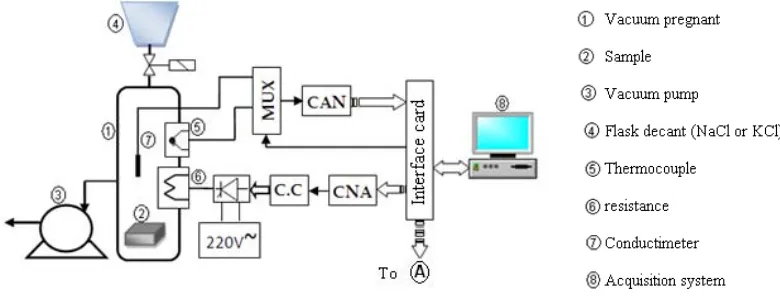
Firstly, the sample is successively weighed to determine its initial density, secondly dried at a temperature of 105°C then, covered with resin to keep water on its sides and impregnated under vacuum with a salt tracer KCl (0.2M) at a temperature T°. (Figure 1)
Figure 1: Illustration of the vacuum impregnation of the sample
The sample is then immersed at a speed stirring for a rotation ω and temperature T in ionized distilled water simultaneous data conductivity is acquisitions are collected. We measure the conductivity variation of distilled water containing the sample against time through its free faces in transient state. (Figure 2)
Figure 2: Illustration of the measurement concentration of desorption.
3. Modeling
Our model is based on the mass balance of chemical species diffusing through an elementary volume of the composite. The general equation governs the diffusion mass transfer for different geometries of the composite. The model is based on the fact that the composite has an initial concentration (c0) and remains in a stirred media for a concentration (c∞). The coefficient of surface mass transfer (k) is considerable as the surface concentration
(cs) still constant and is equal to (c *) while starting the process (c = * kp. C∞). One determines the
concentration distribution inside the composite for a finite simple geometry during desorption. This consideration can be explained in dimensionless form, as in our case it works in the absence of terms of production and convection, and then we get:
0
)
,
(
)
,
(
)
,
(
2 2
j j j i j j
j j i iapp j
j j i
X
Fo
X
C
X
X
Fo
X
C
D
Fo
Fo
X
C
(1)
With: Cireduced concentration {Ci = (ci – ci0) / (cip – ci0)}, Xj = ζ/ξ the reduced size {Xj = Xl = x / L:
longitudinal direction for the reduced and Xj= Xl= r / R: for radial direction} and (Fo)j = (Diapp . t) / ξ2 {(Fo)l =
Similarly, it is possible to reach the quantity of the substance released experimentally at time t (mt)exp from the
instantaneous concentration (ct)exp measured by the meter:
m
t
exp
c
t
exp
v
sol
(2)
Where mt is, the mass of the released substance at time t, m∞ is the mass of the transferred substance after total
desorption of the sample at infinite time; vsolthe volume is the liquid solution immersing the object.
The solution for the previous system is:
0 2 2 2 2 24
)
1
2
(
exp
)
1
2
(
1
8
1
n app i tt
l
D
n
n
m
m
(3)The bulk diffusion coefficient of our mortar is indirectly inferred from experimental measurements of conductivity of water that is initially distilled with the instantaneous concentration Ci.
Solute concentration CKCl (mM) during desorption (equation 4) is calculated from the limit equivalent
conductivity
x (
K(
T
)
or
Cl(
T
)
(extrapolated to infinite dilution) of solute ions used at temperatureT(°C) [4].
2 3
2
3
0 25 25 25 25 25 25 ) ( ) ( ) ( T c T b T a T c T b T a T T mM c t KCl t KCl Cl K KCl KCl (4)
With:
KCl The conductivity of the solute indicated by the meter as versus time.4. Statistical modeling by ANN
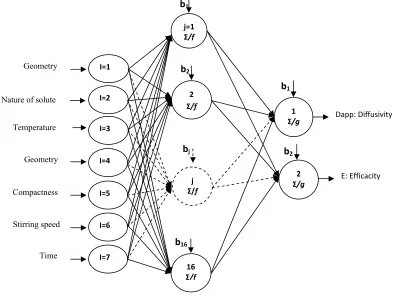
The data used in this work were taken from the experimental database. A restricted of data was dedicated for validation, testing and interpolation of data. So as to describe the kinetics of desorption of aqueous solution in the concrete by an ANN model. We selected seven variables supposed to govern the process under study that are the nature of the aqueous solution, concentration, temperature, stirring speed, time, geometry and the compactness of the flask. The main objective is to achieve the most appropriate architecture in relation to the assigned task and the network which is most able to cope for less available data. Above all, some researchers [7, 8] have proposed new methods of learning often in layers to overcome practical limitations of back propagation and to better exploit the potential of internal representation of networks. The design and optimization focus the most appropriate number of hidden layers and the number of neurons needed in each case.
5. Results and discussion
Figure 3: Architecture of the neural network optimized.
Table 1: Structure of the ANN optimized model
Network
Type Algorithm
Input layer Hidden layer Output layer Neurons number Neurons number Activation function Neurons number Activation function FFBP NN
(newff) gradient (trainscg) Scaled conjugate 7 16 (tansig) 2 (purelin)
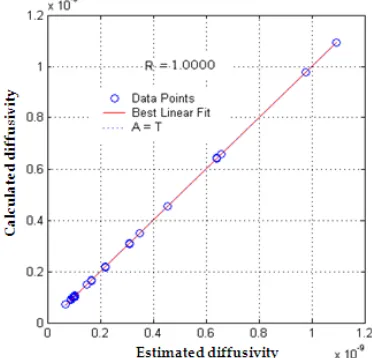
That are the comparison between the desired outputs and response network is represented by plots illustrated in Figures 4-7. For all studied test / generalization phases, the correlation coefficient R=1.0000. This result confirms the robustness of the neural model established and the possibility of predicting the various parameters that characterize the mass diffusion in anisotropic porous media.
Dapp: Diffusivity
b2
bj
Stirring speed Compactness
Geometry I=1
I=2
I=3
I=4
I=6
I=7
I=5
b1
j=1 Σ/f
b2
2 Σ/f
b16
25 16 Σ/f j
Σ/f
1
Σ/g
2
Σ/g
Nature of solute
Temperature
Geometry
Time
E: Efficacity
Figure 4:Comparison between desired outputs Figure 5: Comparison between desired outputs to the ANN calculated (Efficiency - test). to the ANN calculated (Diffusivity - test).
Figure 6:Comparison between desired outputs Figure 7: Comparison between desired outputs to the ANN calculated (Efficiency - validation). to the ANN calculated (Diffusivity-validation).
Table 2: ANN statistics performance
ANN AARE (%) test generalization AARE (%) MAETest case (%)
Diffusivity 0.09 0.089 0.078
Performance of mass
transfert 0.52 0.51 6.13 10-11
0 2 4 6 8 10 12 14 16 18 20 22 0,0
2,0x10⁻¹⁰ 4,0x10⁻¹⁰ 6,0x10⁻¹⁰ 8,0x10⁻¹⁰ 1,0x10⁻⁹ 1,2x10⁻⁹
Calculated diffusivity Estimated diffusivity
D
iffu
si
vi
ty
Numberofexperiments
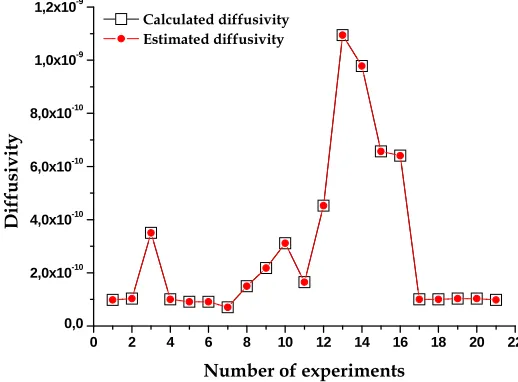
Figure 8: Comparison between the experimental and the optimized ANN estimated diffusivity.
6. Conclusion
Despite the complexity of the phenomena of mass transfer due to the interdependence of numerous parameters, the model of artificial neural networks have been advantageously used for predicting the apparent diffusivity in anisotropic porous medium that is Concrete, that for a range of 10-11. The ANN is an optimized architecture (7-16-2). This was achieved by implementation strategy based on the evaluation parameters of best fit validation agreement plots (correlation coefficient R = 1). The optimized ANN is able to predict the apparent diffusivity with EAM which not exceed 0.09%. This outcome shows the performance and predictive ability of ANN might be coupled with an expert system for preventing the degradation of a porous medium in a humid environment.
REFERENCES
[1] S.F. Wong, T.H. Wee, L. Swaddiwudhipong and S.L. Lee, Study of water movement in concrete, Magazine of Concrete Research, 53(3): pp 205-220, (2001).
[2] O.S.B. Al-Amoudi, Durability of plain and blended cements in marine environments Advances in Cement Research 14(3): pp 89-100, (2002).
[3] H.m. Künzel and A.N. Karagiozis, WUFIORNL/IBP, Hygrothermal Design Tool for Architects ans Enngineers, Manual 40 in Moisture Analysis and Condensation, Control in Building Envelopes, (2001) .
[4] T. Kermezli, S. Hanini and A. Bensmaili, Mass Transfer in an Anisotropic Porous Medium-Experimental Analysis and Modelling of Temperature and Desorption Direction Effect, Adv. Theor. Appl. Mech., 1(8): pp 349-360, (2008).
[5] K. Amokrane, T. Kermezli, A. Bensmaili, D. Amarbouzid and A. Gacemi, Modeling and experimental measurement of mass diffusion coefficient in a standard cement mortar under isothermal conditions, Contemporary Engineering Sciences, Vol. 3(6), pp:259 – 267, (2010).
[6] K. Park, T. Noguchi and J. Plawsky, Modeling of hydration reactions using neural networks to predict the average properties of cement paste, Cement and Concrete Research, 35(9) pp: 1676-1684, (2005).