A CASE STUDY OF SERIOUS COPMLICATION BY VAMANA KARMA
Kulkarni Satyajit Pandurang
HOD, Associate professor, PG Department of Panchakarma, Yashwant Ayurvedic College, Ko-doli, Kolhapur, Maharashtra, India
INTRODUCTION
Panchakarma treatments are popular
treat-ments nowadays. Although under
Pancha-karma a number of procedures are per-formed some of them are only external, some of them internal and some are mixed.
The importance of classical 1Panchakarma
i.e. 2Vamana, Virechana, Niruh Basti,
Anuvasan Basti and Naysa remains un-abated. As the drugs, dosages, and the me-thod of administration of these classical Panchakarma is not followed perfectly and varies region wise. Even sometimes compli-cations of these procedures occur, but go unnoticed as they are not discussed. The
dif-ficulty in performing Vamana or
Virechan-karma is that the dosage and the procedure described in the text cannot be understood or followed perfectly. For example one cannot
decide the dosage of Madanfal in
Vaman-karmaonly by reading texts. He has to learn it practically and do it repeatedly to perform Vamanakarma confidently. Unfortunately, erroneous method of performing these pro-cedures have been practiced and taught in some institutes that is why, fresher follow
1 Charak Samhita Sutrashthana, 2/15 2Sharngdhar Samhita Uttarkhanda, 8/70
the same method and can lead to complica-tion. Aim of this publishing the case study is not to scare others, but to make vigilant while performing these procedures and avoid the complications.
Case report
A female of 48 was brought by her hus-band to the O.P.D. for psoriatic patches at both the foot. Itching and secretions were troubling her since 5 days. No sleep during night due to itching at that site. She was a
known case of Rheumatic heart disease
since 30 years. She had mitral stenosis and 2 times got serious heart complaints. She was
undergone BMV (Balloon Mitral
Valvot-omy) under guidance of cardiac physician before 3 years. Since then she had almost no cardiac related complaints. Though the pa-tient was suffering from R.H.D. She was not having any cardiac symptoms from 3 years and she was more troubled with psoriasis. She was taking treatment for R.H.D. at
car-diologist so I decided to go for Virechana.
Patient and her relatives were well educated, rich enough and wanted to go by my opi-nion.
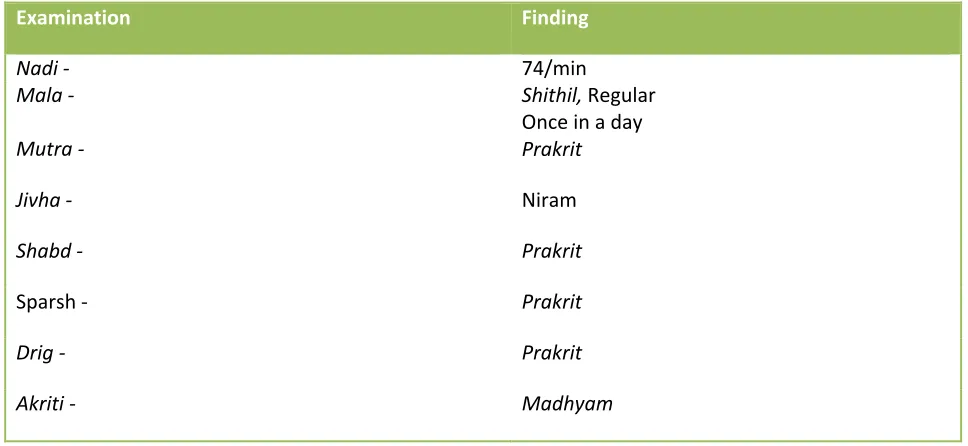
Table No 1 Ashtavidh Pariksha
-Examination Finding
Nadi - 74/min
Mala - Shithil, Regular
Once in a day
Mutra - Prakrit
Jivha - Niram
Shabd - Prakrit
Sparsh - Prakrit
Drig - Prakrit
Akriti - Madhyam
INVESTIGATIONS –
All the investigations relating to her disease were done already by physician’s advice. She showed me reports. Blood investiga-tions were normal. Her blood sugar levels and urine sugar levels were within normal limits. ECG was normal. Investigations were done 15 days before.
EXAMINATION
-I examined the patient carefully there were no cardiac related signs and symptoms. She was taking one anticoagulant, beta-blocker, diuretic and antacid regularly under cardiac physician’s observation. Only the psoriasis was worsened. There was no treatment for psoriasis as per modern medical specialists. So patient used to go to Ayurvedic doctor and got temporary relief. They transferred city and that is why visited our hospital.
Preparatory procedure for Panchakarma
started. Written consent was taken. I used
to closely observe the patient. 3Rukshana
was advised prior to Snehapan. For that 3gm
3Charak Samhita Sutrasthana 13/49, 53
Trifala Churna was given for 3 times for 1 day. Patient was told to drink hot water only.
From the next day Snehpana was started.
60ml cow ghee was given with gruel twice a day 60ml at 9 AM and 8 PM so the total dose of 120ml per day. This method of ghee administration with small quantity of food is 4Vicharana Snehpana. Snehapanawas
con-tinued till 5Samyak Snehan Lakshana were
seen. In this case, it was period of 5 days.
Thus, Snehapanawas given for total 5 days.
Her general condition during Snehpana was
getting deteriorated. At that time respiratory rate was increased but mild only. Symptoms automatically alleviated after ghee got di-gested completely. She was explained all the
6does and don’ts during Snehapana and she
followed it. On the Sneha Vishram Din 7oil
massage was performed to the whole body by Dashmool Bala Taila followed by Mridu
4Ashtang Hridya Sutrashthana, 16/14 5 Charak Samhita Sutrasthana, 13/58 6 Charak Samhita Sutrashthana 13/62
Nadi Sweda to the whole body. Patient was complaining of nausea and she felt that she might have vomiting. The above symptoms
were showing the movement of Dosha to the
upward direction. That is why performing Vamana was relevant in this case. There are 3 reasons for that
1) As per 8Doshagati which is Urdhva,
Adha and Tiryak. One should follow it.
In this case it was Urdhva, so Vamanais
treatment of choice.
2) 9One should not Perform Virechana in
the patient who has not undergone
Va-manaalready.
3) 10Sushruta have indicated Vamana in Hridroga too and it is indicated in Kushthaby both Charakaand Sushruta
So, I decided to performVamanainstead of
Virechana and instructed the patient to
consume 11Kapha- Utklesh Karak Aahar
like rice and curd during evening.
On the next morning, again performed mas-sage and hot fomentation in the same way as that of previous day. Her parameters like B.P., Pulse, RR, and Temperature were ex-amined. They were within normal limits. Vamana commenced. First, cow milk was given to drink. She drank 1 liter cow milk.
She refused to drink Yashtimadhu Fanta
from first glass but managed somehow to
finish about 4 glasses of Yashtimadhu Fanta
Her will power was strong that is why even after so much critical illness she was
under-going the therapy. 12Vamak Aushadhi
8 Charak Samhita Sutrasthana 17/113
9Sushruta Samhita Chikitsasthana 33/19
10 Sushruta Samhita Chikitsasthana 33/18 11 Charak Samhita Sidhisthana 1/8
12 Ashtang Hridya Sutrasthana 18/14, Ashtang Sangrah Sutrasthana 18/14
nistered in form of medicinal paste after
enchanting the Mantra.
Medicinal Paste (Vamak Aushadhi) 1)
Ma-danfal – 3gm 2)Saindhav (rock salt) – 1gm, 3) Madhu(Honey) – 10 gm
Vamanopaga Aushadhi: 1) Cow milk – 1
liter 2) Yashtimadhu Fanta– 1 liter 3)
Lava-nodaka – 1 liter
13Vamana started 20 minutes after ingestion
of medicinal paste. 4 vegoccurred finely but
patient then was not replying to further Vega. She was avoiding vomiting. Her hus-band was also present and encouraging her.
Again two vomiting were seenYashtimadhu
fantawas expelled in larger quantity. Patient was feeling uncomfortable. Therefore She was reexamined there was not much in-crease in B.P., Pulse but difficulty in breathing and uncomfortable feeling in ab-domen (B.P. 140/90 mmhg, pulse- 88/min
RR- 20/min). I finished Vamana somehow
by giving 2 glasses of Lavanodaka. Again
Vomiting occurred 2 times and all the con-tents returned. This time she felt better. I suspected this patient may complicate
fur-ther so stopped Vamana further and
Dhoom-panawas administered.
In the end BP was normal (2 hours after Vamana 120/80 MMHG pulse – 74/min
RR-21/min) but by text, type of Shudhi is Hina
type as the Pitta was not expelled, neither
Tiktasyatawas felt by patient. Though total
Vamana Vega 8 as per Laingiki Shudhi it is
Hina Shudhi. I explained her entire regimen
after Vamana as per Hina Shudhi which
means Peya – 1 Annakala, Vilepi – 1
Anna-kala and Yusha -1 AnnaAnna-kala and as the pa-tient was vegetarian mutton soup avoided
That day passed safely. During evening her husband called me and asked some quarries.
She consumed Peya ones and Yusha once
but feeling little pain in abdomen and dysp-noea (mild). I thought it will relieve after rest.
But the destiny was not on my side. On the next day during noon her husband called me and told she has stopped eating and com-plaining of dyspnoea. I ran to her home and checked her meticulously. I found that she had 4 loose motions and moderate dyspnoea (pulse – 90/min, RR- 24/min) looking these parameters I suggested her husband to im-mediately transfer her to a multispecialty hospital. Within 15 minutes we rushed to the hospital where physician told me that she is already suffering from RHD, and watery stool motions further can cause dehydration so she is in critical condition she was ad-mitted in ICU and she was given oxygen and other supportive treatment. But later on after 3 days patient was responding to the treat-ment so shifted to another hospital at district place. Diahorrea was subsided on the same day with total of 6 watery stool motions. But dyspnoea was not subsiding. In the next hospital she was admitted for almost 10 days.
Due to Virechana dehydration occurred.
There may be increase in her venous return due to feedback mechanism. The increase in venous return could not be compensated by the weak heart. Fortunately she received oxygen therapy and other medicines in time. Otherwise she would have suffered from pulmonary edema. Thereafter, the patient was treated by anti-anginal, beta blockers, calcium channel blockers, oxygen therapy
etc under cardiac physician observation.
After 10 days (almost 13 days after
Va-mana) she felt fine and discharged from the
hospital. The patient or family members fortunately never blamed me in any way.
As per Ayurvedic classics this is Vamana
Ayoga Vyapad called 14Upadrva
Causes – Mridu Aushadhi in Snighdha
(un-ctuous) and Mridu Koashthaperson
Symptoms – 1) Tandra
2) Gurav 3) Klama 4) Daurbalya 5) Angasad
Treatment – 1) Aashu Vamana
2) Langhan 3)Pachan
4) Snigdh, Teekshna Shodhan In my patient all these signs and symptoms were present. Ayurvedic diagnosis and mod-ern diagnosis of the same patient can be en-tirely different at one time. For example I have a known hypertensive patient of age
76. He is obese, having KrurKoshtha. He
tells me when he gets constipation he feels
his blood pressure increased and after Niruh
basti he gets all the sign and symptoms gets relieved.
CONCLUSION
1) Vamana or Virechana should be avoided in the seriously ill patients or having com-plicated medical disorder such as RHD (Rheumatic heart disease) this is very se-rious disease because it directly causes pul-monary edema which is very serious condi-tion and rapidly leads to death.
2) In other patients also one should perform Vamana Karma at a place where he can
manage or refer to hospital where casualty can be successfully handled and where all the facilities are available.
3) Even not so in your hospital you should keep all the arrangements of intravenous fluid therapy and oxygen therapy. One should take written consent of the patient prior to these procedures
4) One should read and write about true
Vyapad experiences of various
Pancha-karmaprocedures through journals. REFERENCES
1. Charak Samhita: Kashinath Shashtri, Go-rakh Nath Chaturvedi, Choukhambha Bha-rati Academy, Varanasi, 1998.
2. Sushruta Samhita: K. L. Bhishagratna, 5th
Edition, Choukhambha Sanskrit Series, Va-ranasi, 1976.
3. Ashtang Hridya: Dr. Bramhanand Tripa-thi, Choukhambha Sanskrit Pratishthan, Va-ranasi, 2003.
4. Ashtang Sangrah: Lal Chandra Shastri, 1s Edition, Shri Baidyanath Ayurved Bhavan Limited, Nagpur, 1959
5. Panchakarma Ki Satyakathaein by Late Dr.T.M. Gogate, Edited by Dr. Shivananda Tonde Dr. T.M. Gogate Pratishtan, Nasik 6. Ayurvediy Panchakarma Vigyan by vaidya Haridas Sridhar Kasture Edition 2009
CORRESPONDING AUTHOR
Dr. SATYAJIT PANDURANG KULKARNI
HOD and Associate professor in Panchakarma, Yashwant Ayurvedic college and P.G. Institute, Kodoli , Dist – Kolhapur ,
Maharashtra 416114