let count over several days should provoke suspicion of candidemia in premature infants on broad-spec-trum antibiotic therapy.
The pathogenesis of mycetoma formation is thought to be secondary to intravascular fungal dis-semination3,6. Our results (11 children with positive
blood or CSF cultures) support this mechanism. The rate of positive blood cultures in our population was greater than we might have anticipated, given the low sensitivity of blood cultures for candida8—which
can be particularly problematic in neonates where the volume of blood obtained for culture is often#1 mL. Ten of the 14 patients with mycetoma had urine cultures obtained within 5 days of initiation of am-photericin, and each patient had a positive culture. No aspect of the urinalysis, as previously reported in adults,7 correlated reliably with a subsequent
posi-tive urine culture.
In a mouse model of candidemia, intravenous injec-tion of a large burden of candidal organisms led to rapid septicemia and death, whereas the administra-tion of smaller burdens led to kidney infecadministra-tion. Once infection was established in the kidneys, however, they became the source for later dissemination.3This finding
suggests a possible mechanism for the development of candidemia in neonates, who may have an initially low burden of organisms easily missed by blood culture.
The insensitivity of blood culture poses a persis-tent problem in the timely diagnosis of candidemia in the neonate.8 Given the high frequency of renal
mycetoma in these neonates,1,2one way to make an
earlier diagnosis of candidemia follows: in infants who are on broad-spectrum antimicrobial therapy, at the first clinical sign of possible fungemia (sustained decline in platelet count, fever, sepsis picture, etc) obtain a urine culture by in-and-out catheterization or suprapubic aspiration. Image the kidneys of all children with positive urine cultures. If mycetoma are found, candidemia can be assumed.
One of the dilemmas in caring for patients with mycetoma is how to determine the duration of ther-apy. Our review suggests that ultrasonic evidence of the fungus ball may persist long after viable organ-isms are no longer present. In all children who sur-vived, antifungal therapy was stopped before echo-genic resolution. In fact, in most, the therapy was stopped before there was any improvement in the ultrasonic appearance of the lesions. In this cohort of children, cessation of therapy despite the persistence of the lesions did not change the outcome. Therefore, renal ultrasound, while helpful in the initial evalua-tion, is not particularly useful in guiding the dura-tion of medical management. Positive urine cultures suggest the continuing presence of viable organisms; therefore, therapy should not be discontinued until negative urine cultures are obtained.
Mycetoma formation did not lead to evidence of long-term renal dysfunction; each of the patients who survived had normal creatinine values before discharge.
The 3 children who died secondary to candidemia all died while on treatment with amphotericin B. The 11 children who survived candidemia were treated either for 3 weeks after negative cultures or for 5 or 6 weeks after negative cultures. Although there was
no difference in outcome based on length of therapy or the use of adjunctive antifungal agents (flucon-azole and flucytosine), this result may have been occasioned by the small sample size.
Many of the early reports of mycetoma in neonates are in the surgical literature, involving case presen-tations of infants who were treated medically and surgically, often with nephrostomy tube placement and direct irrigation with amphotericin. Although 1 of the 14 patients was treated with nephrostomy drainage, the other 13 were managed medically. Our results suggest that a neonate with mycetoma can be managed medically when there is no clinical evi-dence of complete obstruction.
Daniel K. Benjamin, Jr, MD Randall G. Fisher, MD Ross E. McKinney, Jr, MD Department of Pediatrics Duke University Medical Center Durham, NC 27710
Daniel K. Benjamin, PhD Department of Economics Clemson University Clemson, SC 29631
ACKNOWLEDGMENTS
We wish to thank Robert H. Smith, MD, Leigh G. Donowitz, MD, Laura K. Smith, and the Clinical Microbiology Laboratory at Duke University Medical Center for their assistance.
REFERENCES
1. Parker JC, McCloskey JJ, Knauer KA. Pathobiologic features of human candidiasis. A common deep mycosis of the brain, heart and kidney in the altered host. Am J Clin Pathol.1976;65:991–1000
2. Butler KM, Baker CJ. Candida: an increasingly important pathogen in the nursery.Pediatr Clin North Am. 1988;35:543–563
3. Hurley R, Winner HI. Experimental moniliasis in the mouse.J Pathol Bacteriol.1963;86:75– 81
4. MacDonald L, Baker C, Chenworth C. Risk factors for candidemia in a children’s hospital.Clin Infect Dis.1998;26:642– 645
5. Baley JE, Kliegman RM, Fanaroff MB. Disseminated fungal infections in very low-birth-weight infants: clinical manifestations and epidemiol-ogy.Pediatrics.1984;73:144 –152
6. Stamos JK, Rowley AH. Candidemia in a pediatric population. Clin Infect Dis.1995;20:571–575
7. Gubbins PO, Piscitelli SC, Danziger LH. Candidal urinary tract infections: a comprehensive review of their diagnosis and management.
Pharmacotherapy.1993;13:110 –127
8. Pizzo PA, Walsh TJ. Fungal infections in the pediatric cancer patient.
Semin Oncol.1990;17:S6 –S9
Pancreatic Duct Stenting as a
Treatment for Hereditary
Pancreatitis
ABSTRACT. Hereditary pancreatitis is a genetically transmitted condition usually presenting in childhood or adolescence. The natural history of the condition is that recurrent episodes of pancreatitis may be followed by the
Received for publication Jun 8, 1998; accepted Apr 13, 1999.
Address correspondence to Professor Brendan Drumm, Professorial Unit, University College Dublin, Our Lady’s Hospital for Sick Children, Crumlin, Dublin 12, Ireland. E-mail: [email protected]
development of pancreatic exocrine and endocrine fail-ure. Treatment options are limited, usually consisting of surgical drainage procedures whose efficacy is uncertain and whose effect on disease progression is unknown. We report a child with hereditary pancreatitis treated by means of a pancreatic duct stent placed via endoscopic retrograde cholangiopanctreatography resulting in long-term control of symptoms and speculate that earlier in-tervention may alter the disease course.Pediatrics1999; 104:1129 –1133; hereditary pancreatitis; pancreatic duct stent, endoscopic retrograde cholangiopanctreatography.
ABBREVIATIONS. HP, hereditary pancreatitis; ERCP, endoscopic retrograde cholangiopanctreatography; TPN, total parenteral nu-trition; CP, chronic pancreatitis.
H
ereditary pancreatitis (HP) is a disease char-acterized by recurrent severe episodes of pancreatitis with complications including pseudocyst formation, ascites, and ultimately pan-creatic exocrine and endocrine failure. It is a very rare cause of abdominal pain in childhood. Until recently, the diagnosis was made based on clinical presentation and a positive family history of chronic relapsing pancreatitis in 1 or more first-degree rela-tives. Recently, a mutation in the cationic trypsino-gen trypsino-gene has been identified as the cause of HP.1Approximately 100 affected kindreds have been re-ported. HP is an autosomal dominant disorder with 80% penetrance and variable expressivity.
The natural course of the disease is to ultimately develop pancreatic insufficiency. Treatment has proved to be difficult; some authors have suggested that a pancreaticojejunostomy may be beneficial to increase pancreatic exocrine drainage. We describe a case of HP that was treated using a pancreatic duct stent placed via endoscopic retrograde cholangio-panctreatography (ERCP) resulting in long-term con-trol of symptoms.
CASE REPORT
In 1987, a 4-year-old girl presented with a 6-week history of recurrent abdominal pain and vomiting. Her family history was remarkable. Her paternal great-grandfather had pancreatic stones requiring operative intervention at a young age. Her paternal grandfather developed pancreatic carcinoma at the age of 67. Her father suffered from recurrent pancreatitis that began when he was 20 years old requiring ongoing narcotic analgesia, a cystgas-trostomy, a cystduodenostomy, and multiple pseudocyst aspira-tions. After total pancreatectomy at the age of 35 he developed insuldependent diabetes mellitus and pancreatic exocrine in-sufficiency.
Clinical examination was normal. Serum amylase was elevated at 564 IU/L (normal: 70 –300); liver function tests, serum calcium, cholesterol, and triglycerides were all normal. An abdominal ul-trasound was normal.
She continued to have recurrent episodes of abdominal pain and vomiting 3 to 4 times per year. These spells generally lasted 4 to 5 days and resolved at home without medical intervention. She did not require hospitalization until March 1993, when she was admitted at 10 years of age with abdominal pain and vomiting. An appendectomy was performed but the appendix histology was normal. Two days postoperatively she developed jaundice. The serum bilirubin, aspartate aminotransferase, and g-glutamyl transferase were elevated; amylase was normal. An abdominal ultrasound showed dilatation of the pancreatic duct. Her symp-toms settled with conservative management.
She was readmitted in November 1993 with abdominal pain. Serum amylase was elevated at 400 IU/L (normal: 70 –300 IU/L).
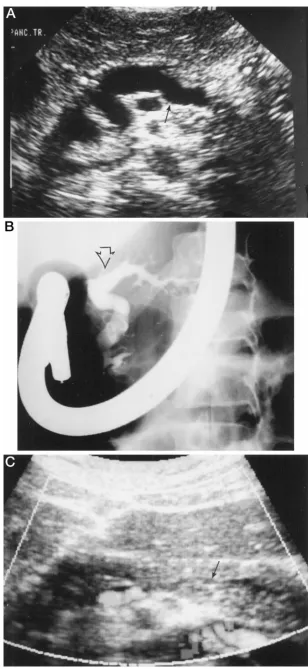
An abdominal ultrasound showed a grossly distended and tortu-ous proximal portion of the pancreatic duct (Fig 1A). There was enlargement of the head of pancreas consistent with inflamma-tion. A diagnosis of HP was made based on clinical presentation and family history. She required treatment with total parenteral nutrition (TPN) for 3 weeks. A computerized tomography scan of her pancreas 1 month later showed persistent dilatation of the pancreatic duct.
An ERCP was conducted in January 1994. This showed a sig-nificantly dilated main pancreatic duct with dilatation of the sec-ondary radicals and duct stones at both the head and tail of the pancreas. She had two further episodes of severe abdominal pain between January and May 1994. These episodes of pancreatitis resulted in her admission to hospital for periods of 2 to 3 weeks and treatment with TPN. She had persisting abdominal tender-ness between relapses. Abdominal ultrasounds performed during these exacerbations showed a dilated main pancreatic duct with the diameter varying between 4 and 8 mm and a considerable loss of pancreatic substance.
She had a very poor quality-of-life because of the recurrent spells of severe pain and vomiting as well as her persistent ab-dominal tenderness. In an attempt to alleviate her symptoms, it was decided to try to reduce the distension of her pancreatic duct by placing a stent. A stent was inserted into the main pancreatic duct under ERCP guidance in October 1994. Findings at that time were a slightly dilated common bile duct and a dilated pancreatic duct (Fig 1B). A 5-cm 7 French straight stent was inserted into the pancreatic duct without complication. She did not have a sphinc-terotomy or any other drainage procedure performed.
The clinical response has been dramatic. She had one mild episode of pain 2 weeks after the procedure that settled very quickly. Since that initial episode, she has had no further bouts of pain for.3 years. She has not had to use any analgesia. Serial abdominal ultrasounds have shown resolution of the pancreatic duct dilatation (Fig 1C). There is no evidence of pancreatic swell-ing but contraction in the region of the head of the pancreas persists. The stent continued to be visible at the head of the pancreas until 1996. From early 1997, the stent has not been visible on ultrasound and is presumed to have spontaneously passed from the duct. Nevertheless, the duct has not dilated again (Fig 1C). She remains asymptomatic 2 years after the last visualization of the stent in situ. Growth and puberty status have been appro-priate. There has been no evidence of pancreatic exocrine or en-docrine insufficiency.
Recently, it was confirmed that this girl and her father have a single copy of the R117H mutation in the cationic trypsinogen gene. This is consistent with the diagnosis of HP.
DISCUSSION
HP is an autosomal dominant condition with in-complete penetrance. Recent work has shown that a mutation of the cationic trypsinogen gene is associ-ated with the HP phenotype.1 Such a mutation has
been confirmed in our patient and her father who has both endocrine and exocrine pancreatic insufficiency as a result of recurrent pancreatitis. It is speculated that this mutation leads to a failure to inactivate trypsin hence causing autodigestion and pancreati-tis. It is not known, however, if HP is a single con-dition or if some of the families have an underlying abnormality of the pancreatic duct system. Treat-ment options may therefore vary in terms of their efficacy.
is usually offered to children only after years of recurrent spells.
Our report suggests that the placement of a pan-creatic duct stent should be considered in such chil-dren when there is clear evidence of duct dilatation. The dramatic improvement in our patient suggests that we succeeded in dilating a strictured area. This benefit has been maintained for a long period after spontaneous passage of the stent from the duct. However, while this girl has obtained remarkable relief of symptoms, it will be some years before we know the effect of this procedure on other potential complications of HP.
Surgical intervention is indicated when the diam-eter of the pancreatic duct is .5 to 8 mm. A large number of strategies have been attempted including denervation,2 sphincterotomies,3 drainage
proce-dures,4or pancreatectomy (subtotal5and total6). The
Puestow‘‘s procedure appears to be the most suc-cessful with good outcomes in 70% to 100% of cases.7
The presumed mechanism of action of the Puestow’’s procedure is thought to be that of enhancing drain-age of pancreatic enzymes, thereby reducing the risk of auto-digestion.
The largest series on surgical treatment of HP in children8reported that 55% of patients with HP
un-derwent surgery, most commonly a longitudinal pancreaticojejunostomy. The major indication was pain relief. The remainder were treated with cysten-terostomies or cystgastrostomies and sphincteroto-mies were performed in 2 patients. Immediate relief was obtained in 43% of cases of HP and by 2 years’ follow-up, pancreatitis had abated in 81%. Of those undergoing Puestow‘‘s procedure, 75% were symp-tom-free at 2 years’ follow-up. It was argued that a relatively low incidence of steatorrhea and diabetes mellitus provided indirect evidence that disease pro-gression had been arrested. Others have also re-ported success with pancreaticojejunostomies.9,10The
role of sphincterotomy has not been widely de-scribed in HP, although occasional case reports sug-gest it may be beneficial. Thus it appears reasonable to conclude that procedures which enhance pancre-atic drainage in situations where there is evidence of obstruction (ie, a dilated pancreatic duct) may pro-vide symptom relief. Additional support for this view comes from animal experimental models of chronic pancreatitis (CP)..11
Because of the relative ease of stent placement as compared with surgical drainage, this procedure may be conducted early in the course of the disease. This could possibly change the natural history of the disease with regard to long-term complications. De-bate continues as to the beneficial effects of surgery in preserving pancreatic function. Some authors have speculated that early operative intervention may relieve symptoms and possibly arrest progres-sion of the disease, thereby salvaging some pancre-atic function. Nealon et al12have argued that earlier
intervention in CP preserved pancreatic function and Crombleholme13 concluded that a modified
Puestow’’s may prevent progression of insufficiency if performed early in the course of the disease. How-ever, while Puestow‘‘s procedure may provide
symptomatic relief, many have argued that surgical intervention has no effect on disease progression and the ultimate outcome of exocrine and/or endocrine failure.
Stenting has not to our knowledge been described previously in the treatment of HP. However, its use in the treatment of HP is logical if one considers that the rationale of other therapeutic procedures in HP is to enhance pancreatic drainage. The procedure has been reported to have success rates of 80% in the treatment of CP attributable to other causes with minimal mortality.14A successful outcome was
asso-ciated with a decrease in duct diameter. In contrast, surgical drainage procedures are associated with a mortality of 2% to 5% and a morbidity of 20% to 40%. Nevertheless, complications of pancreatic duct stenting may occur. Recognized complications in-clude clogging of the stent, stent migration, sponta-neous passage of the stent, infection related to stent occlusion, acute pancreatitis, duodenal erosion and development of ductal and parenchymal changes. Stents are now being removed after shorter dura-tions in situ to reduce the risk of complicadura-tions.14,15
CONCLUSION
In summary, we describe a case of HP treated with ERCP stenting. We believe that the placement of a stent allows for very early intervention to try and relieve duct distention as the procedure is relatively noninvasive compared with surgery. This early in-tervention could possibly be important in terms of preventing long-term complications of this disease.
David Vaughan, MRCPI Cameron Imrie, FRACP Jerry Kelleher, FRCR Brendan Drumm, FRCPC Department of Paediatrics University College Dublin Childrens Research Centre
Our Lady’s Hospital for Sick Children Crumlin, Dublin 12, Ireland
Henry Osborne, FRCSI Department of Surgery Beaumont Hospital Dublin 9, Ireland
ACKNOWLEDGMENT
We thank Dr Sarah Rutherford, Mersey Regional Molecular Genetics Laboratory, Liverpool, for carrying out the studies on the cationic trypsinogen gene and Dr Peter Durie, Hospital for Sick Children, Toronto, for his very helpful advice on this case.
REFERENCES
1. Whitecomb DC, Gorry MC, Preston RA, et al. Hereditary pancreatitis is caused by a mutation in the cationic trypsinogen gene. Nat Genet. 1996;14:141–145
2. Cahow CE, Hayes MA. Operative treatment of chronic recurrent pan-creatitis.Am J Surg.1973;125:390 –398
3. Traverso LW, Tompkins RK, Urrea PT, et al. Surgical treatment of chronic pancreatitis. Twenty-two years experience. Ann Surg. 1979;190: 312–319
4. Puestow CB, Gillesby WJ. Retrograde surgical drainage of pancreas for chronic relapsing pancreatitis.Arch Surg. 1958;76:898 –907
5. Child CG III, Frey CF, Fry WJ. A reappraisal of removal of ninety-five percent of the distal portion of the pancreas.Surg Gynecol Obstet. 1969; 129:49 –56
chronic pancreatitis.Ann Surg. 1978;188:317–322
7. Crombleholme TM, deLorimier AA, Way LW, Adzick NS, Longaker MT, Harrison MR. The modified Puestow procedure for chronic relaps-ing pancreatitis in children.J Pediatr Surg. 1990;25:749 –754
8. Moir CR, Konzen KM, Perrault J. Surgical therapy and long term follow-up of childhood hereditary pancreatitis.J Pediatr Surg. 1992;27: 282–286
9. Scott HW, Neblett WW, O’Neill JA, Sawyers JL, Avant GS, Starnes VA. Longitudinal pancreaticojejunotomy in chronic relapsing pancreatitis with onset in children.Ann Surg. 1984;199:610 – 622
10. Ghishan FK, Greene HL, Avant G, O’Neill J, Neblett W. Chronic relaps-ing pancreatitis in childhood.J Pediatr. 1983;102:514 –518
11. Carnevali JF, ReMine WH, Dockerty MD, et al. An experimental study of side to side pancreatiocjejunostomy after ductal obstruction.Arch Surg. 1960;80:774
12. Nealon WH, Townsend CM Jr, Thompson JC. Operative drainage of the pancreatic duct delays functional impairment in patients with chronic pancreatitis. A prospective analysis. Ann Surg. 1988;208:221–229 13. Smits ME, Badiga SM, Rauws EA, Tytgat GN, Huibregtse K. Long term
results of pancreatic stents in chronic pancreatitis.Gastrointest Endosc. 1995;42:461– 467
14. Hogan WJ. Stenting the pancreas: is this the solution to post-ERCP pancreatitis.Gastroenterology. 1998;115:1591–1594. Editorial
15. Pitchumoni CS. Chronic pancreatitis. Pathogenesis and management of pain. J Clin Gastroenterol. 1998;27:101–107
Isolated Congenital Malabsorption
of Folic Acid in a Male Infant:
Insights Into Treatment and
Mechanism of Defect
ABSTRACT. An instructive case of isolated congenital folate malabsorption provides insight into the under-standing of this rare disease. Folate loading tests with both timed serum and cerebrospinal fluid folate deter-minations suggest that both of the two mechanisms in-volved in gastrointestinal folate absorption are defective in this condition. Pediatrics 1999;104:1133–1137; folate, malabsorption, congenital.
ABBREVIATIONS. ICFM, isolated congenital folate malabsorp-tion; CSF, cerebrospinal fluid; IM, intramuscular; PCP, Pneumocys-tis carinii pneumonia; TMP/SMX, trimethoprim-sulfamethoxas-ole.
I
solated congenital folate malabsorption (ICFM) is a rare disorder characterized by hematologic, im-munologic, and neurologic consequences of inad-equate serum and tissue folate. Folate participates in de novo synthesis of thymidine and adenine, constit-uents of DNA and RNA; and of methionine, an amino acid critical in both protein and s-adenosyl-methionine synthesis (a universal methyl donor ac-tive in .100 methylation reactions). This makes fo-late a vital substrate for normal fetal and infant development.Before the 1987 report of a male patient with ICFM
by Urbach et al,1 all such patients reported were
females. ICFM was, consequently, believed to be sex-linked and lethal in males. Currently there are 13 reported cases of ICFM in the world literature, all but 2 occurring in females.2 The patients previously
re-ported have had a spectrum of responses to enterally administered folate therapy. Some patients contin-ued to have low serum folate concentrations despite oral therapy and required parenteral treatment, while others responded to large oral doses of folate with raised serum folate levels. Use of reduced folate (folinic acid) orally, provided in an attempt to over-come the block in folate absorption, also has been variably effective. Even in patients whose serum fo-late concentration can be normalized by large oral doses of either folate or folinic acid, the cerebrospinal fluid (CSF) folate level, which normally is 1.5 to 2 times that of serum,3 remains low. The exception
being the 2 male patients in whom CSF folate in-creased in response to raised serum folate. Literature suggests that CSF folate in the patient whose CSF folate level does not respond to an increase in serum folate level can be raised after daily intramuscular (IM) injections of folinic acid, even if enteral or par-enteral folate or par-enteral folinic acid fail to do so.4
These observations suggest that a specific trans-port protein(s) is necessary for movement of folate across membranes. That transport protein is likely a common gene product active at cellular sites in the gastrointestinal tract and at the blood-brain interface. We report the third male patient affected with ICFM who, unlike the other male patients, demonstrated both the gastrointestinal absorption defect and the defect in CSF penetration. Attempts to treat this pa-tient provide insight into this rare and poorly under-stood condition.
CASE REPORT
A 3-month-old male infant, reported as previously well, was noted to be feeding poorly and to have increased respiratory effort. Symptoms worsened over 2 days, prompting medical eval-uation in a local emergency department. There, the child appeared to be ill with lethargy, dyspnea, and tachycardia. Hemoglobin was 2.5 g/dL just before transfer to the referral institution. Vital signs on arrival included a heart rate of 160; a respiratory rate of 58 with moderate respiratory distress; blood pressure of 79/40; and a temperature of 35.4°C. The infant was at the 15th percentile for both length and weight. Additional findings included rales on pulmonary auscultation and a neurologic examination revealing opsoclonus. Chest radiograph revealed slightly enlarged cardiac silhouette with mildly increased pulmonary vascular markings. Pulse oximetry was 76% on 100% oxygen by face mask. Hemo-globin was again found to be profoundly depressed at 2.4 g/dL, with a platelet count of 34 000/mm3and a leukocyte count of 3200/mm3with 22% neutrophils and 78% lymphocytes. Reticulo-cyte count was .9%. The peripheral blood smear revealed abun-dant fragmented red blood cells and reduced polymorphonuclear leukocytes, a few of which were notable for 6 nuclear lobes.
The child was placed on a respirator and multiple small trans-fusions were given, along with furosemide. Blood urea nitrogen and serum electrolytes, creatinine, calcium, phosphorus, and mag-nesium were normal. A venous blood gas sample revealed a mixed respiratory alkalosis (on artificial ventilation) and meta-bolic acidosis. Subsequently, studies for human immunodefi-ciency virus antibody, polymerase chain reaction for proviral RNA, and culture were negative. A bone marrow aspirate re-vealed megaloblastic hematopoiesis. Serum amino acid and urine organic acid determinations were normal, as was serum B12 level. Serum folate level was,1 ng/mL on three determinations.
Received for publication Sep 28, 1998; accepted Jun 24, 1999.
Reprint requests to (J.J.M.) Professor of Pediatrics, MCP Hahnemann School of Medicine, Director, Diagnostic Referral Center, St Christopher’s Hospital for Children, Erie Avenue at Front Street, Philadelphia, PA 19134-1095. E-mail: [email protected]
DOI: 10.1542/peds.104.5.1129
1999;104;1129
Pediatrics
David Vaughan, Cameron Imrie, Jerry Kelleher, Brendan Drumm and Henry Osborne
Pancreatic Duct Stenting as a Treatment for Hereditary Pancreatitis
Services
Updated Information &
http://pediatrics.aappublications.org/content/104/5/1129
including high resolution figures, can be found at:
References
http://pediatrics.aappublications.org/content/104/5/1129#BIBL
This article cites 15 articles, 0 of which you can access for free at:
Subspecialty Collections
http://www.aappublications.org/cgi/collection/hepatology_sub
Hepatology
http://www.aappublications.org/cgi/collection/gastroenterology_sub
Gastroenterology
http://www.aappublications.org/cgi/collection/aap_abroad
AAP Abroad
following collection(s):
This article, along with others on similar topics, appears in the
Permissions & Licensing
http://www.aappublications.org/site/misc/Permissions.xhtml
in its entirety can be found online at:
Information about reproducing this article in parts (figures, tables) or
Reprints
http://www.aappublications.org/site/misc/reprints.xhtml
DOI: 10.1542/peds.104.5.1129
1999;104;1129
Pediatrics
David Vaughan, Cameron Imrie, Jerry Kelleher, Brendan Drumm and Henry Osborne
Pancreatic Duct Stenting as a Treatment for Hereditary Pancreatitis
http://pediatrics.aappublications.org/content/104/5/1129
located on the World Wide Web at:
The online version of this article, along with updated information and services, is
by the American Academy of Pediatrics. All rights reserved. Print ISSN: 1073-0397.