DEVELOPMENT OF FITTING KIT USING AUGMENTED REALITY FOR FITTING SKILL SUBJECT AT VOCATIONAL COLLEGE
Mohd Erfy Ismail1, Hasyimah Hamzah2, Irwan Mahazir Ismail3, Saiful Hadi Masran4 & Mohd Fairuz Marian5
1,2,3,4&5
Faculty of Technical and Vocational Education *Correspondence: [email protected]
Abstrak
Perkembangan Teknologi Maklumat yang pesat pada hari ini telah memberi satu nafas baru kepada penggunaan teknologi khususnya dalam bidang pendidikan. Salah satu perkembangan yang semakin popular pada masa kini ialah teknologi Augmented reality (AR) yang menggunakan teknologi mengimbas barcode sebagai media pembelajaran. Kajian ini bertujuan membina satu multimedia interaktif yang berasaskan teori pengajaran pembelajaran dan reka bentuk yang bersesuaian bagi mata pelajaran Kemahiran Menggegas berdasarkan sukatan pelajaran Kolej Vokasional. Faktor- fakor yang menyumbang kepada kajian ini ialah, kaedah pengajaran guru, keselamatan ketika proses P&P, visualisasi pelajar dan kekurangan ABBM dalam subjek Kemahiran Menggegas. Bagi fasa pembangunan fitting kit, pengkaji menggunakan model ADDIE sebagai rujukan dan panduan. Populasi kajian melibatkan 125 orang pelajar Pemesinan Industri di KV Kluang dan sampel kajian ialah 30 orang pelajar tahun 1 kursus Pemesinan Industri yang mengambil subjek Kemahiran Menggegas. Instrumen yang digunakan berbentuk borang soal selidik untuk mendapatkan maklumat. Data yang diperolehi di kumpul dan dianalisis secara deskriptif menggunakan perisian SPSS (Statistical Package for The Sosial Sciences) versi 24. Berdasarkan analisis yang dibuat, nilai kebolehpercayaan instrumen r= 0.86 dan menunjukkan kebolehpercayaan instrumen berada pada tahap tinggi. Hasil kajian mendapati bahawa penggunaan multimedia interaktif berbantukan AR mampu meningkatkan minat pelajar dan seterusnya menjadikan pengajaran guru lebih menarik disamping dapat menambah baik ABBM yang sedia ada. Selain itu, dapatan menunjukkan penggunaan AR dalam pendidikan mampu meningkatkan daya visualisasi pelajar yang mampu membantu mereka dalam melakukan ujian amali dan mewujudkan satu suasana P&P yang selamat.
Abstract
AR in education can improve visualization of the students which are able to assist them in carrying out practical tests and creating a safety atmosphere for learnig and teaching process.
Keywords: Augmented Reality (AR), Alat bahan bantu Mengajar (ABBM), Kemahiran Menggegas
1.0 INTRODUCTION
Nowadays, in addition to have a good academic results, skills are also required to put themselves in the working world. The government has established a Technical and Vocational High School (MTV) to train students in the field of skill. Vocational Secondary School (SMV) train students towards technical and practical skills. The Ministry of Education has established a vocational education in 1968 to training students in skills field (Sharudin and Yahaya, 2008). Vocational secondary schools have been converted into Vocational College (KV) for the upgrading of Vocational education in Malaysia. Through this transformation, teachers receive a new challenge in achieving the requirements of the country as it requires new learning techniques.
Teaching at school still using an old technique where many students are still learning based on conventional schools where classes is the place for learning, most tasks are based on the use of paper and a pen or pencil, the teacher is the main source of important information and each curriculum built from different areas based on fields of endeavour (Grose, 2014). To enhance students' skills and understanding of the subject, medium of learning are use such as teaching aids may be used. Use of teaching aids are very important to facilitate student understanding in a subject and teachers able to teach with ease. To ensure that the teaching and learning process running smoothly, the teaching aid plays an important role (Abu Hassan, 2004). Teaching aid grow from time to time accordance with the circulation period such as use of multimedia, computer and electronic.
In research conducted by ECAR (Centre for Analysis and Research) to students in 15 countries, most students bring their own digital devices to school, small and portable such as smartphones and tablets (Smith & Caruso, 2010). Various devices used by the students for learning purposes and used to facilitate the students to find information and learning process. The use of laptops is one important tool in education, followed by mobile devices such as tablets, mobile phones and e-book reading (Chen, Baiyun and Denoyelles, 2013). One of the M-Learning technology that are concern nowadays is the Augmented Reality (AR). AR is also use in education system. The AR learning system could connect students with a real world and virtual. AR able to motivate students with user friendly interaction, which will affect the understanding in the process of teaching and learning. Many research on education using AR were done in foreign countries, including:
Table 1.1 Research and Researchers
Research and Researchers Simple Description
The use of Augmented Reality for introduction in piano music instrument (Nugraha, IS, Satoto, KI, and Martono, KT, 2014).
Developing a tool for learning about the theory on the piano in the piano chord.
Augmented Chemistry (Morten & Benedikt, 2002).
Learning chemistry using AR technology and explain its benefits.
2.0 PROBLEM STATEMENT
Technical and Vocational Education through induced a significant change when the government upgrade vocational schools become Vocational College. The process of restructuring of the education system saw various changes and new paradigm has been implemented primarily in the system of technical and vocational education (PTV) in the country (Heong, Othman, Yunos, Kiongr, and Hassan & Mohamad 2011). However there are some disadvantages in context, student safety while using the equipment, teacher teaching, lack of ABBM and student visualization in the manufacturing subject.
In the context of teacher teaching, teachers that teach technical subjects do not like to use a teaching aids in learning and teaching process in class. Meanwhile, according to Ting (2007), technical teachers face the problem of concern in technology and the factors deterring the use of teaching aids in teaching. In fact, the findings show the use of teaching aid among technical teachers are still at a moderate level (Hamdan and Yasin, 2010). In the process of learning in Fitting Skills subject, teaching methods still using traditional methods. This situation is influenced by many factors, including the difficulty of handling and accessibility of teachers to teaching aids.
In context of a lack in teaching aid, the process of delivering information based on teacher-centred only would not achieve the objective. The demands of a teacher to build a new teaching aid becomes prohibitive factor. While the self-produced teaching aid requires a long period of time, focus and energy (Hamzah et. Al., 2007). According Jasmi, Ilias, Tamura, and Hamzah (2011) the preparation of a variety and creative teaching aids demands extra efforts and the continued commitment of the teachers, it increases the burden of teacher that already burdened with many tasks and other co-curricular and curriculum. Therefore, teaching aids for Fitting Skill subject are limited and teachers’ prefers use slide presentations and lead the process of learning to become bored.
In the context of safety, many of Vocational College students will doing practical work in the workshop and safety when using hand tools, machine and the environment are emphasized to avoid any accidents that cause damage to the machine or equipment and human. While doing practical work, students will be exposed to various dangers, especially when doing activities provide materials for practical projects, while operating various types of sharp instruments and high-powered machines as well as through the process of learning in the workshop (Che Juhan State, 2012).
In visualization context, technical students cannot imagine an object clearly. According Nazamuddin (2003) students have difficulty imagining a 3D object to 2D and vice versa. This will difficult for students to understand the lesson learned. As a result, fewer students are lost interested in learning, and limit them to imagine something. Based on previous studies found the level of student visualization skills are at low levels (Earth, 2007). This make teacher are difficult to teach and make the process of learning does not achieve its objective.
From the problem stated, the researchers intend to develop a teaching kit on the Fitting Skill subject as teaching aids that can help teachers and students in the process of learning.
3.0 RESEARCH QUESTION
This study aims to find answers for several questions of study as listed below:
i) How does the development of fitting kit as teaching aid can make the learning process become smoothly?
ii) How does the development of fitting kit can help students in the practical test?
4.0 RESEARCH METHODOLOGY
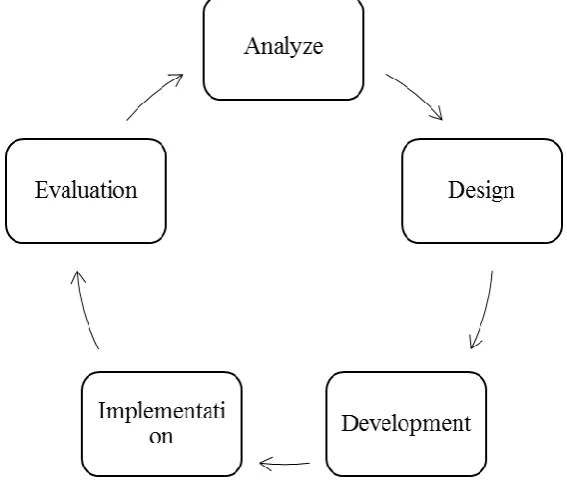
ADDIE model has been developed by Rosset in 1987 and became the basic for the design of other models, ADDIE model also has five parts, Analysis, Design, Development, Implementation and Evaluation (Elsevier, 2015). According Embi et. al. (2010) ADDIE model is a teaching model that is often used as the basis for instructional design models
Figure 4.1: Model of teaching ADDIE (Source: Module header design educational technology and instructional model 2012).
4.1 Analysis Phase
The first phase in the ADDIE model of instructional design is the analysis phase. Analysis phase is to determine the selection of input that underlie the development of a product (Embi, et. Al., 2010). Phase Analysis is the foundation of all phases in the instructional design model. Assessment of the needs of teaching aids in the process of learning undertaken in order to make the development of teaching aid better planned. Some analysis has been made by researchers, which are:
1. Input Analysis 2. Process Analysis 3. Analysis of target users
4.2 Design Phase
4.3 Development Phase
This phase 'translate' the activities specified in the Phase 1 and Phase 2 of the prototype so it's easier to understand (Embi, et. Al., 2010) Researchers will develop a teaching kit according to features found in the design phase including, cost, materials, and safety. These aspects should be applied to create an interesting teaching aids, portable and user-friendly.
Figure 4.1 Product development process
4.4 Implementation phase
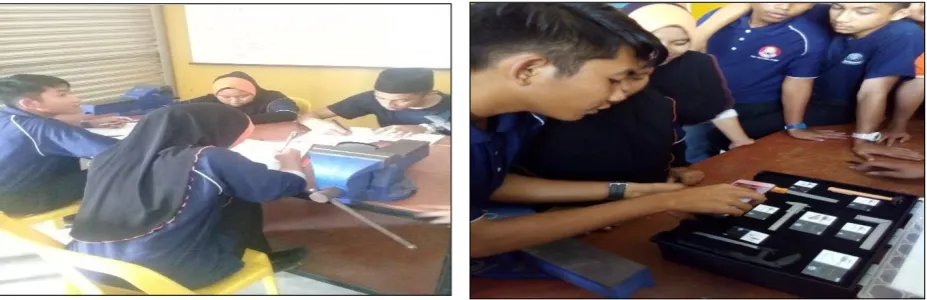
Implementation phase, is any training materials and related materials evaluation carried out temporarily, to determine the impact to the real world (Welty, 2008). This phase involved the development of teaching aid as planned in the development phase. In this phase, testing was carried out. Testing will be made against the teaching aid that are developed by researchers. This phase will also involve target user where the user will use the teaching aid prototype before the teaching aid were evaluated by experts.
Figure 4.2 uses of fitting kit prototype by target user
4.5 Evaluation Phase
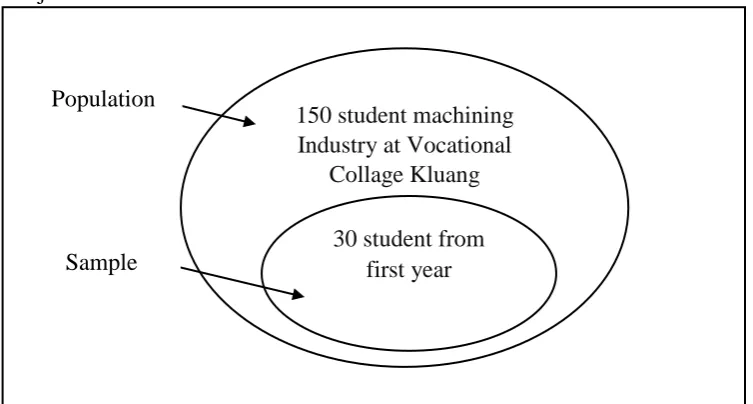
150 student machining Industry at Vocational
Collage Kluang
30 student from first year
other hand, from the aspect of suitability will be assessed by the ABBM lecturer who teaches the subject of Fitting Skill in terms of effectiveness against the target user.
4.6 Population and sampling study
Population in this study were students who took Machining Industry course at Vocational College Kluang. The sampling method used is purposive sampling. The samples were first year students from the general machining totalled of 30 students who’s taking the Fitting Skill subject.
Figure 4.3 Population and sampling study
4.7 Reliability and Validity
Reliability is a measurement instrument to determine the consistency of the scores for each item contained in the questionnaire. This is to maintain the accuracy of the instrument in questionnaires from having any problems and the data obtained was correct. To view the validity of the survey, a consistently method is used which is the Cronbach Alpha method. Based on the analysis that has been made, the Cronbach's alpha was 0.86 and is at a high level. Najib (2003) argues that the value of Cronbach Alpha 0.8-1.0 showed high reliability.
To ensure a questionnaire can be used, validity must be made in advance. The validity used in the study is content validity. Researchers have gained three experts to determine the validity of the questionnaire which have been constructed. Three experts is composed of one expert in language and two experts in content. Refer to Appendix B.
5.0 FINDINGS
The questionnaire used in this study was developed to get the data from respondents to solve the question review that have been mentioned in Chapter 1. All the items contained in the questionnaire were analysed by evaluating the mean score based on a Likert scale of four degrees that are strongly disagree, disagree agree and strongly agree. Item analysis are refers to the range of mean scores in Table 5.1 to determine the stance of respondents to the question review in the study. Source (Mohd Yusoff Osman, Shaari, and Ghazali, 2012).
Table 5.1 Score mean analysis
Score Mean Mark Level
1.00 - 2.00 Low
2.01 - 3.00 Moderate
3.01 - 4.00 High
Population
5.1 First Research Question
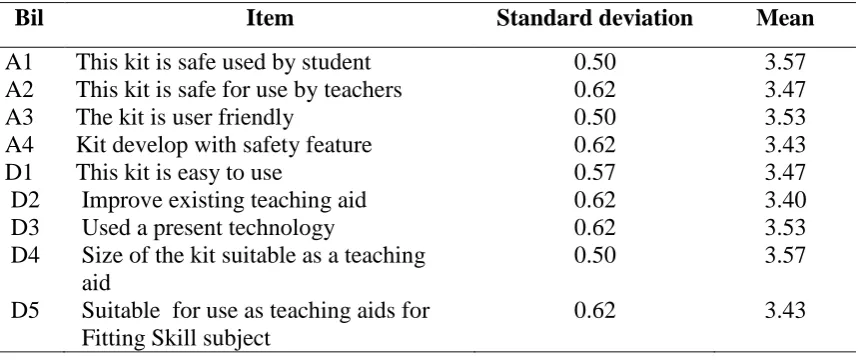
The objective of the first research question is to determine how far the fitting kit development will make the learning process become more efficient. The results are shown in Table 5.1. Table 5.1 shows the results of the respondents involved in the survey according items and show that result (mean) obtained is at high level and showed respondents strongly agreed with the given items and shows the results of the respondents answered that first question review agreed that the fitting kit is capable make the learning process become more efficient.
Table 5.2: Score mean and standard deviation of item A and D
5.2 Second Research Question
The objective of the second research question is to see how far the fitting kit is able to help students perform in practical tests related with fitting skill. The findings of the survey are shown in Table 5.2, namely the analysis of the item C. There are 5 items found in this section. Referring to the results in Figure 5.2 the majority of respondents strongly agreed on the items given and show that the use of fitting kits will assist students in conducting practical tests
Table 5.3: Score mean and standard deviation of item C1 to C5
The high score mean on item C2 clearly indicates that respondents strongly agree that this kit can show the uses of hand tool clearly and able to assist respondents in doing practical.
5.3 Third research question
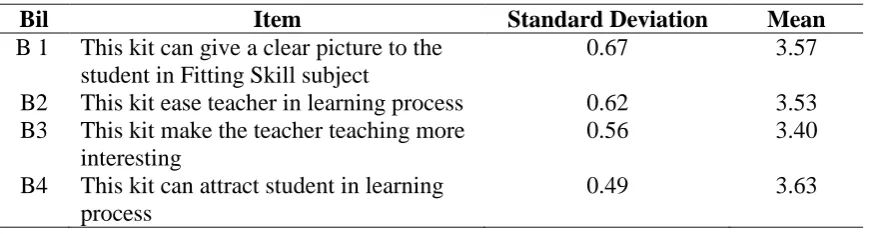
The third research question objective is to test the functionability of the fitting kit to uses as a teaching aid in learning process. The results are shown in Table 5.3 are. There are 4 items contained in this section and been proposed to respondents to obtain their feedback on the functionability of the fitting this kit. Topping the highest mean score is at item B4 and the
Bil Item Standard deviation Mean
A1 This kit is safe used by student 0.50 3.57 A2 This kit is safe for use by teachers 0.62 3.47
A3 The kit is user friendly 0.50 3.53
A4 Kit develop with safety feature 0.62 3.43
D1 This kit is easy to use 0.57 3.47
D2 Improve existing teaching aid 0.62 3.40
D3 Used a present technology 0.62 3.53
D4 Size of the kit suitable as a teaching aid
0.50 3.57
D5 Suitable for use as teaching aids for Fitting Skill subject
0.62 3.43
Bil Item Standard eviation Mean
C1 Audio can be hear clearly 0.57 3.47
C2 This kit can show the uses of hand tool clearly
0.49 3.60
C3 Video shown are clear 0.62 3.43
low mean score on an item B3. The value of the mean item score on B4 was high and shows that respondents agreed that this kit is capable of engaging students in learning and proving the functionability of this fitting kit.
Table 5.4 Score mean and standard deviation of item B1 to B4
6.0 DISCUSSION
6.1 Development of Fitting Kit as teaching aid improve learning process
A good teaching aids must meet the characteristics, the suitability of the materials with the content of the lessons taught are important to ensure that the content of education presented clearly acceptable by students, next neatness, clarity and attention of students must be met (Azman, Azli, Mustapha, Balakrisnan & Isa, 2014).
According to Halim et. Al. (2012) the main character in the determination of the design kit is an easy operated, multi-functional and small-sized and lightweight. Findings show that the fitting kit size is and the handling of the kit is simple and can improve the learning process. The advantage of the kit is dynamic, which other beneficial to experimental or practical activities in the workshops, the kit can also be harnessed for use in the classroom to make a demonstration (Khanafiyah, 2009). This shows that the fitting kit is able to be used as teaching aid in Fitting Skill subject because teachers are able to use it in class or in the workshop.
6.2 Fitting kit development can assits student doing praktical test
Multimedia technologies such as graphics and animation enhance the ability of memory, affect social interaction and help visualization skills (Marian, Rahim, Baser & Tahar, 2011). The use of AR in this kit fitting development give the user a new experience where users can interact with the virtual world to obtain information from audio, graphics, video and text that has been developed.
Findings from the development of this fitting kit show that respondents strongly agree that with this fitting kit, itcapable to help students in enhancing their imagination and visualization. This statement is supported by the findings from respondents that indicating high lecel mean score with 3.52, showing that respondents agree that this fitting kit is able to enhance their visualization.
6.3 Functionability of fitting kit as teaching aid in the teaching and learning process Findings of this study show the use of the fitting kit attracts students and in associated with the findings from, Cagility and Seferoglu (2008) who found the M-Learning using mobile phones has increased students interest through the use of multimedia. It is shown that the use of technology in the P&P is able to create a learning environment that is more attractive than conventional methods just based on textbooks (Mohammad Noor, Mahamod, Hamat & Embi,
Bil Item Standard Deviation Mean
B 1 This kit can give a clear picture to the student in Fitting Skill subject
0.67 3.57
B2 This kit ease teacher in learning process 0.62 3.53 B3 This kit make the teacher teaching more
interesting
0.56 3.40
B4 This kit can attract student in learning process
2012). The advantages of the use of the AR is enable students to imagine something objects and concepts that cannot be seen with the naked eye.
The findings stated the use of technology in the development of teaching aids will make teacher teaching more interesting and this statement supported by Azman et. Al., (2014) stated that the use of teaching aids in line with the development of technology able to create an active learning environment between students and teachers.
7.0 CONCLUSION
In a nutshell, the result of a study conducted found fitting kit developed meet the objective of the study which had been mentioned in chapter one where development at fitting kit is able to imrove the learning process. In addition, the development of this fitting kit can help students in the practical test. Fitting kit is also able to assist students in learning process and attract students with the help of AR technology that are capable of facilitating a teacher during the learning process and can create a self learning.
A few suggestions is highlighted so that future researchers and parties get an early overview about scenario that happens when learning process are conducted at vocational College. It is hoped that research in the future will be able to add information in terms of the contents to cover the entire topic in the subject of Fitting Skill. There are three levels to be included in the content which is high level, medium and low. All of these three levels must be found in the contents so that teachers can choose the appropriate level according to the students performance.
Finally, based on the findings researces expected the development of the fitting kit will meet the needs of students and teachers and ensure the learning process run well. In addition, it is hoped that the findings and recommendations can be used as a guide to researchers in the future, especially to the parties who want to continue or improve this study in future.
REFERENCES
Abdullah, S. B. (2015). Pembangunan Modul Pengajaran Dan Pembelajaran Lukisan Bangunan Dalam Topik Pengenalan Lukisan Bangunan. (Universiti Tun Hussein Onn Malaysia).
Abu Hassan, N. (2004). Kebolehgunaan kit pengajaran dan pembelajaran bagi
meningkatkan prestasi pelajar: satu tinjauan di KUITTHO (Doctoral dissertation, Kolej Universiti Teknologi Tun Hussein Onn)
Aumi Syahidah (2007). “Tahap Kemahiran Visualisasi Tahap Keupayaan Visualisasi Ruang Pelajar Kejuruteraan Awam dan Kejuruteraan Mekanikal di Sekolah Menengah
Teknik”. Di muat turun daripada ftmk.upsi.edu.my/ftmk07/index2. php?option=com_docman&task=doc_view&gid=27&Itemid=79.pdf.
Azman, M. N. A., Azli, N. A., Mustapha, R., Balakrishnan, B., & Isa, N. K. M. (2014). Penggunaan Alat Bantu Mengajar ke Atas Guru Pelatih Bagi Topik Kerja Kayu, Paip dan Logam. Sains Humanika, 3(1).
Che Juhan Negara, R. (2012). Tahap kesediaan pelajar kejuruteraan Politeknik terhadap keselamatan di dalam bengkel (Doctoral dissertation, Universiti Tun Hussein Onn Malaysia).
Chen, B., & Denoyelles, A. (2013). Exploring students’ mobile learning practices in higher education. Educause Review, 7.
Halim, A., Hanim, H., & Lai, C. S. (2012). Penilaian keberkesanan kit pengajaran transistor bagi aliran vokasional
Karen Grose (2014). From 21st Century Learning to Learning in the 21st Century: Influences on Transforming Teacher Knowledge of Constructivist Practices in Technology-Rich Learning Environments. Tesis Ph.D. University of Toronto; 2014.
Hamdan A. R., H. Mohd Yasin. (2010). Amalan Penggunaan Alat Bantu Mengajar (ABM) di Kalangan Guru-Guru Teknikal di Sekolah Teknik Daerah Johor Bharu. 1–8.
Hamzah, M. I. M., & Attan, N. (2007). Tahap kesediaan guru sains dalam penggunaan teknologi maklumat berasaskan komputer dalam proses pengajaran dan pembelajaran. Sains Humanika, 46(1).
Heong, Y. M., Othman, W. B., Yunos, J. B. M., Kiong, T. T., Hassan, R. B., & Mohamad, M. M. B. (2011). The level of marzano higher order thinking skills among technical
education students. International Journal of Social Science and Humanity, 1(2), 121. Jasmi, K. A., Ilias, M. F., Tamuri, A. H., & Hamzah, M. I. M. (2011). Amalan penggunaan
bahan bantu mengajar dalam kalangan guru cemerlang Pendidikan Islam Sekolah Menengah di Malaysia. JIAE: Journal of Islamic and Arabic Education, 3(1), 59-74. K. S. Ting. (2007). Kajian Mengenai Penggunaan e-Pembelajaran (e-Learning) di Kalangan
Pelajar Jurusan Pendidikan Teknik dan Vokasional di Institusi Pengajian Tinggi (IPTA) Negeri Johor. Universiti Teknologi Malaysia: Tesis Falsafah Kedoktoran.
Khanafiyah, S. (2009). Pemanfaatan KIT OPTIK Sebagai Wahana dalam Peningkatan Sikap Ilmiah Siswa. Jurnal Pendidikan Fisika Indonesia, 5(2).
Marian, M. F., Rahim, M. B., Abd Baser, J., & Tahar, M. S. (2011) Keberkesanan penggunaan cd interaktif lukisan isometric terhadap kemahiran visualisasi pelajar. Mohammad Noor, N. A., Mahamod, Z., Hamat, A., & Embi, M. A. (2012). Persepsi pelajar
terhadap aplikasi perisian multimedia dalam pembelajaran komsas bahasa melayu tingkatan 1. Jurnal Pendidikan Bahasa Melayu, 2(1), 1–16.
Mohd Yusoff, N., Osman, R., Shaari, A. S., & Ghazali, M. I. (2012). Kemahiran Belajar dalam Kalangan Pelajar Bidang Pendidikan. Seminar Kebangsaan Majlis Dekan Pendidikan IPTA 2012, 1–12.
Najib, M. (2003). Reka bentuk tinjauan soal selidik pendidikan. Skudai, Universiti Teknologi Malaysia.
Nazamuddin Ahmad Razali (2003). Penghasilan Modul Pembelajaran Lukisan Kejuruteraan Berbantukan Komputer. Tesis Sarjana. Universiti Tun Hussein Onn Malaysia. Tidak diterbitkan.
Nugraha, I. S., Satoto, K. I., & Martono, K. T. (2014). Pemanfaatan Augmented Reality untuk pembelajaran pengenalan alat musik piano. Jurnal Teknologi dan Sistem Komputer, 2(1), 62-70.
Saran, M., Cagiltay, K., Seferoglu, G. (2008). Use of mobile phones in language learning: developing effective instructional materials. Kertas kerja dibentangkan di 5th IEEE International Conference on Wireless, Mobile, and Ubiquitous Technology in Education (pp.39-44). Beijing, China. Dimuat turun pada April 18, 2008 daripada http://doi.ieeecomputersociety.org/10.1109/WMUTE.2008.49
Sharudin, S. A., & Yahaya, A. (2008). Faktor yang mempengaruhi keberkesanan pengajaran dan pembelajaran di dalam Bengkel Vokasional di dua buah Sekolah Menengah Teknik di Negeri Sembilan (Doctoral dissertation, Universiti Teknologi Malaysia). Smith, S. D., & Caruso, J. B. (2010). The ECAR study of undergraduate students and
information technology, 2010 (p. 118). Colorado: Educause.