A Short Method for the Synthesis of
α
-Tocopherol Side Chain
Mohammadi Ziarani, Ghodsi*
+Department of Chemistry, Faculty of Sciences, Alzahra University, Tehran, I.R. IRAN
Chenevert, Robert
Department de Chimie, Faculte des Sciences et de genie, Universite Laval, Quebec, G1K 7P4, CANADA
Badiei, Alireza
Department of Chemistry, Faculty of Sciences, University of Tehran, Tehran, I.R. IRAN
ABSTRACT: The enzymatic hydrolysis of meso-1,7-diacetoxy-2,6-dimethylheptane 5, prepared from 2,6-dimethylhepta-1,6-diene 6, gave the (2S,6R)-7-acetoxy-2,6-dimethyl-1-heptanol 1, which was transformed to the (2R,6R)-2,6,10-trimethyl-1-undecanol 7. In this manner, the C14 side chain of α-Tocopherol was synthesized from 2,6-dimethylhepta-1,6-diene 6 in only 5 steps.
KEY WORDS: α-Tocopherol, Natural products, Chemoenzymatic reaction, Pseudomonas cepacia lipase, Desymmetrization.
INTRODUCTION
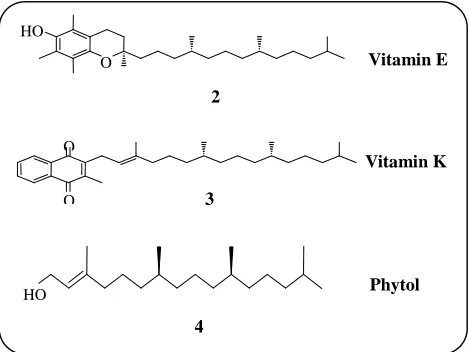
The chiral compound of (2S,6R)-7-acetoxy-2,6-dimethyl-1-heptanol 1 could be used in the synthesis of many natural products such as vitamin E 2, vitamin K 3, phytol 4 and in many several other natural products (Fig.1)[1].Wereportherethe enzymatic desymmetrization of meso-1,7-diacetoxy-2,6-dimethylheptane 5 and the use ofresultingmonoester 1, (2S,6R)-7-acetoxy-2,6-dimethyl- 1-heptanol , in the synthesis of α-Tocopherol side chain.
EXPERIMENTAL SECTION
IR spectra were recorded using a Bomen MB-100 spectrophotometer. NMR spectra were recorded in CDCl3 solutionsat300MHZ(1H),282 MHZ (19F), 75 MHZ (13C)
on a Bruker AC-300 instrument. Optical rotation values were obtained from a JASCO DIP-300 polarimeter (c as g of compound per 100 ml). Elemental analyses performed on a Carlo Ebra 1106 instrument. Column purifications were conducted by flash chromatography on silica gel 60 (230-400 mesh).
Synthesis of meso-2,6-dimethyl-1,7-heptanediol 8 via hydroboration [1,2,5] of 2,6-dimethylhepta-1,6-diene 6
Preparation of the thexylborane solution (0.5 M) Borane-tetrahydrofuran complex (10.0 ml, 1.0 M) was added under nitrogen to a dry flask and then chilled to - 10 °C. To this solution, 2,3- dimethylbut -2- ene
*To whom correspondence should be addressed.
+E-mail: [email protected]
Fig. 1: The structures of Vitamin E, Vitamin K and Phytol.
(10.0 ml, 1.0 M) was added dropwise. The reaction mixture was allowed to warm to 0 °C and stirred for 1h. The resulting solution must be immediately used in the next reaction.
Hydroboration of 2,6-dimethylhepta-1,6-diene 6 [1,2] The solution of thexyl borane in THF (18.0 ml, 0.5 M) was added to a dry flask and diluted with 71.0 mL anhydrous THF under dry N2. The solution was then chilled to -78 °C and then 2,6-dimethylhepta-1,6-diene 6 (0.788 g, 6.34 mmol) in 2 ml THF was added in a singleone portion. The mixture was stirred for 15 minutes at -78 °C and allowed to warm to room temperature over a period of 2h. The reaction was quenched with 2 to 3 ml of ethanol. To this mixture, at room temperature, a solution of NaOH (6 ml, 3.0 M) and a solution of hydrogen peroxide (6 ml, 30 %) were added. The mixture was stirred at rt. for 1h and then diluted with 100 mL ether. After saturation of the aqueous phase with sodium chloride, the ether portion was removed and the aqueous phase was extracted 2 more times with ether. The combined ether fractions were washed with saturated aqueous sodium chloride, dried with MgSO4 and evaporated. Flash chromatography of the crude diol with 15 % ether / 85 % petroleum ether to 100 % ether afforded diol 8 (599 mg, 59 %) as a colourless oil. FM:
C9H20O2, MW: 160.2558, Rf: 0.17 (80 % ether / 20 % petroleum ether). IR (neat) νmax: 3600 - 3050, 2980 - 2800, 1460, 1375, 1030 cm-1. 1H NMR (CDCl3) δ: 3.44 (dd, 2H, J1 = 5.9 Hz, J2 = 10.4 Hz, CHHOH), 3.36 (dd, 2H, J1 = 6.5 Hz, J2 = 10.4Hz, CHHOH), 2.2 (s, 2H, 2 Χ OH), 1.63 - 1.50 (m, 2H, C2H, C6H), 1.42 - 1.05 (m, 6H, 3CH2), 0.87 (d, 6H, J = 6.8Hz, 2CH3).
13
C NMR (CDCl3) δ: 67.96 (C1, C7), 35.4 (C2, C6), 33.26 (C3, C5), 24.08 (C4), 16.51 (CH3C2, CH3C6).
Preparation of meso-1, 7-diacetoxy-2, 6-dimethylheptane 5
A solution of diol 8 (178 mg, 1.11 mmol) in 5 mL anhydrous pyridine was acetylated by the addition of 0.05 eq DMAP as catalyst and 5 eq acetic anhydride (500 µl, 5.50 mmol). The mixture was stirred for 16 h at room temperature under dry N2. The solvents were evaporated to near dryness, and 100 ml ether and 30 mL 1N HCl were added. After transfer to a separatory funnel, the ether portion was separated and the aqueous phase extracted 2 more times with ether. The combined ether fractions were washed with saturated aqueous NaHCO3 solution, dried and evaporated. Flash chromatography of the crude diacetate 5 was performed using 10 % ether / 85 % petroleum ether to 15 % ether / 90 % petroleum ether to give the diacetate 5 (217 mg, 80 %) as a colourless oil. FM: C13H24O4, MW: 244.3302, Rf: 0.71 (50 % ether / 50 % petroleum ether). IR (neat) νmax: 2800 - 3000, 1740 (C=O), 1465, 1380, 1250, 1030 cm-1. 1H NMR (CDCl3) δ: 3.83 (dd, 2H, J1 = 6.0 Hz, J2 = 10.8 Hz, CHHOAc), 3.73 (dd, 2H, J1 = 6.8 Hz, J2 = 10.8 Hz, CHHOAc), 1.94 (s, 6H, 2CH3CO), 1.70 (m, 2H, C2H, C6H), 0.88 - 1.36 (m, 6H, 3CH2), 0.81 (d, 6H, J = 6.7 Hz, 2CH3). 13C NMR (CDCl3) δ: 170.8 (2C=O), 69.1 (C1, C7), 69.0 (C1, C7 of the racemic product), 33.3 (C3, C5), 32.2 (C2, C6), 23.8 (C4), 20.6 (CH3CO), 16.6 (CH3C2, CH3C6), 16.5 (CH3C2or6 of the racemic product).
Me H C C BH2
Me Me
Me
Me Me
OH HO
1
4
7
8
O
O
HO
Vitamin E
Vitamin K
Phytol
O HO
2
3
4
Thexylborane
Me Me
OAc AcO
1 3 5 7
Enzymatic desymmetrization of meso-1,7-diacetoxy-2,6-dimethylheptane 5
General procedure for enzymatic hydrolysis of diacetate 5
The diacetate 5 (47 mg, 0.19 mmol) was dissolved in isopropyl ether (4.7 ml), which was previously saturated with phosphate buffer solution at pH 8.5 or 7. To this solution, first Celite (100 mg) and then the enzyme (100 mg) were added. The reaction mixture was stirred at room temperature and the progress of reaction was monitored by TLC. After stopping the reaction, the enzyme and Celite were filtered and washed with ether and then the solvent was evaporated. The monoacetate 1, diol 8 and any remaining diacetate 5 were separated by flash chromatography using 15 % ether / 85 % petroleum ether to 100 % ether. (The results are listed in tables 1 and 2)
General procedure for enzymatic transesterification of diacetate 5 using C2H5OH
The diacetate 5 (47 mg, 0.19 mmol) was dissolved in an anhydrous solvent (4.7 ml). To this mixture were added the enzyme (100 mg) and then anhydrous EtOH (5 eq, 0.95 mmol, 55 µl) as transesterification agent. The reaction mixture was stirred at room temperature. The work up was done in the same manner as described above for the enzymatic hydrolysis of diacetate 5 (the results are listed in table 3).
Synthesis of (2S,6R)-7-acetoxy-2,6-dimethyl-1-heptanol 1 The diacetate 5 (507 mg, 2.075 mmol) was dissolved in isopropyl ether (51 ml) saturated with phosphate buffer at pH 7.0. At first, Celite (400 mg) and then Pseudomonas cepacia lipase (PCL) (400 mg) were added to this solution. The reaction mixture was stirred at room temperature and the progress of the reaction was monitored by TLC (7.5 h). The reaction was stopped after 7.5 h. The enzyme and the Celite were filtered and washed with ether, and the solvent was concentrated in vacuo. Flash chromatography using 15 % ether / 85 % petroleum ether to 100 % ether afforded monoacetate 1 (273 mg, 65 %) along with diacetate 5 (137 mg, 27 %) and diol 8 (16.0 mg, 5 %). FM: C11H22O3, MW: 202.2930, Rf : 0.44 (50 % ether / 50 % petroleum ether). IR (neat) νmax: 3600 - 3100 (OH), 3000 - 2800 (CH) , 1740 (C=O), 1462(CH2),
1390 (CH2), 1365 (CH3), 1240 , 1035 cm-1. 1H NMR (CDCl3) δ: 3.91 (dd, 1H, J1 = 5.9 Hz, J2 = 10.7 Hz, CHHOAc), 3.81 (dd, 1H, J1 = 6.8 Hz, J2 = 10.7 Hz, CHHOAc), 3.46 (dd, 1H, J1 = 5.9 Hz, J2 = 10.3 Hz, CHHOH), 3.38 (dd, 1H, J1 = 6.6 Hz, J2 = 10.3 Hz, CHHOH), 2.02 (s, 3H, CH3CO), 1.75 (m, 1H, C6H), 1.63 (s, 1H, OH), 1.57 (m, 1H, C2H), 1.0 - 1.45 (m, 6H, 3CH2), 0.89 (d, 3H, J = 6.6 Hz, CH3C
6
), 0.88 (d, 3H, J = 6.6 Hz, CH3C
2
). 13C NMR (CDCl3) δ: 171.19 (C=O), 69.24 (C7), 68.03 (C1), 35.53 (C6), 33.46 (C2), 33.14 (C5), 32.32 (C3), 24.00 (C4), 20.80 (CH3CO), 16.74 (CH3C6), 16.43 (CH3C2).
Determination of the enantiomeric composition of (2S,6R)-7-Acetoxy-2,6-dimethyl-1-heptanol 1
Synthesis of (2S,6R)-7-acetoxy-2,6-dimethylheptanoic acid 9 [3]
Monoacetate 1 (20 mg, 0.10 mmol) was dissolved in a mixture of acetonitrile (0.2 mL), CCl4 (0.2 ml) and water (0.3 ml). To this solution, RuCl3 (1 mg, 0.005 mmol) and NaIO4 (90 mg, 0.42 mmol) were successively added. The reaction mixture was stirred for 3 h at room temperature, and then poured into ether. The acid was extracted from the mixture with saturated aqueous NaHCO3. The aqueous phase was acidified to pH 2, and then the acid was extracted with ether. The organic phase was dried using MgSO4 and evaporated. The yield of 9 was quantitative (21.52 mg). FM: C11H20O4, MW: 216.2766, Rf : 0.50 (75 % ether / 25 % petroleum ether). IR (neat) νmax: 3500 - 2500 (COOH), 1735 (C=O, OAc), 1705 (C=O, COOH), 1460 (CH2, CH3), 1380 (CH3), 1235 (C-O) cm-1, 1H NMR (CDCl3) δ: 3.92 (dd, 1H, J1 = 6.1 Hz, J2 = 10.65 Hz, CHHOAc), 3.83 (dd, 1H, J1 = 6.7 Hz, J2 = 10.65 Hz, CHHOAc), 2.42 (m, 1H, C2H), 2.04 (s, 3H, CH3C=O), 1.82 - 1.23 (m, 7H, C3H2C4H2C5H2, and C6H), 1.17 (d, 3H, J = 7.0 Hz, CH3C
6
), 0.90 (d, 3H, J = 6.7 Hz, CH3C2). 13C NMR (CDCl3) δ: 182.58 (COOH), 171.2 (CH3CO), 69.21 (C7), 39.14 (C2), 33.49 (C5), 33.04 (C3), 32.21 (C6), 24.26 (C4), 20.79 (CH3CO), 16.77 (CH3C6), 16.6 (CH3C2).
Me Me
OAc HO
1 3 5 7
Synthesis of amide 10
Acid 9 (20 mg, 0.09 mmol), 1-(3-dimethyl-aminopropyl)- 3- ethylcarbodiimide hydro- chloride (22 mg, 0.11 mmol), and DMAP (2 mg, 0.02 mmol) were dissolved in CH2Cl2 (2 mL). To this solution, (S)- (-)-1-(1-naphthyl)ethylamine (17.9 µl, 0.11 mmol) was added, and then the reaction mixture was stirred at room temperature for 16 h. The solution was poured into ether, and the organic phase was washed with aqueous 1N HCl, saturated aqueous NaHCO3, dried with MgSO4 and evaporated. The yield of reaction was quantitative (33.15 mg). FM: C23H31NO3, MW: 369.5028, Rf: Two traces at 0.56 and 0.44 (75 % ether / 25 % petroleum ether). IR (neat) νmax: 3250 (NH), 3010 (=CH), 2920 (CH), 1740 (C=O), 1640 (NH), 1540 (NH), 1450 (CH2), 1360 (CH2), 1240 cm-1. 1H NMR (CDCl3) δ: 7.35 - 8.20 (m, 7H aromatics), 5.94 (m, 1H, CH -NHCO), 5.66 (d, 1H, J = 7.61, NH), 3.78 (m, 2H, C7H2), 2.16 - 2.01 (m, 1H, C2H), 2.02 (s, 3H, CH3CO), 1.75 - 1.25 (m, 7H, C6H, C3H2, C4H2, C5H2), 1.67 (d, 3H, J = 6.7 Hz, CH3-CHNHCO).
The diastereomeric ratio of 10 was determined by two methods:
A) By 1H NMR spectroscopy: δ: 0.89 (d, CH3CHCH2OAc, J = 6.8 Hz, for (2R,6S)-1), 2.19 (integration), δ: 0.75 (d, CH3CHCH2OAc, J = 6.7 Hz, for (2S,6R)-1), 7.2 (integration).
B) By HPLC:
Column: Nova-Pak®C18 (3.9 X 150 mm) Eluant: 50 % H2O / 50 % CH3CN Detection: UV at 254 nm
Flow rate: 1.2 ml / min
Retention times: 7.7 and 9.0 min Area: 4449787, 1366928
Synthesis of (2S,6R)- 7- acetoxy- 1- (tosyloxy)- 2, 6-dimethylheptane 11
Monoacetate 1 (380 mg, 1.88 mmol), p-toluene-sulfonyl chloride (532 mg, 2.79 mmol), and DMAP (61 mg, 0.49 mmol) as catalyst were dissolved in dry pyridine (20 ml). The reaction mixture was stirred at the room temperature under dry N2 for 48h and then poured into ether. The mixture was washed 3 times with aqueous 1N HCl, 2 times with saturated NaHCO3 and then with water. The organic phase was dried with MgSO4 and evaporated. Flash chromatography was performed with 1 % ether / 99 % petroleum ether to 5 % ether / 95 % petroleum ether to give 11 (537 mg, 80 %) as a colourless oil. FM: C18H28O5S, MW: 356.4762, Rf: 0.58 (50 % ether / 50 % petroleum ether), [α]D25
: 1.24 (c 1.64, CHCl3). IR (neat): 3050 - 2900, 1735 (C=O), 1598 (C=C), 1465 (CH3, CH2), 1389 (CH3), 1363 (S=O), 1241 (C-O), 1178 (S=O), 817 (Ph), 699 (S-O) cm-1. 1H NMR (CDCl3) δ: 7.7 (d, 2H, J = 8.2 Hz, C2′, C6′), 7.33 (d, 2H, J = 8.2 Hz, C3′, C5′), 3.45 (m, 4H, CH2OAc, CH2OSO2Ar), 2.43 (s, 3H, CH3Ph), 2.03 (s, 3H, CH3CO), 1.75 (m, 2H, C
2
H, C6H), 1.31 - 1.08 (m, 6H, CH2CH2CH2), 0.87 (d, 3H, J = 6.7 Hz, CH3C6), 0.86 (d, 3H, J = 6.9 Hz, CH3C2). 13C NMR (CDCl3) δ:171.08 (C=O), 144.51 (C4′), 133 (C1′), 129.67 (C3′, C5′), 127.73 (C2′, C6′), 74.82 (C7), 69.1 (C1), 33.21 (C5), 32.68 (C3), 32.63 (C2), 32.25 (C6), 23.66 (C4), 21.48 (CH3Ph), 20.81 (CH3CO), 16.67 (CH3C6), 16.28 (CH3C2). Mass : M / Z ( Relative abundance) (EI, 70 ev): 356 (2), (M+), 155 (13), 91 (29), 82 (53), 69 (100), 55 (42).
Synthesis of (2R,6R)-2,6,10-trimethyl-1-undecanol 7
Preparation of the Grignard reagent: isoamyl magnesium bromide
A three-necked flask was fitted with a reflux condenser having a tube of CaCl2 and a dropping funnel. A nitrogen inlet tube is connected to the other neck of the flask. In the flask was placed magnesium turnings (777 mg, 32 mmol), and the entire flask was warmed with
Me Me
O
HO OAc
9 M e M e O OA c H N M e 7 6 5 4 3 2 1 10
Me Me
OAc O
1 3 5 7
S
O O
a soft flame while a slow stream of nitrogen was passed through and permitted to escape by way of the dropping funnel. The flask was allowed to cool and then the dropping funnel was closed. The magnesium was covered with dry ether (5 ml), introduced from the dropping funnel, and a solution of pure isoamyl bromide (4.025 g, 3.32 mL, 26.66 mmol) in dry ether (15 ml) was placed in the dropping funnel. A few millilitres of the bromide solution were added to the flask, and the stirrer was started. The flask was warmed gently if the reaction did not start spontaneously. The remainder of the bromide was added during 1-2 hours, and the mixture was refluxed for 15 minutes longer. The flask was cooled, and the stirrer was stopped for precipitation of the salts. The upper layer was transferred to another dry flask, and the salts were washed with anhydrous THF (8 ml) and then the upper layer was transferred again. This solution of isoamyl magnesium bromide must be standardized.
General procedure for the standardization of the organometallic solution
A newly prepared solution of Grignard reagent should be standardized before use. There is often a considerable difference between the expected and the actual concentrations. A number of standardization procedures are available [4] and the method of Gilman will be described here.
The method of Gilman
The organometallic solution (1.0 ml) is withdrawn from its storage vessel by syringe, under N2 pressure, and dispensed cautiously into a conical flask containing water (10 ml). A few drops of indicator solution (phenol-phthalein) are added to give a purple solution. The aqueous solution is titrated with 0.1 M hydrochloric acid until a permanent colourless end point is reached in order to determine the total base concentration. The deter-mination is done by the equation of “N1V1 = N2V2”.
Coupling
To a solution of tosylate 11 (200 mg, 0.56 mmol) in anhydrous THF (0.87 ml) under dry N2 at -78 °C were added dropwise a solution of isoamyl magnesium bromide (1.05 M in THF, 2.14 ml, 2.24 mmol) and then a solution of Li2CuCl4 (0.1 M in THF, 83 µl). The mixture was stirred at -78 °C for 20 min and at
room temperature for 24 h and then poured into an aqueous saturated NH4Cl solution. The aqueous phase was extracted twice with 20 mL of 5 % ether / 95 % hexane. The organic layer was dried (MgSO4) and concentrated in vacuum. Flash chromatography with 5 % ether / 95 % petroleum ether to 25 % ether / 75 % petroleum ether gave 7 (84 mg, 70 %) as a colourless oil. The spectral data for this sample were identical with those reported in literature [1,5]. FM: C14H30O, MW: 214.3904, Rf:0.29 (20 % ether / 80 % petroleum ether), [α]D25: 4.0 (c 3.68, hexane), lit.[1] [α]D25
= 7.9 (c 1.15, hexane). IR (neat) νmax: 3337 (OH), 2950 (CH), 2924 (CH), 1464 (CH3, CH2), 1381 (CH(CH3)2), 1367 (OH), 1036 (CO) cm-1. 1H NMR (CDCl3)δ: 3.5 (dd, 1H, J1 = 5.7 Hz, J2 = 10.6 Hz, CHHOH), 3.4 (dd, 1H, J1 = 6.5 Hz, J2 = 10.6 Hz, CHHOH), 2.2 (s, 1H, OH), 1.53 (m, 1H, C2H), 0.99 - 1.49 (m, 14 H, 6 X CH2, C6H and C10H), 0.90 (d, 3H, J = 6.7 Hz, CH3C2), 0.85 (d, 6H, J = 6.5 Hz, (CH3)2C10), 0.83 (d, 3H, J = 5.4 Hz, CH3C6). 13C NMR (CDCl3)δ: 68.25 (C1), 39.21 (C9), 37.26 (C5), 37.12 (C7), 35.65 (C2), 33.35 (C3), 32.62 (C6), 27.83 (C10), 24.64 (C4), 24.27 (C8), 22.57 (CH3C10), 22.47 (C11), 19.58 (CH3C6), 16.49 (CH3C2).
RESULTS AND DISCUSSION
Our construction strategy for the synthesis of α-Tocopherol side chain 7 is based on the retrosynthetic analysis shown in scheme 1. This strategy introduces the chiral monoacetate 1, (2S,6R)-7-acetoxy-2,6-dimethyl- 1-heptanol, prepared from enzymatic desymmetrization of meso-1,7-diacetoxy-2,6-dimethylheptane 5, as the main intermediate for the synthesis of alcohol 7, (2R,6R)- 2,6, 10- trimethyl- 1- undecanol. Through a sequence of functional group manipulations, meso-diester 5 could be derived from diene 6 (scheme 1). The first step was the hydroboration of 2,6-dimethylhepta-1,6-diene 6 with thexyl borane. This reaction was carried out according to the method of Still et al. [2] to provide meso-2,6-dimethyl-1,7-heptanediol8(scheme2a).
Me Me
OH Me
Me
1 3 5 7 9 11
4 8
2 6
10
Scheme 1: Retrosynthesis of the α -Tocopherol side chain.
Scheme 2: a) Hydroboration of diene 6, b) Synthesis of meso-diester 5, c) Enzymatic hydrolysis of meso-diester 5.
This methodology involves the cyclic hydroboration of nonconjugated dienes and provides a stereoselective synthesis of nonvicinal, acyclic diols.
Meso-Diol 8 was acetylated in organic solvent with acetic anhydride as acetylating agent to provide the meso-diester 5 (scheme 2b), which could be subjected to enzymatic desymmetrization in order to find the desired chiral synthon 1. We have effected the enzymatic desymmetrisation of meso-diester 5 using different enzymes and conditions to prepare chiral monoacetate 1 (scheme 2c).
The resulting monoacetate 1 was separated from the diester 5 and the diol 8 by flash chromatography. The enantiomeric excess and chemical yield of monoacetate 1 was determined for each of the used enzymes. The resulting chiral compound was derivatized with several common chiral agents such as Mosher’s ester, but
subsequent NMR or chromatographic analyses failed to give distinct signals for diastereomeric products. As an alternative, monoacetate 1 was oxidized to the carboxylic acid 9 by ruthenium tetraoxide-periodate in a CCl4 / H2O / CH3CN solvent system [3]. Treatment of the resulting acid 9 with (S)-(-)-naphthylethylamine gave the amide 10. NMR (300 MHz) and HPLC analyses of this derivative 10 were successful (scheme 3).
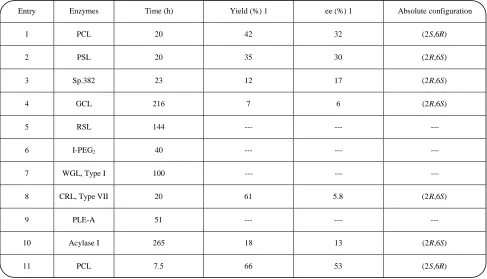
Initially, enzymatic hydrolysis of diester 5 was done using a variety of enzymes such as Pseudomonas cepacia lipase (PCL) and Pseudomonas species lipase (PSL) in the presence of Celite in isopropylether saturated with phosphate buffer at pH 7. The results are listed in table 1. The best result was achieved using PCL by lowering the time of reaction (entry 11). In an effort to increase the enantiomeric excess, other reactions were done with this enzyme by changing the other parameters. Addition of
Me Me
Me
Me Me Me
HO HO OAc
7 1
Me Me
Me Me
OAc AcO
5 6
Me Me Me Me
OH HO
1. (thx)BH2
2. NaOH, H2O2
Me Me
OAc AcO
Me Me
OH
HO Ac2O
DMAP, py 90%
Me Me
OAc HO
Me Me
OAc
AcO 2 6
S R
Lipase
Hydrolysis agent
8 6
5 8
(2S,6R)-1 5
a)
b)
Scheme 3: Reactions sequence for determination of enantiometric excess.
Scheme 4: Optimized enzymatic hydrolysis of diacetate 5 by PCL.
various co-solvents and changing the solvent did not lead in general to an increase in enantiomeric excess as shown by the results in table 2. When a mixture of hexane and i-Pr2O(1:1)wasusedassolvent (entry 6), the enantiomeric excess reached 53 %, but the yield of reaction decreased to only 36 %. Then, we tested enzyme-catalysed transesterification reactions using C2H5OH in the presence of PCL and different organic solvents, hoping to improve the enantiomeric excess. The results are shown in table 3. Under these conditions no satisfactory enantiomeric excess and chemical yield were achieved.
Of the enzymes and conditions studied, the hydrolysis of 5 with phosphate buffer at pH 7 in the presence of Pseudomonas cepacia lipase in isopropyl ether, the conditions reported in entry 11 in table 1, gave the best result and provided the chiral monoacetate 1 with an ee ≥ 53 % in 66 % yield (scheme 4). The absolute configuration of monoacetate 1 was determined by correlation with the known absolute configuration of the α-Tocopherol side chain, (2R,6R)-2,6,10-trimethyl-1-undecanol 7 (scheme 6). This correlation proved that monoacetate 1 has the (2S,6R) configuration and PCL had selectively hydrolyzed the S stereocenter
(scheme 5). The enzymatic hydrolysis of meso-diester 5 gave the desired (2S,6R)-monoacetate 1, so we used the conditions reported in entry 11 in table 1 for scaling up the reaction and then, the resulting (2S,6R)-monoacetate 1 served as a chiral building block in the synthesis of the C14 side chain of α-Tocopherol by the reaction sequence shown in scheme 6. Monoacetate 1 was converted into the corresponding tosylate 11 with p-toluenesulfonyl chloride in pyridine. Condensation of tosylate 11 with excess isoamylmagnesium [4] in the presence of tetra-chlorocuprate as catalyst in THF (Kochi’s conditions) resulted in the formation of (2R,6R)-2,6,10-trimethyl-1-undecanol 7, the C14 side chain of α-Tocopherol.
CONCLUSION
The enzymatic hydrolysis of meso-1,7-diacetoxy-2,6-dimethylheptane 5 gave the desired (2S,6R)-monoacetate 1, which was used as the chiral building block in the synthesis of alcohol 7. In this manner, the C14 side chain of α-Tocopherol or vitamin E was synthesized in only 5 steps from diene 6. Therefore, an improvement in the number of steps has been obtained.
Me Me
O HO Me
Me
OAc
HO OAc
RuCl3, NalO4
CCl4, CH3CN
H2O
Me
Np NH2 Me Me
O OAc
H N
Me EDC, CH2Cl2
(2S,6R) 1 9
10
Me Me
Me Me
OAc
AcO HO OAc
PCL (i-Pr)2O
Buffer, pH=7 66%
Table 1: Enzyme-catalysed hydrolysis of meso-diester 5 iniso-propylether saturated with phosphate buffer at pH 7.
Entry Enzymes Time (h) Yield (%) 1 ee (%) 1 Absolute configuration
1 PCL 20 42 32 (2S,6R)
2 PSL 20 35 30 (2R,6S)
3 Sp.382 23 12 17 (2R,6S)
4 GCL 216 7 6 (2R,6S)
5 RSL 144 --- --- ---
6 I-PEG2 40 --- --- ---
7 WGL, Type I 100 --- --- ---
8 CRL, Type VII 20 61 5.8 (2R,6S)
9 PLE-A 51 --- --- ---
10 Acylase I 265 18 13 (2R,6S)
11 PCL 7.5 66 53 (2S,6R)
Table 2: Enzyme-catalysed hydrolysis of meso-diacetate 5 using PCL in different solvents.
Entry Solvent Time (h) Yield (%) 1 ee (%) 1 Absolute configuration
1 C6H14 58 14 27 (2R,6S)
2 CHCl3 55 5 16 (2S,6R)
3 C6H14 + i-Pr2O
(1:1) 4 41 42 (2S,6R)
4 CHCl3 + i-Pr2O
(1:1) 22 34 24 (2S,6R)
5 CH2Cl2 115 17 48 (2S,6R)
6 C6H14 + i-Pr2O
(1:1) 2 36 53 (2S,6R)
Table 3: Enzyme-catalysed transesterification of meso-diester 5 using C2H5OH in the presence of PCL.
Entry Solvent Time (h) Yield (%) 1 ee (%) 1 Absolute configuration
1 C6H14 2.30 21 23 (2S,6R)
2 CHCl3 93 8 52 (2S,6R)
3 THF 48 16 39 (2S,6R)
Scheme 5: Enzymatic hydrolysis of meso-diester 5 in the presence of PCL.
Scheme 6: Synthesis of the C14 side chain of α-Tocopherol using monoacetate (2S,6R)-1.
Received : 23th April 2006 ; Accepted : 11th September 2006
REFERENCES
[1] Chênevert, R., Desjardins, M., Enzymatic Desym-metrization of meso-2,6-Dimethyl-1,7-heptanediol, Enantioselective Formal Synthesis of the Vitamin E Side Chain and the Insect Pheromone Tribolure, J. Org. Chem., 61, 1219 (1996).
[2] Still, W. C., Darst, K. P., Remote Asymmetric Induction. A Stereoselective Approach to Acyclic Diols via Cyclic Hydroboration, J. Am. Chem. Soc., 102, 7385 (1980).
[3] Carlsen, P. H. J., Katsuki, T., Martin, V. S., Sharpless, K. B., A Greatly Improved Procedure for Ruthenium Tetroxide-Catalyzed Oxidations of Organic Compounds, J. Org. Chem., 46, 3936 (1981).
[4] a) Gilman, H., Beaber, N. J., A New Type of Synthesis, 1. The Reaction Between Halogen-alkyl
Sulfonates and Organomagnesium Halides, J. Am. Chem. Soc., 45, 839 (1923). b) Gilman, H., Cartledge F. K., The Analysis of Organolithium Compounds, J. Organomet. Chem., 2, 447 (1964). c) Whitesides, G. M., Casey, C. P., Krieger, J. K., Thermal Decomposition of Vinylic Copper(I) and Silver(I) Organometallic Compounds, J. Am. Chem. Soc., 93, 1379 (1971). d) Heathcock, C.H., Tice, C. M., Germroth, T.C., Synthesis of Sesquiterpene Antitumor Lactones. 10. Total Synthesis of (.+-.)-Parthenin, J. Am. Chem. Soc., 104, 6081 (1982). e)Watson,S.C.,Eastham,J.F., Colored Indicators for Simple Direct Titration of Magnesium and Lithium Reagents, J. Organomet. Chem., 9, 165 (1967). f) Lin, H.S., Paquette, L. A., A Convenient Method for Determining the Concentration of Grignard - Reagents, Synth. Commun., 24, 2503 (1994).
AcO OAc
s
HO OAc
s
PCL
(i-Pr)2O
Bufer, pH=7
5 (2S,6R)-1
Me Me
OAc TsO
Me Me
OAc
HO TsCl, py
DMAP, 85%
(2S,6R)-1 11
Me Me
OH Me
Me
2 6
R R
MgBr
Li2CuCl4, THF
70%
[5] McGuirk, P. R., Collum, D. B., Total Synthesis and Stereochemistry of (+)-Phyllanthocindiol, J. Org. Chem., 49, 843 (1984).