[Gupta* et al., 5(4): April, 2018]
ISSN: 2349-5197
Impact Factor: 3.765
I
NTERNATIONAL
J
OURNAL OF
R
ESEARCH
S
CIENCE &
M
ANAGEMENT
OPTIMIZATION APPLICATIONS WITH MULTIMODAL TEST FUNCTION
COMPARISON
Mukesh Kumar Gupta
*1, Samar Wazir
2& Md. TabrezNafis
3*1,2&3
JamiaHamdard, New Delhi, India
DOI: 10.5281/zenodo.1236839
Keywords
:
Swarm optimization, multi-object optimization, cloud computing, genetic algorithms.General Terms
Swarm intelligence, nature-inspired algorithm.
Abstract
This paper attempts to put up a general review of common knowledge of dis-similar types of the intelligent optimization process, controlling techniques and algorithms like that swarm optimization or PSO. In this algorithm, we are deploying two models called as global – best and local – best, and hence we consider these models as in multimodal test functions. At last, the studies and results show that the methods are very highly competitive and also can be used as a suitable another approach to solving the problem of multi-object optimization when dealing with multimodal functions. We study different uncertainties from present approaches to addressing them and relationship of different processes is discussed. At last, we would like to propose some promising points are suggested for future research purpose.
Introduction
In the past some years ago, the optimization was only a curiosity. In 1995, optimization was first put forward by two scientists Dr. Eberhart and Dr. Kennedy in the domain of computing and artificial intelligence [1]. Nowadays PSO algorithms have so many significant attention by all researchers. Now swarm optimizations have more applications for researchers around the globe. Swarm optimization or PSO is the study of social behavior and cognitive knowledge [2]. It is a concept, which consists of accelerating the particle with respect to time. PSO has been a win-win position which is successfully implemented in almost all research areas. It is a population-based continuous non-linear optimization technic [3]. It is a logical step by step process which is a family of nature inspired. The most common algorithms are particle swarm optimization, ant colony optimization, and many more. It has several attributes. These algorithms are based on collective artificial intelligence [4]. Swarm is a collection of something that moves somewhere in large numbers like in the form of birds flock. It is a natural phenomenon as inspiration like a group of animals or flock of bird’s sweeps across in the sky. Swarm intelligences (SIs) [13] are a relatively new approach to problem-solving.Swarmintelligences (SIs) are an artificial intelligence with self – governed the system, usually “multi-agent systems.”It simulates collectively social animal’s behavior such as birds-flocking, fish schooling, ants, bees species, etc. In particle swarm optimization, each individual solution of problem is called the ‘particle’. Evolutionary algorithms (EAs) are the heuristic search method [5]. The social behavior of these species is presided by the art of learning, habits of adaptation and evolution. Examples: the ants easily search the shortest path to the food (source), and another one is the birds search their destination when they move from one place to another. The basic evolutionary technic proposed in the computing and artificial intelligence was genetic algorithms (GAs) [6]. These algorithms were introduced starting point on ‘survival of the fittest’ (Principle of Darwinian) [7]. The GAs algorithms have been used in the most applications of engineering and science [8]. Recent developments in GAs and various improvements in EAs, mimetic algorithms (MAs) [9], PSO and SFL [11] which inspired by the different-differentnature-based process.
[Gupta* et al., 5(4): April, 2018]
ISSN: 2349-5197
Impact Factor: 3.765
I
NTERNATIONAL
J
OURNAL OF
R
ESEARCH
S
CIENCE &
M
ANAGEMENT
In ant colony optimization, whenever ants find food, it marks it return path or journey with a chemical substance called pheromones [12]. The shortest path will be reinforced by the pheromones further. Finally, the ants arrive at the shortest path.Fig 1: Ant Colony Optimization
Ant characteristics: ant leaves pheromone when they travel for in search of food. Other ants follow the trail of pheromone if there is one side is more pheromone. Ants can figure out the shortest path.
Bee Algorithm: It has two steps:- - ManageBeeActivity() - Calculate Vectors()
Related Work
We see that Kennedy and Eberhart [14] proposed advice called PSO. It is a biological inspiration for the behavior of bird flocking. In this advice, we have learned as a distributed animal behavioral algorithm which may be performed in a broad or multi-dimensional space search. In this particle swarm optimization algorithm, the behavior of every andeach particle is influenced by either in the best global particle or may be the best local particle. In a PSO, we see by which particle swarm optimization allows particles to grant from their lapse of time i.e. past experiences. An interesting aspect is that there are many facts to extend particle swarm optimization to manage so many multi-objects. So, we will read here some multi-objects.
Parsopoulos and Vrahtis algorithm [15]: In this algorithm, it approaches an aggregating function out of all three approaches; first is the bang-bang aggregating weighted function, second is a conventional linear aggregation approach, and third is a dynamic aggregation approach.
Moore and Chapman algorithm [16]: Basically this algorithm is the key focus on Pareto dominance. In this algorithm, the best of performing a particle and a global search.
Hu and Eberhart algorithm [17]: This algorithm is based on dynamic neighborhood PSO. In this algorithm, lexicographic ordering is usedwith respect to time.
The swarm metaphor by Ray and Liew [18]: In this approach, it approaches Pareto dominance using particle swarm optimization.
Sir Deelman et al. [19] have done a remarkable scientific workflow on cloud mapping, planning, information-reuse in the field of job scheduling algorithm, etc. The mapping of job scheduling is an NP-complete problem which generally has two easy steps: First is job-scheduling with equally weighted up to two processors and another is scheduling jobs with continuous weights are more than two processors [20].
Lei et al. [21] stateby which the PSO algorithmsare to use best job schedule other than a genetic algorithm (GA) [6] on the basis of their experiment simulation for distributed computing.
Mostaghim and Teich [22] give a concept ofthe sigma approach that is a local – best solutions or guides for each particle. It refines convergence as well as diversity of a PSO which is nearly new for multiple objective optimizations. A concept of the Sigma method is familiar with compromise programming [23].
[Gupta* et al., 5(4): April, 2018]
ISSN: 2349-5197
Impact Factor: 3.765
I
NTERNATIONAL
J
OURNAL OF
R
ESEARCH
S
CIENCE &
M
ANAGEMENT
Problem declaration
Multiple criteria optimization can be proposed as:-
Suppose that a variable vector satisfies some restrictions and also optimizes the vector function F (v).
Here we can propose it in the following way: -
Vector V = [V1, V2, ..., VN], if m=inequality constraints.
If we add the weight of inertia (w) in PSO, weight of inertia (w) is reduced to manage the impact of the limiting speeds on the present speed. Hence, impact of the compensation in the local and global exploration capabilities
of a ‘flight points’ [24].
Some years ago, the meta-model was assisted by some approximate matching functions [25]. Motivations: The use of the approximate physical fitness function of the meta-model is motivated by the
following reasons:-
- Each individual assessment of aptitude requires a lot of time. It is necessary to perform computational fluid dynamics (CFD) simulations [26] to evaluate the quality of
a structure in dynamic design optimization. A CFD simulation is very expensive and also takes more than 10 hours for a single calculation in a high-end computer system [27].
- In an art design and music composition cases, the quality of the solutions must be evaluated by a human user [30]. The interactive EA framework can be adopted [28]. In the context of interactive multiple object EAs, meta-model approximation adequacy models [29] have also been used. In a real-time EO of control systems, simulations can be used for fitness evolutions. The estimation of physical fitness is an inherent problem if a person writes code for a part of the solutions and, therefore, the quality of the user cannot be evaluated [31].
- Extra aptitude assessments are also necessary when trying to find solid solutions [32].
- The main assumption in a global meta - model can be made to smooth the local optimum without changing the
location of the global optimum [33].
Approximation methods: several methods can be adopted for the approximation of the aptitude in the
evolutionary computation.
- Approximation of problems: try to use the original statement of the problem, which is the same as in the main
problem to solve it easily.
- There are many ad hoc methods used to solve some optimization problems. Example, random sampling is used to solve the problem instead of the complete sampling of an image using GAs [6]. - Assignment of physical aptitude, imitation of physical fitness and physical condition: this approach is specific to EA. The goal is to develop the fitness of a user of other similar individuals is called inheritance [34]. An approach similar to the inheritance of fitness has also been suggested. Individuals are grouped that will be evaluated by the meta-model's fitness function. The idea of the imitation of fitness has been more sophisticated estimation methods [35]. Individuals in one of the two populations code or are part of the problem in two -level co-evolutionary optimization algorithm. The process is known as physical activity allocation to estimate physical fitness values to solve this problem [36]. The idea of imitation of physical conditioning has been broadened, and more sophisticated estimation methods have been developed [37]. Mechanisms for meta-model incorporation: meta-models can take advantage of each EA element, including initialization, recombination, mutation, and physical fitness assessments.
- Use of approximation aptitude models to initialize the population.
[Gupta* et al., 5(4): April, 2018]
ISSN: 2349-5197
Impact Factor: 3.765
I
NTERNATIONAL
J
OURNAL OF
R
ESEARCH
S
CIENCE &
M
ANAGEMENT
Population
It is a collection of N number of individuals. It is a specific factor of a population, if in the first generation of its evolution; it is its generic diversity. If and only if the population is very less, the scarcity of generic diversity can result in a population-based dominated by almost equivalent to chromosomes and then, after decoding the genes and evaluating function. On the other side, on too-large sides of the population, then mating individuals around different groups can produce newborn children who lack the good generic part of both or either of the parents.
Non - Pareto approach population
In VEGA approach, the sub-population is chosen from modified generation from every of its goal. To generate the new population from crossover and mutation method by using shuffling all subpopulation accordingly [38]. The key point of VEGAs was applied and used to fit in the particle swarm optimization framework and hence developing the algorithm. We are using two swarm particles to solve it at least in five benchmark problems like from f1to f5.
Every swarm particle was created to one of its goals accordingly. Especially the second swarm’s best particle was used for the creating new velocities from the particles of the one swarm and also vice-versa. In another way, second swarm’s best positions could be used in an associateship with the second swarm’s best particle for creation of the velocities of the one swarm and also the vice-versa.
Engineering problems on optimization have diluted to the different approaches of alternative solutions. Linear and non-linear programming processes fail due to reaching local optimum. Hence researchers have introduced evolutionary based algorithms to overcome these problems.
Ant colony optimization algorithm
Ant colony optimization evolves their nature-based social behavior. It is developed by Scientist-cum-Doctor Dorigo et al. [39]. Ants are compatible to search the nearest track from the nest to source of food. Ants deposited the pheromone trails, whenever ants travel. Thisis done in the form of communications.
When the ants search a source of food, they take the same food and when returning back to the home with food. In the ACO, ACO requires a variable S for ach ant. Where tmn = Ants associated pheromone concentrations; m = 1,2,…….S and n = 1,2,…….S, when the process is start m random ants, an ant k = 1,2,……,m which is the solution string.
tij (T) = ptij (T-1) + dtij; where T= 1,2,3……..n;
tij (T) is the revised pheromone concentration at iteration T and tij (T-1)at previous iteration, the concentration of pheromone, dtij = pheromone concentration change and p = rate of pheromone evaporation (value should be 0 to 1).
Particle swarm optimization
Various methods may be used to group particles into competitive and semi-independent flocks. The particles mayassociates to only one global flock of bird species. The simple concepts have been increasing effectively in a wide variety of problems. In 1995, PSO was firstly developed by Dr. J. Kennedy and Dr. R. Eberhart from inspiration of the studies of the behavior of waterfowl by biologist Frank Heppner [2]. It is belongs to problem-solving techniques inspiration by evolution, such as evolution and genetic algorithms [6].
PSO algorithm
This algorithm hasconsisted of ‘n’ number of particles. The particles are changing its own conditions in the following three principles accordingly.
1. To change the most optimist position of the swarm 2. To keep its inertia
[Gupta* et al., 5(4): April, 2018]
ISSN: 2349-5197
Impact Factor: 3.765
I
NTERNATIONAL
J
OURNAL OF
R
ESEARCH
S
CIENCE &
M
ANAGEMENT
PSO is the nature-based social behavior of migrating birds flocking. These birds areEach solution is a ‘bird’ when they are flocking to reach the destination, and each ‘bird’ is referring as a particle. We know that the particle swarm optimization simulates the social behavior of the birds flocking. Let us assume that to check the following scenario: Birds flocking randomly searches for a food source in a particular way [3]. If thereare only one source of food in a particular space or field.Moreover,each and every bird do not know, that the where are found the food or lying on the ground or somewhere else. Then, the best strategy is to search the source of food; thenthe most impact is that to follow the species that is closest to the source of food.
In particle swarm optimization, we know that we have learned from the current state. Hence we provided it to solve easily optimization problems. Each and every individual solution is a "species" in the optimization search space in the PSO. Hence we call it "particle."
In PSO, after finding the two best levels that are local best and global best, particle continuously updates their positions and velocitiesare the following from these equations.
Velk+1 = Velk + K
1 * r k * (lpbestk - xi) + K2 * r k * (glbestk - xi) (1)
xi+1 = xi + Velk (2)
Velk is velocities of particles;x
i is the present solution of current state particle. Here lpbestk and glbestk are defined as indicated above. Random r k is a random number and range should be between (from 0 to1). K
1, K2is
learning factors. Usually K1 = K2 = 3.
Let a workflow programme say W = (T, E) is analysis as a graph, in which T = {t1, t2,……….,uptotn} have been as a set of a number of tasks and E may have been as a set of n number of edges. Where an edge ei,jmay have been task form (ti, tj), in which, where are tii= parent task and tjj = child task. Hence we say that if all parent tasks are completed, then no one child tasks are executed. In fig. 1, every workflow application has a deadline dwwhich is equal to the execution of the workflow application time limit. As we know cloud provider - Infrastructure as a Service (IaaS) offering a long range of virtual machines. The type of VMI may be in the form of PVMiwhich is equal to processing capacity,andanother factor is CVMiequal to cost per unit of time.
In our case, let VMs have some memory to run the workflow applications.
The performance variation is carried out by taking the suitable value of the processing capacities.
In the form of floating point operations per second i.e. (FLOPS) and hence calculating a performance based degradation percentage degVMi.
Unit of time taken t is generally provided by the service provider, belongs to the pay-per-use basis,and partial use of the VMsis calculated. We can understand it by a suitable example. For a while, t = 60 minutes and supposed to a VMsare used t = 61 minutes. Hence user has to promote for two cycle periods of each 60 minutes, which will be 120 minutes. The velocities of the particles in each dimension are setto Vmax at maximum velocity.
PSO and Genetic algorithms comparison
A. An initial population’s random generationB. Recognition of fitness level for each object. It will dependproportional on the distance to the optimum. C. Population-based reproduction on fitness levels.
D. If the conditions of requirements are met, then end. Else, come again to B point.
[Gupta* et al., 5(4): April, 2018]
ISSN: 2349-5197
Impact Factor: 3.765
I
NTERNATIONAL
J
OURNAL OF
R
ESEARCH
S
CIENCE &
M
ANAGEMENT
optimizationare significantly different. In genetic algorithm, the chromosomes shares the knowledge between them. Then whole population reallocates in a group towards anminimum value. In particle swarm optimization, only glbest or lpbest delivers exact information to others particles. This is a one-side information exchange process. Evolution optimization (EO) [44] only seeks the best solution to the problem. As compared to GA, all particles are connected to converge rapidly to best solution of the problem, though in local versions also in most cases.PSO controlling parameters
In particle swarm optimization, It is necessary to adjust some parameters. Parameters list and their standard
values are given here.
Number of particles range should be 10 to 50. Basically, for all the problems, 20 particles are so enough to book
the best results.
Particles Dimensions: it is assumed through the problem of being optimized.
Range of particle: It is also assumed through problem to be optimum value, we should specify some ranges for
different particle dimensions.
Condition of stop: Maximum iterations executed by PSO and error requirement will be minimum. Example, we can establish that the error requirement will be minimum is a zigzag pattern. Number of maximum iterations should be set to 2500. The stopping conditions will depend on the problem which is too optimized.
Local and global version: Here we know PSO’s two versions that are global version as well as local version.
The global version will be much faster but can converge to the local optimum values for most problems. The local version is slightly a bit slower,but it is not so easy to be captured for the local optimum values. Anyone may use the global version, so we get the fast results and use a local version to refine more to be search.
Global best model
In this approach, finding the best particle is possible between iteration; all best particles are modified before entering in the next level selection.
Swarm initialization for loop i = 1 to number of particles do for j=1 to
number of dimensions do
initialize xij with a rnd (Xmin, Xmax) value initialize vij = 0
copy xijin pij end end
search the best global leader and record its position
swarm flight through the search space do
for i=1 to
number of particles do for j=1 to
[Gupta* et al., 5(4): April, 2018]
ISSN: 2349-5197
Impact Factor: 3.765
I
NTERNATIONAL
J
OURNAL OF
R
ESEARCH
S
CIENCE &
M
ANAGEMENT
update xijif(loop_number<total_loop *prob_mut) then mutate xij
end for
evaluate fitness (xi) if fitness (pi)< fitness (xi) then update pi
end for
search the best global leader and record its position
while (loop_number<total_loop)
Fig 2: global – PSO algorithm Pseudo-code of global PSO model
Local best model
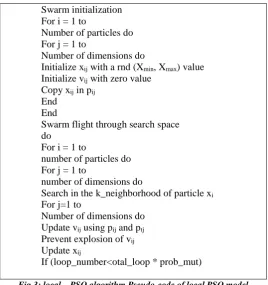
In this case, we always see the best particle,and hence these particles boost up the velocity of the particle within the neighborhood.
Swarm initialization For i = 1 to
Number of particles do For j = 1 to
Number of dimensions do
Initialize xij with a rnd (Xmin, Xmax) value Initialize vij with zero value
Copy xij in pij End End
Swarm flight through search space do
For i = 1 to
number of particles do For j = 1 to
number of dimensions do
Search in the k_neighborhood of particle xi For j=1 to
Number of dimensions do Update vij using pij and ptj Prevent explosion of vij Update xij
If (loop_number<otal_loop * prob_mut)
Fig 3: local – PSO algorithm Pseudo-code of local PSO model
Both models are proposed some results in this paper which follows Carlisle’s discussion and suggestions [40].
Table 1 Year wise natural inspiration optimization algorithm
Year Algorithms name Inspiration
1975 Genetic Algorithms (GAs)[6] Evolution
1983 Simulated annealing Metallurgy
1995 Particle swarm optimization Bird-flocking
2006 Ant colony optimization Ant-colony
2006 Artificial bee colony [41] Honey-bee
[Gupta* et al., 5(4): April, 2018]
ISSN: 2349-5197
Impact Factor: 3.765
I
NTERNATIONAL
J
OURNAL OF
R
ESEARCH
S
CIENCE &
M
ANAGEMENT
Test Functions
At first, we choose some multi-model functions to verify our concept. To find topology either the global best or the local best models, diversity is a key issue. This section compares different types of optimization algorithms using uni-model and non-uni-model test functions. The following functions are used here to test the optimization algorithms:-
1. Rastrigin’s function: - It isa robust Spherical function and arranged as sinusoidal bumps, characterized by deep local minima. If x* = 0, then global minimum is f(x*) = 0.
F1 (x) = nA + xi2 – A cos (wxi) (3)
Where A = 10 (It is a fix value), w =2*3.14 and F1 (x) = 0 for x = (0, 0, …. , 0) is the global optimum.
Table 2 exhibits parameter settings for the functions. Here all the functions are tested using 40 – dimensional search spaces. Default parameters are used through-out to produce acceptable results of test functions.
2. Spherical function: -It is a very easy, uni-modal function. If x* = 0, then global minimum is f(x*) = 0.
F2 (x) = xi2 (4)
Actually this function is a quadratic function.
3. Ackley’s function:- It is a multi-model function as well as deep local minima. If x* = 0, then global minimum is f(x*) = 0. The variable used here are independent.
F3 (x) = - 20 exp (-0.2sqr(1/n*xi2) – exp (1/n * cos (wxi)) + 20 + e (5)
4. Schwefel’s function: - If x* = 0, then global minimum is f(x*) = 0. The variable used here are independent.
F4 (x) = 418.98n + xi sin (sqr xi) (6)
Table 2 Function parameters
Function N Domain Threshold
Ackley 30 030.00 005.00
Rastrigin 30 005.12 100.00
Spherical 30 100.00 000.01
Schwefel 30 100.00 000.01
Conclusions and future related work
PSOsarethe very simple algorithms. It has a broad range of functions for optimizing problems. Our goal is to develop it. We have succeeded because of its easy and simple. These algorithms havesome lines of code. The condition of the requirement is only some parameter of the problem. Moreover, it has to solve it using some specification. In conclusion, we propose some interesting research points for research purpose are as follows. There are various uncertainties in optimization problems, searching robust solutions for fitness evaluation
References
[1] J. Kennedy and R. C. Eberhart, Swarm Intelligence. San Mateo, CA:Morgan Kaufmann, 2001.
[2] K. E. Parsopoulos and M. N. Vrahatis, “Particle swarm optimizationmethod in multiobjective problems,” in Proc. 2002 ACM Symp. AppliedComputing (SAC’2002), Madrid, Spain, 2002, pp. 603– 607.
[3] J. Echer and M.Kupferschmid, Introduction to perations Research.New York: Wiley, 1988.
[4] X. Hu and R. Eberhart, “Multiobjective optimization using dynamicneighborhood particle swarm optimization,” in Proc. Congr. EvolutionaryComputation (CEC’2002), vol. 2, Honolulu, HI, May 2002, pp.1677–1681.
[5] T. Ray and K. M. Liew, “A swarm metaphor for multiobjective designoptimization,” Eng. Opt., vol. 34, no. 2, pp. 141–153, Mar. 2002.
[6] E. Deelman, G. Singh, M.-H. Su, J. Blythe, Y. Gil,C. Kesselman, G. Mehta, K. Vahi, G. B. Berriman, J. Good A. Laity, J. C. Jacob, and D. S. Katz. Pegasus: A frameworkfor mapping complex scientific workflows onto distributedsystems.Sci. Program., 13(3):219–237, 2005.
[7] J. D. Ullman. Np-complete scheduling problems.J. Comput.Syst. Sci., 10(3), 1975.
[8] J. Kennedy and R. Eberhart.Particle swarm optimization.In IEEE International Conference on Neural
[Gupta* et al., 5(4): April, 2018]
ISSN: 2349-5197
Impact Factor: 3.765
I
NTERNATIONAL
J
OURNAL OF
R
ESEARCH
S
CIENCE &
M
ANAGEMENT
[9] L. Zhang, Y. Chen, R. Sun, S. Jing, and B. Yang. A task scheduling algorithm based on pso for gridcomputing. InternationalJournal of Computational Intelligence Research,4(1), 2008.
[10]S. Mostaghim and J. Teich, “Strategies for finding good local guides inMulti-Objective Particle Swarm Optimization (MOPSO),” in Proc. 2003IEEE Swarm Intelligence Symp., Indianapolis, IN, Apr. 2003, pp. 26–33.
[11]C. A. CoelloCoello, D. A. Van Veldhuizen, and G. B. Lamont, EvolutionaryAlgorithms for Solving
Multi-Objective Problems. Norwell,MA: Kluwer, 2002, ISBN 0-3064-6762-3.
[12]Davis, L., Ed. (1991). Handbook of Genetic Algorithms. Van Nostrand Reinhold, New York, NY. [13]Eberhart, R. C. and R. W Dobbins (1990). Neural Network PC Tools: A Practical Guide. Academic
Press, San Diego, CA.
[14]Heppner, F. and U. Grenander (1990). A stochastic nonlinear model for coordinated bird flocks. In S. Krasner, Ed., The Ubiquity of Chaos. AAAS Publications, Washington, DC.
[15]Holland, J. H. (1992). Adaptation in Natural and Artificial Systems.MIT Press, Cambridge, MA. [16]Millonas, M. M. (1994). Swarms, phase transitions, and collective intelligence. In C. G. Langton, Ed.,
Artificial Life III.Addison Wesley, Reading, MA.
[17]J. Kennedy. Small worlds and mega-minds: Effects of neighborhood topology on particle swarm performance. In
[18]Congress on Evolutionary Computation, CEC’99 (WhasingtonDC, USA), volume 3, pages 1931–1938,
Piscataway, NJ.,July 1999. IEEE Service Center.
[19][18] J. Kennedy and R. C. Eberhart. A new optimizer using particleswarm theory. In Proceedings of
Sixth InternationalSymposium on Micro Machine and Humaan Science (Nogoya,Japan), pages 39–43,
Piscataway, NJ., 1995. IEEE ServiceCenter.
[20]J. Kennedy and R. C. Eberhart.Particle swarm optimization.In Proceedings of International Conference
on Neural Networks(Perth, Australia), pages 1942–1948, Piscataway, NJ.,1995. IEEE Service Center.
[21]J. Kennedy and R. C. Eberhart.Swarm Intelligence. MorganKaufmann Publishers, California, USA, 2001.
[22]J. Kennedy and R. Mendes. Population structure and particleswarm performance. In Congress on
Evolutionary Computation(Honolulu, Hawaii), Piscataway, NJ., May 2002. IEEEService Center.
[23]M. Lovbjerg and T. Krink.Extending particle swarm optimiserswith self-organized criticality. In
Congress on EvolutionaryComputation, pages 1588–1593, Piscataway, NJ., 2002.IEEE Service Center.
[24]Z. Michalewicz. Genetic Algorithms + Data Structures = EvolutionPrograms. Springer-Verlag, third edition, 1996.
[25]A. El-Gallad, M. El-Hawary, A. Sallam, and A. Kalas, “Particle swarmoptimizer for constrained economic dispatch with prohibited operatingzones,” in Proc. Canadian Conf. Elect. Comput.Eng., 2002, vol. 1, pp.78–81.
[26]Z. L. Gaing, “Constrained dynamic economic dispatch solution usingparticle swarm optimization,” in
Proc. IEEE Power Eng. Soc. GeneralMeeting, 2004, pp. 153–158.
[27]T. A. A. Victoire and A. E. Jeyakumar, “Reserve constrained dynamicdispatch of units with valve-point effects,” IEEE Trans. Power Syst.,vol. 20, no. 3, pp. 1273–1282, Aug. 2005.
[28]A. I. S. Kumar, K. Dhanushkodi, J. J. Kumar, and C. K. C. Paul,“Particle swarm optimization solution to emission and economicdispatch problem,” in Proc. Conf. Convergent Technol. Asia-PacificRegion, 2003, vol. 1, pp. 435–439.
[29]A. H. Mantawy and M. S. Al-Ghamdi, “A new reactive power optimizationalgorithm,” in Proc. IEEE Power Tech. Conf., 2003, vol. 4,pp. 6–11.
[30]V. Miranda and N. Fonseca, “EPSO-evolutionary particle swarm optimization,a newalgorithm with applications in power systems,” in Proc.IEEE/PES Transmission Distrib. Conf. Exhib.: Asia-Pacific, 2002, vol.2, pp. 745–750.
[31]——, “EPSO—best-of-two-worlds meta-heuristic applied to powersystem problems,” in Proc. Congr. Evol.Comput., 2002, vol. 2, pp.1080–1085.
[Gupta* et al., 5(4): April, 2018]
ISSN: 2349-5197
Impact Factor: 3.765
I
NTERNATIONAL
J
OURNAL OF
R
ESEARCH
S
CIENCE &
M
ANAGEMENT
[33]A. A. A. Esmin, G. Lambert-Torres, and A. C. Zambroni deSouza, “A hybrid particle swarm optimization applied to losspower minimization,” IEEE Trans. Power Syst., vol. 20, no. 2,pp. 859–866, May 2005.[34]J. Chuanwen and E. Bompard, “A hybrid method of chaotic particleswarm optimization and linear interior for reactive power optimization,”Mathematics and Computers in Simulation, vol. 68, no. 1, pp.57–65, Feb. 2005.
[35]G. Coath, M. Al-Dabbagh, and S. K. Halgamuge, “Particle swarm optimizationfor reactive power and voltage control with grid-integratedwind farms,” in Proc. IEEE Power Eng. Soc. General Meeting, 2004, pp. 303–308.
[36]M. A. Abido, “Optimal power flow using particle swarm optimization,”Int. J. Elect. Power Energy Syst., vol. 24, no. 7, pp. 563–571,Oct. 2002.
[37]S. He, J. Y. Wen, E. Prempain, Q. H. Wu, J. Fitch, and S. Mann, “Animproved particle swarm optimization for optimal power flow,” in Proc.Int. Conf. Power Syst. Technol., 2004, vol. 2, pp. 1633– 1637.
[38]A. A. Abido, “Particle swarm optimization for multimachine powersystem stabilizer design,” in Proc.
IEEE Power Eng. Soc. SummerMeeting, 2001, vol. 3, pp. 1346–1351.
[39]M. A. Abido, “Optimal design of power-system stabilizers using particleswarm optimization,” IEEE Trans. Energy Conversion, vol. 17,no. 3, pp. 406–413, Sep. 2002.
[40]T. Okada, T. Watanabe, and K. Yasuda, “Parameter tuning of fixedstructure controller for power system stability enhancement,” in Proc.IEEE/PES Transmission Distrib. Conf. Exhib.: Asia-Pacific, 2002, vol.1, pp. 162–167.
[41]N. A. Al-Musabi, Z. M. Al-Hatnouz, H. N. Al-Duwaish, and S.Al-Baiyat, “Variable structure load frequency controller using particleswarm optimization technique,” in Proc. 10th IEEE Int. Conf. Electron., Circuits, Syst., 2003, vol. 1, pp. 380–383.
[42]Y. L. Abdel-Magid and M. A. Abido, “AGC tuning of interconnectedreheat thermal systems with particle swarm optimization,” in Proc. 10thIEEE Int. Conf. Electron., Circuits, Syst., 2003, vol. 1, pp. 376–379.
[43]C. Juang and C. Lu, “Power system load frequency control by evolutionaryfuzzy PI controller,” in
Proc. IEEE Int. Conf. Fuzzy Syst., 2004,vol. 2, pp. 715–719.
[44]S. P. Ghoshal, “Optimizations of PID gains by particle swarm optimizationsin fuzzy based automatic
generation control,” Electric Power Syst. Res., vol. 72, no. 3, pp. 203–212, Dec. 2004.
[45]L. Chun-Feng and J. Chia-Feng, “Evolutionary fuzzy control of flexibleAC transmission system,” Inst. Elect. Eng. Proc. Generation, Transmission Distrib., vol. 152, no. 4, pp. 441–448, 2005.
[46]A. I. El-Gallad, M. El-Hawary, A.A. Sallam, and A. Kalas, “Swarm-intelligentlytrained neural network for power transformer protection,” inProc. Canadian Conf. Elect. Comput. Eng., 2001, vol. 1, pp. 265– 269.
[47]N. Hirata, A. Ishigame, and H. Nishigaito, “Neuro stabilizing controlbased on Lyapunov method for
power system,” in Proc. 41st SICE Annu. Conf., 2002, vol. 5, pp. 3169–3171.
[48]I. N. Kassabalidis, M. A. El-Sharkawi, R. J. Marks, II, L. S. Moulin,and A. P. ves da Silva, “Dynamic security border identification usingenhanced particle swarm optimization,” IEEE Trans. Power Syst., vol. 17, no. 3, pp. 723–729, Aug. 2002.