Intermittent Behavior of Local Electron Temperature in a Linear
ECR Plasma
∗
)
Shinji YOSHIMURA, Kenichiro TERASAKA
1), Eiki TANAKA
1), Mitsutoshi ARAMAKI
2)and Masayoshi Y. TANAKA
1)National Institute for Fusion Science, 322-6 Oroshi, Toki 509-5292, Japan
1)Interdisciplinary Graduate School of Engineering Science, Kyushu University,
6-1 Kasuga-koen, Kasuga 816-8580, Japan
2)College of Industrial Technology, Nihon University, 1-2-1 Izumi-cho, Narashino 275-8575, Japan
(Received 25 November 2014/Accepted 17 February 2015)
An intermittent behavior of local electron temperature has been observed in a linear laboratory plasma, where a high-temperature region that has circular cross-section is formed along the magnetic field line for a short period of time. The floating potential signals which contain sporadic large-amplitude negative spikes associated with the electron temperature intermittency are analyzed statistically for various gas discharges. All the probability density functions of waiting time for different gas discharges exhibit exponential distributions, indicating that the random nature of this phenomenon, or the underlying Poisson process, is a universal property. On the other hand, mean duration of the intermittent events depends on the atomic mass of discharge gas species, showing that the dynamics of heavier particles may play an important role in this intermittency.
c
⃝2015 The Japan Society of Plasma Science and Nuclear Fusion Research
Keywords: intermittency, laboratory plasma, electron cyclotron resonance, local electron temperature, floating potential, probability density function, Poisson process
DOI: 10.1585/pfr.10.3401028
1. Introduction
Intermittency is one of the important topics in the field of plasma research. Intermittent transport of coherent fil-amentary structures called blobs has frequently been ob-served in the edge of many magnetically confined plas-mas [1]. Because the convection of blobs significantly en-hances cross-field transport and may leads to deterioration in edge plasma confinement, the statistical properties of fluctuations in the edge are crucially important. Intermit-tent transport of similar turbulent structures has also been studied by linear devices [2, 3].
Recently, we have observed a new intermittent behav-ior of local electron temperature in a linear electron cy-clotron resonance (ECR) plasma. In contrast to above-mentioned studies in which bursty ion saturation current signals were observed, we have found sporadic large-amplitude negative spikes in floating potential signals mea-sured by a Langmuir probe. Although similar floating po-tential fluctuations in a detached recombining plasma were reported by Ohno et al. [4], the change in floating po-tential was attributable to the space popo-tential fluctuations. Whereas, in our case, the current-voltage characteristics obtained by the conditional averaging method has revealed that the negative spikes are caused by intermittent enhance-ment of electron temperature,Te(More precisely, it should
author’s e-mail: [email protected]
∗)This article is based on the presentation at the 24th International Toki
Conference (ITC24).
be said as an experimentally obtained effective electron temperature, since it has been evaluated by the slope of the probe characteristics taken by a cylindrical Langmuir probe). Moreover, the circular localization of high-Te
re-gion on the plasma cross-section has also been revealed by a newly-developed High-impedance Wire Grid (HIWG) detector [5]. The diameter of the circular high-Teregion is
about 30-40 mm. This spatial feature has also been con-firmed by ICCD imaging of spontaneous emission from the Ne 2p1state at 585 nm [6].
In this paper, statistical properties of the floating po-tential (Vf) fluctuation associated with the localTe
imter-mittency are investigated in terms of the probability den-sity functions (PDFs) of waiting time and duration, espe-cially focusing on their atomic mass dependence. This pa-per is organized as follows. The expa-perimental setup and diagnostics are described in Sec. 2. Sec. 3 presents exper-imental results including the Vf time series measured in
ECR discharges with different gas species and an example of ICCD imaging. In Sec. 4, we discuss the statistical prop-erties ofVftime series and their atomic mass dependence.
Finally, our conclusions are presented in Sec. 5.
2. Experimental Setup
The experiments were performed in the high density plasma experiment-I (HYPER-I) device [7, 8] at the Na-tional Institute for Fusion Science (NIFS). HYPER-I is a linear device that consists of a cylindrical vacuum
cham-c
⃝2015 The Japan Society of Plasma
Table 1 Filling gas pressures and microwave powers for diff er-ent gas discharges.
gas species filling pressure microwave power helium (He) 1.5 mTorr 20 kW
neon (Ne) 1.0 mTorr 10 kW argon (Ar) 0.5 mTorr 5 kW xenon (Xe) 0.5 mTorr 5 kW
Fig. 1 Schematic of the experimental arrangement for ICCD imaging measurement.
ber, 0.3 m in diameter and 2.0 m in length, surrounded by a set of ten magnetic coils. The magnetic field configu-ration was a weakly-diverging one, where the ECR point for 2.45 GHz microwave was located in the middle of the chamber in the axial direction. Plasmas were produced by ECR discharges of different gas species: helium, neon, ar-gon, and xenon. The filling pressure and the microwave power used for each gas species are listed in Table 1. The discharge time was set to 20 s forVf measurements.
The floating potential was measured with a cylindri-cal Langmuir probe terminated with a 1 MΩresistor atz=
1.175 m, where zstands for the axial distance measured from the microwave injection window. The size of the tungsten electrode tip was 1.5 mm in diameter and 1.0 mm in length. In order to ensure sufficient frequency response, a voltage follower circuit using a precision high-speed op-erational amplifier (OPA627, Burr-Brown) was directly connected to the probe [5]. The Vf signal was recorded
with the DL750P ScopeCorder (Yokogawa), where the sampling rate was set to 2 MHz.
The spatial distribution of high-Te region was
mea-sured by an intensified CCD camera (ICCD 576 MG/1, Princeton Instruments) with an interference filter for He-II emission at 468 nm. Since the high-Teregion appears
intermittently in time, the ICCD camera was operated by a trigger signal fromVf measurement with the Langmuir
probe. The exposure time was set to 5µs. Schematic of the experimental arrangement is shown in Fig. 1. Note that the obtainable image is a projection of line-integrated emis-sion along the axis to the plasma cross-section, because the emission was measured through a viewing window in-stalled at the end of the vacuum chamber.
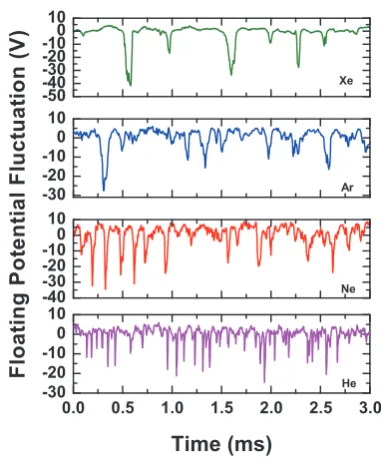
Fig. 2 Typical floating potential signals (fluctuating component) for different gas discharges. The gas species are helium, neon, argon, and xenon from bottom to top.
3. Experimental Results
3.1
Negative spikes on floating potential
signal
Since floating potential (Vf) is, by definition,
deter-mined by the balance between influxes of electrons and ions, abrupt change in electron (ion) influx can give rise to a negative (positive) spike on theVfsignal. In general,Vfis
a function of the space potential (Vs) and electron
temper-ature (Te). WhenTecan be regarded as constant,Vf
pro-vides a good measure ofVsfluctuation. On the other hand,
Vf can be used as an indicator ofTefluctuation whenVs
can be regarded as constant. The latter condition was sat-isfied in the present experiments, which was confirmed by the inflection point of conditionally averaged probe char-acteristics with and without the existence of theVfspike.
Figure 2 shows typical fluctuating component of Vf
extracted from full-length (10 s) time series, where the atomic mass of discharge gas species increases from bot-tom (He) to top (Xe). The event magnitude in this study is defined by the peak amplitude of the negative spikes mea-sured from the mean value. Therefore, the standard devi-ationσof full-length time series can be a good measure that describes how much the peak values deviate from the mean value. In the intense events, the amplitude of neg-ative spikes attains more than 6σ(σ ∼ 3.8 V for He dis-charge), which can hardly be seen in usual Gaussian fluc-tuations. It is also evident that occurrence interval and du-ration of the negative spikes increase with increasing the atomic mass. The effects of atomic mass on the statistical properties of intermittent spikes are discussed in Sec. 4.
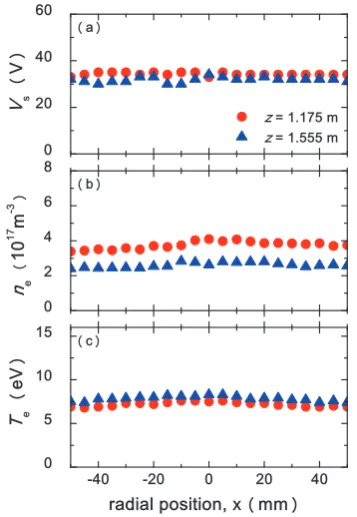
in-Fig. 3 Radial profiles of space potential, electron density, and electron temperature in a helium discharge. Circles and triangles stand for those quantities measured atz=
1.175 m andz=1.555 m, respectively.
termittent spikes. Figure 3 shows radial profiles of space potential, electron density, and electron temperature in a helium discharge, which were obtained by conventional Langmuir probe measurement. All profiles are nearly uni-form and have no steep gradient both in radial and ax-ial directions. Therefore, spatax-ial inhomogeneity is not the source of this intermittency.
3.2
Spatial distribution of high
T
eregion
Figure 4 shows an example of ICCD image of He-II line emission at 468 nm. In order to obtain a clear image, 120 images were conditionally averaged for intense events in which theVf fluctuation amplitude was larger than 47 V
(>12σ). Circular bright region is clearly seen around the probe that was inserted to provide trigger signals for the ICCD camera. The diameter of the bright region is about 30 mm, which is consistent with previous measurement us-ing HIWG detector [5]. It should be emphasized that the occurrence positions of the bright region are not limited in the center of the plasma cross-section. The high-Teregion
appears at various positions in a random manner. The po-sition of the reference probe only determines the region of interest.
He-II line emission at 468 nm is not observed in usual HYPER-I plasmas, because the excitation energy for this transition is about 51 eV, which is much higher than typical bulk electron temperature (Te∼10 eV). In other words, it
can be regarded as a good indicator of the high-Teregion.
Fig. 4 An ICCD image of He-II line emission at 468 nm.
Detailed spatio-temporal evolution of electron temperature in this intermittent phenomenon is beyond the scope of this paper and will be reported elsewhere.
4. Discussions
4.1
Statistics of waiting time
Here we have picked up the negative spikes of which amplitudes exceed 3σand defined them as the intermittent events of interest. In other words, the detection thresh-old value is three times the standard deviation. For exam-ple, the full-length time series of helium discharge contains more than 50,000 events by this definition.
In order to characterize such intermittent phe-nomenon, statistical analysis is a powerful tool. In par-ticular, the statistics of waiting time [9] provides important information on mean occurrence rate and the randomness of the intermittent events. Here the waiting time is defined as the time interval between two minima of consecutive negative spikes whose amplitudes exceed 3σ.
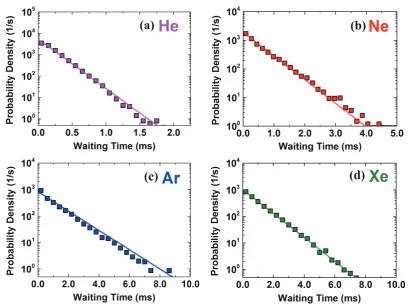
Figure 5 shows the probability density functions (PDFs) of waiting time for different gas discharges in semi-logarithmic plots. Each PDF is constructed from the cor-responding 10-second time series presented in Sec. 3.1. In spite of apparent change in occurrence frequency in diff er-ent gas discharges, all PDFs show obvious linear depen-dences. It has already been reported that the waiting time PDF of intermittent events for helium discharge obeys an exponential distribution [10]. It is remarkable that all the PDFs are well fitted with exponential distributions given by the following expression:
P(τw)=λexp(−λτw), (1)
where the waiting time (τw) PDF is characterized by only
one parameterλ.
proba-Fig. 5 Probability density functions of waiting time for (a) He, (b) Ne, (c) Ar, and (d) Xe discharges in semi-logarithmic scale. Solid lines are exponential distributions.
bility. The exponential distribution is a necessary condi-tion for the Poisson process. A sufficient condition is that the probability for the number of events occurring in given time intervals is described by a Poisson distribution, which has also been confirmed in our previous work [10]. The ex-ponential distribution of waiting time has also been found in blob transport in magnetically confined plasmas [11].
4.2
Statistics of duration
Duration time, which characterizes how long the event lasts, is another important parameter for spiky events. In this study, the duration is defined by the period for succes-sive crossing of the threshold value.
Figure 6 shows the PDFs of duration for different gas discharges in logarithmic scale. A power-law dependence (∝τ−5) can be seen in the longer duration side of the PDFs;
however, the origins of such dependence is still an open question. Another important property of the duration PDF seen in Fig. 6 is that the mean value of each gas discharge increases with increasing the atomic mass.
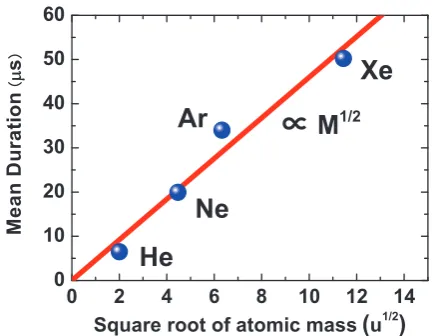
In order to investigate the atomic mass dependence, the mean durations are plotted as a function of atomic mass, which is shown in Fig. 7. A clear dependence that the mean duration is proportional to the square root of the atomic mass can be seen, which indicates a possible impor-tant role of heavier particles in the local electron tempera-ture intermittency in linear ECR plasmas. It should be
em-Fig. 6 Probability density functions of duration for different gas discharges in logarithmic scale.
phasized that the electron temperature intermittency pre-sented in this article is not understandable by wave-particle interaction (electron cyclotron resonance) only. Detailed measurement of the dynamics of heavier particle is our fu-ture work.
5. Conclusions
Fig. 7 Mean duration of the intermittent events for different gas discharge as a function of the square root of atomic mass.
species. The circular localization of high electron tempera-ture region has been confirmed by ICCD imaging of He-II line emission at 468 nm. Statistical analysis of the float-ing potential time series has revealed that the phenomenon is characterized by a stationary Poisson process of which probability density function of waiting time is given by an exponential distribution. The mean duration time of the in-termittent events is proportional to the square root of the
atomic mass of discharge gas, which suggests that the dy-namics of heavier particle may play an important role in this electron temperature intermittency.
Acknowledgments
The authors thank Prof. T. Morisaki for having fruitful discussions on two-dimensional measurement of the inter-mittent phenomenon. This work was supported by JSPS KAKENHI Grant Number 24540554 and by NIFS Collab-oration Research Program NIFS13KBAP016.
[1] G.S. Xuet al., Nucl. Fusion49, 092002 (2009). [2] T.A. Carter, Phys. Plasmas13, 010701 (2006).
[3] T. Windisch et al., Plasma Phys. Control. Fusion 53, 085001 (2011).
[4] N. Ohnoet al., J. Plasma Fusion Res.78, 1093 (2002) [in Japanese].
[5] K. Terasakaet al., Rev. Sci. Instrum.85, 113503 (2014). [6] S. Yoshimura et al., IEEE Trans. Plasma Sci.42, 2554
(2014).
[7] M.Y. Tanakaet al., Rev. Sci. Instrum.69, 980 (1998). [8] S. Yoshimuraet al., to be published in J. Plasma Phys.81
(2015).
[9] M. Aschwanden,Self-Organized Criticality in Astrophysics
(Springer, Berlin, 2011) Chap.5.