Improving Statistical Machine Translation using
Lexicalized Rule Selection
Zhongjun He1,2 and Qun Liu1 and Shouxun Lin1
1Key Laboratory of Intelligent Information Processing
Institute of Computing Technology Chinese Academy of Sciences
Beijing, 100190, China
2Graduate University of Chinese Academy of Sciences
Beijing, 100049, China
{zjhe,liuqun,sxlin}@ict.ac.cn
Abstract
This paper proposes a novel lexicalized ap-proach for rule selection for syntax-based statistical machine translation (SMT). We build maximum entropy (MaxEnt) mod-els which combine rich context informa-tion for selecting translainforma-tion rules dur-ing decoddur-ing. We successfully integrate the MaxEnt-based rule selection models into the state-of-the-art syntax-based SMT model. Experiments show that our lexical-ized approach for rule selection achieves statistically significant improvements over the state-of-the-art SMT system.
1 Introduction
The syntax-based statistical machine translation (SMT) models (Chiang, 2005; Liu et al., 2006; Galley et al., 2006; Huang et al., 2006) use rules with hierarchical structures as translation knowl-edge, which can capture long-distance reorderings. Generally, a translation rule consists of a left-hand-side (LHS) 1and a right-hand-side (RHS). The LHS and RHS can be words, phrases, or even syn-tactic trees, depending on SMT models. Transla-tion rules can be learned automatically from par-allel corpus. Usually, an LHS may correspond to multiple RHS’s in multiple rules. Therefore, in sta-tistical machine translation, the rule selection task is to select the correct RHS for an LHS during de-coding.
The conventional approach for rule selection is to use precomputed translation probabilities which
c
2008. Licensed under the Creative Commons
Attribution-Noncommercial-Share Alike 3.0 Unported
li-cense (http://creativecommons.org/licenses/by-nc-sa/3.0/). Some rights reserved.
1
In this paper, we use LHS and source-side interchange-ably (so are RHS and target-side).
are estimated from the training corpus, as well as a
n-gram language model which is trained on the tar-get language. The limitation of this method is that it ignores context information (especially on the source-side) during decoding. Take the hierarchi-cal model (Chiang, 2005) as an example. Consider the following rules for Chinese-to-English transla-tion2:
(1) X→ ᄝX1 ֥X2, X2 in X1
(2) X→ ᄝX1 ֥X2, at X1 ’s X2
(3) X→ ᄝX1 ֥X2, with X2 of X1
These rules have the same source-side, and all of them can pattern-match all the following source phrases:
(a) ᄝ
in
[ࣜ࠶
economic
ਵთ]1 field
֥
’s
[ކቔ]2 cooperation
[cooperation]2 in [the economic field]1
(b) ᄝ
at
[ࣂ฿]1 today
֥
’s
[߶ၰ
meeting
ഈ]2 on
at [today]1 ’s [meeting]2
(c) ᄝ
with
[ದ]1 people
֥
’s
[ᆦӻ
support
༯]2 under
with [the support]2 of [the people]1
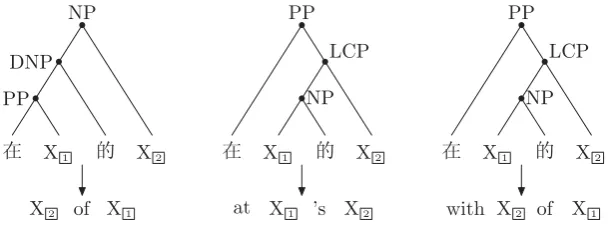
Given a source phrase, how does the decoder know which rule is suitable? In fact, rule (1) and rule (2) have different syntactic structures (the left two trees of Figure 1). Thus rule (1) can be used for translating noun phrase (a), and rule (2) can be applied to prepositional phrase (b). The weakness
2
In this paper, we use Chinese and English as the source and target language, respectively.
NP
DNP PP
ᄝ X1 ֥ X2
X2 of X1
PP LCP
NP
ᄝ X1 ֥ X2
at X1 ’s X2
PP LCP
NP
ᄝ X1 ֥ X2
with X2 of X1
Figure 1: Syntactic structures of the same source-side in different rules.
of Chiang’s hierarchical model is that it cannot distinguish different structures on the source-side. The linguistically syntax-based models (Liu et al., 2006; Huang et al., 2006) can distinguish syntactic structures by parsing source sentence. However, as an LHS tree may correspond to different RHS strings in different rules (the right two rules of Fig-ure 1), these models also face the rule selection problem during decoding.
In this paper, we propose a lexicalized approach for rule selection for syntax-based statistical ma-chine translation. We use the maximum entropy approach to combine various context features, e.g., context words of rules, boundary words of phrases, parts-of-speech (POS) information. Therefore, the decoder can use rich context information to per-form context-dependent rule selection. We build a maximum entropy based rule selection (MaxEnt RS) model for each ambiguous hierarchical LHS, the LHS which contains nonterminals and corre-sponds to multiple RHS’s in multiple rules. We integrate the MaxEnt RS models into the state-of-the-art hierarchical SMT system (Chiang, 2005). Experiments show that the lexicalized rule se-lection approach improves translation quality of the state-of-the-art SMT system, and the improve-ments are statistically significant.
2 Previous Work
2.1 The Selection Problem in SMT
Statistical machine translation systems usually face the selection problem because of the one-to-many correspondence between the source and tar-get language. Recent researches showed that rich context information can help SMT systems per-form selection and improves translation quality.
The discriminative phrasal reordering models (Xiong et al., 2006; Zens and Ney, 2006) pro-vided a lexicalized method for phrase reordering.
In these models, LHS and RHS can be consid-ered as phrases and reordering types, respectively. Therefore the selection task is to select a reorder-ing type for phrases. They use a MaxEnt model to combine context features and distinguished two kinds of reorderings between two adjacent phrases: monotone or swap. However, our method is more generic, we perform lexicalized rule selection for syntax-based SMT models. In these models, the rules with hierarchical structures can handle re-orderings of non-adjacent phrases. Furthermore, the rule selection can be considered as a multi-class multi-classification task, while the phrase reorder-ing between two adjacent phrases is a two-class classification task.
Chan et al. (2007) incorporated a WSD system into the hierarchical SMT system, Hiero (Chi-ang, 2005), and reported statistically significant improvement. But they only focused on solving ambiguity for terminals of translation rules, and limited the length of terminals up to 2. Different from their work, we consider a translation rule as a whole, which contains both terminals and nonter-minals. Moreover, they explored features for the WSD system only on the source-side. While we define context features for the MaxEnt RS models on both the source-side and target-side.
2.2 The Hierarchical Model
The hierarchical model (Chiang, 2005; Chiang, 2007) is built on a weighted synchronous context-free grammar (SCFG) . A SCFG rule has the fol-lowing form:
X→ α, γ,∼
(4)
where X is a nonterminal,αis an LHS string con-sists of terminals and nonterminals,γ is the trans-lation of α, ∼defines a one-one correspondence between nonterminals inαandγ. For example,
(5) X→ ࣜ࠶ ؿᅚ, economic development
(6) X→ X1 ֥X2đthe X2 of X1
Rule (5) contains only terminals, which is simi-lar to phrase-to-phrase translation in phrase-based SMT models. Rule (6) contains both terminals and nonterminals, which causes a reordering of phrases. The hierarchical model uses the max-imum likelihood method to estimate translation probabilities for a phrase pairα, γ, independent of any other context information.
To perform translation, Chiang uses a log-linear model (Och and Ney, 2002) to combine various features. The weight of a derivationDis computed by:
w(D) =
i
φi(D)λi
(7)
whereφi(D)is a feature function andλiis the fea-ture weight of φi(D). During decoding, the de-coder searches the best derivation with the lowest cost by applying SCFG rules. However, the rule selections are independent of context information, except the left neighboringn−1target words for computingn-gram language model.
3 Lexicalized Rule Selection
The rule selection task can be considered as a multi-class classification task. For a source-side, each corresponding target-side is a label. The max-imum entropy approach (Berger et al., 1996) is known to be well suited to solve the classification problem. Therefore, we build a maximum entropy based rule selection (MaxEnt RS) model for each ambiguous hierarchical LHS. In this section, we will describe how to build the MaxEnt RS mod-els and how to integrate them into the hierarchical SMT model.
3.1 The MaxEnt RS Model
Following (Chiang, 2005), we useα, γto repre-sent a SCFG rule extracted from the training cor-pus, whereα andγ are source and target strings, respectively. The nonterminals inαandγ are rep-resented by Xk, where k is an index indicating one-one correspondence between nonterminals in source and target sides. Let us usef(Xk)to rep-resent the source text covered byXk, and e(Xk) to represent the translation off(Xk). LetC(α)be the context information of source text matched by
α, andC(γ) be the context information of target text matched byγ. Under the MaxEnt model, we have:
Prs(γ|α, f(Xk), e(Xk)) =
(8)
exp[iλihi(C(γ), C(α), f(Xk), e(Xk))]
γexp[iλihi(C(γ), C(α), f(Xk), e(Xk))]
wherehiis a binary feature function,λiis the fea-ture weight of hi. The MaxEnt RS model com-bines rich context information of grammar rules, as well as information of the subphrases which will be reduced to nonterminal X during decoding. However, these information is ignored by Chiang’s hierarchical model.
We design three kinds of features for a rule
α, γ:
• Lexical features, which are the words imme-diately to the left and right ofα, and boundary words of subphrasef(Xk)ande(Xk);
• Parts-of-speech (POS) features, which are POS tags of the source words defined in lexi-cal features.
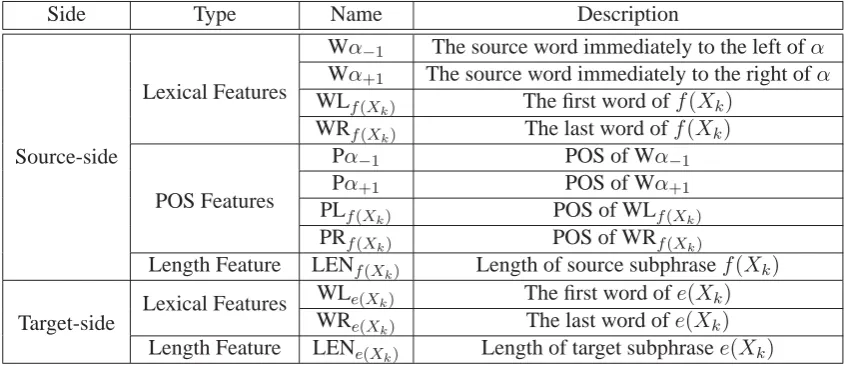
Side Type Name Description
Wα−1 The source word immediately to the left ofα Wα+1 The source word immediately to the right ofα WLf(Xk) The first word off(Xk)
Lexical Features
WRf(Xk) The last word off(Xk)
Pα−1 POS of Wα−1
Pα+1 POS of Wα+1
PLf(Xk) POS of WLf(Xk) POS Features
PRf(Xk) POS of WRf(Xk) Source-side
Length Feature LENf(Xk) Length of source subphrasef(Xk) WLe(Xk) The first word ofe(Xk) Lexical Features
WRe(Xk) The last word ofe(Xk) Target-side
Length Feature LENe(Xk) Length of target subphrasee(Xk)
Table 1: Feature categories of the MaxEnt RS model.
Type Feature
Wα−1=ࡆ఼ Wα+1=b
Lexical Features WLf(X1)=ࣜ࠶ WRf(X1)=ਵთ WLf(X2)=ކቔ WRf(X1)=ކቔ WLe(X1)=economic WRe(X1)=field WLe(X2)=cooperation WRf(X1)=cooperation
Pα−1=v Wα+1=wj POS Features
PLf(X1)=n PRf(X1)=n PLf(X2)=vn PRf(X2)=vn Length Feature LENf(X1)=2 LENf(X2)=1 LENe(X1)=2 LENe(X2)=1
Table 2: Features of rule X→ ᄝX1 ֥X2, X2 in the X1 .
ࡆ఼/v ᄝ/p ࣜ࠶/n ਵთ/n ֥/ude ކቔ/vn b/wj
strengthen the cooperation in the economic field .
Figure 2: An training example for rule extraction.
Table 1 shows these features in detail.
These features can be easily gathered accord-ing to Chinag’s rule extraction method (Chiang, 2005). We use an example for illustration. Fig-ure 2 is a word-aligned training example with POS tags on the source side. We can obtain a SCFG rule:
(9) X→ ᄝX1 ֥X2, X2 in the X1
Where the source phrases covered by X1 and X2
are “ࣜ࠶ ਵთ” and “ކቔ”, respectively. Table 2 shows features of this rule. Note that following (Chiang, 2005), we limit the number of nontermi-nals of a rule up to 2. Thus a rule may have 20 features at most.
After extracting features from the training cor-pus, we use the toolkit implemented by Zhang
(2004) to train a MaxEnt RS model for each am-biguous hierarchical LHS. We set iteration number to 100 and Gaussian prior to 1.
3.2 Integrating the MaxEnt RS Models into the SMT Model
We integrate the MaxEnt RS models into the SMT model during the translation of each source sen-tence. Thus the MaxEnt RS models can help the decoder perform context-dependent rule selection during decoding.
In (Chiang, 2005), the log-linear model com-bines 8 features: the translation probabilities
P(γ|α) andP(α|γ), the lexical weightsPw(γ|α) and Pw(α|γ), the language model, the word penalty, the phrase penalty, and the glue rule penalty. For integration, we add two new features:
• Prs(γ|α, f(Xk), e(Xk)). This feature is computed by the MaxEnt RS model, which gives a probability that the model selecting a target-sideγ given an ambiguous source-side
α, considering context information.
we find that some source-sides are not am-biguous, and correspond to only one target-side. However, if a source-sideα is not am-biguous, the first featurePrswill be set to 1.0. In fact, these rules are not reliable since they usually occur only once in the training corpus. Therefore, we use this feature to reward the ambiguous source-side. During decoding, if an LHS has multiple translations, this feature is set toexp(1), otherwise it is set toexp(0).
The advantage of our integration is that we need not change the main decoding algorithm of a SMT system. Furthermore, the weights of the new fea-tures can be trained together with other feafea-tures of the translation model.
Chiang (2007) uses the CKY algorithm with a cube pruning method for decoding. This method can significantly reduce the search space by effi-ciently computing the top-n items rather than all possible items at a node, using the k-best Algo-rithms of Huang and Chiang (2005) to speed up the computation. In cube pruning, the translation model is treated as the monotonic backbone of the search space, while the language model score is a non-monotonic cost that distorts the search space (see (Huang and Chiang, 2005) for defini-tion of monotonicity). Similarly, in the MaxEnt RS model, source-side features form a monotonic score while target-side features constitute a non-monotonic cost that can be seen as part of the lan-guage model.
For translating a source sentence FIJ, the de-coder adopts a bottom-up strategy. All derivations are stored in a chart structure. Each cellc[i, j]of the chart contains all partial derivations which cor-respond to the source phrase fij. For translating a source-side span [i, j], we first select all possi-ble rules from the rule tapossi-ble. Meanwhile, we can obtain features of the MaxEnt RS models which are defined on the source-side since they are fixed before decoding. During decoding, for a source phrasefij, suppose the rule
X→ fikX1ftj, ek
iX1ej
t
(10)
is selected by the decoder, wherei ≤ k < t ≤ j andk+ 1< t, then we can gather features which are defined on the target-side of the subphrase X1
from the ancestor chart cell c[k+ 1, t−1] since the span[k+ 1, t−1]has already been covered. Then the new feature scoresPrs andPrsn can be computed. Therefore, the cost of the derivation can
be obtained. Finally, the decoding is completed when the whole sentence is covered, and the best derivation of the source sentence FIJ is the item with the lowest cost in cellc[I, J].
4 Experiments
4.1 Corpus
We carry out experiments on two translation tasks with different sizes and domains of the training corpus.
• IWSLT-05: We use about 40,000 sentence pairs from the BTEC corpus with 354k Chi-nese words and 378k English words as our training data. The English part is used to train a trigram language model. We use IWSLT-04 test set as the development set and IWSLT-05 test set as the test set.
• NIST-03: We use the FBIS corpus as the training corpus, which contains 239k sen-tence pairs with 6.9M Chinese words and 8.9M English words. For this task, we train two trigram language models on the English part of the training corpus and the Xinhua portion of the Gigaword corpus, respectively. NIST-02 test set is used as the development set and NIST-03 test set is used as the test set.
4.2 Training
To train the translation model, we first run GIZA++ (Och and Ney, 2000) to obtain word alignment in both translation directions. Then the word alignment is refined by performing “grow-diag-final” method (Koehn et al., 2003). We use the same method suggested in (Chiang, 2005) to extract SCFG grammar rules. Meanwhile, we gather context features for training the MaxEnt RS models. The maximum initial phrase length is set to 10 and the maximum rule length of the source-side is set to 5.
We use SRI Language Modeling Toolkit (Stol-cke, 2002) to train language models for both tasks. We use minimum error rate training (Och, 2003) to tune the feature weights for the log-linear model.
The translation quality is evaluated by BLEU metric (Papineni et al., 2002), as calculated by mteval-v11b.pl with case-insensitive matching of
n-grams, wheren= 4.
4.3 Baseline
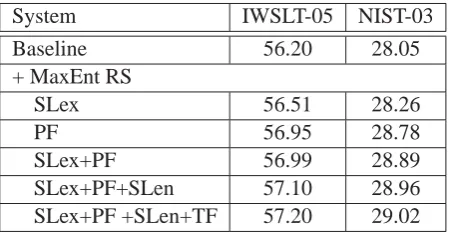
System IWSLT-05 NIST-03
Baseline 56.20 28.05
+ MaxEnt RS
SLex 56.51 28.26
PF 56.95 28.78
SLex+PF 56.99 28.89
SLex+PF+SLen 57.10 28.96
SLex+PF +SLen+TF 57.20 29.02
Table 3: BLEU-4 scores (case-insensitive) on IWSLT-05 task and NIST MT-03 task. SLex = Source-side Lexical Features, PF = POS Features, SLen = Source-side Length Feature, TF = Target-side features.
system. During decoding, we setb= 100to prune grammar rules,β = 10,b = 30to prune X cells, andβ = 10, b = 15to prune S cells. For cube pruning, we set the threshold= 1.0. See (Chi-ang, 2007) for meanings of these pruning parame-ters.
The baseline system uses precomputed phrase translation probabilities and two trigram language models to perform rule selection, independent of any other context information. The results are shown in the row Baseline of Table 3. For IWSLT-05 task, the baseline system achieves a BLEU-4 score of 56.20. For NIST MT-03 task, the BLEU-4 score is 28.05 .
4.4 Baseline + MaxEnt RS
As described in Section 3.2, we add two new fea-tures to integrate the MaxEnt RS models into the hierarchical model. To run the decoder, we share the same pruning settings with the baseline system. Table 3 shows the results.
Using all features defined in Section 3.1 to train the MaxEnt RS models, for IWSLT-05 task, the BLEU-4 score is 57.20, which achieves an abso-lute improvement of 1.0 over the baseline. For NIST-03 task, our system obtains a BLEU-4 score of 29.02, with an absolute improvement of 0.97 over the baseline. Using Zhang’s significance tester (Zhang et al., 2004) to perform paired boot-strap sampling (Koehn, 2004b), both improve-ments on the two tasks are statistically significant atp <0.05.
In order to explore the utility of the context fea-tures, we train the MaxEnt RS models on different feature sets. We find that POS features are the most useful features since they can generalize over all training examples. Moreover, length feature also yields improvement. However, these features are never used in the baseline.
NO. of NO. of NO. of LHS H-LHS AH-LHS
NIST MT-03 163,097 148,671 95,424 Baseline 12,069 7,164 5,745 +MaxEnt RS
(All features) 12,655 10,306 9,259
Table 4: Number of possible source-sides of SCFG rules for NIST-03 task and number of source-sides of the best translation. H-LHS = Hierarchical LHS, AH-LHS = Ambiguous hierarchical LHS.
5 Analysis
Table 4 shows the number of source-sides of the SCFG rules for NIST-03 task. After extract-ing grammar rules from the trainextract-ing corpus, there are 163,097 source-sides match the test corpus, 91.15% are hierarchical LHS’s (H-LHS, the LHS which contains nonterminals). For the hierarchi-cal LHS’s, 64.18% are ambiguous (AH-LHS, the H-LHS which has multiple translations). This in-dicates that the decoder will face serious rule se-lection problem during decoding. We also note the number of the source-sides of the best translation for the test corpus. For the baseline system, the number of H-LHS only account for 59.36% of to-tal LHS’s. However, by incorporating MaxEnt RS models, that proportion increases to 81.44%, since the number of AH-LHS increases. The reason is that, we use the featurePrsnto reward ambiguous hierarchical LHS’s. This has some advantages. On one hand, H-LHS can capture phrase reorderings. On the other hand, AH-LHS is more reliable than non-ambiguous LHS, since most non-ambiguous LHS’s occur only once in the training corpus.
study the best translation of Baseline and Base-line+MaxEnt RS. We find that the MaxEnt RS models improve translation quality in 2 ways.
5.1 Better Phrase reordering
Since the SCFG rules which contain nonterminals can capture reordering of phrases, better rule se-lection will produce better phrase reordering. For example, the source sentence “... [৳ކݓ νಆ ൙߶]1֥[ ۱ ӈ ൙ݓ]2... ” is translated as follows:
• Reference: ... the five permanent members of
the UN Security Council ...
• Baseline: ... the [United Nations Security
Council]1[five permanent members]2 ...
• +MaxEnt RS: ... [the five permanent members]2of [the UN Security Council]1...
The source sentence is translated incorrectly by the baseline system, which selects the rule
(11) X→ X1 ֥X2, the X1X2
and produces a monotone translation. In contrast, by considering information of the subphrases X1
and X2, the MaxEnt RS model chooses the rule
(12) X→ X1 ֥X2, X2 of X1
and obtains a correct translation by swapping X1
and X2 on the target-side.
5.2 Better Lexical Translation
The MaxEnt RS models can also help the decoder perform better lexical translation than the baseline. This is because the SCFG rules contain terminals. When the decoder selects a rule for a source-side, it also determines the translations of the source ter-minals. For example, the translations of the source sentence “ॣஃ ᆃ พ ݴϫ ၘࣜ ר ડ ਔ b” are as follows:
• Reference I’m afraid this flight is full.
• Baseline: I’m afraid already booked for this
flight.
• +MaxEnt RS: I’m afraid this flight is full.
Here, the baseline translates the Chinese phrase “ר ડ” into “booked” by using the rule:
(13) X→ X1 ר ડ, X1 booked
The meaning is not fully expressed since the Chi-nese word “ડ” is not translated. However, the MaxEnt RS model obtains a correct translation by using the rule:
(14) X→ X1 ר ડ, X1 full
However, we also find that some results pro-duced by the MaxEnt RS models seem to decrease the BLEU score. An interesting example is the translation of the source sentence “ᆃ ่ ࢧ ࢡ હ Ĥ”:
• Reference1: What is the name of this street?
• Reference2: What is this street called?
• Baseline: What is the name of this street?
• +MaxEnt RS: What’s this street called?
In fact, both translations are correct. But the trans-lation of the baseline fully matches Reference1. Although the translation produced by the MaxEnt RS model is almost the same as Reference2, as the BLEU metric is based on n-gram matching, the translation “What’s” cannot match “What is” in Reference2. Therefore, the MaxEnt RS model achieves a lower BLEU score.
6 Conclusion
In this paper, we propose a generic lexicalized ap-proach for rule selection. We build maximum en-tropy based rule selection models for each ambigu-ous hierarchical source-side of translation rules. The MaxEnt RS models combine rich context in-formation, which can help the decoder perform context-dependent rule selection during decod-ing. We integrate the MaxEnt RS models into the hierarchical SMT model by adding two new features. Experiments show that the lexicalized approach for rule selection achieves statistically significant improvements over the state-of-the-art syntax-based SMT system.
Acknowledgements
We would like to show our special thanks to Hwee Tou Ng, Liang Huang, Yajuan Lv and Yang Liu for their valuable suggestions. We also appreciate the anonymous reviewers for their detailed com-ments and recommendations. This work was sup-ported by the National Natural Science Foundation of China (NO. 60573188 and 60736014), and the High Technology Research and Development Pro-gram of China (NO. 2006AA010108).
References
Berger, A. L., S. A. Della Pietra, and V. J. Della. 1996. A maximum entropy approach to natural lan-guage processing. Computational Linguistics, page 22(1):39⚶72.
Carpuat, Marine and Dekai Wu. 2007a. How phrase sense disambiguation outperforms word sense dis-ambiguation for statistical machine translation. In 11th Conference on Theoretical and Methodological Issues in Machine Translation, pages 43–52.
Carpuat, Marine and Dekai Wu. 2007b. Improving sta-tistical machine translation using word sense disam-biguation. In Proceedings of EMNLP-CoNLL 2007, pages 61–72.
Chan, Yee Seng, Hwee Tou Ng, and David Chiang. 2007. Word sense disambiguation improves sta-tistical machine translation. In Proceedings of the 45th Annual Meeting of the Association for Compu-tational Linguistics, pages 33–40.
Chiang, David. 2005. A hierarchical phrase-based model for statistical machine translation. In Pro-ceedings of the 43rd Annual Meeting of the Associa-tion for ComputaAssocia-tional Linguistics, pages 263–270.
Chiang, David. 2007. Hierarchical phrase-based trans-lation. Computational Linguistics, pages 33(2):201– 228.
Galley, Michel, Jonathan Graehl, Kevin Knight, Daniel Marcu, Steve DeNeefe, Wei Wang, and Ignacio Thayer. 2006. Scalable inference and training of context-rich syntactic translation models. In Pro-ceedings of COLING-ACL 2006, pages 961–968.
Huang, Liang and David Chiang. 2005. Better k-best parsing. In Proceedings of the 9th International Workshop on Parsing Technologies.
Huang, Liang, Kevin Knight, and Aravind Joshi. 2006. Statistical syntax-directed translation with extended domain of locality. In Proceedings of the 7th Bi-ennial Conference of the Association for Machine Translation in the Americas.
Koehn, Philipp, Franz J. Och, and Daniel Marcu. 2003. Statistical phrase-based translation. In Proceedings of HLT-NAACL 2003, pages 127–133.
Koehn, Philipp. 2004a. Pharaoh: a beam search de-coder for phrase-based statistical machine translation models. In Proceedings of the Sixth Conference of the Association for Machine Translation in the Amer-icas, pages 115–124.
Koehn, Philipp. 2004b. Statistical significance tests for machine translation evaluation. In Proceedings of the 2004 Conference on Empirical Methods in Natu-ral Language Processing (EMNLP), pages 388–395.
Liu, Yang, Qun Liu, and Shouxun Lin. 2006. Tree-to-string alignment template for statistical machine translation. In Proceedings of the 44th Annual Meet-ing of the Association for Computational LMeet-inguistics, pages 609–616.
Och, Franz Josef and Hermann Ney. 2000. Improved statistical alignment models. In Proceedings of the 38th Annual Meeting of the Association for Compu-tational Linguistics, pages 440–447.
Och, Franz Josef and Hermann Ney. 2002. Discrimina-tive training and maximum entropy models for sta-tistical machine translation. In Proceedings of the 40th Annual Meeting of the Association for Compu-tational Linguistics, pages 295–302.
Och, Franz Josef. 2003. Minimum error rate training in statistical machine translation. In Proceedings of the 41st Annual Meeting of the Association for Com-putational Linguistics, pages 160–167.
Papineni, K., S. Roukos, T. Ward, and W.-J. Zhu. 2002. Bleu: a method for automatic evaluation of machine translation. In Proceedings of the 40th Annual Meet-ing of the Association for Computational LMeet-inguistics, pages 311–318.
Stolcke, Andreas. 2002. Srilm – an extensible lan-guage modeling toolkit. In Proceedings of the Inter-national Conference on Spoken language Process-ing, volume 2, pages 901–904.
Xiong, Deyi, Qun Liu, and Shouxun Lin. 2006. Maxi-mum entropy based phrase reordering model for sta-tistical machine translation. In Proceedings of the 44th Annual Meeting of the Association for Compu-tational Linguistics, pages 521–528.
Zens, Richard and Hermann Ney. 2006. Discrimina-tive reordering models for statistical machine trans-lation. In Proceedings of the Workshop on Statistical Machine Translation, pages 55–63.
Zhang, Ying, Stephan Vogel, and Alex Waibel. 2004. Interpreting bleu/nist scores: How much improve-ment do we need to have a better system? In Pro-ceedings of the Fourth International Conference on Language Resources and Evaluation, pages 2051– 2054.
Zhang, Le. 2004. Maximum entropy