© Universiti Tun Hussein Onn Malaysia Publisher’s Office
IJIE
Journal homepage: http://penerbit.uthm.edu.my/ojs/index.php/ijie
The International
Journal of
Integrated
Engineering
ISSN : 2229-838X e-ISSN : 2600-7916
Design of a CSK-CDMA Based Indoor Visible Light
Communication Transceiver Using Raspberry Pi and
LabVIEW
Arslan Khalid
1*, Awais Saeed
2, Nesruminallah Khan
2, Assad Ali
2, Zohair Altaf
2,
Abdul Rafay Siddiqui
21Department of Electrical Engineering, The University of Lahore, Defense Road, Lahore, 54000, PAKISTAN 2Departmet of Electrical and Computer Engineering,
COMSATS University Islamabad, Defense Road, Lahore, 54000, PAKISTAN
*Corresponding author
DOI: https://doi.org/10.30880/ijie.2019.11.08.012
Received 27 August 2019; Accepted 1 October 2019; Available online 15 December 2019
1. Introduction
The entrance of Fifth-generation 5G wireless communication systems has revolutionized the telecommunication industry. The services offered by the 5G communications are ultra-high data rates, reliability, and scalability of communications, low cost, and power consumption, ubiquitousness, and low latency, etc. [1-3]. Conventional radio frequency (RF) based wireless networks try to meet the aforesaid services at a bottleneck of RF spectra. Currently, the investigators put their significant work efforts in seeking substitutes for RF. In this connection, Visible Light Communication (VLC) has to turn out to be an exhilarating technology that employs visible light media to transmit and receive the information signal in future 5G/6G indoor wireless communication networks.
A VLC system is designed for short-range communications that exploit recently developed solid-state lighting infrastructures available in houses and offices such as Light Emitting Diodes (LED) for concurrent delivering of both enlightenment and data transmission [4]. Hence, the total cost of the system is reduced. Besides this, the other key merits
Abstract: Visible Light Communication (VLC) has drastically drawn the attention of both academia and industry as it can offer simultaneous lighting and data communication in an indoor environment. Additionally, VLC also tender a viable means to assuage the radio spectrum crunch. However, the data rate of the VLC system is choked because of the limited modulation bandwidth of Light Emitting Diode (LED), baseband modules, and intersymbol interference (ISI). In this article, an indoor VLC based software-defined radio (SDR) is designed and implemented that make use of Color Shift Keying (CSK) modulation, Code Division Multiple Access (CDMA) technique, and Raspberry Pi (RPi) to enabled the ISI free high data rate communication. The SDR is designed in LabVIEW software interfaced with the MATLAB and tested for text transmission. Numerous experiments were conducted on SDR at different alignments of transmitter and receiver. Our findings through experimentation showed that the SDR delivers an improved data rate of 2.645 𝑀𝑏𝑝𝑠. Over and above, MATLAB based simulation packages are also conceived that validate the effectiveness of the proposed CSK-CDMA based VLC system. The bit-error-rate (BER) results of the proposed system are compared with the traditional CSK-OOK based VLC system. The results are quite impressive and show remarkable coding gain.
information security, and hazardless environment [4-8]. Despite the aforementioned useful VLC advantages, there still occur a number of open research challenges, which need to be addressed properly for physical deployment. The first and foremost open challenge experienced by VLC is the small modulation bandwidth of LED that chokes the overall data rate of the processor it is driven by [9,10]. It is primarily related to LED manufacturing and thus beyond the scope of our work. Other challenges to VLC are the designing of an uplink communication system [11], dimming and brightness control [12], limited range [13], low data rates due to baseband modules [14], multipath effects and intersymbol interference (ISI) [15].
The existing work is done to improve the data rates and the elimination of ISI effects of the VLC system by accompanying the advanced modules and appropriate signal processing techniques. In this connection, Gilani et al. designed and implemented a serial communication-based VLC system that is adept at transmitting a text message at the communication range of approximately 2𝑚 [16]. The system uses an RS-232 protocol to exchange the text data from one computer to the other. Nevertheless, the designed prototype works only with lower transmission rates and does not account for ISI. Later, a customizable VLC transceiver prototype is designed in [17] by using the STM32F4Discovery board. The transceiver is proficient in performing the audio communication but the system is performance-wise imperfect as the audio signal is disturbed when the STM board processes it. In a similar perspective, Khalid et al. [14], proposed a Code Division Multiple Access (CDMA) technique for the VLC system that evades the ISI. This system is implemented using National Instruments (NI) based on cDAQ component tools interfaced with LabVIEW. The conceived prototype is well efficient in carrying out the synchronization and signal conditioning of the received signal as both operations are consummate in the software domain. However, the baseband cDAQ modules employed in the work can only provision transmission rates up to 10 𝐾𝑏𝑝𝑠. Therefore, the effective data rate conveyed by the prototype is 2 𝐾𝑏𝑝𝑠.
In [13], the same workgroup prolongs their foregoing work and conceived a state-of-the-art VLC testbed by engaging the universal asynchronous receiver-transmitter (UART) module programmed in MATLAB that permits the serial communication. The testbed is able to support variable transmission rates and thus attains a maximum data rate of
60.23 𝐾𝑏𝑝𝑠. Later, a Raspberry Pi (RPi) based VLC system is realized in [16]. Although the system was implemented successfully, yet it only supports the transmission speed of 5 Kbps. Moreover, in a brightly lit room, the performance of the prototype was not satisfactory. In this continuum, a combination of Color Shift Keying (CSK) with Pulse Position Modulation (PPM) and Complementary PPM (CPPM) was recommended to boost up the capacity and mitigation of ISI [17]. However, these methods do not provide the data rate as achievable with pure CSK because of the extra time slots obligatory in PPM and CPPM. A CSK-CDMA based VLC system is introduced in [20]. For CDMA spreading, Prime Codes are used as signature waveforms. However, the high side lobes of the auto-correlation function make the system not appropriate for physical deployment, as it is difficult to attain accurate synchronization [21].
In lieu of briefly discussed literature review, a fully organized VLC prototype is compulsory that provides satisfactory results in terms of higher data rates and minimization of ISI. From this perspective, the current work implements the CSK-CDMA based VLC system with advanced broadband modules (RPi). For spreading, instead of using Prime codes the work employs the most optimal codes termed as optical orthogonal codes (OOC). These codes are characterized by the parameters (𝑛, 𝑤, 𝜆𝑎, 𝜆𝑐), where 𝑛 denotes the length of the spreading code, 𝑤 exhibits the weight of the code i.e., number of 1’s in the code, 𝜆𝑎 and 𝜆𝑐 are the auto-correlation and cross-correlation constraints respectively. To test the error performance of the proposed system, simulation packages are conceived in MATLAB tool and the bit-error-rate (BER) results are compared with CSK-OOK based VLC system in the presence of line-of-sight (LOS) environment. The rest of the paper is grouped into the subsequent sections: Section 2 familiarizes with the whole system model of the CSK-CDMA based VLC system. While Section 3 deliberates the simulation setup and deliver the meticulous argument on simulation outcomes. Section 4 contributes to the implementation and working of software-defined radio (SDR). This section also confers the key performance metrics and delivers an exhaustive discussion on the cost analysis of the SDR. The last section of the study will deliver the concluding statements.
2.
System Modeling
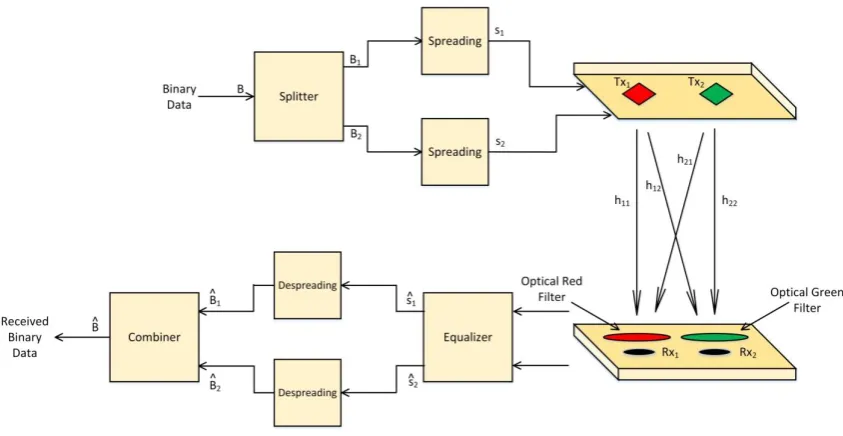
This section acquaints with the complete system model of the proposed CSK-CDMA based indoor VLC system. To implement the CSK modulation, two different colors LED transmitters are considered in the work that is spatially separated from each other. Likewise, on the receiver side, two photo-diodes with optical filters are used. The optical channel model used in this article is borrowed from our earlier work [22] where the indoor environment has dimensions
4𝑚 × 4𝑚 × 3𝑚. The proposed system can be realized as the MIMO-VLC system and its graphic representation is exhibited in Figure 1.
Fig. 1 – System modeling of proposed CSK-CDMA based indoor VLC system
In Figure 1, two receivers with optical filters are placed. The receiver ‘Rx1’ only collects the signal coming from ‘Tx1’ and filter out the ‘Tx2’ signal. Similarly, the receiver ‘Rx2’ only collects the signal from ‘Tx2’. Hence, the inter-channel interference (ICI) is eliminated and the MIMO inter-channel matrix is reduced to a diagonal matrix expressed as [24-26]:
11
22
0 0
VLC
h H
h
=
(1)
Moreover, the LEDs wavelength used in the work ranges from 380 to 780 𝑛𝑚, which is smaller than the collective area of the photo-diode. Therefore, the multipath fading can also be ignored because of high spatial diversity. The receiver also equipped with a sub-optimum linear zero-forcing equalizer that thwarts the effects of the optical channel. The equalized signal is then supplied to individual despreading blocks where the same OOC codes are used to recover the binary data. In the next step, a combiner is used that combines the rows to form a single row received binary data.
Table 1 - Simulation parameters of VLC channel and CSK-CDMA system
Parameters Values
Data Bits 105
OOC length 7 −bits
Modulation OOK
LED colors Warm white, Green
Channel line of sight (LOS) VLC channel
Dimensions of a room 4m × 4m × 3m
Illuminance angle 5°− 15°
Semi-angle at half power 15°
Field of view of a receiver 15°
SNR range 0 − 15 dB
Equalizer Zero-forcing
Noise AWGN
3.
Simulation Results
filters and transform back to electrical signals. Afterward, a zero-forcing equalizer is employed that tries to confiscate the channel impairments. The equalized bitstreams are then decoded with the same codewords that are used for the spreading. In the last phase, the decoded bitstreams are combined to form a single bitstream and erroneous bits are counted.
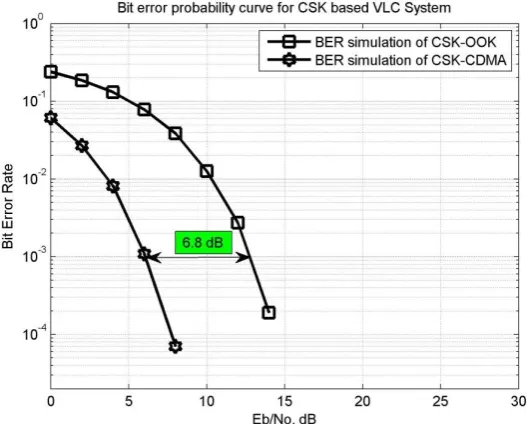
Fig. 2 – Performance comparison of proposed and traditional CSK based VLC system
The simulation results of the suggested and customary CSK based VLC systems are showed in Figure 2. It is noteworthy that the error performance of the CSK-CDMA based VLC system is superior to the traditional CSK-OOK system. At fixed BER of 10−3, the proposed system attains a considerable coding gain of approximately 6.8 dB and it can also be viewed by comparing both simulation results.
Fig. 3 – Block diagram of hardware setup
4.
Hardware Setup, Experimentation, and Discussions
by the RPi 3b+ module, which is interfaced with the LabVIEW. Initially, the goal is to perform parallel communication using an RPi 3b+ module by interfacing it with the MATLAB tool. However, it was noticed during the interfacing that the MATLAB is single-threaded software and parallel transmission is not possible using RPi. Parallel computations can be executed within a MATLAB script, but not in real-time with hardware interfaced with it. For this reason, the proposed work was implemented in LabVIEW that by default able to executes commands in a parallel fashion.
The designed prototype act as a state-of-the-art SDR that is able to transmit and receive a text message on a stand-alone computer. The connection made between the computer and the RPi was wireless over Wi-Fi connectivity [27]. A
16 character long message was taken in LabVIEW and encoded into serial 128 bits (8 bits for one character). The serial data is equally split into two rows to transmit by each transmitter. Both rows are then spread individually by two 7 −bits long OOC codewords. After spreading, the length of each row is 448 bits. These are the total bits transmitted by each transmitter. The final bits are fed to the physical layer by means of RPi. For transmission/reception, the General Purpose Input Output (GPIO) pins of an RPi are used. Four GPIO pins were configured, two as transmitters and two as receivers. The RPi’s transmitter pins are connected with LED driver circuits and the receiver pins with the photo-diodes. It is notable that the driver and amplifier circuits used in the current work are taken from our earlier work and the thorough discussion on these circuits can be getting from [22].
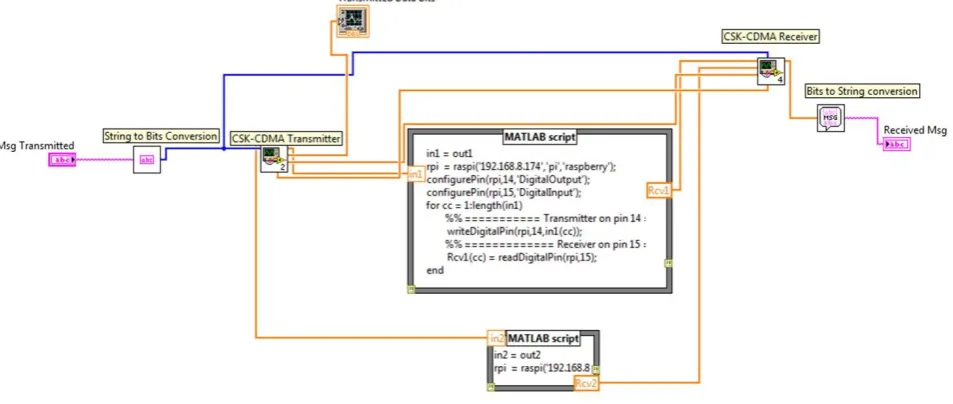
Fig. 4 – Virtual Instrument diagram of the SDR
On the receiver, after optical-to-electrical convergence, the received signal contains partial 1’s and 0’s. To change these partial 1’s and 0’s into strong 1’s and 0’s signal conditioning is performed in the software domain. The signal conditioning is attained in two steps. In the first step, the mean and maximum values of the received signal are computed. Afterward, the division operation is carried out between the values that yield a threshold value. The second step of the signal conditioning involves the comparison between the threshold value and the received signal. If the received signal value is larger than the threshold then the received value is taken as 1 otherwise it is considered as 0. In a similar fashion, the comparator approach is completed for the other received data values. Figure 4 exhibits the LabVIEW based virtual instrument (VI) diagrams of the designed SDR. The transmission rate was obtained from the baud-rate of the RPi 3b+. The mathematical expression for the calculation of baud-rate is expressed as:
_
_
8*(
_
1)
System clock
freq
baudrate
baudrate reg
=
+
(2)The pins assigned for communication purposes are of mini UART type pins whose baud-rate register value is given as 16 and the clock frequency for the system is set as 250 MHz. By using the aforesaid values in Eq. 2, the baud-rate is calculated as 1.838 Mbps. As OOK modulation is employed in the work, the transmission rate is equal to the baud-rate. Using this rate, the total symbols transmitted by each transmitter are 4102.679symbols/s. Hence, the effective data rate comes out to be 0.525 𝑀𝑏𝑝𝑠. Furthermore, the error-free successful transmission is done at the range of 1.36𝑚 in a glisteningly lighted room. Above this transmission range, the errors take place in the received signal and the signal conditioning could not remunerate these errors. It is noteworthy here that the aforementioned transmission range and data rate is achieved without adding header and tail bits.
a total length of 498 bits. Now the total symbols transmitted by each transmitter are 20670.682 symbols/s. The effective data rate, in this case, was found to be 2.645 Mbps. Also, the transmission range in a glisteningly lighted room is reduced to 1.14𝑚. This is because by increasing the transmission rate the energy required per bit also increases, which ultimately reduces the transmission, range. It is pertinent to mention here that the data rate obtained in both cases is surely higher than our earlier works [13,14,22].
4.1 Cost Analysis of designed SDR
The ongoing subsection delivers an ample cost analysis of the designed SDR and compares it with the cost of the prototypes designed in our earlier works. As discussed earlier, the current work exploits an RPi 3b+ module to interface the physical layer with the stand-alone computer. The cost of the RPi module is 35 USD while the cost of the development of the transmitter and receiver is 12 USD. Hence, the total cost of SDR is 47 USD. The prototype conceived in [13] is implemented with the aid of the UART PL-2303HX USB module. For the MIMO-VLC system, four such USB modules are required. The price of a single USB module is 7.40 USD. This means that the overall cost in the implementation of the MIMO-VLC system is 41.6 USD. However, it is prominent that the utilization of the PL-2303HX USB module in the MIMO-VLC system designed cannot fulfill the high data rate demands of the user.
The SDR conceived in [22] was developed by the use of NI cDAQ modules. To support the physical layer, cDAQ-9174 chassis with the NI 9201 (DAC) and NI 9263 (ADC) modules are used. The cost of a single set of cDAQ modules is 2,241 USD. Again, for the MIMO-VLC system, two sets of the cDAQ modules are required and the overall cost in the implementation of SDR is 4,506 USD. On comparing the above costs, it is estimated that the RPi based developed SDR is the cheapest solution for the ISI free high data rate VLC system(s).
5. Concluding Remarks
This paper presents the design and realization of a CSK-CDMA based complete state-of-the-art VLC transceiver that is proficient in transmitting/receiving a text message in an indoor environment. The transceiver is developed by the use of the RPi 3b+ module, which is interfaced with the LabVIEW software. Moreover, the designed prototype is analyzed based on two key performance metrics, namely, transmission range and data rate. During the experimentation, it is noteworthy that the change in the baud rate of the RPi 3b+ module will affect the two-performance metrics. If we choose the moderate baud rate to say 250 𝑀𝐻𝑧 then the prototype achieves the maximum coverage area of 1.36𝑚 in a glisteningly lighted room. However, the data rate of the prototype is 0.525 𝑀𝑏𝑝𝑠. Upon increasing the baud rate, the data rate of the transceiver increases but at the same time coverage area reduces. The work also provides the computer-generated BER based performance comparison results. The proposed CSK-CDMA modem is compared with the traditional CSK-OOK modem in the presence of a LOS environment. The BER results are remarkable and show the coding gain of 6.8𝑑𝐵. From both simulation and hardware-based numerical results, it is depicted that the designed prototype could become an appropriate candidate for future developing 5G communications.
Acknowledgment
The authors would like to gratitude The University of Lahore and the COMSATS University Islamabad for providing us the working environment and the physical resources.
References
[1] Wu, S., Wang, H., & Youn, C. (2014). Visible light communications for 5G wireless networking systems: from fixed to mobile communications. IEEE Network, 28(6), 41-45. DOI: 10.1109/mnet.2014.6963803.
[2] Chowdhury, M., Hossan, M., Islam, A., & Jang, Y. (2018). A Comparative Survey of Optical Wireless Technologies: Architectures and Applications. IEEE Access, 6, 9819-9840. DOI: 10.1109/access.2018.2792419. [3] Gismalla, M. S. M., & Abdullah, M. F. L. (2017). Device to Device Communication for Internet of Things
Ecosystem: An overview. International Journal of Integrated Engineering, 9(4).
[4] Chun, H., Gomez, A., Quintana, C., Zhang, W., Faulkner, G., & O’Brien, D. (2019). A Wide-Area Coverage 35 Gb/s Visible Light Communications Link for Indoor Wireless Applications. Scientific Reports, 9(1). DOI: 10.1038/s41598-019-41397-6.
[5] Kuppusamy, P., Muthuraj, S., & Gopinath, S. (2016, March). Survey and challenges of Li-Fi with comparison of Wi-Fi. In International Conference on Wireless Communications, Signal Processing and Networking (WiSPNET) (pp. 896-899). IEEE.DOI: 10.1109/WiSPNET.2016.7566262
[6] Garber, L. (2011). Turning on the Lights for Wireless Communications. Computer, 44(11), 11-14. DOI: 10.1109/mc.2011.352.
[8] Le Minh, H., O'Brien, D., Faulkner, G., Zeng, L., Lee, K., Jung, D., & Oh, Y. (2008). High-Speed Visible Light Communications Using Multiple-Resonant Equalization. IEEE Photonics Technology Letters, 20(14), 1243-1245. DOI: 10.1109/lpt.2008.926030.
[9] Lin, S., Liu, C., Bao, X., & Wang, J. (2018). Indoor visible light communications: performance evaluation and optimization. EURASIP Journal on Wireless Communications And Networking, 2018(1). DOI: 10.1186/s13638-018-1243-x.
[10] Bawazir, S., Sofotasios, P., Muhaidat, S., Al-Hammadi, Y., & Karagiannidis, G. (2018). Multiple Access for Visible Light Communications: Research Challenges and Future Trends. IEEE Access, 6, 26167-26174. DOI: 10.1109/access.2018.2832088
.
[11] Chow, C., Yeh, C., Liu, Y., Hsu, C., & Sung, J. (2016). Network Architecture of Bidirectional Visible Light Communication and Passive Optical Network. IEEE Photonics Journal, 8(3), 1-7. DOI: 10.1109/jphot.2016.2566340.
[12] Liu, X., Yang, A., Li, Y., & Feng, L. (2015). Separate dimming controlling and data transmission for an indoor visible light communication system. China Communications, 12(3), 71-76. DOI: 10.1109/cc.2015.7084365. [13] Khalid, A., Ahmad, M., Khan, N., & Ali, A. (2018, December). Enhancement of Visible Light Communication
Transceiver using LDPC Codes. In International Conference on Frontiers of Information Technology (FIT) (pp. 94-98). IEEE. DOI: 10.1109/FIT.2018.00024
[14] Khalid, A., & Asif, H. M. (2017, February). NI cDAQ based software-defined radio for visible light communication system. In 2017 2nd Workshop on Recent Trends in Telecommunications Research (RTTR) (pp. 1-5). IEEE. DOI: 10.1109/RTTR.2017.7887870
[15] Han, Q., & Lu, H. (2015, August). Performance improvement of visible light communication system using reed-solomon code. In 12th Intl. Conf. on Ubiquitous Intelligence and Computing and Intl. Conf. on Autonomic and Trusted Computing and 15th Intl. Conf on Scalable Computing and Communications and Its Associated Workshops (UIC-ATC-ScalCom) (pp. 822-825). IEEE. DOI: 10.1109/UIC-ATC-ScalCom-CBDCom-IoP.2015.161
[16] Gilani, A., Faraz, A., Siddique, A., Munir, N., & Asif, H. M. (2015, February). Prototype design of white LED data communication system and optical channel modeling. In 30th IEEEP All Pakistan Students Seminar. Indus University Karachi.
[17] Ali, A., Sehar, A., Najaf, S., & Asif, H. M. (2015, December). Customizable transceiver design of a visible light communication system. In 2015 13th International Conference on Frontiers of Information Technology (FIT) (pp. 138-143). IEEE. DOI: 10.1109/FIT.2015.33
[18] Wang, T., & Zhao, Z. (2018, March). An implementation of visible light communication based on Raspberry Pi. In Integrated STEM Education Conference (ISEC) (pp. 218-219). IEEE. DOI: 10.1109/ISECon.2018.8340486 [19] Pergoloni, S., Biagi, M., Rinauro, S., Colonnese, S., Cusani, R., & Scarano, G. (2015). Merging Color Shift Keying
and Complementary Pulse Position Modulation for Visible Light Illumination and Communication. Journal Of Lightwave Technology, 33(1), 192-200. DOI: 10.1109/jlt.2014.2386274.
[20] Kozawa, Y., & Habuchi, H. (2010, October). Theoretical analysis of M-CSK/CDMA system in optical wireless channel. In 2010 International Symposium on Information Theory & Its Applications (pp. 738-742). IEEE. https://ieeexplore.ieee.org/document/5649647
[21] Qiu, Y., Chen, S., Chen, H., & Meng, W. (2018). Visible Light Communications Based on CDMA Technology. IEEE Wireless Communications, 25(2), 178-185. DOI: 10.1109/mwc.2017.1700051. https://ieeexplore.ieee.org/document/8030546
[22] Khalid, A., Asif, H., Mumtaz, S., Al Otaibi, S., & Konstantin, K. (2019). Design of MIMO-Visible Light Communication Transceiver Using Maximum Rank Distance Codes. IEEE Access, 7, 89128-89140. DOI: 10.1109/access.2019.2924202
[23] Chung, F., Salehi, J., & Wei, V. (1989). Optical orthogonal codes: design, analysis and applications. IEEE Transactions on Information Theory, 35(3), 595-604.
[24] Zhong, W. D., Chen, C., & Wu, D. (2016, July). Non-Hermitian symmetry OFDM for indoor space division multiplexing visible light communications. In 18th International Conference on Transparent Optical Networks (ICTON) (pp. 1-4). IEEE. DOI: 10.1109/ICTON.2016.7550288
[25] Chen, T., Zhens, Z., Liu, L., & Hu, W. (2015, March). High-diversity space division multiplexing visible light communication utilizing a fisheye-lens-based imaging receiver. In 2015 Optical Fiber Communications Conference and Exhibition (OFC) (pp. 1-3). IEEE.
[26] Chen, C., Zhong, W., & Wu, D. (2016). Non-Hermitian Symmetry Orthogonal Frequency Division Multiplexing for Multiple-Input Multiple-Output Visible Light Communications. Journal Of Optical Communications And Networking, 9(1), 36. DOI: 10.1364/jocn.9.000036.