Volume-7 Issue-2
International Journal of Intellectual Advancements
and Research in Engineering Computations
Experimental investigation on partial replacement of coarse aggregate by
coconut shell in concrete
Tharanya.S
1, Pradeep kumar.S
2, Santhosh .M
2, Pravin kumar.G
2, murali.S
21
Assistant Professor, Department of Civil Engineering, Nandha Engineering College, Erode,
TamilNadu, India
2
UG Students, B.E Civil Engineering, Nandha Engineering College, Erode, TamilNadu, India
ABSTRACT
The high cost of conventional building materials is a major factor affecting housing delivery in the world. This has necessitated research into alternative materials of construction. In this study, coconut shell is used as light weight aggregate in concrete. The properties of coconut shell and coconut shell aggregate concrete is examined and the use of coconut shell aggregate in construction is tested. The project paper a ims at analyzing flexural and compressive strength characteristics of with partial replacement using M25 grade concrete. The project also aims to show that Coconut shell aggregate is a potential construction material and simultaneously reduces the environment problem of solid. Beams are casted, tested and their physical and mechanical properties are determined. The main objective is to encourage the use of these seemingly waste products as construction materials in low-cost housing.
Keywords: Cement, Aggregate, Coconut shell, compressive strength, Split tensile strength and Flexural
strengthINTRODUCTION
Generally in design of concrete mix, cement, fine aggregates and coarse aggregates are using from long back, which plays a crucial role in designing of a particular grade of concrete. Today’s world is a concrete jungle. With the ever increasing population of the world, in general and the developing countries there is the tremendous pressure on the Civil Engineer to develop a cost effective as well as eco friendly structure to fulfil the need of the human being. In these components only cement is manufactured and both fine and coarse aggregate has been obtained naturally. This has brought up with a great destruction to the environment. And further the disposal of the huge amount of demolition waste was another problem. To solve both these problems use of waste materials such as coconut shell waste. These materials have also benefits that these materials are
easily available and economical. In this research these wastes are used in 20mm Coarse aggregates simultaneously. The study has been conducted on these wastes used in concrete. This used as partial replacement of coarse aggregate. The coconut shell is a material which can be a substitute for coarse aggregate. Coconut shell concrete has better workability because of the smooth surface on one side of the shell. The impact resistance of coconut shell concrete is high when compared with conventional concrete.
OBJECTIVES
This study was conducted to achieve the
following objectives
i) To study the strength developments hardened concrete with waste coconut shell aggregate.
ii) To determine the effect of various percentage of coconut shell waste as partial coarse aggregates replacement towards compressive strength of concrete.
iii) To study and evaluate the strength properties of coconut shell based concrete building blocks viz: hollow and filled blocks with various options of shells orientations to understand its capability to be used as a filler/composite/reinforcement material.
MATERIAL DESCRIPTION
The materials used in the projects are cement, Fine aggregate, coarse aggregate, Coconut shell waste are detailed below:
Cement
Cement is the essential ingredient to bind all other materials to form workable concrete. The Ordinary Portland Cement of 53 grades was used in this experimentation conforming to IS: 12269:1987 is used in this experimental project.
Table No 1: Physical property on cement
PROPERTY SPECIFICATIONS
Specific gravity 3.15 Fineness 2.6 % Normal consistency 32
Initial setting time 32 Minutes Finial setting time 10 hours
Fine aggregate
Locally available zone II river sand used as fine aggregate. The specific gravity was determined and was found as 2.53 conforming to I.S. – 383-1970.
Coarse aggregate
Crushed angular shape aggregate from a local source was used as coarse aggregate. The specific gravity was not recycled in any form at present. This cause impacts to environment, so it can be reused as construction materials. The used aggregates were in the range of 20 mm to 25mm IS sieve size and it collects from the local crusher. The tests conducted on coarse aggregate include specific gravity, water absorption, aggregate crushing value test, and aggregate impact value test. Mainly this type of recycled aggregate is used
for the developments of concrete with non-conventional aggregates to improve the properties of concrete and reduce the cost.
Specific gravity - 2.87
Advantages
Stronger bonds Light weight concreteCoconut shell
Coconut shell are crushed uniformly to about 20mm size manually using hammer and sieved through 20mm IS sieve. In coconut shell waste about 25%-30% of daily production goes as waste.
Fig No 1: Coconut shell waste
Water
Portable water was used for the experimentation.
DESIGN MIX
As per IS 10292-2000 designed by M25 grade of concrete and water cement ratio 0.5.
Table No: 2 Mix proportion
Materials Quantity Mix ratio
Cement(kg/m3)
383.2
1
FA(kg/ m3)
800.94
1.27
CA(kg/ m3)
1087.75
2.44
Water(lits)
191.6
0.45
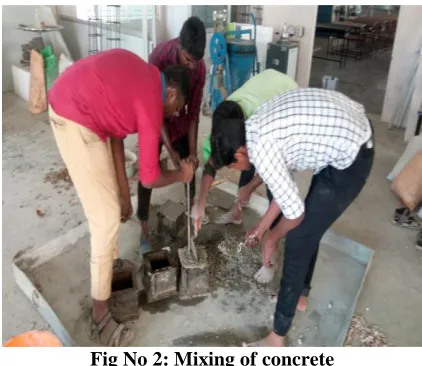
Mixing of Concrete, Casting and Curing of test Specimens Hand mixing was done during the entire process of casting of specimens. Initially the dry mix constituents of the mix namely cement, fine aggregate and coarse aggregate was mixed for
two minutes in the mixer and then the water were added and mixing continued for another 2 minutes. The total mixing time was kept at 4 minutes until a homogeneous mixture was obtained. Compaction was achieved by means of Tamping rod.
EXPERIMENTAL RESULTS
Fresh concrete
The fresh concrete properties slump test is conducted. The slump value of concrete was 72mm.
Hardened concrete
The hardened concrete specimen properties are checked by compressive strength, split tensile strength and flexural strength.
Compressive strength
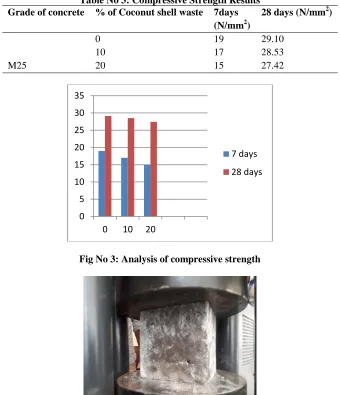
For every percentage of replacement 10 cubes have been casted. Among them, 5 cubes
were tested on the 7th and the other 5 cubes were tested on the 28th day. Totally 10 cubes were casted and 7th & 28th day testing has been
completed. Compressive test of concrete is carried out on specimens like cube by compression testing machine.
fc = (P/A) N/mm2
Where,
P = Load at which the specimen fails in Newton(N) A = Area over which the load is applied in mm fc = Compressive Stress in N/mm2
Table No 3: Compressive Strength Results Grade of concrete % of Coconut shell waste 7days
(N/mm2)
28 days (N/mm2)
M25
0 19 29.10
10 17 28.53
20 15 27.42
Fig No 3: Analysis of compressive strength
Fig No 4: Testing of cube
0 5 10 15 20 25 30 35
0 10 20
7 days
Split tensile Strength
For every percentage of replacement 3 cylinders have been casted. Among them,3 cylinders were tested on the 7th and the other 3 cylinders were tested on the 28th day. Totally 6 cylinders were casted and 7th day and 28th day
testing has been completed. Split tensile Strength test of concrete is carried out on specimens like
cylinders by compression testing machine. The Split tensile strength of the specimen was calculated by using the formula
ft = (2P/Πdl) N/mm2
Where,
P = Maximum load in N applied to the specimen d = Measured length in cm of the specimen l = Measured diameter in cm of the specimen ft= Tensile strength N/mm2
Table No 4: Split Tensile Test Results Grade of concrete % of Coconut shell 7days
(N/mm)
28 days (N/mm2)
M25
0 1.90 -
10 2.02 -
20 1.85 -
Fig No 5: Analysis of split tensile strength
Fig No 6: Testing of cylinder
Flexural Strength Test
For every percentage of replacement 3 beams have been casted. The 3 beams were tested on the 28th day. Totally 6 prisms were casted and 7th day
and 28th day testing has been completed. Flexural
strength is the one of the measure of the tensile strength of concrete. The flexural strength of the specimen was calculated by using the formula Fb =(Pl/bd2) N/mm2
0 0.5 1 1.5 2 2.5 3 3.5
0 10 20
7 days
Where,
P = Load at which specimen fails in (N) l = Effective span in mm
b = Breadth of the specimen in mm d = Depth of the specimen in mm
Table No 5: Flexural Strength Test Results Grade of concrete % of Coconut shell 7days
(N/mm2)
28 days (N/mm2)
M25
0 3.98 -
10 3.65 -
20 3.72 -
Figure no 7: Analysis of Flexural Strength
Fig No 8: Testing of prism
CONCLUSION
From the test results, the coconut shell has a future as lightweight aggregate in concrete. It also reduces the total cost of concreting, because of the low cost and its ease of availability is profusion. Coconut Shell Concrete can be used in rural areas and places where coconut is profusion and the places where the regular aggregates are not
economic. It is concluded that the Coconut Shells are more suitable as low strength-giving lightweight aggregate when used to replace common coarse aggregate in production concrete. Coconut shell s more power to resist crushing, and impact compared to traditional granite aggregate. There is no need to treat the coconut shell before use as an aggregate except for water absorption.
0 1 2 3 4 5 6
0 10 20
7 days
REFERENCES
[1]. J.M.Crow, The Concrete Conundrum,2006, available at www.chemistryworld.com [2]. A. short and W.Kinniburgh, Lightweight Concrete, Applied Science Publishers, London
[3]. Daniel Y.O, ” Experimental Assessment on Coconut Shell as aggregate in concrete”, International Journal of Engineering Science Invention, 2(5), 2013, 07-11
[4]. 4.Maninder Kaur, Manpreet Kaur,,” A review on utilization of coconut shell as coarse aggregate in mass concrete”, International Journal of Applied Engineering Research, 7(11), 2012, 05-08
[5]. Kulkarni V.P, Kumar .S,”Comparitive study on coconut shell aggregate with conventional concrete”, 2(12), 2013, 67-70.
[6]. Shetty M.S,” Concrete Technology Theory and Practice” S.Chand Company Limited, New Delhi. 3, 1991.
[7]. British Standard Institutions, BS 8110 – Part1, The structural use of concrete, BSI, London 1997.
[8]. Kabiru Usman Rogo, Selah Abu-Bakr” Exploratory study of coconut shell as aggregate in concrete production”, Journal of Engineering and Applied Sciences, Vol.2, Dec 2010.
[9]. Gunasekaran K, Kumar P.S, Laxmipathy M” Mechanical and Bond properties of Coconut Shell Concrete” Construction and Building Material (2011),pp 92-96.
[10].Utsev,J.T,Taku,J.K,2012,”Coconut shell ash as partial replacement of ordinary Portland cement in concrete production”, International Journal of Scientific and Technology Research, Vol.1,Issue 8,September 2012,pp 86-89.
[11].I.S 10262-1982:”Recommended guidelines for concrete mix design”, 1982 [12].I.S 12269-1987:”Specifications for 53 grade Ordinary Portland Cement”, 1987 [13].I.S 383-1970:”Specifications for coarse and fine aggregates”, 1970