_____________________________________________________________________________________________________ *Corresponding author: E-mail: [email protected];
Effect of
Moringa oleifera
as Water Coagulant on the
Physico-chemical Properties of Gulbi-water
N. S. Donaldben
1*, E. I. Chukwuma
2and A. L. Chinwende
11
Department of Food Technology, Federal Polytechnic, Kaura Namoda, Zamfara State, Nigeria.
2Departmentof Pre-Science, Federal Polytechnic Kaura Namoda, Zamfara State, Nigeria.
Authors’ contributions
This work was carried out in collaboration among all authors. Author NSD designed the study, performed the analysis, wrote the protocol and write the first draft of the manuscript. Authors EIC and ALC managed the literature searches. All authors read and approved the final manuscript.
Article Information
DOI: 10.9734/IJBCRR/2019/v27i230118 Editor(s): (1) Professor, Halit Demir, Department of Chemistry, Faculty of Art and Science, Van Yüzüncü Yıl University, Turkey. Reviewers: (1) Martin Potgieter, University of Limpopo, South Africa. (2)Nyong Princely Awazi, University of Dschang, Cameroon. (3)Maria Antonietta Toscano, University of Catania, Italy. Complete Peer review History:http://www.sdiarticle3.com/review-history/51403
Received 01 July 2019 Accepted 06 September 2019 Published 12 September 2019
ABSTRACT
Availability of clean water is a serious problem, especially in developing countries like Nigeria; Water for consumption purpose needs to be treated to meet the quality guidelines of 5 Nephelometric Turbidity Unit (NTU) according to World Health Organization, Wastewater treatment are mostly using Polyaluminum Chloride, a synthetic coagulant, which possess health risk and require expensive cost. This research was carried out to observe the effect of Moringa oleifera seed as natural coagulant to replace synthetic coagulant. Highly turbid water was collected from Gulbi River in Kaura-namoda, Zamfara State. Nigeria. M. oleifera seed was processed into flour and de-fated with different organic solvent. (AOY = Normal borehole water, BOY = Raw water sample from the river, COY = Water treated with (de-fated M. oleifera flour with Chloroform.), DOY = Water sample with (de-fated M. Oleifera flour with acetone), EOY = Water sample with (de-fated M. Oleifera flour with diethyl ether.), FOY = Water sample with Alum, GOY = Water sample with unde-fated M. oleifera flour) and used as a coagulant in place of aluminium sulphate (Alum). Collected water samples were treated with different Moringa oleifera flour coagulants samples The water treated with different coagulants samples were analyzed based on physic-chemical properties. The pH values ranged from 5.6 to 6.7. The turbidity, conductivity, total solid, temperature and coliform
Donaldben et al.; IJBCRR, 27(2): 1-9, 2019; Article no.IJBCRR.51403
ranged from 4.19 to 76.5 NTU, 94.0 to 188.4 μS/cm, 45.5 to 89.3 mg/l, 30.4 to 33.8ºC and 9 × 402cfu, respectively. The work has been considered as revolutionary for small household applications in rural areas, where water purification is absent and M. oleifera trees are abundantly available.
Keywords: Moringa oleifera; borehole; physico-chemical properties; turbidity; Gulbi River.
1. INTRODUCTION
Sustainable freshwater supply and effective treatment are critical needs of all countries. In parts of many developing countries throughout
Africa, Asia and Latin America, access to adequate, clean freshwater remains
problematic. A lack of access to freshwater supply in many of these developing countries has been the main cause of disease and infant mortality [1]. It was recently documented that 75% out of the total number of world population was roughly estimated to still live in developing countries and 1.2 billion is still lacking safe drinking water supply. Another 6 million children were also estimated to die from diarrhoea each year in developing country [2].
Over previous decades, chemical coagulants have been used in water treatment for the removal of suspended solids and to reduce the turbidity of water as well as bacterial and viral loads. Common types of these chemical coagulants include aluminium sulphate, ferrous sulphate and ferric sulphate. The application of chemical coagulants in water and wastewater treatments has been found to cause the impurities, present in colloidal forms, to adhere upon contact, forming flocs that can then be easily removed [3].
However, chemical coagulants are not readily available in developing countries, can be quite expensive for people living in remote rural areas, and can have adverse effects on public health if not applied at the correct dosage. Therefore, the use of natural coagulants of plant origin is a viable alternative to chemical coagulants. Chemicals are mostly imported and not to mention expensive as well. Aluminum sulphate needs pH adjustment when used in the treatment process which is regarded as another additional cost for water treatment companies [2]. Naturally occurred coagulants are regarded as safe in terms of health for human while synthetic coagulants, especially aluminum salt, has probability inducing Alzheimer’s disease [2].
It has been widely documented that extracts from plants such as Moringa oleifera have proven more effective in the removal of suspended solids, in turbidity removal, in the softening of hard water, and also in the reduction of slurry produced than chemical coagulants [4].
Water is used for several purposes by humans but level of purity of the water being consumed in very crucial since it has a direct effect on health [5]. The conventional method of water purification using aluminium sulphate and calcium hypochlorite these puts pressure on the nation’s over-burdened financial resources since they are very expensive and beyond the reach of most rural folks. Hence, they resort to sources such as dams, streams, rivers, and lakes. Water from these sources is usually turbid and contaminated with microorganisms that cause many diseases. Water borne diseases are one of the main problems in developing countries, about 1.6 million people are use contaminated water and more than a million people (of which two million are children) die from diarrhea each year globally [5].
This research was carried out to confirm the effectiveness of de-fated and undefated powder extracted from dried Moringa oleifera seeds from Kaura-Namoda local government area of Zamfara State in Nigeria. The main objectives of the present research are to evaluate the effect of Moringa oleifera as coagulant on Gulbi-river water, which happens to be only source of drinking water to adjacent communities.
2. MATERIALS AND METHODS
2.1 Source of Raw Material
Fig. 1. Production of M. oleifera flour (Modified Ghebremichael, [6] method)
2.2 Collection of Water Sample
Water samples were collected according to the method of Francis and Amos [5] with modification. Plastic kegs of 2 liters capacity were used to collect samples for physico-chemical parameters while two kegs of 10 litres capacity were used to collect samples for laboratory-based filtration experiments. Thoroughly washed and sterilized glass bottles were used to collect samples for bacteriological analysis while plastic sample bottles (PTFE) of 60 ml capacity were used to collect samples for analysis. Water sample used was collected from Gulbi-river in Kaura Namoda, Sabon Kaura where the rural people living near the source used it as an actual drinking water, collection of the water was done by submerging the containers into the water body with about 1 m depth of slow flowing at the center of the river at about 6:00 am.
2.3 Preparation Methods
2.3.1 Preparation of Moringa coagulant
The seeds were harvested when they were fully matured. This is determined by observing if there are any cracked pods on the plants. The pods that were plucked were cracked to obtain the
seeds which were air-dried at 40°C for two days. The shells surrounding the seed kernels were removed using knife and the kernels were pounded using laboratory mortar and pestle into powder and sieved using a strainer with a aperture size of 0.5 mm to obtain a fine powder, different portion of the powder were defatted with three different solvents (Chloroform, acetone and diethyl ether). This method is a slight modification of the one proposed by Ghebremichael [6]. This was the coagulant prepared from M. oleifera seed. The chlorine and aluminium sulphate (alum) used in the study was obtained from the Kaura-Namoda water board. The 2% solution of alum was made by adding 2 g of alum in 100 ml distilled water and shaken for 60 seconds. The alum was totally soluble in the water.
2.4 Determination of pH
Donaldben et al.; IJBCRR, 27(2): 1-9, 2019; Article no.IJBCRR.51403
reading was then taken from the LCD display after it had stabilized.
2.5 Determination of Turbidity
The turbidity was determined using the method of Aho and Lagasi [7]. Turbidity was measured with a 2100P turbidimeter from each sample. The initial turbidity was measured 3 times on the raw water while stirring at 100 rpm, and the average value from the three measurements was used as starting value of raw water. After the sedimentation phase, samples for turbidity measurement were collected from the supernatant using a standard pipette. The sample beaker was washed once with distilled water and twice with the supernatant before recording the turbidity. Each measurement took 1-2 minutes, washing included. In order to eliminate any differences in turbidity due to different sedimentation times, samples were taken from jars 1 to 6 before measurements were taken from different samples.
2.6 Conductivity Determination
The Francis and Amos [5] method of pH was slightly modified by standardizing the pH meter with a buffer solution. The A 50ml well-mixed sample was measured into a beaker. The WTW TDS/Conductivity meter probe was immersed in sample and its conductivity and TDS recorded. This was after calibration with 0.01N KC1.
2.7 Total Bacterial Count
The total bacterial count was determined using the method of Broin [8]. The different seed extracts from the different samples (DOY, COY, DOY, EOY, FOY and GOY) was each made into a suspension and introduced into 1 liter each of raw water. A liter of raw water was kept aside as control. Another 1 liter of distilled water was also kept as control. The water samples were stirred at 100 rpm and allowed to settle and observed after 22 hours. The same procedure was repeated using alum. Total bacterial count of the raw water was recorded before and after application of coagulants. Total bacterial count was carried out by pour plate method, and oxoid agar was used as follows:
Water sample was diluted into three dilutions 10-1, 10-2 and 10-3; 1.0 ml from 10-2 and 10-3 dilutions were transferred into sterile Petri-dish. Water and the agar were mixed thoroughly by gentle rotation (clockwise and counterclockwise, and rocking back and forth). The agar and the
contents was allowed to solidify and incubated at 37oC for 24 hours. Average bacterial count from the triplicate plates was taken, and the bacterial content of the water was recorded from the known dilutions and multiplied by the dilution factor as shown by Oria-Usifo [9].
Equation = (C/V x M) where:
C = mean colony count V = volume of plate
M = dilution e.g. (10-2 and 10-3)
3. RESULTS AND DISCUSSION
3.1 pH
After treatment with samples (COY, DOY, EOY, FOY and GOY) coagulants, the pH ranged from 5.7 to 6.7, for the raw water (BOY) was 5.7, but when treated with M. Oleifera samples coagulant. The pH was increased from 5.7 to 6.1. The pH content of the water samples increases with increase in the turbidity removal efficiency of the M. oleifera coagulants. These results however, not in line with the finding of Oria-Usifo et al. [9] who reported a pH range of 6.4 to 6.6 of water treated with M. oleifera flour and de-oil flour. A possible reason for this difference could be that, the action of M. oleifera as a coagulant lies in the presence of water soluble cationic proteins in the seeds [10]. This suggests that in water, the basic amino acids present in the protein of M. oleifera flour would accept a proton from water resulting in the release of a hydroxyl group making the solution basic. In essence the better the coagulating activity of the M. oleifera
coagulant used the treated water tends to be more basic.
3.2 Turbidity
% of turbidity in the treated water with
flour and de-oil flour. A possible reason for this difference could be as a result of the de
of the M. oleifera flour. The oil content in the seed will form an emulsion or film coating which may inhibit the contact with the surface of reaction and thus reduce floc formation. This is the reason for showing maximum percentage reduction observed when coagulation has no content. This therefore implies that additional treatment such as bio-sand filtration must be applied to the water sample before it is assumed safe for human consumption. M.
poses no toxic effects on humans and the
Fig. 2. The pH of collected Gulbi
Key: AOY = Normal borehole water, BOY = Raw water sample from the river, COY = Water treated with (de Moringa flour with Chloroform.), DOY = Water sample with (de
sample with (de-fated Moringa flour with
Fig. 3. Turbidity measurement conducted on collected Gulbi using different coagulants samples
Key: AOY = Normal borehole water, BOY = Raw water sample from the river, COY = Water treated with (de Moringa flour with Chloroform.), DOY = Water sample with (de
sample with (de-fated Moringa flour with
5 5.2 5.4 5.6 5.8 6 6.2 6.4 6.6 6.8 AOY BOY p H m e as u re m e n t
% of turbidity in the treated water with M. oleifera
oil flour. A possible reason for this difference could be as a result of the de-fatening flour. The oil content in the seed will form an emulsion or film coating which may inhibit the contact with the surface of reaction and thus reduce floc formation. This is the reason for showing maximum percentage reduction observed when coagulation has no oil content. This therefore implies that additional sand filtration must be applied to the water sample before it is assumed
M. oleifera seed poses no toxic effects on humans and the
environment. It is an eco-friendly and cheaper method of purification of water and therefore can be used in the rural areas where no facilities are available for the treatment of drinking water. After the treatment of M. oleifera flour, sludge gets settled at the bottom of tank. Large scale treatment at village level produces large quantity of sludge which can be used as bio
it becomes an added advantage of this treatment. Considering the fact that Moringa coagulant can be locally produced, its use in water purification should be encouraged. This is likely to reduce the high cost of the current water treatment systems.
The pH of collected Gulbi-water before and after treatment using different coagulants samples
Key: AOY = Normal borehole water, BOY = Raw water sample from the river, COY = Water treated with (de Moringa flour with Chloroform.), DOY = Water sample with (de-fated Moringa flour with Acetone), EOY = Water
fated Moringa flour with Diethyl ether.), FOY = Water sample with Alum, GOY = Water samp with undefated Moringa flour
Turbidity measurement conducted on collected Gulbi-water before and after treatment ng different coagulants samples
Key: AOY = Normal borehole water, BOY = Raw water sample from the river, COY = Water treated with (de Moringa flour with Chloroform.), DOY = Water sample with (de-fated Moringa flour with Acetone), EOY = Water
fated Moringa flour with Diethyl ether.), FOY = Water sample with Alum, GOY = Water samp with undefated Moringa flour
COY DOY EOY FOY GOY
Samples
friendly and cheaper method of purification of water and therefore can be used in the rural areas where no facilities are available for the treatment of drinking water. After flour, sludge gets . Large scale treatment at village level produces large quantity of sludge which can be used as bio-fertilizers and it becomes an added advantage of this treatment. Considering the fact that Moringa coagulant can be locally produced, its use in fication should be encouraged. This is likely to reduce the high cost of the current water
ng different coagulants
Key: AOY = Normal borehole water, BOY = Raw water sample from the river, COY = Water treated with (de-fated fated Moringa flour with Acetone), EOY = Water Diethyl ether.), FOY = Water sample with Alum, GOY = Water sample
water before and after treatment
Donaldben et al.; IJBCRR, 27(2): 1-9, 2019; Article no.IJBCRR.51403
Fig. 4. Conductivity measurement conducted on collected gulbi-water before and after treatment using different coagulants samples
Key: AOY = Normal borehole water, BOY = Raw water sample from the river, COY = Water treated with (de-fated Moringa flour with Chloroform.), DOY = Water sample with (de-fated Moringa flour with Acetone), EOY = Water sample with (de-fated Moringa flour with Diethyl ether.), FOY = Water sample with Alum, GOY = Water sample
with undefated Moringa flour
Fig. 5. Total solid conducted on collected gulbi-water before and after treatment using different coagulants samples
Key: AOY = Normal borehole water, BOY = Raw water sample from the river, COY = Water treated with (de-fated Moringa flour with Chloroform.), DOY = Water sample with (de-fated Moringa flour with Acetone), EOY = Water sample with (de-fated Moringa flour with Diethyl ether.), FOY = Water sample with Alum, GOY = Water sample
with undefated Moringa flour
3.3 Conductivity
Conductivity is a measure of total dissolved solids in water varies considerable in different geographical regions owing to differences in the solubility of minerals; hence there is no standard
Fig. 6. Temperature measurement conducted on collected gulbi-water before and after treatment using different coagulants samples
Key: AOY = Normal borehole water, BOY = Raw water sample from the river, COY = Water treated with (de-fated Moringa flour with Chloroform.), DOY = Water sample with (de-fated Moringa flour with Acetone), EOY = Water sample with (de-fated Moringa flour with Diethyl ether.), FOY = Water sample with Alum, GOY = Water sample
with undefated Moringa flour
high indicating the presence of dissolved impurities. This indicates that turbid water which is allowed to stand with no treatment is an inadequate procedure for removing dissolved and floating particles. It could be efficient if the turbid water is left to stand for a very long time. The conductivity measurements followed a similar pattern as the turbidity measurements. Increasing concentrations of both the Moringa and alum treatments led to decrease in conductivity values. However the result of these findings does not follow the same pattern with that of the Oria-Usifo et al. [9]. Treatment with M. Oleifera flour values ranged from 102.5 to 112.1 μS/cm; and value of 122.6 μS/cm was recorded for the alum used.
3.4 Total Solid
Total Solids of the raw water sample was 89.30 mg/l which conforms to the standard limits of the W.H.O. After the treatment of the raw water sample with the undefated and de-fated (BOY, COY, DOY, EOY and GOY) Moringa oleifera, the TS were reduced to 45.50 to 55.40 mg/l in sample. When alum (FOY) used in treating the raw water sample, the total solid of the water sample was reduced to 67.40 mg/l. The result of these studies does not confirmed with finding of Oria-Usifo et al. [9] which reported total solid range of 28.45 to 35.85 mg/l from water treated with M. Oleifera powder. M. Oleifera is known to
be a natural cationic polyelectrolyte and flocculent with a chemical composition of basic polypeptides with molecular weights ranging from 6000 to 16,000 Daltons, containing up to six amino acids of mainly glutamic acid, methionine and arginine [13].
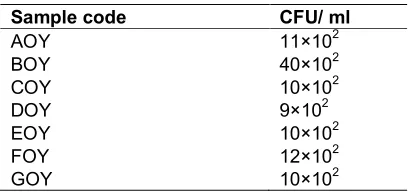
Table 1. Results of total coliform using most probable number (MPN) (cfu/100 ml)
Sample code CFU/ ml
AOY 11×102
BOY 40×102
COY 10×102
DOY 9×10²
EOY 10×102
FOY 12×102
GOY 10×102
3.5 Temperature
Donaldben et al.; IJBCRR, 27(2): 1-9, 2019; Article no.IJBCRR.51403
3.6 Total Bacterial Count
Presence of coliforms indicates that the water is feacally contaminated and not safe for drinking purpose. Due to coli forms various waterborne diseases occur and therefore, coliforms should be not exceed 10 (cfu/100 ml) for drinking water. In the present research, it was observed that the initial coliform of the untreated water sample was 40 (cfu/ml), which was beyond the recommended limits of WHO standards. After the treatment of the water sample with different de-fated and undefated M. oleifera coagulant powder, the coliforms decreased to 10 cfu per 100ml in sample COY, DOY, EOY and GOY which was within the WHO limit and the findings of Oria-Usifo et al. [9]. While sample FOY was 12 per 100ml which was above the WHO limit. The presence of coliform within the WHO limit gives an indication that the impurities present in the water after treatment with de-fated and undefated M. Oleifera powder are not harmful to humans. Therefore the treated
water sample is safe for consumption. While the water sample treated with alum are
safe for human consumption due to the high level of coliform unit present in the water sample which was above the WHO limit for drinking water.
4. CONCLUSION
The results of this research was able to show the ability of M. oleifera contains some coagulating properties have similar effect as the conventional coagulum, alum. The physic-chemical properties of the water after treated with M. Oleifera coagulum were elucided. M. oleifera has an added advantage of having antimicrobial properties. Considering the fact that Moringa coagulant can be locally produced, its use in water purification should be encouraged. This is likely to reduce the high cost of the current water treatment systems. The use of M. oleifera seed flour as a natural coagulant maintains the neutral state of water after treatment. Hence, the use of
M. oleifera seed extract could be more suitable and have a distinct advantage over the use of chemical coagulants such as alum in water treatment for rural communities in developing countries.
COMPETING INTERESTS
Authors have declared that no competing interests exist.
REFERENCES
1. WHO. Guidelines for drinking water quality. Revised and enlarged edition. SEI, Stockholm, Sweden; 2004.
2. Ali EN, Muyibi SA, Salleh HM, Salleh RM, Alam Z. Moringa oleifera seeds as natural coagulant for water treatment. Thirteenth International Water Technology Conference, IWTC 13, Hurghada, Egypt, 2009;163-168.
3. Bhuptawat H, Folkard GK, Chaudhari S. Laboratory evaluation of a water treatment sequence using Moringa oleifera seed coagulant. Int. J. Water. 2007;3(3):299-315.
4. Pritchard M, Craven T, Mkwandawire T Edmodsin A, O’Neil J. A comparison between Moringa oleifera and chemical coagulants in the purification of drinking water-an alternative sustainable solution for developing countries elsevier. 2010; 799-800.
5. Francis Kweku Amagloh, Amos Benang. Effectiveness of Moringa oleifera seed as coagulant for water purification African Journal of Agricultural Research. 2009;4 (1):119-123.
6. Ghebremichael KA. Moringa seed and pumice as alternative natural material for drinking water treatment. Ph.D dissertation. Royal Institude Technology (KTH) Stockholm. Sweden. 2004;(3):23-23.
7. Aho IM, Lagasi JE. A new water treatment system using Moringa oleifera seed. Aamerican Journal of Scientific and Industrial Research. 2012;3(6):487-492. 8. Broin M, Santaella C, Cuine S, Kokou K,
Peltier G, Joet T. Flocculent activity of a recombinant protein from Moringa oleifera
Lam. seeds. Applied Microbiology and Biotechnology. 2002;60(1):114-119. 9. Oria-Usifo EE, Anyata BU, Ekenta EO.
Use of Moringa oleifera seed extracts as alternative natural material for water purification. Journal of Engineering and Applied Sciences. 2014;(10):41-53. 10. Jahn SAA. Using Moringa oleifera seeds
as coagulants in developing countries. Journal of American. Wat. Works. Assoc. 1988;80(6):43-50.
Moringa oleifera seeds. Water Research. 1998;32(3):781-791.
12. WHO. Guideline for drinking-water quality (Electronic resource): Incorporating first addendum Recommendations. 2006;1(3): 11-13.
13. Muyibi SA, Evison LM. Coagulation of turbid water and softening of hard water with Moringa oleifera seeds. International Journal of Environmental Studies. 1996;49: 247-259.
_________________________________________________________________________________
© 2019 Donaldben et al.; This is an Open Access article distributed under the terms of the Creative Commons Attribution License (http://creativecommons.org/licenses/by/4.0), which permits unrestricted use, distribution, and reproduction in any medium, provided the original work is properly cited.
Peer-review history:
![Fig. 1. Production of M. oleifera flour (Modified Ghebremichael, [6] method)](https://thumb-us.123doks.com/thumbv2/123dok_us/8380352.1678451/3.612.182.442.94.349/fig-production-m-oleifera-flour-modified-ghebremichael-method.webp)