Thriveni et al. World Journal of Engineering Research and Technology
AN IMPROVED JOB SCHEDULING METHOD BY USING RELEASED
RESOURCES FOR MAPREDUCE
Indumathi. S1, Pavithra. T. N2, Shruti. M. Masali3, Thriveni. M. D4*, Malatesh. S. H5
1234
B. E, Student of M.S.E.C, Bengaluru, India.
5
HOD (MTech (CSE), PhD, MCSI, MISTE), Department of Computer Science and
Engineering, M.S.E.C, Bengaluru, India.
Article Received on 14/03/2016 Article Revised on 04/04/2016 Article Accepted on 24/04/2016
ABSTRACT
Big data is defined as large amount of data which requires new
technologies and architectures to make possible to extract value from it
by capturing and analysis process. Big data has emerged because we
are living in a society which makes increasing use of data intensive technologies. Due to such
large size of data it becomes very difficult to perform effective analysis using the existing
traditional techniques. Big data concept means a datasets which continue to grow so much
that it becomes difficult to manage it using existing database management concepts and tools.
MapReduce is a framework using which we can write applications to process huge amounts
of data, in parallel, on large clusters of commodity hardware in a reliable manner.
MapReduce has become one standard for big data processing. However job scheduling in this
model is always a challenge for the research fraternity and several job scheduling algorithms
have a already have been proposed by researchers addressing various issues. All such
algorithms mostly emphasize on meeting of job deadline without taking cognizance of
additional released resources being available through intermediate release of resources during
processing. In this paper, we propose a new job scheduling algorithm which satisfies job
deadline for all scheduled jobs along with utilization of the unused resources so that more
number of jobs can be scheduled and the overall system efficiency will be increased.
KEYWORDS: MapReduce; Big Data; Job Scheduling; Improved Fair Scheduling.
World Journal of Engineering Research and Technology
WJERT
www.wjert.org
SJIF Impact Factor: 3.419*Corresponding Author
Thriveni. M. D.
INTRODUCTION
Hadoop is an open-source framework that allows to store and process big data in a distributed
environment across clusters of computers using simple programming models. It is designed
to scale up from single servers to thousands of machines, each offering local computation and
storage. Distributed processing of large sets across clusters of computers using simple
programming modules. A hadoop frame-work application works in an environment that
provides distributed storage and computation across clusters of computers. In recent times,
data generation rate has been increased to a great extent. Huge volume of data is being
generated by various web applications as well as different scientific and technical
experiments.
Hadoop framework includes following 4 modules.
Hadoop common
These are java libraries and utilities required by other hadoop modules. These libraries
provide file system and OS level abstractions and contain the necessary java files and scripts
required to start hadoop.
Hadoop YARN
This is a framework for job scheduling and cluster resource management.
Hadoop Distributed file System(HDFS)
A distributed file system that provides high throughput access to application data.
Hadoop MapReduce
This is a YARN based system for parallel processing of large data sets.
MapReduce is a distributed programming model for parallel processing on Terabytes of data,
which has become one standard for processing Big Data. It is scalable and parallel processing
programming model. There are two functions – a Map functions and a Reduce functions.
The map task: This is the first task which takes input data and converts it into set of data
where individual elements are broken down into tuples (key/value pairs).
The reduce task: This task takes the output from a map task as input and combines those
data tuples into a smaller set of tuples. The reduce task is always performed after the map
There is a technique which decides the execution order of the tasks in the slots, called job
Scheduling Algorithms. Different Job scheduling algorithms have already used for the
parallel processing framework which takes care of the Data Locality, resource utilization,
MapReduce Interdependence and meeting job deadline. when jobs are smaller data locality is
considered and cannot ignore the data travelling and network cost during the calculation of
Map Task Completion Time(MTCT). The data locality is considered as a very little part
when job is with a relatively higher execution time. Hadoop’s default scheduler is FIFO. For
MapReduce jobs FIFO schedules jobs in FIFO order with different priority levels. These job
scheduling algorithms lacks from meeting the job deadline and resource utilization. The other
scheduler FAIR scheduler focuses on guaranteeing FAIR share for all the users and providing
better resource utilization. Here in the FAIR scheduler it lacks in meeting the deadline of a
job and also the data locality, MapReduce interdependence are not addressed here. In this
paper we are focusing to improve the FAIR scheduler by achieving the job deadline by
utilizing the released resources and improving the overall efficiency the system.
HADOOP MAPREDUCE SCHEDULING AND ISSUES
Hadoop allows the user to submit the job and also to configure the job, control the job
execution. Every job consists of some independent tasks, and all those tasks need to have a
system slots to run. In Hadoop all scheduling decisions are made on a task for both map and
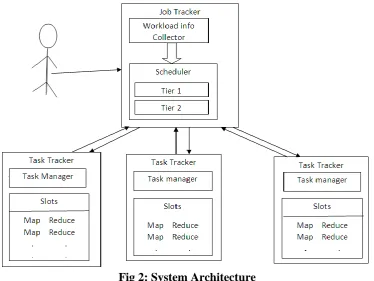
reduce phases. The Hadoop scheduling model is a Master/Slave/Worker cluster structure. The
master node i.e. Job Tracker coordinates the worker machines i.e, .TaskTracker. Job Tracker
is a process which manages the jobs and Task Tracker is which manages the tasks. Map
The Hadoop Map Reduce scheduling issues comes here. There are three important scheduling
issues in MapReduce such as synchronization, locality and fairness. locality is a very crucial
issue affecting performance in a shared cluster environment. The time when scheduler tries
to assign Map tasks to slots available on machine in which the underlying storage layer holds
the intended to be processed is the concept of data locality in MapReduce. Synchronization is
the process of transferring the intermediate output of the map process to the reduce processes
as input and this is also considered as a factor which affects the performance. Generally
reduce process will start when the map process completes. . Due to this dependency, a single
node can slow down the whole process, causing the other nodes to wait until it is finished .So
synchronization of map and reduce phases, made up essential help to get overall performance
of MapReduce Model. The demands of the workload can be elastic, so fair workload to each
job sharing cluster should be considered. Synchronization overhead could affect the fairness.
To solve these important issues many scheduling algorithms have been proposed in the past
decades. in the next section we describe these algorithms.
SCHEDULING ALGORITHMS
The important issues that we described, and many more problems in scheduling of
MapReduce, the Scheduling is one of the most critical aspects of MapReduce. There are
many algorithms to address these issues with different techniques and approaches. Some of
the algorithms get focus to improvement of data locality and some of them implements to
provide Synchronization processing. Also, many of them have been designed to minimizing
the total completion time. In this section we describe briefly some of these algorithms.
FIFO SCHEDULING ALGORITHM
The default scheduler of Hadoop is FIFO.FIFO scheduler chooses the homework to execute
by considering the priority of homework and their arriving.. First come, and first go. FIFO is
quite simple. In the platform of Hadoop there is only one homework queue. And the
submitted homework will be queued by time .The new incoming task will be inserted at the
tail of the task queue. The advantage of this scheduling is simple and easy to realize. But the
disadvantage of this scheduling is obviously. It sees all the homework as the same without
regarding of the time of homework. And this kind of scheduling is bad to small homework.
FAIR SCHEDULING STRATEGY
This method configures the task pool in the system, and a task pool can execute a task. These
every task is assigned to some task pool to execute the tasks. Fair uses a two level hierarchy
for assigning slots to the users. FAIR creates a pool per user. First it allocates task slots
across pools, and at the second level, each pool allocates its slots among various jobs in the
pool. Each pool is given a minimum share, which can be zero and it ensures that each pool
will receive its minimum share, and the sum over the minimum shares of all pools does not
exceed the Cluster Capacity.
When a pool is having some free slots from its minimum share, those slots are distributed
amongst other pools. When a new job enters the system then two different timeouts are given
to it. A newly started job must get its minimum share before the given timeout expires;
otherwise the scheduler starts killing other pools’ tasks and re allocates them to the job. If the
job has not got its fair share by the second timeout, FAIR kills more tasks. While killing task
it chooses the most recently launched task in a job which is having more slots than its fair
share.
This scheduler mostly focuses on resource utilization but it can’t ensure the job deadline. So,
whether a scheduled job can be finished within time or not that question is not answered by
this scheduling algorithm. FAIR scheduler is also not focussed towards MapReduce
interdependence and data locality.
IMPROVED FAIR SCHEDULER
Improved fair scheduler is one of the job scheduling algorithm based on fair scheduler.
Improved fair scheduler algorithm differentiates the job as CPU bound and I/O bound. Jobs
with a smaller data transfer time than the Map Task Completion Time (MTCT) is called CPU
bound job and jobs with a larger data transfer time than the Map Task Completion Time
(MTCT) is called I/O bound job is task completion.
To kill the task an improved fair scheduler considers the job type and data locality. Though
improved FAIR scheduler tries to improve the resource utilization and considers Data
Locality but it not completely meets job deadline and does not take care of Map Reduce
Fig 2: System Architecture
IMPLEMENTATION
We propose a new job scheduling algorithm, which takes care of the MapReduce and
satisfies Job Deadline along with better Resource Utilization.
For the word count a MapReduce functions implemented and is tested in machines of various
capacities.
Input:Jobs_Relaxed_Share,Jobs_Minimum_Share,Map_Task_Completion_Time,Jobs_Start_
Time, Current time
Output: Jobs_Share
Step I: Kill the most recently launched task from Jobs_Relaxed_Share of the job except for a
job that has got its full share.
Step II: If the job has not got its full Jobs_Minimum_Share then do the following.
Step III: Check the number of slots needed to fulfill the Jobs_Minimum_Share.
Step IV: Find a job whose Jobs_Relaxed_Share can fulfill the demand.
Step V: If we get one then we need to check the Estimated Completion Time from
{Map_Task_Completion_Time – (Current time – Jobs_Start_Time)}.
Step VI: If Estimated Completion Time _ {CEILING (Total Slots/ (Present Share of the Job+
Jobs_Relaxed_Share) X Completion Time of a Single Map_Wave}.
Then wait for the slots to complete their execution.
CONCLUSION
In this paper, we have proposed a new job scheduling algorithm, which improves the
utilization of the unused resources it will allow more number of jobs to be scheduled and
satisfies job deadline for a scheduled job. When the job is complete every job releases its
resources and till new job appears these resources are unused. Instead of waiting for a new
job to appear and utilize the leftover resources, we allocate the released resources to the
existing jobs and eventually the jobs with additional resources are finished earlier. So the
resources are utilized efficiently and overall system efficiency will be increased.
REFERENCES
1. Tom White,”Hadoop: The Definitive Guide”, O’Reilly, Yahoo! Press, ISBN:
978-0-596-52197-4.
2. Rajkumar Buyya, James Broberg, Andrej Goscinski,”Cloud Computing: Principles and
Paradigms”, Wiley, ISBN: 978-0-470-88799-8.
3. Kamal Kc, Kemafor Anyanwu, “Scheduling Hadoop Jobs to Meet Deadlines,” CloudCom
In IEEE, Dec 2010.
Indumathi S Pavithra T N Shruti.M.Masali