The Revised Technology Acceptance Model
and the Impact of Individual Differences in
Assessing Internet Banking Use in Taiwan
Chu-Fen Li
Department of Finance, National Formosa University, #64 Wun-Hua Road, Huwei, Yunlin 632, Taiwan
ABSTRACT
The literature on Internet banking indicates that many researchers have been studying the determinant factors relating to a user’s acceptance or adoption behavior using the technology acceptance model. Little attention has been given, however, to exploring how external variables and perceptions of security, privacy, and confidentiality risks affect acceptance or adoption behavior, although these factors may play a significant role in Internet banking use. This study extends the technology acceptance model by introducing risk perceptions as a new construct to evaluate the determinants influencing Internet banking use behavior and to examine the influences of external variables such as individual differences. Based on data from a questionnaire survey of a sample of 788 experienced users in Taiwan, the results reveal that individual differences play a role in directly affecting perceived usefulness, perceived ease of use, and perceived risk, and a role in indirectly affecting user behavior. The research results provide insightful recommendations for use in developing customer satisfaction policies that promote loyalty and future widespread and repeated use.
1.
INTRODUCTION
Internet banking (IB) is one of today’s innovative Internet-enabled technology applications. In recent years, it has experienced rapid growth in many countries and has fundamentally changed the competitive landscape of the banking industry worldwide, blurring the traditional lines that define product, market, and customer base. Compared with its use in developed Western countries, however, IB is still a relatively novel issue and a still-emerging trend in Taiwan’s financial services industry [Yu, 2008]. During the last decade, nearly all types of banks with physical offices in Taiwan rushed to establish their Internet presence. In addition to their traditional delivery channels, they adopted the Internet as another way to deliver their existing financial products and services to their customers. With the increase in the number of Internet users, more and more banks have become well aware that IB can offer them more innovative services and lucrative opportunities than traditional bricks-and-mortar bank branches. With increased awareness, however, has come a growing concern among management about how to increase their competitive advantage and earnings potential with online banks.
The success of IB depends to a large extent on consumer acceptance or adoption of this information system (IS). In the last decade, abundant empirical research has explored customers' attitudes and intentions toward IB, such as studies by Sathye [1999], Shanmugam and Guru [2000], Tan and Teo [2000], Suganthi et al. [2001], Chung and Paynter [2002], Chang [2003], Wang et al. [2003], Chan and Lu [2004], Eriksson [2005]], Jaruwachirathanakul and Fink [2005], Lassar et al. [2005], Ndubisi et al. [2005), Cheng et al. [2006], Lichtenstein and Williamson [2006], Yiu et al. [2007], and Al-Somali et al. [2009].
may not fully reflect the user’s behavior toward newly emerging technology like Internet banking [Wang et al., 2003]. Other variables able to affect perceived ease of use, perceived usefulness, and user acceptance need to be addressed [Davis, 1989].
The current study gives insight into the determinants affecting IB user’s adoption behavior by extending previous studies. In this study, the influence of individual differences is addressed, and a theoretical model is developed by extending TAM to incorporate risk perceptions regarding privacy, confidentiality, and security as a construct to capture the features of Internet-based technology, which does not require any face-to-face interaction between the parties to a transaction. Also, this study examines the actual use of IB systems rather than just the intention to use such systems. Structural equation modeling is used to validate the theoretical model.
Since the first online banking service was launched in Taiwan in March 2000, Taiwan's IB has not developed into the sophisticated and immensely popular facility that it is in Western countries, indicating, therefore, that further promotion and development are required. For this growth to occur, it is imperative to investigate the impact of critical factors affecting user behavior. In contrast to prior work, this study focuses on actual use behavior by considering a combination of different use measures. It is believed that the feedback information from actual users, who are familiar with online banking services to a certain extent, will be critical for devising the optimal marketing strategy to meet customer demands, and further to retain and expand customer base.
2.
BACKGROUND AND LITERATURE REVIEW
This section includes a discussion of the technology acceptance model, individual differences, and risk perceptions.
2.1. Technology Acceptance Model
perceived usefulness and perceived ease of use – which substitute for many of TRA’s attitude measure. According to Davis et al. [1989], perceived usefulness relates to the degree to which a person believes that using a particular system would enhance his or her job performance, whereas perceived ease of use refers to the degree to which a person believes that using a particular system would be free of effort. These two constructs are postulated to determine an individual’s attitude toward using a technology-based system, with behavioral intention to use playing the role of mediator of actual system use. Perceived ease of use is also posited to have a direct effect on perceived usefulness.
Up to now, TAM has accumulated substantial empirical support and has been fully validated to be powerful as a framework to predict user acceptance in prior studies examining different information technologies [Agarwal and Prasad, 1999]. However, very few studies have validated the full TAM using all original constructs [Hubona and Kennick, 1996]. Either intention to use or mostly actual use was generally excluded. In addition, the role of external variables within TAM has received little attention [Hubona and Kennick, 1996; Hubona and Geitz, 1997; Legris et al., 2003]. Nevertheless, as Agarwal and Prasad [1999] noted, external variables did exhibit an influence on individual behavior toward a new IS via their effects on an individual’s beliefs about a new IS.
2.2. Individual Differences
In a wide variety of disciplines, individual differences are the external variables used to explore the effect on technology use. A set of constructs not specifically included in TAM were external variables related to individual differences, which mean user factors that include characteristics such as cognitive, personality, demographic, and situational variables [Zumd, 1979; Agarwal and Prasad, 1999]. Legris et al. [2003] noted the critical importance of examining individual differences, since they are the ultimate drivers for the use of technology. A number of related studies on TAM also found a significant relationship between individual differences and technology acceptance [Hubona and Kennick, 1996; Jackson et al., 1997; Agarwal and Prasad, 1999; Venkatesh, 2000; Venkatesh and Morris, 2000; Burton-Jones and Hubona, 2005; Burton-Jones and Hubona, 2006].
Hackbarth et al., 2003]. Examining the causal link between system experience and ease of use using a sample of 116 users of electronic spreadsheets, Hackbarth et al. [2003] found that system experience was positively related to perceived ease of use. Szajna [1996] suggested that adding a variable to account for system experience would be a worthwhile extension of TAM.
2.3. Risk Perception
The TAM tends to predict user adoption of new IS in a positive perspective. The user perceptions of both ease of use and usefulness are two critical factors affecting an individual's adoption of a system. However, customers will reduce their use or even refuse to use an IS if they subjectively expect that an injury or a loss might possibly occur while using the IS. Perceived risk is defined as a consumer’s perceptions of the adverse consequences and uncertainty associated with his or her action [Bauer, 1960]. The degrees of risk that consumers perceive and their risk tolerance are factors that affect use behavior [Chan and Lu, 2004; Lu et al., 2005].
Perceived risk is deemed a multi-dimensional construct, consisting of numerous categories of risk, including financial, performance (or functional), time, social, physical, and psychological risks [Jacoby and Kaplan, 1972; Havlena and DeSarbo, 1990; Murray and Schlacter, 1990; Stone and Gronhaug, 1993]. E-commerce and other Internet-based applications related to no face-to-face interactions between the transacting parties are also regarded as a risky undertaking [Chan and Lu, 2004] and may even involve more perceived risk than traditional transactions [Tan, 1999].
e-commerce [Miyazaki and Fernandez, 2001]. Especially, in the IB context, consumers’ concerns about security have been emphasized as being the important factor restraining the adoption and use of IB [Sathye, 1999; Wang et al., 2003; Gerrard et al., 2006; Laudon and Traver, 2007; Calisir and Gumussoy, 2008, Aldas-Manzano, 2009]. And, the greatest obstacle to increased use of online financial services is found to be fears about security and confidentiality of financial information [Laudon and Traver, 2007]. It is expected that only individuals who view IB as a low-risk undertaking would have a tendency to perceived it as useful [Chan and Lu, 2004].
3.
METHODOLOGY
This section includes a discussion of the research model and hypotheses, operationalization constructs, and the questionnaire design.
3.1. The Research Model and Hypotheses
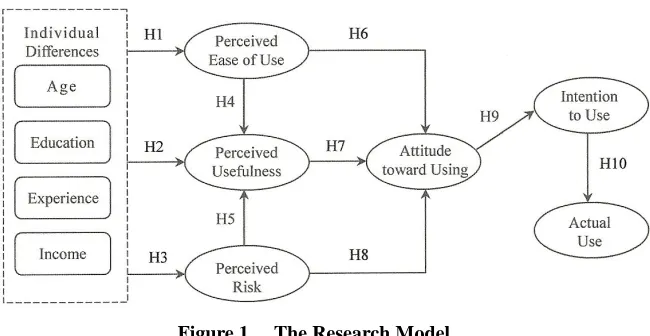
Based on the discussion in Section 2, the research model proposed by this study is shown in Figure 1.
Figure 1. The Research Model
IB, intention to use, and actual use. Each of the external variables is assumed to be mediated by perceived ease of use, perceived usefulness, and perceived risk – which are, in turn, posited to be major determinants of attitude. Attitude influences intention to use, and then intention determines the level of actual use of IB. The following hypotheses detail these relationships:
H1. Individual differences affect perceived ease of use. H1a. Age affects perceived ease of use.
H1b. Education affects perceived ease of use. H1c. Experience affects perceived ease of use. H1d. Income affects perceived ease of use.
H2. Individual differences affect perceived usefulness. H2a. Age affects perceived usefulness.
H2b. Education affects perceived usefulness. H2c. Experience affects perceived usefulness. H2d. Income affects perceived usefulness.
H3. Individual differences affect perceived risk. H3a. Age affects perceived risk.
H3b. Education affects perceived risk. H3c. Experience affects perceived risk. H3d. Income affects perceived risk.
3.2. Operationalization Constructs
Six crucial latent constructs were considered in the research model used in this study: perceived ease of use, perceived usefulness, perceived risk, attitude toward using, intention to use, and actual use. A number of validated items used to operationalize these constructs were in principal adopted from prior TAM-related research and revised by this study for use in the IB context. The constructs are defined as follows.
Perceived Ease of Use (PEOU) – Refers to the degree to which a per-son believes that using IB systems would be free of effort [Davis et al., 1989]
Perceived Usefulness (PU) – Captures the extent to which a user views IB as offering advantages over previous ways of conducting banking transactions [Chan and Lu, 2004]
Perceived Risk (PR) – Defined here as the degree to which an individual believes that banking transactions would be conducted confidentially and safely through IB systems. It comprises three dimensions – namely, security, privacy, and confidentiality – which are frequently used interchangeably, although each has a different meaning. Security denotes protecting the IB system from both internal and external threats such as illegal intrusion, theft, or destruction. Privacy means the ability of a person to control the availability of information about himself or herself. Confidentiality relates to the protection of individuals’ information, and ensuring that the information is not made available or disclosed to unauthorized individuals or entities.
Attitude Toward Using (ATU) – Refers to an individual’s positive or negative feelings (evaluative effect) about using IB [Fishbein and Ajzen, 1975]
Intention to Use (ITU) – Refers to a state of mind that drives an individual to use or not to use IB
etc.). Frequency of use refers to the number of times a person uses IB in a given period, a week, or a day. Volume of use refers to the number of hours a person spends using IB in a week.
All but two of these constructs were measured by six question items. The exceptions were intention to use (ITU) and actual use (AU), which were measured by only three items. Of those, each item of AU was linearly transformed to fit a measurement scale in the same range as all the other measured constructs, which were measured on a 7-point Likert-type scale, ranging from 1 representing “strongly disagree” to 7 representing “strongly agree,” with the items capturing perceived risk being reverse-scored.
3.3. Questionnaire Design
The questionnaire used a structured format and comprised 39 questions divided into three sections. In the first section, 6 questions were designed as fixed alternative items to collect respondents’ use-behavior-related information, such as users’ most frequently used IB account, most frequently used IB service, years of IB experience, online transaction amount of each month over IB, frequency of IB use, and volume of IB use. The second section, containing 27 questions, focused on a number of factors related to users’ perception toward IB and measured these dimensions: PU, PEOU, PR, ATU and ITU. Each dimension except ITU consisted of six items. ITU contained only three items. Respondents were asked to rate all these items on a 7-point Likert-type scale. The final section, consisting of 6 questions, collected basic respondent data related to demographic characteristics such as the respondent’s gender, age, residential area, occupation, education level, and annual personal income.
4.
DATA COLLECTION AND ANALYSIS
comment on the questionnaire. The comments from these users provided the basis for questionnaire revisions. The formal survey was conducted in September 2009. In addition to a traditional paper-and-pencil survey over face-to-face contact, an electronic survey via e-mail and websites was also conducted. A total of 892 responses were received. Of these, 104 are invalid, which left a total of 788 completed and usable questionnaires for analysis. The effective response rate was up to 88.34%. The total sample for this study thus consisted of 788 online banking users.
Structural equation modeling (SEM) was applied to evaluate the entire pattern of the inter-correlations among the constructs and to test related propositions in the theoretical model developed by this study. Basically, SEM is a family of statistical techniques that incorporates and integrates factor analysis and path analysis. It can be used to model multivariate casual relationships and to test multivariate hypotheses. In recent years, the application of SEM is becoming increasingly prevalent in the field of consumer behavior. SEM model building consists of a two-stage process [Jöreskog, and Sörbom, 1993; Hair et al., 1998; Maruyama, 1998], in which the measurement models are tested before testing the structural model. The measurement models specify how hypothetical constructs are measured in terms of the observed variables, whereas the structural model describes causal relationships among the latent variables.
5.
RESULTS
This section presents results relating to the profile of survey respondents, the analysis of the measurement model, and the analysis of the structural model.
5.1. Profile of Survey Respondents
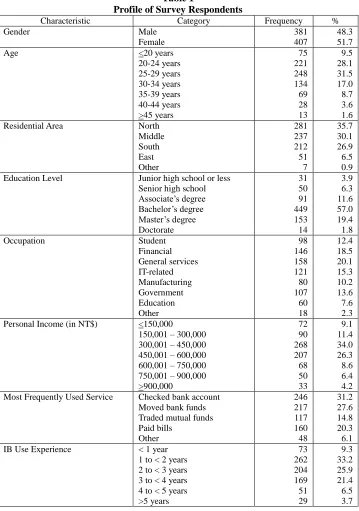
Table 1
Profile of Survey Respondents
Characteristic Category Frequency %
Gender Male
Female
381 407
48.3 51.7
Age <20 years
20-24 years 25-29 years 30-34 years 35-39 years 40-44 years >45 years 75 221 248 134 69 28 13 9.5 28.1 31.5 17.0 8.7 3.6 1.6
Residential Area North
Middle South East Other 281 237 212 51 7 35.7 30.1 26.9 6.5 0.9
Education Level Junior high school or less
Senior high school Associate’s degree Bachelor’s degree Master’s degree Doctorate 31 50 91 449 153 14 3.9 6.3 11.6 57.0 19.4 1.8
Occupation Student
Financial General services IT-related Manufacturing Government Education Other 98 146 158 121 80 107 60 18 12.4 18.5 20.1 15.3 10.2 13.6 7.6 2.3 Personal Income (in NT$) <150,000
150,001 – 300,000 300,001 – 450,000 450,001 – 600,000 600,001 – 750,000 750,001 – 900,000 >900,000 72 90 268 207 68 50 33 9.1 11.4 34.0 26.3 8.6 6.4 4.2 Most Frequently Used Service Checked bank account
Moved bank funds Traded mutual funds Paid bills Other 246 217 117 160 48 31.2 27.6 14.8 20.3 6.1
IB Use Experience < 1 year
In terms of occupation, the largest group of respondents (20%) worked in the general services industry. Next, in order, were those working in the financial services industry (19%), IT-related industry (15%), and the government sector (14%). Students accounted for 12% of the respondents, and 10% worked in the manufacturing industry.
Personal income was measured in NTD. At the time of the study, NT$32.5 was equal to US$1.0. The largest group of respondents (34%) included those with an annual income between NT$300,001 and NT$450,000. Next in order came those earning NT$450,001 to NT$600,000 per year (26%); those earning between NT$150,001 and NT$300,000 (11%); those with an income of more than NT$600,000 per year (11.4%); and then those earning less than NT$150,000 per year (9.1%).
In terms of IB use experience, the respondents were familiar with IB systems, at least to some extent. More than 33% of the respondents had been using IB for 1-2 years, followed by those with 2-3 years of experience (26%) and 3-4 years of experience (21%). More than 10 % of the respondents had more than 4 years of experience, whereas only 9% reported less than one year’s experience.
Respondents ranked the most frequently used IB services in this order: checked bank accounts (31%), moved bank funds (28%), paid bills (20%), and traded mutual funds (15%).
5.1. Analysis of the Measurement Model
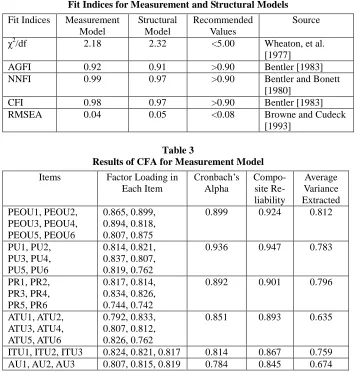
Confirmatory factor analysis (CFA) using LISREL8.8 was first conducted to assess the measurement model. The results from fit measures indicated a fairly good fit for the model. As shown in Table 2, the ratio of chi-square to degrees of freedom (χ2/df) was 2.18, which was lower than 5 recommended by Wheaton et al. [1977]. The adjusted goodness-of-fit index (AGFI), non-normalized fit index (NNFI), and comparative fit index (CFI) were all greater than the recommended cut-off value of 0.90 [Bentler, 1983; Bentler and Bonett, 1980]. The root mean square error of approximation (RMSEA) was 0.04, which was less than the recommended threshold of 0.08 [Browne and Cudeck, 1993]. These results provide evidence that the data collected supports the model.
Table 2
Fit Indices for Measurement and Structural Models
Fit Indices Measurement Model Structural Model Recommended Values Source χ2
/df 2.18 2.32 <5.00 Wheaton, et al. [1977]
AGFI 0.92 0.91 >0.90 Bentler [1983]
NNFI 0.99 0.97 >0.90 Bentler and Bonett
[1980]
CFI 0.98 0.97 >0.90 Bentler [1983]
RMSEA 0.04 0.05 <0.08 Browne and Cudeck
[1993]
Table 3
Results of CFA for Measurement Model
Items Factor Loading in Each Item Cronbach’s Alpha Compo-site Re-liability Average Variance Extracted PEOU1, PEOU2, PEOU3, PEOU4, PEOU5, PEOU6 0.865, 0.899, 0.894, 0.818, 0.807, 0.875
0.899 0.924 0.812
PU1, PU2, PU3, PU4, PU5, PU6 0.814, 0.821, 0.837, 0.807, 0.819, 0.762
0.936 0.947 0.783
PR1, PR2, PR3, PR4, PR5, PR6 0.817, 0.814, 0.834, 0.826, 0.744, 0.742
0.892 0.901 0.796
ATU1, ATU2, ATU3, ATU4, ATU5, ATU6 0.792, 0.833, 0.807, 0.812, 0.826, 0.762
0.851 0.893 0.635
ITU1, ITU2, ITU3 0.824, 0.821, 0.817 0.814 0.867 0.759 AU1, AU2, AU3 0.807, 0.815, 0.819 0.784 0.845 0.674
On the other hand, to test discriminant validity, Fornell and Larcker [1981] recommended that the AVE per construct should be higher than the correlations between any two different constructs. Table 4 presents the AVE matrices, with the AVE on the diagonal and squared correlations among constructs on the off-diagonal. The results indicate that the elements in the principal diagonal were always greater than the off-diagonal elements in their corresponding row and column, confirming discriminant validity.
5.2. Analysis of Structural Model
After validating the measurement scale, the same set of fit indices was applied to analysis of the structural model. As shown earlier in Table 2, the confirmatory factor analysis indicated that the structural model provided a good fit to the data (χ2/df = 2.32, AGFI = 0.91, NNFI = 0.97, CFI = 0.97, RMSEA = 0.05). Then, the structural model could be further assessed by the path coefficients and explanatory power. Figure 2 illustrates the results of SEM analysis in a path diagram, where TAM was extended by incorporating the PR construct regarding user perceptions of security, privacy, and confidentiality risks, and introduced the influence of four external variables – age, education, experience, and income. In the figure, the significance of path coefficients is indicated, and all non-significantpaths are removed
.
As expected, ATU positively affected on ITU (β=0.58, p<0.001), which in turn positively affected on AU (β=0.39, p<0.001), providing support for H9 and H10. ATU explained 46.2% of the variance in ITU, which accounted for 35.7% of the variance in AU. Furthermore, hypotheses H6, H7, and H8 were also supported, in that PEOU, PU, and PR all had a significant effect on ATU. Altogether, the three constructs accounted for 74.8% of the variance in ATU with PU (β=0.74, p<0.001) contributing more to ATU than both PEOU (β=0.25, p<0.001) and PR (β=-0.33, p<0.001). Note that the effect of PR on ATU was negative, whereas the effects of the other two elements, PU and PEOU, were positive. In addition, the effect of PEOU on PU was significant. Thus, H4 was significantly supported (β=0.79, p<0.001). However, H5 (which posits that PR significantly influences PU) was not supported by the data.
Specifically, age, education, and experience significantly affected PEOU (γ=-0.27, 0.32, and 0.37, respectively, p<0.001); education also had a significant effect on PU (γ=0.23, p<0.001); both experience and income had a significant effect on PR (γ=-0.14 and -0.21, respectively, p<0.01). Clearly, experience exhibited a stronger effect than age and education in influencing PEOU. Moreover, the effects of education on PEOU and PU were positive, and so did experience on PEOU. In contrast, the effects of both experience and income on PR and age on PEOU were negative. The percentages of variance explained in PEOU, PU, and PR were 29.1%, 54.6%, and 33.3%, respectively.
6.
DISCUSSION AND IMPLICATIONS
The main purpose of this study was to extend the TAM to shed light on the impact of individual differences on use behavior in the IB environment and to incorporate risk perception as a new construct to reflect the features of the Internet-based technology context. The dimensions of PR (security, privacy, and confidentiality) are more comprehensive than in the previous studies. Distinct from the literature, the current study examined AU of IB systems rather than just ITU and attempted to validate the full TAM using all of the original constructs.
Furthermore, the results of this study also showed partial support for a direct effect of individual differences on PEOU, PU, and PR (H1, H2, and H3, respectively), and individual differences had an indirect effect on ITU and AU via the four key constructs (PEOU, PU, PR, and ATU). Of these, PR exerted a stronger effect on ATU (H8) than PEOU. Similar to the findings of Burton-Jones and Hubona [2006], the influence of users’ age on PEOU appeared to be negative. The results clearly demonstrated that the younger learn new skills relating to emerging technologies more easily than the older.
Moreover, similar to findings of the previous empirical study [Harrison and Rainer, 1992; Hubona and Kennick, 1996], the current study indicated positive effects of the users’ education level on PEOU and PU. The results revealed that higher levels of education are positively related to abilities to use innovative technologies and will thus increase PEOU of the IB system. This study also found especially evidence of a positive effect from prior experience on PEOU [Agarwal and Prasad, 1999; Burton-Jones and Hubona, 2006] and a negative effect on PU, but no significant effects on PU.
The results of this study seemed to be logical and reasonable. The longer that one has used an IB system, the more likely it will become an easy way and a routine tool for him or her to conduct banking business. In addition, it is quite intuitive that an experienced user tends to pay less attention to the risks of using a system because habits can weaken the feelings of fear. In addition, a user’s annual income level was found to have a significant negative effect on risk perception. This can be explained by the fact that higher income earners generally have a higher risk tolerance. As income and wealth increase, one’s level of PR will reduce.
It is noteworthy that PR played a key role in affecting the determinants of AU such as ATU and ITU, even through PR did not directly influence AU. In particular, online banking transactions are concerned with a greater degree of risk that consumers perceive than traditional face-to-face transactions. PR becomes a decisive consideration, besides PEOU and PU. It is therefore suggested that the IB authorities should improve the security measures, privacy protection, and confidentiality advancement in order to enhance online users’ perception of safety toward online banking services, and should take proper precautions to ensure the security of their customer's online transactions.
7.
CONCLUSIONS
Empirical data were collected from experienced users via a questionnaire survey, and SEM was used to test for the relationships among the constructs hypothesized in the research model. Based on a sample of 788 experienced users, the results provided support of the appropriateness of the extended research model in identifying the predictors of user behavior. Also, the study confirmed that individual differences play an important role in directly affecting perceived usefulness, perceived ease of use, and perceived risk, and indirectly affecting user behavior. The findings may provide useful guidelines for developing service satisfaction strategies to build stronger customer loyalty and encourage future widespread and repeat use.
ACKNOWLEDGMENT
The author is grateful to two anonymous referees for their many valuable comments and suggestions to improve the quality of the paper. Furthermore, the author would like to express his appreciation for the financial support from the National Formosa University under TC096045. In addition, students in the Department of Finance at the National Formosa University also deserve her appreciation for helping in data collection.
REFERENCES
Agarwal, R., and J. Prasad. 1999. Are individual differences germane to the acceptance of new information technologies? Decision Sciences 30(2), 361-391. Aldas-Manzano, J.; C. Lassala-Navarre; C. Ruiz-Mafe; and S. Sanz-Blas. 2009. The
role of consumer innovativeness and perceived risk in online banking usage, International Journal of Bank Marketing 27(1), 53-75.
Al-Somali, S.A.; R. Gholami; and B. Clegg. 2009. An investigation into the acceptance of online banking in Saudi Arabia, Technovation 29(2), 130-141.
Bauer, R.A. 1960. Consumer behavior as risk taking, In R. Hancock (ed.), Dynamic Marketing for a Changing World: Proceedings of the 43rd Conference, Chicago: American Marketing Association, 389-398.
Bentler, P.M., and D.G. Bonett. 1980. Significance tests and goodness of fit in the analysis of covariance structures, Psychological Bulletin 88(3), 588-606. Bentler, P.M. 1983. Some contributions to efficient statistics for structural
models: Specification and estimation of moment structures, Psychometrika 48, 493-517.
Browne, M.W., and R. Cudeck. 1993. Alternative ways of assessing model fit, In K.A. Bollen and J.S. Long (eds.), Testing Structural Equation Models, Newbury Park, CA: Sage Publications, 136-162.
Burton-Jones, A., and G.S. Hubona. 2005. Individual differences and usage behavior: Revisiting a technology acceptance model assumption, Database for Advances in Information Systems 36(2), 58-77.
Burton-Jones, A., and G.S. Hubona. 2006. The mediation of external variables in the technology acceptance model, Information and Management 43(6), 706-717.
Calisir, F., and C.A. Gumussoy. 2008. Internet banking versus other banking channels: Young consumers’ view, International Journal of Information Management 28(3), 215-221.
Chan, S.C., and M.T. Lu. 2004. Understanding Internet banking adoption and use behavior: A Hong Kong perspective, Journal of Global Information Management 12(3), July-September, 21-43.
Chang, T.Y. 2003. Dynamics of Banking Technology Adoption: An Application to Internet Banking, Department of Economics, Coventry: University of Warwick.
Chang, I.C.; Y.C. Li; W.F. Hung; and H.G. Hung. 2005. An empirical study on the impact of quality antecedents on taxpayers’ acceptance of Internet tax-filing systems,Government Information Quarterly 22, 389-410.
Cheng, T.C.E,; D.Y.C. Lam; and A.C.L. Yeung. 2006. Adoption of Internet banking: An empirical study in Hong Kong, Decision Support Systems 42, 1558-1572. Chung, W., and J. Paynter. 2002. An evaluation of Internet banking in New
Zealand, Proceedings of the 35th Annual Hawaii International Conference on System Sciences 7, January, p. 185.
Cockburn, C., and T.D. Wilson. 1996. Business use of the worldwide web, International Journal of Information Management 16(2), 83-102.
Davis, F.D. 1989. Perceived usefulness, perceived ease of use, and user acceptance of information technology, MIS Quarterly 13(3), 319-340.
Davis, F.D.; R.P. Bagozzi; and P.W. Warshaw. 1989. User acceptance of computer technology: A comparison of two theoretical models, Management Science 35(8), 982-1003.
Eriksson, K.; K. Kerem; and D. Nilsson. 2005. Customer acceptance of Internet banking in Estonia, International Journal of Bank Marketing 23(2), 200-216. Fishbein, M., and I. Ajzen. 1975. Belief, Attitude, Intention, and Behavior: An
Fornell, C., and D.F. Larcker. 1981. Evaluating structural equation models with unob-servable variables and measurement error, Journal of Marketing Research 18(1), February, 39-50.
Furnell, S. 2004. E-commerce security: A question of trust, Computer Fraud and Security 2004(10), October, 10-14.
Gerrard, P.; J.B. Cunningham; and J.F. Devlin. 2006. Why consumers are not using Internet banking: A qualitative study, Journal of Services Marketing 20(3), 160-168.
Hackbarth, G.; V. Grover; and M.Y. Yi. 2003. Computer playfulness and anxiety: Positive and negative mediators of the system experience effect on perceived ease of use, Information and Management 40(3), 221-232.
Hair, J.F.; R.E. Anderson; R.L. Tatham; and W.C. Black. 1998. Multivariate Data Analysis (5th ed.), Englewood Cliffs, NJ: Prentice-Hall.
Harrison, A.W., and R.K. Rainer Jr. 1992. The Influence of individual differences on skill in end-user computing, Journal of Management Information Systems 9(1), 93-111.
Havlena, W.J., and W.S. DeSarbo. 1990. On the measurement of perceived consumer risk, Decision Sciences 22, 927-939.
Hubona, G.S., and E. Kennick, E. 1996. The influence of external variables on information technology usage behavior, Proceedings of the 29th Annual Hawaii International Conference on System Sciences, HI: Maui, 166-175.
Hubona, G.S., and S. Geitz. 1997. External variables, beliefs, attitudes, and information technology usage behavior, Proceedings of the 30th Annual Hawaii International Conference on System Sciences, January, 21-28.
Igbaria, M., and S. Parasuraman. 1989. A path analytic study of individual characteristics, computer anxiety, and attitudes toward microcomputers, Journal of Management 15(3), 373-388.
Igbaria, M.; T. Guimaraes; and G.B. Davis. 1995. Testing the determinants of microcomputer usage via a structural equation model, Journal of Management Information Systems 11(4), 87-114.
Igbaria, M.; S. Parasuraman; and J.J. Baroudi. 1996. A motivational model of microcomputer usage, Journal of Management Information Systems 13(1), 127-143. Jackson, C.M.; S. Chow; and R.A. Leitch. 1997. Toward an understanding of the
Jacoby, J., and L. Kaplan. 1972. The components of perceived risk, In M. Venkatesan (ed.), Proceedings of the Third Annual Conference for Consumer Research, College Park, MD: Association for Consumer Research, 382-393.
Jaruwachirathanakul, B., and S. Fink. 2005. Internet banking adoption strategies for a development country: The case of Thailand, Internet Research 15(3), 295-311.
Jöreskog, K.G., and D. Sörbom. 1993. LISREL 8: Structural Equation Modeling with the SIMPLIS Command Language, Hillsdale, NJ: Scientific Software International. Kallanmarthodi, G., and M. Vaithiyanathan. 2012. Assessment of a modified
technology acceptance model among e-banking customers in Coimbatore city, International Journal of Innovation, Management , and Technology 3(2), 181-187.
Kesharwani, A., and S.S. Bisht. 2012. The impact of trust and perceived risk on Internet banking adoption in India: An extension of technology a cceptance model, International Journal of Bank Marketing 30(4), 303-322.
Lassar, W.M.; C. Manolis; and S.S. Lassar. 2005. The relationship between consumer innovativeness, personal characteristics, and online banking adoption, International Journal of Bank Marketing 23(2), 176-199.
Laudon, K.L., and C.G. Traver. 2007. E-commerce: Business, Technology, Society (3rd ed.), New York: Pearson Education, 621-647.
Legris, P.; J. Ingham; and P. Collerette. 2003. Why do people use information technology: A critical review of the technology acceptance model, Information and Management 40, 191-204.
Lichtenstein, S., and K. Williamson. 2006. Understanding consumer adoption of Internet banking: An interpretive study in the Australian banking context, Journal of Electronic Commerce Research 7(2), 50-66.
Lu, H.-P.; C.-L. Hsu; and H.-Y. Hsu. 2005. An empirical study of the effect of perceived risk upon intention to use online applications, Information Management and Computer Security 13(2), 106-120.
Maruyama, G.M. 1998. Basics of Structural Equation Modeling, Thousand Oaks, CA: Sage Publications.
Medyawati, H.; M. Christiyanti; and M. Yunanto. 2011. E-banking adoption analysis using technology acceptance model (TAM): Empirical study of bank customers in Bekasi city, 2011 International Conference on Innovation, Management and Service, IPEDR, vol.14, IACSIT Press, Singapore, 91-95.
Murray, K.B., and J.L. Schlacter. 1990. The impact of services versus goods on consumers’ assessment of perceived risk and variability, Journal of the Academy of Marketing Science 18(1), 51-65.
Ndubisi, N.O.; O.K. Gupta; and G.C. Ndubisi. 2005. The Mogul’s model of computing; integrating the moderating impact of users' persona into the technology acceptance model, Journal of Global Information Technology Management 8(1), 27-47.
Nunnally, J.C., and I.H. Bernstein. 1994. Psychometric Theory (3rd ed.), New York: McGraw-Hill.
Nunnally, J.C. 1978. Psychometric Theory (2nd ed.), New York: McGraw-Hill. Quelch, J.A., and L.R. Klein. 1996. The Internet and international marketing,
Sloan Management Review 37(3), spring, 60-75.
Sathye, M. 1999. Adoption of Internet banking by Australian consumers: An empirical investigation, International Journal of Bank Marketing 17(7), 324-334.
Shanmugam, B., and K. Guru. 2000. E-banking developments in Malaysia: Prospect and problems, Journal of International Banking Law 15(10), 250-56. Stone, R.N., and K/ Gronhaug. 1993. Perceived risk: Further considerations for the
marketing discipline, European Journal of Marketing 27(3), 39-50.
Suganthi, R.; K.G. Balachandher; and V. Balachandran. 2001. Internet banking patronage: An empirical investigation of Malaysia, Journal of Internet Banking and Commerce 6(1). Available online:
http://www.arraydev.com/commerce/JIBC/ 0103_01.htm Accessed on 25.07.2010
Szajna, B. 1996. Empirical evaluation of the revised technology acceptance model, Management Science 42(1), 85-92.
Tan, M., and T. Teo. 2000. Factors influencing the adoption of Internet banking, Journal of the Association for Information Systems 1(5), 1-42.
Tan, S.J. 1999. Strategies for reducing consumers’ risk aversion in Internet shopping, Journal of Consumer Marketing 16(2), 163-80.
Taylor, S., and P.A. Todd. 1995. Assessing IT usage: The role of prior experience, MIS Quarterly 19(4), 561-570.
Venkatesh, V., and M.G. Morris. 2000. Why don’t men ever stop to ask for directions? Gender, social influence, and their role in technology a cceptance and usage behavior, MIS Quarterly 24(1), 115-139.
Venkatesh, V. 2000. Determinants of perceived ease of use: Integrating control, intrinsic motivation, and emotion into the technology acceptance model, Information Systems Research 11(4), 342-365.
Wang, Y.S.; Y.M. Wang; H.H. Lin; and T.I. Tang. 2003. Determinants of user acceptance of Internet banking: An empirical study, International Journal of Service Industry Management 14(5), 501-519.
Wheaton, B.; B. Muthen; D.F. Alwin; and G.F. Summers. 1977. A ssessing reliability and stability in panel models, Sociological Methodology 8, 84-136. Yiu, C.S.; Y.K. Grant; and D. Edgar. 2007. Factors affecting the adoption of Internet
banking in Hong Kong – Implications for the banking sector,International Journal of Information Management 2, 336-351.
Yu, C.-S. 2008. Assessing and differentiating the quality of Internet-based services: A case of online banking in Taiwan, Service Industries Journal 28(5), 581-602.
Zumd, R.W. 1979. Individual differences and MIS success: A review of the empirical literature, Management Science 25(10), 966-979.
ABOUT THE AUTHOR