ADE: Utility Driven Self-management in a
Networked Environment
Debzani Deb
Montana State University, Bozeman, USA E-mail: [email protected]
M. Muztaba Fuad
Winston-Salem State University, Winston-Salem, USA E-mail: [email protected]
Michael J. Oudshoorn
The University of Texas at Brownsville, Brownsville, USA E-mail: [email protected]
Abstract ADE, autonomic distributed environment, is a system which engages autonomic elements to automatically take an existing centralized application and distribute it across available resources. The autonomic elements provide self-management to handle the complexities associated with distribution, configuration, coordination and efficient execu-tion of program components. The proposed approach models a centralized application in terms of an application graph consisting application components and then deploys the appli-cation components across the underlying utility-aware hierar-chically organized distributed resources so that all constraints and requirements are satisfied and the system’s overall utility is maximized. Then, based on the observations obtained by the monitoring of the system resources, ADE redeploys the appli-cation graph to maintain maximized system utilization in spite of the dynamism and uncertainty involved in the system. One important aspect of ADE is that, the deployment decisions can be made based solely on locally available information and without costly global communication or synchronization. The proposed model is therefore decentralized and adaptive.
Index Terms Automatic partitioning, autonomic computing, self-management, self-optimization, utility function.
I. INTRODUCTION
The growth of the Internet, along with the proliferation of powerful workstations and high speed networks as low- cost commodity components, is revolutionizing the way scientists and engineers approach their computational prob-lems. With these new technologies, it is possible to
Based on "On Utility Driven Deployment in a Distributed Environment" by D. Deb and M. J. Oudshoorn which appeared in the proceedings of the Fourth IEEE Workshop on Engineering of Autonomic Systems (EASe 2007), Tucson, Arizona, USA, March 2007. © 2007 IEEE.
gate large numbers of independent computing and commu-nication resources with diverse capacities into a large-scale integrated system. Many scientific fields, such as genomics, phylogenetics, astrophysics, geophysics, computational neuroscience or bioinformatics require massive computa-tional power and resources and can benefit from such an integrated infrastructure.
In most corporations, research institutes or universities, there are significant numbers of computing resources un-derutilized at various times. By harnessing the computing power and storage of these idle or underutilized resources, a large-scale computing environment with substantial power and capacity can be formed. With such an infrastruc-ture, it is possible to solve computationally intensive prob-lems efficiently in a cost effective manner as opposed to replacing these systems with expensive computational re-sources such as supercomputers. Having such a large-scale system, one can effectively partition an existing centralized application in terms of communicating components and distribute those components among the available resources in a manner which results in efficient execution of user program and maximized resource utilization.
applica-tion is going to be deployed. Secondly, ensuring maximum utilization requires mechanisms to estimate the application components computation and communication needs and their interdependencies so that an efficient mapping of components to resources can be achieved and the map-ping’s communication cost is minimized. Thirdly, applica-tion behavior is highly dynamic and a different distribuapplica-tion configuration may be appropriate in different phases of the execution of an application. Therefore, application compo-nents should be easy to migrate at runtime to enhance local-ity and to minimize communication cost. Finally, the appli-cation components should be tailored to dynamically re-spond to their environment by expanding their functionality or enhancing their performance as the underlying infra-structure varies over time. Each of these factors introduces additional complexities. In order to deal with them the sys-tem must be adaptive and dynamic in nature.
It would be tremendously useful to have a system that can automatically transform an existing application to a distributed one without the programmer being concerned about distribution and management issues, and which can deploy the distributed application across a large-scale inte-grated infrastructure efficiently. The complexity and cost associated with the management of such an infrastructure and with the manual transformation of applications to be deployed on that infrastructure is enormous. Therefore, automation is paramount to lower operation costs, to allow developers to largely ignore complex distribution issues, to manage system complexities and to maximize overall utili-zation of the system. This research envisions such an auto-matic system as an autonomic computing challenge [1]. In this paper, a self-managing distributed system that incorpo-rates autonomic entities to handle the complexities associ-ated with distribution, configuration, coordination and effi-cient execution of program components is described. The system is referred as ADE (Autonomic Distributed Envi-ronment) [3-8]. The specific objectives that ADE tries to pursue are:
1. To automatically identify the communicating applica-tion components, and their dependencies, within a cen-tralized application and to deploy them to best take ad-vantage of the underlying distributed computing re-sources.
2. To enable distributed resources to self-organize and self-manage.
3. To develop techniques that self-optimize the program execution and the use of distributed computational re-sources in order to maximize the system’s overall business utility rather than focusing on single metrics such as minimizing execution time or maximizing throughput or utilizing resources in best possible way. ADE’s approach is to construct an application model for a centralized application, represented as an application graph and then deploy the application components across the underlying hierarchically organized distributed
re-sources with little or no human intervention. Then, based on the observations obtained by the monitoring of the sys-tem resources, ADE automatically migrates application components, reallocates resources and redeploys the appli-cation graph. With respect to the self-optimizing criteria, ADE maximizes a specific utility function [2] that returns a measure of the overall system utility based on executing application’s requirements, system’s operating conditions as well as some user policies, priorities and constraints. During execution, resource allocation and other operating conditions may change; the corresponding change in the overall utility of the system can be calculated by this utility function and decisions can be taken toward maximizing this value.
This paper provides an overview of ADE [3-8], but focuses primarily on two aspects of management: self-configuration and self-optimization. The other two aspects of autonomic computing defined in [1] are the focus of our earlier works [5-7]. Ref. [4] provides a detailed description of the static analysis and application graph construction approach taken by ADE. This paper specifically focuses on the modeling of the application and underlying architecture into a common abstraction and on the incorporations of autonomic features to those abstractions to achieve self-managed deployment. To represent the underlying hetero-geneous infrastructure, a hierarchical (tree) model [9,10] of distributed resources has been adopted that offers self-organization of distributed nodes in a utility-aware way. To accomplish the self-optimization, a utility-function has been formulated that governs both the initial deployment of an application and maintains the optimality during execu-tion despite the dynamism and uncertainty associated with the application and the networked environment. Moreover, self-management is decentralized to provide adaptability, scalability and robustness.
II. AUTONOMIC DISTRIBUTED ENVIRONMENT (ADE)
ADE aims to achieve self-management of a distributed system via interconnections among autonomic elements across the system. ADE targets existing Java programs, consisting of independent or communicating objects as components, and automatically generates a self-managed distributed version of that program. Based on the cross-platform Java technology, ADE is expected to support all major contemporary platforms and handle heterogeneous issues successfully. The availability of the source code can not always be assumed, so the proposed system performs analysis and transformations at the byte-code level. How-ever, applications for which source code is available can be transformed to byte-code and can exploit the benefits of-fered by this research.
A. Flow of Operation
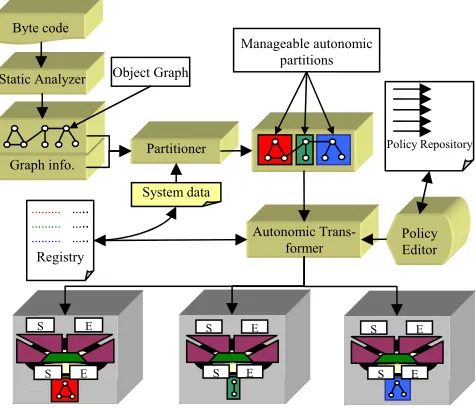
Fig. 1 shows ADE’s overall flow of operation. At first, a code analyzer statically inspects the user supplied byte code to derive an object interaction graph. Based on this graph, the partitioner then generates several partitions (con-sists of a single object or grasps of objects) along with the distribution policies and deploys those partitions to a set of available resources. Deployment decisions are based on several criteria such as the resource (CPU, memory, com-munication bandwidth etc.) requirement of the objects and their interactions, various system information collected via monitoring services such as resource availability, work-load, usage pattern etc. or any user supplied policy.
During deployment, an autonomic transformer injects the distribution and self-management primitives to the partitions according to the system deduced distribution policies and any other user-supplied policies/constraints (e.g. the component C requires some input data that resides
on Machine M, so the component C should execute on Ma-chine M) so that the resultant self-managed partitions can execute on different nodes in a distributed fashion. The underlying system comprises a platform-agnostic language and the associate pre-processor for byte-code to byte-code translation. The transformed program is based on self-contained concurrent objects communicating through any standard communication protocol and incorporates salient features from existing middleware technologies.
B. Autonomic Elements in ADE
In ADE, every distributed site (i.e. PCs, laptops, work-stations, servers etc.) is managed by an Autonomic Element (AE) that control resources and interacts with other AEs in the system. More specifically, each AE encapsulates the program partition allocated to the site managed by the AE as its Managed Element (ME) and interacts with the envi-ronment by using standard autonomic metaphors. Each AE monitors the actual execution of the application and the behavior of the resource itself. AEs also set up a mutual service relationship to interact with each other so that in-formation can be shared among them. Based on the infor-mation, the underlying autonomic system then adjusts the static parameters such as resource consumption, amount of communications to their run time values and if needed dy-namically repartitions the graph. Besides this basic func-tionality, some of the AEs in the system are given some higher level management authority such as managing sys-tem registry or policy depository; acting as the user inter-face for program partitioning and transformation; being the source or destination of program input and output; manag-ing workload etc.
To use the autonomic resources, a potential user must first register her computer with the autonomic system through some user portals. Once registered, an AE is initi-ated on that machine and configures itself properly with all the necessary system data and policy information and con-sequently makes its services available to other AEs. A user may deregister their machine at any time and consequently the AE running on that machine will delegate its current managed element to other available AE without the loss of useful computation. Since the distributed environment is shared by many users, the environment can change at run-time and so does the applications communication pattern, consequently AE need to adapt accordingly. To achieve that, AE provide monitoring services and based on the monitored data automatically takes decisions such as mi-grate the managed element (or portion) to a less busy AE, delays other non dedicated tasks to consume more resource, initiate backup to accommodate more tasks etc.
C. Application Deployment in ADE
ADE supports multiple, logically separated application environments each capable of supporting a distinct applica-tion. As the application components within an application execute with different constraints and requirements, they
Autonomic Trans-former
Policy Editor
S E
S E
S E
S E
S E
S E
Policy Repository
……… …..
……… …..
……… ….. Registry Byte code
Static Analyzer
Graph info.
Partitioner
System data
Figure 1. Overall flow of operation. Object Graph
should be mapped to appropriate hardware resources in the distributed environment so that their constraints are satis-fied and they provide the desired level of performance. Mapping between these resource requirements and the spe-cific resources that are used to host the application is not straightforward.
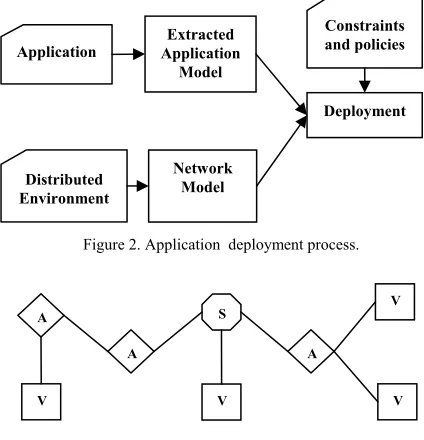
ADE uses a three step process to perform this mapping as shown in Fig. 2. In the first step of mapping, the applica-tion’s code is statically analyzed to extract an application model expressed as lower-level resource requirements such as processing, bandwidth, storage etc. The next step in-volves constructing a model of the underlying network by obtaining knowledge about available resources such as their computational and storage capabilities, workloads etc. and then organizing them according to network proximity (considering latency, bandwidth etc). The third and final step allocates a specific set of resources to each tion with respect to the resources required by the applica-tion components and the resources available in the sys-tem. The goal of the mapping is to maximize the systems overall utility based on certain policies, user-defined con-straints and environmental conditions.
D. An Illustrative Example
Throughout this paper, a simulate-analyze-visualize ap-plication (Fig. 3) is used to illustrate and evaluate the important concepts described in this paper. A large number of scientific and engineering applications can be character-ized by this notion, where information is simulated in a simulator (a high performance server may be required for execution), then passed to some analyzer that analyzes, operates and transforms the data, and eventually delivered to some clients (high end graphics may be necessary) for visualization. This specific application is chosen for
Figure 2. Application deployment process.
Figure 3. Simulate-Analyze-Visualize Application
investigation to realize the concepts of self-management in ADE because it is inherently distributed in nature and closely resembles vast majority of large-scale scientific and engineering applications this research is concerned with.
III. THE APPLICATION MODEL
To be truly autonomic, a computing system needs to know and understand each of its elements. One such ele-ment is the application executing on the autonomic infra-structure; the system needs detailed knowledge of it. In ADE, an application is modeled as a graph consisting of application components and the interactions among them. Analyzing and representing software in terms of its com-ponents and their internal dependencies is important in or-der to provide the self-managing capabilities because this is actually the system’s view of the run-time structure of a program. Well structured graph-based modeling of an ap-plication also makes it easier to incorporate autonomic fea-tures into each of the application components. Moreover, graph theory algorithms can be exploited during deploy-ment of such an application.
To construct such an application graph, two pieces of information must be determined, namely: 1) the resources (i.e. computation time, storage, network etc.) required by each application component and 2) the dependencies (di-rectionality and weight) among the components which is caused by the interactions among them. More formally, it is necessary to construct a node-weighted, edge-weighted directed graph G = (V, E, wg, cg), where each vertex vV represents an application component and the edge (u,v)E resembles the communication from component u to com-ponent v. The computational weight of a vertex v is wg(v) and represents the amount of computation that takes place at component v and the communication weight cg(u,v) cap-tures the amount of communication (volume of data trans-ferred) between vertices u and v. When deployed across a distributed heterogeneous environment, these weights along with various system characteristics, such as the proc-essing speed of a resource and the communication latency between resources, determine the actual computation and communication cost.
IV. THE NETWORK MODEL
In this research, the target environment for the deploy-ment of the application is a distributed environdeploy-ment con-sisting non-dedicated heterogeneous and distributed collec-tion of nodes connected by a network. A resource (node) in this environment could be a single PC, laptop, server or a cluster of workstations. Therefore, each node has different resource characteristics. The communication layer that connects these diverse resources is also heterogeneous con-sidering the network topology, communication latency and bandwidth. This research aims to organize this heterogene-ous pool of resources in a structure such that nodes that are Application
Extracted Application Model
Distributed Environment
Network Model
Deployment Constraints and policies
S
V
V
V A
A A
closer to each other in the structure are also closer to each other considering network distance (latency, bandwidth etc.). Once structured in this way, it is possible to detect higher utility paths that correspond to low latency and high bandwidth between network nodes. The deployment of the application graph then can be performed in a utility-aware way, without having full knowledge about the underlying resources and without calculating the utility between all pairs of network nodes.
To achieve this, a hierarchical model of the computing environment is utilized where the execution begins at the root and each node either executes the tasks assigned to it or propagates them to the next level. More specifically, ADE adopts a tree to model the underlying heterogeneous infrastructure. Each node in the tree is solely responsible for deciding whether to execute the application components allocated to it or propagate them down the hierarchy. Each parent node is capable of calculating the utility of its child based on processor speed, workload, communication delay, bandwidth etc. and selects its best child’s subtree to dele-gate the components to, so that the overall communication is minimized and the delegated component’s resource re-quirement is satisfied.
There are three main advantages of representing the un-derlying layer as a tree network. Each deployment decision can be made locally, which may not be optimal compared to centralized deployment, but certainly is efficient and adaptive. Maintaining a global view of a large-scale dis-tributed environment becomes prohibitively expensive, even impossible at a certain stage, considering the poten-tially large number of nodes and the unpredictability asso-ciated with a large-scale computing system. The tree model adopted in this paper can grow and reconfigure itself to adapt to the dynamically evolving computing environment.
Second, this model relieves ADE from the costly evaluation of the utility function globally by limiting the utility evaluation within a subtree performed by the parent of that subtree. Each parent is capable of monitoring its child and calculating the corresponding utilities, as a result, able to redeploy the assigned subtrees corresponding to the changes in utility of its child. Optimizing certain utility function globally is certainly more attractive, however this does not scale very well when the number of deployed ap-plication and/or number of resources grow within the sys-tem. On the other hand, ADE may not be able to optimize utility or resource allocation, but by reducing the problem of evaluating and maintaining the utility across the whole system to the problem of managing the utility within a sub-tree, ADE promises to provide better adaptability and scal-ability in such a dynamic environment.
Third, the model fits very well with the classes of cations this research is concerned with. For instance, appli-cations with large number of independent tasks basically exhibit master-slave behavior and coincide well with the tree model. Inherently distributed applications, on the other
hand, can be modeled as divide and conquer type applica-tions where components are divided among partiapplica-tions and allocated to the children for execution. Even in the case of applications consisting of a large number of communicat-ing components, there is still a scommunicat-ingle entity that initiates the set of communicating components and allocates them to processors. It is natural to think of the initiator as the root of the tree.
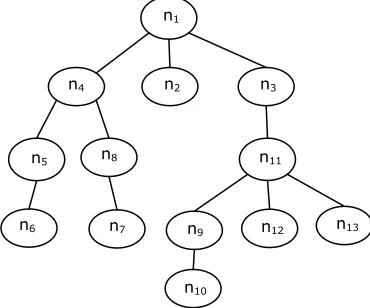
The proposed hierarchical organization is obtained by modeling the target distributed environment as a tree in which the nodes correspond to compute resources, edges correspond to network connections and execution starts at the root. More specifically, a tree structured overlay net-work is used to model the underlying resources, which is built on top of the existing network topology. Such an ar-chitecture was utilized recently in [9,10] to investigate ap-plications with master/worker paradigm. Fig. 4(a) shows an example computing environment where resources are dis-tributed in three domains and Fig. 4(b) illustrates how this environment translates into a tree.
Formally, the entire network is represented as a weighted tree T = (N, L, wt, ct), where N represents the set
n9
n10
n11
n13 n12
n2 n3 n1
Domain 2
Domain 3
Figure 4(a). Sample distributed environment spans at 3 domains.
Figure 4(b). Hierarchical model of the environment.
n4 n5
n6 n8
n7
n1
n2 n3 n4
n5 n8
n6 n7
n11
n9 n12 n13
n10
of computational nodes and L represents network links among them. The weights associated with the nodes and edges represent the corresponding expected computation and communication costs. The computational weight wt(n) indicates the cost associated with each unit of computation at node n. The communication weight ct(m,n) models the cost associated with each unit of communication of the link between node m and n considering both bandwidth and latency. When two nodes are not connected directly, their communication weight is the sum of the link weights on the shortest path between them. Therefore, lar-ger values of node and edge weights translate to slower nodes and slower communication respectively.
V. SELF-CONFIGURATION AND SELF-OPTIMIZATION
This section discusses the application graph deployment process and formulates the utility function that basically drives the initial deployment and further optimization.
A. Utility Function
In a distributed environment, the utility function can be calculated based on many criteria such as application per-formance, resource utilizations, user defined policies, or economic concerns. These issues can be associated with different objective functions of the optimization problem. In this research, the utility function governs both the initial placement of application components and their reconfigura-tions. The goal is to minimize the average application exe-cution time and to provide high utilization of resources ensuring that both application-level (each application may have different importance to the system) and system-level requirements and constraints are satisfied. Toward our goal, the following criteria need to be considered by the utility function:
1. While mapping partitions containing a large number of application components in the tree network, nodes with a higher degree of connectivity should result in a higher utility as a higher degree allows more directions for partition growth.
2. Faster and less busy nodes should be favored over slower and overloaded nodes when assigning compo-nents to resources.
3. Nodes with faster communication links should be pre-ferred over nodes with slower communication links when dealing with communication intensive compo-nents.
4. High priority applications should be preferred during deployment over low priority jobs.
B. Initial Deployment
Once both the application and underlying resources have been modeled, the deployment problem reduces to the mapping of different application components and their in-terconnections to different nodes in the target environment and network links among them so that all requirements and
constraints are satisfied and system’s overall utility is maximized. In ADE, the assumption is that the application can be submitted to any node, which acts as the root or starting point of the application. Also the application may end its execution either at the root node or at one or more clients at different destination nodes. The nodes in the sys-tem are structured into a tree-shaped environment rooted at the source of execution according to the model described in section IV.
Once the application graph G is submitted to the root node of the tree network, the root then decides which ap-plication components to execute itself and which compo-nents to forward to its child’s sub-tree so that the overall mapping results the highest utility. The child, who has been delegated a set of components again deploys them in the same way to its subtrees. For effective delegation of com-ponents at a particular node having |P| children, graph coarsening techniques [11] is exploited to collapse several application components into a single partition, so that |P| or less than |P| partitions are generated at that stage. The coarsened graph is projected back to the original or to a more refined graph once it is delegated to a child.
In the above approach, each parent selects the highest utility child to delegate a particular partition (set of compo-nents). Finding the highest utility child to delegate a parti-tion to means finding the highest utility mapping M of the edges(vj,vk) where vj Vr(represents the set of components that the parent decided to execute itself) and vkVs (repre-sents the set of components that belong to a partition that a parent decided to delegate). More formally, a mapping needs to be produced, which assigns each vkVs to a nqN in a way such that the network node nqis capable of fulfill-ing the requirements and constraints of application node vk and the edge (vj,vk) is mapped to the highest utility link considering all children available at that stage for delega-tion. The utility of an edge (vj,vk)is represented as U(vj,vk), and it is a mathematical function that returns the utility based on different application and system level attributes and considers the factors discussed in Section V.A. Con-sidering all these issues, the utility of an edge (vj,vk), while mapped to the network link (np,nq), where np represents the parent in the tree-shaped network and nqrepresents a potential child for delegation of application node vk, is cal-culated by using the following function:
g j k t p q q t k g kq k
j
n n w v v w f
n w v w f v np
n nc v v U
, ,
,
2
1
u
u u
u
,
increases. In the same way, function f2 should return lower values for increasing communication cost resulting from mapping edge (vj,vk) to link (np,nq).
The terms involved in the above utility function are de-rived to fulfill the requirements (1-3) specified in the previ-ous section. The utility model in this scenario is the "high-est-degree child with the fastest computation capability and fastest communication link is more suitable for utility". To ensure that the partitions with the largest number of com-ponents are delegated to the highest degree child, candidate partitions need to be sorted according to their sizes and then deployed according to that order. In the case of simul-taneous scheduling of multiple applications with different priorities, ADE needs to guarantee that higher priority ap-plications execute before apap-plications with lower priority. To achieve this, applications need to be ordered according to their priorities and then mapped following that order. The overall utility of an application graph G with priority p due to deployment M is then calculated as:
¦
u
E v
vj k j k
v v U p
M G U
) ,
( ( , )
) ,
( .
C. Self-optimization
After initial placement, the environment may change and as a result utility may drop. Therefore it is necessary to monitor the utility and trigger reconfiguration as required. Reconfiguration within a subtree is expected to be a light weight process because of the way the underlying network is modeled. Through the resource monitoring module, each parent node periodically measures the workload at each child node and its bandwidth to that child node and changes computational and communication weights wt and ct ac-cordingly. By employing these new values in the utility function, the parent observes the change in utility due to the changes in the network and computes nodes, and there-fore initiates reconfiguration autonomously. Reconfigura-tion is costly and disruptive, therefore, it is not feasible to initiate reconfiguration unless it is productive. ADE trig-gers reconfiguration whenever the utility drops below a certain threshold (user specified or system generated by comparing the utility during initial deployment).
VI. EXPERIMENTAL EVALUATION
In order to evaluate the approaches described in the previous sections, we set up an experimental environment that simulates the deployment of the example application discussed in section II.D on a networked environment where nodes are organized as a tree. The network is repre-sented as a collection of domains and each of them contains a random number of nodes. Each domain acts like a LAN and contains a single gateway through which communica-tion with other domains is performed. Once created, the domains are populated with a random number of nodes and links are created to connect two randomly-chosen nodes,
provided that adding the link does not create a cycle. Es-sentially, each domain is modeled as a tree whose root is its gateway and each node has a randomly chosen number of children. Each node is assigned a computational weight of the range [3.0, 15.0] and each link is assigned a communi-cation weight in the range [1, 10]. Similarly the vertices and edges of the application graph (Fig. 3) are also popu-lated with random computation and communication weights.
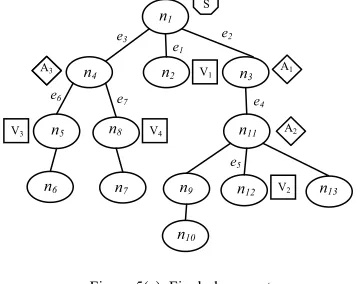
At this stage, we justify the applicability of our decen-tralized utility-driven deployment approach by finding the highest utility mapping of an individual application graph to the underlying network. Fig. 5 shows such a deployment as a result of the highest-utility mapping of the application graph (Fig. 3) to the underlying network (Fig. 4). Fig. 5 also illustrates other implementation aspects such as coars-ening, partitioning etc. The resultant placement of applica-tion components to the network nodes (Fig. 5(c)) validates that it is possible to find the most efficient deployment by applying the utility function derived in this paper locally, between the parent-child pair, and without having the full knowledge of the network and the utility between all pairs of network nodes. As the nodes in the underlying layer are organized in a hierarchy according to network proximity, partitions are allocated to nearer nodes and communication overhead is minimized. By decentralizing the problem of finding the highest utility association among the set of components and the set of nodes, this solution also makes self-management feasible in the case of an infrastructure containing large number of nodes.
VII. RELATEDWORKS
environments and suggest new programming metaphors in order to realize the desired benefits of self-management in a distributed environment. On the contrary, ADE is an exe-cution environment intended for transforming applications written in a centralized fashion to the corresponding dis-tributed version and executing it in a networked environ-ment while offering self-manageenviron-ment at both application and network level.
Unity [15] shares the same goal as ADE and provides a platform designed to help autonomic elements interact with each others and their environment. Unity realizes a number of autonomic system behaviors such as self-organization, self-healing and self-optmization in a distributed environ-ment. However, in Unity resource-level utility functions for multiple application environments are sent to an element called Resource Arbiter, which computes a globally opti-mal allocation of servers across the application. In contrast, by utilizing tree model, ADE is capable of making local
optimization decisions that are lightweight and decentral-ized, and as a result, provides better adaptability and scal-ability in a dynamic environment.
Kinesthetics eXtreme [16], or KX retrofits autonomic capabilities onto legacy systems designed and developed without monitoring and dynamic adaptation in mind. KX is being used to add self-configuration and self-healing func-tionality to several legacy systems, whereas ADE is fo-cused to provide self-configuration and self-optimization. In addition to retrofit autonomic computing, externally, without any need to understand or modify the target sys-tem’s code, ADE also tries to relive the programmer from the distributional concerns by automatically transforming a centralized application to a distributed one and deploying it to the underlying network.
The system proposed in [17] shares similar goal and pre-sents a self-adaptive middleware for distributed stream management that deploys a large number of data flow op-erators across the underlying network to optimize the busi-ness utility. To achieve their goal, they adopt a hierarchical organization of underlying resources clustered according to various system attributes. On the other hand, ADE uses a tree to model the distributed environment.
Several recent works are classified as automatic parti-tioning system [18-21] and have similar goal of distributing an existing centralized application without rewriting the application’s source code or modifying the existing runtime environment. The main difference between these systems and ADE is that ADE’s partitioning and distribution deci-sions are utility driven. Automatic partitioning system only contains knowledge about the internal structure of the ap-plication, not about the environment the application is go-ing to be deployed. ADE, on the other hand, is knowledge-able about both the application and the underlying network and automatically reallocates resources and reconfigures the deployed application graph to maximize the overall utility of the system.
VIII. CONCLUSIONS AND FUTURE WORKS
This paper presents ADE, a self-managed distributed environment where a centralized application is automati-cally decomposed into self-managed components, and dis-tributed across the underlying network to maximize sys-tem’s utility. The approach is to construct an application model for a centralized application, represented as a graph of application components and their interactions and then deploy that graph across the underlying distributed re-sources self-organized as a utility-aware tree. A suitable utility function is derived that controls both initial deploy-ment and reconfiguration ensuring that system’s overall utility is maximized while certain policies and constraints are satisfied. The proposed model is decentralized and adaptive. Preliminary result shows that it is possible to achieve efficient deployment by applying the utility func-tion derived in this paper based solely on locally available
Collapse
n1
n2
n4 n3
n5 n8 n11
n6 n7 n9 n12 n13
n10
e2
e1
e3
e6 e7
e5
Figure 5(a). Application graph collapsed to a coarser level.
Figure 5(b). Graph partitions are allocated to the network nodes.
Figure 5(c). Final placement. n1
n2
n4 n3
n5 n8 n11
n6 n7 n9 n12 n13
n10
e2
e1
e3
e6 e7
e4
e5 A3
V4 V3
e6
e7
A2 e4
e5
V2 A1 S
A1 A3
V1
e1
e2 e3
A2
e5
V2
S
V1
V3 V4
A3 A1
A2
V2
e4 S
A2
A1 A3
V1 V4
V3
e1
e2
e4
e5
e3 e6
e7
V2
S
A1 A3
V1
e1
e2 e3
information and without costly global communication or synchronization.
Currently, ADE is able to configure an individual appli-cation graph to the underlying network at a time while maximizing the utility. In future, we plan to study the be-havior of ADE in the presence of more than one application graph. By deploying applications with different priorities at the same time on the underlying network, we hope to see how the higher utility paths previously available to the low priority application may get assigned to the high-priority application to sustain the overall utility of the system. In future, we also like to conduct experiments to evaluate our self-optimization approach that dynamically reconfigure the application graph based on the changes in the network.
REFERENCES
[1]. J.O. Kephart and D.M. Chess, "The vision of auto-nomic computing", Computer, Vol. 36, No. 1, 2003, pp.41–52.
[2]. W.E. Walsh, G. Tesauro, J.O. Kephart, R. Das, "Util-ity functions in autonomic systems", Proceedings. Of the International Conference on Autonomic Comput-ing (ICAC), May 2004.
[3]. M.M. Fuad and M.J. Oudshoorn, "An Autonomic Architecture for Legacy Systems", Third IEEE Work-shop on Engineering of Autonomic Systems (EASe06), Maryland, USA, April, 2006.
[4]. D. Deb, M.M. Fuad, M.J. Oudshoorn, "Towards Autonomic Distribution of Existing Object Oriented Programs", International Conference on Autonomic and Autonomous Systems (ICAS'06), 2006.
[5]. M.M. Fuad and M.J. Oudshoorn, "Transformation of Existing Programs into Autonomic and Self-healing Entities", The 14th IEEE International Conference on the Engineering of Computer Based Systems (IEEE/ECBS), Arizona, USA, 2007, pp. 133-144. [6]. M. M. Fuad, D. Deb and M. J. Oudshoorn, "An
Auto-nomic Element Design for a Distributed Object Sys-tem", ISCA 20th International Conference on Parallel and Distributed Computing Systems (PDCS 2007), Las Vegus, Nevada, USA, September, 2007, Ac-cepted for publication.
[7]. M. M. Fuad, "An Autonomic Software Architecture for Distributed Applications", Ph. D. thesis, Depart-ment of Computer Science, Montana State University, USA, 2007.
[8]. D. Deb and M. J. Oudshoorn, "On Utility Driven Deployment in a Distributed Environment", Fourth IEEE Workshop on Engineering of Autonomic Sys-tems (EASe 2007), Arizona, USA, 2007.
[9]. O. Beaumont, A. Legrand, Y. Robert, L. Carter, J. Ferrante, "Bandwidth-Centric Allocation of Inde-pendent Tasks on Heterogeneous Platforms", Interna-tional Parallel and Distributed Processing Sympo-sium (IPDPS), 2002.
[10]. B. Kreaseck, L. Carter, H. Casanova, and J. Ferrante, "Autonomous protocols for bandwidth-centric sched-uling of independent-task applications", International Parallel and Distributed Processing Symposium (IPDPS), 2003.
[11]. G. Karypis and V. Kumar, "Multilevel k-way Parti-tioning Scheme for Irregular Graphs", Journal of Par-allel and Distributed Computing, vol. 48, 1998, pp. 86-129.
[12]. H. Liu and M. Parashar, "Accord: A Programming Framework for Autonomic Applications,”, IEEE Transactions on Systems, Man and Cybernetics, Spe-cial Issue on Engineering Autonomic Systems, Edi-tors: R. Sterritt and T. Bapty, IEEE Press, Vol. 36, No 3, pp. 341 – 352, 2006.
[13]. M. Parashar, H. Liu, Z. Li, V. Matossian, C. Schmidt, G. Zhang and S. Hariri, "AutoMate: Enabling Auto-nomic Grid Applications", Cluster Computing: The Journal of Networks, Software Tools, and Applica-tions, Special Issue on Autonomic Computing, Klu-wer Academic Publishers, Vol. 9, No. 1, 2006. [14]. X. Dong, S. Hariri, L. Xue, H. Chen, M. Zhang, S.
Pavuluri, and S. Rao, "AUTONOMIA: An Auto-nomic Computing Environment", Proc. of the 2003 IEEE International Performance, Computing, and Communication Conference, 2003, pp. 61-68.
[15]. D. M. Chess, A. Segal, I. Whalley and S. R. White, "Unity: Experiences with a Prototype Autonomic Computing System", 1st International. Conference. on Autonomic Computing (ICAC), 2004, pp. 140-147. [16]. J. Parekh, G. Kaiser, P. Gross and G. Valetto, "Retro-fitting Autonomic Capabilities onto Legacy Systems." Journal of Cluster Computing, Kluwer Academic Publishers , Vol. 9, No. 2 pp. 141-159, April 2006. [17]. V. Kumar, B. F. Cooper, K. Schwan, "Distributed
Stream Management using Utility-Driven Self-Adaptive Middleware", Second International Confer-ence on Autonomic Computing (ICAC'05), 2005. [18]. M. Tatsubori, T. Sasaki, S. Chiba and K. Itano, "A
Bytecode Translator for Distributed Execution of Legacy Java Software", ECOOP, Hungary, June 2001, pp. 236-255.
[19]. E. Tilevich and Y. Smaragdakis, "J-Orchestra: Auto-matic Java Application Partitioning", ECOOP, Malaga, June 2002.
[20]. R. E. Diaconescu, L. Wang, Z. Mouri and M. Chu, "A Compiler and Runtime Infrastructure for Automatic Program Distribution", IPDPS, 2005.