Rashmi et al. World Journal of Engineering Research and Technology
SEISMIC ANALYSIS OF MULTISTORIED BUILDING WITH AND
WITHOUT VERTICAL MASS IRREGULARITY
Rashmi S. Patil*1, Prof. H. S. Vidyadhar2 and Dr. S. B. Patil3
1
M. Tech Student, Corresponding author, Civil Engineering Department, PDA college of
Engineering, Kalaburagi, India.
2
Professor, Civil Engineering Department, PDA College of Engineering, Kalaburagi, India.
3
Professor, Civil Engineering Department, Dr BATU, Lonere, India.
Article Received on 24/09/2017 Article Revised on 17/10/2017 Article Accepted on 07/11/2017
ABSTRACT
Structures designed for gravity loads, in general, may not be able to
safely sustain the effects of horizontal earthquake shaking. Hence, it is
necessary to ensure adequacy of the structures against horizontal
earthquake effects. In this study, 3D Analytical model of G+15
storeyed buildings have been generated for vertical mass irregularity.
Ten models are generated with difference in vertical mass irregularity
and steel bracings (angle section 127mm× 95mm×12mm) analysed by using analysis tool ‘ETABS Non-linear Version 9.5.0’. The parameters considered in this
paper are fundamental time period, base shear and displacement. The analysis is done with
two different methods namely linear static Method (Equivalent Static Method) and Linear
Dynamic Analysis (Response Spectrum Analysis). In this study, the displacements values are
increasing as the irregular mass shifts towards top. The base shear values are considerably
high in buildings having vertical mass irregularity and as the vertical mass shifts towards top,
base shear decreases.
KEYWORDS: Seismic waves, Vertical Mass irregularity, ETABS, linear Static method, Linear Dynamic method.
wjert, 2017, Vol. 3, Issue 6, 314-319.
World Journal of Engineering Research and Technology
WJERT
www.wjert.org
ISSN 2454-695X Original Article
SJIF Impact Factor: 4.326
*Corresponding Author
Rashmi S. Patil
M. Tech Student,
Corresponding author, Civil
Engineering Department,
PDA college of
Engineering, Kalaburagi,
Rashmi et al. World Journal of Engineering Research and Technology
INTRODUCTION
Irregular buildings constitute a large portion of the modern urban infrastructure. Structures
are never perfectly regular and hence the designers routinely need to evaluate the likely
degree of irregularity and the effect of this irregularity on a structure during an earthquake.
About 90% of all earthquakes result from tectonic events, primarily movements on the faults
(Agrawal and Shrikhande et al., 2006). Structures designed for gravity loads, in general, may
not be able to safely sustain the effects of horizontal earthquake shaking. Hence, it is
necessary to ensure adequacy of the structures against horizontal earthquake effects (C. V. R.
Murty et al., 2002). Need for research is required to get economical and efficient lateral
stiffness system for high seismic prone areas. For optimization and design of high rise
building with different structural framing systems subjected to seismic loads. The innovative
and revolutionary new ETABS is the ultimate integrated software package for the structural
analysis and design of buildings.
LITERATURE REVIEW
The R.C.C and Composite structures with one of the important consideration of Mass
irregularity in the form of swimming pool at 9th floor, analysis is done using SAP 2000
software. The study shows that Composite structures having mass irregularity perform better
than R.C.C. structures. Design base shear values and dead weight are reduced by 18% for
composite structures, hence earthquake forces also reduced by 18% (Cholekar &
Basavalingappa et al., 2015). R.C.C. building of G+10 having mass irregularity in 3rd and 6th
floors and building without mass irregularity is analysed. It was observed that there is an
increase of 67% in the moments of mass irregular buildings than buildings without mass
irregularity (N.Anvesh, Yajdani and Pavan kumar et al., 2015). The seismic performance of
G+6 storey regular and irregular Reinforced Concrete (RC) buildings using ETABS (V.
9.7.1), to evaluate the impact of vertical irregularity on RC buildings in terms of static linear
and nonlinear analysis. Maximum base shear occurs in the mass irregularity building as
compared to other models. (Pathi, Guruprasad, Dharmesh And Madhusudhana et al., 2014).
Building model of G+ 5 storey, the building models are studied for vertical geometric
irregularity in seismic zone V of India. Types of bracings considered for the study are X, V
and K-type steel bracing. Lateral displacement and Storey drift increases as the amount of
irregularity present in the building increases. Addition of bracings to the bare frames shows
reduction in lateral displacement and storey drift (Karthik and Vidyashree et al., 2015).
Rashmi et al. World Journal of Engineering Research and Technology
Frame, Eccentrically Braced Frame, Single Diagonal Braced Frame and X Braced Frame
under same loading conditions is done using ETABS. Use of Chevron braced frame system is
more efficient than any other braced frame system (Odedra and Tarachandani et al., 2016).
MODELLING
The Reinforced Concrete building models used in this study is G+15 storied, have same floor
plan with 5m bays along longitudinal direction and 4.5m bays along transverse direction. The
storey height is 3m for all the stories. The live load taken has 3 KN/m2 for all floors and no
live load on roof, while the floor finish load is taken as 1 kN/m2 on all other floors. Thickness
of brick wall over all floor beams is taken as 0.230 m. Thickness of slab is taken as 0.15 m.
The unit weight of reinforced concrete is 25kN/m3 and brick masonry is taken as 20 kN/m3.
The compressive strength of concrete is 25 N/mm2 and yield strength of steel reinforcements
is 415 N/mm2.The modulus of elasticity of concrete and steel are 25000 N/mm2 and 2×10⁵
N/mm2 respectively. All the structures have been considered to be located in seismic region
V with an importance factor 1 and sub-soil type 2 (medium) and response reduction factor 5
(SMRF). Model 1 is regular frame, model 2 is regular frame with heavy mass on 6th floor,
model 3 is regular frame with heavy mass on 11th floor, model 4 is regular frame with heavy
mass on top storey and model 5 is regular frame with heavy mass on 6th, 11th and top storey.
Models 6th to 10th are same as that of model 1st to 5th respectively with steel bracings. The
model is prepared of G+15 Storey. The regular building model is without mass irregularity as
shown in figure 1. The model 1 regular building is as shown in figure 2. Heavy mass, it is
taken as SIL (Superimposed Load) 20 KN/m2 on 6th floor and on RF (Roof) as shown in
figures 3 and 4 respectively.
RESULTS AND DISCUSSION
Results of the building models studied are presented and discussed in detail. The results of
fundamental natural period of vibration, lateral displacements and storey drifts are included
for building models and compared. The fundamental time period of 10 models are 2.5515,
3.2642, 3.3379, 3.499, 3.7132, 2.4837, 2.6315, 2.7928, 2.9178 and 3.2122 respectively.
The Base shear in X-direction of 10 models are 3656.62 KN, 4959.56 KN, 4722.09 KN,
4612.27 KN, 4965.51 KN, 3603.02 KN, 4023.54 KN, 3761.61 KN, 3598.49KN and
4104.66KN respectively. Base shear in y-direction of 10 models are 3612.7KN, 4408.09 KN,
4217.31 KN, 4136.17 KN, 4443.11 KN, 3264.09 KN, 3571. 44 KN, 3364.09 KN, 3571.44
Rashmi et al. World Journal of Engineering Research and Technology
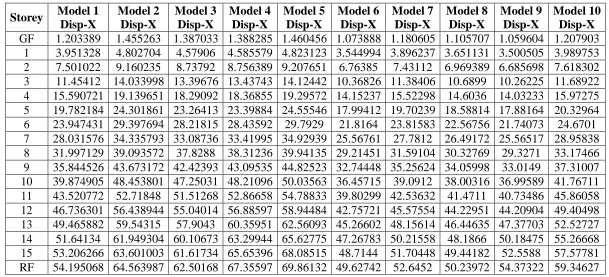
The Storey displacement values in X-direction of Models (Linear static analysis) are tabulated in table 1.
Table 1: The Storey displacement values in X-direction of Models (Linear static analysis).
Storey Model 1 Disp-X
Model 2 Disp-X
Model 3 Disp-X
Model 4 Disp-X
Model 5 Disp-X
Model 6 Disp-X
Model 7 Disp-X
Model 8 Disp-X
Model 9 Disp-X
Model 10 Disp-X
Rashmi et al. World Journal of Engineering Research and Technology
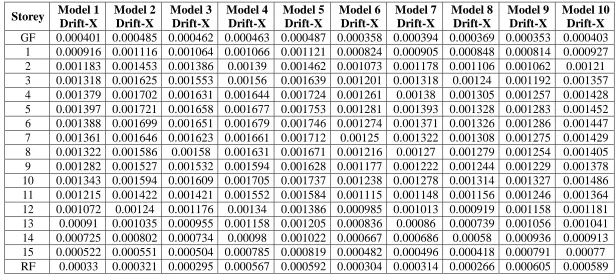
The Storey displacement values in y-direction of Models (Linear static analysis) are tabulated in table 2.
Table 2: The Storey displacement values in y-direction of Models (Linear static analysis).
Storey Model 1 Drift-X
Model 2 Drift-X
Model 3 Drift-X
Model 4 Drift-X
Model 5 Drift-X
Model 6 Drift-X
Model 7 Drift-X
Model 8 Drift-X
Model 9 Drift-X
Model 10 Drift-X
Rashmi et al. World Journal of Engineering Research and Technology
CONCLUSION
More mass means higher inertia force. Therefore, lighter buildings sustain the earthquake
shaking better. The vertical acceleration during ground shaking either adds to or subtracts
from the acceleration due to gravity. Since factors of safety are used in the design of
structures to resist the gravity loads, usually most structures tend to be adequate against
vertical shaking. ETABS is an integrated analysis, design and drafting of buildings systems
tool. ETABS dynamic analysis capabilities include the calculation of vibration modes using
Ritz or Eigen vectors, response-spectrum analysis and time history analysis for both linear
and nonlinear behaviour. According to the results, it is concluded that the fundamental
natural time period of the building increases with the increase in vertical mass irregularity.
The base shear values (i.e. Fx an Fy) are considerably high in buildings having vertical mass
irregularity and as the vertical mass shifts towards top, base shear decreases. Displacement
values of buildings with vertical mass irregularity are more compared to the regular building.
The displacements values are increasing as the irregular mass shifts towards top.
REFERENCES
1. N. Anvesh, Dr. Shaik Yajdani, K. Pavan Kumar, Effect Of Mass Irregularity On Reinforced
Concrete Structure Using Etabs (2015), ISSN(Online): 2319-8753, ISSN (Print) : 2347-6710
International Journal Of Innovative Research In Science, Engineering And Technology (An
ISO 3297: 2007 Certified Organization), October 2015; 4(10): 10091-10096,
DOI:10.15680/IJIRSET.2015.0410055.
2. Karthik. K. M, Vidyashree. D, Effect Of Steel Bracing On Vertically Irregular R.C.C
Building Frames Under Seismic Loads, International Journal Of Research In Engineering
And Technology EISSN: 2319-1163 PISSN: 2321-7308, 2015; 04(06): 90-96.
3. Nuthan L Pathi, Guruprasad T N, Dharmesh N And Madhusudhana Y.B, Static Linear And
Non-Linear (Pushover) Analysis Of Multi Storey Rc Frame With And Without Vertical
Irregularities, International Journal Of Science,Engineering And Technology Research ISSN-2278-7798, 2014.
4. Odedra Chirag R., Deepak Tarachandani, Comparative Study Of Effect Of Structural
Irregularities & Different Types Of Bracings In Multistoried Steel Building, IJSRD -
International Journal For Scientific Research & Development, 2016; 4(03): 2016 | ISSN
(Online): 2321-0613 Pp 547- 552.
5. Prof. Swapnil B. Cholekar, Basavalingappa S. M., Comparative Analysis Of Multistoried Rcc
And Composite Building Due To Mass Irregularity (2015), International Research Journal Of