Volume 40, 2012 35
Advised by Vincentas Lamanauskas, University of Siauliai, Lithuania
received: January 22, 2012 accepted: March 06, 2012
Peter Diedrichs Bachelor of Science, Lecturer, Linnaeus University, SE-391 82 Kalmar, Sweden.
E-mail: [email protected] Website: http://lnu.se/
Berit Willen Lundgren Master of Science, Lecturer, Linnaeus University, SE-391 82 Kalmar, Sweden.
E-mail: [email protected] Website: http://lnu.se/
Peter Karlsudd Associate Professor, Senior Lecturer, Linnaeus University, SE-391 82 Kalmar, Sweden.
E-mail: [email protected]
Website: http://lnu.se/employee/peter.karlsudd?l=en
FaIled INNoVatIoN ImplemeNtatIoN
IN teacher educatIoN: a caSe
aNalySIS
Eva Dobozy
curtin university, perth, australia e-mail: [email protected]
Abstract
The global call for teacher quality improvement and numerous accounts of resistance to education reform at all levels of the education system brings to the forefront the tension between rhetoric and reality. This case study reports on a failed innovation attempt, which was based on the need for a signature pedagogy in Australian teacher education that better prepares beginning teachers for the demands of flexible, student-centred learning design. To assist teacher education students’ development of deep learning engagement, which is a pre-condition for the acquisition of 21st century knowledge, skills and learning attitudes, we need to better understand resistance behaviour. The reported reserach illustrates how the learning-centric teaching design was unable to engage ‘consumer students’ in deep learning experiences due to heightened negative emotion experienced by a great number of students. The provision of this illustrative practical example of innovation failure has the potential to make apparent how students’ ‘out-of-comfort-zone’ behaviour and resistance to change from transmission education practices to social constructivist approaches will need to be managed.
Key words: 21st century learning goals, inquiry-based learning, student resistance.
Introduction
the current global push for 21st century knowledge and skills development is clearly
visible. the restructuring of higher education offerings, irrespective of the discipline area, pertain to a greater focus on creative thinking and problem solving capabilities of graduates (edith cowan university, 2012; university of Glasgow, 2012; university of Western australia, 2012). the move towards a new paradigm in higher education teaching and learning that is focused more on the development of transdiciplinary creative and critical thinking capabilities in students rather than on discipline specific foundational knowledge transmission, demands an all-round different mindset of educators and students. breaking the cycle of traditional knowledge production is, however, not an easy undertaking (adelman, 2009; Kelly, 2008). this global trend in higher education teaching and learning has repercussions for initial teacher training and teacher professional development. teachers and students at all levels of the education system will need to understand the value of the new teaching and learning paradigm and show willingness and ability to perform well within a changed education environment. hence, this case study reports on a failed innovation implementation in an attempt to better understand the obstacles on the road to teacher quality improvement and the development of a signature pedagogy in australian teacher education, which will better align to 21st century learning goals
innovative educational practices that support the development of new capabilities of graduate students (scheurer, loll, niels & mclaren, 2010) and surfacing “stumbling blocks on the road to innovation implementation” (Klein & Knight, 2005, p. 244) need to be analysed and documented. the implementation of learning that promotes the development of general capabilities and deep learning approaches in students is at the centre of the paradigmatic changes (amalathas, 2010). there is consensus that inquiry-based learning (ibl) models arehere is consensus that inquiry-based learning (ibl) models are providing students with opportunities to experience an immersive environment where practices of traditional ‘knowledge transfer’ approaches are becoming less important and instead the co-production of knowledge is valued (murdoch-eaton & Whittle, 2012). in other words: “Whenmurdoch-eaton & Whittle, 2012). in other words: “When. in other words: “When students don’t need to rely on lecturers as the principal sources of subject knowledge, with the ready availability of electronic means of sourcing information becoming ubiquitous, it is inevitable that teaching and learning in universities must change radically” (nygaard, courtney & hotham, 2011, p. ix).
nevertheless, the widespread implementation of ibl in australian teacher education and subsequently in school education has not yet been achieved. so, what are the “obstacles that defeated earlier calls for reform” (calder, 2006, p. 1359) that are in the way of greater uptake of student-centric learning and teaching practices? Why is teacher education unable to embrace, to a greater extent, the opportunities that reform ideas provide? lee shulman (2005) notes: “the first problem that i see in teacher education is the incredible uncertainty of the pedagogical models of practice” (p. 16). this view is echoed by robert slavin (2008), who contends:
the practice of education today is at much the same pre-scientific point as medicine was a hundred years ago. We have much knowledge in education, and educators do occasionally pay attention to it, as physicians did in 1907. … as a result, important decisions about educational programs are likely to be made based on slick marketing, misleading demonstrations, word of mouth, tradition and politics. (slavin, 2008, p. 2).
the tension between traditionalists, arguing for a return to the ‘teaching of basics‘ in a ‘traditional’ didactic manner and the non-traditionalists, insisting on a broader, outcomes-focused and inquiry-based education, is clearly established in australia (donnelly, 2007). Whereas traditionalists insist on teacher-directed and content-focused teaching and learning approaches, providing students with well-structured ‘bite-sized’ tasks (donnelly, 2007), reformists argue that ibl approaches that have a skills-development focus are favourable because they provide students with an opportunity to be active and engaged learners (murdoch-eaton & Whittle,murdoch-eaton & Whittle, 2012). such guiding pedagogical practice provides a need to work in collaboration on real-. such guiding pedagogical practice provides a need to work in collaboration on real-world and complex problems, rich and varied online and print-based resources and encounter opportunities for creative and innovative inquiry, collaboration and debate (errington, 2009; Kuhn, 2007; paul, 2008).
Key Tenets of Sociocultural Theory
of education in the 21st century Volume 40, 2012 37
depending on personal and professional histories, social, cultural and physical factors (Wertsch, 1985).
in the case of the present learning and research context, students who were already in possession of an arts-based or science-based bachelor degree and opted to become primary school teachers, were eligible to enrol in a one-year conversion course. they would receive a Graduate diploma of teaching degree after successful completion of all degree requirements. these learners with transdiciplinary backgrounds and extensive university learning experiences, participated in various social studies specific, collaborative learning activities. as they did so, they engaged in complex relationships with each other and the set tasks, negotiating meaning, but most importantly, they judged the value adding nature of the learning and assessment activities and acted accordingly.
empirical research studies in the field of education are commonly conducted employing a sociocultural perspective, which mostly utilise qualitative research methods (norton, 2009), precisely because the researchers are concerned with documenting and interpreting the primacy of learner variables in the context of pedagogical activities.
Research Methodology
case research is a frequently used qualitative method in education, investigating the implementation success of new methods and learning designs (yin, 2009). seeking an in-depth understanding of the failed implementation of ibl, a case study was conducted of the one particular teacher education unit. all of the data sources for the present study were readily available, such as unit documents and electronic end-of-semester unit evaluations. these data sources complemented each other and the triangulation of the information sources and methods provided a measure of rigor, enhancing validity and reliability of the findings (patton, 1990; yin, 2009). nevertheless, as with all qualitative research designs, this case study was less concerned with representativeness, than with the identification and reporting of emerging topics and themes pertaining to the failed innovation implementation in teacher education, with a view to inform future implementations of ibl models. therefore, the case study may be of wider significance (carlopio, 2009), even if no claim to generalisability can be made.
on the outset of the unit and the call for research participants, the deeply constructivist epistemology and beliefs in the benefits of social constructivist learning approaches was shared with students and tutoring staff. the author and researcher was also the unit coordinator, lecturer, and one of three tutors of the unit. as such, the author had optimal insight into the teaching and learning culture prevalent in the school of education at the university, which is not the author’s current place of employment. the data was analysed using a classic grounded theory approach, following Glaser and holton (2004). classic grounded theory is “a highly structured but eminently flexible methodology ... forming an integrated methodological ‘whole’ that enables the emergence of conceptual theory” (Glaser & holton, 2004, p. 3). to better understand some of ‘the stumbling blocks’ towards the implementation of a signature pedagogy informed by sociocultural theory, it was important to investigate the idiosyncratic ways meaning about the unit was constructed and value was ascribed to ibl pedagogy. hence, this report explores how the graduate diploma teacher education students with different kinds of competencies, goals, attitudes and possibilities to partake in learning and assessment activities, actually constructed and evaluated their learning experiences.
The Case Study Context
familiar and comfortable with traditional university teaching and learning approaches, which are more often than not content-heavy and teacher-centric. this unit presented their first formal encounter with ibl with the specific aim to develop 21st century knowledge and skills, which
are often referred to as generic skills or graduate attributes (murdoch-eaton & Whittle, 2012). in the past, students enrolled in this social studies unit received lectures on the nature and purpose of ibl, which was perceived by the author as an oxymoron and in great need of change.
the purpose of the social studies unit, which formed the context of the case study, was for graduate diploma teacher education students to be inducted into the teaching of history, geography and civics, through inquiry-based learning approaches. the learning design consisted of scenario-based learning and assessment tasks enabling deep engagement with civics and citizenship topics, general societal issues and topic from history and geography. to reflect the ibl approach, the students were presented with a typical learning dilemma, assigned competency-based learning groups and asked to engage in regular face-to-face and online learning conversations. the students were provided with extensive guidance and scaffolding in form of task description. templates, detailed assessment rubrics and worked examples (assignment work completed by previous students with comments). the learning design provided the potential for extensive peer-to-peer collaboration through the use of blackboard, the university’s course management system (cms) and lams (a learning activity management system developed by macquarie university, sydney), which provided an ideal mashup environment for learning. this learning design demanded a new way of working, compelling students to engage deeply with the learning content and each other in an effort to complete the various learning and assignment activities of the unit.
The Case Study Design
students who completed all requirements of the above-mentioned unit were invited to participate in the study. there was no requirement to submit to in-depth interviews or complete questionnaires. instead, students simply had to agree to have their end-of-semester unit evaluations analysed, which were submitted anonymously to a centralised system. the unit obtained university ethics approval for the case study and a total of 135 student responses were analysed.
the student data is presented in narrative form. as outlined above, the analysis is provided from a sociocultural theory perspective and a deep appreciation of constructivist and transformative learning experiences. the role of the analyst in qualitative work involves the balancing of the importance of detailed accounts directly drawing upon the ideas and words of participants, with the need to produce a coherent and logically flowing report. hence, the research data is represented as themed vignettes, synthesising the information provided by different participants into a unique story or vignette. no names are used in the paper. this approach provided protection of participant identities and made possible the reproduction of verbatim comments of actions and emotions of participants.
Results of Research
of education in the 21st century Volume 40, 2012 39
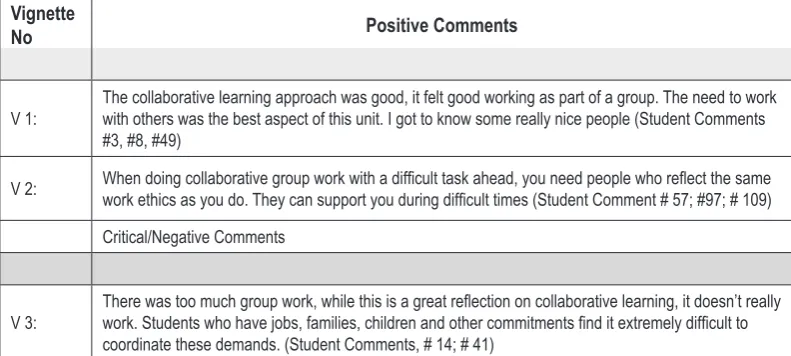
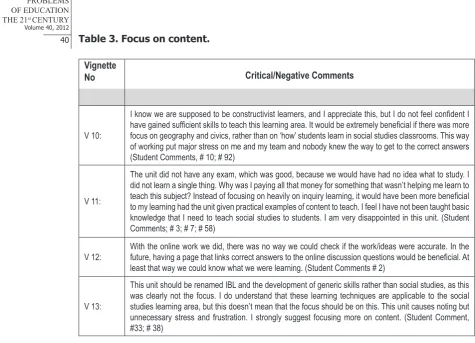
were excluded from this analysis. tables one to three organise the student comments into themes and order them into positive and/or critical or negative comments.
Table 1. Peer-to-peer collaboration and support.
Vignette
No Positive Comments
V 1: The collaborative learning approach was good, it felt good working as part of a group. The need to work with others was the best aspect of this unit. I got to know some really nice people (Student Comments #3, #8, #49)
V 2: When doing collaborative group work with a difficult task ahead, you need people who reflect the same work ethics as you do. They can support you during difficult times (Student Comment # 57; #97; # 109)
Critical/Negative Comments
V 3: There was too much group work, while this is a great reflection on collaborative learning, it doesn’t really work. Students who have jobs, families, children and other commitments find it extremely difficult to coordinate these demands. (Student Comments, # 14; # 41)
Table 2. Constructivist teaching and learning.
Vignette
No Positive Comments
V 4:
The inquiry-based learning and teaching although daunting, was very beneficial for me. It made me think a lot and I’ve learned to work better as part of a team. The content and way of working in this unit really challenged me to understand and comprehend knowledge, because of this, I found that I gained a lot more from this unit than others (Student Comments # 45, # 83, # 91)
V 5: I believe in the inquiry learning process. It is definitely of was of value and I enjoyed the work, putting inquiry learning to the test. (Student Comment # 32; #107)
V 6:
This type of working was interesting, but very time consuming. I didn’t think it would be of value, but thinking about it, I can see how I can use this in my own classroom. Its focus on being able to justify and elaborate on one’s on opinion in a discussion setting was the best thing. I like a challenging assignment. It is good for us, making us talk to each other and problem solve successfully. (Student Comment # 74; #94)
Critical/Negative Comments
V 7:
Inquiry-based learning is a great waste of time. I hate it! Unfortunately, this unit was such a struggle for me in many aspects. I found that there was too much relevant content to learn and not sufficient time to gain an understanding of this. (Student Comments #76, #92,)
V 8: The way inquiry-based learning was taught was confusing and not explained well enough to fully understand what was asked of us. I’m not sure if this was due to the tutorial teacher not fully under -standing the stuff or because they were trying to focus on our critical thinking skills. (#32; #113 )
Vignette
No Critical/Negative Comments
V 10:
I know we are supposed to be constructivist learners, and I appreciate this, but I do not feel confident I have gained sufficient skills to teach this learning area. It would be extremely beneficial if there was more focus on geography and civics, rather than on ‘how’ students learn in social studies classrooms. This way of working put major stress on me and my team and nobody knew the way to get to the correct answers (Student Comments, # 10; # 92)
V 11:
The unit did not have any exam, which was good, because we would have had no idea what to study. I did not learn a single thing. Why was I paying all that money for something that wasn’t helping me learn to teach this subject? Instead of focusing on heavily on inquiry learning, it would have been more beneficial to my learning had the unit given practical examples of content to teach. I feel I have not been taught basic knowledge that I need to teach social studies to students. I am very disappointed in this unit. (Student Comments; # 3; # 7; # 58)
V 12: With the online work we did, there was no way we could check if the work/ideas were accurate. In the future, having a page that links correct answers to the online discussion questions would be beneficial. At least that way we could know what we were learning. (Student Comments # 2)
V 13:
This unit should be renamed IBL and the development of generic skills rather than social studies, as this was clearly not the focus. I do understand that these learning techniques are applicable to the social studies learning area, but this doesn’t mean that the focus should be on this. This unit causes noting but unnecessary stress and frustration. I strongly suggest focusing more on content. (Student Comment, #33; # 38)
in addition to the open-ended questions, students were asked to indicate their dis/ agreement with the following statement on a 5-point likert scale from strongly disagree to strongly agree. to the statement most valued by the university: I am satisfied with this unit (The unit met my expectations in most ways), the 135 study participants were polarised in their responses, with 51% of students indicating that they were dissatisfied with the unit, either disagreeing (18.5%) or strongly disagreeing (32.6%) with the above statement. the rest of the student body (49%) either indicated marginal approval through a ‘neutral’ position (13%), or firm approval, agreeing (27%) or strongly agreeing (9%) with the above statement. more informative to the present study, however, are participant perceptions of the unit’s ability to extend their generic skills. to the statement: The unit improved my generic skills (Generic skills include: teamwork, communication, writing, reasoning, problem-solving etc), only 52.4 % of students indicated some form of agreement with this statement, with 17.2% marginally agreeing, 32.3% agreeing and 3% strongly agreeing. almost half of the students who responded to the evaluation survey (47.5%) disagreed with the above statement, out of which 28% of students strongly disagreed.
Discussion
of education in the 21st century Volume 40, 2012 41
components, as judged by the students through a commonly used quantitative measure, namely the students’ satisfaction rating. the similarity of positive and/or negative response rates to the two statements: I am satisfied with this unit and The unit improved my generic skills, is remarkable. it suggests that students, who were dissatisfied with the unit, because their expectations were not met, were unable to benefit from the ibl approach. it is possible that emotional distress has caused them to ‘disengage’ from the unit processes, unable and/or unwilling to (re-)connect with the unit offerings and peers. not surprisingly, then, the data presented in table 3, exemplifies how much student expectations of a unit are linked to traditional transmission education pedagogies. student comments (Vignettes 10-13) that focus on the explicit teaching of content are highly critical of the pedagogical approach taken in this unit. although the unit provided much content in the form of extended print-based and online resources and 12 formal lectures, what many students expected (and demanded) was a traditional transmission education approach with which they were familiar and most comfortable. this study illustrates that still too many (seasoned) university students are at ease with being passive ‘consumer students’. moreover, it is a clear testimony to the expectations of students, which if not met, often result in ‘disengagement’. clearly, these experienced and mature students struggled with the additional demands that ibl placed on them and the role changes that accompanies the transition from traditional pedagogies to ibl.
the critical end-of-semester unit evaluation to which 51% of respondents indicated that the unit did not met their expectations “in most ways”, exemplifies that the failure of the unit “often reflects not the ineffectiveness of the innovation per se, but the ineffectiveness of the implementation process” (Klein & Knight, 2005). students socialised into a role of ‘information consumption’, delivered conveniently in bite-sized chunks, will not look kindly upon an attempt to change the rules, especially if this change is requiring more effort, new information literacy skills and emotional maturity (dobozy, 2011; murdoch-eaton & Whittle, 2012). Grappling ultimately with implementation success and/or failure of more constructivist pedagogies shows the gap between the idea of the possibilities that new pedagogies offer and the difficulties to change mindsets of university educators and students alike. this problem is compounded by the current rating system, which rewards educators that make the learning journey ‘easy and enjoyable’ rather than construct learning tasks that demand a struggle for meaning, exemplified by student comment # 32 (Vignette 8): “the way inquiry-based learning was taught was confusing and not explained well enough”. as long as students expect to be ‘taught’ and demand that explicit and unambiguous ‘explanations’ are provided so that topics, issues or problems are ‘fully understood’, the implementation of ibl models that support creative thinking and collective problem-solving will not or only marginally succeed. unsurprisingly, shulman (2005) makes the well-documented observation about the emotional reaction of students who are used to traditional ‘safe’, teacher-centric pedagogies that provide bit-size chunks of information that are easily digested and regurgitated on demand, when faced with inquiry-based learning/assignment task design. he notes:
What happens when people who are used to being invisible, to burrowing down when faced with a pedagogical challenge, suddenly or regularly find themselves visible, accountable, and if you will, vulnerable? you (as the teacher) inevitably begin to experience higher levels of emotion in a classroom. there’s a sense of risk. there’s a sense of unpredictability. there’s a sense of – dare i say – anxiety. and for some, anxiety morphs into terror. (shulman, 2005, p. 11).
the reported case study of a failed innovation implementation is motivated by a global and increasingly forceful call for changes to teaching and learning practices at all levels of the education system to better align with 21st century learning goals. the innovation consisted of
the induction of teacher education students to ibl pedagogy, not through lectures, but rather through first-hand experiences with collective knowledge production processes by the way of problem framing, critical and creative problem solving, and regular dialogue and debate. the primary purpose was to contribute actively to the new teaching and learning paradigm, stipulated on numerous university websites and to move away from transmission education approaches in a unit that introduces teacher education students to ibl as a syllabus requirement. this case study provided evidence of the great comfort of university students with the status quo of transmission education. the scepticism regarding the merits of ibl, even in a unit that stipulated an understanding of this pedagogical approach as a learning outcome, highlights the need to invest more time and effort in educating lecturing staff and students in the merits of changed roles, routines and norms as universities struggle to implement new learning and teaching paradigm.
although the global trend in higher education to move towards greater provisions of student-centric learning is cemented in new policy directions and postulated on university websites, the innovation implementation is littered with obstacles. the period in which innovative pedagogical practices are explored in particular contexts, making it “the critical gateway between the decision to adopt the innovation and the routine use of the innovation” (Klein & sorra, 1996, cited in Klein & Knight, 2005, p. 243) is hampered by the need to maximise student satisfaction ratings of units and lecturing staff. this unresolved tension between new accountability measures, such as student ratings of units and lecturers, and the implementation of new and challenging learning provisions, such as ibl, make this endeavour extraordinarily difficult (see dobozy, 2011).
a clear implication of this case study is that learning organisations which socialise students into particular roles (passive consumer students) will need to exhort more effort in disrupting the status quo to make room for experimentation, innovation failure, which give rise to critical evaluations of existing structural and personal obstacles. students’ differing skills levels and learning engagement capabilities will need to be accounted for as newly enrolled undergraduate students will eventually experience an increase in ibl practices.
References
adelman, c. (2009). Excepts from the Bologna Process for U.S. eyes: Re-learning higher education in the age of convergence. Washington, d.c. institute for higher education policy.
amalathas, e. (2010). Learning to learn in future education: A literature review of effective practice in England and abroad. london, uK: campaign for learning.
bruner, J. (1990) Acts of meaning. cambridge, ma: harvard university press.
calder, l. (2006). uncoverage: towards a signature pedagogy for the history survey. Journal of American History, 92 (4), pp. 1358-1370.
carlopio, J. (2009). creating strategy by design. Design Principles and Practices: An International Journal, 3 (5), pp. 155-166.
dewey, J. (1916). Democracy and education: An introduction to the philosophy of education. retrieved 27/5/2010 from: http://www.ilt.columbia.edu/publications/dewey.html
of education in the 21st century Volume 40, 2012 43
donnelly, K. (2007). Dumbing down: Outcomes-based and politically correct – the impact of the culture wars on our schools. prahran, Vic: hardie Grant publishing.
edith cowan university (2012). curriculum 2012 and beyond: enabling the learning journey. retrieved 27/02/2012, from: http://intranet.ecu.edu.au/staff/projects-and-initiatives/curriculum-2012-and-beyond/overview
errington, e. (2009). being there: closing the gap between learners and contextual knowledge using near-world scenarios: The International Journal of Learning, 16 (8), pp. 585-594.
Glaser, b., & holton, J. (2004). remodeling grounded theory. Forum: Qualitative Social Research, 5 (2), article 4. retrieved 15/12/2011 from: http://www.qualitativeresearch.net/fqstexte/2-04/2-04glaser-e.htm
Kelly, e. (2008). Work in the 21st century: changing our mindsets. People & Strategy, 31 (4), pp.
20-24.
Klein, K., & Knight, a. (2005). innovation implementation: overcoming the challenge: Current Directions in Psychological Science, 14 (5), pp. 243-246.
Kuhn, d. (2007). is direct instruction an answer to the right question? Educational Psychology, 42 (2), pp. 109-113.
lave, J., & Wenger, e. (1991). Situated learning: legitimate peripheral participation. cambridge: cambridge university press.
murdoch-eaton, d., & Whittle, s. (2012). Generic skills in medial education: developing the tools for successful lifelong learning. Medical Education, 46 (1), pp. 120-128.
nygaard, c., courtney, n., & holtham, c. (2011) (eds). Beyond transmission – Innovations in university teaching. faringdon, uK: libi publishing
norton, l. (2009). Action research in teaching and learning: A practical guide to conducting pedagogical research in universities. new york, ny: routledge.
patton, m. (1990). Qualitative Evaluation and Research Methods. london, uK: sage.
paul, J. (2008). do european he institutions produce knowledge workers? seminar presentation. university of melbourne. retrieved 27/5/2010 from www.cshe.unimelb.edu.au/downloads/ sem16apr08part2.pdf
rowe, K. (2003). the importance of teacher quality as a key determinant of students‘experiences and outcomes of schooling. australian councile for educational research (acer) research conference. retrieved 09/03/2012 from http://research.acer.edu.au/cgi/viewcontent.cgi?article= 1001&context=research_conference_2003
scheurer, o., loll, f., niels, p., & mclaren, b. (2010). computer-supported argumentation: a review ofcomputer-supported argumentation: a review of the state of the art. International Journal of Computer-Supported Collaborative Learning, 5 (1), pp 43-102.
shulman, l. (2005). the signature pedagogies of the professions of law, medicine, engineering and the clergy: potential lessons for the education of teachers. Keynote delivered at the Math Science Partnership (MSP) Workshop: Teacher education for effective teaching and learning, hosted by the national research council’s centre for education. retrieved 29/10/2010 from: http://hub. mspnet.org/media/data/shulman_signature_pedagogies.pdf?media_000000005488.pdf
slavin, r., & lake, c. (2008). effective programs in elementary mathematics: a best-evidence synthesis. Review of Educational Research, 78 (3), pp. 427-515.
university of Glasgow (2012). enquiry-based learning (ebl): Good practice guide and resources. retrieved 23/02/2012 from: http://www.gla.ac.uk/services/learningteaching/goodpracticeresources/ enquirybasedlearning/enquirybasedlearningeblproject/
university of Western australia (2012). new course structure developed with support from business and industry. retrieved 21/02/2012 from:retrieved 21/02/2012 from: http://www.uwa.edu.au/campaign
Wertsch, J. (1985). Vygotsky and the social formation of the mind. cambridge, m.a.: harvard university press.
yin, r. (2009). Case Study Research: Design and Methods. 4th ed. london, uK: sage.
Advised by Robin Groves, Curtin University, Australia
received: January 25, 2012 25, 2012 accepted: March 09, 201209, 2012, 2012
Eva Dobozy PhD, Senior Lecturer, School of Education, Curtin University, Australia. E-mail: [email protected]