Volume-6 Issue-2
International Journal of Intellectual Advancements
and Research in Engineering Computations
Accessing the Location Based Details
1
Mr. S. Jagadeesan, M.Sc., M.C.A., M.Phil., ME., Assistant Professor/MCA
2
Ms. K. Nandhini, Final MCA
Department of MCA, Nandha Engineering College (Autonomous), Erode-52.
E-Mail ID: [email protected], [email protected]
Abstract—In this paper is solving the severe issues of
current Internet architecture, such as complex usage, poor resource utilization, inefficient mapping, scalability, location dependency, for Named data wireless network. Communication in NDN is based on content names decoupling from their locations. In existing system on-demand protocol called OEFS for NDN-based mobile ad hoc networks is implementing. The OEFS results outperforms other conventional schemes in terms of average content download time, the number of Interest retransmissions, the duplication of Data packets, and the total number of sInterest propagations in the network. In reality, however, some nodes may selfishly decide only to cooperate partially, or not at all, with other nodes. These selfish nodes could then reduce the overall data accessibility in the network. This project examines the impact of selfish nodes in a mobile ad hoc network from the perspective of replica allocation. This is termed as selfish replica allocation. In particular, a selfish node detection algorithm is developed that considers partial selfishness and novel replica allocation techniques to properly cope with selfish replica allocation.
Index Terms— location, selfish node, replica.
I. INTRODUCTION
HISdocumentDelay Tolerant Network (DTN) is an intermittently connected wireless ad-hoc network that allows the communication between the wireless nodes in the state where end to end connectivity can never be achievable or when the delay associated in relaying data could be very high. The DTN is also known as opportunistic networks. The DTN’s are suitable for work in the infrastructure-less environment. It also allows the communication between wireless nodes in the heterogeneous environments as well. The selection of routing protocol in DTN depends on the application environment in which it is to be used. In this study, they describe an attempt to review the existing DTN routing protocols in the literature. Also made a comparison of the existing routing protocols of DTN for the different performance metrics such as number
Of data message generated, message delivery ratio and average delay.
In traditional networks, the routing of packets between a pair of nodes aims to select the optimal path with minimum cost incurred. In these networks an optimal route needs to be established before the actual transmission of message. As in DTN the end to end route can never be achieved so hop byhop, in which the selection of next hop is done dynamically as per the application scenario as well as the algorithm used. In general, when a node receives any bundle (or message then as per the algorithm, that node will search the good relay node to which it can forward the bundle. The transmission of message in DTN can either be done by replicating the message or forwarding it, that depends on the type of algorithm used. In the protocols are categorized into two broad categories as.
•
Flooding Based•
Forwarding BasedII. RELATED WORK
S. Sangeetha and B. Ananthi [1] describe the problem and content searching in mobile disconnected networks has been well studied in previous research articles and the authors discussed many approaches towards the problem of content search in mobile disconnected networks. Still the approaches suffer with the problem of latency and poor searching quality. To overcome the issue of content search in MDN, the author proposes a region based random deployment approach to improve the search quality. The propose method splits the entire network region into different region and maintains Meta data about the content search. Also, the method monitors the query and computes content popularity from the search query. Based on the content popularity, the method analyses the query and the location of the client nodes. Using all these, the method performs random deployment of cache nodes to support content searching in MDN with reduced latency and improved throughput
T
Jivodar B. Tchakarov, Nitin H. Vaidya [2] describe the advances in wireless networking have enabled new paradigms in computing. An abundance of information and services provided by remote servers is expected to become available to wireless users. A fundamental issue in this environment is efficiently locating needed content. Such content may be in the form of files, services, or any other kind of data. In this paper, they describe an algorithm for efficient content location in location-aware ad hoc networks.The Geography-based Content Location Protocol (GCLP) makes use of physical location information to lower proactive traffic while reducing query cost
Cheng-Chang Hoh and Ren-Hung Hwang [3] describe a dynamic nature of MANET causes many challenges in designing robust and scalable P2P system. Although flooding-based techniques are shown to be robust in highly dynamic network, it leads to poor efficiency in terms of bandwidth usage and scalability. In this paper, they propose an efficient and scalable P2P file sharing system based on Swarm Intelligence for MANET, referred to as P2PSI. By applying the behavior of the real ant colonies, P2PSI owns the capability of adaptive learning and is able to cope with mobility problem without flooding
Thomas Repantis and VanaKalogeraki [4] propose adaptive content-driven routing and data dissemination algorithms for intelligently routing search queries in a peer-to-peer network that supports mobile users. In their mechanism nodes build content synopses of their data and adaptively disseminate them to the most appropriate nodes. Based on the content synopses, a routing mechanism is being built to forward the queries to those nodes that have a high probability of providing the desired results. Their simulation results show that their approach is highly scalable and significantly improves resources usage by saving both bandwidth and processing power.
Ying Huang, Yan Gao, KlaraNahrstedt and Wenbo He [5] describe a WiFi-based content distribution community infrastructure (CDCI), file servers are deployed in diverse locations around cities, caching popular files interesting to a community. They serve file download requests from mobile users in proximity via WiFi. In this paper, they study the optimal caching strategy for file servers in CDCI so that file retrieval probability within deadline is maximized, subject to storage constraint of each file server. The optimal caching strategy depends on many factors, such as users’ mobility patterns, access point topology, file popularity, etc. They have formalizedthis content management problem as a mixed integer optimization problem. Because of NP-hardness and a large variable space of this
optimization problem, they propose a heuristic algorithm MobaSsign to allocate file blocks
In addition, reducing traffic on the outgoing link will save bandwidth for other downloads which must go through Internet. Finally, workload at content origins reduces by caching near clients. WiFi-based content distribution community relies on the fact that users within a community share similar interests. If no two users request for the same file, there is no benefit of caching filesat file servers. Fortunately, in a community, it is the usual case that many users are interested in a small set of contents, such as traffic reports and community videos.
III SYSTEM METHODOLOGY
A. Introduction
The strategy existing system does not consists of three parts:
Detecting selfish nodes,
Allocating replica. At a specific period, or relocation period, each node executes the following procedures:
Each node detects the selfish nodes based on credit risk scores.
Each nodemakes its own (partial) topology graph and builds its own SCF-tree by excluding selfish nodes.
Based on SCF-tree, each node allocates replica in a fully distributed manner.
The existing system has following disadvantages.
The existing system is not working on the impact of different mobility patterns.
Does not identify and handle false alarms in selfish replica allocation.
Query delay is not reduced.
B. Replication Model
The proposed system devises novel replica allocation techniques with the developed selfish node detection method. They are based on the concept of a self-centered friendship tree (SCF-tree) and its variation to achieve high data accessibility with low-communication cost in the presence of selfish nodes. The SCF-tree is inspired by our human friendship management in the real world.
Recognizing the selfish replica allocation problem: The existing system views a selfish node in a MANET from the perspective of data replication, and recognizes that selfish replica allocation can lead to degraded data accessibility in a MANET.
Detecting the fully or the partially selfish nodes effectively: It devises a selfish node detection method that can measure the degree of selfishness.
Allocating replica effectively: It proposes a set of replica allocation techniques that uses the self-centered friendship tree to reduce communication cost, while achieving good data accessibility.
Verifying the proposed strategy: The simulation results verify the efficacy of the proposed strategy.
The following advantages are present in the proposed system.
Identifies and handles false alarms in selfish replica allocation.
Peers are classified as high-capability non-selfish peers that handle search or routing, and ordinary peers that act as their clients.
Time threshold is given to treat the node as stable node.
Rating the super peer nodes is possible. This helps to add more capability to that node.
Multimedia content retrieval is efficient and data availability is more.
Most offline peers can be tracked easily.
C. Access Frequency of Nodes
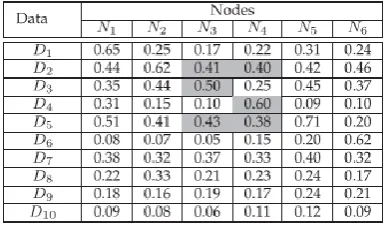
In this module, to find selfish replica allocation, first access frequency of nodes is given as input. The example data is given below.
Table 1: Access Frequency Of Nodes
D. Selfish Replica Allocation
In this module, selfish replication allocation is shown. Fig. 1 illustrates an existing replica allocation scheme, DCG, where nodes N1, N2, ... ,N6 maintain their memory space M1, M2, ... ,M6, respectively, with the access frequency information in Table 1 (In Fig. 1, a straight line denotes a wireless link, a gray rectangle denotes an original data item, and a white rectangle denotes a replica allocated.
Figure 1: Selfish Replica Allocation
In Table 1, the gray colored area shows three data items that are accessed frequently by N3 and N4). As shown in Fig. 1, DCG seeks to minimize the duplication of data items in a group to achieve high data accessibility. Let us consider the case where N3 behaves “selfishly” by maintaining M’3, instead of M3, to prefer the locally frequently accessed data for low query delay. In the original case, D3, D9, and D2 were allocated to N3.
However, due to the selfish behavior, D3, D5, and D2, the top three most locally frequently accessed items, are instead maintained in local storage. Thus, other nodes in the same group, i.e., N1, N2, and N4, are no longer able to access D9. This showcases degraded data accessibility, since N1, N2, and N4 cannot fully leverage N3’s memory space as intended in cooperative replica sharing.
As another example, a node may be only “partially selfish” in a MANET. For instance, node N4 may want to locally hold D2, one of the locally frequently accessed data items. In this case, N4 uses only a part of its storage for its own frequently accessed data, while the remaining part is for the benefit of overall data accessibility. Thus, N4 may decide to maintain M’4, instead of M4. Even with only partial selfishness, data accessibility is still degraded, since the other nodes in the same group, i.e., N1, N2, and N3, cannot access D10.
E. Algorithm: Detect Selfish Nodes
detects selfish nodes based on nCRki. Each node may
have its own initial value of Pkias a system
parameter. Interestingly, the initial value of Pki can
represent the basic attitude toward strangers. For instance, if the initial value equals zero, node Ni
always treats a new node as a nonselfish node. Therefore, Ni can cooperate with strangers easily for cooperative replica sharing. Replicas of data items are allocated by allocation techniques. After replica allocation, Ni sets NDki and SSki accordingly. Recall
that both NDki and SS k
i are estimated values, not accurate ones. The estimated values are adjusted at query processing time, according to Algorithm 2.
Algorithm 1
00: At every relocation period
01: /* Ni detects selfish nodes with this
algorithm */ 02: detection(){
03: for (each connected node Nk ){
04: if (nCRik<Nk is marked as non-selfish;
05: else Nk is marked as selfish;}
06: wait until replica allocation is done; 07: for (each connected node Nk){
08: if (Ni has allocated replica to Nk){
09: NDi k
= the number of allocated replica; 10: SSik = the total size of allocated replica;}
11: else{ 12: NDik = 1;
13: SSi k
= the size of a data item; 14: } } }
F. Algorithm: Update Selfish Features
In this module, the algorithm to update selfish features is executed. In Algorithm 2, Ni maintains its
NDki, SSki, and Pkiduring each query processing
phase. When Ni issues a query, Ni awaits the
response from the expected node Nk during the
predefined wait time w, where w is the expected maximum time taken to exchange one round of request-response message across the entire network. Whenever Ni detects the selfish behavior of Nk, it
modifies Pki, NDki, and SSkiaccordingly.
If Nk serves the query as expected, however, only
Pkiwill be decreased, while
NDkiandSSkiremainunchanged.Note that, in case an
unexpected node Njreplies to Ni’s request, Ni will
modify NDjiandSSjiaccordingly, while not affecting
Pji, P k
i, ND k
i, and SS k
i. That is, the reply from
unexpected nodes does not affect the selfish features of expected nodes. Note also that Ni may receive
multiple replies from unexpected and/or expected nodes. In this case, Ni modifies P
k i, ND
k
i, and/or
SSkiaccordingly for each reply based on Algorithm 2.
If Ni does not receive any reply from expected node
Nk during w, it observes Nk’s selfish behavior
andmodifiesPki,ND k
i, and SS k
iaccordingly.
Algorithm 2
00: At every query processing time 01: /* When Ni issues a query */ 02: update_SF(){
03: while (during the predefined time ){ 04: if (an expected node Nk serves the
query)
05: decrease Pik;
06: if (an unexpected node Nj serves the
query){ 07: NDi
j
=NDi j
+ 1;
08: SSij= SSij+ (the size of a data item);
09: } }
10: if (an expected node Nk does not serve
the query){ 11: increase Pik;
12: NDik= NDik - 1;
13: SSik = SSik - (the size of a data item);
14: } }
G. Flooding Based Method
This module shows the basic structure of the proposed broadcasting format. Each node schedules a broadcast. Clearly, each message is broadcast once at most by a node. A broadcast schedule can be set at any time. For example, a message can be dropped after the first reception but scheduled for broadcast the second time. The node will broadcast the data to maximum number of nodes nearest to it.
H. Advertisement Based Method
1. Super Node And Normal Node Addition
In this module, the node details in the P2P network are added. The node id, computer name and IP address details are saved in ‘Nodes’ table. The super node details in the P2P network are added. The node id is selected from ‘Nodes’ table and are updated as super peer type.
2. Assign Super Node As Parent To Normal Node
In this module, the network is constructed such that ‘n’ number of nodes is interconnected; among which super peer nodes become parent to normal nodes. So the environment resembles the real P2P environment.
3. Update Document Details To Super Nodes
In this module, the node id is selected from ‘Nodes’ table and file is selected, the search phrase (part of the query) to show this file (when the phrase is given as search text) and uploaded in the shared path of that node. The details are saved in ‘Files’ table. In this module, all the nodes update the document/resource list and search phrase one or more super peer nodes to which it is connected.
4. Normal Node Send Query To Super Node
5. Resource Download From Selected Nodes In this module, the node selects the node which is having the required resource and downloads the content.
I. Social Networking Based Method
1. Intracommunity File Searching and Retrieval
Algorithm 1 (Section 4.3.3 A) shows the pseudocode of the intracommunity searching algorithm which describes intracommunity file searching for query Q conducted by node Ni.
2. Intercommunity File Searching and Retrieval
Algorithm 2 (Section 4.3.3 B) shows the pseudocode of the intercommunity searching algorithm.
IV CONCLUSION
The new system eliminates the difficulties in the existing system. It is developed in a user-friendly manner. The aim of the project is to generate data templates with minimum input. The system is very fast and any transaction can be viewed or retaken at any level. Error messages are given at each level of input of individual stages.
This software is very particular in developing web templates. More number of customized templates can be designed. In addition, tags can also be created. Any node with .Net framework installed can execute the application.
The difficulty in distributing the content in the server is eliminated by using this application. It reduces the server bandwidth to consistent amount. The end users need not wait for server in downloading the content since the P2P application gets the content from available clients.
A good documentation of user-friendly features had been incorporated in the system.
The system has been introduced to eliminate human error.
To minimize the time consumption and design & development work.
V SCOPE FOR FUTURE DEVELOPMENT
It is believed that almost all the system objectives that have been planned at the commencement of the software development have been net with and the implementation process of the project is completed. A trial run of the system has
been made and is giving good results the procedures for processing is simple and regular order.
The process of preparing plans had been a new experience, which was found use full in later phases of the project is completed. Efforts had been taken to make the system user friendly and as simple as possible. However at some points some features may have been missed out which might be considered for further modification of the application. The new system become useful if the below enhancements are made in future.
The statistical analysis of download data if prepared, can be used for further development.
The P2P application if developed as web site can be used from anywhere.
The user portal if developed can assist in maintaining download history for end users.
The new system is designed such that those enhancements can be integrated with current modules easily with less integration work
REFERENCES
[1] Y. Huang, Y. Gao, K. Nahrstedt, and W. He, “Optimizing File Retrieval in Delay-Tolerant Content Distribution Community,” Proc. IEEE 29th Int’l Conf. Distributed Computing Systems (ICDCS ’09), 2009.
[2] J. Reich and A. Chaintreau, “The Age of Impatience: Optimal Replication Schemes for Opportunistic Networks,” Proc. Fifth Int’l Conf. Emerging Networking Experiments and Technologies (CoNEXT ’09), 2009.
[3] V. Lenders, M. May, G. Karlsson, and C. Wacha, “Wireless Ad Hoc Podcasting,” ACM SIGMOBILE Mobile Computing and Comm. Rev., vol. 12, pp. 65-67, 2008.
[4] F. Li and J. Wu, “MOPS: Providing Content-Based Service in Disruption-Tolerant Networks,” Proc. IEEE 29th Int’l Conf. Distributed Computing Systems (ICDCS ’09), 2009.
[5] C. Boldrini, M. Conti, and A. Passarella, “ContentPlace: Social-Aware Data Dissemination in Opportunistic Networks,” Proc. 11th Int’l Symp. Modeling, Analysis and Simulation Wireless and Mobile Systems (MSWiM ’08), 2008.
Digest Advances in Wired and Wireless Comm., 2001.
[7] J.B. Tchakarov and N.H. Vaidya, “Efficient Content Location in Wireless Ad Hoc Networks,” Proc. IEEE Int’l Conf. Mobile Data Management (MDM ’04), 2004.
[8] A. Fast, D. Jensen, and B.N. Levine, “Creating Social Networks to Improve Peer-to-Peer Networking,” Proc. 11th ACM SIGKDD Int’l Conf. Knowledge Discovery in Data Mining (KDD ’05), 2005.
[9] A. Iamnitchi, M. Ripeanu, and I.T. Foster, “Small-World File-Sharing Communities,” Proc. IEEE INFOCOM, 2004.
[10] M. Mcpherson, “Birds of a Feather: Homophily in Social Networks,” Ann. Rev. Sociology, vol. 27, no. 1, pp. 415-444 , 2001.
[11] J. Eriksson, H. Balakrishnan, and S. Madden, “Cabernet: vehicular content delivery using wifi,” in MobiCom ’08: Proceedings of the 14th ACM international conference on Mobile computing and networking, 2008.
[12] D. T. J. Kangasharju, K.W. Ross, “Optimizing file availability in peer-to-peer content distribution,” in INFOCOM 2007, 26th
IEEE International Conference on Computer Communications, 2007.
[13] TIER Project,
http://tier.cs.berkeley.edu/wiki/Home.
[14] RSS Advisory Board. RSS 2.0 Specification. http://www.rssboard.org/rss-specification, June 2007.