Feature Selection using Multi-objective Genetic Algorithm: A
Hybrid Approach
JYOTIAHUJA1
SAROJDAHIYARATNOO1
GJUST - Guru Jambheshwar University of Sciecne and Technology DCSE - Department of Computer Science and Engineering
Hisar - Haryana - India - 125001 1
(kwatra.jyoti,ratnoo.saroj)@gmail.com
Abstract.Feature selection is an important pre-processing task for building accurate and comprehensible classification models. Several researchers have applied filter, wrapper or hybrid approaches using genetic algorithms which are good candidates for optimization problems that involve large search spaces like in the case of feature selection. Moreover, feature selection is an inherently multi-objective problem with many competing objectives involving size, predictive power and redundancy of the feature subset under consideration. Hence, Multi-Objective Genetic Algorithms (MOGAs) are a natural choice for this problem. In this paper, we propose a hybrid approach (a wrapper guided by filter approach) for feature selection which employs a MOGA at filter phase and a simple GA at the wrapper phase. The MOGA at filter phase provides a non-dominated set of feature subsets optimized on several criteria as input to the wrapper phase. Now, Genetic Algorithm at wrapper phase does the classifier dependent optimization. We have used support vector machine (SVM) as the classification algorithm in the wrapper phase. The proposed hybrid approach has been validated on ten datasets from UCI Machine learning repository. A comparison is presented in terms of predictive accuracy, feature subset size and running time among the pure filter, pure wrapper, an earlier hybrid approach based on genetic algorithm and the proposed approach.
Keywords:Multi-objective Genetic Algorithm, hybrid, feature selection.
(Received November 28th, 2014 / Accepted May 12th, 2015)
1 Introduction
Feature selection is a process of selecting a subset of original features of a dataset based on certain criteria [13]. It is an important preprocessing task and plays an important role in building more accurate and com-prehensible classifiers, by reducing the dimensionality of large datasets to contain relevant and non-redundant features. The selection of informative features with least redundancy is a challenging problem in domains such as Data Mining, Statistics and Pattern Recogni-tion. Moreover, provided that the feature selection method is reasonably fast, the overall time to build the classifier model is reduced if only the selected
fea-tures are used, rather than the entire set of feafea-tures of a dataset.
Feature selection (FS) is a combinatorial optimiza-tion problem of selecting an optimal set of relevant fea-tures from amongst a large set of feafea-tures. Exhaustive evaluation of all possible feature subsets2N
Jyoti and Saroj Feature Selection using Multi-objective Genetic Algorithm: A Hybrid Approach 27
evolve into an optimal/nearly optimal solution(s) by go-ing through a process of reproduction, recombination and mutation over a large number of generations. Ge-netic algorithms exploit knowledge of the problem do-main to guide the search towards global optimal solu-tions. Several GA based approaches proposed in the literature to solve the feature selection problem have shown promising results as compared to the traditional greedy algorithms developed for this domain [34] [6] [31]. These genetic algorithm based approaches con-verge to a single optimal or nearly optimal feature sub-set. However, often, discovering a single best sub-set of features is not of much interest in itself. In fact, finding several feature subsets reflecting a trade off among several objective criteria can be more ben-eficial. With many optimal feature subsets discovered with respect to multiple criteria, users can exercise a broad choice for good feature subsets according to their preferences. Thus, Multi-objective Genetic Algorithms (MOGAs) are more suitable to deal with the feature se-lection problem because of their ability to yield multiple non-dominated solutions (Pareto optimal solutions).
There are two most common approaches to feature selection, i.e. the filter and wrapper approaches [21]. The filter approaches assign a relevance score to each feature and select the features with high relevance score independent of any bias of classification algorithms. In contrast, the wrapper approaches take accuracy of the classifier as the measure to evaluate a feature subset [1] [11] [19]. The predictive accuracy of a classifier as-sociated with the wrapper approach is mostly greater than the one associated with filter approach. However, the wrapper approaches are computationally expensive. Thus, both the techniques have their own advantages and disadvantages. In order to take benefit of both the methods, we propose a wrapper guided by filter, i.e. a hybrid approach for feature selection in this pa-per. The proposed approach employs the most refer-enced MOGA (Non- dominated Sorting Genetic Algo-rithm (NSGA-II)) [5] in the filter phase to discover di-verse feature subsets optimized on multi-criteria with-out assigning a priority to any of the objectives. Our aim of applying multi-objective optimization is to find diverse feature subsets with small cardinality, high pre-dictive power and least redundancy. At the end of the filter phase, users can use their domain knowledge or experience to select feature subset(s) reflecting the best trade-off between the conflicting objectives to suit their requirements. Subsequently, these subsets become in-put to the population of the wrapper phase genetic al-gorithm for further optimization/customization with re-spect to the classification method used in the wrapper
phase. In this work, support vector machine, a well known classification technique, has been used in the wrapper phase.
The rest of the paper is organized as follows: Sec-tion 2 describes multi-objective optimizaSec-tion and Multi-objective Genetic Algorithm. A brief description of support vector machines is presented in Section 3. Sec-tion 4 contains the review of literature as a context to the work done in this paper. Section 5 details the pro-posed two phased framework for the hybrid approach to feature selection. Section 6 contains the experimen-tal design and a discussion on results. Conclusions and future direction of the work are presented in Section 7.
2 Multi-objective optimization
In a multi-objective optimization problem (MOP), it is hard to find a single solution that is optimal with respect to all the objectives. This requires generating a set of solutions each of which is good enough to satisfy all the objectives to an extent without being dominated by any other solution in the solution space [17]. In reference to a multi-objective minimization problem with respect to k objectives, a feasible solution x is said to domi-nate another feasible solution y(x > y)if and only if fi(x) ≤ fi(y)fori = 1,2...kandfj(x) < fj(y)for
at least one objective function j. A solution is said to be Pareto optimal if it is not dominated by any other solution in the solution space. The set of all possible non-dominated solutions in solution space is referred as the Pareto optimal set and the corresponding objective function values in the objective space are referred to as the Pareto front. The eventual task of multi-objective optimization is to work out solutions in the Pareto opti-mal set.
Multi-objective Genetic Algorithms are specifi-cally suited to solve multi-objective optimization prob-lems and do not require prioritizing the objectives a priori like simple GAs. The most referenced MOGA for the multi-objective optimization is NSGA II, which is an extension of the Non-dominated Sort-ing Genetic Algorithm (NSGA). It outperforms other Multi-objective Evolutionary Algorithms (MOEAs) like Pareto Archived Evolution Strategy(PAES) and Strength Pareto EA(SPEA), in terms of finding a di-verse set of solutions while converging near the Pareto-optimal set [17]. The main features of NSGA II are Non-Domination Ranking Technique and diver-sity preservation using crowding distance. The Non-domination ranking approach explicitly utilizes the con-cept of Pareto dominance in evaluating fitness or assign-ing selection probabilities to solutions. [5] describes the detailed working of NSGA-II.
3 Support Vector Machines
A Support vector machine (SVM) is a machine learn-ing algorithm based on the statistical learnlearn-ing theory [32]to classify the datasets with linear as well as non-linear decision boundary. The purpose of SVM is to search for the maximal marginal hyper-plane (MMH) which classifies all the training tuples corresponding to two classes and find out some essential training tuples, called as support vectors, which fall on the sides of the planes named as margins. SVM finds this hyper-plane by solving the following quadratic optimization problem:
max 2
kwk subject to yi×(w T
xi+b)≥1, i= 1,2, ..., m
(1) where,w=w1, w2, ..., wn, represents a weight vector associated with the attributes; m stands for the number of instances and b signifies a scalar referred to as the ’bias’. The tuples which satisfy Eq. 1 with equal-ity are called support vectors. For non-linearly separa-ble data, it uses a nonlinear mapping to map the data into higher dimensions so that the data can become lin-early separable. This mapping is performed by a kernel functionk(x, y) = Φ(x).Φ(y), which is the dot product of two feature vectors in decision function. Some of the frequently used kernel functions are summed up below.
Linear kernel:x×y (2)
RBF kernel:exp(−g× |x−y|2
) (3)
Sigmoid kernel:tanh(g×xTy+r) (4) P olynomial kernel: (g×xTy+r)d
(5)
In the above equations g is a predefined parameter called as gamma.
4 Related Work
Feature selection has long been a fertile field of research and a vast literature exists on the various techniques of feature selection. A comprehensive survey of existing feature selection techniques and a general framework for their unification can be found in [21]. Feature se-lection algorithms have been reviewed from a statistical learning point of view in [9]. There are two key is-sues in constructing a feature selection method: search strategies and evaluation measures. The feature selec-tion methods has been categorized into two classes-classifier-specific and classifier independent- with re-spect to feature subset evaluation measures. Classi-fier independent (filter) methods use criteria based on statistics such as χ2−
statistics [20], T-statistics [18],
F-statistics [26], Fisher criterion [7], information gain [22], mutual information [9] and entropy-based mea-sures [4]. A well known algorithm that relies on rel-evance evaluation is the Relief algorithm [16]. Some existing evaluation measures that have also been shown to be effective in removing both irrelevant and redun-dant features include the consistency measures sug-gested in [1]. As feature selection involves combina-torial searches through the feature space, a number of GA based filter approaches [8][34][6]and wrapper ap-proaches [28][10][24][15] have been proposed in the literature. GA based approaches have the disadvan-tage that they converge to a single best solution and hence the use of Multi-objective Genetic Algorithms is an obvious choice to discover diverse feature sub-sets based on simultaneous optimization of multiple and often conflicting criteria [17]. Most of the appli-cations of MOGAs have been restricted to wrapper ap-proaches [12] [25] and there have been comparatively less number of applications of MOGAs in filter meth-ods [23][27][30].
Along with sole filter or wrapper approaches, many hybrid approaches have also been promulgated for fea-tures selection to take advantages of filter as well as wrapper approaches. A two phase feature selection method introduced in [35] begins by running a filter ap-proach to remove the irrelevant features and then it runs the wrapper approach to remove redundant or useless features. Filter/wrapper approaches based on informa-tion theory and correlainforma-tion measures in the filter phase have been suggested in [29] and [3]. We have already proposed a two phased genetic algorithm based hybrid approach for feature subset selection [14]. In this work, we employed genetic algorithms in the filter as well as in the wrapper phase. The filter stage ensured the selec-tion of a feature subset consisting of highly predictive but non-redundant attributes whereas the wrapper stage further tuned the subset with respect to the SVM classi-fier used. Because feature subset selection is inherently a multi-objective problem, we have extended our ear-lier work to exploit the strength of MOGAs to discover diverse feature subsets in the filter phase itself.
5 The Proposed Hybrid Approach for Feature Selection
Jyoti and Saroj Feature Selection using Multi-objective Genetic Algorithm: A Hybrid Approach 29
and maximizes the predictive power of the feature sub-sets with respect to the task of classification. A relevant but non-redundant feature subset must contain features that are highly correlated with the class attribute, yet are uncorrelated to each other. Keeping this in mind, we have devised a fitness function that uses correlation be-tween a feature subset and class attribute to optimize the relevance/predictive power of features, intra-correlation among the features to reduce the redundancy and size of the feature subset to enhance the comprehensibility.
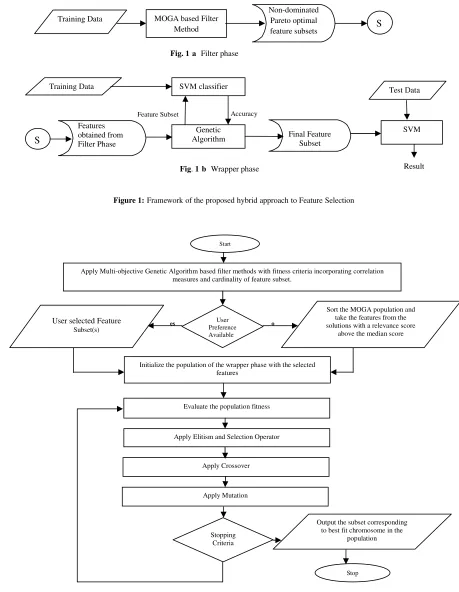
The MOGA based filter phase provides many non-dominated feature subsets varying in size and predictive power. With a number of solutions at hand, a user can exercise a broad choice in selecting feature subset(s) as the input to the wrapper phase for classifier specific tun-ing. As this work does not pertain to a specific appli-cation area and is applied to datasets from diverse do-mains, we have relied on an objective criterion for se-lecting features for the wrapper phase. For this purpose, we have sorted the feature subsets in descending order of first objective (predictive power) and ascending order of second objective (size). The features contained in the subsets whose relevance lye above the second quartile (median) of the relevance score, are passed to the wrap-per phase. The wrapwrap-per phase employs a genetic algo-rithm to further optimize the features with respect to the accuracy of SVM classification. The wrapper phase GA converges very fast because its initial population con-tains highly relevant features and also because the re-dundant and noisy features have already been removed at the filter phase. Fig.1 shows the framework of the proposed hybrid approach.
We expect the following advantages in the proposed hybrid approach:
• The approach is successful in reducing the feature space for the wrapper phase significantly.
• The suggested two phased hybrid method is able to find a subset of highly relevant, non-redundant and well tuned features to the classifier under con-sideration. The accuracy of the classifier trained on such a subset of features is likely to be higher or comparable to the classifier trained with fea-tures discovered solely with filter or wrapper proach. The salient aspect of the envisaged ap-proach is that the filter phase provides a set of non-dominated feature subsets consisting of relevant but non-redundant features. Thereafter, wrapper phase adds only the peculiar and specific features pertinent to the classifier used.
• The filter phase of the proposed hybrid approach provides the user choice from amongst a set of
op-timal solutions. A user is free to exercise his/her preference of feature subsets taking into account the trade-off between the objectives. This may be particularly useful in case the cost of attaining val-ues for different features varies. In such cases the user can select a group of features with lower cost and still get a reasonably acceptable accuracy.
• The running time of the two phased approach is much less as compared to a purely GA based wrap-per algorithm. This is because of faster conver-gence of wrapper phase of hybrid method, which would usually take a longer running time due to the computationally expensive fitness evaluations in successive iterations.
The flowchart describes the proposed algorithm in 2 and the implementation details of genetic algorithms for each phase are given below:
5.1 Chromosome Representation
Each chromosome represents a feature subset. A chro-mosome is represented as a sequence of 0’s and 1’s. The bit value 1 represents the presence of a feature whereas 0 denotes its absence.
In the filter MOGA phase the chromosomes are cre-ated completely randomly while in the wrapper phase the bits corresponding to the pre-discovered features, according to several criteria from the filter phase, are fixed as 1 and others are set as 0.
5.2 Fitness Functions
5.2.1 Fitness Function for filter MOGA Phase:
Since we are considering the optimality of feature sub-set with respect to two objectives, our fitness function comprises of two objective functions. In the filter phase the first objective is to maximize the inter-correlation (i.e. , the overall correlation between feature subset and the class attribute) and minimize intra-correlation (i.e. , mutual correlation among the predicting attributes). Thus the fitness function with respect to the first ob-jective is taken as given in [33]
f1=
RT(S, y)
RI(S) (6)
where RT (S, y) is the overall correlation between the selected feature subset S and the corresponding class y, and is given by:
RT(S, y) = 1 |S|
|S| X
k=1
|corr(x, y)| (7)
Fig. 1(a) Filter phase Training Data MOGA based Filter
Method
Non-dominated Pareto optimal
feature subsets S
Accuracy
Fig. 1(b) Wrapper phase Result
S
Feature Subset
Features obtained from Filter Phase
SVM classifier
Genetic
Algorithm Final Feature Subset
Test Data
SVM Training Data
Figure 1:Framework of the proposed hybrid approach to Feature Selection
Stop
Output the subset corresponding to best fit chromosome in the
population Stopping
Criteria Start
User selected Feature Subset(s)
Sort the MOGA population and take the features from the solutions with a relevance score
above the median score Apply Multi-objective Genetic Algorithm based filter methods with fitness criteria incorporating correlation
measures and cardinality of feature subset.
Initialize the population of the wrapper phase with the selected features
N o Y es User
Preference Available?
Evaluate the population fitness
Apply Elitism and Selection Operator
Apply Crossover
Apply Mutation
Jyoti and Saroj Feature Selection using Multi-objective Genetic Algorithm: A Hybrid Approach 31
Table 1:Contingency table
v1 v2 v3 row sum
y1 n11(e11) n12(e12) n13(e13) R1=P31n1i
y2 n21(e21) n22(e22) n23(e23) R1=P32n2i
Column sum C1=P2j=1nj1 C2=P2j=1nj2 C3=P2j=1nj3 T otalexamples=|E|=P3;2i=1;j=1nij
RI(S) is the overall correlation within the selected fea-ture subset (i.e. , intra-correlation) is defined as:
RI(S) = 1
C(S,2) |S| X
k=1 |S| X
l=k+1
|corr(xk, xl)| (8)
where C(|S|,2) is the number of2−combinations from the selected feature subset S. It is important to men-tion here that the fitness funcmen-tion as such is not re-stricted to nominal attributes but we have applied the chi-squared test of independence for calculating the inter-correlation and intra-correlation of a feature sub-set which is applicable to nominal features only. For computing inter and intra correlations between contin-uous and other types of variables the appropriate statis-tics needs to be used. For example we can use pearson’s coefficient for continuous variables.
To find the chi-squared value between a feature and the class attribute, a contingency table is formed. As-suming a dataset with two classes (y1andy2) and three values (v1,v2andv3) for thekthfeature(xk), the
con-tingency table is shown in 1:
In the above contingency table,nij andeij are the
observed and expected counts of the ith value of the kthfeature in thejth class. The expected counte
ij is
computed as Ci×Rj
|E| . The chi-squared statistics for the kth
feature with respect to class is given by
χ2k= X
i X
j
(nij−eij)2 eij
(9)
corr(xk, y) =critical_valueχ2(df)−χ2k (10)
where, df = (|Y| −1)×(|V| −1) (11)
In the above equations, the critical value for chi-square test is determined from the standard statistical tables for chi-square distribution at a significance level of 0.05, |Y| and |V| are the number of classes present in dataset and number of values of the kth feature
re-spectively. Intra-correlation between any two features (corr(xk, xl))can be computed similarly. The second
objective of the MOGA is to minimize the cardinality of a feature subset as given below:
f2(X) =n− |X| (12)
5.2.2 Fitness Function for the Wrapper Phase:
f3(X) =P redictive Accuracy of SV M (13)
5.3 Genetic Operators
• Selection- Tournament Selection has been used as selection operator in multi-objective genetic algo-rithm used in first phase and Roulette Wheel Se-lection has been used in genetic algorithm used in wrapper phase.
• Crossover- Single Point Crossover has been ap-plied as the crossover operator.
• Mutation- We have used the simple bit flip muta-tion operator.
6 Experimental Design and Results
The proposed approach has been applied for feature selection on eleven benchmark datasets taken from UCI Machine Learning Repository. The methodol-ogy adopted for each dataset consists of the followings steps:
1. Setting Parameters for MOGA and GA used in fil-ter and wrapper phases.
2. Tuning parameters for SVM classifier to obtain best predictive accuracy.
3. Measuring size of feature subsets selected using filter approach, wrapper approach and the pro-posed hybrid approach
4. Measuring predictive accuracy of the classifier us-ing filter approach, wrapper approach and the pro-posed hybrid approach
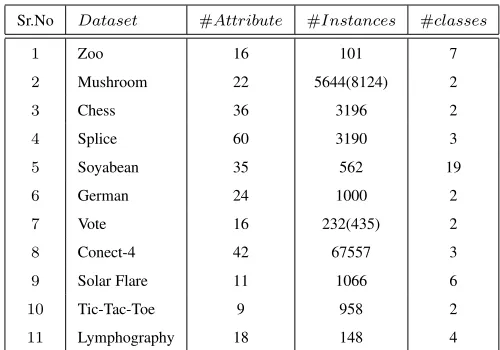
Table 2:Dataset Description
Sr.No Dataset #Attribute #Instances #classes
1 Zoo 16 101 7
2 Mushroom 22 5644(8124) 2
3 Chess 36 3196 2
4 Splice 60 3190 3
5 Soyabean 35 562 19
6 German 24 1000 2
7 Vote 16 232(435) 2
8 Conect-4 42 67557 3
9 Solar Flare 11 1066 6
10 Tic-Tac-Toe 9 958 2
11 Lymphography 18 148 4
6.1 Description of the Datasets
The datasets considered for experimentation are very popular among the data mining researchers. These datasets comprise of diverse number of attributes as well as instances. The size of datasets varies from101 to5644and number of features ranges from9to60. We have also dealt with multi-class classification. Table 2 summarises all the11datasets.
6.2 Parameter setting for MOGA and GA for filter and wrapper phases
Initially some experimentation was done to tune the rameters for filter as well as wrapper phases. The pa-rameter setting is given in Table 3.
In the second phase, the proposed approach calls classifier algorithm, i.e., SVM for each chromosome of the population in each of the iterations. Since fitness evaluations for this phase are computationally expen-sive, we have tuned the population size and number of generations to a minimal size. In addition, convergence is set as the stopping criteria. It is assumed that GA has converged if the best solution does not improve in the last five generations.
6.3 Parameter selection for SVM Classifier
As our focus is on using a hybrid method to select a non-redundant and highly informative set of small num-ber of features, we have neither looked into the affect of different induction algorithms on the resulting fea-ture subset nor have we used any parameter optimiza-tion techniques for SVM model selecoptimiza-tion. We have just compared the different kernel functions associated
Table 3:Genetic Algorithm Parameters
Parameters Filter Phase Wrapper Phase
Population Size 20 20
No. of Generations 400 50
Probability of Crossover 0.8 0.8
Probability of Mutation 0.01 0.01
Table 4:SVM Parameters
Sr.No Dataset Kernel Function Value of C
1 Zoo Linear kernel 10
2 Mushroom Rbf kernel 10
3 Chess Rbf kernel 100
4 Splice Rbf kernel 100
5 Soyabean Rbf kernel 10
6 German Rbf kernel 1
7 Vote Linear kernel 1
8 Conect-4 Rbf kernel 100
9 Solar Flare Rbf kernel 100
10 Tic-Tac-Toe Rbf kernel 1
11 Lymphography Linear kernel 1
Jyoti and Saroj Feature Selection using Multi-objective Genetic Algorithm: A Hybrid Approach 33
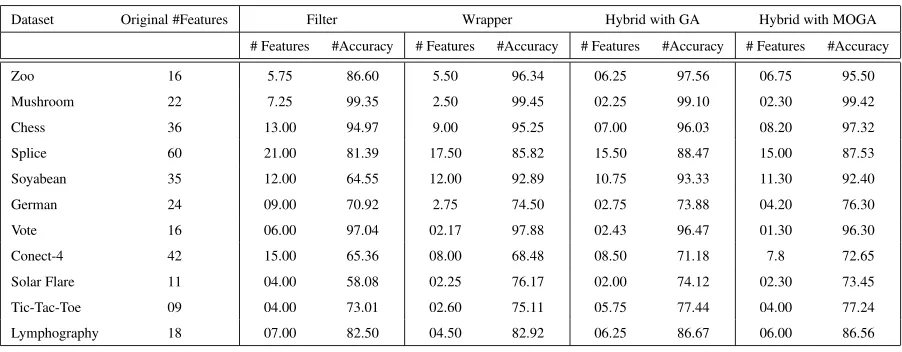
Table 5:Average number of features and classification accuracy of the feature subset resulted from Filter Wrapper and Hybrid Approaches
Dataset Original #Features Filter Wrapper Hybrid with GA Hybrid with MOGA
# Features #Accuracy # Features #Accuracy # Features #Accuracy # Features #Accuracy
Zoo 16 5.75 86.60 5.50 96.34 06.25 97.56 06.75 95.50
Mushroom 22 7.25 99.35 2.50 99.45 02.25 99.10 02.30 99.42
Chess 36 13.00 94.97 9.00 95.25 07.00 96.03 08.20 97.32
Splice 60 21.00 81.39 17.50 85.82 15.50 88.47 15.00 87.53
Soyabean 35 12.00 64.55 12.00 92.89 10.75 93.33 11.30 92.40
German 24 09.00 70.92 2.75 74.50 02.75 73.88 04.20 76.30
Vote 16 06.00 97.04 02.17 97.88 02.43 96.47 01.30 96.30
Conect-4 42 15.00 65.36 08.00 68.48 08.50 71.18 7.8 72.65
Solar Flare 11 04.00 58.08 02.25 76.17 02.00 74.12 02.30 73.45
Tic-Tac-Toe 09 04.00 73.01 02.60 75.11 05.75 77.44 04.00 77.24
Lymphography 18 07.00 82.50 04.50 82.92 06.25 86.67 06.00 86.56
C = { 0.1, 0.5, 1, 10, 20, 30, 40, 50, 60, 70, 80, 90, 100, 200, 300, 400, 500, 1000}
A library for SVM called LIBSVM [2] for running the classifier is used. The SVM parameters for various datasets are shown in Table 4. All experiments are con-ducted on 3rd generation Intel core processor running at 3.30 GHz, 3 GB of RAM and Windows 7 Professional Operating System. We have used the MATLAB R2011a environment for implementing all the algorithms.
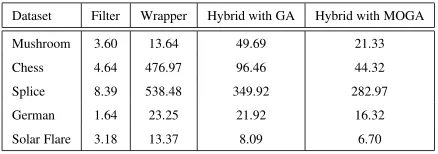
Every dataset is divided into training and test sets and 10 fold cross validation method is used for mea-suring the predictive performance of feature subsets. The results obtained for predictive accuracy and the fea-ture subset size from various non-hybrid and hybrid ap-proaches are given in Table 5. We have also measured the running time for five relatively larger data sets for all the approaches employed as shown in Table 6.
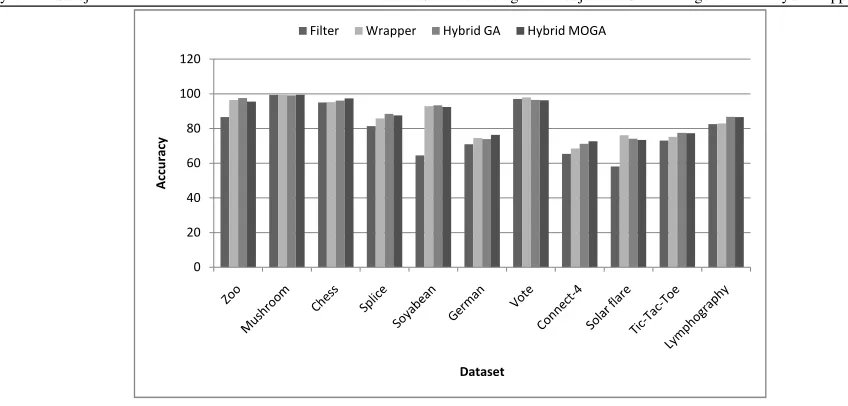
We have applied pairwise Wilcoxon signed rank test at the significance level of 0.05 to compare the per-formance of various approaches for feature selection across several datasets. It is found that wrapper and hybrid approaches are significantly better in terms of predictive accuracies and feature subset size as com-pared to the filter approach. However, the wrapper and hybrid approaches give comparable accuracies and sub-set sizes. Fig. 3 and Fig. 4 show the comparison of all the four approaches. It is obvious that pure fil-ter approach takes the least time and pure wrapper ap-proach takes the highest time across all the data sets. The proposed approach takes significantly less time as compared to the GA based hybrid approach. This is be-cause MOGA at the filter stage is able to provide as-sorted features subsets optimized on multiple criteria and the wrapper phase GA has to do less work
con-verging in lesser number of generations. In order to illustrate the added advantage of using MOGA at fil-ter stage, non-dominated diverse solutions obtained for Chess and Mushroom datasets are shown in Fig. 5 Fur-ther, Table 7 gives some of the Pareto optimal solutions obtained for these datasets in descending order of the first objective (relevance and non-redundancy) and as-cending order of the second objective (feature subset size). The fourth and seventh column of this table gives the predictive accuracies returned by the SVM corre-sponding to each of the feature subsets. The solutions given in the Table 7 are some of the alternate feature subsets that can serve as input to the wrapper phase for classifier specific tuning. The use of MOGA at fil-ter stage provides the opportunity to select the feature subsets to be input to the wrapper phase according to subjective or objective criteria. Here, users can prefer one feature subset over the other based on their domain knowledge. In many applications, the cost of attain-ing different feature values may vary significantly. If these costs are known, the users can opt for cost sensi-tive feature subset selection. In other words users can compromise with accuracy, if required, in order to min-imize the cost of feature subset. For example, if the cost associated with the4thfeature subset is less than that of
the 5th feature subset, a user can choose the4th
solu-tion instead of the5th with somewhat compromise on
accuracy.
7 Conclusion and Future Work
This paper has proposed a novel hybrid approach for feature selection for the task of classification in data mining. The proposed approach worked in two
Jyoti and Saroj Feature Selection using Multi-objective Genetic Algorithm: A Hybrid Approach 34
0 20 40 60 80 100 120
A
c
c
u
rac
y
Dataset
Filter Wrapper Hybrid GA Hybrid MOGA
Figure 3:Variation of Number of Features amongst different approaches
0
5 10 15 20 25
N
u
m
b
e
r
o
f
F
e
at
u
r
e
s
Datasets
Filter Wrapper Hybrid GA Hybrid MOGA
Figure 4:Variation of Predictive Accuracy amongst different approaches
a filter phase and a wrapper phase. A MOGA (NSGA II) was employed in the filter phase to provide a set of diverse non-dominated feature subsets. Subsequently, a GA based wrapper approach was implemented to per-form classifier specific (SVM in this work) optimization by taking the features provided by the filter phase as the input population. The proposed approach was com-pared to pure filter approach, pure wrapper approach and the two phased GA approach suggested earlier in [14]. The proposed approach was found to be compara-ble and competitive with the pure wrapper and the two phased GA based approach and significantly better than
the pure filter approach with respect to predictive accu-racy and the feature subset size. Moreover, the MOGA based hybrid approach took significantly less running time as compared to other approaches except the pure filter approach. In addition, the novel approach pro-vides scope for users to exercise their preferences in feature subset selection at the end of the filter stage.
Jyoti and Saroj Feature Selection using Multi-objective Genetic Algorithm: A Hybrid Approach 35
0 5 10 15 20 25 30 35 40
0 200 400 600 800
f2
f 1
P areto Fron t f or C h ess D ataset
0 5 10 15 20 25
0 1000 2000 3000 4000 5000 6000
f2
f 1
P areto Fron t f or M ush room D ataset
Figure 5:Non-dominated solutions obtained from filter phase of the
Table 7:Non-dominated Solutions in case of Chess Dataset
Chess Dataset Mushroom Dataset
Sr.No f1 f2 Accuracy(%) f1 f2 Accurcy(%)
1 652.78 1 65.05 5277.1 1 98.7
2 556.76 2 76.30 4549.9 2 99.6
3 427.83 4 90.23 3697.2 4 99.6
4 512.98 3 90.23 3267.0 6 100
5 295.94 7 94.06 3057.8 7 100
one of the objectives of the MOGA at the filter stage.
Table 6:Average time taken (in seconds) to run Filter, Wrapper and Proposed Method
Dataset Filter Wrapper Hybrid with GA Hybrid with MOGA
Mushroom 3.60 13.64 49.69 21.33
Chess 4.64 476.97 96.46 44.32
Splice 8.39 538.48 349.92 282.97
German 1.64 23.25 21.92 16.32
Solar Flare 3.18 13.37 8.09 6.70
References
[1] Brönnimann, H., Chen, B., and Manoranjan Dash, P. S., Peter Haas. Efficient data reduction with EASE. InProceedings of the Ninth ACM SIGKDD International Conference on Knowledge Discov-ery and Data Mining, Washington, DC, USA, pages 59–68, 2003.
[2] Chang, Chih-Chung, Lin, and Chih-Jen. LIB-SVM: A library for support vector machines.
ACM Transactions on Intelligent Systems and Technology, 2:1–27, 2011.
[3] Cheng-Huei Yang, C.-H. Y., Li-Yeh Chuang. Ig-ga: a hybrid filter/wrapper method for feature se-lection of microarray data. Journal Medical Bio-logical. Engineering, 30(1):23–28, 2010.
[4] Dash, M. and Liu, H. Handling large unsuper-vised data via dimensionality reduction. InACM Workshop on Research Issues in Data Mining and Knowledge DiscoverySIGMOD, 1999.
[5] Deb, K., Pratap, A., Agarwal, S., and Meyarivan, T. A fast and elitist multiobjective genetic algo-rithm: Nsga-ii. IEEE Transactions on Evolution-ary Computation, 6(2):182–197, Apr. 2002.
[6] ElAlami, M. A filter model for feature subset se-lection based on genetic algorithm. Knowledge-Based Systems, 22(5):356–362, 2009.
[7] Furey, T. S., Cristianini, N., Duffy, N., Bednarski, D. W., Schummer, M., and Haussler, D. Sup-port vector machine classification and validation of cancer tissue samples using microarray expres-sion data. Bioinformatics, 16(10):906–914, 2000.
[8] Goldberg, D. E. Genetic Algorithms in Search, Optimization and Machine Learning. Addison-Wesley Longman Publishing Co., Inc., Boston, MA, USA, 1989.
[9] Guyon, I. and Elisseeff, A. An introduction to variable and feature selection. The Journal of Machine Learning Research, 3:1157–1182, Mar. 2003.
[10] Guyon, I., Weston, J., Barnhill, S., and Vapnik, V. Gene selection for cancer classification using sup-port vector machines. Machine Learning, 46(1-3):389–422, 2002.
[11] Hall, M. A. Correlation-based feature selec-tion for machine learning. InProceedings of the Seventeenth International Conference on Machine Learning, San Francisco, CA, USA, 2000. Mor-gan Kaufmann Publishers Inc.
[12] Hamdani, T. M., Won, J.-M., Alimi, A., and Kar-ray, F. Multi-objective feature selection with nsga ii. In Beliczynski, B., Dzielinski, A., Iwanowski, M., and Ribeiro, B., editors,Adaptive and Natu-ral Computing Algorithms, volume 4431 of Lec-ture Notes in Computer Science, pages 240–247. Springer Berlin Heidelberg, 2007.
[13] Huan Liu, R. S., Hiroshi Motoda and Zhao, Z. Feature selection: An ever evolving frontier in data mining. In4th Workshop on Feature Selec-tion in Data Mining, pages 4–13, Hyderabad, In-dia, 2010.
[14] Jyoti and Saroj. Feature selection using genetic al-gorithm: A hybrid approach. In7th International Conference on Advanced Computing and Com-munication Technologies (ICACCT-2013), pages 101–106, Panipat, India, 2013.
[15] Kabir, M. M., Shahjahan, M., and Murase, K. A new local search based hybrid genetic algo-rithm for feature selection. Neurocomputing, 74(17):2914–2928, 2011.
[16] Kira, K. and Rendell, L. A. The feature selection problem: Traditional methods and a new algo-rithm. InProceedings of the Tenth National Con-ference on Artificial Intelligence, AAAI’92, pages 129–134, 1992.
[17] Konak, A., Coit, D. W., and Smith, A. E. Multi-objective optimization using genetic algorithms: A tutorial.Reliability Engineering System Safety, 91(9):992–1007, 2006.
[18] Liu, H., Li, J., and Wong, L. A comparative study on feature selection and classification meth-ods using gene expression profiles and proteomic patterns. Genome Informatics Series, 13:51–60, 2002.
[19] Liu, H., Motoda, and Hiroshi. Feature selec-tion for knowledge discovery and data mining. Springer, 1998.
[20] Liu, H. and Setiono, R. Chi2: Feature selection and discretization of numeric attributes. InIn Pro-ceedings of the Seventh International Conference on Tools with Artificial Intelligence, pages 388– 391, 1995.
[21] Liu, H. and Yu, L. Toward integrating feature selection algorithms for classification and cluster-ing. IEEE Transactions on Knowledge and Data Engineering,, 17(4):491–502, 2005.
[22] Liu, Y. A comparative study on feature se-lection methods for drug discovery. Journal of Chemical Information and Computing Sciences, 44(5):1823–1828, 2004.
[23] Mukhopadhyay, A., Maulik, U., Bandyopadhyay, S., and Coello, C. A. C. A survey of multiobjec-tive evolutionary algorithms for data mining: Part i. IEEE Transactions on Evolutionary Computa-tion,, 18(1):4–19, 2014.
[24] Oh, I.-S., Lee, J.-S., and Moon, B.-R. Hybrid ge-netic algorithms for feature selection.IEEE Trans-actions on Pattern Analysis and Machine Intelli-gence,, 26(11):1424–1437, 2004.
[25] Pappa, G. L., Freitas, A. A., and Kaestner, C. At-tribute selection with a multi-objective genetic al-gorithm. In Bittencourt, G. and Ramalho, G., ed-itors, Advances in Artificial Intelligence, volume 2507 ofLecture Notes in Computer Science, pages 280–290. Springer Berlin Heidelberg, 2002.
[26] Peng, H., Long, F., and Ding, C. Feature selec-tion based on mutual informaselec-tion: criteria of max-dependency, max-relevance, and min-redundancy.
IEEE Transactions on Pattern Analysis and Ma-chine Intelligence, 27:1226–1238, 2005.
[27] Saroj and Jyoti. Multi-objective genetic algorithm approach to feature subset optimization. InIEEE International Conference on Advance Computing (IACC-2014), pages 544–548, 2014.
Jyoti and Saroj Feature Selection using Multi-objective Genetic Algorithm: A Hybrid Approach 37
[29] Sebban, M. and Nock, R. A hybrid filter/wrapper approach of feature selection using information theory. Pattern Recognition, 35(4):835 – 846, 2002.
[30] Spolaór, N., Lorena, A., and Lee, H. Multi-objective genetic algorithm evaluation in feature selection. In Takahashi, R., Deb, K., Wanner, E., and Greco, S., editors, Evolutionary Multi-Criterion Optimization, volume 6576 of Lec-ture Notes in Computer Science, pages 462–476. Springer Berlin Heidelberg, 2011.
[31] Tan, F., Fu, X., Zhang, Y., and Bourgeois, A. G. A genetic algorithm-based method for feature subset selection.Soft Computing, 12(2), 2007.
[32] Vapnik, V. N.Statistical Learning Theory. Wiley-Interscience, 1998.
[33] Wang, C.-M. and Huang, Y.-F. Evolutionary-based feature selection approaches with new cri-teria for data mining: A case study of credit ap-proval data. Expert System with Applications, 36(3), 2009.
[34] Yang, J. and Honavar, V. Feature subset selection using a genetic algorithm.Intelligent Systems and their Applications, IEEE, 13(2):44–49, 1998.
[35] Yuan, H., Tseng, S.-S., Gangshan, W., and Fuyan, Z. A two-phase feature selection method using both filter and wrapper. In IEEE International Conference on Systems, Man, and Cybernetics, IEEE SMC ’99, volume 2, pages 132–136, 1999.