Review
Tripartite Entanglement: Foundations
and Applications
Márcio M. Cunha1 , Alejandro Fonseca2 and Edilberto O. Silva1,*
1 Departamento de Física, Universidade Federal do Maranhão, São Luís 65085-580, Maranhão, Brazil; [email protected]
2 Departamento de Física, Universidade Federal de Pernambuco, Recife 50670-901, Pernambuco, Brazil; [email protected]
* Correspondence: [email protected] or [email protected]
Received: 29 August 2019; Accepted: 1 October 2019; Published: 9 October 2019
Abstract: We review some current ideas of tripartite entanglement. In particular, we consider the case representing the next level of complexity beyond the simplest (though far from trivial) one, namely the bipartite case. This kind of entanglement plays an essential role in understanding the foundations of quantum mechanics. It also allows for implementing several applications in the fields of quantum information processing and quantum computing. In this paper, we review the fundamental aspects of tripartite entanglement focusing on Greenberger–Horne–Zeilinger and W states for discrete variables. We discuss the possibility of using it as a resource to execute quantum protocols and present some examples in detail.
Keywords: quantum mechanics; quantum entanglement; tripartite entanglement; GHZ states; W states
1. Introduction
Quantum entanglement is one of the most astonishing aspects of quantum mechanics, initially, by virtue of its deep implications in the context of the theory itself and more recently due to the large amount of applications within the emerging fields of quantum information processing [1] and quantum computation1.
The most well-known type of entanglement involves two parts sharing a pair of qubits, the so-called EPR (after Einstein Podolsky Rosen) or Bell states2[3]. Nevertheless, note that two parts may also share an entangled state in larger dimensions, such as qutrits [4] and/or subsystems in continuous variables. Besides the relevance of bipartite entanglement in the understanding of quantum foundations and quantum information science, the search of entangled states involving more than two qubits is also desirable. After all, it may provide useful insights regarding fundamental aspects of the theory itself, offering in this way new possibilities in the development of applications such as protocols in quantum information [5]. Moreover, the usage of genuine multipartite entanglement often displays several advantages in comparison to bipartite entanglement [6]. For instance, it is possible to establish quantum networks with multi-users, execute quantum computation with cluster states [7,8] and perform measurement-based quantum computing [9]. These kinds of entangled states can be used, for instance, as a quantum channel to establish quantum communication between several separated
1 Note that entanglement is not the only nonclassical resource useful for computation, though.
2 It is important to keep in mind thatbipartite entanglementdoes not necessarily imply two spatially separated parts. Instead,
it can be generated between different degrees of freedom in a single part [2].
locations. An introduction to multipartite entanglement can be found in [10]. In [11], a study of maximally multipartite entangled states was carried out. In [12], entanglement in many-body systems is reviewed, including aspects of multipartite entanglement in that scenario. A general review about multipartite entanglement can be found in [13].
The simplest case of multipartite entanglement is tripartite entanglement that involves three-parts. This kind of entanglement play an essential role in the development of aspects such as quantum nonlocality and has a large number of applications in quantum information protocols. In this review, we explore the main features of tripartite entanglement focusing our attention on Greenberger-Horne-Zeilinger (hereafter GHZ) and the so called W states. We discuss the most fundamental aspects and applications.
The paper is organized in the following way: In Section2, we give a brief overview of bipartite entanglement. In Section3, we discuss tripartite entanglement and define the corresponding classes of entanglement for qubits. Then, we review some aspects of quantum nonlocality and tripartite entanglement in Section4. In Section5, we provide several examples of quantum information protocols employing tripartite entanglement. We review the main aspects of these applications, illustrating the corresponding schemes. In Section6, we list several proposals for how to experimentally produce tripartite entanglement in the literature. Then, we devote time to briefly exploring some aspects related to detection and characterization of tripartite entanglement in Section7. In Section8, we consider the topic of remote preparation of quantum states. In Section9, we examine some aspects of tripartite entanglement involving continuous variables. The effects of noisy environments are considered in Section10. Finally, we emphasize the main conclusions in Section11.
2. Overview of Bipartite Entanglement
For the sake of completeness, let us quickly review some important aspects of entanglement between two parts. We start by describing the case of pure states and then we cite some of the most important entangled mixed states.
2.1. Pure States
Due to the Schmidt decomposition, any quantum state shared between two parts, say Alice and Bob as usual, may be written as|ψi =∑dj=−01
q
λj|φAij⊗ |ϕBij =∑d −1 j=0
q
λj|j,ji, with Schmidt
coefficientsλj ∈ R, satisfying∑dj=−01λj = 1 andd= min(dimHA, dimHB), whereHkis the Hilbert
space associated with thek-th part. In particular, it is possible to say that|ψiis entangled whenever there exists more than one nonzero Schmidt coefficient. Furthermore, we can define a basis for the Hilbert space associated with both partsHAB=HA⊗ HB, composed byd2elements given by:
φ
(d) mn
E =
d−1
∑
k=0
βkm|k,k⊕ni, m,n=0, . . . ,d−1, (1)
where the symbol “⊕” denotes a sum modulod, theβkmcoefficients control how entangled the basis is
and satisfy the relation∑d−1
k=0βkmβ∗km0=δmm0. In particular, ford=2, the basis can be parametrized
as [14]:
φ
(2) 00
E
=cosθ|00i+sinθ|11i, φ
(2) 10
E
=sinθ|00i −cosθ|11i,
φ
(2) 01
E
=cosθ|01i+sinθ|10i, φ
(2) 11
E
with 0 ≤ θ ≤ π/2. Moreover, any element of the basis with βkm = ωkd·m/
√
d, corresponds to a maximally entangled state, whereωd=exp(2πi/d)is the primitived-th root of unity. Explicitly, it is
known as the Bell or EPR3basis ford=2 and is written as:
φ±= √1
2(|00i ± |11i),
ψ±= √1
2[|01i ± |10i]. (2)
Hereafter, φ
(d) mn
E
denotes a maximally entangled state, for the sake of simplicity.
An important feature is that any Bell state can be converted into another one by using local unitary transformations and classical communication (hereafter LOCC) only. Moreover, it has been shown that these states can be used to develop several informational tasks such as superdense coding [16] and quantum teleportation [17] with the highest attainable performance [18,19]. They also represent a very useful resource for testing fundamental aspects of the quantum world.
2.2. Some Special Families of Mixed States
Suppose Alice and Bob have a source of entangled qubits prepared in a state ˆρ. Then, Alice applies a unitary operation ˆUchosen at random and informs Bob to carry out either ˆUor ˆU∗4on his qubit. Regardless of the initial state of the system, after many repetitions of the same procedure, the final state shared by Alice and Bob reduces to a Werner or an isotropic state.
2.2.1. Werner States
When Alice and Bob apply local operations ˆU⊗Uˆ, we have [20]:
ˆ ρ→
Z
ˆ
U⊗Uˆ ρˆUˆ†⊗Uˆ†dU= ˆ
ρW, (3)
where dUis the Haar measure of the unitary groupU(d)and ˆρWis the Werner state, given by:
ˆ
ρW = (1−p)
2 d2+dPˆ
(+)+p 2
d2−dPˆ
(−), (4)
with ˆP(±) = 12 ˆ1±Vˆ
, where ˆ1 is the identity: ˆ1 = ∑djk−=10|jkihjk| and ˆV is the flip operator: ˆV =
∑d−1
jk=0|jkihkj|. It is important to mention that the Werner state ˆρWis invariant under ˆU⊗Uˆ operations.
By using the following relations ˆP(+)Pˆ(−)=0, ˆP(±)2=Pˆ(±)and tr ˆP(−)= 12(tr ˆ1−tr ˆV) = 12(d2−d), it is easy to show that the operation-invariantp5is equal top=trPˆ(−)ρˆW
.
2.2.2. Isotropic States
In the case of local operations ˆU⊗Uˆ∗, the state ˆ
ρis transformed as [21]:
ˆ ρ→
Z
ˆ
U⊗Uˆ∗ρˆ Uˆ ⊗Uˆ∗†
dU=ρˆf, (5)
where ˆρf is the isotropic state, given by:
ˆ ρf =
1−f d2−1ˆ1+
f d2−1
d2−1 Pˆ+, (6)
3 EPR, after Einstein’s, Podolsky’s, and Rosen’s seminal paper [15].
4 The symbol “∗” indicates complex conjugation of the associated matrix elements.
5 In the cased=2, in particular,pdenotes the singlet fraction or, in other words, the degree of similarity of the state before ( ˆρ)
and after ( ˆWp) applying twirling operations to the singlet state
φ211, i.e.,p=trφ211φ112ρˆ=trφ112 φ112Wˆp
with ˆP+ =
φ
(d) 00
ED φ00(d)
. Analogously to the Werner state, the isotropic state is invariant under ˆU⊗Uˆ
∗
operations.
By expanding the identity operator in the generalized Bell basis ˆ1 = ∑d−1 µν=0
φ
(d) µν
ED φ(µνd)
, the isotropic state takes the following form:
ˆ ρf = f
φ
(d) 00
ED φ(00d)
+
1− f d2−1
d−1
∑
µν=0 (µ,ν)6=(0,0)
φ
(d) µν
ED φµν(d)
. (7)
In this expression, it is possible to see more clearly that the operation invariant f is equal to: f = tr
φ
(d) 00
ED φ00(d)
ρˆ = tr φ
(d) 00
ED φ(00d)
ρˆf
. Due to their properties, these states have been very useful to unveil the relation between the concepts of entanglement and Bell nonlocality [22,23]. Several proposed generalizations to the multipartite case are presented later in this review.
3. Tripartite Entanglement
3.1. Genuine Tripartite Pure States
When dealing with tripartite quantum systems, it is possible to write the associated state|Ψiin one out of three ways: totally separable|Ψi=|ψAi ⊗ |ψBi ⊗ |ψCi, in terms of biseparable partitions |Ψi=ψj⊗ |ψkli({j,k,l}={A,B,C}) or genuinely entangled, which will be explained in the next
part. In [24], Zhao and collaborators provide a set of methods based on expectation values of Pauli operators to identify the class of a given state. The possible configurations are presented in Figure1.
A
B
C
B
A C
A C B
A C B B A C Genuine Tripartite Biseparable Separable
Figure 1.Possible scenarios of three-qubit quantum states. From top to bottom: First, Genuine tripartite entanglement, where all qubits are in an entangled state. Second, biseparable partitions, where only two qubits are entangled. Third, full separable state.
It is a well-known fact that it is possible to transform any state from the Bell basis into another one by using LOCC only, or to another arbitrary state of two qubits with nonzero probability [25,26]. However, a very interesting feature emerges when we deal with quantum systems involving more than two qubits: different classes of entanglement arise. For the simplest instance, namely three qubits, there are two nonequivalent classes of entanglement: GHZ states [27,28] and W states [29], defined as:
|GHZi= √1
2(|000i+|111i), |Wi= 1
√
These two classes are totally nonequivalent under Stochastic Local Operations and Classical Communication (hereafter SLOCC). It means that it is impossible to convert any state of a given class into one of another class and vice versa. Thus, GHZ and W states constitute genuinely entangled states for the case of three qubits.
The idea of GHZ entanglement by itself has its deep origins in the foundations of quantum theory. In fact, this family of states was proposed to investigate quantum nonlocality beyond Bell’s Theorem [28]. Furthermore, as shown in [30], the premises of the EPR argument about the incompleteness of quantum theory are also inconsistent when applied to GHZ states. As discussed in more detail in the next section, employing GHZ states enabled a demonstration of the incompatibility between the predictions of local realism and quantum mechanics without demanding the usage of an inequality [3].
As in the bipartite case, it is also possible to write a GHZ state with an arbitrary amount of entanglement6. In this case, we start by defining the state:
|ψ000i=cosθ|000i+sinθ|111i, (9)
withθ={0,π/2}. From local operations on|ψ000i, we can construct a GHZ basis. These states are
given by:
ψµλω
=
1
∑
j=0
(−1)µjbµ⊕j|j,j⊕λ,j⊕ωi, (10)
whereb0=cosθeb1=sinθ. They can be written more explicitly as:
|ψ000i=cosθ|000i+sinθ|111i, |ψ001i=cosθ|001i+sinθ|110i, (11)
|ψ010i=cosθ|010i+sinθ|101i, |ψ011i=cosθ|011i+sinθ|100i, (12)
|ψ100i=sinθ|000i −cosθ|111i, |ψ101i=sinθ|001i −cosθ|110i, (13)
|ψ110i=sinθ|010i −cosθ|101i, |ψ111i=sinθ|011i −cosθ|100i. (14)
In the same way, we can also define a more general family of entangled W states, given by [32]:
|W1i=sinθcosϕ|001i+sinθsinϕ|010i+cosθ|100i, (15)
withθ,ϕ∈(0,π/2). The W state in Equation (8) corresponds toϕ=π/4 andθ=cos−1(1/
√
3). By using local unitary operations, we can generate the seven other states of the W basis as:
|W2i= +sinθsinϕ|001i −sinθcosϕ|010i+cosθ|111i, (16)
|W3i=−sinθsinϕ|100i+cosθ|010i+sinθcosϕ|111i, (17)
|W4i= +sinθcosϕ|100i+cosθ|001i+sinθsinϕ|111i, (18)
|W5i= +sinθcosϕ|110i+sinθsinϕ|101i+cosθ|011i, (19)
|W6i= +sinθsinϕ|110i −sinθcosϕ|101i+cosθ|000i, (20)
|W7i=−sinθsinϕ|011i+cosθ|101i+sinθcosϕ|000i, (21)
|W8i= +sinθcosϕ|011i+cosθ|110i+sinθsinϕ|000i. (22)
6 Nevertheless, note that in contrast to the bipartite case, there is no unique way of measuring entanglement in multipartite
The state given by Equation (15) can be converted to the maximally entangled W state (Equation (8)) by the process known as entanglement concentration. In [33], efficient schemes for entanglement concentration of an arbitrary W state into a maximally entangled one are presented. In [34], a protocol for entanglement concentration of W states was proposed by using quantum-dot and optical microcavities. A generalization of the protocol mapping arbitrary N-particle less-entangled W states to maximally entangled W states has also been proposed [35]. For additional examples of entanglement concentration protocols, see [36,37].
Now, let us consider the partial trace operation on the third qubit in|ψ000iand|W1ito examine
the differences between the GHZ and W classes. A simple calculation provides:
ˆ
ρ12=tr3(|ψ000ihψ000|) =
1
2|00ih00|+ 1
2|11ih11|, (23)
for the GHZ state. For the W state, we have:
ˆ
ρ12=tr3(|WihW|) =2
3 φ
(2) 01
ED φ01(2)
+
1
3|00ih00|. (24)
Thus, in the case of a W state, the reduced density operator contains a residual EPR entanglement. In contrast, the same operation on the GHZ state gives a completely disentangled state.
3.2. Other Instances of Tripartite Entanglement
In analogy with the bipartite case, Acín and collaborators, [38], defined a Schmidt-like decomposition useful to classify pure three-qubit states [39]. Subsequently, these results were generalized to include mixed states [40].
In addition to the cases mentioned above, there are several instances of tripartite entanglement. For example, in [41], a procedure to generating a generalization of tripartite GHZ entangled states is presented, using three-level particles instead. In [42], Siewer and Eltschka use the following generalization of the Werner states:
ˆ
$W= p|ψ000ihψ000|+1
8(1−p)ˆ18, (25)
to treat the problem of entanglement quantification.
3.3. Tripartite Entanglement in Other Areas
It is worth noting that there are several works exploring the idea of entanglement and its classification in other fields in Physics and Mathematics. For instance, there are some works discussing the relationship between entanglement and topology. A connection between Borromean rings and GHZ states was established by Aravind in [43]. In [10], a schematic comparison between GHZ and W tripartite states is presented by using knots. There have been efforts to unveil the relation between quantum entanglement and topological entanglement [44,45]. A recent review on this topic can be found in reference [46]. The idea of entanglement in networks has also been explored.
In [47], a strategy for percolation involving GHZ states was presented. In [48], it was verified experimentally that three and four-party entanglement occurs in quantum networks.
In [49], a connection between black-hole physics and quantum entanglement was demonstrated to exist. This finding shows that there is a match between the classification of tripartite entanglement and black holes. A more recent work concerning this topic is given by reference [50].
4. Non-Locality, Bell’s Theorem and GHZ States
Besides the success of quantum theory describing systems in the microscopic world and all the experimental tests in its favor, the foundations of the theory have been widely discussed since its proposal. Albert Einstein, working with Boris Podolski and Nathan Rosen, for instance, questioned whether quantum mechanics could give a complete description of the physical reality. In a paper published in 1935, they established their famous EPR paradox [15]. In their work, EPR conceived an experiment in which Alice and Bob share an ensemble of entangled pairs of qubits, and each of them can perform local measurements. Under this scenario, the measurement events are separated by space-like intervals. At each instant, Alice may choose one out of two incompatible observables
ˆ
A1or ˆA2(analogously for Bob, ˆB1or ˆB2). Assuming that any local action on each particle cannot
influence its counterpart (locality) and that results of the measurement pre-exist for any observable independent of the choice (realism)7, they were able to show that two local measurements (one in Alice’s and the other in Bob’s location) allow for determining the values associated with the four involved observables. This finding holds in special systems with a high degree of symmetry and is in contradiction with Heisenberg’s uncertainty principle. EPR concluded that there is no way in which QM satisfies the assumption of local realism and then there should exist a more general theory possibly described by a set of hidden variables (not available to the experimenter). This situation is in analogy with the relationship between thermodynamics and statistical mechanics, in which the position of particles in the phase space play the role of hidden variables. Inspired by this, Bell derived a set of conditions (Bell inequalities) satisfied by predictions from any theory based on local hidden variables, which, as mentioned before, quantum mechanics violates in certain scenarios [51]. Since then many efforts have been made to experimentally test quantum theory against the hypothesis of local realism, with a vast majority in favor of the first one. An important contribution with regards to these experimental tests was reported in 2014. A loophole-free Bell inequality violation was obtained using electron spins separated by 1.3 kilometers [52]. For a recent revision on the subject, we refer the reader to reference [22].
Now, let us analyze the conflict between local realism and the predictions of quantum mechanics by employing a GHZ state. This analysis was initially proposed by Greenberger, Horne and Zeillinger. Here, we present an alternative version by Mermin [53]. For an intuitive introduction, see also [3,54]. An interesting extension which covers W states is given in [55].
First, recall the following relations valid for a single qubit:
ˆ
σx|0i=|1i, σˆx|1i=|0i, σˆy|0i=i|1i, σˆy|1i=−i|0i. (26)
Consider three parties, Alice, Bob and Charlie, sharing a state|ψ000ias illustrated in Figure2. Let
us calculate(σˆx⊗σˆy⊗σˆy)|ψ000i. It means that Alice, Bob, and Charlie apply ˆσx, ˆσy, and ˆσylocally on
their qubits, respectively. This calculation gives:
ˆ
σx⊗σˆy⊗σˆy|ψ000i= √1
2σˆx⊗σˆy⊗σˆy(|000i+|111i) =−1|ψ000i. (27)
Thus, the GHZ state is an eigenstate of ˆσx⊗σˆy⊗σˆywith eigenvalue−1. By using the notation
employed in [3], we can say that the product:
mxAmBymCy =−1, (28)
wheremAx = ±1 indicates the result of the operation ˆσxon Alice’s qubit, for example. We can also
calculate ˆσy⊗σˆx⊗σˆy|ψ000iand ˆσy⊗σˆy⊗σˆx|ψ000iobtaining the same result,−1. In this way, we can
also write the outcome products as:
myAmBxmCy =−1, mAymBymCx =−1. (29)
The product of the three terms in Equations (28) and (29) gives
mAxmyBmCymyAmBxmCymyAmBymCx =mxAmBxmCx =−1. (30)
Please note that in the latter calculations we used the fact thatmyA
2 =mBy
2
=mCy
2 = +1. Moreover, the calculation of ˆσx⊗σˆx⊗σˆx|ψ000i leads to a quite different result: +1|ψ000i, which
implies that:
mxAmBxmCx = +1. (31)
x y
A
x
y
B
x y C
S
Figure 2.Bell nonlocality in a tripartite scenario. The source S emits three spin-1/2 particles prepared in a GHZ state, traveling to one out of three different detectors located in A, B and C. Each part, namely Alice, Bob and Charlie possess a Stern-Gerlach magnet, and can choose to perform either a ˆσxor a ˆσy measurement, obtaining the eigenvalues+1 or−1, corresponding to turn either green or red lights on.
Thus, there is a contradiction between Equations (30) and (31). It indicates the fundamental impossibility of associating pre-determined outcomes with every local measurement performed on a quantum entangled state. In fact, the so-called GHZ paradox constitutes the first proof of a possible violation of local realism without using an inequality8. Furthermore, it is possible to find generalized
versions of Bell inequalities for the tripartite case. For instance, Mermin, Ardehali, Belinski, and Klyshko (MABK) independently derived a set of inequalities capable of testing violation of local realism for states ofNspin-1/2 particles [57–59]. In addition, Svetlichny made an important contribution to the understanding of genuine tripartite nonlocality [60]. In his work, an inequality that allows for the
8 An alternative interesting proof of the violation local realism without using Bell inequalities is given by the Hardy
detection of genuine nonlocality in scenarios involving three observers, each capable of performing one out of two dichotomic measurements, was presented for the first time. In [61], the notion of tripartite entanglement is discussed in contrast to that of nonlocality in the context of the Svetlichny inequality. See also [62] for a definition of genuine multipartite nonlocality that serves as an alternative to Svetlichny’s original proposal. A more recent discussion on tripartite genuine nonlocality can be found in [63].
Tripartite entangled states have been widely used to test the previsions of quantum theory via Models of Local Hidden Variables. For instance, in [64], an experimental test of quantum nonlocality using GHZ states was reported. An experimental setup to generate GHZ states and to test the Svetlichny inequality was also reported [65]. An experimental verification of violations of Mermin’s inequality by distributing tripartite GHZ states between independent observers was achieved [66], closing locality and freedom-of-choice loopholes for three particles. Experimental investigations of nonlocality dealing with W states have also been considered [67]. In [68], an analysis of nonlocality robustness of GHZ and W states under noisy conditions and weak measurements was made. An experimental demonstration of Mermin’s and Svetlichny’s inequalities for GHZ and W states was discussed in [69]. The violation of Svetlichny inequality in the presence of several kinds of noise for the case of GHZ states was studied in [70]. More recently Chaves, Cavalcanti, and Aolita have found new different expressions of nonlocality on tripartite states by using the formalism of Bayesian networks [71].
Several works have been published focusing on the use of both GHZ and W classes as quantum resources to develop quantum protocols, such as quantum teleportation and superdense coding. In fact, as we will see, both classes work in a different way depending on the specific task.
5. Quantum Information Protocols Using Three-Partite Entanglement
Tripartite entanglement can be widely used to execute tasks in the field of quantum information. In this section, we give examples of applicability of this type of entanglement in some protocols.
5.1. Teleportation of a Single-Qubit State by Using a GHZ Channel and EPR Measurements
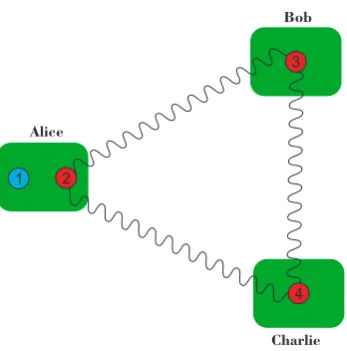
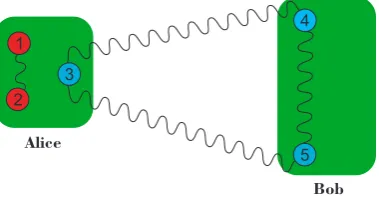
A scheme to perform quantum teleportation of a qubit state by using a GHZ state as the channel was developed in [72]. In this scheme there are three users, namely Alice, Bob, and Charlie, as shown in Figure3. They share a GHZ state. Let Alice possess an additional qubit whose state she wants to teleport,|φi=α0|0i1+α1|1i1. The state of the system is:
|Ψi= (α0|0i+α1|1i)1⊗
1
√
2(|000i+|111i)234. (32)
We can write this state in a more compact form as|Ψi=∑1i=0αi|ii1⊗∑1j=0√12|jjji234. In this case,
Alice makes a Bell-measurement on qubits 1 and 2. Let us separate the qubits in the following way:
|Ψi= √1
2
∑
i,jαi|iji12|jji34. (33)
Let us calculate the projection of|Ψiinto them,nelement of the EPR basis on qubits 1 and 2, D
φmn(2)
12. It holds:
hφmn|12|Ψi=|ηmni34 = 1
2
∑
ijkαi(−1)mkhk,k⊕n|i,ji
12⊗ |j,ji34 = 1
∑
k=0
Figure 3.A possible scheme to perform quantum teleportation of a qubit state by using a three-particle entangled state as the quantum channel.
Thus, the state Charlie and Bob share is one out of the four states of the EPR basis (Equation (1), ford=2) and depends on Alice’s measurement result. It is important to note that the new state shared by Charlie and Bob is not a perfect EPR state because the coefficients of this state areα0andα1. If Alice
obtains the state|ψ00i, for instance, Bob and Charlie share the state:
|η00i34 =
∑
kαk|k,ki=α0|00i+α1|11i. (35)
Table1exhibits the states that can be shared by Bob and Charlie after Alice’s measurement. Let us explore in more detail the case|η00i. As shown in [72], to proceed with the protocol, either Bob or
Charlie should carry out a measurement on a single qubit. Let us suppose that Alice wants to teleport the state of her input qubit to Charlie. Then, she asks Bob to make a measurement on his part by using the following basis:
|0i3=sinϑ|x0i3+cosϑ|x1i3, |1i3=cosϑ|x0i3−sinϑ|x1i3. (36)
Table 1.Results after Alice’s measurement, labeled by the indexes(m,n), and corresponding states shared by Bob and Charlie.
Alice’s Result State Shared by Bob and Charlie
m n state
0 0 |η00i=α0|00i+α1|11i 0 1 |η01i=α0|01i+α1|10i 1 0 |η10i=α0|00i −α1|11i 1 1 |η11i=α0|01i −α1|10i
After carrying out proper substitutions in Equation (35), we have:
|η00i34 =α0(sinϑ|x1i3+cosϑ|x2i3)|0i4+α1(cosϑ|x1i3−sinϑ|x2i3)|0i4. (37)
We can reorganize this expression as:
Thus, if Bob’s measurement outcome is|x1i, then the state of Charlie’s qubit (up to normalization)
is projected onto α0sinϑ|0i4+α1cosϑ|1i4. Table 1 shows all possibilities after subsequent measurements by Alice and Bob.
Let us come back to the general case by definingb0 ≡sinϑandb1 ≡cosϑ. We can then write
Bob’s measurement basis as:
|ki3= 1
∑
j=0
(−1)jkbj⊕k
xj
3. (39)
In this way we have:
|ηmni34=
1
∑
k=0
(−1)mkαk 1
∑
j=0
(−1)jkbj⊕k
xj
3
!
|k⊕ni4. (40)
To obtain the final state of Charlie’s qubit, we can calculate the projection of the above state on
xj
, wherej=0, 1.
χmnj4=xj
3 |ηmni34= 1
∑
k=0
(−1)(m⊕j)kαkbk⊕j|k⊕ni. (41)
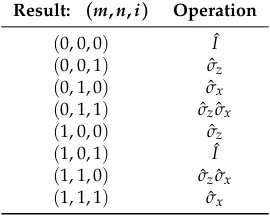
The indexes(m,n,j)are related to the measurement outcomes on Alice and Bob parts. A complete list of the correspondence between outcomes and final states for Charlie is presented in Table2. To recover the desired state, Charlie needs to apply a unitary transformation on his qubit. Which unitary transformation he will choose depends on Alice’s and Bob’s measurement outcomes. Table3shows a list of operations for all results. For instance, for the case(0, 0, 0), the state (up to normalization) is:
|χ000i=α0sinϑ|0i4+α1cosϑ|1i4. (42)
Table 2. Alice’s and Bob’s measurement outcomes and corresponding projected states in Charlie’s location.
Alice’s Result Bob’s Result Charlie’s Unnormalized State
m n |xii State
0 0 |x0i α0sinϑ|0i+α1cosϑ|1i
0 0 |x1i α0cosϑ|0i −α1sinϑ|1i
0 1 |x0i α0sinϑ|1i+α1cosϑ|0i
0 1 |x1i α0cosϑ|1i −α1sinϑ|0i
1 0 |x0i α0sinϑ|0i −α1cosϑ|1i
1 0 |x1i α0cosϑ|0i+α1sinϑ|1i
1 1 |x0i α0sinϑ|1i −α1cosϑ|0i
1 1 |x1i α0cosϑ|1i+α1sinϑ|0i
In this case, the required operation is the identity. The normalized state reads:
|ζ000if =
α0sinϑ|0i4+α1cosϑ|1i4 q
|α0|2sin2ϑ+|α1|2cos2ϑ
. (43)
Let us see what happens when the result is(0, 0, 1). In this case, the state, up to normalization, is:
now, Charlie must apply the ˆσzoperation on his qubit to recover the desired state. After normalization,
we have:
|ζ001if =
α0cosϑ|0i4+α1sinϑ|1i4 q
|α0|2cos2ϑ+|α1|2sin2ϑ
. (45)
Explicitly, the unitary transformation is given by:
ˆ
U= (σˆz)m⊕j(σˆx)n. (46)
Thus, the final state is: ˆ
Uχmnj=
ζmnj=
∑
kαkbk⊕j|ki. (47)
Then, Charlie’s qubit holds in the same state as the initial one wheneverθ = π/4, i.e., Bob’s measurement is carried out in the|±ibasis. Another work dealing with GHZ states as the quantum channel can be found in [73].
Table 3.Alice’s and Bob’s results; and the corresponding operations needed to recover the desired state.
Result: (m,n,i) Operation
(0, 0, 0) Iˆ (0, 0, 1) σˆz
(0, 1, 0) σˆx
(0, 1, 1) σˆzσˆx
(1, 0, 0) σˆz
(1, 0, 1) Iˆ
(1, 1, 0) σˆzσˆx
(1, 1, 1) σˆx
5.2. Teleportation of a Single-Qubit State: GHZ Channel and Measurement
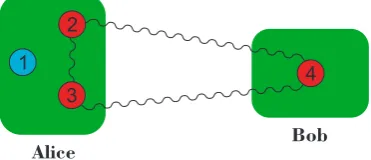
Another possibility of using GHZ states in quantum teleportation is by employing a GHZ channel and making a GHZ measurement on Alice’s side. An example of a protocol dealing with GHZ measurements can be viewed in [74]. Let us suppose that now Alice wants to teleport a single qubit and shares a GHZ entangled state with Bob. We want to consider the situation that Alice shares two qubits of the shared GHZ state and that Bob has another one. Thus, now Alice has three qubits and Bob has one. To diversify the mathematical approach used here, we intend to write the states by using the formalism of the density matrix. This problem has been discussed in [75] where a maximally balanced state as the channel and measurements was considered. This procedure was shown to help to improve the quality of the protocol under the occurrence of bit-flip errors. Here, let us consider non-maximally entangled GHZ states. It is interesting to take into account such states, because we can study how the quality of the entanglement affects the final results. The effect of dealing with non-maximally GHZ entangled states can also be examined in other scenarios. In [76], for instance, the problem of sharing a multiqubit state by employing non-maximally GHZ entangled states is addressed.
Consider the scheme of Figure4. Alice wants to teleport the state of qubit 1:
|φi1=α0|0i1+α1|1i1= 1
∑
i=0
αi|ii1. (48)
The corresponding density operator is given by:
ˆ ρ1=
∑
ij
The channel is a GHZ-type state of the qubits 2, 3, 4, expressed in the form|ψ001i= β0|000i+
β1|111i, whereβ0=cosθandβ1=sinθ. We can write this state as|ψ001ighz=∑1k=0βk|kkki.
Figure 4.Scheme to teleport a single-qubit state by using a GHZ state as the quantum channel. A GHZ measurement is carried out on qubits 1, 2, 3.
The corresponding density operator of the whole system is:
ˆ
ρ234=
∑
k`βkβ`|kkki h```|. (50)
The state of the whole system reads:
ˆ
ρ=ρˆ1⊗ρˆ234=
∑
ijk`αiα∗jβkβ`|ikkki1234hj```|1234. (51)
Let us separate the qubits that will be part of the GHZ measurement:
ˆ
ρ=ρˆ1⊗ρˆ234 =
∑
ijk`αiα∗jβkβ`|ikki123hj``|123⊗ |ki4h`|4. (52)
To perform the measurement, we will consider the basis introduced in Equation (10). After the measurement, the unnormalized state is given by:
˜
ρI(µ,λ,ω) =
∑
j0k0
(−1)µj0(−1)µk0bµ⊕j0bµ⊕k0βk0⊕λβj0⊕λδλ,ωαk0α∗j0
k0⊕λ
4
j0⊕λ4. (53)
This state depends on the parameters related to the measurement,(µ,λ,ω). For the case where, for example,(µ,λ,ω) = (0, 0, 0)we have:
˜
ρI(0, 0, 0) =
∑
j0k0(bj0bk0βj0βk0δλ,ω)αk0α∗j0
k0 j0
. (54)
More explicitly:
˜
ρI(0, 0, 0) =b20β20|α0|2|0i h0|+b21β12|α1|2|1i h1|+b0b1β0β1(α0α∗1|0i h1|+α1α0∗|1i h0|). (55) On the other hand:
˜
ρI(1, 1, 1) =
∑
j0k0(−1)j0(−1)k0bj0⊕1bk0⊕1βk0⊕1βj0⊕1δλ,ωαk0α∗j0k0⊕1
4
j0⊕1
4, (56)
or: ˜
ρI(1, 1, 1) =b21β21|α0|2|1i h1|+b20β20|α1|2|0i h0| −b0b1β0β1(α1α∗0|0i h1|+α0α1∗|1i h0|). (57) The normalized state after the measurement is given by:
ˆ
ρI=ρˆI(µ,λ,ω) = ˆ Pρˆ0Pˆ†
P =
˜ ρI
where:
ˆ
P=Pˆµλω= Φ
µ λ
E D
Φµ λω
123 (59)
is the projector associated with the GHZ measurement and:
P=Pµλδω =Tr(Pˆρˆ0) (60)
corresponds to probability of each outcome.
Each outcome(µ,λ,ω)requires a unitary transformation to recover the desired state. In the case (0, 0, 0), the operation is just the identity. In the case(1, 1, 1), Bob needs to apply ˆσzσˆx. Looking at the
expression of ˜ρI, it is possible to suggest that the general form of the operation needed is given by:
ˆ
U=Uˆµλω= (σˆz)µ(σˆx)λ. (61)
After the measurement, by using a classical channel, Alice informs Bob whichµandλare needed to recover the desired state. We can check if this operation works by calculating ˆUρ˜IUˆ†.
˜
ρf =Uˆρ˜IUˆ†=
∑
j0k0bµ⊕j0bµ⊕k0βk0⊕λβj0⊕λδλ,ωαk0α∗j0
k0 j0
. (62)
In this way, the unitary transformation corrects the factork0⊕λon theketas well as the factor (−1)µk0. However, it is impossible to correct the factors involvingbandβ. The fidelity corresponding to a specific outcome is:
Fµλω=Tr(ρˆinρ˜f). (63)
The average fidelity reads:
F=
∑
µλω
PµλωFµλω=
∑
µλωPµλωTr[ρˆinρˆf]. (64)
Here, ρf is the final state after the unitary transformation. When we deal with GHZ maximally
entangled states, we know that the probability of obtaining a specific outcome is the same of the others (the probability is the same for all outcomes). It is not true in more general cases. Then, this average fidelity takes into account that when we deal with non-maximally entangled states, the probability of obtaining an outcome depends on the amount of entanglement. Also, each outcome has a different probability. In this case, we need to sum all the contributions of each outcome times the corresponding statistical weightPµλω. But:
ˆ ρf =
ˆ Uρ˜ˆIUˆ†
Pµλω
= ρ˜f Pµλω
. (65)
Thus:
F=
∑
µλω
Tr[ρˆinρ˜f], (66)
or:
F=
∑
k`µνλω
|αk|2|α`|2b∗µ⊕kbµ⊕`βk⊕λβ`⊕λ. (67)
Performing all the sums, we have:
F=|α0|4+|α1|4+2|α0|2|α1|2(b0b1β0β1). (68)
The expression above depends on the initial state. To obtain a quantity independent of the parameters of the initial state, let us consider that the initial state can be parametrized as:
In such a way, we can now calculate an average of all possible input states:
hFi= 1 2π
Z 2π
0
Z 1
0 F(|α0| 2,
ϕ)d|α0|2dϕ. (70)
Evaluating the integral, we obtain:
hFi= 2 3+
1
3sin(2θ)sin(2φ). (71)
In this expression, the first term corresponds to the classical contribution, and the second one depends on the entanglement of the channel and measurement basis. Essentially, it has the same form as the fidelity for the standard teleportation protocol, using EPR channel and measurements. However, as pointed out in [75], in the presence of bit-flip noise, GHZ states allow for corrections of this kind of errors. In this way, it is possible to improve fidelity.
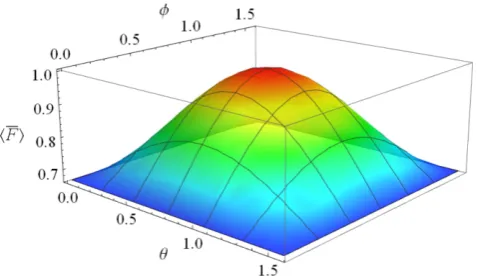
In Figure5, we plot the fidelity as a function ofθandφ. When the states on the channel and in the measurement basis are maximally entanglement, the maximum fidelity is reached, corresponding tohFi=1, which is the ideal case.
Figure 5. Fidelity of teleportation corresponding to the case of a single-qubit state by using a GHZ channel as a function of the entanglement parameters in the channel and measurement basis. Please note that the maximum fidelity is obtained wheneverθ=φ=π/4, i.e., for maximum entanglement.
5.3. Teleportation of a Two-Qubit State
A very interesting proposal involves the teleportation of a two-qubit entangled state [77]. An EPR-like state, for example, can be teleported by using GHZ states as the channel [78]. Other schemes have also been proposed [79,80]. Recently, a scheme to teleport an arbitrary two-qubit state by using two GHZ states [81] was presented. In [82], a protocol to teleport a two-qubit state by using both GHZ and W states simultaneously as the quantum channel was developed. Teleportation of an EPR state by a non-maximally entangled GHZ quantum channel is also possible [83]. In [84], a scheme to perform bidirectional teleportation of an EPR state by employing GHZ states was shown. In [85], a protocol dealing with a composite channel using EPR and GHZ states to execute a multihop teleportation of a two-qubit state is presented. In reference [86], a scheme is introduced to teleport an arbitrary two-qubit state based on a channel consisting of a tripartite entangled state (GHZ or W) and an EPR state.
Figure6shows a possible scheme to teleport an EPR state. A GHZ state can be used as the quantum channel, and a measurement in a GHZ basis on the qubits 1, 2, and 3 is performed. The state of the system is:
(α0|00i+α1|11i)12⊗
1
√
Figure 6.An EPR state can be teleported by using a GHZ state as the quantum channel. In this case, a measurement in the GHZ basis is also necessary.
5.4. Teleportation of a GHZ State
Another possibility of a quantum teleportation protocol is the teleportation of a GHZ state. This is an interesting aspect, because besides performing teleportation of information itself, the protocol also provides a way of delivering quantum entanglement to initially distant locations. It is relevant in the sense that the distribution of entanglement could be used, in principle, to connect several distant users in a quantum network, for example. Several works have addressed this problem. In [87], the teleportation of a GHZ state with N photons by using a two-photon entangled state as the quantum channel was investigated. A scheme to teleport a GHZ state via entanglement-swapping is shown in [88]. The teleportation of a GHZ state by using two W entangled states as the quantum channel was considered in [89]. GHZ states can also be transmitted through a multihop teleportation scheme by using Bell’s states as intermediate quantum channels [90]. In [91], a scheme to teleport a GHZ-like state by employing three pairs of non-maximally entangled states as the quantum channel was proposed. The configuration to make the protocol is illustrated in Figure7. In [92], a similar protocol to the latter was presented, but this time it was designed to teleport an arbitrary tripartite state.
1
1 4
6
8
Figure 7.Scheme to teleport a GHZ state. In this scheme, three EPR states are used as the quantum channel and EPR measurements are taken on qubits 1, 4 and 2, 6 and 3, 8, respectively. At the end, the qubits 5, 7, 9 hold in a GHZ state.
Figure7shows a possible scheme to develop a teleportation protocol of a GHZ state by using three EPR states as the quantum channel. The state of the system is given by:
|Ψi=|φi123⊗ |ηi45⊗ |χi67⊗ |ζi89, (73)
where:
|φi123=α0|000i123+α1|111i123, (74)
|ηi45 =
∑
j
bj|jji45, |χi67 =
∑
kck|kki67, |ζi89 =
∑
`
In this scheme, Alice makes three EPR measurements on her side. The measurements are taken on particles (1, 4), (2, 6) and (3, 8). Reference [91] shows the procedure in detail to finish the protocol.
5.5. Teleportation of a Single-Qubit State Using a W Channel
In [93], a possible scheme to deal with a single-qubit state teleportation by employing a W state as the channel and an EPR measurement was reported, showing that W states are suitable to make the protocol in a probabilistic manner. In that work, some calculations of probabilities were erroneous. Subsequently, the errors were corrected by [94] and [95]. However, although the conclusion presented in [93] is correct, the calculations for the case of a W state with the generic state is not quite precise. As follows, we explicitly perform the calculations for the teleportation of a qubit state by using a generic W state. The state to be teleported is:
|φi1=α0|0i1+α1|1i1. (76)
The channel is given by:
|Wi234=a|100i234+b|010i234+c|001i234. (77)
The general state of the system reads:
|Ψi= [α0|0i+α1|1i]1⊗[a|100i+b|010i+c|001i]234. (78)
More explicitly, we have:
|Ψi=α0a|0100i1234+α0b|0010i1234+α0c|0001i1234
+α1a|1100i1234+α1b|1010i1234+α1c|1001i1234. (79)
Now, we can write the states of qubits 1 and 2 in terms of the EPR basis.
|Ψi= α√0a
2
ψ++ψ−12|00i34+ α√0b 2
Φ+
+
Φ−
12|10i34
+ α√0c
2 Φ+
+
Φ−
12|01i34+
α√1a
2 Φ+
− Φ−
12|00i34
+α√1b
2
ψ+−ψ−12|10i34+α√1c 2
ψ+−ψ−12|01i34; (80)
We can write this expression in the following way:
|Ψi= |Φ
+i
12 √
2 [α0b|10i+α0c|01i+α1a|00i]34+
|Φ−i12 √
2 [α0b|10i+α0c|01i −α1a|00i]34 + |ψ
+i
12 √
2 [α0a|00i+α1b|10i+α1c|01i]34+
|ψ−i12
√
Separating the qubits 3 and 4 results in:
|Ψi= |Φ
+i
12 √
2 "
α0b|1i3+α1a|0i3
!
|0i4+α0c|0i3|1i4
#
+|Φ
−i 12 √
2 "
α0b|1i3−α1a|0i3
!
|0i4+α0c|0i3|1i4
#
+|ψ
+i
12 √
2 "
α0a|0i3+α1b|1i3
!
|0i4+α1c|0i3|1i4
#
+|ψ
−i 12 √
2 "
α0a|0i3−α1b|1i3
!
|0i4−α1c|0i3|1i4
#
. (82)
Let us suppose that after a measurement on qubits 1 and 2 in the EPR basis, Alice obtains|ψ+i. In this case, the unnormalized state of qubits 3 and 4 is given by:
1
√
2 "
α0a|0i3+α1b|1i3
!
|0i4+α1c|0i3|1i4
#
. (83)
It is worth noting that the joint state of the qubits 3 and 4 also contains EPR entanglement. In this way, after a single-qubit measurement, it is possible to complete the protocol. If the qubit 4 is projected on the|0istate, then the state of qubit 3 (up to normalization) will be|ηi3=α0a|0i3+α1b|1i3. This
state looks like the initial state|φi1. However, there is an imperfection due the coefficientsaandb. We can say that the initial state was teleported, but contained an imperfection. On the other hand, if the qubit 4 is projected on the state|1i, teleportation does not occur. In this way, we can conclude that the protocol works probabilistically. A further paper on the use of W states as the quantum channel is stated in [96]. In [97], the teleportation of a single-qubit state was also analyzed. After that, an important contribution was provided by [98] where it was shown that there is a type of W state that can be used for perfect teleportation and superdense coding. This work was generalized in [99]. In [100], a composite W-Bell channel is used to execute quantum teleportation and superdense coding protocols.
5.6. Teleportation of a W State
A quantum teleportation scheme of a tripartite W state was presented in [101]. In that scheme, shown in Figure8, Alice wants to teleport the state,
|φi123 =α0|001i123+α1|010i123+α2|100i123, (84)
on particles 1, 2, 3. She shares two entangled states with Bob, a GHZ state, and an EPR state, which will be used as the quantum channels. The EPR state is given by:
|ψi45 =a0|00i45+a1|11i45, (85)
and the GHZ state is:
|ηi678=β0|000i678+β1|111i678. (86)
The state of the whole system reads:
6
8 7
2 1
3 4 5
Figure 8.A possible way of teleporting a W state is illustrated. A GHZ state and an EPR channel are used as the quantum channel.
Particles 1, 2, 3, 4, and 6 are on Alice’s side, while particles 5, 7, and 8 are on Bob’s side. To execute the teleportation, two EPR measurements are taken on particles 1, 6 and 3, 4. After the measurements, the resultant state involves particles 2, 5, 7, and 8. Thus, it is necessary to trace out particle 2. Here, the protocol is more complicated than that discussed previously. Now, it is necessary to employ combinations of a Hadamard gate and a CNOT gate as well as to introduce an auxiliary particle. All procedures to carry out are presented in reference [101]. More recently, another scheme to teleport a W state was provided by reference [102] where two W states are used as the quantum channel.
5.7. Dense Coding
The original Dense Coding was presented by using a two-entangled state as the resource, but tripartite entanglement is also suitable to make the protocol work [103]. Several schemes have been proposed to do so. Two examples of controlled dense coding dealing with GHZ states can be accessed in [104,105]. The W state is also suitable to make a controlled dense coding protocol [106]. Super Dense Coding with W states was studied recently in [107]. In [108], a scheme was proposed to implement a dense coding protocol by employing tripartite entanglement in cavity QED. In [109] the use of GHZ and W states to make Deterministic Dense Coding was analyzed.
5.8. Quantum Cryptography and Quantum Secure Communication
Quantum Mechanics can also be used to perform cryptographic protocols. The base of this field was founded by Wiensner [110]. Subsequently, other fundamental steps were due to C. Bennet and G. Brassard (scheme known as BB84 protocol) [111], and A. Ekert [112]. After these initial developments, the use of multipartite entanglement has been considered. In [113], it was shown that a GHZ state can be used to make the quantum secret sharing protocol. In [114], some variants of protocols of quantum secure communication dealing with W states were presented.
5.9. Other Developments
In [120], a quantum protocol to send and receive messages anonymously was presented where nplayers have access to a sharedn-qubit GHZ entangled state. Recently, a scheme to transmit an anonymous message in a network employing W-type states with N qubits [121] was developed. In [122], quantum algorithms to the generation of GHZ and W states ofnqubits are proposed to be used on quantum networks. In [123], tripartite entanglement in a non-inertial frame with one of the parties subject to a uniform acceleration is examined. Tripartite entanglement also has been studied in the context of distillation of entanglement.
Methods of distillation of GHZ states can be accessed in [124,125]. Protocols for the optimal distillation of W states were given in [126]. In [127], a method for entanglement purification of three-qubit states by using weak measurements is presented. In [128], a distillation of GHZ-type states from two copies of a mixed state in a single step was shown.
The relationship between tripartite entanglement and quantum computing can also be explored. In [129], it was demonstrated that a GHZ state can be used as an ingredient in the construction of a universal quantum computer. The relationship between state complexity and quantum computing is discussed in [130], including GHZ and W states in the analysis. A discussion on the computational power of GHZ and W states is provided in [131]. In [132], a conceptual design for a quantum block-chain by using a temporal entangled GHZ state was proposed.
6. Production of Three-Partite Entanglement
was presented in 2017 [153]. In [154], a deterministic scheme for preparing W states of size of any power of 2 was presented. Recently, a scheme to prepare anN-qubit GHZ state in a chain of four-level Rydberg atoms was proposed in [155]. In [156], the creation of entangled states with up to 20 qubits was demonstrated.
7. Detection and Characterization of Tripartite Entanglement
The detection of multipartite entanglement is a hard task [157]. Several efforts, both theoretical and experimental ones, have been made to improve the methods to do so. The detection of entanglement involves a key ingredient: the construction of Entanglement Witness [158,159]. In several practical situations, it is possible to certify entanglement through the violation of some inequality that indicates nonlocality. However, the number of inequalities increases when the number of qubits increases. While a measurement of nonlocality depends on correlations, an Entanglement Witness is an operator corresponding to a physical observable. The first GHZ state-analyzer was proposed in [160] where two of the eight GHZ states can be distinguished by using linear optical elements. After this first step, several contributions were reported. In the [161], a scheme for a universal tripartite GHZ state analyzer using two-photon polarization QND is presented9employing parity detectors based on weak nonlinearity. The method allows for discrimination of all eight states with a probability near 1.
In [163], a method to construct a nondestructive n-qubit GHZ state analyzer is presented. The proposal of a GHZ state analyzer using only linear-optics elements through hyperentangled states10 with polarization and momentum degrees of freedom can be found in [166]. Another scheme involving GHZ hyperentangled states was proposed recently [167]. In [168], the existence of tripartite entanglement in a noninteracting Fermi gas was investigated and some Entanglement Witnesses were introduced in that scenario. A recent study on separability criteria of three-qubit GHZ states can be accessed in [169]. In [170], sufficient conditions for detecting genuine tripartite entanglement are established that provide an operational point of view to measure and detect this type of entanglement. Experimental schemes to identify the entanglement classes of tripartite states can be accessed in [171,172]. A powerful tool to describe a density matrix of a system is the method known as quantum state tomography, which allows for the characterization of a quantum state [173]. These methods have been employed in the study of tripartite entangled states. In [174], an experimental tomographic reconstruction of a three-photon polarization GHZ state was realized. The more recent work [175] uses the method for GHZ states. In [176], a scheme for the experimental generation of a W state was introduced alongside its full characterization by using a quantum state tomography method.
8. Remote Preparation
Besides the quantum teleportation protocol, an additional type of protocol dealing with the quantum state transfer is the remote preparation protocol (RSP) [177]. There are several possibilities of implementing RSP involving different kinds of channels. It is possible to use RSP to prepare single-qubit states and states with two or more qubits [178]. Currently, this topic is studied by considering the preparation of multipartite entangled states. It is an interesting task since the remote production of entanglement can help to use this resource to establish quantum communication between distant multi-users and establish quantum distributed computation [179]. For instance, two non-maximally entangled three-qubit GHZ states can be used to prepare a four-qubit GHZ state [180] remotely. The remote preparation of a three-qubit state by using GHZ states was considered in [181]. GHZ states can also be used as the quantum channel for the remote preparation of arbitrary states of one and two qubits [182]. In [183], two maximally entangled GHZ states are employed as
9 Here, QND means Quantum Non-demolition related to the idea of a QND measurement [162].
10 Hyperentanglement is a type of entanglement dealing with multiple different degrees of freedom of a system. More details
the quantum channel for the remote preparation of an arbitrary equatorial two-qubit state. A scheme for preparing atomic states remotely by using GHZ states is also possible [184]. In [185], W states are used for the remote preparation of single and two-qubit states. A scheme for the remote preparation of a two-qubit state by using two W-type states as the quantum channel was developed, as well [186]. The remote preparation ofm-qubit states by using non-maximally GHZ entangled states was studied in [187]. In [188], an experimental demonstration of remote preparation of three-photon entangled states by using a single photon measurement was reported on. In [189], a scheme of joint remote preparation of anm-qubit state by using ad-dimensional GHZ state was presented. In [190], EPR pairs are used as the quantum channel to preparing an arbitrary three-qubit state. Tripartite entangled states can not only be employed to remotely prepare single and two-qubit states, but they can also be remotely prepared themselves. In [191], a scheme for preparing W states remotely by using two four-particle GHZ states as the quantum channel was presented. A proposal to remotely preparing a three-particle state by employing a three-particle orthonormal basis projective measurement can be accessed in [192]. An idea for remotely preparing W states of three and four qubits using tripartite GHZ states was presented in [193]. In [194], an efficient scheme for the remote preparation of a 2n-qubit W state vian three-qubit GHZ states was provided. A scheme to prepare a tripartite equatorial state by using three maximally entangled GHZ states was proposed in [195]. In [196], a protocol for remotely preparing a tripartite W-type state by using an eight-qubit state as the quantum resource was presented.
9. Continuous-Variable Systems
To this point, we have explored several aspects involving tripartite entanglement of discrete variables, which refers to qubit-based developments such as photon polarization or the spin of the electron. It is worth noting that it is also possible to deal with multipartite entangled states in the domain of continuous variables [197,198]. Several quantum information protocols have been considered in this domain where the variables have a continuous spectrum of eigenvalues. For instance, an analysis of quantum teleportation of quantum states with continuous variables was presented in [199]. In [200], an experimental investigation of this subject was reported on. Entanglement swapping that involves continuous variables was investigated in [201] and [202]. A study that develops necessary conditions of separability of a multiparty continuous-variable state can be found in [203]. A detailed discussion on quantum information and continuous variables is presented in [204]. In [205], criteria were derived to detect genuine multipartite entanglement by using continuous-variable measurements including the continuous-variable GHZ state. A complete analysis of three-mode Gaussian entangled states is shown in [206]. In that work, the counterparts of GHZ and W states in the continuous-variable scenario are presented. Experimentally, the creation of a tripartite entangled state in continuous variables was realized [207]. In [208], the generation of entanglement among three beams of light with different wavelengths was demonstrated. Reference [209] reports on the experimental demonstration of tripartite entanglement where correlations involving energies and emission times of photons occur. In [210], hierarchies of separability criteria of multipartite entanglement for continuous-variable states are discussed. Recently, the development of a full quantum description of triple-photon states in the continuous-variable domain was presented in [211].
10. Noisy Environments
recent work [214]. In [215], the decay of entanglement ofN-particle GHZ states due the interaction with the environment was considered. The impact of a decoherence process on the entanglement of GHZ and W states was analyzed in [216]. In [217], the quantum discord of a W state in the presence of noise was studied. The evolution of the quantum discord under noisy effects to GHZ and W states is analyzed in [218]. In [219], some properties of GHZ and W states under a depolarizing noise are discussed. In [220], noise effects on the quantum correlations of a three-qubit system was studied. A comparison between GHZ and W noisy channels that execute the quantum teleportation of a single-qubit state can be accessed in references [221,222]. In [223], the effect of the generalized amplitude damping channel on GHZ states was investigated. In [224], the problem of teleporting an unknown atomic state through a noisy GHZ channel was addressed. The entanglement of GHZ states with decoherence in non-inertial frames is discussed in [225]. In [226], the quantum teleportation by using noisy bipartite and tripartite entangled states was studied where one of the users experiments with a uniform acceleration.
In [227], schemes based on GHZ states are presented to make quantum secret sharing protocols immune to some kinds of collective noise. Effects of a particular type of noise in GHZ channels on remote preparation of states has also been investigated for a single-qubit state [228,229] and a two-qubit state [230,231]. In [232], GHZ states are considered for remote state preparation of quantum states in noisy environments. The relationship between weak measurements and GHZ entanglement distribution in the presence of noise was also investigated [233]. The robustness of GHZ and W states against decoherence was studied experimentally in [234]. In [235], a scheme for quantum communication in noisy environments by using a hybrid channel Bell-GHZ was presented. Teleportation of a GHZ state in the presence of noisy channels was analyzed in [236]. Finally, the robustness of cat-like states under Pauli noises was explored in [237].
11. Conclusions
In this work, we have addressed several aspects of tripartite entanglement with a special focus on discrete systems. We have started revisiting the main properties of this type of entanglement. We have also made some remarks on bipartite entanglement to clarify our discussion on tripartite entanglement. Subsequently, we have explored in more detail the two inequivalent classes of tripartite entanglement, namely GHZ and W, and defined the corresponding basis. We proceeded by reviewing the relationship between Bell’s Theorem and the GHZ states. After that, we stated some examples of quantum information protocols working with tripartite entanglement. We gave special attention to quantum teleportation protocols, performing some calculations and exhibiting several possible schemes. After this, we listed the main contributions to the literature relevant to the production and detection of tripartite entanglement. Then, we explored some aspects important to remote preparation protocols and reviewed several characteristics of tripartite entanglement in the continuous-variable regime. Finally, we discussed the study of tripartite entanglement in the presence of a noisy environment in several scenarios.
Author Contributions: M.M.C. performed the calculations in Section5, and wrote Sections6–11. A.F. wrote Sections2and3. M.M.C. and A.F. wrote Sections1,4and5. E.O.S. checked the calculations, revised the text, and designed all the figures.
Funding: This work was partially supported by the Brazilian agencies CAPES, CNPq, and FAPEMA. EOS acknowledges CNPq Grants 427214/2016-5 and 303774/2016-9, and FAPEMA Grants 01852/14 and 01202/16. MMC acknowledges CAPES Grant 88887.358036/2019-00.
Acknowledgments:We thank M.G.M Moreno for useful suggestions.We are grateful to M. Schreck for the careful reading of the manuscript and all the suggestions to improve the text. We also acknowledge the referees for all the criticism, comments and suggestions.
References
1. Nielsen, M.A.; Chuang, I.L.Quantum Computation and Quantum Information; Cambridge University Press: New York, NY, USA, 2000.
2. Gabriel, C.; Aiello, A.; Zhong, W.; Euser, T.G.; Joly, N.Y.; Banzer, P.; Förtsch, M.; Elser, D.; Andersen, U.L.; Marquardt, C.; et al. Entangling different degrees of freedom by quadrature squeezing cylindrically polarized modes. Phys. Rev. Lett.2011,106, 060502. [CrossRef]
3. Barnett, S.Quantum Information; Oxford University Press: New York, NY, USA, 2009.
4. Luo, Y.H.; Zhong, H.S.; Erhard, M.; Wang, X.L.; Peng, L.C.; Krenn, M.; Jiang, X.; Li, L.; Liu, N.L.; Lu, C.Y.; et al. Quantum teleportation in high dimensions. Phys. Rev. Lett.2019,123, 070505. [CrossRef]
5. Chen, P.X.; Zhu, S.Y.; Guo, G.C. General form of genuine multipartite entanglement quantum channels for teleportation. Phys. Rev. A2006,74, 032324. [CrossRef]
6. De, A.S.; Sen, U. Quantum Advantage in Communication Networks. Available online:https://arxiv.org/ abs/1105.2412(accessed on 26 September 2019).
7. Raussendorf, R.; Briegel, H.J. A one-way quantum computer.Phys. Rev. Lett.2001,86, 5188–5191. [CrossRef] 8. Li, M.; Jia, L.; Wang, J.; Shen, S.; Fei, S.M. Measure and detection of genuine multipartite entanglement for
tripartite systems. Phys. Rev. A2017,96, 052314. [CrossRef]
9. Briegel, H.J.; Browne, D.E.; Dür, W.; Raussendorf, R.; Van den Nest, M. Measurement-based quantum computation. Nat. Phy.2009,5, 19. [CrossRef]
10. Bengtsson, I.; Zyczkowski, K. A Brief Introduction to Multipartite Entanglement. Available online:https: //arxiv.org/abs/1612.07747(accessed on 26 September 2019).
11. Enríquez, M.; Wintrowicz, I.; ˙Zyczkowski, K. Maximally entangled multipartite states: A brief survey.J. Phys. Conf. Ser.2016,698, 012003. [CrossRef]
12. Amico, L.; Fazio, R.; Osterloh, A.; Vedral, V. Entanglement in many-body systems. Rev. Mod. Phys.2008,
80, 517–576. [CrossRef]
13. Walter, M.; Gross, D.; Eisert, J. Multi-Partite Entanglement. Available online:https://arxiv.org/abs/1612. 02437(accessed on 26 September 2019).
14. Fortes, R.; Rigolin, G. Fighting noise with noise in realistic quantum teleportation. Phys. Rev. A2015,
92, 012338. [CrossRef]
15. Einstein, A.; Podolsky, B.; Rosen, N. Can quantum-mechanical description of physical reality be considered complete? Phys. Rev.1935,47, 777–780. [CrossRef]
16. Bennett, C.H.; Wiesner, S.J. Communication via one- and two-particle operators on Einstein-Podolsky-Rosen states.Phys. Rev. Lett.1992,69, 2881–2884. [CrossRef]
17. Bennett, C.H.; Brassard, G.; Crépeau, C.; Jozsa, R.; Peres, A.; Wootters, W.K. Teleporting an unknown quantum state via dual classical and Einstein-Podolsky-Rosen channels. Phys. Rev. Lett.1993,70, 1895–1899. [CrossRef] 18. Barreiro, J.T.; Wei, T.C.; Kwiat, P.G. Beating the channel capacity limit for linear photonic superdense coding.
Nat. Phys.2008,4, 282. [CrossRef]
19. Takesue, H.; Dyer, S.D.; Stevens, M.J.; Verma, V.; Mirin, R.P.; Nam, S.W. Quantum teleportation over 100 km of fiber using highly efficient superconducting nanowire single-photon detectors. Optica2015,2, 832–835. [CrossRef]
20. Werner, R.F. Quantum states with Einstein-Podolsky-Rosen correlations admitting a hidden-variable model.
Phys. Rev. A1989,40, 4277–4281. [CrossRef]
21. Horodecki, M.; Horodecki, P. Reduction criterion of separability and limits for a class of distillation protocols.
Phys. Rev. A1999,59, 4206–4216. [CrossRef]
22. Brunner, N.; Cavalcanti, D.; Pironio, S.; Scarani, V.; Wehner, S. Bell nonlocality. Rev. Mod. Phys. 2014,
86, 419–478. [CrossRef]
23. Hirsch, F.; Quintino, M.T.; Vértesi, T.; Navascués, M.; Brunner, N. Better local hidden variable models for two-qubit Werner states and an upper bound on the Grothendieck constant $K_G(3)$. Quantum2016,1, 3. [CrossRef]
24. Zhao, M.J.; Zhang, T.G.; Li-Jost, X.; Fei, S.M. Identification of three-qubit entanglement.Phys. Rev. A2013,
87, 012316. [CrossRef]