1
BISLAMA WORKBOOK
NOTES, EXERCISES & TIPS
ACKNOWLEDGEMENTS
Most of this workbook is an adaptation of material written for Peace Corps Vanuatu by a host of Language and Crosscultural trainers and used in Bislama lessons taught during Peace Corps Vanuatu Pre-service Training.
Peace Corps Vanuatu greatly appreciates the efforts all of those dedicated and hardworking people who have made this workbook possible, with special thanks to Judy Japheth,
3
Contents
INTRODUCTION
5
FACTS ABOUT BISLAMA
6
Unit 1: SOUNDS OF BISLAMA
8
Unit 2: GREETINGS
18
Unit 3: MARKET WOKABAOT
23
Unit 4: INTRODUCTION OF SELF
29
Unit 5: PAST, PRESENT AND FUTURE TENSES
35
Unit 6: Blong 39
Unit 7: LONG
44
Unit 8: BISLAMA PRONOUNS
49
Unit 9: HEM AND EM
57
Unit 10: GAT
61
Unit 11: INTERROGATIVES
68
Unit 12: VERBS AND VERB ENDINGS
71
Unit 13: ADDITIONAL VERBS
77
Unit 14: CONNECTIVE WORDS
83
Unit 15: MONTHS, WEEKS, DAYS AND AGES
87
Unit 16: STAP
91
Unit 17: OLSEM
96
Unit 18: SAVE
101
Unit 20: KLOSAP
109
Unit 21: NOMO
111
Unit 22: KASEM, KAREM, TEKEM
112
Unit 23: SE
115
Unit 24: RELATIVE AMOUNT/QUANTITY
117
Unit 25: ASKING FOR DIRECTIONS & LOCATION
120
Unit 26: BAKEGEN, WANWAN & REPETITIVE ACTION
122
Unit 27: LIKES & DISLIKES
126
Unit 28: TAEM, TAEM WE, LONG TAEM WE
127
Unit 29: ASKING & TELLING TIME
129
Unit 30: SHOPPING AT A STORE
131
Unit 31: ANATOMY/HEALTH CONDITIONS
133
Unit 32: NEGATIVE AND YES/NO QUESTIONS
135
5
INTRODUCTION
This workbook has three goals:
1. To introduce you to Bislama, the national language of Vanuatu.
2. To give you tips that will help you gain a functional knowledge of Bislama as quickly as possible.
3. To provide you with exercises and notes that reinforce important elements of Peace Corps Vanuatu’s Pre-Service Training (PST).
Your knowledge of Bislama is very important to your effectiveness as a Peace Corps volunteer in Vanuatu. However, there is limited Bislama teaching/learning time during PST. The workbook provides you an opportunity for self-directed learning that will equip you with some basic Bislama skills before you start your PST. The topics and notes contained in the workbook provide the basis for Bislama training during PST.
We suggest you start with Unit 1: Sounds of Bislama. Written and oral Bislama skills are built upon your understanding of how the language sounds. As you master the basic rules surrounding the use of the alphabet in Bislama, you are able to efficiently and effectively acquire knowledge of the application of the language itself.
If you have any questions concerning Bislama or the contents of this workbook, do not hesitate to contact -
Solomon Jimmy: [email protected]
Training Manager, Peace Corps Vanuatu Judy Japheth: [email protected]
FACTS ABOUT BISLAMA
Bislama is the national language of the Republic of Vanuatu. It is a pidgin derived from English, French and indigenous languages that is spoken throughout the country as the lingua franca; a common tongue which enables communication between the many different language communities of Vanuatu. There are more than one hundred recognized languages spoken in Vanuatu by the
approximately 220, 000 residents of the islands, excluding the European languages of English and French. There is a distinct language for, on average, every 2,200 inhabitants of Vanuatu which makes it the country with one of the highest, if not the highest, language densities in the world. It is not surprising; therefore, that a common language should develop that ensures communication amongst all citizens.
In addition, English and French are spoken and understood by many ni-Vanuatus (as the citizens of the republic choose to be called), however, it is rare for a ni-Vanuatu to speak both English and French - especially outside the capital Port Vila on the island of Efate. One cause of this situation is that in pre-Independence times (pre-1980) the British and French condominium government
duplicated facilities; they established competing British and French schools. The net result was that those ni-Vanuatu who attended French schools were educated in French, while students at the British schools were educated in English. Since independence the two-language education system has been maintained, and is, in fact, specified in the Vanuatu constitution. This situation effectively ruled out the possibility of either English or French becoming the national language. The only language that is spoken throughout the country is Bislama, and this has occurred only relatively recently. Previously Bislama was not at all well known in some of the more remote areas, especially among women, who typically do not tend to travel outside their immediate area. Among older women in the more remote areas, this may still be the case. Since Bislama is the only universal language of Vanuatu, it is not surprising that it was proclaimed the national language of the republic in the country’s constitution.
How did Bislama Develop?
In the first half of the nineteenth century there was intensive whaling in the Pacific, especially in the regions of Polynesia and Micronesia. During the course of this activity, many South Sea islanders were engaged as ships’ crew. A kind of jargon developed as a means of communication between the Europeans and the islanders engaged in the whaling trade. Gradually whale numbers in Polynesia became severely depleted, with the result that the whalers moved their center of activity progressively westwards into Melanesia. This, in turn resulted ni-Vanuatu working in the whaling industry. They, therefore, learned the trade jargon used as the means of general communication.
At roughly the same time, an Irishman, Captain Pita Dillon, discovered stands of sandalwood on Erromango. This wood was much prized by the Chinese and soon became the basis of a flourishing export trade. Once traders in Australia learned of the profits to be made selling sandalwood, there was a frantic rush to Vanuatu to acquire cargoes of the fragrant-smelling wood. The islands involved were mainly Vanuatu’s southern ones - Erromango, Tanna and Aneitym; the same islands that had the greatest contact with the early whalers. In fact, the only whaling station in Vanuatu, was run by James Paddon, an early whaler, on Aneitym,.
Apart from whaling and sandalwood, another activity which involved contact and communication between Europeans, Polynesians and the ni-Vanautu was the bêche-de-mer industry. Bêche-de-mer or bêches-de-mer, also called Trepang, is the boiled, dried, and smoked flesh of sea cucumbers used to make soups. Its primary market was, and is, in China.
By the early 1860’s all of these industries were winding down. However, new economic
7
All of these industries were highly labour intensive. The nearest source of available labour lay in Melanesia and in 1863 the first boatload of ni-Vanuatu were recruited and brought to Queensland. Between 1863 and 1911, more than 50,000 ni-Vanuatu worked as indentured labourers on
plantations, mainly in Queensland but also in Fiji and Samoa. Most worked for a term of three years, returning home at the end of that time. However, a significant number continued for a second and even a third term.
Labor recruiting first began in the southern islands of the then-named New Hebrides, with the first recruits coming from the island of Tanna. By the end of the 1860s, the recruiters moved north through central and northern New Hebrides to the Banks Islands and on to the Solomon Islands. By the early 1880s, they finally reached what is now Papua New Guinea. During this period the recruiters signed on laborers at nearly every island. Unfortunately, many of the ships’ captains were not always scrupulous about how they recruited their labour nor about returning recruits to their home islands at the end of their contract period.
It was on the foreign plantations, especially in Queensland, that Bislama developed and stabilized. The first recruits already had some knowledge of the ‘jargon’ or ‘broken English’ used by the whalers and sandalwood traders. When they reached the plantations, recruits from the same island who spoke the same language were generally separated so that they could not make trouble or plot against their employers. Recruits were then forced to speak to one another in the jargon, which quickly spread among the labourers, reinforced by the English spoken by their overseers.
The early 1890’s saw the end of the recruiting period. During this time Bislama fully established its vocabulary and grammar. It appears not to have changed very significantly during the next 100 years. As recruits returned home to the Solomon Islands and Papua New Guinea, the distinctive features of Bislama’s sister dialects, Tok Pisin in Papua New Guinea and Pidjin in the Solomons, began to emerge.
In 1981 Bislama was accepted by the churches of Vanuatu, which up to that time were mostly
administered by foreign missionaries. At that time it was deemed to be a language that was worthy of using to communicate the word of God. Previously Bislama was considered to be a rough and inadequate “plantation language,” not worthy of use for that purpose. Acceptance of Bislama by the churches in Vanuatu was a crucial step towards raising the status of the language to the point where it became universally accepted as the language of administration, occupying a pre-eminent position because of its use throughout Vanuatu.
Bislama is the vibrant and expressive national language of Vanuatu. It is a Melanesian language in its own right, justly recognized by the government of Vanuatu for what it is - a truly national language which allows communication across all the language boundaries which criss-cross the country.
Unit 1: SOUNDS OF BISLAMA
1.1
Vowels
Bislama has five vowels - A, E, I, O, U
In Bislamathe vowels are pronounced as follows -
A A as in Artist or Cart. The A always must have an “ah” sound. Never will an A sound like the A in Airfield, Age, April. The long-A sound in these words is pronounced and written as E as in Enter.
E E as in Enter or Enhance. The E always will sound like “eh” in English or an “é” in French. Never will an E take an E sound such as in Meal or Deep. The long-E sound is written as I as in Graffiti.
I I as in Graffiti or the final I in Manicotti. The I must have an “ee” (long-E) sound such as in Meal or Deep. Never will an I sound like the I in Idol or Iron. Bislama speakers will intepret the long-I in these two words as the dipthong ae.
O O as in Open or Over. O in Bislama is pronounced “oh” - the long-O sound. Never will it take on other sounds as in English, e.g., pot or women.
U U as in Salute or Jubilee. The U always will have a “oo” sound. Never will a U take the uh sound such as in Under or Umpire. Bislama speakers will inteprete the U when it is pronounced in the above two words as a.
Diphthongs
A dipthong is a sound formed by the combination of two vowels in a single syllable, in which the sound begins as one vowel and moves toward another. Examples in English are coin, loud, and side.
There are four (4) diphthongs which occur with great frequency in Bislama. They are EI,
AE, AO,and OE.
In Bislamathese dipthongs are pronounced as follows - EI Pronounced like a long-A.
English Bislama
Day Dei
Pay Pei
9 AE Pronounced like a long-I.
English Bislama
Night Naet
White Waet
Island Aelan
AO Pronounced “ow” as in towel.
English Bislama
House Haos
Flower Flaoa
Ground Graon
OE Pronounced “oy” as in joy.
English Bislama
Noise Noes
Boy Boe
Join Joen
Summary
Letter(s) English Examples Bislama Examples English Meanings
A Father
Abandon
Tanda Andanit
Thunder Underneath
E Pest
Escape
Pepa Etkwek
Paper Earthquake
I Pita
Peal
Pikinini Kilim
Child Hit
O Only
Stove
Popo Moskito
Papaya Mosquito
U Emu
Glucose
Muvum Fulap
Move Full
EI Pray
Delay
Medeldei Imeil
Midday Email
AE Recline
Crime
Taem Straek
Time Strike
AO Plow
Ouch
Braon Taon
Brown Town
OE Deploy
Royal
Voes Loea
Exercise
Practice pronouncing the following letter combinations in Bislama -
BA KA FA SAS LAS
BE KE FE SES LES
BI KI FI SIS LIS
BO KO FO SOS LOS
BU KU FU SUS LUS
1.2
Consonants
The following consonants are not used in “correct” written Bislama - C, Q, X, Z However, you will come across many ni-Vanuatu who use them. In addition, because
Bislama is spoken by most people in addition to their own local language, there is a tendency for some sounds to be pronounced in ways that show influence of local languages which sometimes makes their transcription problematic.
The rules and guidelines that are contained in this handbook provide guidance and facilitate learning. However, you will discover that many ni-Vanuatu have their own set of rules concerning written Bislama. Bislama currently is a loosely structured language with few hard and fast rules, although there are efforts undeway to standardize it.
Letter Used in English
Letter Used
in Bislama Example in English
English Word as Written in Bislama
C K Candle Kandel
Q KW Queen Kwin
X EKS X-ray Eksre
11
1.3
Letter Combinations
Some letter combinations in English are transliterated and pronounced as a single letter in Bislama. They are -
English Bislama Examples in English Examples in Bislama
SH S Ship
Shoes
Sip Sus
CH J or K Church
Chest Channel Christmas
Jioj Jes Kanal Krismes
PH F Photo
Telephone
Foto Telefon
TH T Thank you
Thirty
Tankio Teti
1.4
Basic Sentence Types
In English the basic sentence type is a simple sentence containing a subject or actor, a verb
and, in most cases an object or goal, thus: For example:
(1) The elephant twisted his trunk. (2) You can go to the beach. (3) Paul jumped up and down. (4) That didn’t help at all.
Sentences (1) and (2) are called transitive sentences since objects are expressed in both - namely trunk and to the beach. Sentences (3) and (4) are called intransitive as neither has an object of the verb.
SUBJECT + VERB + OBJECT
Transitive: Designating a verb or verb construction that expresses an action carried from the subject to the object; requiring a direct object to complete meaning. For example-
(1) My friend helped me. Fren blong mi i helpem mi. (2) Julie broke her leg. Julie i brekem leg blong hem.
Intransitive: Designating a verb or verb construction that does not require or cannot take a direct object. For example
The following are Bislama examples of the verbal sentence types and their English translations -
Bislama Sentence English Translation
Pikinini i krae. The child cried. Hem i foldaon. He/she fell down. Man ia i save. This man knows. Pita i sik tumas. Pita is very sick. Hem i kilim mi. He/she hit me. Rat i kakae taro. The rat ate the taro
The structure of this sentence type is the same as that outlined above for English with the addition of is what is called a predicate marker – “i” (pronounced ee, as in bee) placed between the subject and the verb. A predicate is the part of the sentence containing the verb. The predicate marker marks the beginning of the verb phrase - the predicate of the
sentence.
These types of verbal sentences are very common in Bislama as well as sentences which do not contain a verb. This feature is common to Bislama and the other pidgin languages of the Pacific area and is refered to as a verbless sentence.
The structure of this verbless sentence type can be represented as follows -
These occur frequently and, at first, appear strange to English-speakers. Here are some examples:
Bislama Sentence English Translation
Pita hemi pasta. Pita is a pastor. Olgeta oli bisop. They are bishops. Wanem samting ia? What is this/that thing? Haos ia i blong jif. This is the chief’s house. SUBJECT + Predicate Marker + VERB + OBJECT
13
In the first two examples, the predicate marker “i” is attached to the subject. The third person singular subject- English she, he and it- translate to hem. The attachment of the predicate marker creates the word hemi. Due to the non-standard spelling of Bislama, you may see it written either as hemi or as hem i. The same attachment can occur to the third person plural – English they – or Bislama ol which becomes oli.
EXERCISES #1
A. List the four letters that are not used in Bislama and beside each, write which letter is used instead.
Letter(s) Not Used Letter Used Instead
B. Spell the following in Bislama: 1) Airport
____________________________ 2) Agriculture
____________________________ 3) Church
____________________________ 4) Cold
____________________________ 5) Clever
____________________________ 6) Physical Training
____________________________ 7) Peace Corps
____________________________ 8) Pineapple
____________________________ 9) Queen
____________________________ 10)Shellfish
____________________________
11)Telephone
____________________________ 12)Three
____________________________ 13)Teacher
____________________________ 14)Young People
____________________________ 15)Zero
____________________________ 16)Plane
____________________________ 17)Basket
____________________________ 18)Yam
____________________________ 19)Pull
____________________________ 20)Butter
____________________________ 21)Yellow
15
C. Think about what you had for breakfast this morning and write down each item in English in the left hand column then write the Bislama spelling in the corresponding place in the right hand column.
English Bislama
Example: Water Wota
D. What are the names of the two sister languages to Bislama in Melanesia that were developed around the time of the early traders and missionaries? (Refer to the introductory chapter “What is Bislama.”).
(1) (2)
E. Write the English words for the following Bislama words.
Bislama English
Bas Kantri
Rif Drae
DIALOGUE 1
LONG VANUATU
Pita i storian wetem wan fren, nem blong hem Shem. Shem i askem kwesten long Pita olsem -
Shem: Pita, mi wantem askem wan kwesten long yu.
Pita: Olsem wanem fren?
Shem: Kantri blong yumi emi winim Independens long 1980. Emi no olsem bifo. Wanem tingting blong yu long hemia?
Pita: Tru ia, kantri blong yumi emi gohed nao. Emi gat wan gavman nomo. Taem we yumi no kasem independens yet i gat tufala govman.
Shem: Hemia nao. Rod i klia blong yumi save gohed blong mekem kantri blong yumi i kam antap.
Pita: Mi sori, Shem. Bas i kam nao. Bae mi mas go.
Shem: Yu go wea?
Pita: Mi go long nambatri, long haos blong mi.
Shem: Oraet, mi tu mi go nao blong pem kakae long stoa.
Pita: Oraet, lukim yu bakegen.
IN VANUATU
Peter is chatting with a friend named Shem. Shem asks Peter a question -
Shem: Peter, I want to ask you a question.
Peter: What about, friend?
Shem: Our country gained its Independence in 1980. It is not the same as before. What’s your opinon about that?
Peter: That’s right. Our country is progressing now. It has only one government. Before we had independence, we had two governments.
Shem: That’s right! Now the path is cleared for us to make our country progress.
Peter: I’m sorry, Shem. The bus is coming, I have to go.
Shem: Where are you going?
Peter: I’m going to Nambatri, to my house.
Shem: All right, I’m going also; to buy some food at the store.
17
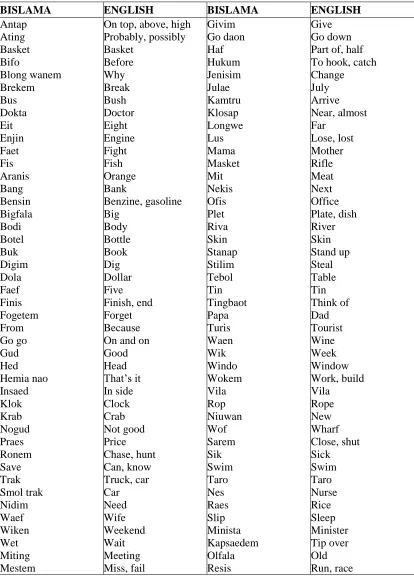
VOCABULARY
BISLAMA ENGLISH BISLAMA ENGLISH
Askem Bas Em Gohed Kakae Kantri Klia Kwesten Mo Nem No/Nogat Olsem Oraet Ripablik Sam Stoa Taem Tru Tufala Wanem Wetem Yu Bakegn Fastaem Fren Gavman Haos Inglis Kam Kasem Mekem Nao Niufala Nomo Pem Rod Sori Ask Bus He/she Go ahead Eat/food Country Clear Question And Name No Like, thus All right Republic Some Store Time, when True, right Two of them What With You Again Previously Friend Government House English Come
Catch, fetch, get Make Then New Only, just Pay, buy Road Sorry Aelan Hu Puskat Bisi Baskel Jif Rat Faenem Bisop Kambak Rif Fas Drae Kam soa Sanbij Flae Hem Krae Sidaon Giaman Faol Laekem Skelem Gud Foldaon Natalae Strong Laf Gel Plante Taon Spel Storian Tingting Tu Wantem Winim Island Who Cat Busy Bicycle Chief Rat Find Bishop
Return, come back Reef Stuck Dry Came ashore Beach Fly He, she, it Cry Sit Lie Fowl, hen Like Weigh Good Fall Clam shell Loudly, strong Laugh Girl Many, plenty Town Rest Story, chat Think, opinion Too, two Want
Unit 2: GREETINGS
Greetings in Vanuatu vary with location. Common greetings include saying “Moning” to anyone you happen to meet between 5:30am and 9:00am or just “Halo”. “Halo” is used at anytime of the day. In the evenings and at night, people say “Gud naet,” at both greeting and parting. If you are lucky, you may get a smile accompanied with a little nod of the head or raised eyebrows. In most parts of the country locals would prefer to shake your hand if they meet you for the first time or if they haven’t seen you for a while. The shaking of hands is a general ni-Vanuatu trademark for greeting other people and is basically a friendly gesture.
2.1
Common and Useful Greetings
Bislama
English
Halo Hello
Olsem wanem? I gud? How are you? OK?
I oraet? Are you OK?
I stret! Everything’s fine/I’m fine.
I gud! I’m fine.
Gudmoning Good morning.
Gudnaet Good night/Good evening.
Tata Good bye
Lukim yu See you later
Nem blong mi… My name is…
Take Note!!
You will also come to realize that, in addition to greeting you, ni-Vanuatu people who know you will also tend to ask where you are going and tell you where they are going even if you didn’t ask.
19
2.2
Useful Vocabulary Upon Leaving/Departing
Bislama
English
Ale mi go nao. Okay, I’m leaving/I’m going. Bae mi go nao. I will leave now/I will go now. Mi go fastaem. I’m going/leaving.
2.3
Greeting Dialogues
Dialog A
K: Gud moning Mala.
Good morning Mala.
M: Eh, Kalo, moning, olsem wanem?
Hey Kalo, morning, how are you?
K: I stret be yu go wea?
Alright and where are you going?
M: Wokabaot nomo.
Just strolling.
K: Ale mi go nao.
Okay, I’ll be going now.
M: Ale.
Okay.
Dialog B
J: Halo Alice, yu kam wea?
Hello Alice, where did you just come from?
A: Mi kam long maket nomo. I just came from the Market.
J: Mi tu, mi go karem kabis nomo. Me too, I just got some cabbage.
A: Ale Jenny, mi go fastaem. Okay Jenny, I’d better be going.
J: I gud, bae mi luk yu afta.
EXERCISES #2
A. What are the parts of a Ni-Vanuatu greeting should you expect to hear from a ni-Vanuatu friend?
B. From the vocabulary used in the Greeting Dialogs, predict what the two words “Ale” and “Bae” might mean?
Ale: ______________________________________________________________ Bae: ______________________________________________________________ C. Dialogs
(1) A Peace Corps Volunteer (PCV) went to the city on Monday and was greeted by Mr. X. Their conversation is given in Dialogue A.
Dialog A - Monday
Mr. X: Gud morning fren. Olsem wanem? I oraet? Good morning friend. How are you? Good? PCV: I oraet, be yu?
Alright - yourself?
Mr X: I stret be yu stap mekem wanem? Fine. So, what are you up to? PCV: Mi wantem go long taon.
I want to go to town.
Mr X: Afta bae yu mekem wanem? What will you do after that? PCV: Bae mi stap long haos nomo.
I’ll be home.
Mr X: Be yestedei yu bin mekem wanem? But what did you do yesterday?
PCV: Yestedei mi bin go swim long riva. Be yu?
Yesterday I went and had a swim in the river. What about you? Mr X: Yestedei mi bin go long taon.
Yesterday I went to town. PCV: Ale, fren mi stap go nao.
Okay friend I should be going now. Mr X: Ale, lukim yu
Okay, see you. PCV: Ale, tata
21 DIALOGUE B - Tuesday
Mrs C: Gud morning fren.
PCV: ______________________________________________________________
Mrs C: I stret be yu stap go wea?
PCV: ______________________________________________________________
Mrs C: Afta bae yu mekem wanem long aftenun?
PCV: ______________________________________________________________
Mrs C: Be yu bin mekem wanem yestedei?
PCV: ______________________________________________________________
Mrs C: Mi bin go daeva long solwota.
PCV: ______________________________________________________________
Mrs C: Ale, lukim yu.
COMPREHENSION 1
stori = tell
Pijin blong solwota = Seagull Sotleg = Ground dove Talem = tell, say
Karen = garden Sel = shellfish Delaet = dawn
Kamdaon = come down Solwota i drae = low tide Solwota i kam so = high tide Tok = speak
Mo = and Afta = then
Askem = ask Tekemaot = remove Olsem wanem = how Mekem = make, do Putum = put
Insaed = in side
PIJIN BLONG SOLWOTA (Story from Epi)
Mi stori long wan stori abaot pijin blong solwota mo sotleg. Wantaem tufala i stap finis tufala i go long solwota. Tufala i go blong luk se solwota i drae o no. Wan i talem se, “Tumoro bae yumitu go long karen mo tekem kakae i kamdaon long sanbij afta yumitu go lukaotem sel long rif.”
Taem deilaet i kam, tufala i go long karen mo karem kakae blong tufala i kamdaon long solwota. Tufala i putum i stap. Tufala i luk se solwota i drae. Ale, tufala i go long rif. Tufala i wokbaot long rif mo faenem wan sel, nem blong em natalae. Pijin blong solwota i talem long sotleg i se, “Sel ia, emi blong mi.”
Be sotleg i talem, “No, emi blong mi, mi faenem, emi blong mi.”
Pijin blong solwota i nomo tok mo emi stap kwaet nomo. Sotleg i traem blong tekemaot sel ia be emi no save tekem aot. Afta hemi askem long pijin blong solwota se, “Bae mi mekem olsem wanem blong tekem sel blong mi?”
Pijin blong solwota i talem long sotleg se, “Yu putum wan leg blong yu i go insaed long hem. Ale, bae yu save tekemaot.”
Sotleg i putum wan leg blong em i go insaed long sel ia. Taem leg blong sotleg i go insaed, sel ia i kam sat mo i fas long leg blong sotleg ia. Naoia leg blong Sotleg i stap insaed. Hemi nomo save pulumaot leg blong hem bakegen from sel ia i holem taet. Pijin blong solwota ia i stap wokabaot long rif be sotleg, natalae ia i holem leg blong hem. I stap kasem taem we solwota i kam fulap bakegen. Ale, sel ia i open bakegen. Sotleg i pulumaot lek blong hem afta hemi kam soa be pijin blong solwota i flae i go aotsaed long solwota.
23
Unit 3: MARKET WOKABAOT
Volunteers often walk to the marketplace to buy fresh vegetables and fruits. While at the market you learn the names of various tropical fruits, root crops and vegetables, which come in various shapes, sizes and colors. The following are many of the words and phrases associated with buying goods at the market.
3.1
Useful Vocabulary for Shopping at the Market
Bislama
English
Hamas long …? How much for …?
Hamas long … (item) ia? How much for this … (item)?
Yu salem …? Do you sell …?
Mi wantem pem …. I want to buy ….
Wanem ia? What is this?
Wanem nem blong hemia? What is the name for this? Tanko tumas (blong/long) …. Thank you very much for ….
3.2
Quantities/Sizes/Kinds of Items
Bislama
English
Sam Some
Wan bandl A bundle
Tu basket Two baskets
Tri rol Three rolls
Fo pis Four pieces
Faev plastik Five plastic (bags) Siks botel Six bottles
Ol bigwan Big ones
Ol smol wan Small ones
Sas Expensive
Jip Cheap
Raep Ripe
Redi Mature
Konkon Bitter
3.3
Names of Products
English
Bislama
Papaya/Pawpaw Popo
Orange Aranis
Banana Banana
Cucumber Kukamba
Carrot Karot
Breadfruit Bredfrut
Watermelon Wotamelon
Pineapple Paenapol
Mandarin Orange Mandarin
Lemon Lemon
Mango Mango
Passionfruit Pasenfrut
Guava Guava
Avocado Avoka
Island cabbage Aelan kabis
Taro Taro
English
Bislama
Cassava Manioc
Coconut Kokonas
Grapefruit Pamplemus
Tomato Tomato
Chinese cabbage Waet Bun
Sweet potato Kumala
Pumpkin Pamkin
Beans Bin
Ginger Jinja
Corn Kon
Water cress Wota kris
Firewood Faeawud
Coconut oil Oel kokonas
Bell pepper Kapsikom
Yam Yam
25
3.4
Market Dialog
Vendor: Gudmoning! Good morning.
Trainee: Gudmoning. Hamas long wan frut aranis? Good Morning. How much for an orange?
Vendor: 50 vatu long ol bigwan mo 30 vatu long ol smol wan. 50 vatu for the big ones and 30 vatu for the small ones.
Trainee: Bae mi pem 2 smol wan mo wan bigwan. I will buy two small ones and a big one.
Vendor: Hemi 110 vatu long evriwan. It is 110 vatu for all of them.
Trainee: Hemia mane blong yu. Here’s your money.
Vendor: Tankiu tumas. Thank you very much.
Trainee: I oraet, be wanem nem blong hemia? Great, but what is the name of this?
Vendor: Oh, nem blong hemia, Navara. Oh, it’s called Navara.
Trainee: Mi wantem pem wan. Hamas long hem? I want to buy one. How much is it?
Vendor: 50 vatu long wan. 50 vatu for one.
Trainee: Hemia mani blong yu. Tankiu tumas. Here is your money. Thank you very much.
Vendor: Tankiu tu; ale tata. Thanks as well; okay, bye.
EXERCISES #3
A. Translate these sentences into Bislama. i. What’s the name for this?
__________________________________________________________________ ii. How much for this taro?
__________________________________________________________________ iii. I’d like to buy some oranges.
__________________________________________________________________ iv. Thank you very much.
__________________________________________________________________ v. I’d like to buy some ripe bananas.
__________________________________________________________________
B. Using arrows match these jumbled phrases. ten rol aelan kabis
tri bandel faeawud sam aranis
faev plastik bak blong lemon siks botel oil kokonas wan raep mango
five plastic bags of lemons some oranges
a ripe mango
six bottles of coconut oil ten rolls of island cabbage three bundles of firewood
C. Spell these numbers in Bislama
27
DIALOG 2
AT THE BANK
In the morning the banks open at half past eight. Peter came to town to go to the Vila market. When the market was over, at nearly 11:00 o’clock, he hurried to the bank to withdraw some money to buy fuel for his outboard motor. Inside the bank he sees one of his friends, Tom.
Peter: How are you, Tom? Are you OK?
Tom: Fine, Peter. What brings you here?
Peter: I’ve come to withdraw some money, since I spent all my cash at the market.
Tom: Yes, I’ve also come to get some money for the weekend as well.
Peter: The price for petrol has gone high. I’ll probably withdraw 5,000vt.
Tom: I would also like to change some American dollars into vatu. A tourist bought a plate of my food at the market.
Peter: You can change American and Australian dollars into vatu. It’s no problem.
Tom: Yes, I think an American dollar would be close to a hundred vatu.
Peter: That’s right. Okay Tom, you can take your turn, there’s nobody in line.
Tom: Okay buddy, see you again next week, on July 10th. Don’t forget the church committee meeting.
Peter: That’s right, I won’t miss it.
LONG BANG
Long moning ol bank oli open long haf pas eit. Pita hemi kam long taon blong go long Vila maket. Taem market i finis, klosap long leven oklok, hem i resis kwik taem i go long bank blong tekemaot mane blong pem bensin blong enjin blong hem. Insaed long bank, hemi luk wan fren, nem blong hem Tom.
Pita: Olsem wanem Tom, i gud?
Tom: I gud nomo, Pita. Yu kam blong mekem wanem?
Pita: Mi kam blong tekem smol mane from olgeta mane blong mi i go finis long maket.
Tom: Yes, mi tu mi kam blong tekem mane blong wiken ia.
Pita: Praes blong bensin i go antap. Ating bae mi kaerem aot faev taosen vatu.
Tom: Mi wantem jenisim sam dola blong Amerika i kam long vatu. Wan turis i pem wan plet blong mi long maket.
Pita: Yu save jenisim dola blong Amerika mo Ostrelia i go long vatu – hem i isi nomo.
Tom: Yes, mi ting se wan dola blong Amerika hemi klosap long wan hanred vatu.
Pita: Hemia nao. Okay Tom, yu save gohed nao. I no gat man i stap long laen.
Tom: Oraet, fren. Bae mi luk yu bakegen long nekis wik, long namba ten Julae. Yu no fogetem miting blong komiti blong jioj.
VOCABULARY
BISLAMA ENGLISH BISLAMA ENGLISH
Antap Ating Basket Bifo Blong wanem Brekem Bus Dokta Eit Enjin Faet Fis Aranis Bang Bensin Bigfala Bodi Botel Buk Digim Dola Faef Finis Fogetem From Go go Gud Hed Hemia nao Insaed Klok Krab Nogud Praes Ronem Save Trak Smol trak Nidim Waef Wiken Wet Miting Mestem
29
Unit 4: INTRODUCTION OF SELF
The first time you meet someone who wants to talk to you, it may be a good idea to introduce yourself. The vocabulary in this section will help you introduce yourself.
4.1
Vocabulary and Phrases for Starting Conversations
English
Bislama
Hello Halo
How are things? OK? Olsem wanem? I gud?
Just fine I gud nomo
My name is … Nem blong mi...
What’s your name? Wanem nem blong yu?
Come Kam
I come from … Mi kam long ...
Come for/to ... Kam blong …
Come back from.. Kam bak long….
Island Aelan
You’re welcome I stret/ I oraet
What do you do? Yu stap mekem wanem?
Please Plis
I am very happy/pleased Mi glad tumas
I am from … Mi blong ….
I speak only a little Bislama Mi toktok smol Bislama nomo
Very glad/Happy Glad tumas
Good Gud
Like Laekem
4.2
Introduction Dialogs
Dialog A A: Gudmoning.
Good morning. B: Gudmoning.
Good morning.
A: Wanem nem blong yu?
What is your name?
B: Nem blong mi Erick, be yu?
My name is Erick, and you?
A: Nem blong mi Robin, mi kam long aelan blong Tanna, be yu?
My name is Robin; I come from the island of Tanna. What about you? B: Mi blong America mo mi kam olsem wan volentia blong Pis Kop.
I come from America and I am here as a Peace Corps Volunteer. A: Mi glad tumas blong mitim yu.
I am so glad/happy to meet you. B: Mi tu, mi glad tumas blong mitim yu.
Same here, I’m very glad/happy to meet you. A: Ale, lukim yu nekis taem.
Okay, see you next time. B: Ale, ta ta.
Okay, bye! Dialog B
C: Gud moning, olsem wanem?
Good morning. How are you? D: I oraet, be yu?
Fine, yourself?
C: Mi oraet, be, mi save askem nem blong yu?
I’m alright; can I ask your name? D: Nem blong mi John, be yu?
My name is John, what’s yours?
C: Nem blong mi Patrick. Mi wan volentia blong Pis Kop long Malekula. Be yu blong wea?
My name is Patrick. I am a Peace Corps Volunteer (working) on the island of Malekula. So where are you from?
D: Mi blong Santo mo mi wan student blong Malapoa College.
I am from (the island of) Santo and I am a student at Malapoa College C: Mi glad tumas blong mitim yu.
(I am so glad to meet you.)
D: Mi tu, mi glad tumas blong mitim yu.
EXERCISES #4
This is a jumbled dialogue of a conversation between a Peace Corps Volunteer (PCV) and a local from the island of Santo. Arrange the sentences so that the dialogue makes sense in a Bislama conversation.
Local: Halo fren.
PCV: Mi blong America be yu? Local: Mi stap wokem karen nomo. PCV: Nem blong mi Andy, be yu? Local: Ale, tata.
PCV: Halo.
Local: Olsem wanem? PCV: I stret be yu?
Local: Mi glad tumas blong mitim yu. Bae mi lukim yu samtaem bageken.
PCV: I oraet. Ale lukim yu.
Local: Mi oraet. Wanem nem blong yu?
PCV: I gud, mi laekem Karen. Mi stap wok wetem ol fiuja farmer blong Vanuatu. Local: Nem blong mi Vuro. Be yu blong wea?
PCV: Mi wok olsem wan Volentia blong Pis Kop. Be yu wok wea? Local: Mi blong South Santo. Be yu stap wokem wanem?
Local: _______________________________________________________________
PCV: _______________________________________________________________
Local: _______________________________________________________________
PCV: _______________________________________________________________
Local: _______________________________________________________________
PCV: _______________________________________________________________
Local: _______________________________________________________________
PCV: _______________________________________________________________
Local: _______________________________________________________________
PCV: _______________________________________________________________
Local: _______________________________________________________________
PCV: _______________________________________________________________
33
Local: _______________________________________________________________
COMPREHENSION 2
Read the following story and answer the following questions in English.
bambae = will (future marker) kastom = traditional
saot = south kolem = to call be = but stap go = to go
mekem lif = to make magic nandao = lychee friut namambe = chestnut laplap = pudding
fidim = feed wosip = to worship blong = so that mekem karen = To garden kakae = food oltaem = Continually sapos = if
singaotem = to call to taem = when
katem = to cut, shorten we = which
wantaem = once
hadwok = to work hard lukluk = look at, see yu wan nomo = only you samting ia = this thing tabu = forbidden strong = obstinate tedei = Today
OL WELFIS
Nem blong mi, Sempet Naritantop. Bae mi storian long wan moa kastom storian. Storian ia hemi go olsem:
I gat wan man long Potnarvin emi stap long wan ples wetem woman blong em, emia saot long Erromango we oli kolem Unulmar. Man ia nem blong em Rungu, be mi no save nem blong woman blong em. Olgeta i stap long long Unulmar. Man ia, plante man oli stap go luk em blong emi mekem lif blong ol frut olsem bretfrut, namambe, nandao, ol kaen frut olsem. Hemi stap karem lif blong em mo mekem i go long laplap yam mo i stap go fidim ol welfis mo ol welfis ia nao em i stap wosipim olgeta blong oli stap givim ol frut long ol man.
Plante taem we emi stap mekem karen, emi mekem wan blong em, mo wan blong olgeta welfis ia mo taem emi stap mekem laplap emi mekem difren laplap blong ol welfis mo difren wan blong em mo waef blong em. Oltaem emi stap mekem olsem, be samtaem sapos emi no mekem, ol welfis ia oli stap kam singaotem em blong givim kakae long olgeta, oli stap singaot “Rungio,” be man ia nem blong em “Rungu.” Be from kakae we ol welfis oli stap kakae mifala i singaotem “io” mekem se oli singaotem hem “Rungio.” Taem we emi harem olsem, emi karem laplap mo go givim long olgeta.
Plante taem ol man i kam askem mo em nomo i stap mekem olsem go go wantaem woman blong em i talem long em se,
“Man, mi mi stap hadwok blong mekem laplap ia, be mi neva luk ol welfis ia, yu wan nomo yu stap go luk olgeta. Bambae tedei yumitu go.”
Be man blong emi talem se, “No, samting ia em tabu blong ol woman i luk.”
finis = complete action stanap = to stand sakem = to throw lidim = to lead kros = angry jam = jump tel = tail
stap daon = to be down
tanem = to turn around kasem = as far as
semtaem = at the same time ded = dead
wan samting = something hapen = happen kwiktaem = quick
Comprehension questions: (1) What is the narrator’s name?
(2) How many human characters are there in the story?
(3) To whom did Rungu give the laplap?
(4) Why did he do this?
(5) What was his wife’s reaction?
(6) What did she want to do?
(7) What happened when Rungu threw the food down to the whales?
(8) Why were the whales angry?
(9) What did Rungu then say to his wife?
(10) What happened to the couple when they reached home?
Taem tufala i mekem laplap finis, tufala i karem i go. Taem tufala i go stanap olsem blong givim kakae, man ia i sakem kakae i go, be ol welfis oli no wantem kakae. I gat wan welfis we emi stap lidim ol fren blong em i kam, em i kros. Nao emi jam long solwota olsem ia, i putum tel blong em i stap daon long solwota be emi stanap stret nomo long solwota. Taem man ia i luk olsem, emi tanem em mo talem long woman blong em se,
“Yu luk, mi talem long yu finis se bae yu stap, mi nomo mi kam, be yu mekem naoia ol samting ia oli kros nao. Naoia kwiktaem bae yumitu go bak long haos. Ating bae wan samting bae i hapen long yumitu.”
35
Unit 5: PAST, PRESENT AND FUTURE TENSES
5.1
Present Tense Indicators
“Naoia” Now
“Stap” At present (refers to ongoing action)
When ‘naoia’ or ‘stap’ is used in a Bislama sentence, it indicates the present tense.
5.2
Future Tense Indicator
“Bae/Bambae” will do something.
(An ‘m’ is sometimes placed in front of the words to make mbae or mbambae.) Compare the two sentences below:
Bislama
English
Mi go long taon. I’m going to town. (i.e., now) I went to town.
Bae mi go long taon. I will go to town.
The first sentence doesn’t specify tense. The hearer knows the tense of the verb by the context. In the second sentense, however, the use of bae (or bambae) before the subject means that this sentence is referring to the future. (Note: Bae (or bambae) can occur in many different places in a sentence.)
5.3
Past Tense Indicators
“Jas” (“tes”) Just (to have just done something.) “Bin” Been (past activities.)
“Finis” Finished (completed action/something already done) Notes: “Bin” is most commonly used when time occurred of event is not given.
Now, compare these two sentences:
Bislama
English
Alfred hemi wokabaot long bus. Alfred has been walking in the bush. Alfred’s going to walk in the bush. Alfred is walking in the bush.
Alfred hemi bin wokabaot long bus. Alfred walked/has been walking in the bush.
Again, the first sentence can refer to the past, the present or the future depending on the context. When bin is added after the predicate marker, or before the verb, the sentence refers to past time. Unlike bae (or bambae), bin must occur between the predicate marker and the verb. Similarly, jas and finis in sentences also indicate action in past tense.
5.4
Examples Indicating Tense
Naoia – Present Tense
Mi wantem tokktok wetem yu naoia. I want to talk with you now.
Naoia hemi taem blong go long haos. Now its time to go home.
Yumi mas statem wok naoia. We must/have to start work now.
‘Stap’ – Present Tense (indicates ongoing action) Mi stap klapem han blong mi.
I am clapping my hands.
Mi stap kakae yet. I am still eating.
Yufala i stap mekem wanem. What are you doing?
Stap & Naoia combined – Present Tense (Note: Naoia translates now/this time)
Mi stap kakae naoia. I am eating now.
37 Bae (Mbae, Bambae, Mbambae) – Future Tense
Bae yumi mit bakegen samtaem. We will meet again sometime.
Mbae mi go kakae. I am going to eat.
Bambae mi go silip. I am going to sleep. Jas – Past Tense
Mi jas kambak long taon. I just returned from town.
Mi jas Kakae nomo. I’ve just eaten.
Bin – Past Tense
Mi bin go long taon long moning. I went to town this morning.
Mi bin tuarem Ostrelia las yia. I toured Australia last year.
Tufala i bin wok long kontena sip bifo. Those two have worked on a cargo ship before. ‘Finis’ – Past Tense (refers to a completed action)
Rebecca i kakae finis. Rebecca has eaten.
Hem i kambak long haos finis. He/She has returned to the house.
EXERCISES #5
A. Write the Bislama tense indicators.
i. Present Tense: _____________________________ _____________________________
ii. Future Tense: _____________________________ _____________________________
iii. Past Tense: _____________________________ _____________________________ _____________________________
B. Write three sets of three short sentences using each of the three tenses in each set.
i. ______________________________________________________________________ ________________________________________________________________________ ________________________________________________________________________ ii. _____________________________________________________________________ ________________________________________________________________________ ________________________________________________________________________ iii. _____________________________________________________________________
39
Unit 6: BLONG
Blong (most often pronounced “blow”) is used frequently in Bislama and in many different contexts. Below are some its uses.
6.1
Blong Indicating Belonging To or Possession
Bislama
English
Haos blong mi. My house. Naef blong yu. Your knife Haos blong mifala. Our house.
Wil blong trak. The wheel of the truck. Pikinini blong hem. His/Her child.
6.2
Blong + Hu Meaning Whose?
Bislama
English
Leta blong hu ia? Whose letter is this? Buk ia blong hu? Whose book is this/that?
6.3
Blong Indicating Function or Purpose For
Bislama
English
Taem blong stadi. Time to study. Kokonas blong
planem.
Coconuts for planting.
6.4
Blong Indicating Reason for Action
Bislama
English
Mi go long taon blong pem bred. I went to town to buy bread Mi go long skul blong lanem
samting.
I go to school to learn things.
Mi kam blong pentem haos. I came to paint the house.
6.5
Blong Describing Character of Identity
Bislama
English
Hemi man blong drink. He is a drunkard. Hemi man blong toktok. He is talkative.
Hemi woman blong wok. She is a hardworking woman. Hemi blong Tanna. He/she is from Tanna.
EXERCISES #6
A. Indicate where “blong” fits in the following sentences by placing a small star between the words.
For example; Hed * Ronald i soa tumas.
i. Mi wantem klaem wan tri kokonas mifala i dring.(I want to climb coconuts for us to drink.)
ii. Susan i kam luk mi. (Susan came to see me.)
iii. Olgeta ofisa Polis i kam wan ples. (The Police officers came from the same place.)
iv. Bigfala haos hu ia? (Whose big house is it?)
v. Kevin hemi wan man wok. (Kevin is a hardworking man.)
vi. Famli mi i go long Solwota. (My family went to the beach.)
vii. Brata Rebecca i kam tedei long moning. (Rebecca’s bother came this morning.)
41 x. John hemi man bus. (John is a bushman.)
A. If a “pig’s tusk” is “tut blong pig” and a “mango seed” is “sid blong mango” and “blade of a saw” is “tut blong so,” write down how you would say the following things in Bislama.
i. Crab’s claw_____________________________________________________________ ii. Blade of an axe__________________________________________________________
iii. Watermelon seed________________________________________________________
iv. Bird’s wing_____________________________________________________________ v. Lion’s teeth_____________________________________________________________
B. Using arrows, match the usages of blong with the correct Bislama example.
Blong Usage Bislama Example
1. BLONG – used to indicate possession or ownership. 2. BLONG HU? – whose? 3. BLONG – indicating the
function or purpose.
4. BLONG – indicating reason for action.
5. BLONG – describing the
character or identity of a person.
1. Mi kam blong wok olsem wan Pis Kop Volentia. 2. Windo blong haos.
3. Jerry i wan man blong daeva. 4. Sus blong hu ia?
DIALOG 3
LONG MAKET AT THE MARKET
Misis Jons hem i go long maket wetem haos gel blong em, Evelin. Long Vila i gat maket tri taem long evri wik, long Wenesdei, long Fraede mo long Sarere. Taem ol turis i kam long Vanuatu long stima, samtaem oli mekem wan narafala maket bakegen.
Mrs J: Evelin, yumi hariap blong go long maket. Sipos yumi no go daon kwiktaem, bae yumi mestem ol gudfala kakae.
Evelin: Oraet Misis. Mi tekem basket blong mi. Mi kam kwiktaem.
Mrs J: Mi wantem pem sam kokonas, mo eni kaen salad fastaem. Sipos i gat, bae mi karem sam banana tu.
Evelin: Yes, luk, Misis, woman ia i gat sam gudfala grin kokonas.
Mrs J: Emi hamas long wan?
Evelin: Oli 30 vatu long wan.
Mrs J: Yu talem se bambae yumi tekem fo long wan handred vatu.
Evelin: I gud, Misis. Woman ia em i talem se yu save tekem long praes ia. Wanem mo yu wantem pem?
Mrs J: Yu traem faenem sam aelan kabis, Evelin. Wan narafala samting mi wantem, emi tuluk we olgeta woman blong Mele i mekem.
Evelin: Mi luk tuluk finis. Emi stap daon long saed i go long Postofis. Bae mi traem karem sam, be ating praes i go antap tumas, olsem 50 vatu long wan.
Mrs J: Oh Evelin, mi fogetem aranis. Yu save pem wan basket plis. Emi naf long wan wik. Tufala pikinini blong mi i laekem ol aranis blong Lelepa from we oli swit tumas.
Evelin: Mi wantem pem wan basket taro blong famli blong mi tu, be praes i hae tumas - 500 vatu long wan smol basket. Ating i moa gud sipos mi livim taro. Bambae mi pem sam maniok.
Mrs J: Oraet, Evelin, yumi go bak long haos nao. Yu save karem evri samting? Trak
Mrs Jones goes to the market with her house girl, Evelin. In Vila there is a market three times a week, on Wednesdays, Fridays and Saturdays. When tourists come to Vanuatu on a cruise ship there is yet another market.
Mrs J: Evelin, we'd better hurry to the market. If we don't go down quickly, we'll miss all the good food.
Evelin: All right, ma’am. I haven't forgotten my basket. I’m coming right away.
Mrs J: I want to buy some coconuts and some salads first - and, if there are some, I will get bananas as well.
Evelin: Yes, look ma’am, this lady has some good green coconuts.
Mrs J: How much is it for one?
Evelin: They cost 30 vatu each.
Mrs J: Tell her we will take four for a hundred vatu.
Evelin: That is fine ma’am. This woman says you can take them for that price. What else do you want to buy?
Mrs J: Try and look for island cabbage, Evelin. Another thing I want is tuluk made by the women from Mele.
Evelin: I saw some tuluk already. They are on the side towards the post office. I will try and get some but the price has probably really gone up, to 50 vatu each.
Mrs J: OhEvelin, I forgot oranges. Please buy one basket. That will be enough for a week. Both my children like Lelepa oranges, since they are very sweet.
Evelin: I want to buy a basket of taro for my family too, but the price is too high - 500 vatu for a small basket. It’s probably better to leave out the taro. I'll buy some manioc instead.
Mrs J: All right Evelin, we'll go home now. Can you manage everything? Our car is rather a long way away.
43
VOCABULARY
BISLAMA ENGLISH BISLAMA ENGLISH
angekejif handkerchief bambu bamboo, flute
bihaen after/later bildem build
bislama bislama blo blow
blong hu whose blong wanem why
bonem burn but shoe
danis dance devel devil, spirit
faenem find fiva malaria
folem follow foto photo
fraede Friday franis France, French
futbol soccer grin green
hariap hurry harem gud feel well
hil hill kabis cabbage
kamaot come from kampani company
kaon loan/credit kaori kaori tree
kapten captain kwaet quiet
lanem learn lanwis language
lelebet somewhat, a little Lelepa Lelepa
livim leave layaken lawyer cane
lusum lose/lost medel middle
Unit 7: LONG
Although long (frequently pronounced “low”) sounds similar to blong it is used quite differently. Here are some of its meanings.
7.1
Long Used to Point to a Location
Bislama
English
Long wei Over there/ Far away
Klosap long Near/close to Narasaed long Opposite/beside
Kam long From
Examples
Bislama
English
Fredi i stap long wei Freddy is over there Yut senta i stap klosap long Fres
Wota Skul
Youth Center is close to Fresh Water School
Stoa i stap narasaed long bang The store is opposite the bank Ruth i kam long Niu Silan Ruth comes from New Zealand
7.2 Long Used to Describe an Instrument/Means of Transport
Bislama
English
45
Bata i isi long katem long naef. Butter is easy to cut with a knife.
7.3
Long Used as a Preposition
Bislama
English
Long On
Long In
Andanit long Underneath Insaed long Into
Narasaed long Beside
Other positional words are
-Bislama English
Bislama English
Antap On top Baksaed Backside
Insaed Inside Bihaen Behind
Aotsaed Outside Foret Front
Klosap Close up/near Saed Side Raetsaed Right side Saed ia This side Lefsaed Left side Saed i go That side
Examples
Bislama
English
Bred i stap long tebol. Bread is on the table.
Wan geko i stap andanit long ston.
A gecko is under the stone.
Rebecca i jam insaed long reva. Rebecca jumps into the river.
Mi stap sitdaon narasaed long yu. I’m sitting beside you.
7.4
Long Used as an Interrogative
Bislama
English
Long wea Where
Long At
Examples
Bislama
English
Yu kam long wea? Where do you come from?
Patrik i stap long stoa. Patrick is at the store.
47
EXERCISES #7
A. Write down the four different uses of the Bislama word long.
i. LONG - _______________________________________________________________________
ii. LONG - _______________________________________________________________________
iii. LONG - _______________________________________________________________________
iv. LONG - _______________________________________________________________________ B. Write in English the usage of long and its translation for each of the following sentences. For
example: Kofi I stap long tebol – Preposition (on).
i. Pis Kop Ofis i stap long
wei.______________________________________________________
ii. Haos blong Lance i stap klosap long post
ofis.________________________________________
iii. Bae yumi go long aelan long ship._________________________________________________
iv. Mifala i kambak long Tanna yestedei.______________________________________________
v. Mi wantem sitdaon narasaed long Patrick.___________________________________________
vi. Putum sam suka long ti blong yu.__________________________________________________
vii. Bas bae i kam long 10
o’klok._____________________________________________________
viii. Wan rat i stap andanit long haos blong
mi.___________________________________________
ix. Stoa i stap long wea?___________________________________________________________
COMPREHENSION 3
Read the following story and answer the following questions in English. Comprehension questions:
(1) Where was the volcano?
(2) When did the eruption take place?
(3) Which came out first, the lava or the fire? (4) Where did they end up?
(5) Where did the people take shelter? (6) What did they wait for?
(7) Where did the relief ship take them? (8) Where did they find some new land? (9) To whom did this land belong?
(10)What was the result of the negotiations?
Flaea=fire Stap=happen Wantaem=once Sande=Sunday Faerap=erupt Wota=lava Bihaen=behind Bonem=burn Wud=tree Tufala=both Si=sea, ocean Folem=follow Soa=shore Kasem=as far as
Stap wanples=stay together ples=place Andanit=under Nambangka=banyan Wet=wait Sip=ship Pikimap=pick up narafala=another Ale=then, all Paama=Paama VOLKENO BLONG LOPEVI (Epi)
Mi stori long faea we oli kolem volkeno, we i stap long Lopevi. Wantaem long wan Sande long aftenun, emi wantem kamdaon. Long Sande long aftenun emi faerap. Taem we i faerap, wota i kamaot long em i kamdaon, faea i laet bihaen. Tufala i kamdaon, wota i go fastaem long solwota, faea i kam bihaen. I bonem ol wud mo ston. Faea i laet long soa, i kam kasem long solwota. Emi laet long solwota tu. Taem we ol man oli luk faea ia i kamdaon wetem wota, oli ran i go long saed we faea i no kamdaon long em. Oli go stap wanples long ples ia. Oli stap andanit long wan tri, oli kolem nambanga. Oli stap wet long wan sip bae i kam pikimap olgeta blong go long wan narafala aelan. Long nara dei, wan sip i kam tekem olgeta oli go stap long aelan blong Paama. Gavman i kam luk olgeta, i talem se: "oh, yumi lukaot wan ples blong yumi tekem yufala i go stap long em"
Oli tekem jif wetem sam moa man, oli kam raon long Epi, oli wantem faenem wan ples blong oli stap. Taem oli kam askem long Epi, olgeta long Epi oli talem se “wan ples i stap, blong B.P. Sipos yufala wantem, yufala go askem long B.P bae oli kam stap long em.” Gavman i askem long B.P.
49
Unit 8: BISLAMA PRONOUNS
Pronouns in Bislama indicate number (i.e., singular: hem - he, she, it - vs. plural olgeta -they) but not gender. The third person singular pronoun, hem, is used irrespective of the gender of its object.
8.1
Pronoun Forms
Bislama pronouns are -
Singular yu, mi, hem
Dual yutufala, mitufala, tufala, yumitu Trial yutrifala, mitrifala, trifala, yumitri Plural Yufala, mifala, olgeta, yumi
Note: Ol is the short form of olgeta, which means they/them.
8.2
Direct Speech
Talking directly to the person or the people concerned, pronouns to use are - 1st Person mi, mifala, mitufala, mitrifala
2nd Person yu, yutufala, yutrifala, yufala Inclusive yumi, yumitufala, yumitrifala
8.3
Indirect Speech
Talking to someone about a third person or some other people pronouns to use are - 3rd Person hem, tufala, trifala, olgeta
8.4
Pronoun Summary Chart
SINGULAR DUAL TRIAL PLURAL
1st Person mi mitufala mitrifala mifala
Inclusive -- yumitufala yumitrifala yumi
2nd Person yu yutufala yutrifala yufala
Examples
Bislama
English
Mi go nao. I’m going.
Mitufala i go nao. We (the two of us, but not you) are going. Mitrifala i go nao. We (the three of us, but not you) are going. Mifala i go nao. We (several of us but not you) are going. Yumitrifala i go nao. We (the three of us, are going) are going. Yumitufala i go nao. We (you and I) are going.
Yumi go nao. We (several of us including you) are going. Yu go nao. You (singular) are going.
Yutrifala i go nao. You (the three of you) are going. Yutufala i go nao. You (the two of you) are going. Yufala i go nao. You (plural) are going.
Hem i go nao. He (She/It) is going.
Tufala i go nao. They (the two of them) are going. Trifala i go nao. They (the three of them) are going. Olgeta i go nao. They (plural) are going.
More Examples
Bislama
English
Mi wantem lukim yu. I want to see you.
Hem i stap go wea? Where is he/she going?
Yutufala i blong wea? Where do you two come
from?/Where are the two of you from?
Mitrifala i bin kakae laplap. We (the three of us) ate laplap.
51
Bae mitufala i silip smol. We (two of us but not you) will take a short nap.
8.4
Pronouns and Predicate Markers
The following pronouns must immediately be followed by the predicate marker “i” when they are the subject of the sentence -
hem, yutufala, mitufala, tufala, yutrifala, mitufala, trifala yufala, mifala, olgeta. For example: Olgeta i stap kakae.
They are eating.
Tufala i go bak long haus.
Those two are going back to the house now. Bae mifala i go long maket long 10 o’klok. We are going to the market at 10:00.
The following pronouns do not require an ‘i’ anywhere in a sentence -
mi, yu, yumi, yumitu, yumitri.
No object in a sentence is followed by the predicate marker, because it is not the active agent in the sentence.
EXERCISES #8
A. List all the Bislama pronouns and their meanings.