GERMINATION AND FLOWERING IN DIFFERENT-SIZED BULBS OF TUBEROSE (POL/A.NTHES TUBEROSA. L.)
S. PATHAK, M.A. CHOUDHURI AND S.K. CHATTERJEE Department of Botany, Goiaphag, Burdwan University, Burdwan.
Received on s.::ptember 23, 1918
SUMMARY
The differential germination and flowering behaviour of tuberose (Polianthes tuberosa L.) bulbs of different sizes were analysed. The bulbs were categorised on the basis of their size, weight, respiratory rate, soluble and insoluble carbohydrates amylase activity and gibberellin content. The amylase activity was highest in category lJ[ (small) bulbs whereas gibberellin content and soluble carbohydrates WeN highest in category I (big) bulbs.. Soluble carbohydrates in the apical region of the bulbs always remained high compared to basalplate and scale leaves in aU categories or' bulbs. Higher metabolic activity was restricted to the apical region of the smaller bulbs whereas the metabolic activity in the larger bulbs was lower in apical and higher in basalplate and scales.
Pretreatment of bulbs with GAll' kinetin and ABA show.'!d that GA3 had Df) effect while kinetin and ABA had pronounced promotive effects on germination. ABA VI as most effective in promoting germination of smaller bulbs. Here GAs
and kinetin completely inhibited flowering. ABA promoted flowering in all cate gories of bulbs but more remarkably in the larger bulbs. The possible reasons for differential b;:haviour in germination and ftowering of different categories of bulbs have been discussed.
INTRODUCTION
s.
PATFiAx:, M.A. dHotimttitu AND S.B:. CHA.TI'I!iu'BBMATElUALS AND MRmODS
Bulbs of tuberose were collected from the growers' nursery just after harvest.
The bulbs were first graded on the basis of size difference into three distinct groups
1
viz.• large, medium and small. The average weight and time required for germina~tion and for iloral emergence for each category of bnlbs were recorded. Respiration was measured by the method of Biswas and Choudhuri (1976). soluble and insoluble carbohydrates by the method of Bell (1955) and «-amylase activity by the modified method of Biswas and Choudhuri (1978). Gibberellin was extracted by Murakami's (1973) method and estimated by employing rice half-endosperm bioassay method (Reeve & Crozier, 1975). Soluble and insoluble carbohydrates as well as amylase activities were separately determined in apical, basalplate and scale leaves of the bulbs.
Effect of gibberellic acid (GAs), kinetin (KIN) and abscisic acid (ABA) on germination and flowering behavionr of the plants grown. from these bulbs was studied. Each category of bulbs was pretreated with different concentrations (109,200 & 300 ppm for GAs and KIN and 10,20 & 50 ppm for ABA) and for different durations (12,24,36 & 48 hrs). 20 bulbs were sown in each plot and fertilized wth compost organic manure (Biswas and Choudhuri, 1976). The rates of germination and Rowering behaviour were recorded and only the effective concen tration for ~ach growth regulator was taken into consideration.
RESUL1S .
Table I depicts the differences in the physical and developmental behaviour of three categories of· bulbs. The large-sized bulbs had 7.3 cm length and 8.4 em diameter (Category I) and had weight ranging from 19-35 g. The medium-sized bulbs having length and diameter of 6.1 and 8.0 em respectively weighed between 11-15 g (Category II). The small-sized bulbs constitute the category HI and had length and diameter of 4.5 and 5.0 em respectively with wei~t varying between 5-10 g. Average period required for hundred per cent germinaiton of category I. II and III bulbs was 50, 35 and 20 days and for first iloral emergence as 45. 58 and 70 days, (Table I).
Table I. Categorisation of tuberose bUlbs on the basis of some physical and physiological behaviour
Category of bulbs Dimension Average days required for
Length Diameter Weight l000,.{, germination First floral
(Cm) (Cm) (g) emergence
-,
1
I 1.3 8.4 19-3S 50 4S
j
n
6.1 8.0 11-1S 35 58~
ill 4.S S.O S-10 20 10
49
Respiratory rate, soluble and insoluble carbohydrates, amylase activity and gibberellin content of each category of bulbs were analysed (Table II). Respiratory rate was highest in category III and lowest in category I while both soluble and insoluble carbohydrates per g fresh weight gradually declined with size of the bulbs. The ratio of soluble to insoluble carbohydrates was maximum in small-sized (category III) bulbs. This ratio was much lower in case of category I and II bulbs. Amylase activity was maximum in category II and minimum in category I.
Gibberellin content was highest in category I and lowest in category III. Table II. The differential metabolic activity of three categories of bulbs
Category of bulbs
Respiratory rate mIO.g-1h-1
Carbohydrate content
Ratio of soluble to
a-amylase activity
Gibberellin content mgg-1 insoluble carbohy (enzyme unit) mgg-l fresh
drate wt. X 10-·
insoluble soluble
I 26 12.0 21.3 1.16 S3 5.9
n
30 10.17 18.0 1.61 82 4.2III 41 2.01 11.6 5.6 16 2.4
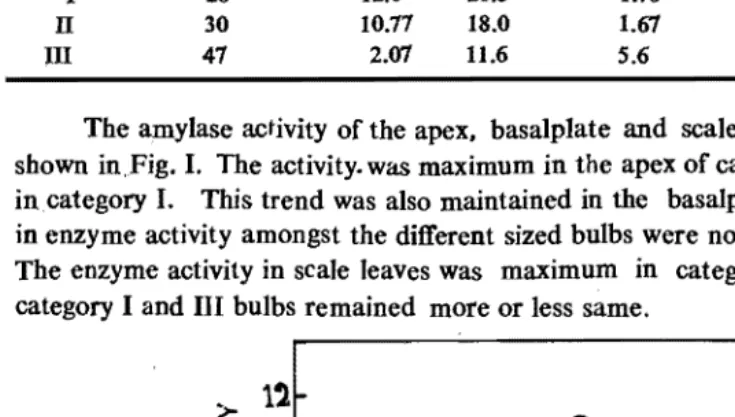
The amylase activity of the apex. basalplate and scale leaves of the bulbs is shown in,Fig. I. The activity. was maximum in the apex of category III and minimum in category I. This trend was also maintained in the basalpJate but the differences in enzyme activity amongst the different sized bulbs were not very much pronounced. The enzyme activity in scale leaves was maximum in category II while that of the category I and III bulbs remained more or less same.
>
f...
>
...
fu
<tW
~
>
N; Z
W i
!
I
f
12
r--8
§.
4-A
I
~
~
E!
A
r
A
r-!!~
I
I
i
I
II
lIT
t
~
CATEGORY
S. l>ATHAK, M.A. CHOuDHlUU A,Ni:>
S.K..
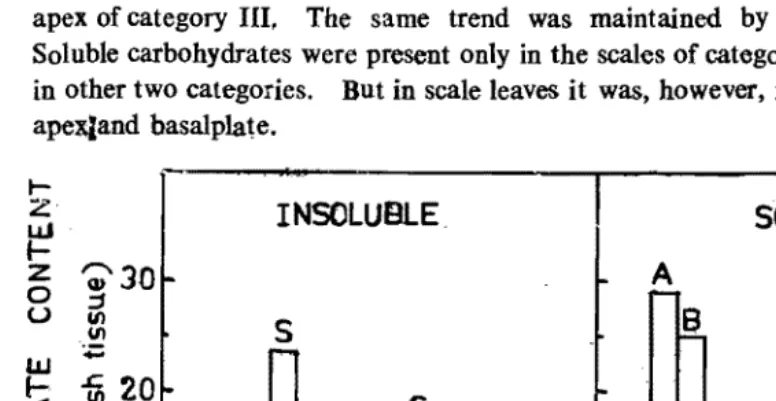
CHA'ITER.m~The insoluble and soluble carbohydrates in the apex, basalplate and the scale leaves are shown in Fig. 2 (a) and (b) respectively. The insoluble carbohydrates in the apex of category I bulbs were maximum and minimum in category III. In the scale leaves these carbohydrates were maximum in category I and minimum in category III. Insoluble carbohydrates were highest in the scale leaves of .category I bulbs (Fig. 2a). The soluble carbohydrates in the apex of category I and II bulbs
did not vary much, while the content of soluble carbohydrates was much less in the 1 apex of category III. The same trend was maintained by the basalplate tissues. , J
I
Soluble carbohydrates were present only in the scales of category I bulbs and absent
1
in other two categories. But in scale leaves it was, however, much less compared to Iape~and basal plate.
INSOLUBLE
SOLUBLE
~
~
~
S
~
B
I"""
-..
A
~
~8
~
A
.
A~
~.r-- ;....
~
~
S
S
I
IZ
l
LIJ
f-z
0
';' 30
::11
U III III +:: LLJ
~
20
~
<IIa:::
I 0.,..
>
r
en10
0
m
entr
E
tS
'-'I
II
III
I
II
III,
CATEGORY
Fig. 2 (a) Insoluble c~rb:>hydrate content (mgjg fresh tissue) in the apical (AJ. basalplate (B) and scale leaf (S) regions of three categories of bulb".
(b) Soluble carbohydrate content (mgjg fresh tissue) in the apical (A); basalplate (B) and scale leaf (S) regtons of the categories of bulbs.
,...
r .
I !
GERMINATION ANDFLOWmtING ·IN TImEROSE 51
Table III. Effects ofpretreatments of different categories of bulbs for different durations with kinetin (300 ppm) and ABA (10 ppm) on their germination behaviour
Number of bulbs germinated after weeks
Treatments Duration Category I Category II Category III
(ppm) (h) 2 3 4 2 3 4 2 3 4
Kinetin 24 10 13 11 20 5 9 13 15 5 10 15 20
(300) 36 10 13 18 20 5 1 9 10 6 9 12 15
48 11 15 19 20 0 5 8 10 1 12 15 15
ABA 24 5 8 10 15 7 16 20 20 15 18 20 20
(10) 36 1 II 15 ]8 10 18 20 20 18 20 20 20
48 10 16 20 20 1 10 15 18 18 20 20 20
Control 6 10 12 ]4 7 12 13 18 13 17 20 20
..
GA was completely ineffective in all the categories of bulbs.
The flowering behaviour of the plants raised from the three categories of bulbs
~~~~~~~~~~~~~~~~
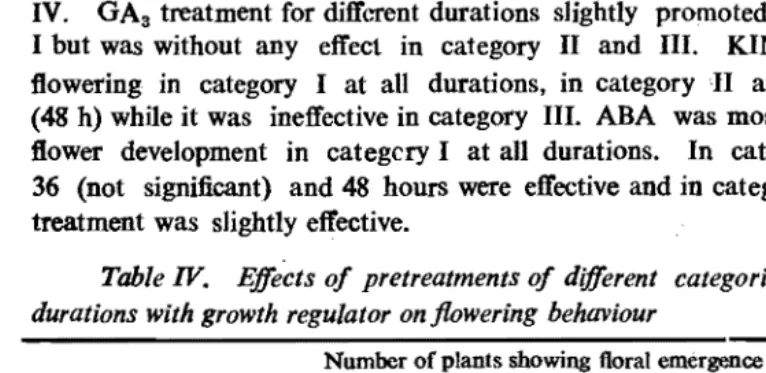
IV. GAa treatment for diff<.-rent durations slightly promoted fl.owering in category I but was without any effect in category II and III. KIN treatment stimulated flowering in category I at all durations, in categoryU at the highest duration (48 h) while it was ineffective in category III. ABA was most effective in promoting flower development in categcry I at aU durations. In categ'ory II treatments for 36 (not significant) and 48 hours were effective and in category III only 24 hours treatment was slightly effective.
TablelV. Effects of pretreatments of different categories of bulbs for differeni durations with growth regulator on flowering behaviour
Number of plants showing floral emergence after weeks Treatment
(ppm)
Duration (b)
-.,
Category I
8 9 10 11 1 8
Category II
9 f(f 11 7
Category
m
8 9 10 11
GA. 24 0 0 0 5 10 0 0 0 0 5 0 0 0 0
(300) 36 0 0 0 5 12 0 0 0 0 5 0 0 0 0 0
48 0 0 0 5 10 0 0 3 5 5 0 0 0 0 0
Kinetin 24 10 12 15 15 15 0 0 0 0 0 0 0 0 0 0
(300) 36 15 18 20 20 20 0 0 0 0 0 0 0 0 0 0
48 10 15 18 20 20 9 13 13 15 15 0 0 0 0 0
ABA 24 0 8 10 15 15 0 0 0 0 0 0 S 5 5 5'
-
(50) 3648 5 5 10 9 15 13 20 15 20 15 S 5 5 6 5 8 8 13 8 14 0 0 0 0 0 0 0 0 0 0
Control 5 5 1 8 8 0 3 5 6 6 0 0 0 4
DJSCUSSION
S2
S. PATHAK, M,A. CHOUDHURI AND S.K. CHATI'ERJEEcategories on the basis of this size difference. The main shoot flowered early only if the bulb was above a certain critical size, while the bulbs germinated earlier when the size fell below a critical dimension. Such differential behaviour of plants propagated by vegetative means has been shown to be directly related to the amount offood reserves contained in them (Bremner and EI-Saeed, 1963; Burton 1966; Afonja 1967; Rees 1969). The analysis with the three categories of bulbs of tuberose showed that the metabolic activity of the category III (small) bulbs was higher than category I (large) so far respiration rate. soluble carbohydrate content and IX-amylase activity were concerned (Table II). The smaller bulbs germinated much earlier than the larger ones. Gibberellin content was much higher in larger bulbs and the flowering was also much earlier in the plants raised from these bulbs. Apparently this situation would lead one to speculate that gibberellin was not responsible for germination initiation in those bulbs but might be involved in early flowering of targer bulbs. Analysis of soluble and insoluble carbohydrate contents in different parts of the bulb showed that the soluble carbohydrates in the apical region of the bulb always remained higher in all categories of bulbs compared to basalplate and scales. This is reminiscent of the enhanced carbohydrate metabolism
in the apical" region of potato tuber (Dimalla and van Staden 1977). Higher metabolic activity was restricted to the apical region of smaller bulbs whereas in the larger bulbs it was lower in apical region and higher in the basalplate and scales. 'I'his suggests that the growth and differentiation of the apex of larger bulbs was perhaps dependent upon the supply of soluble carbohydrates from scales and basal plate where insoluble carbohydrate content and amylase activity were highest. This might be the reason for early and late germination of category III and I bulbs respective]y.
It is interesting to note that GAs had no effect on germination of any of three categories of bulbs whereas KIN and ABA had pronounced promotive effect on germination. Kinetin effect was found to be related to the size difference of the bulbs, being most effective in larger bulbs and least so in smaller bulbs. ABA was found to be etrective in promoting germination in all categories of bulbs but the effect was most spectacular in the smaller bulbs. The higher promotive effect of ABA in smaller bulbs might be correlated with ABA induced hydrolysing enzyme
activity (Mann, 1975). •
Promotion of germination of seeds or bulbs by ABA has not been reported so far. Stimulation of a few growth phenomena by ABA was, however noted by some workers where ABA was shown to either compete for or counter the mhibitory effect of GA (Milborrow 1974). The present experiment supports the above finding and suggests that ABA is intricately involved in germination process of tuberose bulbs which is irrespective of the!r endogenous gibberellin content. The result s also
~owthat GA, and kinetin produced &Ome stim,ulatory effects on tlowerin~ in lar;er
i
,
!
GERMlNATION AND FEOWERINO IN TUBEROSE 53 category of bulbs but they are completely inhibitory in smaller bulbs. On the other hand, ABA was most effective in promoting flowering in all categories of bulbs, though most remarkably in the larger ones. These results further support that ABA was intimately involved in the regulation of growth and development of the three categories of bulbs. The situation would have been further clear if the endogenous cytokinin and ABA levels of these bulbs were critically examined. The present role of ABA in the germination and flowering behaviour of different-sized bulbs received further support from the observations that in Ribes nigrum GA level decreased under short-days wi1h the concomitant increase in ABA resulting in flowering (Wareing and EI-Antably. 1970). Interestingly, under long'days ABA level was very low and this plant did not flower, but when this deficiency was relieved with the exogenous supply of ABA, flowering took place.
ACKNOWLEDGEMENT
The present study was financially supported by the University Grants Commission under a Project No. F-23-17Ij75 (SR II)B
REFERENCES
Afonja, B. (1967). An Analysis of an experiment with plots of dift'erent sizes. Trop. agrlc. Trin., 44 : 39-44.
Bell, D.J. (1955). Mono and oligosaccharides and acidic monosaccharide In: Modern methods 0/
Plant analysis vol. II. (Ed. K. Peach., M.V. Tracey). Springer-Verlag. pp. 1-52.
Biswas. A.K. and ChQudhuri, M. A. (1976). Control of senescence of rice by nutrient sprays at different developmental stages and its impact on yield. Indian J. agric. Sci., 46 (5) : 225-28.
i~ ---and----(1978).Differential behaviour of the flag leaf of intact rice plant doom! ageing. Biochem. Physiol. Pflanzen., 173: 220-28.
Bremner, P.M. and El-Saeed, A. K. (1963). The significance f seed size and spacing. In: The growth 0/Potato (Ed. J.D. Ivins and F.L. Milthorpe) Buttereworths Sci. Publ., London. pp.267-80.
Burton. W.O. (1966)' The Potato. Veeman, Wageningen.
Dimalla, 0.0. and Van Staden. J, (1977). ApIcal dominance and the utilisation of carbohydrates during storage of potato tubers. Ann. Bot., 41 : 387-91.
Jindal, S.l•. (1975). Ornamental bulbous plants (A book published from ICAR, New Delhi).
Mann, J.D. (1975). Mechanism of action of gibberellins. In: Gribberellins and Plant Growth (Ed. H.N. Krishnamoorthy). Wiliey Eastern Limited, New Delhi. pp. 239-87.
Milborrow, B.V. (1974). The chemistry and physiology of abscisic acid. Ann. Rev. Plant. Physiol.,
2S : 259-307.
Rameswar, A. (1976). Tuberose cultivation around Bangalor.;. Indian Hort, 21 (1): 22-23.
Ramaswamy, N. and Chockalingam, P. (1977). Iniluence of weight of tubers on yield of tuberQS<) .
...
S. PA-mAK, M.A. 1 CHOUDHUllIAND S;K.'CHA'ITEJBE
Rees, A.R. (1969). Effect of bulb size on the growth of tulips. Ann Bot., 33: 133-42.
. Reeve, D. R. and Crozier, A. (1975). Gibberellin bioassays. In: Gibberellins and Plant Growth
(Ed. H.N. Krishnamoorthy). Wiley Eastern Limited, New Delhi. pp. 35-64.
'Sadhu, M.K: and Bose, T. K. (1973). Tuberose for most artistic garlands. Indllln Hort., 18(3) :
11-20.
Sharga, A.N. (1977). Tuberose for elegance and fragrance. Indian Hon., 21 (4): 25-29.
Wareing, P.F. and EI-Antably, H.M.M. (1970). The possible roles of endogenous growth inhibitors in the control of flowering. In: G. Berlin (00.) Cellular and Molecular aspects of Floral
lnduction, Longman, London. pp. 285-303.