INDEPENDENT LEARNING WITHIN THE CONTEXT OF HIGHER EDUCATION Zita Baužienė, Aldona Vosyliūtė
Kauno Kolegija, University of Applied Sciences Pramonės pr. 20, Kaunas, Lithuania
Abstract
Constant changes in external environment of higher education (massification of higher education, diversification, high requirements from society and state, students’ expectations, changes in financing system, external and internal competition, internationalisation of higher science and etc.) impose higher and higher study quality related requirements. When planning and organising the study process, higher education institutions have to guarantee and provide conditions facilitating achievement of the study outcomes foreseen in the study programmes. One of the most complicated and important part of the learning process is independent learning. The interrelation between teaching and independent learning within the context of higher education as well as the experiences of the researchers who have analyzed the phenomenon of independent learning are discussed is this article. The core elements needed for independent learning (abilities, skills, motives and etc.) are highlighted and the situations in which they appear are discussed.
The research aimed at identifying factors fostering independent learning among the students of Social Sciences has been the basis for establishing the level of independence as well as providing recommendations for selection of more effective learning strategies and other supportive measures.
Key words: independent learning, self-directed learning, level of independent learning
1. INTRODUCTION
“Whenever I think about the people who have most inspired or motivated me during my life, I return, without fail, to my student days. I can still remember in particular the professor who inspired me in International and European affairs. His positive influence on me then continues to this day…This experience of learning from, and alongside, a good university or college teacher is one that should be shared by every one of the millions of students in Europe today. Not only because good teachers make one’s student days challenging, motivating and rewarding; but because quality higher education teaching is absolutely crucial in enabling our higher education institutions to produce the critically-thinking, creative, adaptable graduates who will shape our future.”
Androulla Vassiliou, European Commissioner for Education, Culture, Multilingualism, Youth and Sport (Report on Modernization of higher education, 2013)
Bologna reforms have dramatically changed the higher education landscape. The restructuring of degrees, the introduction of a three-cycle system as well as the curricular reforms have led the participants of the Bologna Process to change in their higher education systems and higher education mindset. Such phenomena like qualification frameworks, learning outcomes, internal and external quality assurance, transparency tools, emphasis on student-centred teaching and learning which is impossible without counselling, monitoring and interactive ways of teaching requiring the development of new assessment forms that take into consideration not only knowledge but farther reaching competences such as analytical capacity, critical thinking, communication, team working, and intercultural skills imposed a considerable challenge on those acting in the education area and feeling responsible for it (Communication from the Commission, 2012).
Change has always been an inseparable part of human life but it was not as rapid as it is today. Modern, knowledge-based economies require people with higher and more relevant skills who are able
to adapt to constantly changing environments. CEDEFOP forecasts predict that the proportion of jobs in the EU requiring tertiary level qualifications will increase from 29% in 2010 to 34% in 2020, while the proportion of low skilled jobs will fall in the same period from 23% to 18%. By 2020, 20% more jobs will require higher level skills. Despite progress over the last five years in the percentages of those qualifying from higher education, sustained efforts will be needed to reach the headline target of 40% of young people completing higher education (Communication from the Commission, 2012). In order to prepare skilful professionals for today and for demanding future, education needs to set higher requirements imbedded both in standards and levels of achievement.
Teaching and learning in higher education has always been a shared process. Even with the focus on student-centred learning, both a student and a teacher have responsibilities to contribute to their mutual success. Teachers are responsible for creating such learning situations and environments which foster students’ engagement in questioning their ideas and models of the world leading to higher level of understanding. This engagement is not complicated if a student is a self-directed personality having necessary cultural capital (experience, abilities, skills, attitudes etc). But what about those who are not motivated learners ready to face this challenge, or not driven by an inner desire to become qualified specialists (Varaška, 2014)? What if their only desire is a completion of higher education? Will these higher education leavers possess all attributes needed for becoming active players of our rapidly changing modern societies? In order to provide a positive answer to the last question, the best teaching as well as high standards of achievement are the must. According to the report on Modernization of higher education (2013), the best teaching helps students to question their preconceptions, and motivates them to learn, by putting them in a situation in which their existing model does not work – and in which it matters to them that it does not work and in which they come to see themselves as authors of answers, as agents of responsibility for change. That means that students need to be faced with problems which they think are important. They need to engage with new questions which are bigger than the course itself, which have relevance to their own lives and which provoke a lively participation far beyond simply getting through assessment or exams. The best teaching supports evolvement of independent learner and as the result of self-directed personality.
The aim of the article is to identify factors fostering independent learning among the students of social sciences.
The objectives:
• to highlight peculiarities of independent learning on the basis of the analysis of scientific literature;
• to identify the level of independent learning among the students of social sciences; • to reveal factors supporting independent learning.
Methodological provisions for carrying the research
• Pragmatism is a philosophy of true experience, according to which constantly changing reality is a phenomenon that is unfinished, unfixed and pluralistic as the experience of each individual. This approach to understanding the surrounding world leaves space for creativity because it allows individual definition of every single phenomenon. This knowledge position gives freedom for the researcher to choose research methods, techniques, procedures (Patton, 1990; Murphy et. al., 1990; Žydžiūnaitė, 2007). This is why the empiric research described in this paper is based both on qualitative and quantitative methods.
• Holistic approach has been chosen for identification of each individual’s (in this case, a student’s who is the key player of the study process) independent learning behaviour. From methodological point of view, it is very important to realise that before looking for individual’s opinion as well as self-assessment on certain issues each respondent has to be viewed as a functioning and adaptable individual (Maslow, 2006). According to S. Kanišauskas (2008), the whole world is a single organism in which all elements influence each other.
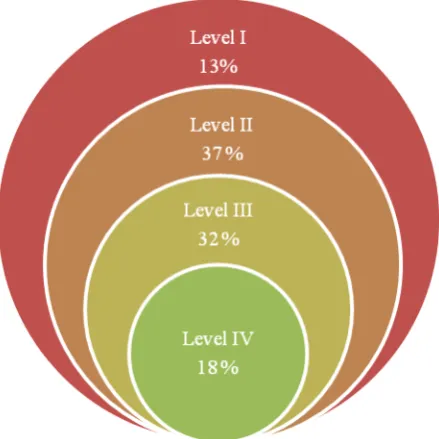
Findings of S. Warring (2010), G. Gedvilienė et. al. (2012) as well as the research results helped to determine the students’ independence level focusing on the following four components which are of the key importance in becoming a self-directed learner: abilities, motivation, beliefs and confidence. Representatives of the first independence level can be characterised by poor abilities, low self-confidence and motivation, and refuse to accept responsibility for poor study achievements. Specific characteristics of the second independence level are poor abilities but high motivation and self-confidence. Good skills and abilities, shared responsibility for the study results, low motivation and self-confidence describe the learners of the third independence level. And typical characteristics of those who are self-directed learners and fall into the fourth independence level are strong abilities, high motivation and self-confidence as well as responsibility for learning and study achievements.
2. INDEPENDENT VS. SELF-DIRECTED LEARNING
The concept of ‘independent learning’ is widely spread and very common not only in academic discourse. This popularity is the result of changes in teaching and learning processes caused by requirements of modern society. As B. Meyer et. al. (2008) and M. O’Doherty (2006) state, academic literature is rich with synonyms to describe this phenomenon: autonomous learning, ownership, independent study, personalisation, student-centred learning, self-directed learning, student initiated learning, project orientation, teaching for thinking, learning to learn, life long learning, self-regulated learning. This abundance of the concepts is confusing, especially when it comes to the fact that the same terms are used to describe different things or vice versa. According to J. Broad (2006), confusion exists due to the number of terms and possible interpretation of those terms.The key problem with the concepts including the term ‘independent’ is identified by the semantic meaning of it. Independent implies going it alone, not depending on other people, not relying on another or others for aid or support. It isabsolutely clear that learning as such is interdependent, and a learner’s success (as it is highlighted in the report on Modernization of higher education, 2013) strongly depends on the quality of teaching and learning.
Higher education has always been associated with ambitious and self-directed personalities ready or willing to become ready for self-directed learning. M. Knowles (1975) points out that in its broadest meaning ‘self-directed learning’ describes a process in which individuals take the initiative, with or without the help of others, in diagnosing their learning needs, formulating learning goals, identifying human and material resources for learning, choosing and implementing appropriate learning strategies, and evaluating learning outcomes. According to M. Gibbon (2004), self-directed learning is any increase in knowledge, skill, accomplishment or personal development chosen by an individual and brought about by his or her own efforts using any method in any circumstances at any time. Moreover, he points out that direction is immobile without motivation, and blind without self-assessment. He also identifies following essential elements of self-directed learning:
• Student control over as much of the learning experience as possible.
• Skill development (inner control is aimless unless students learn to focus and apply their talents and energies intensely).
• Challenge (students learn to challenge themselves to their best possible performance).
• Student management, management of themselves and of their learning enterprises (in self-directed learning choices and freedoms are matched by self-control and responsibilities).
• Students motivate and assess their own efforts.
B. Meyer et. al. (2008) in the review of the literature states, that the authors conceptualise independent learning in terms of processes of self-regulation which are organised around four or more phases for students to complete including: planning, self-monitoring, controlling the pace and direction of the work and evaluation. Self-motivation is also identified as necessary for successful independent learning as well as cognitive, metacognitive and affective skills.
The key role in assisting students to become self-directed learners lies behind teachers. M. Gibbon (2004) introduces idea of a bridge both for students and teachers, a bridge of five stages each involving a new set of tasks, and together providing steps in a gradual transition to self-direction. These five stages are:
• Incidental self-direction: introducing self-direction in assignments, special projects or brief use of any of the other approaches to self-direction.
• Independent thinking: teaching students to form their own judgements, ideas and solutions to problems by transforming the curriculum into questions or by using such participatory approaches as case studies, trials, debates and dramatizations.
• Self-managed learning: creating guides that tell students how to achieve course outcomes, then teaching them how to regulate their work on the guides, and providing support systems to assist them.
• Self-planned learning: teaching students how to design their own plans for achieving course outcomes, negotiating their proposals with them, and coaching them to success.
• Self-directed learning: teaching students to analyze the situation formulate their own goals, plan how to achieve them, take action, solve problems that arise, and demonstrate their achievement. To avoid misunderstandings, the concept of ‘independent learning’ in this article is used to discuss those periods of study process when students work without a teacher (individually or in groups) demonstrating such attributes of self-directed learning like abilities, skills and willpower or motivation.
P. Jarvis (2001) identifies the following three elements of autonomous learning: independence, norms created by a learner and his/her ability to foresee and choose. The author emphasises the importance of relationships between as well as activities of a teacher and a learner for adult education. He also notes that reduction of pedagogical control when organising independent studies fosters development of self-directed learners.
Motivation is one of the most important factors fostering individual’s independence. When discussing this concept, in general sense, it can be described as an energy source and guide for behaviour. This force has such expression as the need for food, love, desire to win (Myers, 2000). Motivation can be divided into:
• internal (aspiration to perform actions because of the activity itself and be active); • external (to perform some activities because of the promised reward).
D. G. Myers (2000) states, that internal motivation helps students achieve better results, especially when working independently.
Respondents of a quantitative research are the first and second year students (N=469) studying social sciences. The data provided by the Centre for Monitoring and Analysis of Science and Studies (2013) leads to observation that the average score of those who received state financing and chose to study social sciences in colleges in 2010 – 2013 is 15,5 and in universities 18,5. It shows that preparation level of college students for studying is poorer if to compare to universities. The research findings are summarised using Microsoft Excel 2013. Nine students studying social sciences were respondents in a free interview which was chosen to carry on a qualitative research. Content analysis was chosen for summarising data collected during these interviews.
3. INDEPENDENCE LEVELS BASED ON THE EMPIRIC RESEARCH FINDINGS Quantitative research finding
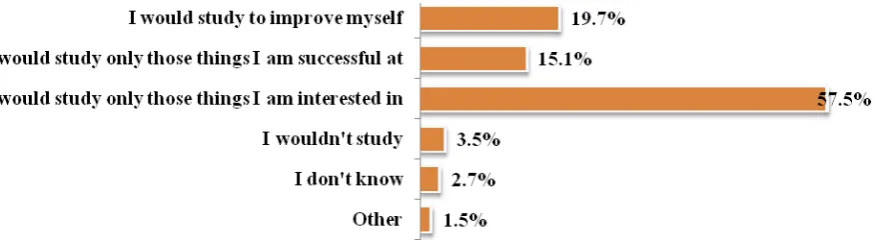
The research findings revealed the fact that more than 57 % of the respondents would study only those subjects which they are interested in (see Picture 1) and 15, 1 % would concentrate on less demanding
subjects which they like and are successful at if their achievements were not assessed. It is necessary to note that 19, 7 % of the respondents would study less attractive study subjects because they are focused on personal development. It leads to conclusion that internal motivation of the last group of respondents is higher.
Picture 1. Spread of the respondents’ opinion in case their achievements are not assessed
According to the research findings, external motivation prevails among the students of social sciences (see Table 1) because they are motivated to study by the rewards for their success (66, 6 %) or when assessment results meet their expectations (66, 4 %). In this case, internal motivation dominates only among 28 % of the respondents; 30, 8 % of the students enjoy hard work leading to foreseen study outcomes and 13, 11 % like complicated tasks.
Table 1. Expression of internal and external motivation
I n t er n al mo t iv a ti o n
Yes Rarely No Don‘t know
I like those study subjects which require extra effort
30,8 51,4 16,2 1,6
I like complicated tasks 13,1 43,6 41,7 1,6
I never move to simple tasks until I learn well what I don‘t know
26,7 41,3 23,6 8,4
E x t er n al mo t iv a ti o n If assessment results meet my expectations, it
motivates for earnest study
66,4 26,3 4,6 2,7
Some form of rewards for good study results motivates me for earnest study
74,9 16,6 4,2 4,3
I study to have a well paid job in the future 77,6 11,6 5,4 5,4
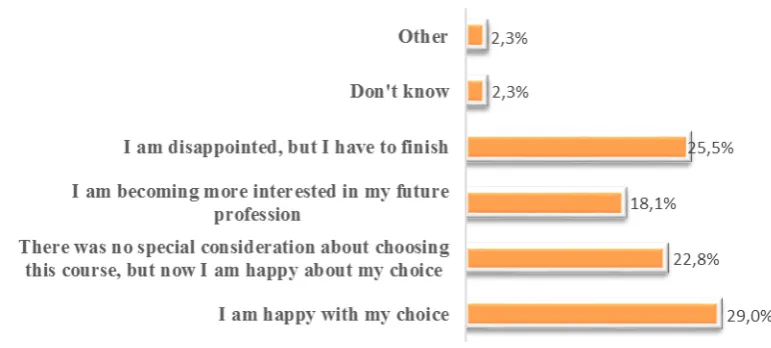
Picture 2. Evaluation of the choice of the study programme
When answering the question about the decision to study social sciences (see Picture 2), 29 % of respondents pointed out that they are happy about their choice, for 22, 8 % it was an accidental solution, but now they are content with it. However, only 18, 1 % of the students pay more attention to deeper studies, and 25, 5 % are disappointed in their choice but want to finish studies.
Picture 3. Factors influencing the choice of studies
For deeper understanding of research findings, it was very important to clarify reasons for choosing to study social sciences (see Picture 3). The research data revealed that 33, 2 % of the respondents always wanted to study in this field, and 15, 1 % chose college studies because of less demanding entry requirements. 12 % were influenced by their parents or friends. However, 25, 5 % are here by accident, and it is likely that their internal motivation is lower than external.
Table 2. Information sources used by students
A from lecture materials but also look for information on the internet 1
B only from lecture materials 2
C from lecture materials, look for information in Lithuanian in the library and on the internet
3
D from lecture materials, look for information on the internet, read literature in the Lithuanian, English and other languages
4
E from what my friends tell me 5
Note. 1 – the most important; 2 – less important; 5 – not important
The following ranking of the information sources used by students is based on research findings. The most popular source is lecture materials and internet. Lecture materials are put to the second position, and a big group of information sources including lecture materials, books in the Lithuanian language as well as internet takes the third place. Information provided by friends is not very popular. These findings reveal that various information sources are used by students when preparing independent learning assignments. It leads to conclusion that teachers have to pay more attention to diversity of self study assignments because they foster deeper interest in the future profession as well as guarantee better study results.
Picture 4. Spread of responsibility for the study achievements (%)
The following picture of the spread of responsibility for the study achievements was highlighted by the research findings: 37, 4 % of the students feel that both they and teachers are responsible for students’ success, and 34, 7 % of the respondents think that they didn’t pay enough attention to independent learning.
According to S. Warring (2010), G. Gedvilienė et. al. (2012) as well as research findings, the following distribution of the students by independence levels can be provided (see Picture 5).
Picture 5. Distribution according to the level of independence
The smallest number of the students falls into the group of the first independence level. Preparation for studies is the lowest among representatives of this group. They feel that teachers are responsible for their study results, and external motivation is dominant among these students. When answering open questions, they state that at school they ‘were taught by poor teachers’. There are 18 % of the students with the fourth (highest) level of independence. High internal motivation, good preparation for studies, feeling responsible for study results are typical characteristics of these students. The biggest numbers of respondents fall into the second (37 %) and third (32 %) independence levels. Their study achievements are average; however, involving study content and interesting assignments foster their transition to a higher independence level.
Summary of the qualitative research findings
Table 3. Peculiarities of independent learning
Categories Key units Interpretations
Planning <... I am more responsible than I have thought...>;<... now I manage to meet the deadlines...>;<...I don‘t know how to
plan time...>;<...because of the lack of control, I can’t meet deadlines...>
It has come to light that some of the students have improved their time
planning skills; it ensures better learning results. However, part of the students still fails to plan independent learning time which leads to poor study
results.
Career <... I am happy with my career choice, but would like to study something else>; <... I have got interested in my speciality and would like to study in the same field for Master’s degree...>; <... I am looking for more information related to my future
profession…>
Those students who demonstrate good study results usually have career plans and are more interested in their future profession. Internal motivation of these
students is increasing.
Simple tasks <...I want to choose lectures...> It has become clear that students with
<... I want to study only interesting things...>
<... I don’t like tasks that require a lot of time...>
stronger external motivation are looking for ‘easier’ studies and prefer simple
tasks.
Responsibility <…if you study, everything will be okay...>; <... a teacher hasn’t spent enough time for explanation...>; <... a teacher is also responsible for student’s
results...>
According to responsibility level, students can be divided into three groups: 1) a responsible student; 2)
responsibility is shared between a student and a teacher; 3) only a teacher
is responsible.
Readiness for study
<... I have chosen this study programme because of my personal interests, but now
I think it is too difficult for me>; <...I didn’t study enough at school..., now it is
too difficult...>; <... I appeared here by accident and now have to finish even
though I don’t want...>
It has been observed that students with poorer secondary education achievements have more difficulties
with studying.
Cooperation <...after explanations, I understood...>; <...I was brave enough to ask questions...>; <...assessment planned in
stages helped me...>; <... interesting tasks supported understanding...>
Teacher’s qualification, the ability to communicate and cooperate with students makes a huge impact on
students’ learning outcomes.
The qualitative research findings were the basis for revealing (see Table 2) factors fostering independent learning. The respondents state that well organised study process as well as properly prepared assignments support development of students’ planning skills. Successful studies encourage career planning which results both in stronger internal motivation and improved self-esteem. Positive teacher-student interaction leads to better understanding of oneself,improved relationships as well as better achievements. These factors create conditions for students to fulfil their needs, express themselves, think and create. Even though the paradigm shift in education has put the learner into the centre of teaching and learning process, it is absolutely clear that the role of the teacher still remains very important.
These findings strongly suggest that student-teacher cooperation is apremise for successful studies.
4. CONCLUSIONS
1. The findings from the opening review of the scientific literature indicate that independent learning depends very much on the processes of self-regulation which are organised around four or more phases for students to complete including: planning, self-monitoring, controlling the pace and direction of the work and evaluation. Self-motivation is also identified as necessary for successful independent learning as well as cognitive, metacognitive and affective skills. Even with the focus on student-centred learning, both a student and a teacher have responsibilities to contribute to their mutual success.
2. The following distribution of the respondents according to independence level has been identified on the basis of the research findings carried out among the students of social sciences: the first level (the lowest independence) – 13 %, the second – 37 %, the third – 32 % and the fourth – 18 %. This information leads to conclusion that a lot of attention has to be paid to the students falling into the first, second and third groups. It can be done through independent study assignments
which have to be performed in certain stages foreseeing feedback from teachers. In other words, their study process has to be controlled.
3. Factors fostering independent learning have been identified on the basis of qualitative research. The most important of them are well organised study process, interesting and involving assignments, positive student-teacher communication and cooperation (which is especially very important during the first year of studies), reinforcement of internal motivation, and development of students planning skills.
REFERENCES
1. Broad, J. (2006). Interpretations of independent learning in further education. Journal of Further and Higher Education. Available at:
http://www.tandfonline.com/doi/abs/10.1080/03098770600617521#.U1o3pYbfqe8 (Accessed 23 April 2014).
2. European Commission (2012). Communication from the Commission to the European Parliament, the Council, the European Economic and Social Committee and the Committee of the Regions. Rethinking Education: Investing in skills for better socio-economic outcomes. Available at: http://eur-lex.europa.eu/legal-content/EN/TXT/PDF/?uri=CELEX:52012DC0669&from=EN (Accessed 17 April 2014).
3. European Commission (2013). Modernization of higher education. Report to the European Commission on improving the quality of teaching and learning in Europe’s higher education institutions. Available at:
http://ec.europa.eu/education/library/reports/modernisation_en.pdf (Accessed 22 April 2014).
4. Gedvilienė, G., Teresevičienė, M., Kaminskienė, L., Žydžiūnaitė, V. (2012). Savimoka ir savarankiškas mokymasis aukštojoje mokykloje: kritinė diskurso analizė./Acta Paedagogika Vilnensia. Available at:
http://www.leidykla.eu/fileadmin/Acta_Paedagogica_Vilnensia/2012_29/47-60.pdf (Accessed 27 March 2014).
5. Gibbons, M. (2004). Motivating Students And Teaching Them to Motivate Themselves. Available at:
http://www.selfdirectedlearning.com/teaching-self-directed-learning-tools/articles/empowering-students.htm (Accessed 15 April 2014).
6. Gibbons, M. (2004). Pardon Me, Didn't I Just Hear A Paradigm Shift. Available at:
http://www.selfdirectedlearning.com/teaching-self-directed-learning-tools/articles/paradigm-shift.html (Accessed 15 April 2014).
7. Jarvis, P. (2001). Mokymosi paradoksai. Kaunas: Vytauto Didžiojo universiteto Švietimo studijų centras.
8. Kanišauskas, S. (2008). Sinergetinio pasaulėvaizdžio kontūrai. Vilnius: Mykolo Riomerio universiteto Leidybos centras.
9. Knowles, M. (1975). Self-directed learning: a guide for learners and teachers. Chicago: Follett
Publishing Company.
10. Maslow, A. H. (2006). Motyvacija ir asmenybė. Vilnius: APOSTROFA.
11. Meyer, B., Haywood, N., Sachdev, D., Faraday, S. (2008). Independent learning. Literature review. Learning and Skills Network. Available at:
https://www.gov.uk/government/uploads/system/uploads/attachment_data/file/222277/DCSF-RR051.pdf (Accessed 20 March 2014).
12. Myers, D. G. (2000). Psichologija. Kaunas: UAB „Poligrafija ir informatika“.
13. Mokslo ir studijų stebėsenos ir analizės centras. (2013). Bendrojo priėmimo į Lietuvos aukštąsias mokyklas 2013 m. apžvalga. Mokslo ir studijų stebėsenos ir analizės centras.
14. Murphy, J., Rotry, R. (1990). Pragmatism: From Pearce to Davidson. Moulder. CO: Westiew Press.
15. O’Doherty, M.(2006). Definitions of Independent Learning – Initial Overview. Available at: http://archive.learnhigher.ac.uk/resources/files/Independant%20Learning/Independent_Learning%5b1 %5d.pdf (Accessed 22 February 2014).
16. Patton, M. (1990). Qualitative evaluation and research methods. Newbury Park, CA: Sage.
17. Varaška, M. (2014) Ištižėliams keliaklupsčiaujame ir universitetuose. Available at:
http://www.delfi.lt/news/ringas/politics/m-varaska-istizeliams-keliaklupsciaujame-ir-universitetuose.d?id=64622215#ixzz2ztBDWE3J (Accessed 25 April 2014)
18. Warring, S. (2010). Facilitating independence amongst Chinese international students completing a Bachelor of Applied Business Studies Degree. Journal of Further and Higher Education. Available at:
http://www.tandfonline.com/doi/abs/10.1080/14703297.2010.518430#.U1o2QIbfqe8 (Accessed 05 February 2014)
19. Žydžiūnaitė, V. (2008). Tyrimo dizainas: struktūra ir strategijos. Kaunas: Technologija.