533
Effect Of Investment In Contract Extension On
PSC Cost Recovery And Gross Split
Yuan Ananda Pratama, Syamsul Irham, Andry Prima, Djunaedi Agus Wibowo
Abstract: The study was conducted to analyze and compare the economic results of the current oil and gas Production Sharing Contract (PSC) systems of Cost Recovery and Gross Split in Indonesia. This was due to the introduction of a new regulation passed through ESDM Regulation No. 08 of 2017 and revised with Permen No.52 Year 2017. Based on data processing and calculations, the economy of the Y field, PSC Gross Split was found to be better with net income contract amounting to 206.42 million US Dollars compared to PSC Cost Recovery of 107.74 million US Dollars with a total investment of 258,41 million US Dollars. Besides, the Net Present Value (NPV) was 107,85 MMUSD and 54,28 MMUSD, Internal Rate of Return (IRR) was 62,24% and 46,82%, and Pay Out Time (POT) was 3,11 years and 3,31 years for Gross Split and Cost Recovery respectively.
Keywords: Production Sharing Contract, Investment, Cost Recovery, Gross Split, Net Present Value, Internal Rate Return, Pay Out Time —————————— ——————————
1.
INTRODUCTION
THE oil and gas sector is one of the largest sources of export for the Indonesian government and the revenue obtained aids national development. Therefore, several efforts have been made by the Government to improve the sector, such as increasing oil production, developing new fields, and forming contract cooperation with contractors through Production Sharing Contract (PSC). Production Sharing Contract (PSC) is a business agreement used in the oil and gas field to increase the revenue of the country by attracting contractors to invest. In Indonesia, there are two types of the contract system and they include Production Sharing Contract Cost Recovery and Gross Split with the main distinguishing characteristic being the cost recovery which is the government’s obligation to return the operating costs by the amount issued by the contractor. The Gross Split was recently launched through the Government of ESDM Regulation No. 08 of 2017 and revised by the ESDM No. 52 of 2017 as a new calculated contract system. This scheme requires the elimination of the Cost Recovery component by ensuring the contractor covers the entire cost of upstream oil and gas operations and vice versa, with the government only obtaining the result of the production division. Moreover, the determination of extra split for contractors depends on the additional percent of variable and progressive splits earned by existing regulations. Y Field is an oil and gas field located in Z Work Area of Jambi province, located on the north side of the South Sumatra basin in the North West and the Bengkulu basin in the Southwest, including onshore fields with a reservoir depth of <2500m. This field started production in 2018 and has 13 active wells with the current contract being a PSC Cost Recovery with 44% tax. The economic analysis of the PSC Gross Split system is the most widely discussed due to the risk involved in the oil and gas industry. This discourse is very interesting as observed in many research papers such as "The new management policy: Gross Split Indonesian PSC applied on CO2 flooding project"[5] and "The new energy management policy: Indonesian Gross PSC split applied on steam flooding
project"[4] by Mr. Syamsul Irham as well as others on PSC Cost Recovery like "Indonesia Milestone in Production Sharing Contracts in Perspective of The Government Take, Contractor Take, Cost Recovery, and Production Target"[2] by Mr. Daniel. Besides, some other research papers have also been written to draw a comparison between Cost Recovery and Gross Split, such as "Valuation of Production Sharing Contract Cost Recovery vs Gross Split in Earth Oil and Gas Cooperation Contracts in Indonesia"[12] by Mrs. Rulandari, "Proposed Modification of ASR mechanism in Gross Split PSC for Marginal Field"[9] by Kurniawan, and "Comparative Analysis of PSC Cost Recovery Contract System with Gross Split in Field Z"[1] by Alaydrus. These publications served as the reference and foundation on which this research was conducted.
2
METHODS
2.1 Production Sharing Contract (PSC)
These are the agreements or contracts made with the contractors by the agency in charge of upstream Oil and Gas businesses (BP MIGAS) to conduct exploration and exploitation activities in Indonesia in order to increase the revenue for the country. The number of years in which this PSC applies depends on the contractual requirements and invention of oil and gas in a commercial amount within a given period. These years can, however, generally be extended through an agreement between the contractor and the Government.
2.2 PSC Cost Recovery
This scheme used by Indonesia since 1960, instead of the concession system, and several changes have been made to produce the First Tranche Petroleum (FTP). This is enforced to ensure initial revenue is obtained before Cost Recovery and management as Upstream oil and gas operations are held by SKK Migas, as government representatives, using this method.
_________________________________
Yuan Ananda Pratama is currently student Undergraduate Program in Petroleum Engineering inTrisakti University.
Syamsul Irham is currently a lecturer of Petroleum Engineering Departement in Trisakti University, E-mail: [email protected] Andry Prima is currently a lecturer of Petroleum Engineering
Departement in Trisakti University.
534
TABLE1
GENERATIONS OF PSC
The Cost Recovery scheme has undergone three generations of change and the first tended to be very simple with the government portion relatively constant at around 50% of production per year. However, the oil crisis due to the activities in the Middle East in 1973-1974 led to the second generation which was characterized by negotiations with the contractor. In 1986, the price of oil was 10$/barrel and this created a new problem due to the importance of oil and gas to the country’s revenue as well as the reduction in production which removed the limit on Cost Recovery to have the third generation. This involved the implementation of 20% First Tranche Petroleum to ensure replacement of cost recovery through the use of a large quantity of oil when there is a tendency for a decrease in prices and all production output can be sucked up by Cost Recovery.
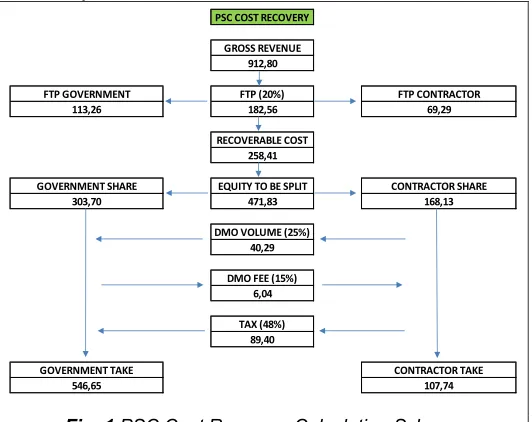
Fig. 1 PSC Cost Recovery Calculation Scheme
2.3 PSC Gross Split
This is a new model of contract based on the principle of gross production sharing without operating costs as implemented through ESDM Regulation No. 08 of 2017 and revised with ESDM Regulation No.52 of 2017. The existence of Cost Recovery in the previous contracts often caused debate due to
the mutual suspicion between contractors and the government, one of which was the determination of the values. Therefore, this scheme was designed by the government and divided into Base, Variable, and Progressive Splits. The split is usually determined at the beginning of the contract using the base division of 57%:43% for oil and 52%:48% for natural gas excluding additional tax for the government. Moreover, ten variable splits that can be added or subtracted by the contractor include Working Area Status (WK), Location of WK (onshore or offshore), Depth of Reservoir, Supporting Infrastructure, Content of CO2 (carbon dioxide), H2S Content Level (sulfur), Specific Gravity, Domestic Component Level (TKDN), and Production Stages. While the two components included in the progressive split are Oil and Gas Prices and Cumulative Production. Some advantages of these additional splits in the contract include investment certainty even though oil prices rise or fall. For example, it is possible for the contractor to obtain additional high splits despite the relatively low price of oil. Furthermore, the cost of oil and gas operations is fully the responsibility of the contractor, and its efficiency determines the profit to be accrued.
Fig. 2 PSC Gross Split Calculation Scheme
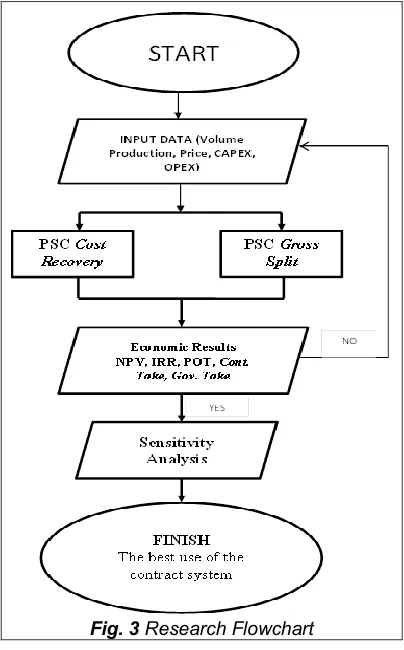
In this section, the steps in calculating the economic analysis of the Y field using the cost recovery are calculated and compared with the Gross Split profit-sharing scheme. It started with the data collection stage to the comparison of the sensitivity analysis in the two contract schemes as follows.
1st PSC Generation
2nd PSC Generation
3rd PSC Generation
(1965-1976) (1976–1988) (1988-Now)
FTP None None 20%
Cost Recovery Ceiling 40%
100% (no ceiling)
80% (due to FTP) Investment Credit 10% 20% 17% to 20%
DMO
DMO was defined as 25% of equity oil at 0.2 cent$/barrel
25% of equity oil, full price for the first 60 months and 0.2 cent $/barrel there after
25% of equity oil, full price for the first 60 months and 10% of export price there after
Equity to be Split
Government:
Contractor
Oil 65%: 35% 85%: 15% 85%: 15%
Gas N/A
70%: 30% or 65%: 35%
70%: 30% or 65%: 35%
258,41 PSC COST RECOVERY
GROSS REVENUE 912,80
FTP (20%) 182,56
FTP CONTRACTOR 69,29 FTP GOVERNMENT
113,26
RECOVERABLE COST
EQUITY TO BE SPLIT 471,83
CONTRACTOR SHARE 168,13 GOVERNMENT SHARE
303,70
GOVERNMENT TAKE 546,65
CONTRACTOR TAKE 107,74 DMO VOLUME (25%)
40,29
DMO FEE (15%) 6,04
TAX (48%) 89,40
PSC GROSS SPLIT
GROSS REVENUE 912,80
SPLIT
GOVERNMENT SHARE 310,35
GOVERNMENT TAKE 447,97
CONTRACTOR SHARE 602,45
DEDUCTABLE EXPANSES 258,41
DMO VOLUME (25%) 40,29
CONTRACTOR TAKE 206,42 DMO FEE (FULL PRICE ICP)
40,29
535
Fig. 3 Research Flowchart
3 RESULTS
&
DISCUSSION
Y Field, located in the working area (WK) of XY uses a PSC Cost Recovery contract system with the contract expiring in 2023. Therefore, it was planned to be further developed through the use of the new contract system, PSC Gross Split with reference to the Republic of Indonesia Minister of Energy and Mineral Resources No. 08 of 2017 Article 24. Moreover, this new method has been previously discussed in "The new energy management policy: Indonesian Gross PSC split applied on steam flooding project"[4] by Mr. Syamsul Irham.
The first step in economic calculations was to obtain production data from Y Field based on Production Forecast as follows:
Fig. 4 Forecast Production Y Field
This was followed by the multiplication with the price of each
and the results obtained is as follows.
Fig. 5 Oil and Gas Price
After the calculation, the gross revenue from Y Field was obtained every year as follows:
Fig. 6 Gross Revenue Y Field
The investment costs found in Y Field consists of CAPEX (Capital Expenditure) such as Development Drilling, Workover, and Production Facilities and Operating Expenditure such as OPEX Oil/Gas and ASR.
Fig. 7 Y Field Investment Costs
After the input data has ben obtained, the economic calculation of the Y Field using the two contract systems was initiated. In the PSC Cost Recovery contract system, several fiscal policies were used.
TABLE2
FISCAL TERMS YFIELD
Fiscal Terms Percentage First Tranche Petroleum (FTP) 20% Oil Contractor Share (After Tax) 15% Oil Government Share (After Tax) 85% Gas Contractor Share (After Tax) 35% Gas Government Share (After Tax) 65%
DMO Fee (Price) 15%
DMO Volume 25%
Tax 44%
Depreciation (Oil 5 Years) 25% Depreciation (Gas 4 Years) 10% Contractor Before Tax (Oil) 26.79% 0 200 400 600 800 1000 1200 1400 2 0 1 8 2 0 1 9 2 0 2 0 2 0 2 1 2 0 2 2 2 0 2 3 2 0 2 4 2 0 2 5 2 0 2 6 2 0 2 7 2 0 2 8 2 0 2 9 2 0 3 0 2 0 3 1 P ro duks i, M B OE Oil Gas 0 20 40 60 80
2017 2019 2021 2023 2025 2027 2029 2031
$
Oil, $/bbl Gas, $/mmbtu
0 50 100 2 0 1 8 2 0 1 9 2 0 2 0 2 0 2 1 2 0 2 2 2 0 2 3 2 0 2 4 2 0 2 5 2 0 2 6 2 0 2 7 2 0 2 8 2 0 2 9 2 0 3 0 2 0 3 1 Gr os s re ve nue , M M USD Oil Gas 0 20 40 60 80 100 2 0 1 8 2 0 1 9 2 0 2 0 2 0 2 1 2 0 2 2 2 0 2 3 2 0 2 4 2 0 2 5 2 0 2 6 2 0 2 7 2 0 2 8 2 0 2 9 2 0 3 0 2 0 3 1 In v es ta si , M M US$
536 Government Before Tax (Oil) 73.21%
Contractor Before Tax (Gas) 62.50% Government Before Tax (Gas) 37.50% While in the PSC gross split contract system, production sharing between the government and contractors was divided directly from gross revenue according to the size of each split depending on the base, variable, and progressive. Following the Indonesian Minister of Energy and Mineral Resources Number 52 of 2017, the amount of base split for contractors was 43% for oil and 48% for gas. The split was adjusted again with a variable through the addition of split contractors based on the ten characteristics of the field.
TABLE3
ADDITION OF VARIABLE SPLIT YFIELD
CHARACTERISTICS PARAMETER CONTRACTOR SPLIT (%)
Field Status POD I 5
Field Location Onshore -
Res. Depth (m) ≤2500 -
Availability of Supporting
Infrastructure Well Developed - Reservoir Type Conventional -
CO2 Content (%) <5 -
H2S Content (ppm) <100 -
SG ≥25 -
TKDN (%) 50≤x<70 3
Production Stages Primer -
TOTAL 8
Moreover, the progressive split based on two characteristics of oil and gas prices and cumulative production was added for the contractor. In the end, the total split obtained by the contractor and government was calculated.
TABLE4
ADDITION OF PROGRESSIVE SPLIT YFIELD CHARACTERISTICS PARAMETER CONTRACTOR SPLIT (%)
Oil Price (US$/BBL) 65 5
Gas Price
(US$/MMBTU) 7 s/d 10 -
Cumulative Production
(MMBOE) <30 10
TOTAL 15
However, after adjusting the fiscal terms for the Cost Recovery, calculations were made with the scheme while the amount in the Gross Split PSC was adjusted to the variables and progressive splits for the contractor. This was followed by the division of Y's gross revenue between the government and the contractor according to the split obtained.
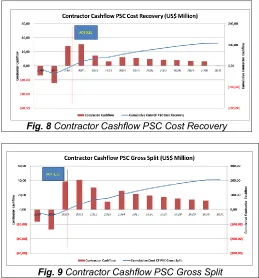
Fig. 8 Contractor Cashflow PSC Cost Recovery
Fig. 9 Contractor Cashflow PSC Gross Split
Therefore, the economic results of the Y Field obtained are as follows:
TABLE5
SUMMARY ECONOMIC CALCULATION OF YFIELD
PARAMETER Cost Recovery Gross Split CAPEX, MMUSD 128.44 128.44
OPEX, MMUSD 129.97 129.97
Gross Revenue,
MMUSD 912.80 912.80
Contractor Take,
MMUSD 107.74 206.42
NPV, MMUSD 54.28 107.85
IRR, % 46.82% 62.24%
POT, year 3.31 3.11
Government Take,
MMUSD 546.65 447.97
The table above shows the economic calculation of Y Field using the Gross Split is better than the Cost Recovery, as observed in all economic indicators, IRR, NPV, and POT. The Gross Split PSC showed a 10% NPV of 107.85 million US Dollars, an IRR of 62.24%, and a POT of 3.11 Years, while PSC Cost Recovery showed a 10% NPV of 54.28 million US Dollars, IRR amounting to 46.82%, and POT for 3.31 years. All these aspects of economic indicators showed Gross Split PSC to be more beneficial for application in the Y field.
4
CONCLUSION
537 NPV of 107.85 million US dollars compared to the PSC Cost
Recovery of 54.28 million US dollars, the IRR value of 62.28% compared to 46.82% and POT at 3.11 years compared to 3.31 years. Moreover, it is also more sensitive to CAPEX, OPEX, production, and price changes compared to the Cost Recovery PSC due to the additional parameters of Variable and Progressive Splits. The most influential parameter observed in this scheme was the 10% split for contractors in cumulative production under the progressive split.
ACKNOWLEDGMENT
The author expresses special gratitude to the college advisors, Mr. Syamsul Irham and Mr. Andry Prima, and also to the office advisor, Mr. Febri who provided the opportunity and helped in conducting this wonderful research. Secondly, the author is grateful to his parents and friends for providing help for the completion of this research within the limited time frame and also for the motivation and prayers.
REFERENCES
[1] Alaydrus, M.E. (2018). Comparative Analysis of PSC Cost Recovery Contract System with Gross Split in Field Z. Final Assessment, Petroleum Engineering Department, Trisakti University.
[2] Daniel, H. (2017). Indonesia Milestone in Production Sharing Contract in Perspective of Government Take, Contractor Take, Cost Recovery and Production Target, Society of Petroleum Engineers. Doi:
https://doi.org/10.2118/187008-MS
[3] Dharmadji, T. (2013). Fiscal Regimes Competitiveness Comparison of Oil and Gas Producing Countries in Asia Pacific, Society of Petroleum Engineers. Doi:
https://doi.org/10.2118/77912-MS
[4] Irham, S., Julyus, P. (2018). The new energy management policy: Indonesian PSC-gross split applied on steam flooding project, IOP Conf. Series: Earth and Environmental Science. Doi: 10.1088/1755-1315/106/1/012109
[5] Irham, S., Sibuea, N.S., Danu, A. (2018). The new management policy: Indonesian PSC-Gross split applied on CO2 flooding project, IOP Conf. Series: Earth and Environmental Science. Doi: 10.1088/1755-1315/106/1/012108
[6] Jaluakbar, W., and Putra, S.I. (2017). Accelerated Depretiation Increase The Economical of PSC Contractors Project in Indonesia, Society of Petroleum Engineers. Doi: https://doi.org/10.2118/186228-MS
[7] Kasyanto, A., Putrohari, R.A., Suryanto, H., Rashid, I.M.A. (2007). PSC Term and Condition and its Implementation in Southeast Asia Region. Indonesia Petroleum Association. Available at:
http://ipapublication.org/home?page=488
[8] Kurniwan, R., and Amir, H., (2017). Fiscal Aspects of Upstream Oil and Gas Business, Nagakusuma Media Kreatif, Jakarta.
[9] Kurniawan, S.T., and Jaenudin, J. (2017). Proposed Modification of ASR mechanism in Gross Split PSC for Marginal Field, Society of Petroleum Engineers. Doi: https://doi.org/10.2118/186378-MS [10]Lubiantara, B. (2012). Oil and Gas Economy
Overview of Commercial Aspects of Oil and Gas Contracts. Gramedia Sarana Indo, Jakarta.
[11]Nasir, K. (2014). History of the Indonesian Fiscal System. Gramedia Sarana Indo, Jakarta.
[12]Rulandari, N., Rusli, B., Mirna, R., Nurmanto, S., Setiawan, M. (2019). Valuation of Production Sharing Contract Cost Recovery Vs Gross Split in Earth Oil and Gas Cooperation Contracts in Indonesia and The Aspect of Public Service, IOP Publishing Ltd. Doi: 10.1088/1742-6596/1114/1/012132
[13]Regulation of the Minister of Energy and Mineral Resources. (2017). Gross Split Production Sharing Contract. Jakarta.
[14]Schantz, R. (2013). Comparison of Petroleum Fiscal Systems and Auctions, Swarthmore. Available at:
https://pdfs.semanticscholar.org/734c/d439ed539d408bb 87aac74d6b3130793297c.pdf