www.earth-syst-dynam.net/2/53/2011/ doi:10.5194/esd-2-53-2011
© Author(s) 2011. CC Attribution 3.0 License.
Earth System
Dynamics
Role of volcanic forcing on future global carbon cycle
J. F. Tjiputra1,3and O. H. Otter˚a2,3
1Geophysical Institute, University of Bergen, Bergen, Norway 2Uni Bjerknes Centre, Uni Research, Bergen, Norway 3Bjerknes Centre for Climate Research, Bergen, Norway
Received: 8 February 2011 – Published in Earth Syst. Dynam. Discuss.: 16 February 2011 Revised: 6 June 2011 – Accepted: 6 June 2011 – Published: 16 June 2011
Abstract. Using a fully coupled global climate-carbon cycle model, we assess the potential role of volcanic eruptions on future projection of climate change and its associated carbon cycle feedback. The volcanic-like forcings are applied to-gether with a business-as-usual IPCC-A2 carbon emissions scenario. We show that very large volcanic eruptions sim-ilar to Tambora lead to short-term substantial global cool-ing. However, over a long period, smaller eruptions sim-ilar to Pinatubo in amplitude, but set to occur frequently, would have a stronger impact on future climate change. In a scenario where the volcanic external forcings are prescribed with a five-year frequency, the induced cooling immediately lower the global temperature by more than one degree be-fore it returns to the warming trend. Therebe-fore, the climate change is approximately delayed by several decades, and by the end of the 21st century, the warming is still below two degrees when compared to the present day period. Our climate-carbon feedback analysis shows that future volcanic eruptions induce positive feedbacks (i.e., more carbon sink) on both the terrestrial and oceanic carbon cycle. The feed-back signal on the ocean is consistently smaller than the ter-restrial counterpart and the feedback strength is proportion-ally related to the frequency of the volcanic eruption events. The cooler climate reduces the terrestrial heterotrophic res-piration in the northern high latitude and increases net pri-mary production in the tropics, which contributes to more than 45 % increase in accumulated carbon uptake over land. The increased solubility of CO2gas in seawater associated with cooler SST is offset by a reduced CO2partial pressure gradient between the ocean and the atmosphere, which re-sults in small changes in net ocean carbon uptake. Similarly, there is nearly no change in the seawater buffer capacity sim-ulated between the different volcanic scenarios. Our study
Correspondence to: J. F. Tjiputra
shows that even in the relatively extreme scenario where large volcanic eruptions occur every five-years period, the induced cooling leads to a reduction of 46 ppmv atmospheric CO2concentration as compared to the reference projection of 878 ppmv, at the end of the 21st century.
1 Introduction
Future climate change is expected to vary considerably ac-cording to the rate of anthropogenic carbon emissions and uptake by both the ocean and the terrestrial biosphere. Earth system models, which contain interactions between the at-mospheric and oceanic physics coupled with the global car-bon cycle, are useful tools for predicting how future climate would evolve under a given anthropogenic greenhouse gas emission scenario. Recent studies using such models have in-dicated that future climate change will reduce the efficiency of the Earth system to absorb the emitted anthropogenic car-bon, and would hence provide a positive feedback (Friedling-stein et al., 2006; Crueger et al., 2008; Tjiputra et al., 2010). Those studies, however, did not take into account not yet pre-dictable factors such as volcanic eruptions or similar external forcings.
minimal effect upon the overall concentrations and thus, do not directly impact the greenhouse effect.
The most important climatic effect of explosive volcanic eruptions is through the emission of sulphur species, mostly as SO2, into the stratosphere. The SO2is rapidly converted into sulphuric acid, which in turn condenses into aerosols. These volcanic aerosols are then spread around the globe by atmospheric circulation and produce aerosol clouds that scat-ter more incoming solar radiation back to the space, resulting in cooler surface temperatures. In addition, volcanic aerosols also absorb both solar and terrestrial radiation, which heat the stratosphere (Robock, 2000). The resulting perturbation to the Earth’s radiative balance, in turn, alters the atmospheric circulation and other climate parameters. However, the large reduction in direct short-wave radiation reaching the surface is the primary response of the volcanic aerosols resulting in a net surface and global cooling.
Sulfate aerosols resulting from strong volcanic explosions last for 3–5 years in the lower stratosphere. Therefore, it has traditionally been believed that volcanic impacts produce mainly short-term, transient climate perturbations. However, the ocean integrates volcanic radiative cooling and responds over a wide range of time scales. Some recent model stud-ies indicate that very large eruptions or a clustering of major eruptions may represent a substantial climate forcing over decadal to multi-decadal time scales (Stenchikov et al., 2009; Otter˚a et al., 2010). In these studies key variables in the Atlantic climate system, such as sea ice and the ocean cir-culation are found to be quite sensitive to volcanic forcing. The associated processes, especially ocean heat uptake, play a key role in ongoing climate change. An improved assess-ment of possible long-term climate effects of volcanic erup-tions is therefore important in order to put the ongoing cli-mate change into a proper context.
By perturbing the climate system, volcanic eruption will alter the global carbon cycle as well. Studies by Sarmiento (1993) and Jones and Cox (2001) show a measurable change in the atmospheric CO2 concentration growth rate follow-ing the 1991 Mount Pinatubo eruption, which cannot be ex-plained by the changes in anthropogenic carbon emissions alone. A further study by Bousquet et al. (2000) indicates an additional carbon sink of about 2 Pg C in response to the Pinatubo eruption. These changes are dominated by changes in the terrestrial carbon uptake predominantly due to the re-duction in soil remineralization as a result of high latitude cooling following the eruption event.
In addition to the short term change in the terrestrial and oceanic carbon balance, the climate perturbation introduced by the volcanic forcings can also have a long term impact on the global carbon cycle, which introduce an additional feedback to the climate system. For example, in their proba-bilistic study coupled with an ensemble of proxy data, Frank et al. (2010) show a broad distribution of the climate sen-sitivity of the global carbon cycle over the preindustrial pe-riod. This large uncertainty is, to some extent, attributed to
the short-term climate variability (e.g., volcanic eruptions) that is not detected from the proxy record, as also shown in Gerber et al. (2003). A study by Fr¨olicher et al. (2011) in-dicates that short term volcanic forcings, depending on the forcing magnitude, plays an important role in altering the carbon cycle-climate sensitivity. They demonstrate that the change in atmospheric CO2per unit change in global mean surface temperature decreases with increasing magnitude of the volcanic perturbation. For the historical period over the past few decades, other studies has also stated and empha-sized the important roles of volcanic forcings in influencing the observed variability of the air-sea, air-land CO2fluxes, and the airborne fraction of anthropogenic CO2 emissions (Le Qu´er´e et al., 2009; Gloor et al., 2010; Sarmiento et al., 2010). This change in trends and variability could, in turn, further implicate and contribute to the uncertainties of the climate carbon cycle feedbacks, which is suggested to be an important element for the future model projections (Meehl et al., 2007). For the reasons mentioned above, it is therefore necessary to better understand the role of potential future vol-canic forcings on the global carbon cycle to better interpret any uncertainties associated with future climate and carbon cycle projections.
Even though it is well established that volcanic forcings is important for the climate-carbon cycle sensitivity, most studies have so far focused only on analysing this sensi-tivity for the historical periods (e.g., Brovkin et al., 2010; Fr¨olicher et al., 2011). Our study, to the authors’ best knowl-edge, represents the first attempt to assess the role of vol-canic forcings on the future carbon cycle and its respective feedback strength to the climate by using a comprehensive coupled climate-carbon cycle model. Here, we focus on understanding the role of pulse-like volcanic forcings un-der the business-as-usual, IPCC SRES-A2 future CO2 emis-sions scenario. We apply the future emisemis-sions scenario into the Bergen Earth system model (BCM-C), which consists of a fully interactive climate model coupled with interactive oceanic and terrestrial carbon cycle models. In addition to the reference run, three simulations adopting different future volcanic eruption scenarios are performed to better under-stand the role of magnitude and frequency of the eruption events. The spatial and temporal perturbation of the temper-ature and precipitation after the volcanic eruptions event are analyzed together with changes in sea-air and land-air carbon fluxes. Regional change in carbon inventory in both land and ocean reservoirs projected in the future are also assessed.
Earth system remain poorly understood. A more detailed assessment is therefore needed before one could even con-sider the method as promising or would have to reject it. Earth system models, such as the BCM-C, offer the ideal laboratory to perform such sulfur injection schemes in a con-trolled environment, and systematically assess potential im-pacts on climate and environment. Therefore, this study will also improve our understanding how the Earth system, par-ticularly how the global carbon cycle may be influenced by stratospheric sulphur injection type geoengineering mitiga-tion.
The paper is organized as follows: the next section will describe the model and experiment design adopted in this study. The third section will discuss our experiment results in regards to the global climate sensitivity and changes to the terrestrial and oceanic carbon cycles. The final section includes a discussion and a summary of the paper.
2 Method
2.1 Model description
The Bergen Earth system model (BCM-C) used in this study is an updated version of the Bergen Climate Model (BCM; Furevik et al., 2003) coupled with terrestrial and oceanic car-bon cycle models. The atmospheric component is ARPEGE-Climat version 3 with a truncation at wave number 63 (TL63) and 1800 s time step. A total of 31 vertical levels, ranging from the surface to 0.01 hPa are employed. The current ver-sion differs from the original BCM in that the vertical dif-fusion scheme has been updated to that of ARPEGE-Climat version 4 (Otter˚a et al., 2009). The ocean component is a modified version of MICOM (Bleck and Smith, 1990; Bleck et al., 1992; Bentsen et al., 2004), an isopycnic ocean GCM. It has approximately 2.4◦×2.4◦horizontal resolution with 34 isopycnic vertical layers. The model adopts a single non-isopycnic surface mixed layer, which provides the linkage between the atmospheric forcing and the ocean interior. The ocean carbon cycle model is the Hamburg oceanic carbon cycle (HAMOCC5) model (Maier-Reimer et al., 2005). The HAMOCC5 model simulates carbon chemistry and includes an NPZD-type (nutrient, phytoplankton, zooplankton, and detritus) ecosystem model. The terrestrial carbon model is the Lund-Potsdam-Jena (LPJ) model (Sitch et al., 2003). The LPJ is a large-scale dynamic vegetation model and contains 10 plant functional types. A more detailed description of the BCM-C model and its evaluation are available in Tjiputra et al. (2010).
In all simulations, the BCM-C is interactively coupled with the carbon cycle modules with no flux adjustments applied. In order to simulate volcanic eruptions, sulphur aerosols are injected directly into the stratosphere. Note that the model does not have an interactive aerosol scheme. Thus, for each volcanic scenario experiment, we applied different
atmospheric boundary condition to the model where the op-tical properties of the atmospheric aerosols is modified ac-cording to the different magnitude and frequencies of vol-canic eruption. The volvol-canic aerosol time series is supplied as monthly optical depths at 0.55 microns, in the middle of the visible spectrum (Crowley et al., 2003). The forcing were applied as quarterspheric (30◦N–90◦N, 0–30◦N, 30◦S–0, 90◦S–30◦S) monthly values, and distributed in each model level in the stratosphere (Otter˚a, 2008). The volcanic mass of the stratospheric aerosols are calculated at each grid point and model level in the stratosphere by dividing the total aerosol concentration by the total air mass of all stratospheric levels at that grid point.
The atmosphere model ARPEGE (i.e., the atmospheric component of the BCM-C) is able to reproduce many of the observed features after the Mount Pinatubo eruption (Otter˚a, 2008). Both the simulated short-wave and long-wave reduc-tions as well as the general global cooling after the erup-tion compares favourably with observaerup-tions. In addierup-tion, the observed winter warming pattern over NH land is well captured. This winter warming was caused by an anoma-lously positive phase of the Arctic Oscillation (AO) associ-ated with the enhanced Equator-to-pole temperature gradient in the stratosphere that developed due to aerosol heating of the tropics. Similarly, the opposite summer cooling observed is also produced by the model. Finally, a strong response of the AO/NAO to historical volcanic forcing in BCM (i.e. in coupled mode) has been further confirmed in a long transient simulation of the last 600 years (Otter˚a et al., 2010). 2.2 Experiment design
To validate the model capacity in simulating the expected changes associated to the volcanic forcing perturbation, we performed two historical period simulations (1989–2001). In the first simulation, the model is forced only by the ob-served CO2emissions (the same with experiment REF de-scribed below), whereas the second simulation includes the Pinatubo eruption forcing introduced in the year 1991. The 1991 Mount Pinatubo eruption forcing is taken from histori-cal data set of Crowley et al. (2003).
Next, a total of four future scenario model simulations are performed with the BCM-C model. Note that prior to all model simulations, the model has been spun up for more than 1000-years based on constant preindustrial atmospheric CO2 concentration of 284.7 ppmv. Afterwards, the fully coupled model is simulated from year 1850 to 2019 forced only by prescribed historical and the SRES-A2 CO2 emission time series (Marland et al., 2005; Houghton and Hackler, 2002). The model is then branched out into four separate simula-tions, while still prescribing the A2 emissions scenario to-ward the end of the 21st century.
2020 2030 2040 2050 2060 2070 2080 2090 2100 0
0.1 0.2 0.3 0.4
Year
Aerosol loading
GEO_PIN5 GEO_PIN25 GEO_TAM25
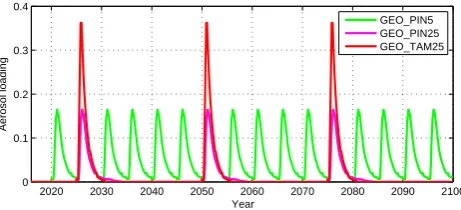
Fig. 1. Mean global change in aerosol loading (optical depth at 0.55 µm) applied to simulate the volcanic forcings in the GEO TAM25, GEO PIN25, and GEO PIN5 experiments.
set of Crowley et al. (2003) and construct three alternative scenarios based on different magnitudes and frequencies. In the second branch, a volcanic eruption corresponding to the Tambora 1815 historical eruption is applied in 25-year in-tervals, starting from year 2025, GEO TAM25. In the third branch a relatively weaker magnitude of volcanic eruption corresponding to the 1991 Mount Pinatubo eruption is ap-plied, also in 25-year intervals from year 2025, GEO PIN25. Finally, in the fourth branch, the Pinatubo-like volcanic erup-tions are applied again, but with higher frequency of 5-year intervals, starting from year 2020, GEO PIN5. Figure 1 il-lustrates the modification in the aerosol loading applied in experiments GEO TAM25, GEO PIN25, and GEO PIN5, shown as change in monthly optical depths at 0.55 microns, in the middle of the visible spectrum. Table 1 summarizes the descriptions of all three model simulations together with the integrated change in optical depth (aerosol loadings) added into each volcanic scenario. This change in aerosol opti-cal depth properties, in turn, alters the incoming short-wave (SW) and emitted long-wave (LW) radiative fluxes at the top of the atmosphere simulated by the atmospheric model in the BCM-C model.
Note that natural volcanic eruptions also release green-house gases such as H2O and CO2, but both in negligible amounts compared to the associated concentrations in the current atmosphere. Thus, only sulfur aerosols are included in this study. The BCM-C future projection and climate-carbon cycle feedback under the SRES-A2 have been evalu-ated and is well within the range of other models (Friedling-stein et al., 2006; Tjiputra et al., 2010).
3 Results
For the present day simulation, Fig. 2 shows that the model simulates a reduction in the global surface temperature fol-lowing the 1991 Pinatubo eruptions, which lasts for some years before returning to the reference value (i.e., as the run without the Pinatubo eruption). In addition to the aerosol-associated atmospheric cooling, the simulated atmospheric
1990 1992 1994 1996 1998 2000 13
13.5 14 14.5
Surface Temperature [°C]
1990 1992 1994 1996 1998 2000 350
360 370 380
Atmospheric CO
2 [ppmv]
1990 1992 1994 1996 1998 2000 −3
0 3 6 9
Terrestrial carbon uptake [Pg C yr−1]
1990 1992 1994 1996 1998 2000 0
0.1 0.2 0.3 0.4
Oceanic carbon uptake [Pg C yr−1]
Fig. 2. Time series of global mean surface temperature, atmospheric CO2concentration, terrestrial and oceanic carbon uptake for the
1989–2001 period. Shown here are two simulations, with (red lines) and without (blue lines) the 1991 Mount Pinatubo eruption.
Table 1. List of the performed experiments with the period of integrations, CO2emissions, volcanic frequencies, and the integrated change
in aerosol optical depth for each volcanic scenario.
Experiment Period CO2emissions Volcanic frequency Aerosol loading
REF 1850–2099 Historical, IPCC-A2 none none
HIST PIN 1989–2001 Historical once (1991) 3.6410
GEO TAM25 2020–2099 IPCC-A2 25-year (from 2025) 18.4819 GEO PIN25 2020–2099 IPCC-A2 25-year (from 2025) 10.9229 GEO PIN5 2020–2099 IPCC-A2 5-year (from 2020) 54.7848
Fig. 3. Regional change in (top) vegetation and (bottom) soil carbon content due to the Mount Pinatubo eruptions computed at year 2001.
a result of stronger terrestrial carbon uptake. The simulated changes in temperature, atmospheric CO2concentration, and carbon uptakes are broadly consistent with earlier studies (Sarmiento, 1993; Bousquet et al., 2000; Lucht et al., 2002; Angert et al., 2004). The increase in terrestrial carbon up-take in our model is dominated by the reduction in the het-erotrophic respiration due to cooler climate. This is shown by the increase in high latitude soil carbon content simulated at year 2001, ten years after the Pinatubo eruption, as shown in Fig. 3. However, the change in vegetation carbon is more complicated, with opposite signals (increase and reduction) occurring in both low latitude and high latitude regions.
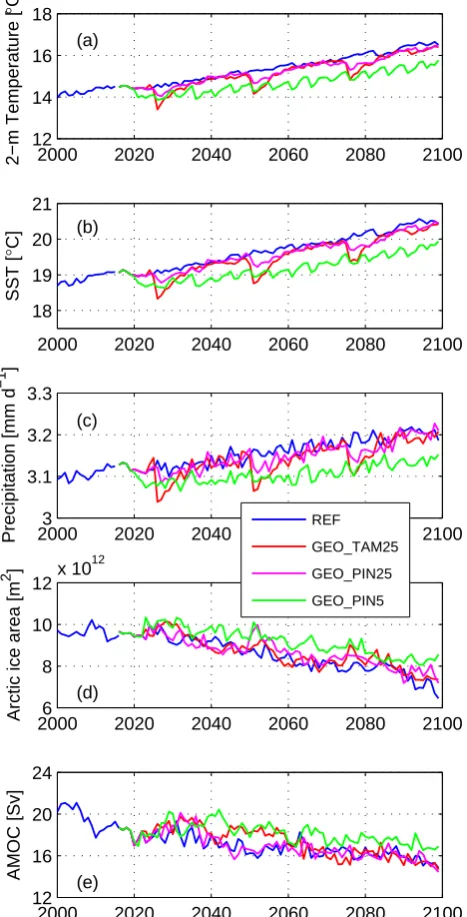
As expected, the simulated short-term cooling effect is weaker in GEO PIN25 than in GEO TAM25. However, when the frequency of volcanic forcings is increased, GEO PIN5, the short-term cooling associated with the first few volcanic events accumulate and the overall persisted warming trend is delayed by several decades. Figure 4 also shows that the warming rate in GEO PIN5 is not as sharp as in the REF with the simulated global air temperature being approximately one degree lower.
Similar to the temperature, the global mean precipita-tion also undergoes changes. As a result of a reducprecipita-tion in incoming SW radiation, the model simulates global reduc-tions in evaporation and atmospheric water vapor content (not shown), thus decreasing the global precipitation. Similar to the temperature signals, the short-term reduction in global precipitation is strongest in the GEO TAM25 run. Interest-ingly, by the end of the 21st century, GEO PIN5 simulates relatively small changes in global precipitation relative to the period before the volcanic forcings are introduced (i.e., year 2019), despite the fact that considerable changes in SST and air temperature are predicted. Figure 4 also illustrates that in GEO TAM25, GEO PIN25, and GEO PIN5 the Arctic sea ice extent and the Atlantic Meridional Overturning Circu-lation (AMOC) are expected to decrease toward the end of the experiment period, closely following the REF simulation. Again, the GEO PIN5 simulates the least reduction by the end of the experiment period.
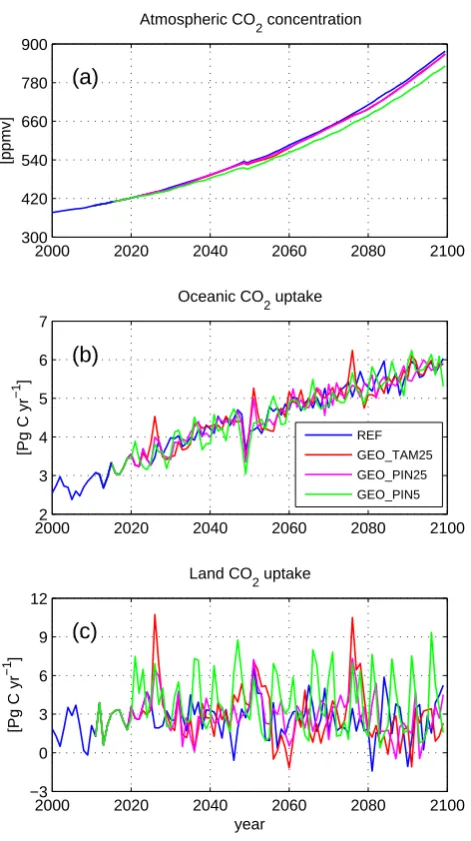
With regards to the global carbon cycle, there are notice-able increases in both the oceanic and terrestrial carbon up-takes following the volcanic events in GEO TAM25 as com-pared to the REF. Nevertheless, REF, GEO TAM25, and GEO PIN25 all project virtually the same atmospheric CO2 concentration by the end of the 21st century (Fig. 5). Figure 5 also indicates that the volcanic-like forcings induce tempo-rary increases in oceanic and terrestrial carbon uptakes, with the land uptake being more pronounced. The terrestrial and oceanic carbon uptakes simulated by GEO PIN25 generally resemble that of GEO TAM25, but with weaker amplitudes. In the GEO PIN5, the volcanic forcings induce a more pronounced change in the terrestrial carbon uptake than the oceanic counterpart. For the 2020 to 2099 period, the model simulates accumulated oceanic and land carbon uptake of 373.1 and 313.5 Pg C, as compared to 377.0 and 215.9 Pg C simulated in REF (see also Table 2). Therefore, to a first or-der, an increase in terrestrial carbon uptake in GEO PIN5 could explain the simulated 45.6 ppmv lower atmospheric CO2concentration at the end of the 21st century (i.e., differ-ence in terrestrial carbon uptake of 97.6 Pg C approximately corresponds to 46.7 ppmv).
In the next subsection, we will attempt to quantify the global climate sensitivity, carbon feedback associated to the volcanic forcings, and analyze the post-eruption changes. Due to the relatively small changes simu-lated in GEO TAM25 and GEO PIN25 compare to REF,
2000 2020 2040 2060 2080 2100
12 14 16 18
2−m Temperature [
°
C
]
(a)
2000 2020 2040 2060 2080 2100
18 19 20 21
SST [
°
C] (b)
20003 2020 2040 2060 2080 2100
3.1 3.2 3.3
Precipitation [mm d
−1
]
(c)
20006 2020 2040 2060 2080 2100
8 10
12x 10
12
Arctic ice area [m
2 ]
(d)
REF
GEO_TAM25
GEO_PIN25
GEO_PIN5
2000 2020 2040 2060 2080 2100
12 16 20 24
AMOC [Sv] (e)
Fig. 4. Model projection of global mean (a) 2-m surface air tem-perature, (b) sea surface temtem-perature, (c) precipitation, (d) summer (September) Arctic sea ice area, and (e) Atlantic Meridional Over-turning Circulation (AMOC) strength for each experiments.
our post-eruption analysis will be focused more on the GEO PIN5 results.
3.1 Climate sensitivity and carbon feedback
Table 2. Simulated change in global mean temperature (1T), atmospheric CO2concentration (1CA), oceanic (1CO) and terrestrial (1CL)
carbon content, and residual carbon uptake (ROandRL) computed over the 2020–2099 period.
Experiment 1T [◦C] 1CA[ppmv] 1CO[Pg C] 1CL[Pg C] RO[Pg C] RL[Pg C]
REF 2.10 454.30 377.03 215.88 0.00 0.00
GEO TAM25 1.99 446.13 377.11 230.15 5.22 10.10
GEO PIN25 2.04 444.81 375.77 235.90 6.25 22.73
GEO PIN5 1.42 408.73 373.09 313.48 23.25 66.95
2000 2020 2040 2060 2080 2100
300 420 540 660 780 900
Atmospheric CO
2 concentration
[ppmv]
(a)
20002 2020 2040 2060 2080 2100
3 4 5 6 7
Oceanic CO
2 uptake
[Pg C yr
−1
]
(b)
REF GEO_TAM25 GEO_PIN25 GEO_PIN5
2000 2020 2040 2060 2080 2100
−3 0 3 6 9 12
Land CO2 uptake
[Pg C yr
−1
]
year
(c)
Fig. 5. Model projection of annual mean (a) atmospheric CO2
con-centration, (b) oceanic carbon uptake, and (c) terrestrial carbon up-take over the 2000–2099 period.
global mean temperature and atmospheric CO2 of 2.1◦C and 454.3 ppmv, respectively. These quantities yield a cli-mate sensitivity of 0.0046◦C ppmv−1for the BCM-C model over the studied period. The value is reasonable and well within the range of the other Earth system models of 0.0038– 0.0082◦C ppmv−1(Friedlingstein et al., 2006). Table 2 sum-marizes the change in global mean temperature and carbon content in the atmosphere, ocean, and land for each volcanic scenario simulation over the 2020–2099 period. Multiplying the climate sensitivity above with the change in atmospheric CO2 concentration yields the expected change in tempera-ture of 2.05, 2.05, and 1.88◦C for the three volcanic scenario simulations. Therefore, by the end of experiment period, the aerosol loading added into the GEO TAM25, GEO PIN25, and GEO PIN5 experiments lead to additional cooling of 0.06, 0.01, and 0.46◦C, respectively. While this suggests that the aerosol loading indeed induce cooling to the global temperature, over a long period, the effect is generally small, except for the case when large volcanic eruptions occur very frequent (i.e., GEO PIN5).
The volcanic forcings also induce changes in both the oceanic and terrestrial carbon content. Following Friedling-stein et al. (2006), the change in oceanic and terrestrial car-bon uptake due to change in temperature and atmospheric CO2concentration can be estimated as follows:
1COi = βO1CAi +γO1Ti +ROi, (1)
1CLi = βL1CAi +γL1Ti +RLi, (2) where1C represents change in carbon inventory in atmo-sphere (A), ocean (O), and land (L) for each experimenti. Here, we include residual terms (RiL andROi), which rep-resent the change in land and oceanic carbon inventory at-tributed to the volcanic eruption forcing in each scenario. For the period of 2020–2099, the sensitivity of ocean and land carbon storage to change in atmospheric CO2(βO/βL) computed from experiments in Tjiputra et al. (2010) are equal to 0.9346 and 0.9903 Pg C ppmv−1, respectively. Sim-ilarly the change in ocean and terrestrial carbon content to temperature change (γO/γL) are equal to −22.6470 and
Latitude
Temperature [°C]
(a)
−1 −0.5 0 0.5 −30
0 30 60
Precipitation [mm d−1]
(b)
−0.3−0.15 0 0.15 0.3 −30
0 30 60
NPP [Pg C]
(c)
−0.2−0.1 0 0.1 0.2 0.3 −30
0 30 60
Rh [Pg C]
(d)
−0.2 −0.1 0 0.1 0.2 −30
0 30 60
NEP [Pg C]
(e)
−0.2−0.1 0 0.1 0.2 0.3 −30
0 30 60
1st year 2nd year 3rd year 4th year
Fig. 6. Latitudinal change in annual mean (a) temperature, (b) precipitation, (c) net primary production, (d) heterotrophic respiration, and (e) net ecosystem production over land following the volcanic eruption forcing in GEO PIN5. Colors represent different years immediately follow the eruptions. Both the temperature and precipitation change are computed only for land grid points. The grey shading represents the plus minus one-standard deviation of the year-to-year variability of each variable to indicate whether or not the signals are detectable.
given by Friedlingstein et al. (2006). Inserting these num-ber to Eqs. (1) and (2) yield the oceanic and terrestrial resid-ual terms for each experiment as summarized in Table 2. Table 2 suggests that the volcanic forcings in all volcanic simulations induce positive feedback on the oceanic and ter-restrial carbon cycle (i.e., more carbon uptake). The largest terrestrial residual term is simulated in GEO PIN5, where the land takes up approximately additional 66.95 Pg C. Experi-ment GEO TAM25 yield the smallest increase in terrestrial carbon uptake of 10.10 Pg C. The difference in the terrestrial residual terms are not obvious. For example, despite hav-ing more aerosol loadhav-ing (see Table 1), GEO TAM25 sim-ulates smaller residual term than GEO PIN25. While the ocean demonstrates relatively small change in accumulated carbon uptake in all experiments, the oceanic residual terms also show distinct variations. For example, an additional up-take of 23.25 Pg C is simulated in the GEO PIN5, whereas only 6.25 Pg C is simulated in GEO PIN25, suggesting that the frequency of the volcanic events is of importance. 3.2 Terrestrial carbon cycle
Fluxes of carbon between the atmosphere and the land are primarily controlled by the difference between terrestrial photosynthesis (uptake) and heterotrophic respiration (out-gassing). In order to analyze the regional change in cli-mate and carbon cycle over land associated with the erup-tions, we compute the latitudinal mean change in land surface air temperature, precipitation, net primary tion (NPP), soil respiration, and net ecosystem produc-tion (NEP = NPP−respiration−fire emissions) in the first, second, third, and fourth years after the volcanic events
(Fig. 6). The mean deviation shown in Fig. 6 is computed from all 16 eruption events in GEO PIN5 as compared to the year prior to each eruptions. Latitudinal change in pre-cipitation is well within the standard deviation, suggesting that regional change in precipitation is generally not signifi-cant. However, change in the temperature in the first and sec-ond years show relatively large cooling signals. Changes in terrestrial carbon parameters appear to be detectable only in high latitudes. The largest mean cooling period occurs imme-diately following the volcanic eruption (i.e., first year) with a mean reduction of nearly 1◦C simulated in some regions in the Northern Hemisphere. Afterwards the temperature steadily recovers to the pre-eruption level. This is consistent with study by Brovkin et al. (2010), which also demonstrates a pronounced cooling over high latitude Northern Hemi-sphere landmasses. Also similar to their study, the BCM-C only simulates a small cooling in the Southern Hemisphere, essentially caused by the distinct land and ocean distribution between the two hemispheres.
Over the period when the volcanic forcings are applied, GEO PIN5 simulates NPP and soil respiration reduction of approximately 27.7 and 122.8 Pg C as compared to the REF run. GEO PIN5 also simulates slightly less accumulated car-bon outgassing associated with fire fluxes of 2.4 Pg C. This strongly reduced respiration more than offsets the reduced NPP and essentially leads to increased net terrestrial carbon uptake of about 97.5 Pg C. By the end of the model simula-tion, the LPJ simulates increases in soil, litter and vegetation carbon masses by approximately 34.6, 13.8, and 48.8 Pg C, respectively in GEO PIN5 when compared to REF.
−180 −120 −60 0 60 120 180 −60
−30 0 30 60 90
Vegetation Carbon
−1 −0.5 0 0.5 1
−180 −120 −60 0 60 120 180
−60 −30 0 30 60 90
Soil Carbon
−1 −0.5 0 0.5 1
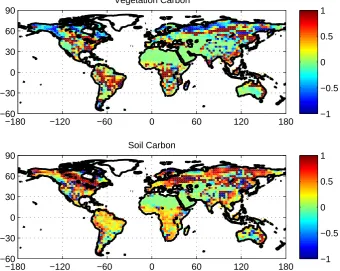
Fig. 7. Mean changes (GEO PIN5 minus REF) in total land (top) vegetation and (bottom) soil carbon content due to additional volcanic forcings computed over 2090–2099 period. Units are in [Kg C m−2].
We attribute the former to the increase in net primary pro-duction as shown in Fig. 6. On the other hand, the net car-bon gain in the mid-latitude Northern Hemisphere is domi-nated by reduced soil respiration due to the simulated cooler temperatures following the eruption events. An earlier mod-eling study by Jones and Cox (2001) features similar mech-anisms in the tropics associated with the Mount Pinatubo eruption. Figure 7 shows that the net primary production in-crease in the tropics leads to an inin-crease in carbon stored in the vegetation pool, whereas reduced respiration in the mid-and high-latitude Northern Hemisphere lead to an increased soil carbon pool in these regions.
3.3 Oceanic carbon cycle
The global carbon uptake by the ocean is not perturbed sub-stantially by the volcanic eruption forcings. Over the 2020– 2099 period, experiments REF, GEO TAM25, GEO PIN25, and GEO PIN5 simulate accumulated oceanic carbon uptake of 377.0, 377.1, 375.8 and 373.1 Pg C, respectively. Nev-ertheless, regional changes would be expected as a result of changing climate. In the model, the carbon fluxes from the atmosphere to the ocean are formulated as a function of solubility, gas transfer rate, and difference in atmospheric and oceanic partial pressure CO2 (pCO2) following Wan-ninkhof (1992). Thus changes in atmospheric circulation and temperature would alter the solubility and gas transfer rate
parameters in the model, whereas changes in terrestrial car-bon fluxes would, in addition, contribute to an altered air-sea pCO2gradient. Changes in the gas transfer rate turns out to be relatively small compared to changes in the solubility (not shown). Figure 8 shows that the solubility of CO2gas in sea-water is expected to steadily decrease toward the end of the 21st century for all ocean regions, based on experiment REF. Cooling effects associated with volcanic eruptions in both the GEO TAM25 and GEO PIN25 can clearly be detected, increasing the solubility temporarily for a few years follow-ing the eruptions before returnfollow-ing to the decreasfollow-ing trend as in REF. In GEO PIN5, more frequent volcanic forcings are able to increase and maintain a high solubility until the mid-21st century before they start to decrease. Interestingly, in the high latitude Southern Ocean, the solubility parameter appears to recover towards the end of experiment period.
Despite the delayed solubility reduction simulated in GEO PIN5, there is no significant increase in global oceanic carbon uptake (see also Fig. 5). In fact, GEO PIN5 sim-ulates approximately 4 Pg C less uptake than the REF. We attribute this to the reduction in the atmospheric CO2 con-centration, associated with a stronger carbon uptake by the terrestrial reservoir. This lower atmospheric CO2 concen-tration reduced the pCO2 gradient between the ocean and atmosphere, thus weakening the oceanic uptake strength.
90oE 180oW 90oW 0o 58oS
18oS 18oN 66oN
2010 2040 2070 2100
56 57 58 59 60 61
Polar Southern Ocean
2010 2040 2070 2100
35 36 37 38 39
Southern Ocean
2010 2040 2070 2100
26 27 28 29
Tropical Indian
2010 2040 2070 2100
26 27 28 29
Tropical Pacific
2010 2040 2070 2100
26 27 28 29
Tropical Atlantic
2010 2040 2070 2100
35 36 37 38 39
North Pacific 342010 2040 2070 2100 35
36 37
North Atlantic
2010 2040 2070 2100
67 68 69 70
Arctic
Fig. 8. Regional evolution of CO2 gas solubility in seawater from 2020 to 2099 period. Plotted here are the five-year running means
from (blue-lines) REF, (red-lines) GEO TAM25, (magenta-lines) GEO PIN25, and (green-lines) GEO PIN5 experiments. Units are in [mmol l−1ppm−1]. Regions are defined as follow: Arctic (>66◦N), North Atlantic (18◦N–66◦N), North Pacific (18◦N–66◦N), Tropical Atlantic (18◦S–18◦N), Tropical Pacific (18◦S–18◦N), Tropical Indian (18◦S–25◦N), mid latitude Southern Ocean (58◦S–18◦S), high latitude Southern Ocean (>58◦S).
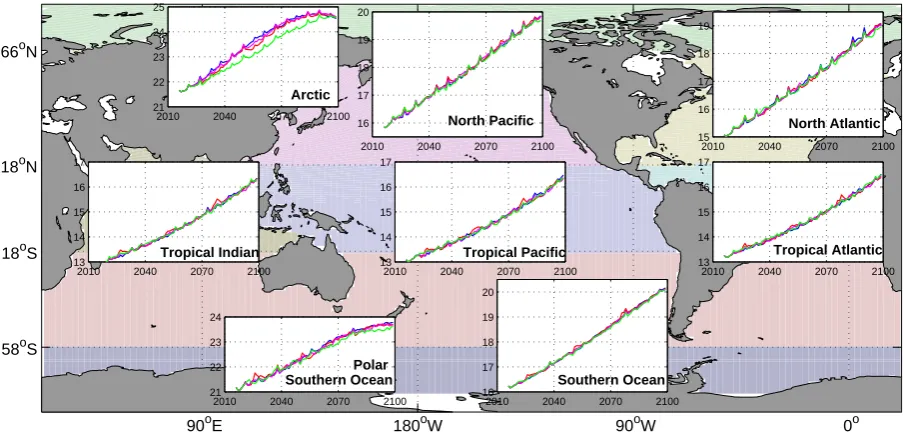
the Revelle factor. The Revelle factor provides a conve-nient means to calculate changes in sea water chemistry, tak-ing into account both the anthropogenic carbon uptake and change in the seawater physical state, such as temperature (Thomas et al., 2007; Egleston et al., 2010). It is computed as the change ofpCO2in seawater for a given change in surface concentration of dissolved inorganic carbon (DIC). Its value is indirectly proportional to atmospheric CO2concentration and reversely proportional to the temperature of the seawater (Zeebe and Wolf-Gladrow, 2001). Therefore, given the same atmospheric CO2concentration, relatively warm low latitude oceans generally have lower Revelle factors whereas colder high latitude oceans have higher Revelle factors (Sabine et al., 2004). This difference in temperature cause the DIC to vary, which in turn, indirectly alters the Revelle factor. As explained in literature (e.g., Mehrbach et al., 1973; Broecker and Peng, 1982), the change in temperature alter the dissoci-ation constant of the chemistry reaction between the differ-ent carbon species (carbonic acid, bicarbonate, and carbon-ate), and therefore, perturbed the equilibrium between these species in seawater. Seawater with high (low) Revelle factor has low (high) buffer capacity of CO2in the associated water mass. For this reason, seawater with low Revelle factor has a higher capacity in taking up anthropogenic CO2from the atmosphere.
Future climate change is associated with raising tempera-ture and atmospheric CO2concentration. While higher sea surface temperature increase the buffer capacity, higher at-mospheric CO2 does the opposite. It is a balance between
these two factors that control the future oceanic buffer ca-pacity, and hence the oceanic carbon uptake. Figure 9 shows the area-weighted regional evolution in the Revelle factor, estimated following Maier-Reimer and Hasselmann (1987). While Fig. 8 shows that the volcanic forcings alter the re-gional solubility of CO2 in seawater considerably, there is principally no change in the simulated Revelle factor (except for the Arctic). This suggests that on large scales, the ocean takes up approximately similar amount of carbon between the three volcanic experiments in this study. We note that while the Revelle factor is a useful indicator for estimating the ocean capacity in absorbing atmospheric CO2, it is im-portant to keep in mind that the state of the ocean surface shown here is far from steady state, due to the transient state of the climate and atmospheric CO2.
90oE 180oW 90oW 0o 58oS
18oS 18oN 66oN
2010 2040 2070 2100 21
22 23 24
Polar Southern Ocean
2010 2040 2070 2100 16
17 18 19 20
Southern Ocean
2010 2040 2070 2100 13
14 15 16 17
Tropical Indian
2010 2040 2070 2100 13
14 15 16 17
Tropical Pacific
2010 2040 2070 2100 13
14 15 16 17
Tropical Atlantic
2010 2040 2070 2100 16
17 18 19 20
North Pacific
2010 2040 2070 2100 15
16 17 18 19
North Atlantic
2010 2040 2070 2100 21
22 23 24 25
Arctic
Fig. 9. Similar to Fig. 8 for the Revelle factor.
whereas GEO PIN5 maintains a relatively higher export pro-duction of 8.7±0.3 Pg C yr−1 at the end of this century, still within the preindustrial variability. Figure 10 shows Hovm¨oller diagrams of mean latitudinal differences in the annual export production between each of the perturbed sim-ulations compared to the REF over the 2020–2099 period. The future reduction in the export production occurs pre-dominantly at high latitudes, due to the simulated shallower mixed layer depth in this regions, consistent with the finding by Steinacher et al. (2010). However, the mixed layer depth reduction in the GEO PIN5 is relatively small compared to the GEO TAM25 and GEO PIN25, mainly due to the fact that GEO PIN5 experience less SST warming (see also Fig. 4). As a result, the GEO PIN5 run projects higher annual export production at the Northern and Southern Hemisphere high latitudes relative to the REF. In the polar latitude South-ern Ocean, the signal is more difficult to interpret, which is attributed to the variations in the projected sea-ice in this re-gions. The pulse in the Equatorial regions could possibly be due to the impact of the volcanic forcings on the ENSO cycle. However, the experiment set up in this study is insuf-ficient to draw any conclusions on how the different volcanic scenarios affect the future ENSO cycles.
Some studies have shown that the volcanic ash deposition could potentially lead to micro-nutrient fertilization (particu-larly iron) and enhance marine biological production locally following the short period after the volcanic event (Frogner et al., 2001; Jones and Gislason, 2008; Watson, 1997). How-ever, a review paper by Duggen et al. (2010) indicates that the scientific community at present lacks a comprehensive understanding of the role of volcanic ash on the marine phy-toplankton growth. In addition, difficulties regarding how to
correctly model the volcanic dust impact on the marine pro-duction also arise from the diversity of particle dust composi-tions for the different volcanic sources and from the effects of volcanic dust on different phytoplankton species. Also, there are large uncertainties associated with the regional distribu-tion of aerial volcanic dust deposidistribu-tion to the ocean, since this is highly dependent on the location of the eruption event. Fi-nally, potential effects of other toxic trace metals associated with volcanic dust on various phytoplankton species remain poorly understood. Therefore, the analysis shown here sim-ply represents the change in biological production that pre-dominantly take place due to changes in the physical vari-ability.
4 Summary and discussion
Future climate and carbon uptake are projected using the Bergen Earth system model under the SRES-A2 emission scenario. To study the potential feedback associated with episodic volcanic forcings within the 21st century, multiple simulations were performed, applying three different scenar-ios of volcanic eruptions. In the first scenario, large volcanic eruptions, comparable to the 1815’s Tambora, are prescribed for the year 2025, 2050, and 2075. On the second, slightly weaker eruptions comparable to the 1991’s Pinatubo, are pre-scribed with the same frequency. On the third, the 1991’s Pinatubo are prescribed with larger occurrence frequency of five-years, starting from year 2020.
Fig. 10.
Hovm¨oller diagrams of difference in annual marine export production between the three volcanic
scenario simulations (GEO TAM25, GEO PIN25, GEO PIN5) with the reference (REF) run for the
2020–2099 period.
36
Fig. 10. Hovm¨oller diagrams of difference in annual marine ex-port production between the three volcanic scenario simulations (GEO TAM25, GEO PIN25, GEO PIN5) with the reference (REF) run for the 2020–2099 period.
temperature perturbation vary depending on the magnitude and frequency of volcanic forcings, predominantly by the lat-ter. In addition, Wigley (2006) and Fr¨olicher et al. (2011) also suggest that the recovery time of the temperature to the pre-eruption condition may vary between models depend-ing on the climate sensitivity. We show that while aerosol loading indeed induce cooling to the global mean tempera-ture, over a long period only an experiment with a high fre-quency of volcanic events simulates a long-lasting impact. For the preindustrial period, Fr¨olicher et al. (2011) show that volcanic eruption could considerably alter the atmospheric CO2 concentration for up to several decades. However, we find that under business-as-usual future scenario, the back-ground increase in atmospheric CO2associated with the an-thropogenic emissions would dominate.
For all experiments, there are positive feedbacks (i.e., more carbon uptake) on both the oceanic and terrestrial car-bon reservoirs as a result of the volcanic forcings. Our experiments show that the feedback on the global carbon cy-cle is dominated by the terrestrial biosphere. Cooling over land leads to prolonged soil carbon turnover rate in mid-latitude Northern Hemisphere and increased vegetation car-bon budget at low latitudes, resulting in overall net carcar-bon uptake. In some regions such as the polar Northern Hemi-sphere, the reduced soil respiration still prevails over the low-ered photosynthesis rate. The enhanced carbon uptake by the land biosphere following a volcanic eruption is well sup-ported by both modeling and inversion studies (Bousquet et al., 2000; Jones and Cox, 2001; Lucht et al., 2002; Brovkin et al., 2010) for the historical periods. Nevertheless, the re-gional uptake anomalies vary considerably between studies. For example, increased carbon content in the tropics is sug-gested by Jones and Cox (2001) and Brovkin et al. (2010), whereas the study by Bousquet et al. (2000) indicates more terrestrial carbon uptake in the Northern Hemisphere regions (e.g., north of 45◦N) due to eruption-induced cooling. An-other study by Lucht et al. (2002), using a similar dynam-ical vegetation model as the BCM-C, also simulates high-latitude carbon uptake following the Pinatubo eruptions. In-terestingly, the BCM-C simulates increased carbon content both in the tropics and Northern Hemisphere following the eruption events. We attribute this to the additional “CO2 fer-tilisation effect” induced in our model’s future projections because the model does not simulate clear signals in the veg-etation carbon content following the 1991 Mount Pinatubo eruption under the present day condition (see Fig. 3). Addi-tionally, Tjiputra et al. (2010) have shown that the tropical terrestrial NPP in the BCM-C model is sensitive to an in-crease in atmospheric CO2. Thus the increase in the tropical vegetation carbon content shown in Fig. 7 is likely driven by the higher atmospheric CO2concentrations simulated in the model future projections.
Over the ocean, the volcanic eruptions reduce the ocean heat content, and consequently lower the projected SST (Gregory, 2010). This condition favour stronger atmospheric CO2uptake because the solubility of CO2 gas is higher in colder water, though the solubility effect is partly counter-acted by a decrease in buffering ability at lower temperatures (i.e., under colder temperature, there are less occurring disso-ciation of carbonic acid into carbonate ion, which is impor-tant for buffering the dissolved CO2 at the ocean surface). In addition, simultaneous and stronger terrestrial carbon up-take lead to a reduction in atmospheric CO2, lowering the pCO2 gradient between the atmosphere and the ocean. On large-scales, all of these factors contribute to relatively small changes in the buffer capacity of the seawater, which resulted in small changes in long-term oceanic carbon uptake among the different experiments.
warming. This perturbation only last for a short term pe-riod until the background climate warming trend returns and come into effect. Our study indicates that geoengineering methods mimicking the volcanic eruptions would be in prin-ciple, and if no other reasons would speak against the proce-dure, reduce the anthropogenic climate change to some ex-tent. The experiments also show that such methods could offer some benefits to the Earth system, such as by delay-ing the future warmdelay-ing rate, increasdelay-ing anthropogenic carbon uptake, and slowing down the reduction in marine produc-tivity. Nevertheless, there remain many unanticipated con-sequences that could lead to potentially catastrophic conse-quences. For example, the potential stratospheric ozone de-struction, potential acid rain, effects on cirrus clouds, im-pacts of the released volcanic dust on terrestrial and ma-rine ecosystem (Sarmiento, 1993; Duggen et al., 2010), and changes in regional atmospheric and ocean circulation that may need decades or centuries to recover (Jones et al., 2011). All of these factors remain poorly understood and the recent geoengineering studies (Matthews and Caldeira, 2007; Jones et al., 2010; Llanillo et al., 2010) include the warning that, should geoengineering fail or be stopped abruptly, it could lead to very rapid climate change, with warming rates up to 20 times greater than present-day rates. Even if such meth-ods can be deployed successfully, our study suggests that a high concentration of atmospheric CO2would remain in the atmosphere for a long time. Also, since our simulations do not produce considerable change in oceanic carbon uptake, the ocean could still be expected to acidify considerably by the end of the 21st century.
There are also some caveats associated with the model used in this study. The ocean biogeochemistry model does not take into account any potential iron fertilization associ-ated to the dust released by the volcanic eruptions (Duggen et al., 2010). The current version of the land carbon cycle model does not take into account change in diffuse light as-sociated with changes in aerosol loadings. Mercado et al. (2009) show that changes in the cloud cover arising from vol-canic eruptions alter the photosynthetically active radiation, hence the terrestrial carbon balance. The LPJ also does not implement nitrogen limitation, which could alter the carbon uptake due to climate change (Bonan and Levis, 2010).
Acknowledgements. We thank Christoph Heinze for the discus-sions and valuable feedbacks, Caroline Roelandt for reviewing the early version of the manuscript. We also thank Chris Jones and an anonymous referee for their thorough reviews and suggestions, which considerably improved the manuscript from its initial ver-sion. This study at the University of Bergen and Bjerknes Centre for Climate Research is supported by the Research Council of Nor-way funded project CarboSeason (grant no. 185105/S30), and the EU FP7 large-scale integrating projects CARBOCHANGE (grant no. 264879) and COMBINE (grant no. 226520). We acknowledge the Norwegian Metacenter for Computational Science and Storage Infrastructure (NOTUR and NorStore, “Biogeochemical Earth system modeling” project nn2980k and ns2980k) for providing
the computing and storing resources essential for this study. This is publication no. A342 from the Bjerknes Centre for Climate Research.
Edited by: P. Friedlingstein
References
Angert, A., Biraud, S., Bonfils, C., Buermann, W., and Fung, I.: CO2seasonality indicates origins of post-Pinatubo sink,
Geo-phys. Res. Lett, 31, L11103, doi:10.1029/2004GL019760, 2004. Bentsen, M., Drange, H., Furevik, T., and Zhou, T.: Simulated vari-ability of the Atlantic meridional overturning circulation, Clim. Dynam., 22, 701–720, 2004.
Bleck, R. and Smith, L. T.: A wind-driven isopycnic coordinate model of the North and Equatorial Atlantic Ocean, 1. Model development and supporting experiments, J. Geophys. Res., 95, 3273–3285, 1990.
Bleck, R., Rooth, C., Hu, D., and Smith, L. T.: Salinity-driven Ther-mocline Transients in a Wind- and Thermohaline-forced Isopyc-nic Coordinate Model of the North Atlantic, J. Phys. Oceanogr., 22, 1486–1505, 1992.
Bonan, G. B. and Levis, S.: Quantifying carbon-nitrogen feedbacks in the community land model (CLM4), Geophys. Res. Lett., 37, L07401, doi:10.1029/2010GL042430, 2010.
Bopp, L., Monfray, P., Aumont, O., Dufresne, J.-L., Le Treut, H., Madec, G., Terray, L., and Orr, J. C.: Potential impact of climate change on marine export production, Global Biogeochem. Cy., 15, 81–99, 2001.
Bousquet, P., Peylin, P., Ciais, P., Le Qu´er´e, C., Friedlingstein, P., and Tans, P. P.: Regional changes in carbon dioxide fluxes of land and oceans since 1980, Science, 290, 1342–1346, 2000. Broecker, W. S. and Peng, T. H.: Tracers in the sea, Eldigio Press
Lamont Doherty Geological Observatory, New York, 500–568, 1982.
Brovkin, V., Lorenz, S. J., Jungclaus, J., Raddatz, T., Timmreck, C., Reick, C. H., Segschneider, J., and Six, K.: Sensitivity of a coupled climate-carbon cycle model to large volcanic eruptions during the last millennium, Tellus B, 62, 674–681, 2010. Crowley, T., Baum, S. K., Kim, K.-Y., Hegerl, G. C., and Hyde, W.
T.: Modeling ocean heat content changes during the last millen-nium, Geophys. Res. Lett., 30, 1932, 2003.
Crueger, T., Roeckner, E., Raddatz, T., Schnur, R., and Wet-zel, P.: Ocean dynamics determine the response of oceanic CO2 uptake to climate change, Clim. Dynam., 31, 151–168,
doi:10.1007/s00382-007-0342-x, 2008.
Crutzen, P. J.: Albedo enhancement by stratospheric sulfur injec-tions: a contribution to resolve a policy dilemma?, Climatic Change, 77, 211–219, 2006.
Frank, D. C., Esper, J., Raible, C. C., B¨untgen, U., Trouet, V., Stocker, B., and Joos, F.: Ensemble reconstruction constraints on the global carbon cycle sensitivity to climate, Nature, 463, 527–530, doi:10.1038/nature08769, 2010.
Friedlingstein, P., Cox, P., Betts, R., Bopp, L., von Bloh, W., Brovkin, V., Cadule, P., Doney, S., Eby, M., Fung, I., Gala, B., John, J., Jones, C., Joos, F., Kato, T., Kawamiya, M., Knorr, W., Lindsay, K., Matthews, H. D., Raddatz, T., Rayner, P., Re-ick, C., Roeckner, E., Schnitzler, K.-G., Schnur, R., Strassmann, K., Weaver, A. J., Yoshikawa, C., and Zeng, N.: Climate-carbon cycle feedback analysis: Results from the C4MIP model inter-comparison, J. Climate, 19, 3337–3353, 2006.
Fr¨olicher, T. L., Joos, F., and Raible, C. C.: Sensitivity of atmo-spheric CO2and climate to explosive volcanic eruptions,
Bio-geosciences Discuss., 8, 2957–3007, doi:10.5194/bgd-8-2957-2011, 2011.
Frogner, P., G´ıslason, S. R., and ´Oskarsson, N.: Fertilizing potential of volcanic ash in ocean surface water, Geology, 29, 487–490, 2001.
Furevik, T., Bentsen, M., Drange, H., Kindem, I. K. T., Kvamstø, N. G., and Sorteberg, A.: Description and evaluation of the Bergen climate model: ARPEGE coupled with MICOM, Clim. Dynam., 21, 27–51, doi:10.1007/s00382-003-0317-5, 2003.
Gerber, S., Joos, F., Br¨ugger, P. P., Stocker, T. F., Mann, M. E., Sitch, S., and Scholze, M.: Constraining temperature variations over the last millennium by comparing simulated and observed atmospheric CO2, Clim. Dynam., 20, 281–299,
doi:10.1007/s00382-002-0270-8, 2003.
Gloor, M., Sarmiento, J. L., and Gruber, N.: What can be learned about carbon cycle climate feedbacks from the CO2
airborne fraction?, Atmos. Chem. Phys., 10, 7739–7751, doi:10.5194/acp-10-7739-2010, 2010.
Gregory, J. M.: Long-term effect of volcanic forcing on ocean heat content, Geophys. Res. Lett., 37, L22701, doi:10.1029/2010GL045507, 2010.
Hansen, J., Sato, M., Ruedy, R., Lacis, A., Asamoah, K., Boren-stein, S., Brown, E., Cairns, B., Caliri, G., Campbell, M., Cur-ran, B., de Castro, S., Druyan, L., Fox, M., Johnson, C., Lerner, J., McCormick, M. P., Miller, R. L., Minnis, P., Morrison, A., Pandolfo, L., Ramberran, I., Zaucker, F., Robinson, M., Russell, P., Shah, K., Stone, P., Tegen, I., Thomason, L., Wilder, J., and Wilson, H.: A Pinatubo climate modeling investigation, in: The Mount Pinatubo eruption: Effects on the atmosphere and climate, edited by: Fiocco, G., Fua, D., and Visconti, G., NATO ASI Se-ries, Ser. I, 42, 219–231, 1996.
Houghton, R. A. and Hackler, J. L.: Carbon flux to the atmosphere from land-use changes, Trends: A compendium of data on global change, Carbon Dioxide Information Analysis Center, US De-partment of Energy, Oak Ridge, TN, USA, 2002.
Jones, A., Haywood, J., and Boucher, O.: Climate impacts of geo-engineering marine stratocumulus clouds, J. Geophys. Res., 114, D10106, doi:10.1029/2008JD011450, 2009.
Jones, A., Haywood, J., Boucher, O., Kravitz, B., and Robock, A.: Geoengineering by stratospheric SO2injection: results from
the Met Office HadGEM2 climate model and comparison with the Goddard Institute for Space Studies ModelE, Atmos. Chem. Phys., 10, 5999–6006, doi:10.5194/acp-10-5999-2010, 2010.
Jones, A., Haywood, J., and Boucher, O.: A comparison of the cli-mate impacts of geoengineering by stratospheric SO2injection
and by brightening of marine stratocumulus cloud, Atmos. Sci. Lett., 12, 176–183, doi:10.1002/asl.291, 2011.
Jones, C. D. and Cox, P. M.: Modeling the volcanic signal in the atmospheric CO2record, Global Biogeochem. Cy., 15, 453–465,
2001.
Jones, M. T. and Gislason, S. R.: Rapid releases of metal salts and nutrients following the deposition of volcanic ash into aque-ous environments, Geochim. Cosmochim. Acta, 72, 3661–3680, 2008.
Le Qu´er´e, C., Raupach, M. R., Canadell, J. G., Marland, G., Bopp, L., Ciais, P., Conway, T. J., Doney, S. C., Feely, R., Foster, P., Friedlingstein, P., Gurney, K., Houghton, R. A., House, J. I., Huntingford, C., Levy, P. E., Lomas, M. R., Majkut, J., Metzl, N., Ometto, J. P., Peters, G. P., Prentice, I. C., Randerson, J. T., Running, S. W., Sarmiento, J. L., Schuster, U., Sitch, S., Viovy, T. T. N., van der Werf, G. R., and Woodward, F. I.: Trends in the sources and sinks of carbon dioxide, Nat. Geosci., 2, 831–836, doi:10.1038/ngeo689, 2009.
Llanillo, P., Jones, P. D., and von Glasow, R.: The influence of stratospheric sulphate aerosol deployment on the surface air tem-perature and the risk of an abrupt global warming, Atmosphere, 1(1), 62–84, doi:10.3390/atmos1010062, 2010.
Lucht, W., Prentice, I. C., Myneni, R. B., Sitch, S., Friedlingstein, P., Cramer, W., Bousquet, P., Buermann, W., and Smith, B.: Cli-mate control of the high-latitude vegetation greening trend and Pinatubo effect, Science, 296, 1687–1689, 2002.
Maier-Reimer, E. and Hasselmann, K.: Transport and storage of CO2in the ocean-an inorganic ocean-circulation carbon cycle
model, Clim. Dynam., 2, 63–90, 1987.
Maier-Reimer, E., Kriest, I., Segschneider, J., and Wetzel, P.: The HAMburg Ocean Carbon Cycle Model HAMOCC5.1 – Technical Description Release 1.1, Berichte zur Erdsystem-forschung 14, ISSN 1614-1199, Max Planck Institute for Me-teorology, Hamburg, Germany, 50 pp., 2005.
Marland, G., Boden, T. A., and Andres, R. J.: Global, regional, and national CO2 emissions, Trends: A compendium of data
on global change, Carbon Dioxide Information Analysis Center, US Department of Energy, Oak Ridge, TN, USA, 2005. Matthews, H. D. and Caldeira, K.: Transient climate-carbon
simu-lations of planetary geoengineering, P. Natl Acad. Sci. USA, 104, 9949–9954, doi:10.1073/pnas.0700419104, 2007.
Meehl, G. A., Stocker, T. F., Collins, W. D., Friedlingstein, P., Gaye, A. T., Gregory, J. M., Kitoh, A., Knutti, R., Murphy, J. M., Noda, A., Raper, S. C. B., Watterson, I. G., Weaver, A. J., and Zhao, Z.-C.: Global climate projections, in: Climate Change 2007: The Physical Science Basis. Contribution of Working Group I to the Fourth Assessment Report of the Intergovernmental Panel on Climate Change, edited by: Solomon, S., Qin, D., Manning, M., Chen, Z., Marquis, M., Averyt, K. B., Tignor, M., and Miller, H. L., Cambridge University Press, Cambridge, UK and New York, NY, USA, 747–845, 2007.
Mercado, L. M., Bellouin, N., Sitch, S., Boucher, O., Huntingford, C., Wild, M., and Cox, P. M.: Impact of changes in diffuse ra-diation on the global land carbon sink, Nature, 458, 1014–1017, doi:10.1038/nature07949, 2009.
Moore, J. C., Jevrejeva, S., and Grinsted, A.: Efficacy of geoengi-neering to limit 21st century sea-level rise, P. Natl. Acad. Sci. USA, 107(36), 15699–15703, doi:10.1073/pnas.1008153107, 2010.
Otter˚a, O. H.: Simulating the effects of the 1991 Mount Pinatubo volcanic eruption using the ARPEGE atmosphere general circu-lation model, Adv. Atmos. Sci., 25, 213–226, 2008.
Otter˚a, O. H., Bentsen, M., Bethke, I., and Kvamstø, N. G.: Simu-lated pre-industrial climate in Bergen Climate Model (version 2): model description and large-scale circulation features, Geosci. Model Dev., 2, 197–212, doi:10.5194/gmd-2-197-2009, 2009. Otter˚a, O. H., Bentsen, M., Drange, H., and Suo, L.: External
forc-ing as a metronome for Atlantic multidecadal variability, Nat. Geosci., 3, 688–694, doi:10.1038/ngeo955, 2010.
Rasch, P. J., Tilmes, S., Turco, R. P., Robock, A., Oman, L., Chen, C. C., Stenchikov, G. L., and Garcia, R. R.: An overview of geoengineering of climate using stratospheric sulphate aerosols, Philos. T. Roy. Soc. A, 366, 4007–4037, 2008.
Robock, A.: Volcanic eruptions and climate, Rev. Geophys., 38, 191–219, 2000.
Robock, A., Oman, L., and Stenchikov, G. L.: Regional climate responses to geoengineering with tropical and Arctic SO2 injections, J. Geophys. Res., 113, D16101,
doi:10.1029/2008JD010050, 2008.
Robock, A., Bunzl, M., Kravitz, B., and Stenchikov, G. L.: A test for geoengineering?, Science, 327, 530–531,, 2010.
Royal Society: Geoengineering the climate, Policy Report 09/09, Royal Society, London, 2009.
Sabine, C. L., Feely, R. A., Gruber, N., Key, R. M., Lee, K., Bullis-ter, J. L., Wanninkhof, R., Wong, C. S., Wallace, D. W. R., Tilbrook, B., Millero, F. J., Peng, T.-H., Kozyr, A., Ono, T., and Rios, A. F.: The oceanic sink for anthropogenic CO2, Science,
305, 367–371, 2004.
Sarmiento, J. L.: Atmospheric CO2stalled, Nature, 365, 697–698,
1993.
Sarmiento, J. L., Gloor, M., Gruber, N., Beaulieu, C., Jacobson, A. R., Mikaloff Fletcher, S. E., Pacala, S., and Rodgers, K.: Trends and regional distributions of land and ocean carbon sinks, Bio-geosciences, 7, 2351–2367, doi:10.5194/bg-7-2351-2010, 2010. Sitch, S., Smith, B., Prentice, I. C., Arneth, A., Bondeau, A., Cramer, W., Kaplan, J. O., Levis, S., Lucht, W., Sykes, M. T., Thonicke, K., and Venevsky, S.: Evaluation of ecosystem dy-namics, plant geography and terrestrial carbon cycling in the LPJ dynamic global vegetation model, Global Change Biol., 9, 161– 185, 2003.
Steinacher, M., Joos, F., Fr¨olicher, T. L., Bopp, L., Cadule, P., Cocco, V., Doney, S. C., Gehlen, M., Lindsay, K., Moore, J. K., Schneider, B., and Segschneider, J.: Projected 21st century decrease in marine productivity: a multi-model analysis, Bio-geosciences, 7, 979–1005, doi:10.5194/bg-7-979-2010, 2010. Stenchikov, G., Delworth, T. L., Ramaswamy, V., Stouffer, R. J.,
Wittenberg, A., and Zeng, F.: Volcanic signals in oceans, J. Geo-phys. Res., 114, D16104, doi:10.1029/2008JD011673, 2009. Thomas, H., Friederike Prowe, A. E., van Heuven, S., Bozec, Y.,
de Baar, H. J. W., Schiettecatte, L.-S., Suykens, K., Kon´e, M., Borges, A. V., Lima, I. D., and Doney, S. C.: Rapid decline of the CO2buffering capacity in the North Sea and implications for
the North Atlantic Ocean, Global Biogeochem. Cy., 21, GB4001, doi:10.1029/2006GB002825, 2007.
Tjiputra, J. F., Assmann, K., Bentsen, M., Bethke, I., Otter˚a, O. H., Sturm, C., and Heinze, C.: Bergen Earth system model (BCM-C): model description and regional climate-carbon cycle feedbacks assessment, Geosci. Model Dev., 3, 123–141, doi:10.5194/gmd-3-123-2010, 2010.
Wanninkhof, R.: Relationship between wind speed and gas ex-change over the ocean, J. Geophys. Res., 97, 7373–7382, 1992. Watson, A.: Volcanic iron, CO2, ocean productivity and climate,
Nature, 385, 587–588, doi:10.1038/385587b0, 1997.
Wigley, T. M. L.: A combined mitigation/geoengineering approach to climate stabilization, Science, 314, 452–545, 2006.
Zeebe, R. E. and Wolf-Gladrow, D. E.: CO2in seawater: