Asthmatic School Children
WHAT’S KNOWN ON THIS SUBJECT: Hypothalamic-pituitary-adrenal axis suppression caused by inhaled corticosteroids is considered rare. Adrenal crisis has been described in children treated with high doses of inhaledfluticasone propionate. It was recommended that doses licensed for children should not be exceeded.
WHAT THIS STUDY ADDS: Biochemically confirmed hypothalamic-pituitary-adrenal axis dysfunction may occur in two-thirds of children treated with corticosteroids. Suppression may occur at low doses and especially with concomitant nasal steroids. Children with poor adherence or obesity may be less prone to adrenal crisis.
abstract
BACKGROUND AND OBJECTIVE: Hypothalamic-pituitary-adrenal axis suppression (HPAS) when treating children with corticosteroids is thought to be rare. Our objective was to determine the prevalence of and predictive factors for various degrees of HPAS.
METHODS:Clinical features of HPAS, doses, adherence, asthma score, and lung functions were recorded in 143 asthmatic children. The overnight metyrapone test was performed if morning cortisol was .83 nmol/L. Spearman correlations coefficients (r) were calculated between 3 postmetyrapone outcomes and each continuous variable. A multiple linear regression model of √postmetyrapone adrenocorticotropic hormone (ACTH) and a logistic regression model for HPAS were developed.
RESULTS:Hypocortisolemia was seen in 6.1% (1.8–10.5), hypothalamic-pituitary suppression (HPS) in 22.2% (14.5–29.9), adrenal suppression in 32.3% (23.7–40.9), HPAS in 16.3% (9.3–23.3), and any hypothalamic-pituitary-adrenal axis dysfunction in 65.1% (56.5–72.9). Log daily nasal steroid (NS) dose/m2was associated with HPAS in the logistic regression model (odds ratio = 3.7 [95% confidence interval: 1.1–13.6]). Daily inhaled corticosteroids (ICSs) 1 NS dose/m2 predicted HPAS in the univariate logistic regression model (P = .038). Forced expiratory volume in 1 second/forced vital capacity ,80% was associated with HPAS (odds ratio = 4.1 [95% confidence interval: 1.0–14.8]). Daily ICS1 NS/m2dose was correlated with the postmetyrapone ACTH (r=20.29, P,.001). BMI (P= .048) and percent adherence to ICS (P,.001) and NS (P= .002) were predictive of√postmetyrapone ACTH (R2= .176).
CONCLUSIONS: Two-thirds of children on corticosteroids may have hypothalamic-pituitary-adrenal axis dysfunction. In one-third, central function had recovered but adrenal suppression persisted. Predictive factors for HPAS are NS use, BMI, and adherence to ICS and NS. Pediatrics2012;130:e1512–e1519
AUTHORS:Ekkehard Werner Zöllner, MB ChB, MMed (Paed), DCH, DTM&H, DPH,aCarl J. Lombard, PhD,bUshma
Galal, MSc,bF. Stephen Hough, MB ChB, FCP, MMed, MD,c
Elvis M. Irusen, MB ChB, PhD,dand Eugene Weinberg, MB
ChB, FCPe
aPaediatric Endocrine Unit, Tygerberg Children’s Hospital, cEndocrine Unit, Department of Medicine, anddPulmonology
Division, Tygerberg Hospital, University of Stellenbosch, Cape Town, South Africa;bBiostatistics Unit, Medical Research Council,
Cape Town, South Africa; andeAllergy Unit, Red Cross Children’s
Hospital, University of Cape Town, Cape Town, South Africa
KEY WORDS
pituitary-adrenal-function tests, adrenal insufficiency, steroids/ adverse effects, asthma
ABBREVIATIONS
11DOC—11-deoxycortisol
ACTH—adrenocorticotropic hormone AS—adrenal suppression
BDP—beclomethasone dipropionate BSA—body surface area
CI—confidence interval
FEV1—forced expiratory volume in 1 second
FVC—forced vital capacity
HP—hypothalamus and pituitary gland HPA—hypothalamic-pituitary-adrenal axis
HPAS—hypothalamic-pituitary-adrenal axis suppression HPS—hypothalamic-pituitary suppression
HV—height velocity ICS—inhaled corticosteroid NS—nasal steroid MDI—metered dose inhaler OCS—oral corticosteroid
ONMTPT—overnight metyrapone test SDS—SD score
TS—topical steroid WV—weight velocity
Hypothalamic-pituitary-adrenal axis sup-pression (HPAS) when treating asthmatic children with inhaled corticosteroids (ICSs) or nasal steroids (NSs) was be-lieved to be uncommon.1–6The insulin
tolerance and metyrapone tests do not confirm this belief.7,8 Regarding the
former, a cohort study revealed that when asthmatic children are treated with a beclomethasone dipropionate (BDP) chlorofluorocarbon metered dose inhaler (MDI) without a spacer at a dose of 250 to 600mg/m2per day, all children can be expected to have a suppressed hypothalamic pituitary axis (HPA) after 6 to 42 months.8,9When
the metyrapone test was performed on asthmatic children treated with a budesonide, chlorofluorocarbon, or hydrofluoroalkane MDI (with or without a spacer), as well as with nasal BDP, the prevalence of HPAS was 35% (95% confidence interval [CI]: 17–56).10There
are many possible explanations for the difference in the findings of these 2 studies,101 of which is highlighted later.
Suppression of the hypothalamus and pituitary due to exogenous cortico-steroids precedes inactivity and atrophy of the adrenal glands. On removal of corticosteroids, central recovery pre-cedes peripheral recovery, which often requires “supernormal” plasma adre-nocorticotropic hormone (ACTH) levels. Adrenal function might take a mini-mum of 9 months to normalize.11 The
metyrapone test is ideally suited to distinguish between the various levels of suppression of the HPA.12In atopic
children, steroid omission by the child or the caregiver may trigger the recov-ery of the hypothalamus and pituitary gland (HP). This could lead to some chil-dren presenting with impaired adre-nal (inadequate rise of 11-deoxycortisol [11DOC] on metyrapone testing) rather than impaired HP function (inadequate rise of ACTH on metyrapone testing). Patients with hypopituitarism respond differently. In these patients, the
adre-nals may not have lost their function yet, because HP impairment did not occur long enough or was only mild. Consequently, far more patients can be expected to have hypothalamic pitui-tary suppression (HPS) without con-comitant adrenal dysfunction.13
In our recently published pilot study, we identified the concomitant use of NSs, the cumulative dose of ICSs, and body size as contributing factors to the de-velopment of HPAS in asthmatic children treated with ICSs. Confirmation in a larger study became necessary. We, therefore, performed a study to determine the prevalence of and the predictive factors for various degrees of HPAS in asthmatic children treated with corticosteroids in the allergy units of academic children’s hospitals in Cape Town, South Africa.
METHODS
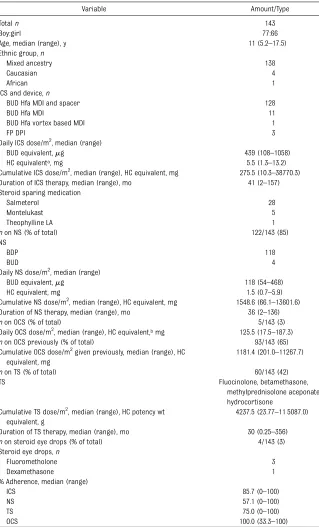
One hundred forty-three asthmatic chil-dren, 5 to 18 years old on ICSs with or without additional corticosteroid therapy, were recruited from the allergy units of Tygerberg Children’s Hospital, Red Cross Children’s Hospital, and the Lung Institute over a 2-year period (Table 1). Every eligible patient $11 years and every second eligible patient,11 years was included, and informed consent was obtained. Children who were known to have HPA dysfunction, had untreated hypothyroidism or liver disease, and who were treated with phenobarbi-tone, phenytoin, rifampicin, amitriptyline, chlorpromazine, neomercazole, or hor-mone replacement therapy were ex-cluded. Symptoms compatible with past (hypoglycemia, shock, depressed level of consciousness, and seizures) and present HPAS (anorexia, nausea, vom-iting, diarrhea, weakness, lassitude, and dizziness) were documented. The daily and cumulative dose of ICSs, NSs, topical steroids (TSs), and oral corti-costeroids (OCSs) were recorded. ICS, NS, and OCS doses were corrected for body surface area (BSA) and converted
to hydrocortisone equivalents.14,15 All
TSs were converted, on weight for weight basis, to hydrocortisone potency equivalents.16 Adherence to
corticosteroid therapy was assessed by 2 different investigators at different times by inquiring how many doses had been omitted in the preceding week. The highest number of omissions was re-corded. The asthma control question-naire was administered, lung functions (forced expiratory volume in 1 second (FEV1), forced vital capacity (FVC), and peak expiratory flow rate established, and the asthma score was deter-mined.17Height, weight, and change in
systolic blood pressure, as measured with an electronic blood pressure measuring device, were recorded. The annualized height velocity (HV) and weight velocity (WV) were calculated by extracting the height and weight data of ∼1 year earlier from the records. The following growth standards were used: the UK 1990 weight, height, and BMI standards; the UK 1966 HV standards for HV; and the Gerver 2001 WV standards for WV. Anthropometric measurements and velocities were recorded as SD scores (SDSs). Fasting blood between 8 am and 9 am for cortisol and ACTH was taken. The overnight metyrapone test (ONMTPT) was performed if the fasting morning serum cortisol was
.83 nmol/L. An adequate response was defined by a rise of ACTH from baseline to .106 pg/mL (23.3 pmol/L),18 an
11DOC rise to .208 nmol/L,19 or an
11DOC1cortisol rise to.400 nmol/L.19,20
Because the assays used in this study were different from the assays in the original description, the published cutoffs were modified by correlation studies, done either in-house (11DOC) or by the manufacturer (ACTH).
Assays
Serum cortisol was measured with the ADVIA automated chemilumines-cent assay (Bayer, Dublin, Ireland). The analytical sensitivity was 5.5 nmol/L. At
107.05 nmol/L, the intraassay coefficient of variation (CV) was 3.69%, whereas the interassay CV was 5.45%. No cross-reactivity to fluticasone, budesonide, beclomethasone, or prednisone is
known. ACTH was measured by an au-tomated sequential chemiluminescent immunometric assay (Immulite 2000, Siemens Healthcare Diagnostics, Flan-ders, NJ). Its analytical sensitivity was 5
from 8.7% (within run) to 10% (run-to-run). No cross-reactivity has been reported. Levels of plasma 11DOC were established by utilizing the Biosource competitive radioimmunoassay. Its an-alytical sensitivity was 0.1 nmol/L; 0.1% cross-reactivity with cortisol has been reported. The intraassay CV at 82 nmol/ L was 7.8%, and the interassay CV at 95 nmol/L was 14.1%.
Statistical Analysis
Growth velocities were analyzed by Growth Analyzer, version 3.5 (Rotterdam, The Netherlands). Age-adjusted preva-lence of HPAS, hypothalamic-pituitary suppression (HPS), adrenal suppression (AS), and the corresponding CIs were calculated. Spearman correlations (r) were calculated between the post-metyrapone ACTH, 11DOC, 11DOC 1 cortisol, and each continuous variable. The Fisher’s exact test was used to es-tablish the statistical significance of nominal variables. To model ACTH on daily ICS1NS/m2dose, a quantile re-gression of fractional polynomials of order22 and21 was used. The CI of the median ACTH prediction was also obtained. Based on the most significant Spearman correlations, multiple linear regression was carried out to test for associations with postmetyrapone ACTH. A square root transformation of postmetyrapone ACTH was used in the modeling to improve the normality of the model variance. Univariate and multivariate logistic regression was used to test for associations with HPAS. The multiple linear regression and multivariate logistic models were ad-justed for baseline characteristics (age and BMI). Linear and quadratic models were fitted to test for signifi -cance of nonlinear associations. Mathematical corrections for multiple comparisons were not made. Except for the age-adjusted prevalence of HPAS, HPS, and AS, which was carried
Totaln 143
Boy:girl 77:66
Age, median (range), y 11 (5.2–17.5)
Ethnic group,n
Mixed ancestry 138
Caucasian 4
African 1
ICS and device,n
BUD Hfa MDI and spacer 128
BUD Hfa MDI 11
BUD Hfa vortex based MDI 1
FP DPI 3
Daily ICS dose/m2, median (range)
BUD equivalent,mg 439 (108–1058)
HC equivalenta, mg 5.5 (1.3–13.2)
Cumulative ICS dose/m2, median (range), HC equivalent, mg 275.5 (10.3–38770.3) Duration of ICS therapy, median (range), mo 41 (2–157) Steroid sparing medication
Salmeterol 28
Montelukast 5
Theophylline LA 1
non NS (% of total) 122/143 (85)
NS
BDP 118
BUD 4
Daily NS dose/m2, median (range)
BUD equivalent,mg 118 (54–468)
HC equivalent, mg 1.5 (0.7–5.9)
Cumulative NS dose/m2, median (range), HC equivalent, mg 1548.6 (66.1–13601.6) Duration of NS therapy, median (range), mo 36 (2–136)
non OCS (% of total) 5/143 (3)
Daily OCS dose/m2, median (range), HC equivalent,bmg 125.5 (17.5–187.3)
non OCS previously (% of total) 93/143 (65)
Cumulative OCS dose/m2given previously, median (range), HC equivalent, mg
1181.4 (201.0–11267.7)
non TS (% of total) 60/143 (42)
TS Fluocinolone, betamethasone,
methylprednisolone aceponate, hydrocortisone
Cumulative TS dose/m2, median (range), HC potency wt
equivalent, g
4237.5 (23.77–11 5087.0)
Duration of TS therapy, median (range), mo 30 (0.25–356)
non steroid eye drops (% of total) 4/143 (3)
Steroid eye drops,n
Fluorometholone 3
Dexamethasone 1
% Adherence, median (range)
ICS 85.7 (0–100)
NS 57.1 (0–100)
TS 75.0 (0–100)
OCS 100.0 (33.3–100)
BUD, budesonide; DPI, dry powder inhaler; FP,fluticasone propionate; HC, hydrocortisone; Hfa, hydrofluoroalkane; TS, topical steroids.
out in Stata (Stata Corp, College Sta-tion, TX), all other statistical analyses were done with R (www.r-project.org).
RESULTS
Prevalence
The prevalence varied with the degree of suppression of the HPA (Table 2). Hypocortisolemia (serum basal corti-sol ,83 nmol/L) was least common, and AS (postmetyrapone 11DOC,208 nmol/L or 11DOC 1 cortisol ,400 nmol/L) was most common. The prev-alences of HPS (postmetyrapone ACTH
,106 pg/mL [23.3 pmol/L) and HPAS (postmetyrapone ACTH ,106 pg/mL [23.3 pmol/L] and postmetyrapone 11DOC , 208 nmol/L and post-metyrapone 11DOC 1 cortisol ,400 nmol/L) were similar. The whole or part of the axis was suppressed in
two-thirds of patients. Nausea, vomiting, and diarrhea occurred while on ther-apy in only 2 of 8 patients with overt hypocortisolemia (P= .016). Moreover, the symptoms of anorexia, weakness, lassitude, fatigue, or dizziness, as well as an HV,25th percentile, WV, 22 SDS, or orthostatic hypotension (a fall in systolic blood pressure of$20 mm Hg from standing to recumbent), were not prevalent in the suppressed children.
Predictors of Suppression
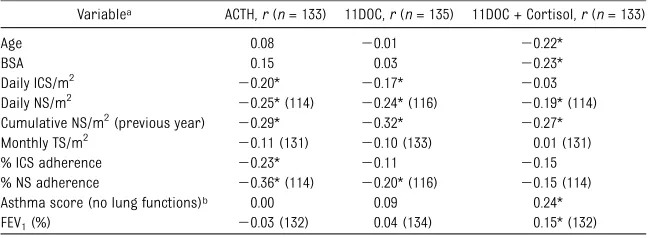
Some variables were weakly, but sig-nificantly, correlated to postmetyrapone ACTH, 11DOC, and/or 11DOC1cortisol (Table 3). No correlation was found with the cumulative OCS, ICS, NS, or TS/m2, the monthly TS/m2 and the asthma score. There was no significant associ-ation between HPAS and the number of
OCS courses administered in the pre-ceding year (P= .355). There was also no significant (Rue de l’Industrie, Nivelles, Belgium) difference in the average postmetyrapone√ACTH,√11DOC, and √11DOC1cortisol between those who received potent TS (betamethasone) and those who did not (Pvalues were .711, .829, and .700, respectively).
The quantile regression line based on fractional polynomials, with ICS ad-herence as additional covariate, in the scatter plot (Fig 1) of postmetyrapone ACTH versus the daily ICS 1 NS/m2 confirms a mild inverse correlation to the dose of corticosteroid (modelR2= .115). At physiologic doses (equating to a normal cortisol production rate of 3.0210.6 mg/m2per day21), the median
ACTH response is nonlinear, whereas at supraphysiologic doses (area to the right of the vertical dotted line) the response is linear. The CI around the median predicted ACTH level straddles 106 pg/mL (cutoff between an ade-quate and inadeade-quate ACTH response), indicating that the ACTH-dose effect is nonsignificant at these levels.
A univariate logistic regression analysis also identified the daily ICS1NS dose/m2 as a significant determinant of HPAS (P= .038). The cumulative ICS1NS dose/m2 and the cumulative ICS1NS dose/m2for the previous year were, however, not sig-nificant (P= .450 and .380, respectively).
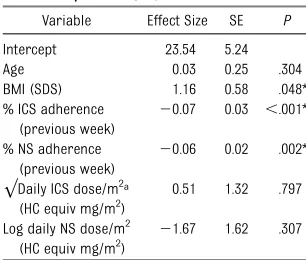
Only 84 subjects, not treated with TS, were considered for the prediction models. A linear regression model of √postmetyrapone ACTH was found to explain 17.6% (R2= .176) of the variance (Table 4). It identified poor adherence to ICS and NS, as well as the BMI as sig-nificant protective factors for an in-adequate ACTH response. As indicated by the effect size, a child, who was only 50% adherent to his ICS treatment, can be expected to have a postmetyrapone ACTH level 125 pg/mL (27.5 pmol/L) higher than a child who is 100% ad-herent. Similarly, the postmetyrapone TABLE 2 Age-Adjusted Prevalence Estimates for Various Degrees of HPAS
Category n %a 95% CI
Basal C,83 nmol/La 8/142 6.1 1.8–10.5
HPSb: ACTH,106 pg/mL (23.3 pmol/L) 27/133 22.2 14.5–29.9
ASc: 11DOC,208 nmol/L 63/135 47.5 38.5–56.5
11DOC + C,400 nmol/L 62/129 45.8 36.7–55.0
Both 43/129 32.3 23.7–40.9
HPASd 20/127 16.3 9.3–23.3
Alle 91/140f 65.1 56.5–72.9
C, cortisol.
aDuration of ICS and NS therapy is 4 to 226 (median 25) and 2 to 167 (median 36) months, respectively. bHypothalamic pituitary suppression as established by postmetyrapone ACTH.
cAdrenal suppression as established by postmetyrapone, 11DOC, and 11DOC + C. dACTH,106 pg/mL (23.3 pmol/L) and 11DOC,208 nmol/L and 11DOC + C,400 nmol/L.
eBasal C,83 nmol/L or ACTH,106 pg/mL (23.3 pmol/L) or 11DOC,208 nmol/L or 11DOC + C,400 nmol/L. fDenominator varies because not all children had all investigations for various reasons.
TABLE 3 Spearman Correlations Between Postmetyrapone ACTH, 11DOC, 11DOC + Cortisol, and Patient Variables
Variablea ACTH,r(n= 133) 11DOC,r(n= 135) 11DOC + Cortisol,r(n= 133)
Age 0.08 20.01 20.22*
BSA 0.15 0.03 20.23*
Daily ICS/m2 20.20* 20.17* 20.03
Daily NS/m2 20.25* (114) 20.24* (116) 20.19* (114) Cumulative NS/m2(previous year) 20.29* 20.32* 20.27* Monthly TS/m2 20.11 (131) 20.10 (133) 0.01 (131)
% ICS adherence 20.23* 20.11 20.15
% NS adherence 20.36* (114) 20.20* (116) 20.15 (114) Asthma score (no lung functions)b 0.00 0.09 0.24*
FEV1(%) 20.03 (132) 0.04 (134) 0.15* (132)
aOnly selected variables listed. bAs published by E. Juniper. *P,.05.
ACTH level of a patient who misses half of his NS therapy would be 116 pg/mL (25.5 pmol/L) higher compared with the level of one who is fully compli-ant. Furthermore, the postmetyrapone ACTH level of a child with a BMI SDS of 2 would be 100 pg/mL (22 pmol/L) higher compared with one with a BMI SDS of 0.
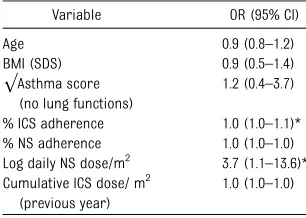
A logistic regression model for HPAS identified percent ICS adherence and the log daily NS dose/m2as significant predictors of its development (Table 5). A patient treated with a dose of 400mg BDP per day is 3 1/2 times more likely to present with HPAS compared with a child who is not on NSs.
Lung Functions and Asthma Control
FEV1/FVC was the only lung function that was found to be significantly as-sociated with HPAS (Table 6). This was independent of the cumulative ICS 1 NS dose, the percent ICS and NS ad-herence, and the asthma score. A child with a FEV1/FVC ,80% was found to have a 4 times greater chance to de-velop HPAS than a child who had a FEV1/FVC.80%.
The prevalence of HPAS in well-controlled children (asthma score
,0.75) was found to be 20% (95% CI: 5.7–43.7), whereas the prevalence of HPAS in poorly controlled children (score .1.5) was 55% (95% CI: 31.5– 76.9). The prevalence of HPAS thus did not change significantly with the level of asthma control. In the 8 children who presented with hypocortisolemia, the difference was accentuated yet not significant (14% [95% CI: 0.4–57.9] for good control versus 43% [95% CI: 9.9– 81.6] for poor control).
DISCUSSION
The 22% prevalence of HPS confirmed thefindings of our recently published pilot study.10 The larger sample size
allows for generalization of our results to other study populations. Provided
may mount an inadequate ACTH re-sponse to stress. This, in itself, may not be clinically relevant. Severe or pro-longed HPS may, however, cause the adrenal glands to atrophy and become less responsive to ACTH. An adrenal crisis may be precipitated if the child is exposed to stress, especially if coupled with cessation or inadequate dosing of exogenous corticosteroids. In practice, however, adrenal crisis is rarely seen. Our study may explain why.
The most appropriate cutoff for an ad-equate ACTH response after an ONMTPT is open to debate. Levels ranging from as low as 64 (14.1 pmol/L)22to as high as
200 pg/mL (44 pmol/L)18 have been
proposed. The 106 pg/mL (23.3 pmol/L) cutoff, used in this study, was based on the only published trial comparing the ACTH response of the insulin tolerance test to that of the ONMTPT in adults with normal pituitary function. It was found that no subject in either group mounted an ACTH response below 100 pg/mL (22 pmol/L).18Though not the largest study
on this topic, it is still the best com-parison of the ONMTPT to hypoglycemia. Over- or underdiagnosis is kept to a minimum by setting the decision level between the suggested extremes (ie, at 106 pg/mL [23.3 pmol/L]). One can only assume that the established cutoff for adults also applies to children.
Twice the number of asthmatic children who had HPS was found to have AS. Both 11DOC and the 11DOC + cortisol decision levels should apply, indicating appro-priate inhibition of the 11b-hydroxylase by metyrapone to produce 11DOC with consequently decreased production of cortisol.20 The higher number of
chil-dren with AS suggests that the axis is already in the process of recovery in these children. Their central structures have fully recovered, but their adrenal gland function is still impaired. Sup-pression of the axis is thus not an all or FIGURE 1
Scatter plot and quantile regression (median and CI) of postmetyrapone ACTH versus the daily ICS and NS dose, adjusted for BSA (ICS adherence as covariate). Horizontal dotted line = cutoff between adequate and inadequate response. Vertical dotted line = upper limit of normal cortisol production rate. Con-version factor for converting ACTH in pg/mL to pmol/L = 0.2202.
TABLE 4 Linear Regression Model of
√Postmetyrapone ACTH (R2= .176) Variable Effect Size SE P
Intercept 23.54 5.24
Age 0.03 0.25 .304
BMI (SDS) 1.16 0.58 .048*
% ICS adherence (previous week)
20.07 0.03 ,.001*
% NS adherence (previous week)
20.06 0.02 .002*
√Daily ICS dose/m2a (HC equiv mg/m2)
0.51 1.32 .797
Log daily NS dose/m2 (HC equiv mg/m2)
21.67 1.62 .307
HC equiv, hydrocortisone equivalent. aPer m2
none phenomenon. It is in fact in a state of constantflux determined by adher-ence, dose adjustment, technique, and supplementary steroid use, as well as genetic and epigenetic factors.23,24
As shown previously10and confirmed in
this study, adrenal insufficiency, though present biochemically, is not usually clinically apparent. If exposed to stress coupled with the abrupt discontinuation of corticosteroid therapy, frank adrenal crisis may still be likely. HPAS may thus be dynamic, presenting on a spectrum from mild and unapparent to severe and clinically obvious. Presumably, this reversible dynamism is lost when the glands have atrophied, potentially re-sulting in death, if cortisol is not ade-quately replaced by pharmacological corticosteroids.
Our study suggests that 65% of patients attending pediatric allergy units may suffer steroid suppressive effects, ne-cessitating a good screening test to detect HPAS. To this end, we have recently proposed the early-morning serum ACTH.25It may, however, be premature to
recommend this for universal use, which is why we have attempted to identify predictors for HPAS.
The univariate logistic regression anal-ysis identified the daily ICS + NS/m2as a significant predictor for HPAS. How-ever, when plotting postmetyrapone ACTH against ICS1NS/m2(Fig 1), it is evident that the inverse dose-effect re-lationship is weak. Furthermore, at supraphysiologic doses, this effect is lost, making it impossible to predict HPS at high doses. Confirmation in a larger study is necessary because the number of patients at these doses is small.
The linear regression model of√ post-metyrapone ACTH (Table 4) identifies the BMI and percent adherence to ICS and NS as useful predictors. A normal ACTH stress response should be at least 100 pg/mL (22 pmol/L). The 100 pg/mL (22 pmol/L) difference in ACTH release be-tween a normal and an obese child is thus clinically significant. The potential for a thin child to develop HPAS could be even higher.
By halving the adherence to ICSs or NSs, an ACTH rise of 125 to 116 pg/mL (27.5– 25.5 pmol/L) may be expected to occur during stress. Poor adherence, there-fore, also exerts a protective effect on HPAS development. ICS compliance, ascertained by using electronic mea-suring devices, ranges between 63% and 92%,26similar to thefindings in our
study (79%), employing nondirective questioning. Because self-reporting of adherence is usually an overestimate, actual adherence may be even lower.
The logistic regression model for HPAS (Table 5) clearly identifies log daily NS dose/m2 as the most significant pre-dictor. This concurs with thefinding of our pilot study.10NSs bypass the lungs
and enter the systemic circulation di-rectly through absorption via the nasal mucosa and may thus have a greater systemic effect than ICSs, which enter the pulmonary circulation first. The systemic effect may also be mediated by direct inhibition of adrenal cortisol production by NS through a short feedback loop.27 AS, without previous
suppression at HP level, may therefore be more likely.
Limited documentation made it difficult to determine the monthly TS dose ac-curately. This is a well-recognized lim-itation in dermatological studies.28
Moreover, categorization of TSs into the different potency groups by their skin blanching ability is problematic be-cause this assessment is subjective. Furthermore, potency as determined by vasoconstriction does not equate potency as determined on a weight-for-weight basis. This explains the lack of correlation between the monthly TS/m2 and the postmetyrapone outcomes. Evidence from the literature suggests that TSs rarely precipitate HPAS, unless highly potent agents are used to treat a significant percent of BSA or various corticosteroids are given via multiple routes.28
Combined ICS and OCS exposure has been shown to increase HPAS risk.29The
lack of correlation with the cumulative OCS/m2was thus unexpected. This may reflect treatment and adherence prac-tice. OCS courses are often prescribed in anticipation of an exacerbation but, in the absence of an attack, may never be administered, or the course may be shortened. Corticosteroid load is thus reduced, making suppression less likely.
A child with a FEV1/FVC ,80% had a significantly higher probability of TABLE 5 Logistic Regression Model for HPAS
Variable OR (95% CI)
Age 0.9 (0.8–1.2)
BMI (SDS) 0.9 (0.5–1.4)
√Asthma score (no lung functions)
1.2 (0.4–3.7)
% ICS adherence 1.0 (1.0–1.1)* % NS adherence 1.0 (1.0–1.0) Log daily NS dose/m2 3.7 (1.1–13.6)* Cumulative ICS dose/ m2
(previous year)
1.0 (1.0–1.0)
Postmetyrapone ACTH,106 p/mL (23.3 pmol/L) and 11DOC
,208 nmol/L and 11DOC + cortisol,400 nmol/L. * Significant,P,.05.
TABLE 6 A Comparison of Lung Functions of Children With HPAS to Those Without HPAS
Lung Function nWith HPAS (%) P OR (95% CI)
FEV1$80% 11/84 (13.1) .30 1.8 (0.6–5.3)
,80% 9/42 (21.4)
Peak expiratoryflow rate
$80%
11/58 (20.0) .47 0.6 (0.2–1.9)
,80% 9/69 (13.0)
FEV1/FVC$80% 14/110 (12.7) .02* 4.1 (1.0–14.8)*
,80% 6/16 (37.5)
OR, odds ratio. * Significant,P,.05.
a trend for children with a high asthma score to have a higher prevalence of HPAS. Both findings were unexpected because good control is associated with higher suppressive corticosteroid doses. It was thought previously that relative adrenal insufficiency in asth-matic children might contribute to the development of more severe asthma.30
An alternative suggestion has been that asthma itself down-regulates HPA activity by inhibiting corticotrophin-releasing hormone release, possibly through mediation by interleukin-6 and tumor necrosis factor-a.7,31A large
in-terindividual variation in adrenal re-sponse to ACTH, reduced bioavailability of glucocorticoids, and altered signal transduction mechanisms have also been described.23,24,32
Two-thirds of children treated with corticosteroids in allergy units may have a degree HPA dysfunction. HPS may occur at doses equal to the daily cortisol production rate. The use of NSs, in ad-dition to ICSs, is a significant predictor of HPAS. Cumulative corticosteroid doses are not predictive. High BMI and poor adherence to ICSs and NSs protect against HPAS. Low FEV1/FVC may be predictive of HPAS independently of the corticosteroid suppressive effect.
We, therefore, recommend that every asthmatic child with a low BMI, who is treated with both ICSs and NSs, and is adherent to therapy, should have his or her HPA function assessed. Although desirable, an assessment before com-mencement of treatment is not feasible because the primary physician would
be made to determine the level of ad-herence to corticosteroids. Further research is needed to identify genetic factors that might predict or protect from HPAS.
ACKNOWLEDGMENTS
We thank Sisters Hill, Poggenpoel, Pontac, and Steyn, and their superiors (for allowing them to participate), as well as all pediatricians and medical officers at the various centers for re-cruitment of patients. We are grateful to Professor E. Juniper for supplying the asthma control questionnaire, and we are grateful for the laboratory support provided by B. Fenemore and the laboratories of Groote Schuur and Tygerberg Hospitals and the Bioanalytic Research Corporation.
REFERENCES
1. Dluhy RG. Clinical relevance of inhaled corticosteroids and HPA axis suppression. J Allergy Clin Immunol. 1998;101(4 pt 2): S447–S450
2. Russel G. Commentary: Symptomatic ad-renal insufficiency during inhaled cortico-steroid treatment.Arch Dis Child. 2001;85 (4):333–334
3. Bisgaard H, Pedersen S. Safety of treat-ment. Eur Respir J Suppl. 1996;21(suppl 21):28s–34s
4. Sizonenko P. Effects of inhaled or nasal glucocorticosteroids on adrenal function and growth. J Pediatr Endocrinol Metab. 2002;15(1):5–26
5. Boner AL. Effects of intranasal cortico-steroids on the hypothalamic-pituitary-adrenal axis in children. J Allergy Clin Immunol. 2001;108(suppl 1):S32–S39
6. Bruni FM, De Luca G, Venturoli V, Boner AL. Intranasal corticosteroids and adrenal suppression.Neuroimmunomodulation. 2009; 16(5):353–362
7. Zöllner EW. Hypothalamic-pituitary-adrenal axis suppression in asthmatic children on inhaled corticosteroids: part 1. Which test should be used?Pediatr Allergy Immunol. 2007;18(5):401–409
8. Zöllner EW. Hypothalamic-pituitary-adrenal axis suppression in asthmatic children on
inhaled corticosteroids (Part 2)—the risk as determined by gold standard adrenal
function tests: a systematic review.Pediatr
Allergy Immunol. 2007;18(6):469–474
9. Vaz R, Senior B, Morris M, Binkiewicz A.
Adrenal effects of beclomethasone
in-halation therapy in asthmatic children.
J Pediatr. 1982;100(4):660–662
10. Zöllner EW, Lombard C, Galal U, Hough S, Irusen E, Weinberg E.
Hypothalamic-pituitary-adrenal axis suppression in asthmatic
chil-dren on inhaled and nasal corticosteroids—
more common than expected? J Pediatr
Endocrinol Metab. 2011;24(7–8):529–534
11. Graber AL, Ney RL, Nicholson WE, Island DP,
Liddle GW. Natural history of pituitary-adrenal recovery following long-term
suppression with corticosteroids. J Clin
Endocrinol Metab. 1965;25:11–16
12. Dolman LI, Nolan G, Jubiz W. Metyrapone test
with adrenocorticotrophic levels. Separating
primary from secondary adrenal in-sufficiency.JAMA. 1979;241(12):1251–1253
13. Steiner H, Bähr V, Exner P, Oelkers PW.
Pi-tuitary function tests: comparison of ACTH
and 11-deoxy-cortisol responses in the
metyrapone test and with the insulin
hy-poglycemia test.Exp Clin Endocrinol. 1994;
102(1):33–38
14. Johansson S-A, Andersson KE, Brattsand R, Gruvstad E, Hedner P. Topical and systemic glucocorticoid potencies of budesonide, beclomethasone dipropionate and pred-nisolone in man. Eur J Respir Dis Suppl. 1982;122:74–82
15. Rossiter D, ed. South African Medicines Formulary. Rondebosch, South Africa:
Health and Medical Publishing Group of the South African Medical Association; 2010:258
16. Brazzini B, Pimpinelli N. New and estab-lished topical corticosteroids in dermatol-ogy: clinical pharmacology and therapeutic use.Am J Clin Dermatol. 2002;3(1):47–58
17. Juniper EF, Bousquet J, Abetz L, Bateman ED; GOAL Committee. Identifying‘well-controlled’ and ‘not well-controlled’asthma using the Asthma Control Questionnaire.Respir Med.
2006;100(4):616–621
18. Staub JJ, Noelpp B, Girard J, Baumann JB, Graf S, Ratcliffe JG. The short metyrapone test: comparison of the plasma ACTH re-sponse to metyrapone and insulin-induced hypoglycaemia.Clin Endocrinol (Oxf). 1979; 10(6):595–601
19. Fiad TM, Kirby JM, Cunningham SK, McKenna TJ. The overnight single-dose metyrapone test is a simple and reliable
axis.Clin Endocrinol (Oxf). 1994;40(5):603–
609
20. Berneis K, Staub JJ, Gessler A, Meier C,
Girard J, Müller B. Combined stimulation of
adrenocorticotropin and compound-S by single dose metyrapone test as an
out-patient procedure to assess
hypothalamic-pituitary-adrenal function.J Clin Endocrinol Metab. 2002;87(12):5470–5475
21. Linder BL, Esteban NV, Yergey AL, Winterer
JC, Loriaux DL, Cassorla F. Cortisol pro-duction rate in childhood and adolescence.
J Pediatr. 1990;117(6):892–896
22. Endert E, Ouwehand A, Fliers E, Prummel
MF, Wiersinga WM. Establishment of refer-ence values for endocrine tests. Part IV:
Adrenal insufficiency.Neth J Med. 2005;63 (11):435–443
23. Mormede P, Foury A, Barat P, et al.
Molec-ular genetics of
hypothalamic-pituitary-adrenal axis activity and function. Ann N Y Acad Sci. 2011;1220:127–136
24. Derijk RH. Single nucleotide poly-morphisms related to HPA axis reactivity. Neuroimmunomodulation. 2009;16(5):340– 352
25. Zöllner EW, Lombard C, Galal U, Hough S, Irusen E, Weinberg E. Hypothalamic-pituitary-adrenal axis suppression in asthmatic chil-dren on inhaled and nasal corticosteroids: is the early-morning serum adrenocortico-tropic hormone (ACTH) a useful screening test? Pediatr Allergy Immunol. 2011;22(6): 614–620
26. Cochrane MG, Bala MV, Downs KE, Mauskopf J, Ben-Joseph RH. Inhaled corticosteroids for asthma therapy: pa-tient compliance, devices, and inhalation technique.Chest. 2000;117(2):542–550
27. Saito E, Ichikawa Y, Homma M. Direct in-hibitory effect of dexamethasone on ste-roidogenesis of human adrenal in vivo.J Clin Endocrinol Metab. 1979;48(5):861–863
28. Ellison JA, Patel L, Ray DW, David TJ, Clayton PE. Hypothalamic-pituitary-adrenal function
and glucocorticoid sensitivity in atopic dermatitis. Pediatrics. 2000;105(4 pt 1): 794–799
29. Mortimer KJ, Tata LJ, Smith CJP, et al. Oral and inhaled corticosteroids and adrenal insufficiency: a case-control study.Thorax. 2006;61(5):405–408
30. Barr J, Rapoport MJ, Tauber T, Hertzianu I, Cafri Y, Bistritzer T. The relation between adrenal function and the severity of bron-chial hyperresponsiveness in children as measured by the methacholine provocation test. J Pediatr Endocrinol Metab. 2002;15 (3):307–312
31. Chrousos GP. Stress and disorders of the stress system. Nat Rev Endocrinol. 2009;5 (7):374–381
32. Bertagna X, Coste J, Raux-Demay MC, Letrait M, Strauch G. The combined corticotropin-releasing hormone/lysine va-sopressin test discloses a corticotroph phenotype.J Clin Endocrinol Metab. 1994; 79(2):390–394
(Continued fromfirst page)
Dr Zöllner has made substantial contributions to the conception and design and acquisition of data. He also made a contribution to the analysis and interpretation of data. He drafted the article and revised it. He gave his approval for this version of the article to be published. Dr Lombard was involved in the design of the study. He also made a contribution to the analysis and interpretation of data. He reviewed the article. He gave his approval for this version of the article to be published. Dr Galal has performed the data analysis and contributed to the interpretation of the data. She has revised the article, and she gave her approval for this version of the article to be published. Dr Hough made a fundamental intellectual contribution to this article and approves publication of the version to be published. Dr Irusen has made a contribution to the conception and design of the study. He also made a contribution to analysis, interpretation, and discussion of the data. He gave his approval for this version of the article to be published. Dr Weinberg has had intellectual input in this article. He gave his approval for this version of the article to be published.
Dr Zöllner’s former affiliation is Endocrine Unit, Red Cross Children’s Hospital, University of Cape Town, Cape Town, South Africa.
www.pediatrics.org/cgi/doi/10.1542/peds.2012-1147
doi:10.1542/peds.2012-1147
Accepted for publication Jul 24, 2012
Address correspondence to Ekkehard Werner Zöllner, MB ChB, MMed (Paed), DCH, DTM&H, DPH, Endocrine and Diabetes Unit, Faculty of Health Sciences, Department of Paediatrics, PO Box 19063, 7505 Tygerberg, South Africa. E-mail: [email protected]
PEDIATRICS (ISSN Numbers: Print, 0031-4005; Online, 1098-4275).
Copyright © 2012 by the American Academy of Pediatrics
FINANCIAL DISCLOSURE:The authors have indicated they have nofinancial relationships relevant to this article to disclose.
FUNDING:Supported by the Medical Research Council, the University of Stellenbosch, the SA Thoracic Society, the Harry Crossley Foundation, and Red Cross Children’s Hospital.
DOI: 10.1542/peds.2012-1147 originally published online November 12, 2012;
2012;130;e1512
Pediatrics
M. Irusen and Eugene Weinberg
Services
Updated Information &
http://pediatrics.aappublications.org/content/130/6/e1512
including high resolution figures, can be found at:
References
http://pediatrics.aappublications.org/content/130/6/e1512#BIBL
This article cites 31 articles, 2 of which you can access for free at:
Subspecialty Collections
http://www.aappublications.org/cgi/collection/respiratory_tract_sub Respiratory Tract
http://www.aappublications.org/cgi/collection/pulmonology_sub Pulmonology
following collection(s):
This article, along with others on similar topics, appears in the
Permissions & Licensing
http://www.aappublications.org/site/misc/Permissions.xhtml
in its entirety can be found online at:
Information about reproducing this article in parts (figures, tables) or
Reprints
http://www.aappublications.org/site/misc/reprints.xhtml
DOI: 10.1542/peds.2012-1147 originally published online November 12, 2012;
2012;130;e1512
Pediatrics
M. Irusen and Eugene Weinberg
Ekkehard Werner Zöllner, Carl J. Lombard, Ushma Galal, F. Stephen Hough, Elvis
Hypothalamic-Pituitary-Adrenal Axis Suppression in Asthmatic School Children
http://pediatrics.aappublications.org/content/130/6/e1512
located on the World Wide Web at:
The online version of this article, along with updated information and services, is
by the American Academy of Pediatrics. All rights reserved. Print ISSN: 1073-0397.