Continuous Improvement Learning for Residents
Linda A. Headrick, MD*; Amy Richardson, MD‡; and Gregory P. Priebe, MD§
ABSTRACT. Physicians must be ready to assume an active role in the design, implementation, and improve-ment of emerging models of health care delivery. Knowl-edge and skill in continuous improvement prepare them to engage seriously in the processes of change, on the basis of the same scientific principles they always have relied on in the use of evidence to improve outcomes. This includes include the ability to 1) identify the health needs of the individuals and communities for which they provide health services; 2) assess the impact of current practice with appropriate outcome measures; 3) discover what in the process of health care may be contributing to less than desired outcomes; 4) design and test interven-tions to change the process of care to improve outcomes; 5) act as an effective member of the interdisciplinary team required to complete these tasks; and 6) consider ethical principles and professional values when making decisions about change in health services delivery. Grad-uate medical education presents special opportunities and challenges for learning about continuous improve-ment. Early experiences at Rainbow Babies and Chil-dren’s Hospital in Cleveland and ChilChil-dren’s Hospital in Boston suggest how we might prepare pediatricians and other physicians to create positive change and continu-ally improve health care. Pediatrics 1998;101:768 –774; managed care, graduate medical education, total quality management.
ABBREVIATIONS. PDSA, Plan–Do–Study–Act (cycle); GME, graduate medical education; MDI, metered-dose inhaler.
W
hen young physicians earn their medicaldegrees, they also earn a special responsi-bility for the health of patients, families, and communities. To fulfill that trust completely, physicians must be ready to assume an active role in the design, implementation, and improvement of emerging models of health care delivery. They must be able to create positive change, not just react to change made by others, to ensure that the results reflect their professional values. This is especially important in times of constrained resources. Unfor-tunately, most physicians confront this responsibility with a tremendous handicap, in that they have no access to the body of knowledge currently available about making change successfully.
Knowledge and skill in continuous improvemet1,a
help physicians engage seriously in the processes of change, on the basis of the same scientific principles they have always relied on in the use of evidence to improve outcomes. The Pew Health Professions Commission Project on Health Professions Education for Managed Care recommended that students learn to participate in continuous quality improvement as part of what is needed to ensure value in health care.1 In a report prepared for the Council on Graduate Medical Education, Lurie identified the following as one of eight competencies needed for practice in a managed care environment: “Learners will be able to use tools for measuring and improving the quality of care they provide to individuals and groups of pa-tients for whom they are responsible.”2,3Kachur and her colleagues found that quality management was cited by six of seven documents and projects they reviewed regarding managed care-related learning needs for physicians.4
CORE CONCEPTS OF CONTINUOUS IMPROVEMENT
Continuous improvement is a set of concepts, prin-ciples, and methods elucidated by W. Edwards Deming, Joseph Juran, and others that allows people to improve the processes and systems in which they work.5–7At the center are serial tests of change aimed at demonstrable improvement. Core concepts in-clude the following.
1. Success is achieved through meeting the needs of those we serve. Quality is defined by how well we meet those needs.
2. Most problems are in processes, not people. Often, people know what to do and want to do a good job, but are prevented from doing so by barriers embedded in the system in which they work, over which they have little or no control.
3. Unintended or unnecessary variation in processes can lead to unwanted variation in outcomes. For instance, in a study of patients undergoing elec-tive surgery at a large teaching hospital, Classen and his colleagues found that variation in the timing of prophylactic antibiotic administration resulted in marked differences in the incidence of postoperative wound infection. Patients receiving antibiotics postoperatively were found to have a nearly sixfold increase in wound infection, com-From the *Department of Medicine, Metro Health Medical Center, Case
Western Reserve University, Cleveland, Ohio; the ‡Department of Pediat-rics, Otis J. Moss Hospitals Medical Center, Case Western Reserve Univer-sity, Cleveland, Ohio; and the §Division of Infectious Diseases, Children’s Hospital, Boston, Massachusetts.
Address correspondence to Dr Linda A. Headrick, Metro Health Medical Center, 2500 Metro Health Drive, Room R225A, Cleveland, OH 44109-1998. PEDIATRICS (ISSN 0031 4005). Copyright © 1998 by the American Acad-emy of Pediatrics.
aIn this paper, the term continuous improvement will be used in place of
pared with patients who received antibiotics in the 2 hours before surgery.8There was no plan to vary the antibiotic administration; the investiga-tors simply observed what happened in a consec-utive series of patients. They found a marked impact attributable to unnecessary (and possibly unintended) variation in the process of care. 4. It is possible to achieve continual improvement
through serial experimentation. Tests of change in continuous improvement often are described as Plan–Do–Study–Act (PDSA) cycles.5One identifies and plans an intervention, carries it out, studies the results, and then acts to hold the gain. That is, if the intervention is successful, one might choose to ex-pand the pilot, applying the new process to a larger part of the organization. If the pilot is not successful, one can take advantage of what has been learned, modify the intervention, and try again.
ELEMENTS OF SUCCESSFUL IMPROVEMENT IN HEALTH CARE
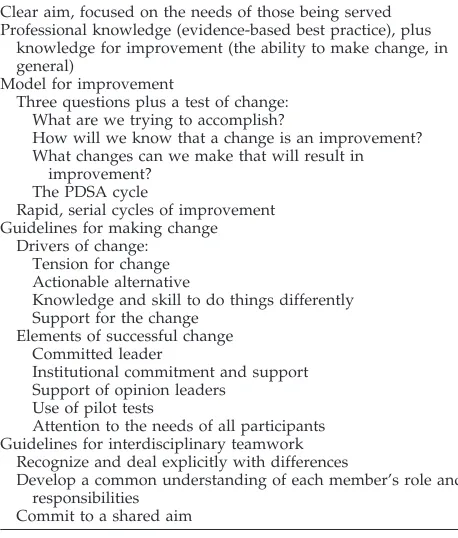
Table 1 summarizes elements of successful im-provement, as shown in numerous applications in community health, health care delivery, and health professions education.9 –12 First is a definite aim, fo-cused on the needs of those being served. A clear goal is important to the success of work groups in general.13Similar results are found by those working in health care.11
The second element is a framework for improve-ment, described by Batalden and Stoltz, which com-bines professional knowledge (evidence-based best practice) with the ability to make improvements in general (knowledge for improvement).10 Third is the Langley, Nolan, and Nolan Model for Improvement, a straightforward and powerful step-by-step approach.16 It consists of three questions, followed by a test of
change: “What are we trying to accomplish? How will we know that a change is an improvement? What changes can we make that will result in improve-ment?” Langley, Nolan, and Nolan also describe the power of a series of tests of change (PDSA cycles) linked together and driven by data, allowing one to move progressively from theories and ideas about what would useful to demonstrable improvements.
Fourth are guidelines for making change success-fully. Gustafson and colleagues described four driv-ers that increase the likelihood of change: 1) tension for change, 2) actionable alternative, 3) knowledge and skills to do things differently, and 4) support for the change.17 In addition, the following have been observed to be important in improvement efforts focused on health: a committed leader, institutional commitment and support, the support of opinion leaders (local and national), the use of pilot tests, and attention to the needs of all participants.10 –12
Fifth are guidelines for interdisciplinary team-work. The four criteria presented below can be used to determine whether or not an interdisciplinary team is needed.18
1. The problem addressed is major and complex, and no one discipline possesses all the skills and knowledge needed to address it.
2. Forming a team of professionals from a variety of disciplines will enhance the ability to solve the problem.
3. Individual skills and knowledge are considered rel-evant and equally important to problem solving. 4. The individual persons share a common goal.
Most health care improvement efforts involve complex processes of care and thus require an inter-disciplinary team. Differences in language, culture, history, and philosophy create differences in per-spective that can enrich a problem-solving effort, but also can be obstacles to communication and under-standing. Interdisciplinary teams will be more effec-tive if they can recognize and deal explicitly with these differences and come to a common under-standing of the role and responsibilities of each team member. The motivation to do so comes from a shared aim.19
TABLE 1. Elements of Successful Improvement Clear aim, focused on the needs of those being served Professional knowledge (evidence-based best practice), plus
knowledge for improvement (the ability to make change, in general)
Model for improvement
Three questions plus a test of change: What are we trying to accomplish?
How will we know that a change is an improvement? What changes can we make that will result in
improvement? The PDSA cycle
Rapid, serial cycles of improvement Guidelines for making change
Drivers of change: Tension for change Actionable alternative
Knowledge and skill to do things differently Support for the change
Elements of successful change Committed leader
Institutional commitment and support Support of opinion leaders
Use of pilot tests
Attention to the needs of all participants Guidelines for interdisciplinary teamwork
Recognize and deal explicitly with differences
Develop a common understanding of each member’s role and responsibilities
Commit to a shared aim
TABLE 2. Health Professions Education in Continuous Im-provement
Teaching methods should focus on active experiential learning, such as learner participation in meaningful improvement projects
Didactic learning should be planned to support and reinforce experiential learning, providing learners with concepts and skills when they can apply them
Learner assessment should be multifaceted to measure both knowledge and skills
Structured reflective practice can help learners examine and improve their skills and attitudes, especially with respect to teamwork
Faculty development may be required, especially with respect to competence in continuous improvement
CONTINUOUS IMPROVEMENT IN HEALTH PROFESSIONS EDUCATION
Based on what has been learned so far in the application of continuous improvement to health care, one may summarize the improvement compe-tencies needed by physicians and other health pro-fessionals. They include the ability to:
1. identify the health needs of the individuals and communities for which they provide health ser-vices;
2. assess the impact of current practice (their own and that of the health care system in which they work) with appropriate outcome measures; 3. discover what in the process of health care may be
contributing to less than desired outcomes; 4. design and test interventions to change the
pro-cess of care to improve outcomes;
5. act as an effective member of the interdisciplinary team required to complete these tasks; and 6. consider ethical principles and professional values
when making decisions about change in health services delivery.20
For instance, physicians and other health profession-als involved in cardiac surgery in northern New En-gland used continuous improvement techniques to re-duce their in-hospital mortality rate after coronary artery bypass graft surgery.21After training in contin-uous improvement methods, interdisciplinary teams (which always included the cardiac surgeon) ex-changed site visits. From these, each group identified ways to improve the care processes involved in cor-onary artery bypass graft surgery. Specific changes varied from hospital to hospital; examples included technical changes in perfusion procedures and stan-dardization of postoperative management. These inter-disciplinary teams identified a health need, agreed on an appropriate outcome measure, followed that mea-sure over time to assess the impact of current practice, identified and tested changes in the process of care, studied the results, and took steps to solidify and ex-pand successes. After 2 years, they achieved a 24% reduction in in-hospital mortality rate, adjusted for age, sex, presence of left main coronary artery stenosis, left ventricular ejection fraction, left ventricular diastolic pressure, and priority at surgery.
The cardiac surgery teams learned about continu-ous improvement after they were in practice; would these results have been achieved sooner had they acquired these skills as part of their education? How might this be done?
The first experiments in continuous improvement education for medical students and residents did not begin until the late 1980s.22A recent four-site national demonstration project may offer the broadest experi-ence to date.12The project, the Interdisciplinary Profes-sional Education Collaborative, was begun by the In-stitute for Healthcare Improvement, with support from the Health Resources and Services Administration/ Bureau of Health Professions and the Pew Health Pro-fessions Commission. Its goal was to design interdisci-plinary learning in continuous improvement for students and residents in medicine, along with
stu-dents in nursing, health administration, and other dis-ciplines. The four sites were Medical University of South Carolina, Charleston, SC; Case Western Reserve University and Cleveland State University, Cleveland, OH; Allegheny University of the Health Sciences (for-merly Medical College of Pennsylvania and Hahne-mann University), with LaSalle University, Duquesne University, and Carnegie Mellon University, spon-sored by the Allegheny Health Education and Research Foundation, Philadelphia and Pittsburgh, PA; and George Washington University and George Mason University, Washington, DC.
The groups shared goals and core concepts, but in-dependently developed teaching strategies tailored to local culture and resources. Lessons that emerged across sites are summarized in Table 2. A combination of didactic and experiential learning emerged as the dominant educational model. Students reported the greatest learning when they were engaged in meaning-ful improvement projects, becoming part of interdisci-plinary teams that addressed local health care needs. Examples included improving well-child follow-up at a nursing center in Philadelphia, PA; initiating hyper-tension screening for African-American men in Charleston, SC; creating systematic diabetes care for an urban free clinic serving a largely Central-American population in Washington, DC; and developing an ob-jective assessment of rehabilitation progress for pa-tients with multiple sclerosis in a referral center in Cleveland, OH.
At each site, faculty attempted to coordinate di-dactic instruction with learning needs as they oc-curred in the students’ improvement projects. Didac-tic methods ranged from self-study to team-based learning to seminars. Learner assessment focused on applied knowledge and skills, with structured stu-dent reports and reflections about their projects. Var-ious methods of reflective practice (such as journal-ing) asked students to examine their attitudes, especially about interdisciplinary teamwork.
Faculty development was a major need at all sites. This included faculty competence in continuous im-provement and skills in the teamwork required for interdisciplinary education. Also reported was a strong sense that faculty themselves must engage in continuous improvement, especially concerning the educational process.
CONTINUOUS IMPROVEMENT IN GRADUATE MEDICAL EDUCATION (GME)
GME presents special opportunities for learning about continuous improvement. Residents have con-siderable professional knowledge; they can contribute readily to any improvement project their understand-ing of the clinical issues. Residents work at the front-lines of medical care and have intimate personal knowledge of how care actually occurs. They often are interested in change and are motivated to work quickly, so that they and their patients can benefit personally. Finally, their association with a particular health care organization over a long period facilitates ongoing involvement that will contribute to enduring change.
involvement in continuous improvement efforts in teaching hospitals is critical to the success of those efforts.23,24 Parenti et al reported a house staff-led improvement effort to reduce unnecessary intrave-nous catheter use; previous attempts with house staff education alone were unsuccessful.24 The residents identified important reasons why intravenous cath-eters were left in place “just in case,” despite the increased risk of iatrogenic complications such as phlebitis. One example was a hospital policy that the initial intravenous catheter must be started by a house officer. This may have encouraged early inser-tion at a convenient time to avoid later inserinser-tion at an inconvenient time. The authors felt that house officer involvement was key to the successful development and implementation of guidelines that decreased by 13% the number of unused intravenous catheters left in place.
Others have applied continuous improvement to the residency itself.25–27This offers an opportunity for residents to learn about the principles and methods of continuous improvement by working to improve their own educational experience. In an internal medicine residency, house staff improvement activ-ities resulted in changes that improved the distribu-tion of patients admitted to the inpatient service and increased the time available for ambulatory-based teaching. At the end of the first 6 months, 63% of the house staff felt that the residency had improved, and 85% felt that the new improvement program should continue. The faculty described a number of lessons from this effort, including:25
1. Start with a values statement.
2. Make the effort important. Incorporate it into the usual educational activities of the residency by replacing other activities, not just adding on. 3. Stress the use of the scientific method and the
common ground with clinical epidemiology and health services research.
4. Choose projects important to the house staff. 5. Move quickly to active tests of change. 6. Evaluate progress.
7. Disseminate accomplishments. 8. Keep the program flexible.
RAINBOW BABIES AND CHILDREN’S HOSPITAL, CLEVELAND, OH
We could find no published experience in pediat-ric residency; however, efforts that mirror those de-scribed above are beginning. At Rainbow Babies and Children’s Hospital of University Hospitals of Cleve-land (Case Western Reserve University), continuous improvement projects were introduced into the pe-diatric resident continuity clinics, with the following goals:
1. to improve a specific aspect of primary patient care in the pediatric practice;
2. to teach residents about both the specific areas under study and the process of continuous im-provement; and
3. to create for residents a sense of ownership, be-longing, and empowerment in their continuity practices.
In the 1996 to 1997 academic year, senior residents created two projects with support from a member of the General Academic Pediatric faculty and others. The first project sought to improve the care of chil-dren with asthma by 1) increasing the use of me-tered-dose inhalers (MDIs) with spacing devices in place of nebulizers or oralb-agonists, and 2) improv-ing resident skill in instructimprov-ing patients and families in the correct use of MDIs and spacers.28
Fifty of 60 residents completed a pretest in which they were asked to instruct the tester in the use of an MDI without spacer, an MDI with an Aerochamber, and an MDI with an Inspirease. The majority of the residents performed ,50% of steps correctly. A se-nior resident and a member of the Division of Pedi-atric Pulmonology designed an educational interven-tion to demonstrate the correct use of the devices. Eighteen of the original 50 subjects attended the demonstration. Thirty-one residents (14 of 18 trained, 17 of 32 untrained) were retested. There was a highly statistically significant improvement in per-formance among the trained residents. The un-trained residents demonstrated no improvement from the pretest. The intervention will be repeated for all residents and faculty in the continuity clinic. The appropriate use of MDIs with spacers is ex-pected to increase with a corresponding decrease in the use of nebulizers and oralb-agonists.28
A second project was designed to increase compli-ance with new guidelines for tuberculosis screening during health supervision visits. Approximately 4 months before the beginning of this project, the prac-tice changed from universal screening with tubercu-lar tine tests to selective use of PPDs based on an-swers to routine screening questions. The policy had been announced via a single memo in each physi-cian’s mailbox. Casual observation indicated that screening had fallen from universal use of an inac-curate test to rare use of the questionnaire and even less common use of the PPD when indicated. A resident targeted her intervention on one of the three patient care modules in the practice. The interven-tion consisted of a more detailed review of the new policy and the data on which it was based, given in writing to each resident and faculty member in the module. The second component of the intervention consisted of placing a large bright blue poster listing the screening questions in each module exam room above the doctor’s desk. It was directed toward the parents and doctors. This project was interrupted by major physical renovations to the practice space shortly after the interventions occurred and changes in the administrative support structure needed to complete the data collection. Informal observation indicated that residents in the module where the intervention occurred now routinely and accurately comply with the policy and can recite the screening questions without prompting.
and enthusiasm. Barriers such as practice renova-tions and staff changes are inevitable, but should not deter others from the use of continuous improve-ment as a teaching tool. Residents supported the process enthusiastically and have plans to create a team of residents from each class to continue the asthma-related projects.
CHILDREN’S HOSPITAL, BOSTON, MA At Children’s Hospital, pediatric residents have been involved in continuous improvement initiatives since the start of a clinical practice guideline program in 1993. Practice guidelines at Children’s Hospital— the majority of which center on common medical diagnoses such as asthma, bronchiolitis, diabetes mellitus, pelvic inflammatory disease, and urinary tract infection—are decision aids developed by mul-tidisciplinary clinical working groups in an evi-dence- and consensus-based manner. Recognizing the key role of house staff in the process of care in a teaching hospital, each working group has had sev-eral members who are residents. In the spring of 1996, for example, 19% of the intern class alone were involved, and 100% rated their experience favor-ably.29The residents’ roles range from reviewing the literature, to designing customized admission forms or order sheets, to introducing the guidelines to other residents during the implementation phase.
To expand resident participation in clinical prac-tice guideline initiatives, the Residency Training Committee at Children’s Hospital convened a sub-committee whose charge was 1) to integrate clinical practice guidelines into residency education, and 2) to involve residents in all phases of guideline devel-opment, implementation, and evaluation. In the 1996 to 1997 academic year, when a guideline topic was the subject of a didactic conference for residents, copies of the guideline were distributed and the thought process and important points of the guide-line were discussed during the conference. In addi-tion, first- and second-year residents were actively recruited to become members of guideline working groups of their choice, with the eventual goal to have one resident from each year affiliated with each group. The roles of the residents were to review the literature for their clinical practice guideline topic and to attend the meetings of the working groups (ranging in frequency from one to four times a year), thereby becoming an expert on that topic and keep-ing the workkeep-ing groups up to date on recent litera-ture.
In the spring of 1997, residents also became in-volved in continuous improvement projects on each of the age-based medical services. During the 4-week rotations, in which residents were assigned to a unit, they met as a team to discuss an issue chosen by the service chief, consider possible solutions, and devise an intervention to be tested. Examples included achieving more timely patient discharges to reduce the number of patients admitted to geographically distant areas and improving patients and families’ understanding of the roles of multiple providers (the intern, the resident, the attending, and others) in
hope of achieving better communication and patient satisfaction.
The faculty and residents have found scheduling to be the greatest challenge to resident participation in continuous improvement activities. With continu-ity clinics, call responsibilities, and clinical assign-ments at other locations, they found it difficult for a resident to attend every working group meeting. Residents spend on average only 4 weeks at a time on a particular inpatient service, limiting their ability to participate in improvement activities focused there. This is complicated further by staggered schedules in which interns, residents, and attendings move on and off service at different times. Useful strategies to address these barriers have included timely communication of working group agendas and actions, shared team roles in which residents can substitute for one another, and projects structured to take advantage of fresh input from changing person-nel. Clearly, however, improvement activities must be scheduled as a core part of the residents’ program.
CHALLENGE OF THE FUTURE
These examples highlight the logistic difficulties posed by including continuous improvement learn-ing in GME. For many residency programs, other challenges are found in the local service demands that strongly influence the curriculum, making it difficult to introduce anything new. Learning by do-ing in continuous improvement requires the oppor-tunity to make change and measure the results; the surrounding health care environment must be will-ing to make that possible. Any improvement projects in which residents are engaged must be important to the residents themselves and to the organizations in which they work. The residents must feel the project is worth their effort and time; the organization must feel it merits the investment of resources.
More experience is needed if we are to discover how to prepare pediatricians and other physicians with the ability to continually improve health care. What is the best way for them to learn to assess health needs, measure the outcomes of current prac-tice, and carry out tests of change? How will they learn to work with other health professionals to an-alyze their own health care delivery system and make sure that best practice happens for every pa-tient every day? Early experiences such as those at Rainbow Babies and Children’s Hospital and Chil-dren’s Hospital suggest some answers. The Interdis-ciplinary Professional Education Collaborative dem-onstrated the value of a multisite, collaborative approach. Perhaps a similar effort is needed for res-idency training.
REFERENCES
1. Pew Health Professions Commission.Health Professions Education and Managed Care. Challenges and Necessary Responses. San Francisco, CA: UCSF Center for the Health Professions; 1995
2. Lurie N.Preparing Learners for Practice in a Managed Care Environment. Prepared for the Council on Graduate Medical Education, October 1996 3. Lurie N. Preparing Physicians for Practice in Managed Care
Environ-ments.Acad Med. 1996;71:1044 –1049
Educating Physicians For the Future: Medical Education Research In-forming Practice and Policy; September 18, 1995; Herndon, VA 5. Deming WE.The New Economics. Cambridge, MA: Massachusetts
Insti-tute of Technology, Center for Advanced Engineering Study; 1993 6. Juran JM, ed.Juran’s Quality Control Handbook. 4th ed. New York, NY:
McGraw-Hill; 1988
7. Berwick DM. Continuous improvement as an ideal in health care.
N Engl J Med.1989;320:53–56
8. Classen DC, Evans RS, Pestotnik SL, et al. The timing of prophylactic administration of antibiotics and the risk of surgical-wound infection.
N Engl J Med.1992;326:281–286
9. Nolan TW, Knapp M. Community-Wide Health Improvement. Lessons from the IHI-GOAL/QPC Learning Collaborative.Qual Lett. 1996:3–20 10. Batalden PB, Stoltz PK. A framework for the continual improvement of health care. Building and applying professional and improvement knowledge to test changes in daily work.Joint Comm J Qual Improvement.
1993;19:424 – 452
11. Berwick DM. A primer on leading the improvement of systems.Br Med J. 1996;312:619 – 622
12. Headrick LA, Knapp M, Neuhauser D, et al. Working from upstream to improve health care: the IHI Interdisciplinary Professional Education Collaborative.Joint Comm J Qual Improvement.1996;22:149 –164 13. Hackman JR, ed. Groups That Work (and Those That Don’t): Creating
Conditions for Effective Teamwork. San Francisco, CA: Jossey-Bass Publishers; 1990
14. Ackoff RL.The Democratic Corporation: A Radical Prescription for Recreat-ing Corporate America and RediscoverRecreat-ing Success. New York, NY: Oxford University Press; 1994
15. Senge PM. The Fifth Discipline: The Art and Practice of The Learning Organization. New York, NY: Doubleday; 1990
16. Langley GJ, Nolan KM, Nolan TW, Norman CL, Provost LP.The Im-provement Guide: A Practical Approach to Enhancing Organizational Perfor-mance. San Francisco, CA: Jossey-Bass Publishers; 1996
17. Gustafson DH, Cats-Baril WL, Alemi F.Systems to Support Health Policy Analysis: Theory, Models, and Uses. Ann Arbor, MI: Health Administra-tion Press; 1992
18. Health Resources and Services Administration, Bureau of Health Pro-fessions, Interdisciplinary, Geriatrics and Allied Health Branch.
Inter-disciplinary education: the state of the art of interInter-disciplinary education and training in geriatrics. In:A National Agenda for Geriatric Education: White Papers. Rockville, MD: Health Resources and Services Administration; 1995
19. Baldwin DC. The Role of Interdisciplinary Education and Teamwork in Primary Care and Health Care Reform. Rockville, MD: Health Resources and Services Administration, Bureau of Health Professions; 1994 20. Worthy Aims Working Group, UCSF Center for the Health Professions.
Ten Worthy Aims for Health Professions Education. In press 21. O’Connor GT, Plume SK, Olmstead EM, et al. A regional intervention to
improve the hospital mortality associated with coronary artery bypass graft surgery.JAMA.1996;275:841– 846
22. Headrick L, Neuhauser D, Schwab P, Stevens D. Continuous quality improvement and the education of the generalist physician.Acad Med. 1995;70:S104 –S109
23. Ashton CM. “Invisible” doctors. Making a case for involving medical residents in hospital quality improvement programs.Acad Med.1993; 68:823– 824
24. Parenti CM, Lederle FA, Impola CL, Peterson LR. Reduction of unnec-essary intravenous catheter use: internal medicine house staff partici-pate in a successful quality improvement project.Arch Int Med.1994; 154:1829 –1832
25. Ellrodt AG. Introduction of total quality management (TQM) into an internal medicine residency.Acad Med.1993;68:817– 823
26. Goldberg E, Diamond HS, Rongaus AM. Total quality management of a medical residency.Am J Med Qual.1995;10:10 –13
27. Gunther PGS, Bingham RL. A continuous quality improvement cycle for teaching the identification of psychosocial problems to general internal medicine residents.Acad Med.1993;68:308 –310.26
28. Strong J, Richardson A, Ferkol T. The effect of housestaff physician education on the use of metered dose inhalers. Poster presentation, Science Day, Rainbow Babies and Children’s Hospital; June 12, 1997; Cleveland, OH
29. Grossman RG, Priebe GP, Finkelstein J, Goldmann D. Integrating clin-ical practice guidelines and resident training. In:Program and Story-boards, National Forum on Quality Improvement in Health Care; December 4 –7, 1996; New Orleans, LA: Storyboard P6
COMMENTARY
Teaching Quality Improvement: Needed Skills for Survival in the
21st Century, by Headrick et al
P
hysicians in the 21st century will practice in a markedly different environment. Success in this environment will demand increased atten-tion to customer needs, creative innovaatten-tions in pa-tient care, reduction in cost, and increased efficiency through reduced cycle time. What relevance do these success factors have for the education of future phy-sicians? First and foremost, future physicians will need to be increasingly aware of their patient needs. Although patients are interested in staying healthy and getting better when sick, they also are interested in other important outcomes such as coordination of complex processes of care, effective interpersonal communication, and being able to care for them-selves. Attention to these outcomes has not been a major part of the traditional medical curriculum, but in the new era of managed care and customer choice there will have to be increased focus in these areas. For the future physician, the option of decreasingcosts by reducing unnecessary care will be limited because of previous efforts to “pick the low lying fruit” in this area. Additional reductions in care will be more difficult to achieve and will potentially put quality of care at risk. In the future, we will need to achieve cost reduction through the rapid innovation and evaluation of new interventions to improve health care outcomes and not just by limiting re-sources. What skills do physicians have to meet this challenge? Currently, physicians approach improve-ment of outcomes through the scientific method and the design and implementation of clinical trials. Al-though this methodology is essential to proving the efficacy of our interventions, it suffers several signif-icant drawbacks. Well done clinical trials require a considerable period of time to complete, often 3 to 5 years. This long cycle time does not allow for the rapid innovation often needed to curtail costs and achieve needed improvements in the current envi-ronment. Moreover, these trials require considerable resources to conduct. The long cycle time and the cost involved mitigate against the serial learning that can occur through iterative studies and may dampen Received for publication Nov 6, 1997; accepted Nov 11, 1997.
creative thinking because of the reluctance to risk resources on an intervention that may be instructive but not effective. Clinical improvement requires the effective dissemination of new interventions and the rapid implementation of changes based on this new knowledge. Too often, there is a gap between what we know and what we do that can persist for de-cades. Ineffective implementation of new knowledge can lead to unnecessary and potentially harmful variation in clinical practice.
Physicians in the 21st century also will be practic-ing medicine in increaspractic-ingly complex health care systems. These systems will often require unique solutions to health care problems that are specific to a given site. The design and implementation of these solutions will involve the key stakeholders in the analysis and improvement of complex processes of care. Clinical problem-solving no longer will be the sole province of the physician. Improvement of care will take place in multidisciplinary teams focused on processes of care. Effective teams do not develop magically on their own. Their implementation and operation depend on a discrete set of skills that will need to be part of the future physician’s education.
How, then, do a changing environment and new skills required for success relate to teaching quality improvement to medical students and residents? Headrick and colleagues outline the important aspects of continuous quality improvement. These involve cus-tomer awareness, serial learning through iterative ex-perimentation, the importance of implementation, an orientation to the process instead of to the individual, and the importance of multidisciplinary teams. Expo-sure to the methods of quality improvement can pro-vide a context in which many of the important skills outlined above can be taught to students and residents.
These authors document early successes at implement-ing education in quality improvement for students and residents. Although these initial results are encourag-ing, additional success will require a more systematic approach to teaching quality improvement. This ap-proach needs to begin in the preclinical years with instruction in quality improvement models for perfor-mance improvement, as well as in analytic techniques such as statistical process control. Students need to be taught that quality improvement is a data-driven meth-odology on equal footing with other methods of clinical research that uses different analytic techniques and a different measuring stick for significance and success.
This systematic approach also will require active participation in quality improvement projects. Med-icine has a long tradition of student involvement in clinical and basic science research. These opportuni-ties should be extended to quality improvement projects in medicine and, possibly, in other indus-tries. Lastly, the eventual success of teaching quality improvement hinges on faculty development in this area. Currently, there is a dearth of teachers in med-icine in quality improvement. To build capacity in this area, fellowships and midcareer training oppor-tunities will need to be developed. For these efforts to be sustained, there will have to be increased rec-ognition of continuous quality improvement as a legitimate area of scholarship for faculty and a crite-ria for promotion. The stakes are high. Success in this effort, however, will ensure that physicians are ade-quately prepared with the abilities to continually improve health care.
David Bergman, MD
1998;101;768
Pediatrics
Linda A. Headrick, Amy Richardson and Gregory P. Priebe
Continuous Improvement Learning for Residents
Services
Updated Information &
http://pediatrics.aappublications.org/content/101/Supplement_3/768
including high resolution figures, can be found at:
References
BIBL
http://pediatrics.aappublications.org/content/101/Supplement_3/768#
This article cites 13 articles, 1 of which you can access for free at:
Subspecialty Collections
ev_sub
http://www.aappublications.org/cgi/collection/teaching_curriculum_d
Teaching/Curriculum Development
b
http://www.aappublications.org/cgi/collection/medical_education_su
Medical Education
following collection(s):
This article, along with others on similar topics, appears in the
Permissions & Licensing
http://www.aappublications.org/site/misc/Permissions.xhtml
in its entirety can be found online at:
Information about reproducing this article in parts (figures, tables) or
Reprints
http://www.aappublications.org/site/misc/reprints.xhtml
1998;101;768
Pediatrics
Linda A. Headrick, Amy Richardson and Gregory P. Priebe
Continuous Improvement Learning for Residents
http://pediatrics.aappublications.org/content/101/Supplement_3/768
located on the World Wide Web at:
The online version of this article, along with updated information and services, is
by the American Academy of Pediatrics. All rights reserved. Print ISSN: 1073-0397.