Designing and Conducting Simulation-Based
Research
abstract
As simulation is increasingly used to study questions pertaining to pe-diatrics, it is important that investigators use rigorous methods to con-duct their research. In this article, we discuss several important aspects of conducting simulation-based research in pediatrics. First, we describe, from a pediatric perspective, the 2 main types of simulation-based research: (1) studies that assess the efficacy of simulation as a training methodology and (2) studies where simulation is used as an investigative methodology. We provide a framework to help struc-ture research questions for each type of research and describe illus-trative examples of published research in pediatrics using these 2 frameworks. Second, we highlight the benefits of simulation-based re-search and how these apply to pediatrics. Third, we describe simulation-specific confounding variables that serve as threats to the internal validity of simulation studies and offer strategies to mit-igate these confounders. Finally, we discuss the various types of out-come measures available for simulation research and offer a list of validated pediatric assessment tools that can be used in future simulation-based studies.Pediatrics2014;133:1091–1101
AUTHORS:Adam Cheng, MD,aMarc Auerbach, MD, MSc,b
Elizabeth A. Hunt, MD, MPH, PhD,cTodd P. Chang, MD,d
Martin Pusic, MD, PhD,eVinay Nadkarni, MD,fand David
Kessler, MD, MScg
aUniversity of Calgary, Section of Emergency Medicine, Department of Pediatrics, Alberta Children’s Hospital; bDepartment of Pediatrics, Section of Emergency Medicine, Yale University School of Medicine, New Haven, Connecticut; cDepartments of Anesthesiology, Critical Care Medicine and Pediatrics, Johns Hopkins University School of Medicine, Baltimore, Maryland;dDivision of Emergency Medicine, Children’s Hospital Los Angeles, Los Angeles, California;eOffice of Medical Education, Division of Educational Informatics, New York University School of Medicine, New York, New York;fDivision of Anesthesia and Critical Care Medicine, Children’s Hospital of Philadelphia, University of Pennsylvania School of Medicine, Philadelphia, Pennsylvania; andgDepartment of Pediatrics, Division of Pediatric Emergency Medicine, Columbia University College of Physicians and Surgeons, New York, New York
KEY WORDS
simulation, pediatric, research, education, study design
ABBREVIATIONS
SBEI—simulation-based educational interventions SBR—simulation-based research
Drs Cheng, Auerbach, and Kessler conceptualized the paper, contributed intellectual content, drafted the initial manuscript, and reviewed and revised the manuscript; Drs Hunt, Chang, Pusic, and Nadkarni contributed intellectual content and reviewed and revised the manuscript; and all authors approved thefinal manuscript as submitted.
www.pediatrics.org/cgi/doi/10.1542/peds.2013-3267
doi:10.1542/peds.2013-3267
Accepted for publication Jan 23, 2014
Address correspondence to Adam Cheng, MD, FRCPC, Associate Professor, University of Calgary, KidSim-ASPIRE Research Program, Section of Emergency Medicine, Department of Pediatrics, Alberta Children’s Hospital, 2888 Shaganappi Trail NW, Calgary, Alberta, Canada T3B 6A8. E-mail: [email protected]
PEDIATRICS (ISSN Numbers: Print, 0031-4005; Online, 1098-4275).
Copyright © 2014 by the American Academy of Pediatrics
FINANCIAL DISCLOSURE:The authors are members of the INSPIRE network, which receives infrastructure support from the Laerdal Foundation for Acute Medicine, project funding from Rbaby Foundation, and funding for biannual meetings from the Society for Simulation in Healthcare and the International Pediatric Simulation Society.
FUNDING:No external funding.
Health care simulation can be defined as a tool, device and/or environment with which the learner or subject in-teracts to mimic an aspect of clinical care.1The technologies used to enable
health care simulation include a wide variety of products and devices, including mannequins (with varying degrees of realism), computer/screen-based simulators, inert animal products, task trainers, and human cadavers.1
This technology, when applied for train-ing health care providers, is created or adapted to help address practical clinical problems.1Thefield of pediatric
simu-lation has grown rapidly in the past decade, both as an educational inter-vention2–9 and as an investigative
methodology.10–14Recent articles have
described important attributes of simu-lation research,15simulation-based
edu-cational interventions (SBEI),16 and the
types of research studies that should be conducted to advance the science of simulation.17 Although the quantity of
simulation-based research (SBR) is on the rise, the quality is highly variable.1,18In
a recent systematic review of simulation-based educational research, 22.5% of studies had a randomized controlled study design, 15.1% were multicenter studies, and only 5.3% reported patient and/or health care outcomes.1Specific
strategies to improve the quality of SBR are not well described in the literature. An emphasis on study design and op-timizing research methodology is nec-essary to optimize the impact of future SBR in pediatrics.
This article aims to describe the effective use of simulation for pediatric research. First we present 2 categories of SBR and provide a framework to help structure research questions for each type of research. Second, we provide examples from the field of pediatrics while highlighting advantages of SBR. Next we discuss the key simulation-specific var-iables that must be carefully controlled when conducting SBR. Lastly, we discuss
various types of outcome measures for simulation research.
CATEGORIES OF SBR
Research on the Efficacy of
Simulation as a Training Methodology
Research about simulation as a training methodology examines whether the spe-cific features of simulation experiences add to overall educational effectiveness. A systematic review by Issenberg high-lighted that high-fidelity medical sim-ulations (eg, simulators that change and respond to the user) are educa-tionally effective and that simulation-based education complements medical education in patient care settings.19
A recent systematic review and meta-analysis noted that compared with no intervention (eg, a control group or pre-intervention assessment), simulation-based training was effective in improving the knowledge, skills, and behaviors of health care professionals.1In pediatrics,
simulation has been effectively used to teach neonatal20–22 and pediatric
re-suscitation,3,6,7 crisis resource
manage-ment,8,9,20,23–24anesthesia,25–27procedural
skills5,28–30(eg, gynecology examination,
airway management), and surgical skills31–33(eg, endoscopy and minimally
invasive surgery). Although the scope of simulation-based education in pediatrics is growing, few comparative studies have helped to clearly define the optimal in-structional design features of effective pediatric SBEI.
The research agenda has clearly shifted from“if”simulation works to examin-ing“who, what, when, where, why and how.”Cook et al characterized features of effective SBEI.34However, a key
ques-tion that remains largely unanswered for simulation educators is: How do SBEI need to be modified for different educa-tional contexts? Comparative research is warranted to explore which instructional design features have the optimal impact for specific learning objectives, learner
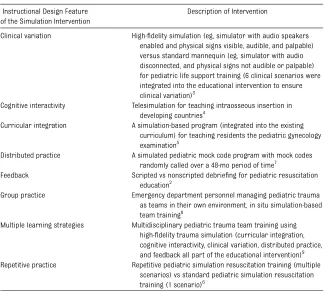
groups, and learning environments. Ex-amples of comparative pediatric studies, using the various instructional design features as a framework, are described in Table 1.
Research Using Simulation as an Investigative Methodology
Research using simulation as an in-vestigative methodology leverages the standardization provided by simulation to answer diverse research questions that otherwise could not be answered feasibly, safely, ethically, or in a timely fashion in clinical settings. The simu-lated environment is used as an exper-imental model to study factors affecting human and systems performance in health care. Mannequin-based simula-tion has been particularly useful in this context. In this form, a mannequin con-nected to a computer that controls its vital signs and physical findings pro-vides health care providers a realistic clinical experience. The use of mannequin-based simulation allows the researcher to have complete control over nearly every aspect of the clinical environment, including but not limited to the type, location, and size of equipment; the age and clinical status of the patient; and the composition, number, and experience of the health care providers.
SBR studies in this category can be grouped based on the performance-shaping factors that can enhance or degrade performance and subsequently impact patient safety and risk.35,36The
factors (eg, clinical presentation).36 By
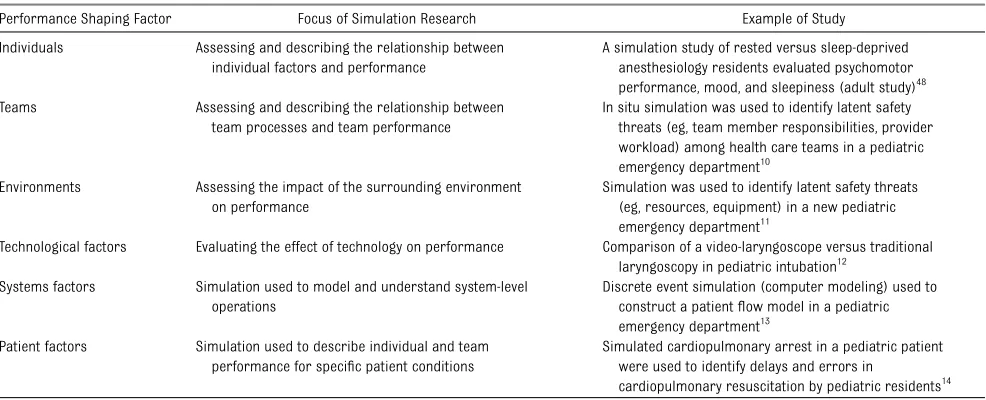
using simulation as an investigative methodology, investigators can system-atically identify latent safety threats, test new technology and protocols, and im-prove the health care environment with-out any potential for harm to real patients. Lessons learned from research per-formed in the simulated environment can then be applied to the real clinical environment to optimize patient care processes and outcomes. Table 2 pro-vides examples of studies that use sim-ulation as an investigative methodology.
ADVANTAGES OF SBR
The use of SBR in pediatrics confers several distinct advantages. Unlike clinical research in which patient presentations are variable and unpredictable, SBR allows for standardized patient pre-sentations that can be provided on demand. It is also permits the most important clinical variables, apart from
the variable of interest, to be carefully controlled and accounted for. Stan-dardization of the simulated environ-ment for research can potentially be achieved provided the research team has carefully accounted for the majority of the confounding variables (clinical diagnosis, clinical progression, etc). The authenticity of the simulated envi-ronment is particularly important when it is being used as a surrogate for the real clinical environment. Researchers should ensure that, to the best of their ability, all elements in the real clinical environment that could affect participant performance are also appropriately rep-resented during the simulations.36
Be-cause it is not always possible to control every factor that could affect participant performance during a simulation (eg, institutional culture), optimizing authen-ticity in the environment can often be best achieved by using a real clinical space (eg, in situ simulation) to conduct the simulations. Another major advantage is
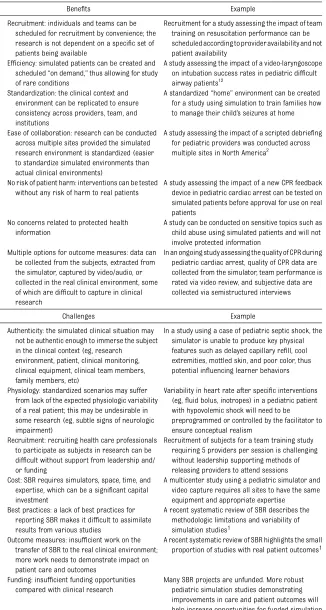
that recruitment of individuals and/or teams of pediatric health care pro-fessionals can be scheduled according to convenience, thus allowing for more predictable recruitment. Additionally, there is no risk for patient harm when using simulation to test new technology, protocols, or clinical spaces, enabling the researcher to allow a study subject to make patient care errors, such that contributing factors can be fully ob-served and analyzed. Much like clinical research, SBR also has some challenges. These challenges are listed, along with a summary of benefits, in Table 3.
KEY ELEMENTS OF SBR DESIGN
Research assessing the effectiveness of simulation as a training methodology shares similar design considerations with traditional research in medical education. In a recent article, Cook and Beckman outline important issues in designing experimental research in education.37One of the key issues they
highlighted was the importance of de-scribing both the educational inter-vention and the comparison group in sufficient detail to allow replication in other contexts. Thus, it is important to first address potential threats to the internal validity of traditional educa-tion research studies, such as subject characteristics, selection bias, history, instrumentation, testing, location, par-ticipant attitude, and implementation.37
In addition, for research assessing simulation as a training methodology, several distinct elements of study design (ie, simulation-specific confounding var-iables), including simulator selection, scenario design, confederates, realism, debriefing, and video capture/review must be carefully controlled to mitigate threats to the internal validity of the re-search study.
Many of the same simulation-specific confounding variables described above may be important for research using simulation as an investigative methodology. TABLE 1 Examples of Pediatric Studies With Simulation as the Subject of Research: Examining the
Effectiveness of Simulation as an Educational Intervention
Instructional Design Feature of the Simulation Intervention
Description of Intervention
Clinical variation High-fidelity simulation (eg, simulator with audio speakers enabled and physical signs visible, audible, and palpable) versus standard mannequin (eg, simulator with audio disconnected, and physical signs not audible or palpable) for pediatric life support training (6 clinical scenarios were integrated into the educational intervention to ensure clinical variation)3
Cognitive interactivity Telesimulation for teaching intraosseous insertion in developing countries4
Curricular integration A simulation-based program (integrated into the existing curriculum) for teaching residents the pediatric gynecology examination5
Distributed practice A simulated pediatric mock code program with mock codes randomly called over a 48-mo period of time7
Feedback Scripted vs nonscripted debriefing for pediatric resuscitation education2
Group practice Emergency department personnel managing pediatric trauma as teams in their own environment, in situ simulation-based team training8
Multiple learning strategies Multidisciplinary pediatric trauma team training using high-fidelity trauma simulation (curricular integration, cognitive interactivity, clinical variation, distributed practice, and feedback all part of the educational intervention)9
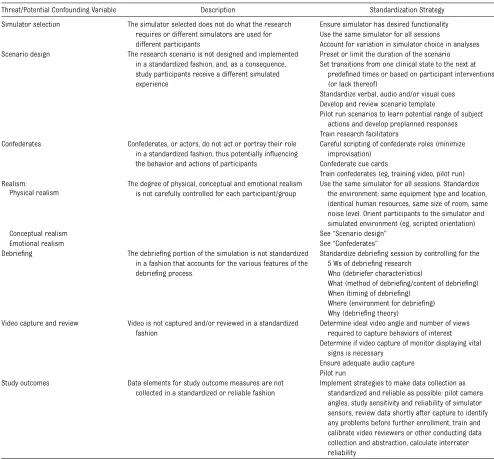
Additionally, these confounding varia-bles are important in multicenter re-search studies in which standardization of the study protocol is of paramount importance (eg, high likelihood of variability between sites). These issues should also be carefully considered for SBR research in other potential study groups (eg, adult studies, interprofessional studies). Table 4 provides an overview of standardization strategies for threats to the internal validity of SBR studies. We describe how each of these simulation-specific confounding variables affect SBR in pediatrics, in which issues re-lated to patient age, parental presence, equipment size, and disease type may all influence study design and standardization.
Simulator Selection
Because several options for infant and pediatric simulators exist, researchers must consider the functionality and features of the simulator when de-signing the study. The functionality of commercially available infant and pe-diatric simulators is highly variable, with differences in their ability to sim-ulate eye opening and closing, location and quality of pulses, size and compli-ance of lungs and chest, and design and
anatomy of the airway. Studies using scenarios and mannequin-based sim-ulation may require a certain level of functionality and realism to accurately simulate a certain medical problem. For example, if a study is designed to assess the impact of a real-time feedback device on the depth of chest compressions, it would be important to select a simulator which, at a minimum, allows for chest compressions to a depth greater than that required by resuscitation guide-lines (eg, at least 5 cm for children or adults). Similarly, a study to assess the impact of a trauma checklist on the management of head injury requires a simulator that could mimic deterioration in level of consciousness in which the eyes are able to open and close and pupils can react to light. Failure to consider the functionality of the simulator may in-fluence the relevance and accuracy of the study outcomes. If a particular function is crucial to the study, it should be men-tioned in the methodology prominently. The most logical strategy would be to choose the same simulator with all of the desired functionality for all research sessions. For multicenter research, this may have resource implications if not all sites have the desired simulator avail-able, that is, some sites may not be able to
enroll subjects if the required simulator is integral to the study design and cannot be made available to them.
Scenario Design
For either type of SBR, scenarios should be developed that can be delivered in a uniform fashion from participant to participant, group to group, and, if multicenter, from institution to in-stitution. For example, a research study to test the impact of an SBEI on man-agement of pediatric anaphylaxis requires the scenario be standardized in a fashion that will ensure each group of participants is exposed to a case of similar difficulty, with similar challenges in decision-making and clinical care. Allowing too much variation in case delivery would change the intervention of interest or add unnecessary confounders. To en-sure scenarios are delivered in a stan-dard fashion, researchers can consider various strategies, the selection of which is dependent on the research question, goal of the study, participant charac-teristics, and outcome measures: (1) control the duration of the scenario by limiting the overall time (ie, scenario is stopped at a certain time independent of participant actions/interventions) and/or setting transitions from one TABLE 2 Examples of Studies With Simulation as the Environment for Research: Simulation as an Experimental Model to Study Factors Affecting Human
and Systems Performance in Health Care
Performance Shaping Factor Focus of Simulation Research Example of Study
Individuals Assessing and describing the relationship between individual factors and performance
A simulation study of rested versus sleep-deprived anesthesiology residents evaluated psychomotor performance, mood, and sleepiness (adult study)48
Teams Assessing and describing the relationship between
team processes and team performance
In situ simulation was used to identify latent safety threats (eg, team member responsibilities, provider workload) among health care teams in a pediatric emergency department10
Environments Assessing the impact of the surrounding environment on performance
Simulation was used to identify latent safety threats (eg, resources, equipment) in a new pediatric emergency department11
Technological factors Evaluating the effect of technology on performance Comparison of a video-laryngoscope versus traditional laryngoscopy in pediatric intubation12
Systems factors Simulation used to model and understand system-level operations
Discrete event simulation (computer modeling) used to construct a patientflow model in a pediatric emergency department13
Patient factors Simulation used to describe individual and team performance for specific patient conditions
Simulated cardiopulmonary arrest in a pediatric patient were used to identify delays and errors in
clinical state to the next at predefined times, independent of subject inter-ventions (eg, normotensive to hypo-tensive at 5 minutes). Doing so allows researchers to see if certain tasks are done in a predefined time frame, with the benefit of standardizing scenario duration. The unfortunate consequence of this strategy is that sometimes conceptual realism is sacrificed (eg, patient spontaneously converts from ventricular tachycardia to sinus rhythm without intervention). (2) Alternatively, researchers can control the responses of the simulated patient by setting transitions from one clinical state to another based on subject interventions and independent of time (eg, blood pressure changes from normotensive to hypotensive if 20 mL/kg normal saline fluid bolus is not given in the first 5 minutes). Doing so allows clinical pro-gression based on participant inter-ventions (ie, high conceptual realism), but the downside is that the duration of the scenario may be highly variable from group to group. (3) Finally, researchers can control confederate behaviors by clearly standardizing verbal, audio or visual cues that are provided to confederates and facili-tators (eg, capillary refill, level of con-sciousness). These cues can be tied to participant actions/inaction, patient transitions in physiology, or certain time points in the scenario. During SBR, improvisation must be minimized for confederates and facilitators and only used to maintain standardization and realism of the scenario. Careful review of the scenario template and training of scenario facilitators is recommended to establish reliability. Pilot testing scenarios before starting a research study will help investigators identify and correct potential pitfalls before enrollment begins. This is particularly important for multicenter research, in which sites will be using different re-search coordinators. Pilot testing pro-vides an opportunity to train research TABLE 3 Benefits and Challenges of Simulation Research
Benefits Example
Recruitment: individuals and teams can be scheduled for recruitment by convenience; the research is not dependent on a specific set of patients being available
Recruitment for a study assessing the impact of team training on resuscitation performance can be scheduled according to provider availability and not patient availability
Efficiency: simulated patients can be created and scheduled“on demand,”thus allowing for study of rare conditions
A study assessing the impact of a video-laryngoscope on intubation success rates in pediatric difficult airway patients12
Standardization: the clinical context and environment can be replicated to ensure consistency across providers, team, and institutions
A standardized“home”environment can be created for a study using simulation to train families how to manage their child’s seizures at home
Ease of collaboration: research can be conducted across multiple sites provided the simulated research environment is standardized (easier to standardize simulated environments than actual clinical environments)
A study assessing the impact of a scripted debriefing for pediatric providers was conducted across multiple sites in North America2
No risk of patient harm: interventions can be tested without any risk of harm to real patients
A study assessing the impact of a new CPR feedback device in pediatric cardiac arrest can be tested on simulated patients before approval for use on real patients
No concerns related to protected health information
A study can be conducted on sensitive topics such as child abuse using simulated patients and will not involve protected information
Multiple options for outcome measures: data can be collected from the subjects, extracted from the simulator, captured by video/audio, or collected in the real clinical environment, some of which are difficult to capture in clinical research
In an ongoing study assessing the quality of CPR during pediatric cardiac arrest, quality of CPR data are collected from the simulator, team performance is rated via video review, and subjective data are collected via semistructured interviews
Challenges Example
Authenticity: the simulated clinical situation may not be authentic enough to immerse the subject in the clinical context (eg, research
environment, patient, clinical monitoring, clinical equipment, clinical team members, family members, etc)
In a study using a case of pediatric septic shock, the simulator is unable to produce key physical features such as delayed capillary refill, cool extremities, mottled skin, and poor color, thus potential influencing learner behaviors
Physiology: standardized scenarios may suffer from lack of the expected physiologic variability of a real patient; this may be undesirable in some research (eg, subtle signs of neurologic impairment)
Variability in heart rate after specific interventions (eg,fluid bolus, inotropes) in a pediatric patient with hypovolemic shock will need to be preprogrammed or controlled by the facilitator to ensure conceptual realism
Recruitment: recruiting health care professionals to participate as subjects in research can be difficult without support from leadership and/ or funding
Recruitment of subjects for a team training study requiring 5 providers per session is challenging without leadership supporting methods of releasing providers to attend sessions Cost: SBR requires simulators, space, time, and
expertise, which can be a significant capital investment
A multicenter study using a pediatric simulator and video capture requires all sites to have the same equipment and appropriate expertise
Best practices: a lack of best practices for reporting SBR makes it difficult to assimilate results from various studies
A recent systematic review of SBR describes the methodologic limitations and variability of simulation studies1
Outcome measures: insufficient work on the transfer of SBR to the real clinical environment; more work needs to demonstrate impact on patient care and outcomes
A recent systematic review of SBR highlights the small proportion of studies with real patient outcomes1
Funding: insufficient funding opportunities compared with clinical research
Many SBR projects are unfunded. More robust pediatric simulation studies demonstrating improvements in care and patient outcomes will help increase opportunities for funded simulation research
facilitators ahead of time and for the re-search team members to share their experiences and struggles and offer suggestions for streamlining the research process. Sharing videos of pilot runs (both successes and failures with descriptions of lessons learned) allows sites to have a shared mental model of exactly how the scenarios should be managed.
Confederates
Confederates, or actors, can be used in SBR to increase realism and help create
and/or manipulate a situation for study purposes. In adult studies, confederates are used in the role as members of the health care team or as the patient. In pediatric research, confederates can be integrated into the simulated environ-ment as family members or caregivers to enhance pediatric-specific aspects of clinical care, or children (in selected circumstances) can be recruited as confederates to play the role of the sick patient. In contrast to adult studies, the use of real children to play the role of
a sick patient may be at times imprac-tical (or impossible) because younger children as less likely to adhere to the predefined confederate role or are unable to reliably reproduce desired physical findings (eg, tachypnea). This limitation creates an exaggerated reliance on sim-ulation technology in pediatrics. As such, the pros and cons of using a child as a confederate should be carefully weighed, and the relative benefits of using a simu-lator as the patient should be considered before making afinal decision.
TABLE 4 Standardization Strategies to Mitigate Threats to Internal Validity of SBR Studies
Threat/Potential Confounding Variable Description Standardization Strategy
Simulator selection The simulator selected does not do what the research requires or different simulators are used for different participants
Ensure simulator has desired functionality Use the same simulator for all sessions
Account for variation in simulator choice in analyses Scenario design The research scenario is not designed and implemented
in a standardized fashion, and, as a consequence, study participants receive a different simulated experience
Preset or limit the duration of the scenario Set transitions from one clinical state to the next at
predefined times or based on participant interventions (or lack thereof)
Standardize verbal, audio and/or visual cues Develop and review scenario template
Pilot run scenarios to learn potential range of subject actions and develop preplanned responses Train research facilitators
Confederates Confederates, or actors, do not act or portray their role in a standardized fashion, thus potentially influencing the behavior and actions of participants
Careful scripting of confederate roles (minimize improvisation)
Confederate cue cards
Train confederates (eg, training video, pilot run)
Realism: The degree of physical, conceptual and emotional realism
is not carefully controlled for each participant/group Physical realism
Use the same simulator for all sessions. Standardize the environment: same equipment type and location, identical human resources, same size of room, same noise level. Orient participants to the simulator and simulated environment (eg, scripted orientation)
Conceptual realism See“Scenario design”
Emotional realism See“Confederates”
Debriefing The debriefing portion of the simulation is not standardized in a fashion that accounts for the various features of the debriefing process.
Standardize debriefing session by controlling for the 5 Ws of debriefing research
Who (debriefer characteristics)
What (method of debriefing/content of debriefing) When (timing of debriefing)
Where (environment for debriefing) Why (debriefing theory)
Video capture and review Video is not captured and/or reviewed in a standardized fashion
Determine ideal video angle and number of views required to capture behaviors of interest Determine if video capture of monitor displaying vital
signs is necessary Ensure adequate audio capture Pilot run
Study outcomes Data elements for study outcome measures are not collected in a standardized or reliable fashion
As an example of how confederates may be used in research, an SBEI may be used to teach residents how to com-municate with family members, and confederates could be scripted to play the role of parents who are interacting with the participants. The use of con-federates requires careful scripting of confederate roles, which can be tai-lored to address the research question (eg, issues of health literacy, culture factors in pediatrics, delivering bad news). Unfortunately, no research to date has described the ideal way to train confederates for SBR, although there are descriptions of multiple meth-ods used in a single study.38Strategies
that can be used to orient confederates to their roles include the following: (1) development of a scenario script or template with detailed description of confederate roles, (2) confederate cue cards that can be used as a quick ref-erence during the scenario, (3) confed-erate training video with expert modeling of desired confederate actions, and (4) confederate training session with pilot research sessions prior to initiation of the study. During pilot sessions, inves-tigators will be able to see how par-ticipant and confederate behaviors tend to deviate from expected, thus allowing time to revise the study protocol and supporting materials to be more resilient to the variability associated with human actors and participants. Careful consideration of strategies to standard-ize confederate behaviors in multicenter research is particularly crucial; individ-uals selected to be confederates may differ in background, experience, and expectations.
Realism
Several ways of categorizing simulation fidelity or realism have been described.39,40
Although the impact of realism on the quality of simulation-based pediatric ed-ucation is controversial,2,41 investigators
should be attentive to the importance of realism when running simulation
sce-narios for research purposes. Enhanced levels of realism help to immerse par-ticipants in the simulated experience, whereas a lower level of realism may lead to disengaged participants. A vari-able level of realism from scenario to scenario can introduce a confounding variable that may potentially affect the way individuals or teams perform. When designing a scenario for SBR, there are 3 important components of realism to consider.39,40“Physical realism”refers
to the physical properties of the sim-ulation mannequins and environment used to run the scenario. Standardizing the environment involves providing the same equipment and human resour-ces, as well as positioning the equip-ment in the same location to which the participants are accustomed and in the same fashion for all participants. While doing so may help to achieve standardization among groups and/or sites (eg, in a multicenter study), it may also systematically introduce a bias that favors participants from one institution where, for example, the resuscitation cart is placed in the exact spot they are used to in the real clinical environment. Furthermore, replicating certain noises or distractors (eg, phone call or page) typically found during real patient care may help to promote standardization but also inadvertently introduce a confound-ing variable (eg, one institution typically has less ambient background noise compared with another). As such, while researchers attempt to achieve complete standardization of the physi-cal environment, they must also con-sider the introduction of confounding variables when doing so. One effective strategy is to orient all subjects to the features of the simulator and the physi-cal environment and effectively removing unfamiliarity with the simulator or space as a potential confounder. This can be achieved by providing a scripted ori-entation to the research environment. “Conceptual realism”refers to the theory, meaning, concepts, and relationships
attached to each simulated scenario.39
Specifically, conceptual realism involves clinical authenticity with “if–then” relationships presented during the simulation,39such as,“Iffluid is given
for hypovolemic shock, then the blood pressure should increase.”A consistent degree of conceptual realism relies heavily on carefully designed scenarios and facilitators who are familiar with the scenario. Finally, “emotional re-alism”relates to the feelings that are evoked in subjects as a result of par-ticipating in the simulation.39
Manag-ing the degree of emotional realism in subjects can be difficult but is especially important when individual or team per-formance is an outcome measure. The degree and nature of interaction be-tween subjects and confederates can often have a strong impact on emo-tional realism (eg, a confederate play-ing the role of a parent starts cryplay-ing during the scenario in an unscripted manner); this must be understood by research confederates, who should be carefully scripted in the manner de-scribed earlier.
Debriefing
Studies assessing the efficacy of simula-tion as a training methodology should carefully consider the relative value of debriefing as part of the overall learning experience.19 Conversely, many studies
using simulation as an investigative methodology may not involve debrief-ing at all. Although debriefing has been characterized as the most important element of simulation-based education, failure to standardize the debriefing introduces a major threat to the validity of any SBEI. A recent review of the debriefing literature outlined the key characteristics of debriefing as the 5 Ws of debriefing research: who (debriefer characteristics), what (content and methods of debriefing), when (timing), where (environment), and why (theory).42
reported when assessing simulation as an educational intervention. For ex-ample, if using multiple debriefers in a study, each debriefer should have the same level of expertise and should be trained to use the same method of debriefing. This is particularly crucial when 1 element of the debriefing is the intervention of interest in the study. Standardization of the other debriefing characteristics will allow for isolation of the specific debriefing variable (eg, location of debriefing: in resuscitation room vs in separate debriefing room).
Video Capture and Review
Many SBR studies use video to capture individual or team performance and then rate the videos using assessment tools as an outcome measure.2Using
video in this manner requires the re-searcher to consider the ideal video an-gle(s) and the number of views required for capturing the desired behaviors. Similarly, microphone placement and audio interference are important, partic-ularly for studies focusing on communi-cation. Researchers should also consider whether the vital signs monitor display is a necessary as an adjunct to the video views for raters.
Improperly or inadequately captured video or audio can hinder the rater’s ability to accurately score performance. This should be accounted for when cal-culating the sample size for studies required video capture and review. In multicenter studies in which video capture hardware and software varies from site to site, there is a greater need to standardize the methods of video capture and account for dropout re-lated to technical issues when calcu-lating sample size. On the basis of our collective experience in conducting SBR with video review, we have occa-sionally lost up to 10% of video because of issues with poor camera angle, sound quality, or problems with technology. As such, we recommend including video
capture and review as part of the pilot testing process in which pilot videos are reviewed for quality (ie, video, au-dio, and camera angle). Also consider increasing your sample size a priori to account for lost video; however it will be important to assess whether there is any systematic bias to the lost videos.
OUTCOMES FOR PEDIATRIC SBR
The selection of outcome measures for SBR primarily depends on the research question. One should choose outcome measures that are relevant, measure-able, and hold a plausible association to the intervention. Outcomes for both types of SBR may be framed based on Kirkpatrick’s hierarchy of evidence, with learner’s attendance at the base of the pyramid (eg, satisfaction); knowl-edge, skills, and attitudes of participants in the middle; and behavior change and clinical outcomes in respectively higher positions.43Satisfaction data are easier
to capture but less impactful than evi-dence of actual process of care or patient improvements based on the intervention. In quantitative SBR, methods to measure outcomes most commonly fall within 1 of 3 categories: (1) the simulator itself as a measurement tool, (2) observational checklists, and (3) clinical and/or trans-lational outcomes. We focus our discus-sion on these 3 categories as they pertain to pediatric simulation research.
Simulator as the Measurement Tool
Most pediatric simulators are able to measure and record specific data points related to the passive physio-logic state of the simulator as well as the actions performed on it by participants. These provide objective measurements (eg, timing of head tilt, chin lift, or pulse check; depth and rate of chest com-pressions) that can be exported into a research database for analysis. Sev-eral studies have leveraged the simu-lator’s ability to precisely capture time to study an intervention’s impact on
time to performance of a skill or pro-cedure.44–46As technology evolves, so
will the ability to collect and store various types of data in usable formats for research.
One potential pitfall to using simulation technology to measure outcomes is that the accuracy of certain measurements is largely unknown. For example, some simulators can provide detailed logs of how deeply chest compressions are performed. However, information about precision or validity of this measure-ment is unknown. For example, if a study is measuring depth of compressions as the main outcome measure, how does the researcher know if the compliance and depth of the simulator chest wall matches that of a live infant or pediatric patient? More research is needed to validate proxy measurements from sim-ulators in the clinical world. Industry partnerships can help to address some of these limitations. In the meantime, it is important for the commercial simulation and research community to collectively explore and document the validity and reliability of these features.
Observational Checklists
Observational checklists are often used to assess technical skills, behavioral performance, and/or clinical perfor-mance in SBR studies.2,3,6Discussion on
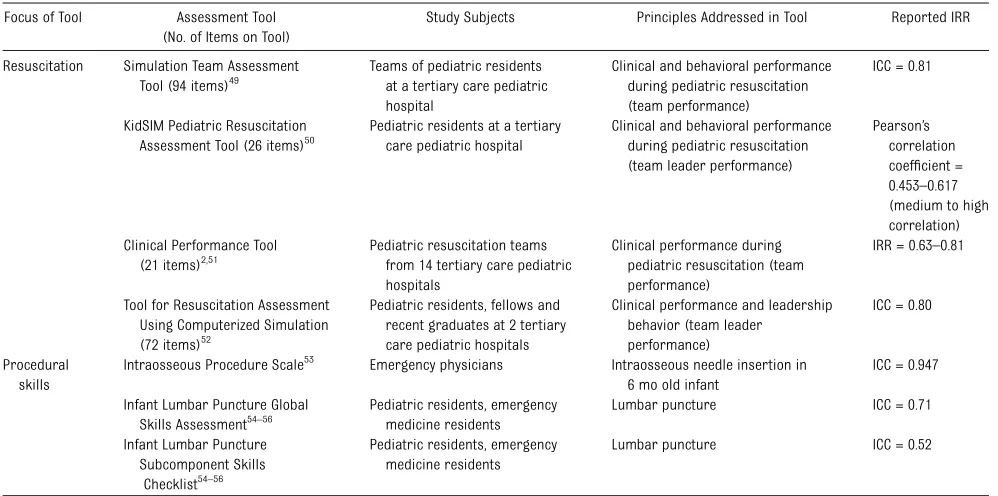
observational checklists for pediatric care have been developed and vali-dated in a simulated environment. Ta-ble 5 summarizes several clinical and behavioral assessment tools that have been validated for pediatric resuscitation and provides examples of pediatric pro-cedural skills checklists.
If observational checklists are used as an outcome measure, the researcher can apply the tool in real-time and/or retrospectively by video review. Real-time review allows for rapid acquisition of data. However, reliability of data col-lected in real-time is highly dependent on rater familiarity with the tool and the ability of the rater to accurately assess performance in real-time while con-currently recording scores. Conversely, video recording allows reviewers to pause, rewind, or repeatedly review performance to more thoroughly extract objective details. Use of video also allows the researcher to more easily blind the rater to study purpose or group allo-cation. Our research network has lev-eraged technology to share videos online and therefore make available to a large
group of raters.47Regardless of whether
real-time and/or recorded review is used in a study, the implementation of a rater training process before the study will help to improve interrater reliability.2
Clinical/Translational Outcomes
The ultimate measure of any medical intervention is how it affects patient care and clinical outcomes. This is particu-larly important because it is unclear the degree to which selected human per-formance measures in a simulated en-vironment (eg, observational checklists) correlate with true patient and/or health care outcomes. Because of the size and cost of conducting such studies with real patient outcomes, there are far fewer examples of SBR measuring clinical outcomes. In Cook’s meta-analysis of 609 technology-enhanced simulation arti-cles, only 32 studies reported patient/ health outcomes.1 In a recent study,7
Andreatta demonstrated improved sur-vival rates from pediatric cardiac arrest after implementing a longitudinal sim-ulation mock code program. Studies like
this are especially challenging because there are typically numerous confound-ing variables that have an impact on clinical outcomes, and learner groups have other sources of learning outside of the study intervention. In an attempt to address these challenges, several groups have begun to form longitudinal data-bases to measure the impact of educa-tional interventions over time (eg, the American Heart Association’s Get With the Guidelines—Resuscitation registry). A multicenter pediatric network, the In-ternational Network for Simulation-based Innovation, Research and Education (INSPIRE, http://www.inspiresim.com) has been formed to help achieve the sample size and power needed to measure more infrequent clinical outcomes. These ini-tiatives have the potential to facilitate the incorporation of clinical outcomes into future pediatric SBR studies.
Summary
The effective use of simulation research in pediatrics is dependent on understanding the benefits and challenges of SBR, the simulation-specific threats to the internal
TABLE 5 Examples of Assessment Tools for Pediatric Resuscitation and Procedural Skills
Focus of Tool Assessment Tool
(No. of Items on Tool)
Study Subjects Principles Addressed in Tool Reported IRR
Resuscitation Simulation Team Assessment Tool (94 items)49
Teams of pediatric residents at a tertiary care pediatric hospital
Clinical and behavioral performance during pediatric resuscitation (team performance)
ICC = 0.81
KidSIM Pediatric Resuscitation Assessment Tool (26 items)50
Pediatric residents at a tertiary care pediatric hospital
Clinical and behavioral performance during pediatric resuscitation (team leader performance)
Pearson’s correlation coefficient = 0.453–0.617 (medium to high correlation) Clinical Performance Tool
(21 items)2,51
Pediatric resuscitation teams from 14 tertiary care pediatric hospitals
Clinical performance during pediatric resuscitation (team performance)
IRR = 0.63–0.81
Tool for Resuscitation Assessment Using Computerized Simulation (72 items)52
Pediatric residents, fellows and recent graduates at 2 tertiary care pediatric hospitals
Clinical performance and leadership behavior (team leader
performance)
ICC = 0.80
Procedural skills
Intraosseous Procedure Scale53 Emergency physicians Intraosseous needle insertion in 6 mo old infant
ICC = 0.947
Infant Lumbar Puncture Global Skills Assessment54–56
Pediatric residents, emergency medicine residents
Lumbar puncture ICC = 0.71
Infant Lumbar Puncture Subcomponent Skills
Checklist54–56
Pediatric residents, emergency medicine residents
Lumbar puncture ICC = 0.52
validity of simulation studies, and the implementation of strategies in simula-tion research studies to minimize these threats as they exist in a pediatric context. Selecting valid outcome measures that are relevant, consistently measureable, and hold a plausible association to the intervention being studied is an impor-tant component in designing simulation research studies. Careful consideration of these elements, along with the es-tablishment of a common research
agenda for the pediatric simulation community, will help to ensure that high-quality SBR that tackles the most pertinent questions in pediatrics will contribute to improving the quality of care and clinical outcomes for pediatric patients.
ACKNOWLEDGMENTS
The authors would like to acknowledge the contributions of members of the Inter-national Network for Simulation-based
Pediatric Innovation, Research and Edu-cation (INSPIRE) who have participated in SBR studies, and whose efforts over the years have helped to shaped the con-tent of this manuscript. The authors would also like to acknowledge the Laerdal Foun-dation for Acute Medicine and the Rbaby Foundation for supporting INSPIRE re-search, and the Society for Simulation in Healthcare and the International Pediatric Simulation Society for supporting the bi-annual INSPIRE research meetings.
REFERENCES
1. Cook DA, Hatala R, Brydges R, et al. Technology-enhanced simulation for health professions education: a systematic review and meta-analysis.JAMA. 2011;306(9):978–988 2. Cheng A, Hunt EA, Donoghue A, et al.
Ex-amining pediatric resuscitation education using simulation and scripting debriefing: a multicenter, randomized-controlled trial.
JAMA Pediatr. 2013;167(6):528–536 3. Donoghue AJ, Durbin DR, Nadel FM, Stryjewski
GR, Kost SI, Nadkarni VM. Effect of high-fidelity simulation on Pediatric Advanced Life Sup-port training in pediatric house staff: a ran-domized trial.Pediatr Emerg Care. 2009;25 (3):139–144
4. Mikrogianakis A, Kam A, Silver S, et al. Telesimulation: an innovative and effective tool for teaching novel intraosseous in-sertion techniques in developing countries.
Acad Emerg Med. 2011;18(4):420–427 5. Loveless MB, Finkenzeller D, Ibrahim S,
Satin AJ. A simulation program for teach-ing obstetrics and gynecology residents the pediatric gynecology examination and procedures. J Pediatr Adolesc Gynecol. 2011;24(3):127–136
6. Auerbach M, Kessler D, Foltin JC. Repetitive pediatric simulation resuscitation training.
Pediatr Emerg Care. 2011;27(1):29–31 7. Andreatta P, Saxton E, Thompson M, Annich G.
Simulation-based mock codes significantly correlate with improved pediatric patient cardiopulmonary arrest survival rates.
Pediatr Crit Care Med. 2011;12(1):33–38 8. Hunt EA, Heine M, Hohenhaus SM, Luo X,
Frush KS. Simulated pediatric trauma team management: assessment of an educa-tional intervention. Pediatr Emerg Care. 2007;23(11):796–804
9. Falcone RA Jr, Daugherty M, Schweer L, Patterson M, Brown RL, Garcia VF.
Multidis-ciplinary pediatric trauma team training us-ing high-fidelity trauma simulation.J Pediatr Surg. 2008;43(6):1065–1071
10. Patterson MD, Geis GL, Falcone RA, LeMaster T, Wears RL. In situ simulation: detection of safety threats and teamwork training in a high risk emergency department. BMJ Qual Saf. 2013;22(6):468–477
11. Geis GL, Pio B, Pendergrass TL, Moyer MR, Patterson MD. Simulation to assess the safety of new healthcare teams and new facilities.Simul Healthc. 2011;6(3):125–133 12. Fonte M, Oulego-Erroz I, Nadkarni L,
Sánchez-Santos L, Iglesias-Vásquez A, Rodríguez-Núñez A. A randomized comparison of the GlideScope videolaryngoscope to the stan-dard laryngoscopy for intubation by pediat-ric residents in simulated easy and difficult infant airway scenarios. Pediatr Emerg Care. 2011;27(5):398–402
13. Hung GR, Whitehouse SR, O’Neill C, Gray AP, Kissoon N. Computer modeling of patient
flow in a pediatric emergency department using discrete event simulation. Pediatr Emerg Care. 2007;23(1):5–10
14. Hunt EA, Vera K, Diener-West M, et al. Delays and errors in cardiopulmonary resusci-tation and defibrillation by pediatric resi-dents during simulated cardiopulmonary arrests.Resuscitation. 2009;80(7):819–825 15. Weinger MB. The pharmacology of simulation:
a conceptual framework to inform progress in simulation research.Simul Healthc. 2010;5 (1):8–15
16. McGaghie WC, Issenberg SB, Petrusa ER, Scalese RJ. A critical review of simulation-based medical education research: 2003– 2009.Med Educ. 2010;44(1):50–63 17. Cook DA. One drop at a time: research to
advance the science of simulation. Simul Healthc. 2010;5(1):1–4
18. McGaghie WC, Issenberg SB, Cohen ER, Barsuk JH, Wayne DB. Translational educa-tional research: a necessity for effective health-care improvement. Chest. 2012;142 (5):1097–1103
19. Issenberg SB, McGaghie WC, Petrusa ER, Lee Gordon D, Scalese RJ. Features and uses of high-fidelity medical simulations that lead to effective learning: a BEME systematic review.
Med Teach. 2005;27(1):10–28
20. Thomas EJ, Taggart B, Crandell S, et al. Teaching teamwork during the Neonatal Resuscitation Program: a randomized trial.
J Perinatol. 2007;27(7):409–414
21. Duran R, Aladag N, Vatansever U,
gurluoglu Y, Süt N, Acunas¸ B. Proficiency and knowledge gained and retained by pediatric residents after neonatal resuscitation course.
Pediatr Int. 2008;50(5):644–647
22. Campbell DM, Barozzino T, Farrugia M, Sgro M. High-fidelity simulation in neonatal re-suscitation.Paediatr Child Health (Oxford). 2009;14(1):19–23
23. Gilfoyle E, Gottesman R, Razack S. De-velopment of a leadership skills workshop in paediatric advanced resuscitation.Med Teach. 2007;29(9):e276–e283
24. Jankouskas T, Bush MC, Murray B, et al. Crisis resource management: evaluating outcomes of a multidisciplinary team.
Simul Healthc. 2007;2(2):96–101
25. Schilleman K, Witlox RS, Lopriore E, Morley CJ, Walther FJ, te Pas AB. Leak and ob-struction with mask ventilation during sim-ulated neonatal resuscitation.Arch Dis Child Fetal Neonatal Ed. 2010;95(6):F398–F402 26. Shavit I, Keidan I, Hoffmann Y et al.
27. López YM, Pilar FJ, Medina JA, et al. Cour-ses on mechanical ventilation in pediatrics:
first experience in Spain.Pediatr Pulmonol. 2007;42(11):1072–1077
28. Ballard HO, Shook LA, Iocono J, Turner MD, Marino S, Bernard PA. Novel animal model for teaching chest tube placement. J Ky Med Assoc. 2009;107(6):219–221
29. Gaies MG, Morris SA, Hafler JP, et al. Re-forming procedural skills training for pedi-atric residents: a randomized, interventional trial.Pediatrics. 2009;124(2):610–619 30. Sudikoff SN, Overly FL, Shapiro MJ. High-fidelity
medical simulation as a technique to improve pediatric residents’emergency airway man-agement and teamwork: a pilot study.Pediatr Emerg Care. 2009;25(10):651–656
31. Nakajima K, Wasa M, Takiguchi S, et al. A modular laparoscopic training program for pediatric surgeons.JSLS. 2003;7(1):33–37 32. Thomson M, Heuschkel R, Donaldson N,
Murch S, Hinds R. Acquisition of compe-tence in paediatric ileocolonoscopy with virtual endoscopy training.J Pediatr Gas-troenterol Nutr. 2006;43(5):699–701 33. Hamilton JM, Kahol K, Vankipuram M, Ashby
A, Notrica DM, Ferrara JJ. Toward effective pediatric minimally invasive surgical sim-ulation.J Pediatr Surg. 2011;46(1):138–144 34. Cook DA, Hamstra SJ, Brydges R, et al. Comparative effectiveness of instructional design features in simulation-based educa-tion: systematic review and meta-analysis.
Med Teach. 2013;35(1):e867–e898
35. Vincent C, Taylor-Adams S, Stanhope N. Framework for analysing risk and safety in clinical medicine.BMJ. 1998;316(7138): 1154–1157
36. LeBlanc VR, Manser T, Weinger MB, Musson D, Kutzin J, Howard SK. The study of factors affecting human and systems performance in healthcare using simulation. Simul Healthc. 2011;6(suppl):S24–S29
37. Cook DA, Beckman TJ. Reflections on ex-perimental research in medical education.
Adv Health Sci Educ Theory Pract. 2010;15 (3):455–464
38. Kassab ES, King D, Hull LM, et al. Actor training for surgical team simulations.Med Teach. 2010;32(3):256–258
39. Rudolph JW, Simon R, Raemer DB. Which reality matters? Questions on the path to high engagement in healthcare simulation.
Simul Healthc. 2007;2(3):161–163 40. Dieckmann P, Gaba D, Rall M. Deepening the
theoretical foundations of patient simula-tion as social practice.Simul Healthc. 2007; 2(3):183–193
41. Donoghue AJ, Durbin DR, Nadel FM, Stryjewski GR, Kost SI, Nadkarni VM. Per-ception of realism during mock resuscita-tions by pediatric housestaff: the impact of simulated physical features.Simul Healthc. 2010;5(1):16–20
42. Raemer D, Anderson M, Cheng A, Fanning R, Nadkarni V, Savoldelli G. Research regarding debriefing as part of the learning process.
Simul Healthc. 2011;6(suppl):S52–S57 43. Kirkpatrick DI.Evaluating Training Programs:
The Four Levels. 2nd ed. San Francisco, CA: Berrett-Koehler; 1998
44. Schunk D, Ritzka M, Graf B, Trabold B. A comparison of three supraglottic airway devices used by healthcare professionals during paediatric resuscitation simulation.
Emerg Med J. 2013;30(9):754–757 45. Rahman T, Chandran S, Kluger D, et al.
Tracking manikin tracheal intubation using motion analysis.Pediatr Emerg Care. 2011; 27(8):701–705
46. Martin P, Theobald P, Kemp A, Maguire S, Maconochie I, Jones M. Real-time feedback can improve infant manikin cardiopulmo-nary resuscitation by up to 79%—a rando-mised controlled trial.Resuscitation. 2013; 84(8):1125–1130
47. Cheng A, Nadkarni V, Hunt EA, Qayumi K; EXPRESS Investigators. A multifunctional online research portal for facilitation of simulation-based research: a report from the EXPRESS research collaborative.Simul Healthc. 2011;6(4):239–243
48. Howard SK, Gaba DM, Smith BE, et al. Simulation study of rested versus
sleep-deprived anesthesiologists. Anesthesiology. 2003;98(6):1345–1355, discussion 5A 49. Reid J, Stone K, Brown J, et al. The Simulation
Team Assessment Tool (STAT): development, reliability and validation.Resuscitation. 2012; 83(7):879–886
50. Grant EC, Grant VJ, Bhanji F, Duff JP, Cheng A, Lockyer JM. The development and assess-ment of an evaluation tool for pediatric resident competence in leading simulated pediatric resuscitations.Resuscitation. 2012; 83(7):887–893
51. Donoghue A, Ventre K, Boulet J, et al; EXPRESS Pediatric Simulation Research Investigators. Design, implementation, and psychometric analysis of a scoring instrument for simu-lated pediatric resuscitation: a report from the EXPRESS pediatric investigators. Simul Healthc. 2011;6(2):71–77
52. Brett-Fleegler MB, Vinci RJ, Weiner DL, Harris SK, Shih MC, Kleinman ME. A simulator-based tool that assesses pediatric resident resuscitation compe-tency.Pediatrics. 2008;121(3). Available at: www.pediatrics.org/cgi/content/full/121/3/ e597
53. Oriot D, Darrieux E, Boureau-Voultoury A, Ragot S, Scépi M. Validation of a perfor-mance assessment scale for simulated intraosseous access.Simul Healthc. 2012;7 (3):171–175
54. Gerard JM, Kessler DO, Braun C, Mehta R, Scalzo AJ, Auerbach M. Validation of global rating scale and checklist instru-ments for the infant lumbar puncture procedure.Simul Healthc. 2013;8(3):148– 154
55. Auerbach MA, Chang TP, Reid J, et al. Are pediatric interns prepared to perform infant lumbar punctures? A multi-institutional de-scriptive study.Pediatr Emerg Care. 2013;29 (4):453–457
DOI: 10.1542/peds.2013-3267 originally published online May 12, 2014;
2014;133;1091
Pediatrics
Vinay Nadkarni and David Kessler
Adam Cheng, Marc Auerbach, Elizabeth A. Hunt, Todd P. Chang, Martin Pusic,
Designing and Conducting Simulation-Based Research
Services
Updated Information &
http://pediatrics.aappublications.org/content/133/6/1091 including high resolution figures, can be found at:
References
http://pediatrics.aappublications.org/content/133/6/1091#BIBL This article cites 54 articles, 6 of which you can access for free at:
Subspecialty Collections
http://www.aappublications.org/cgi/collection/gastroenterology_sub
Gastroenterology
following collection(s):
This article, along with others on similar topics, appears in the
Permissions & Licensing
http://www.aappublications.org/site/misc/Permissions.xhtml in its entirety can be found online at:
Information about reproducing this article in parts (figures, tables) or
Reprints
DOI: 10.1542/peds.2013-3267 originally published online May 12, 2014;
2014;133;1091
Pediatrics
Vinay Nadkarni and David Kessler
http://pediatrics.aappublications.org/content/133/6/1091
located on the World Wide Web at:
The online version of this article, along with updated information and services, is
by the American Academy of Pediatrics. All rights reserved. Print ISSN: 1073-0397.