Overdiagnosis: How Our Compulsion for Diagnosis
May Be Harming Children
abstract
Overdiagnosis occurs when a true abnormality is discovered, but de-tection of that abnormality does not benefit the patient. It should be distinguished from misdiagnosis, in which the diagnosis is inaccurate, and it is not synonymous with overtreatment or overuse, in which ex-cess medication or procedures are provided to patients for both cor-rect and incorcor-rect diagnoses. Overdiagnosis for adult conditions has gained a great deal of recognition over the last few years, led by real-izations that certain screening initiatives, such as those for breast and prostate cancer, may be harming the very people they were designed to protect. In the fall of 2014, the second international Preventing Over-diagnosis Conference will be held, and the British Medical Journal will produce an overdiagnosis-themed journal issue. However, overdiagno-sis in children has been less well described. This special article seeks to raise awareness of the possibility of overdiagnosis in pediatrics, suggesting that overdiagnosis may affect commonly diagnosed condi-tions such as attention-deficit/hyperactivity disorder, bacteremia, food allergy, hyperbilirubinemia, obstructive sleep apnea, and urinary tract infection. Through these and other examples, we discuss why over-diagnosis occurs and how it may be harming children. Additionally, we consider research and education strategies, with the goal to better elucidate pediatric overdiagnosis and mitigate its influence.Pediatrics 2014;134:1013–1023
AUTHORS:Eric R. Coon, MD,aRicardo A. Quinonez, MD,b
Virginia A. Moyer, MD, MPH,cand Alan R. Schroeder, MDd
aDivision of Inpatient Medicine, University of Utah School of Medicine, Primary Children’s Hospital, Salt Lake City, Utah; bBaylor College of Medicine, San Antonio Children’s Hospital, San Antonio, Texas;cAmerican Board of Pediatrics, Maintenance of Certification and Quality, Chapel Hill, North Carolina; and dDepartment of Pediatrics, Santa Clara Valley Medical Center, San Jose, California
KEY WORDS
medical education, public health
ABBREVIATION
ADHD—attention-deficit/hyperactivity disorder
Dr Coon participated in conception and design, drafted the initial manuscript, and critically reviewed and revised the manuscript; Drs Quinonez, Moyer, and Schroeder participated in conception and design and critically reviewed and revised the manuscript; and all authors approved thefinal manuscript as submitted.
www.pediatrics.org/cgi/doi/10.1542/peds.2014-1778
doi:10.1542/peds.2014-1778
Accepted for publication Aug 20, 2014
Address correspondence to Eric R. Coon, MD, Department of Pediatrics, Division of Inpatient Medicine, University of Utah School of Medicine, Primary Children’s Hospital, 100 North Mario Capecchi Dr, Salt Lake City, UT 84113. E-mail: [email protected]. edu
PEDIATRICS (ISSN Numbers: Print, 0031-4005; Online, 1098-4275).
Copyright © 2014 by the American Academy of Pediatrics
FINANCIAL DISCLOSURE:The authors have indicated they have nofinancial relationships relevant to this article to disclose.
FUNDING:No external funding.
Overdiagnosis is defined as the identi-fication of an abnormality where detec-tion will not benefit the patient. Unlike misdiagnosis, thefinding is accurate; the condition detected may be precisely the condition that was meant to be detected (a true-positive). The notion that an ac-curate diagnosis could be anything but beneficial runs counter to the conven-tional wisdom that the more that is known about a patient, the better. Un-fortunately, not only do overdiagnosed patients fail to benefit from their di-agnosis, they may also be harmed. Consider the following common clinical scenarios. An 8-year-old boy with ton-sillar hypertrophy on examination and polysomnography consistent with ob-structive sleep apnea undergoes an adenotonsillectomy. A 4 year-old girl with a head injury, 2 episodes of vom-iting, and a normal physical examina-tion undergoes a head CT scan, which shows a small subdural hematoma, for which she is admitted to the PICU. A 3-month-old girl with bronchiolitis seen in an emergency department has an ox-ygen saturation of 94% at triage but desaturates to 88% while asleep on continuous pulse oximetry, prompting hospital admission. In each case, the diagnoses were accurate; the diag-nostic tests detected precisely what they were intended to detect. Providers may disagree on the optimal treatment approaches for these diagnosed chil-dren, but the focus of this article is not mistreatment or overtreatment but rather the incipient event of diagnosis. Did these 3 children benefit from their accurate diagnoses?
For an individual patient, determining whether a diagnosis is beneficial can be a nearly impossible task, just as it is often difficult to tell how much benefit an individual derives from treatment; one can never know with certainty what would have happened if the diagnosis had not been made or the treatment not given. However, just as it is possible to
evaluate the likelihood of benefit from treatments across populations, it is pos-sible to know the likelihood of benefit from diagnostic testing.
RESEARCH METHODS TO INVESTIGATE OVERDIAGNOSIS
The following experimental designs have been used to detect overdiagnosis.
Randomized Trials of Screening Tests
The most convincing examples of over-diagnosis come from randomized trials of cancer screening tests. If patients randomly assigned to screening expe-rience more diagnosis of disease but do not experience net benefit (generally measured in terms of overall mortality) compared with those randomly as-signed to no screening or less screen-ing, overdiagnosis exists. For example, in the recent Canadian trial of screen-ing mammography involvscreen-ing almost 90 000 women, breast cancer diagno-sis was unsurprisingly more common in women randomly assigned to receive annual mammography than in women assigned to no mammography.1
How-ever, over the next 25 years all-cause and breast cancer–specific mortality were equivalent in both groups. The authors estimated that 1 overdiagnosed breast cancer occurs for every 424 women who undergo screening mammography. Mam-mography was successful in detecting breast cancer but did not save lives. Randomized trials were similarly used to demonstrate overdiagnosis of neu-roblastoma in young children with implementation of universal urine screening (Table 1). A German trial found unchanged mortality rates from neuro-blastoma after widespread screening with urinary catecholamines at 1 year of age and estimated that 62% of neu-roblastoma cases identified were overdiagnosed.2,3A Canadian trial of
universal screening for neuroblastoma yielded similar results.4 However, it
should be noted that randomized trial designs are often limited by a commit-ment to internal validity and efficacy, which limits generalizability. Testing or screening interventions may show an effect under idealized trial conditions, but post hoc naturalistic studies may be better equipped to evaluate their effec-tiveness in real-world conditions.
The Natural Experiment: Delayed or Missed Diagnoses Without Patient Harm
Diagnoses made after a patient has overcome the abnormality or remained asymptomatic over a lifetime, despite the absence of detection and medical intervention, suggest overdiagnosis. For example, nearly 10% of men in their 20s and .80% of men in their 70s have prostate cancer discovered in-cidentally on autopsy after they die from an accident, yet only 3% of men die of prostate cancer.5,6 In other
words, although many men have or will have prostate cancer, most are not overtly harmed by this condition. Indeed, randomized trials of prostate cancer screening have demonstrated increased detection with screening without an improvement in mortality.7,8
In children, studies have identified pro-portions of missed and untreated di-agnoses of bacteremia,9 urinary tract
infection (UTI),10 and medium-chain
acyl-coenzyme A dehydrogenase de-ficiency,11 without any harm to the
child (Table 1). This study design can be confounded by prognostic factors, in that missed diagnoses may be sys-tematically different (ie, milder or more indolent) compared with conditions that reached detection.
Increasing Disease Incidence but Unchanging Morbidity or Mortality
important to patients (usually mortal-ity), overdiagnosis is a likely explanation. For example, thyroid cancer incidence increased almost two and a half fold from 1973 to 2002, but mortality due to thyroid cancer did not change.12 Analogous
pediatric examples include hypoxemia in bronchiolitis and hyperbilirubinemia (Table 1), where increased detection and treatment of both conditions has not decreased mortality.13,14 An
alter-native explanation could be that a clini-cally important increase in incidence occurred, but an otherwise higher rate of outcomes important to patients was exactly matched by effective treatment modalities, keeping outcomes constant. This explanation requires both a biologic mechanism to explain a truly increased incidence and evidence of improved treat-ment outcomes.
Although it is clear that the most con-clusive evidence of overdiagnosis comes from adult trials of cancer screening, it has been suggested that overdiagnosis also affects nonneoplastic, common adult conditions such as hypertension, diabetes, and osteoporosis.15In these
chronic diseases, lowering the thresh-old values for disease has further in-creased the risk of overdiagnosis.15
Similarly, overdiagnosis is probably af-fecting routine conditions in pediatrics. However, although the importance of overdiagnosis as a driver of avoidable and potentially harmful medical care in adult populations has gained promi-nence recently, through conferences,16
books,15and dedicated themed journal
issues,17the phenomenon is rarely
de-scribed in pediatrics.
OVERDIAGNOSIS IN CHILDREN
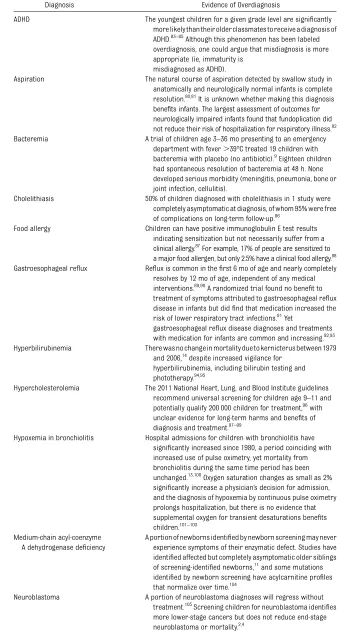
There will almost always be a proportion of patients who benefit from any di-agnosis, including the examples we have chosen. In evaluating the importance of overdiagnosis in a condition at the population level, we propose focusing on the frequency of overdiagnoses relative
TABLE 1 Examples of Possible Overdiagnosis in Pediatrics
Diagnosis Evidence of Overdiagnosis
ADHD The youngest children for a given grade level are significantly more likely than their older classmates to receive a diagnosis of ADHD.83–85
Although this phenomenon has been labeled overdiagnosis, one could argue that misdiagnosis is more appropriate (ie, immaturity is
misdiagnosed as ADHD).
Aspiration The natural course of aspiration detected by swallow study in anatomically and neurologically normal infants is complete resolution.80,81It is unknown whether making this diagnosis benefits infants. The largest assessment of outcomes for neurologically impaired infants found that fundoplication did not reduce their risk of hospitalization for respiratory illness.82 Bacteremia A trial of children age 3–36 mo presenting to an emergency
department with fever.39°C treated 19 children with bacteremia with placebo (no antibiotic).9Eighteen children had spontaneous resolution of bacteremia at 48 h. None developed serious morbidity (meningitis, pneumonia, bone or joint infection, cellulitis).
Cholelithiasis 50% of children diagnosed with cholelithiasis in 1 study were completely asymptomatic at diagnosis, of whom 95% were free of complications on long-term follow-up.86
Food allergy Children can have positive immunoglobulin E test results indicating sensitization but not necessarily suffer from a clinical allergy.87
For example, 17% of people are sensitized to a major food allergen, but only 2.5% have a clinical food allergy.88 Gastroesophageal reflux Reflux is common in thefirst 6 mo of age and nearly completely
resolves by 12 mo of age, independent of any medical interventions.89,90A randomized trial found no benefit to treatment of symptoms attributed to gastroesophageal reflux disease in infants but didfind that medication increased the risk of lower respiratory tract infections.91Yet
gastroesophageal reflux disease diagnoses and treatments with medication for infants are common and increasing.92,93 Hyperbilirubinemia There was no change in mortality due to kernicterus between 1979
and 2006,14despite increased vigilance for hyperbilirubinemia, including bilirubin testing and phototherapy.94,95
Hypercholesterolemia The 2011 National Heart, Lung, and Blood Institute guidelines recommend universal screening for children age 9–11 and potentially qualify 200 000 children for treatment,96
with unclear evidence for long-term harms and benefits of diagnosis and treatment.97–99
Hypoxemia in bronchiolitis Hospital admissions for children with bronchiolitis have significantly increased since 1980, a period coinciding with increased use of pulse oximetry, yet mortality from bronchiolitis during the same time period has been unchanged.13,100Oxygen saturation changes as small as 2% significantly increase a physician’s decision for admission, and the diagnosis of hypoxemia by continuous pulse oximetry prolongs hospitalization, but there is no evidence that supplemental oxygen for transient desaturations benefits children.101–103
Medium-chain acyl-coenzyme A dehydrogenase deficiency
A portion of newborns identified by newborn screening may never experience symptoms of their enzymatic defect. Studies have identified affected but completely asymptomatic older siblings of screening-identified newborns,11
and some mutations identified by newborn screening have acylcarnitine profiles that normalize over time.104
Neuroblastoma A portion of neuroblastoma diagnoses will regress without treatment.105
to needed diagnoses, the ratio of po-tential benefits from needed diagnoses to potential harms from overdiagnoses, and the amount of resource utilization resulting from overdiagnosis. Thus, the examples in Table 1 feature diagnoses with unclear or infrequent opportunity for benefit, the possibility for harm, or high resource utilization.
For example, universal or nearly uni-versal bilirubin screening is common in the United States, intended to decrease infants’risk of kernicterus, a rare but devastating neurologic condition. How-ever, the number of infants who must be treated with phototherapy to prevent 1 infant from needing exchange trans-fusion is high,18meaning that most
in-fants with hyperbilirubinemia do not benefit from diagnosis and treatment. The number needed to treat for the more important outcome, kernicterus, is probably much larger. Unfortunately, as concluded by the US Preventive Services Task Force19in 2009, evidence
to support the efficacy of screening and treatment to reduce the risk of kernicterus is inadequate. Nevertheless, 10 to 80 in 1000 term and preterm
in-fants are treated for hyperbilirubinemia in the United States, at a cost of $150 million per year for the healthy term cohort.20Because kernicterus is a
dev-astating and potentially lethal condi-tion, overdiagnosis and overtreatment of hyperbilirubinemia have been accepted as a reasonable tradeoff. However, the potential for harm from hospitalization and treatment of hyperbilirubinemia has not been adequately researched, and recentfindings of a possible asso-ciation between phototherapy and child-hood leukemia may affect the risk/benefit analysis.21,22
HOW IS OVERDIAGNOSIS HARMFUL?
Medical tests are more accessible, rapid, and frequently consumed than ever before. Discussions between pa-tients and providers tend to focus on the potential benefits of testing, with less regard for potential harms.23Yet a
sin-gle test can give rise to a cascade of events, many of which have the poten-tial to harm.24We use a recently
pub-lished taxonomy of 4 harm domains to frame the harms of overdiagnosis in
pediatrics: physical effects, psycholog-ical effects, financial strain, and op-portunity cost.25
Physical Effects
The physical effects of testing and in-terventions motivated by overdiagnoses are the most visible harms of unnec-essary detection of an abnormality. Un-til recently, the standard of care for small, localized adrenal tumors in in-fants, including those overdiagnosed by neuroblastoma screening, was surgical resection, the mortality of which is 2% or higher.26For young infants with
fe-ver, the detection of bacteremia leads to prolongation of antibiotic therapy,27
often via a peripherally inserted cen-tral catheter, for which the complica-tion rate necessitating line removal in children,1 year of age is 48%.28The gold
standard diagnostic test for aspiration, a videofluoroscopic swallow study, expo-ses subjects to radiation, and an as-piration diagnosis often results in an intervention, ranging from thickening feeds to surgery for gastric tubes and Nissen fundoplications.
Psychological Effects
Subtle but potentially common byproducts of overdiagnosis are psychological ef-fects, because all diagnoses, whether beneficial to the patient or not, change the perception of the child for the child, his or her caregivers, and society. Fun-damentally, diagnoses connote abnor-mality, something to be remedied. One recent study found that parents given a hypothetical clinical scenario of a child with a gastroesophageal reflux disease label were more likely to believe the child would benefit from medication than parents given the same scenario without a gastroesophageal reflux dis-ease label, a belief that persisted even when parents were told that the medi-cations were probably ineffective.29
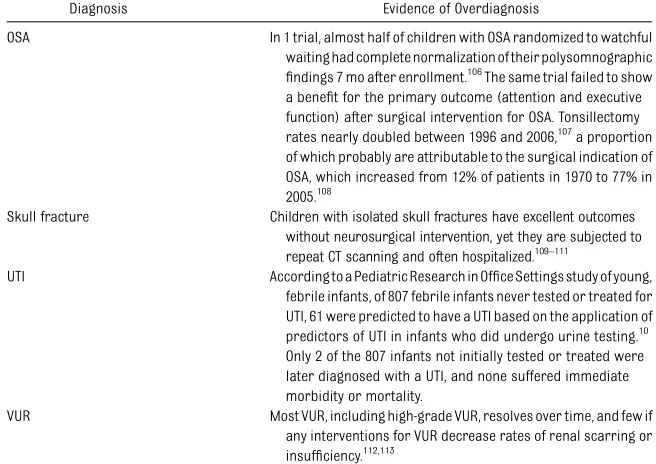
Parental belief in their child’s vulnera-bility after illness, despite full recovery, TABLE 1 Continued
Diagnosis Evidence of Overdiagnosis
OSA In 1 trial, almost half of children with OSA randomized to watchful waiting had complete normalization of their polysomnographic findings 7 mo after enrollment.106The same trial failed to show a benefit for the primary outcome (attention and executive function) after surgical intervention for OSA. Tonsillectomy rates nearly doubled between 1996 and 2006,107a proportion of which probably are attributable to the surgical indication of OSA, which increased from 12% of patients in 1970 to 77% in 2005.108
Skull fracture Children with isolated skull fractures have excellent outcomes without neurosurgical intervention, yet they are subjected to repeat CT scanning and often hospitalized.109–111
UTI According to a Pediatric Research in Office Settings study of young, febrile infants, of 807 febrile infants never tested or treated for UTI, 61 were predicted to have a UTI based on the application of predictors of UTI in infants who did undergo urine testing.10 Only 2 of the 807 infants not initially tested or treated were later diagnosed with a UTI, and none suffered immediate morbidity or mortality.
VUR Most VUR, including high-grade VUR, resolves over time, and few if any interventions for VUR decrease rates of renal scarring or insufficiency.112,113
was first described in 1964.30
Unfor-tunately, the debilitating effects of the
“vulnerable child syndrome” require only that a diagnosis is made, regard-less of a child’s ability to benefit from the diagnosis. Forty percent of junior high school children with a history of an innocent heart murmur or other cardiac nondisease in 1 study suffered physical and psychological restriction after their diagnosis.31 In another
study, parents of children with feeding and crying problems in infancy necessi-tating a change in formula were more likely to perceive their child as vulnera-ble .3 years later, despite being no more likely to report allergies, asthma, or eczema for their child.32Finally,
par-ents of infants with jaundice or photo-therapy exposure are more likely to seek medical attention for their child well after jaundice resolution,33
per-ceive subsequent illnesses as moderate or severe, and fear leaving their baby with any other caregiver.34
Diagnoses also affect how children are treated by society. Approximately one-third of children with food allergy (a diagnosis now given to ∼8% of children) suffer from allergy-related bullying and an associated lower qual-ity of life.35,36The widespread bullying of
children with this diagnosis has pro-mpted the “It’s Not a Joke” campaign, highlighting the emotional toll of food allergy bullying.37
Financial Strain
Overdiagnosis is also harmful because of the resultant financial costs. Un-necessary and wasteful care are esti-mated to constitute 21% to 47% of all expenditures, which probably ignores the contribution of overdiagnosis given that accurate diagnoses, regardless of their benefit to the patient, are assumed to be necessary.38Providing oxygen to
children with bronchiolitis, stimulants to students with attention or hyperac-tivity problems, and phototherapy to
infants with elevated bilirubin values are unlikely to be included in waste estimates, despite the fact that in some cases these interventions are not ben-eficial. The annual US health care costs for each of these conditions are $543 million,39$1.6 billion,40and $150 million,20
respectively.
Opportunity Cost
Finally, consideration must be given to the opportunity cost of overdiagnosis, the possibility that needed medical care is not provided because of unnecessary diagnoses, their subsequent interven-tions, and the psychological andfi nan-cial burdens they impose. Unfortunately, this is an almost completely unstudied harm of overdiagnosis. The value of patient and family time and the quantity of theirfinancial resources consumed by care related to overdiagnosis are unquantified. The attention and re-sources that providers could divert to patients who stand to benefit from di-agnoses and treatments, were they not consumed by the overdiagnosed, are also unquantified.
WHAT IS DRIVING OVERDIAGNOSIS?
Drivers of excessive care are poorly quantified in health care in general, and we are aware of no research quantifying the factors that motivate pediatricians to test or treat. Drawing on the limited available literature from adult medicine, we propose several candidate drivers of overdiagnosis in pediatrics.
Physician Factors
Overdiagnosis is rarely addressed in the pediatric literature, and some pe-diatric providers may not be aware that the detection of abnormalities could be harmful. If a diagnostic test discovers the condition it was meant to discover, how could it have been unnecessary or even harmful? A head CT scan revealing a small bleed or a skull fracture might
leave a practitioner feeling validated by his or her decision to obtain the CT scan, even though detection of these abnor-malities is unlikely to change manage-ment in a way that benefits the patient. If physicians are not aware of the po-tential harms of overdiagnosis, patients and families cannot be expected to ap-preciate them either. A survey of adult medicine providers found that their understanding of cancer screening sta-tistics, including overdiagnosis, was poor. Almost half of those surveyed believed thatfinding more cancer cases in screened as opposed to unscreened populations proved that screening saved lives.41Unfortunately, similar knowledge
assessments have not been performed in pediatrics.
Intolerance of uncertainty can be a powerful motivator for diagnostic test-ing.42–44Providers may be troubled by
not having an answer to explain a patient’s complaint and respond to this uncertainty by relying on diagnostic tests or expert consultation. Provider perceptions that families want an an-swer, that testing expresses caring, and that watchful waiting ignores pa-tient needs may propagate this behav-ior. For example, in a study investigating decisions to obtain head CT scans in children with minor blunt head trauma, providers acknowledged the influence of parental anxiety or request on their decision to order more CT scans. In-terestingly, white non-Hispanic children were more likely to undergo unnec-essary cranial CT scanning than their minority counterparts.45
The culture of medical education is an early impetus for training providers to find comfort in commission and fear in uncertainty.46Problem-based learning
strategies in medical school encour-age a shotgun approach, which tends to reward unusual diagnoses and contributes to overtesting and over-diagnosis.47–49An emphasis on
conferences and morbidity and mortal-ity conferences may strengthen these tendencies. Given this milieu, the pro-duction of providers eager for diagnosis, but unsighted of its possibility to harm, is only natural.
Finally, fear of litigation may motivate unnecessary testing, exposing patients to unnecessary diagnoses. Indeed, er-rors of omission (a patient is harmed because a necessary test or treatment was not provided) are more frequently punished by litigation than errors of commission (a patient is harmed be-cause an unnecessary test or treatment was provided).50 However, although
providers often cite defensive medicine as a stimulus for unnecessary testing and care,51,52reforms to lessen provider
liability do not necessarily change their behavior.53
System Incentives
External systemic forces may incen-tivize testing and diagnosis. Fee-for-service reimbursement, a target for reform, financially rewards providers for providing more, and potentially ex-cessive, care. Supply-sensitive care, where higher capacity in the form of hospital beds and imaging modalities drives medical utilization, inevitably un-covers patient abnormalities.54
Pro-posed pediatric quality indicators tend to encourage greater testing and treat-ment. In one evaluation, only 5 in 242 proposed pediatric ambulatory indica-tors focused on problems of overuse (compared with 225 in 242 for un-deruse),55 whereas none of the 62
pediatric emergency department indi-cators in a separate assessment eval-uated unnecessary tests.56In addition,
physicians more readily improve on quality indicators aimed at underuse as opposed to overuse.57Finally, time
constraints and loss of continuity of care lead to a substitution of testing for thorough review of records and patient assessment.58,59
Industry Influence
Industry interests contribute to over-diagnosis by lobbying for widened di-agnostic boundaries and using the media to generate demand for diag-nosis, both of which create more pa-tients and more profit.60For example,
lowering the definition of hypercho-lesterolemia in adults from 240 to 200 mg/dL, a 2002 recommendation made by an expert panel where 8 of 9 pan-elists hadfinancial conflicts of interest, created.42 million new diagnoses.61,62
Such conflicts of interest in defining disease are not unusual. In one study, 75% of members of panels responsible for defining the most common diseases in the United States had ties to industry that stood to benefit from expanded definitions.63The 2012 attention-deficit/
hyperactivity disorder (ADHD) guide-line panel included 9 members, 5 of whom had industry ties to manu-facturers of widely used medications for ADHD.63Based on this committee’s
recommendations, the definition of ADHD was broadened to include chil-dren 4 to 18 years old (previously 6–12 years old).64Although it is unclear how
many new diagnoses of ADHD this ex-pansion created, diagnostic creep has resulted in the prescription of stimu-lants to.10 000 toddlers aged 2 and 3 years old.65 Similar to concerns
generated by the extension of the di-agnosis of depressive disorder to in-clude bereavement, the ADHD expansion risks medicalizing variations of normal human behavior.66
Patients are also influenced by industry. Pharmaceutical companies spent $4.5 billion on direct-to-consumer market-ing in 2009.67Advertisements capitalize
on our fear of undiagnosed disease and urge us to see our doctor for testing. Industry also reaches patients through patient advocacy groups. Once considered unbiased, third-party advo-cacy groups are often used to deliver the same message. A random sample of
US patient groups found that 80% re-ceived industry funding.68The National
Alliance on Mental Illness, a mental health advocacy organization, received $23 million, or approximately three-quarters of its donations, from drug makers between 2006 and 2008.69
Public Psyche
Belief in scientific advance and a tech-nological imperative, a confidence that the use of technology to detect disease is always beneficial, also drive over-diagnosis. A positive feedback loop of testing ensues, in which the test results, independent of the actual value (posi-tive, nega(posi-tive, posi(posi-tive, or false-negative), confirm for patients that they should have been tested and make them more likely to seek additional testing.15In a survey of adults, 98% of
those who had experienced a false-positive test were glad they had the initial screening test, and 73% of all respondents would forgo $1000 in cash for a total body CT scan.70 Two
but-tresses of public enthusiasm for screening are lead time and length bias, which mistakenly bolster the argument for testing by erroneously overestimating prevalence and improved outcomes. Lead time bias occurs when diagnoses are identified earlier than they would be discovered clinically, falsely appearing to prolong survival, and length bias occurs when screening identifies disproportionately milder diagnoses.71
THE WAY FORWARD
A research agenda aimed at evaluating the harms and benefits of individual pediatric diagnoses and the frequency of overdiagnosis is needed. Of the ex-amples presented here, the only conclu-sive evidence of pediatric overdiagnosis is for neuroblastoma screening.2–4
to important outcomes that benefited patients. The 3 research methods pre-viously outlined (randomized trials, nat-ural experiments, and comparison of incidence versus outcomes) provide rea-sonable starting points for studying the possibility of overdiagnosis for a particular abnormality. Additionally, practice variation may be an impor-tant beacon for overdiagnosis. Condi-tions for which testing and diagnostic variation exist, but important patient outcomes do not differ, would suggest overdiagnosis.
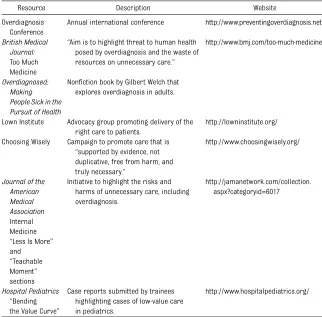
Because providers may be reluctant to accept evidence that is counter to their customary practice or experience, in-vestigations delineating pediatric over-diagnosis ultimately must be augmented by advocacy and awareness efforts. The campaigns in Table 2 have each made strong contributions to this ob-jective. Choosing Wisely is an example of dissemination and implementation of measures that aid providers in de-creasing practice variation and un-necessary diagnostic testing, which may reduce the risk of overdiagnosis. Specifically, the majority of the pediatric Choosing Wisely initiatives decrease opportunities for overdiagnosis, with recommendations that limit the use of CT scans, MRI, chest radiographs, apnea monitors, food allergy screening, and continuous pulse oximetry.72,73 In
gen-eral, guidelines that endorse testing can address the harms of overdiagnosis and support strong recommendations for testing with evidence that impor-tant outcomes for children are improved by diagnosis. Use of the US Preventive Services Task Force analytic framework, which considers both harms and bene-fits and clearly delineates pertinent out-comes, would help guideline panels in this endeavor.74
Despite efforts made by the organi-zations listed in Table 2, there remains a large proportion of underinformed patients: Only 9.5% of adults with high
exposure to cancer screening pro-grams reported being advised by their physician about the risk of overdiagno-sis or overtreatment from screening.75
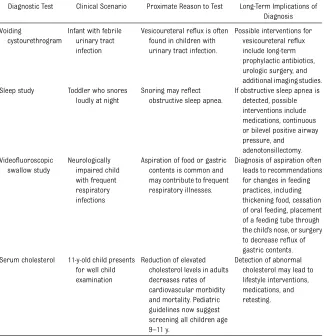
Future pediatric research can evaluate the impact on patient decision-making when patients are exposed to farther-reaching impacts of a diagnosis. In Ta-ble 3, we list several common clinical scenarios where diagnostic tests are performed and provide examples of both proximate and long-term perspectives on why the test might be indicated. The proximate perspective addresses the immediate rationale for a diagnostic test, whereas the long-term perspective as-sesses possible diagnostic results and subsequent interventions. Both per-spectives are important, but discussions about less immediate diagnostic corol-laries, in particular, will help patients and providers frame testing deci-sions within the context of potential
overdiagnosis. Although it is unclear how this type of shared decision-making would affect diagnostic testing in chil-dren, examples from adult medicine reveal that many patients opt out of tests when provided comprehensive evidence on risks and benefits.76
Finally, the incorporation of over-diagnosis into medical education cur-ricula is critical. Students may be guided to produce carefully crafted differ-entials and workups that are proba-bilistic rather than “possibilistic.”77
Differential-generating teaching ses-sions can acknowledge the risk of over-diagnosis, and morbidity and mortality conferences can expand to include cases of harms caused by overdiagnosis. The Do No Harm Project, vignettes produced by University of Colorado internal medi-cine residents illustrating harms from medical overuse, can serve as a model in the development of pediatric-specific
TABLE 2 Overdiagnosis Awareness and Mitigation Resources
Resource Description Website
Overdiagnosis Conference
Annual international conference http://www.preventingoverdiagnosis.net/
British Medical Journal: Too Much Medicine
“Aim is to highlight threat to human health posed by overdiagnosis and the waste of resources on unnecessary care.”
http://www.bmj.com/too-much-medicine
Overdiagnosed: Making People Sick in the Pursuit of Health
Nonfiction book by Gilbert Welch that explores overdiagnosis in adults.
Lown Institute Advocacy group promoting delivery of the right care to patients.
http://lowninstitute.org/
Choosing Wisely Campaign to promote care that is
“supported by evidence, not duplicative, free from harm, and truly necessary.”
http://www.choosingwisely.org/
Journal of the American Medical Association Internal Medicine
“Less Is More” and
“Teachable Moment” sections
Initiative to highlight the risks and harms of unnecessary care, including overdiagnosis.
http://jamanetwork.com/collection. aspx?categoryid=6017
Hospital Pediatrics
“Bending the Value Curve”
Case reports submitted by trainees highlighting cases of low-value care in pediatrics.
curricula to directly address over-diagnosis.78 Perhaps most importantly,
medical education can discourage black-and-white thinking, instead nurturing critical thinking and comfort with un-certainty. If symptoms are not severe,
a stepped approach can be undertaken to reduce the risk of overdiagnosis. This method begins with normalizing prob-lems, if appropriate, and pursuing a pe-riod of watchful waiting.79If resolution
or an acceptable level of improvement
does not occur with watchful waiting, minimal interventions, with the poten-tial for diagnosis, are used. Such a patient approach is important, be-cause the risk of overdiagnosis is greatest for the child with no symp-toms or a few nonspecific symptoms; the milder an abnormality, the less potential for benefit.15 If the
magni-tude of hypothetical benefit is small for pursuing a diagnosis and the pos-sibility of harm exists, perhaps the child and family are better off avoiding diagnostic exposure.
CONCLUSIONS
Substantial proportions of children may not benefit from commonly pursued pediatric diagnoses. In some cases, overdiagnosis is necessary to ensure larger gains for the children who do benefit from the diagnosis. However, for many diagnostic tests, the ratio of ben-efit to harm resulting from the diagno-sis is incompletely understood. Patient, physician, investigator, and society-wide attention to this complex benefit as-sessment will help ensure that we,first, do no harm.
ACKNOWLEDGMENTS
The authors thank Christopher G. Maloney, MD, PhD, and Thomas B. Newman, MD, MPH, for their thoughtful review of this article.
REFERENCES
1. Miller AB, Wall C, Baines CJ, Sun P, To T, Narod SA. Twentyfive year follow-up for
breast cancer incidence and mortality of
the Canadian National Breast Screening Study: randomised screening trial. BMJ.
2014;348:g366
2. Schilling FH, Spix C, Berthold F, et al.
Neu-roblastoma screening at one year of age.N
Engl J Med. 2002;346(14):1047–1053
3. Spix C, Michaelis J, Berthold F, Erttmann R,
Sander J, Schilling FH. Lead-time and
over-diagnosis estimation in neuroblastoma
screening.Stat Med. 2003;22(18):2877–2892
4. Woods WG, Gao RN, Shuster JJ, et al. Screening of infants and mortality due to
neuroblastoma. N Engl J Med. 2002;346 (14):1041–1046
5. National Cancer Institute. Surveillance,
epidemiology, and end results program. Available at: http://seer.cancer.gov
6. Sakr WA, Grignon DJ, Haas GP, Heilbrun
LK, Pontes JE, Crissman JD. Age and racial
distribution of prostatic intraepithelial neoplasia.Eur Urol. 1996;30(2):138–144
7. Ilic D, Neuberger MM, Djulbegovic M,
Dahm P. Screening for prostate cancer.
Cochrane Database Syst Rev. 2013;1: CD004720
8. Andriole GL, Crawford ED, Grubb RL III,
et al; PLCO Project Team. Mortality results from a randomized prostate-cancer
screen-ing trial.N Engl J Med. 2009;360(13):1310– 1319
9. Jaffe DM, Tanz RR, Davis AT, Henretig F,
Fleisher G. Antibiotic administration to treat
possible occult bacteremia in febrile chil-dren.N Engl J Med. 1987;317(19):1175–1180
10. Newman TB, Bernzweig JA, Takayama JI,
Finch SA, Wasserman RC, Pantell RH. Urine TABLE 3 “Why Are We Doing This test?”: Proximate Versus Long-Term Implications for Diagnostic
Testing
Diagnostic Test Clinical Scenario Proximate Reason to Test Long-Term Implications of Diagnosis
Voiding
cystourethrogram
Infant with febrile urinary tract infection
Vesicoureteral reflux is often found in children with urinary tract infection.
Possible interventions for vesicoureteral reflux include long-term prophylactic antibiotics, urologic surgery, and additional imaging studies. Sleep study Toddler who snores
loudly at night
Snoring may reflect obstructive sleep apnea.
If obstructive sleep apnea is detected, possible interventions include medications, continuous or bilevel positive airway pressure, and
adenotonsillectomy. Videofluoroscopic
swallow study
Neurologically impaired child with frequent respiratory infections
Aspiration of food or gastric contents is common and may contribute to frequent respiratory illnesses.
Diagnosis of aspiration often leads to recommendations for changes in feeding practices, including thickening food, cessation of oral feeding, placement of a feeding tube through the child’s nose, or surgery to decrease reflux of gastric contents. Serum cholesterol 11-y-old child presents
for well child examination
Reduction of elevated cholesterol levels in adults decreases rates of cardiovascular morbidity and mortality. Pediatric guidelines now suggest screening all children age 9–11 y.
testing and urinary tract infections in fe-brile infants seen in office settings: the Pediatric Research in Office Settings’ Fe-brile Infant Study.Arch Pediatr Adolesc Med. 2002;156(1):44–54
11. Waisbren SE, Albers S, Amato S, et al. Ef-fect of expanded newborn screening for biochemical genetic disorders on child out-comes and parental stress.JAMA. 2003;290 (19):2564–2572
12. Davies L, Welch HG. Increasing incidence of thyroid cancer in the United States, 1973–2002.JAMA. 2006;295(18):2164–2167
13. Shay DK, Holman RC, Roosevelt GE, Clarke MJ, Anderson LJ. Bronchiolitis-associated mortality and estimates of respiratory syncytial virus-associated deaths among US children, 1979-1997.J Infect Dis. 2001; 183(1):16–22
14. Brooks JC, Fisher-Owens SA, Wu YW, Strauss DJ, Newman TB. Evidence sug-gests there was not a “resurgence” of kernicterus in the 1990s.Pediatrics. 2011; 127(4):672–679
15. Welch HG, Schwartz L, Woloshin S. Over-diagnosed: Making People Sick in the Pursuit of Health. Boston, MA: Beacon Press; 2011
16. Preventing Overdiagnosis Conference. Available at: www.preventingoverdiag-nosis.net/
17. Moynihan R, Glasziou P, Woloshin S, Schwartz L, Santa J, Godlee F. Winding back the harms of too much medicine.
BMJ. 2013;346:f1271
18. Newman TB, Kuzniewicz MW, Liljestrand P, Wi S, McCulloch C, Escobar GJ. Numbers needed to treat with phototherapy ac-cording to American Academy of Pediat-rics guidelines. Pediatrics. 2009;123(5): 1352–1359
19. US Preventive Services Task Force. Screening of infants for hyperbilirubinemia to prevent chronic bilirubin encephalopa-thy: US Preventive Services Task Force rec-ommendation statement.Pediatrics. 2009; 124(4):1172–1177
20. Suresh GK, Clark RE. Cost-effectiveness of strategies that are intended to prevent kernicterus in newborn infants. Pediat-rics. 2004;114(4):917–924
21. Podvin D, Kuehn CM, Mueller BA, Williams M. Maternal and birth characteristics in relation to childhood leukaemia.Paediatr Perinat Epidemiol. 2006;20(4):312–322
22. Wickremasinghe AC, Grimes B, McCulloch CE, Newman TB. Association between neo-natal phototherapy and admissions for in-fantile cancer. Paper presented at: Pediatric Academic Societies, platform presentation; 2014; Vancouver, BC
23. Hoffman RM, Lewis CL, Pignone MP, et al Decision-making processes for breast, co-lorectal, and prostate cancer screening: the DECISIONS survey.Med Decis Making. 2010;30(5 suppl):53s–64s
24. Mold JW, Stein HF. The cascade effect in the clinical care of patients. N Engl J Med. 1986;314(8):512–514
25. Harris RP, Sheridan SL, Lewis CL, et al. The harms of screening: a proposed taxonomy and application to lung cancer screening.
JAMA Intern Med. 2014;174(2):281–285
26. Nuchtern JG, London WB, Barnewolt CE, et al. A prospective study of expectant observation as primary therapy for neu-roblastoma in young infants: a Children’s Oncology Group study.Ann Surg. 2012;256 (4):573–580
27. Roman HK, Chang PW, Schroeder AR. Di-agnosis and management of bacteremic urinary tract infection in infants. Hosp Pediatr. In press
28. Jumani K, Advani S, Reich NG, Gosey L, Milstone AM. Risk factors for peripherally inserted central venous catheter compli-cations in children. JAMA Pediatr. 2013; 167(5):429–435
29. Scherer LD, Zikmund-Fisher BJ, Fagerlin A, Tarini BA. Influence of“GERD”label on par-ents’decision to medicate infants. Pediat-rics. 2013;131(5):839–845
30. Green M, Solnit AJ. Reactions to the threatened loss of a child: a vulnerable child syndrome. Pediatric management of the dying child, part III. Pediatrics. 1964; 34:58–66
31. Bergman AB, Stamm SJ. The morbidity of cardiac nondisease in schoolchildren. N Engl J Med. 1967;276(18):1008–1013
32. Forsyth BW, Canny PF. Perceptions of vul-nerability 3 1/2 years after problems of feeding and crying behavior in early in-fancy.Pediatrics. 1991;88(4):757–763
33. Usatin D, Liljestrand P, Kuzniewicz MW, Escobar GJ, Newman TB. Effect of neonatal jaundice and phototherapy on the fre-quency offirst-year outpatient visits. Pe-diatrics. 2010;125(4):729–734
34. Kemper K, Forsyth B, McCarthy P. Jaundice, terminating breast-feeding, and the vul-nerable child.Pediatrics. 1989;84(5):773– 778
35. Shemesh E, Annunziato RA, Ambrose MA, et al. Child and parental reports of bul-lying in a consecutive sample of children with food allergy.Pediatrics. 2013;131(1). Available at: www.pediatrics.org/cgi/content/ full/131/1/e10
36. Gupta RS, Springston EE, Warrier MR, et al. The prevalence, severity, and dis-tribution of childhood food allergy in the
United States.Pediatrics. 2011;128(1). Available at: www.pediatrics.org/cgi/content/ full/128/1/e9
37. Food Allergy Research & Education. Food allergy bullying: it’s not a joke. 2014; Available at: www.foodallergy.org/its-not-a-joke#.Ur2nRPRDt8E
38. Berwick DM, Hackbarth AD. Eliminating waste in US health care.JAMA. 2012;307 (14):1513–1516
39. Pelletier AJ, Mansbach JM, Camargo CA Jr. Direct medical costs of bronchiolitis hospitalizations in the United States. Pe-diatrics. 2006;118(6):2418–2423
40. Birnbaum HG, Kessler RC, Lowe SW, et al. Costs of attention deficit–hyperactivity disorder (ADHD) in the US: excess costs of persons with ADHD and their family mem-bers in 2000.Curr Med Res Opin. 2005;21 (2):195–206
41. Wegwarth O, Schwartz LM, Woloshin S, Gaissmaier W, Gigerenzer G. Do physicians understand cancer screening statistics? A national survey of primary care physi-cians in the United States.Ann Intern Med. 2012;156(5):340–349
42. Merrill JM, Lorimor RJ, Thornby JI, Vallbona C. Reliance on high technology among se-nior medical students.Am J Med Sci. 1998; 315(1):35–39
43. van der Weijden T, van Bokhoven MA, Dinant GJ, van Hasselt CM, Grol RP. Un-derstanding laboratory testing in diagnostic uncertainty: a qualitative study in general practice.Br J Gen Pract. 2002;52(485):974– 980
44. Lysdahl KB, Hofmann BM. What causes increasing and unnecessary use of ra-diological investigations? A survey of radi-ologists’perceptions.BMC Health Serv Res. 2009;9:155
45. Natale JE, Joseph JG, Rogers AJ, et al; PECARN (Pediatric Emergency Care Ap-plied Research Network). Cranial com-puted tomography use among children with minor blunt head trauma: association with race/ethnicity. Arch Pediatr Adolesc Med. 2012;166(8):732–737
46. Nevalainen M, Kuikka L, Sjoberg L, Eriksson J, Pitkala K. Tolerance of uncertainty and fears of making mistakes among fi fth-year medical students.Fam Med. 2012;44 (4):240–246
47. Samadian S, Farhat A. Problem based learning, litigation, and EWTD contribute to too much medicine.BMJ. 2013;347:f4790
medical schools. In: Research in Medical Education: Proceedings of the Annual Con-ference. Conference on Research in Medi-cal Education. 1988;27:276–281
49. Emanuel EJ, Fuchs VR. The perfect storm of overutilization.JAMA. 2008;299(23):2789– 2791
50. Wallace E, Lowry J, Smith SM, Fahey T. The epidemiology of malpractice claims in pri-mary care: a systematic review.BMJ Open. 2013;3(7)
51. Bishop TF, Federman AD, Keyhani S. Physicians’ views on defensive medicine: a national survey.Arch Intern Med. 2010; 170(12):1081–1083
52. Sirovich BE, Woloshin S, Schwartz LM. Too little? Too much? Primary care physicians’ views on US health care: a brief report.
Arch Intern Med. 2011;171(17):1582–1585
53. Sloan FA, Shadle JH. Is there empirical evidence for“defensive medicine”? A re-assessment.J Health Econ. 2009;28(2):481– 491
54. The Dartmouth Atlas Project. Supply-sensitive care. January 15, 2007. Available at: www. dartmouthatlas.org/downloads/reports/supply_ sensitive.pdf
55. Mangione-Smith R, DeCristofaro AH, Setodji CM, et al. The quality of ambula-tory care delivered to children in the United States.N Engl J Med. 2007;357(15): 1515–1523
56. Stang AS, Straus SE, Crotts J, Johnson DW, Guttmann A. Quality indicators for high acuity pediatric conditions.Pediatrics. 2013; 132(4):752–762
57. Kale MS, Bishop TF, Federman AD, Keyhani S. Trends in the overuse of ambulatory health care services in the United States.
JAMA Intern Med. 2013;173(2):142–148
58. Bosanquet D, Cho J, Williams N, Gower D, Thomas KG, Lewis M. Requesting radio-logical investigations: do junior doctors know their patients? A cross-sectional survey.JRSM Short Rep. 2013;4(1):3
59. Rogg JG, Rubin JT, Hansen P, Liu SW. The frequency and cost of redundant labora-tory testing for transferred ED patients.
Am J Emerg Med. 2013;31(7):1121–1123
60. Moynihan R, Henry D. The fight against disease mongering: generating knowl-edge for action.PLoS Med. 2006;3(4):e191
61. Schwartz LM, Woloshin S. Changing dis-ease definitions: implications for disease prevalence. Analysis of the Third National Health and Nutrition Examination Survey, 1988–1994. Eff Clin Pract. 1999;2(2):76– 85
62. Ricks D, Rabin R. Cholesterol guidelines: drug panelist’s links underfire.Newsday,
July 15, 2004
63. Moynihan RN, Cooke GP, Doust JA, Bero L, Hill S, Glasziou PP. Expanding disease definitions in guidelines and expert panel ties to industry: a cross-sectional study of common conditions in the United States.
PLoS Med. 2013;10(8):e1001500
64. Wolraich M, Brown L, Brown RT, et al; Sub-committee on Attention-Deficit/Hyperactivity Disorder; Steering Committee on Quality Improvement and Management. ADHD: clin-ical practice guideline for the diagnosis, evaluation, and treatment of attention-deficit/hyperactivity disorder in children and adolescents. Pediatrics. 2011;128(5): 1007–1022
65. Schwarz A. Thousands of toddlers are medicated for A.D.H.D., reportfinds, rais-ing worries.The New York Times,May 16, 2014
66. Friedman RA. Grief, depression, and the DSM-5.N Engl J Med. 2012;366(20):1855– 1857
67. Ventola CL. Direct-to-consumer pharma-ceutical advertising: therapeutic or toxic?
P T. 2011;36(10):669–684
68. Mintzes B. Should patient groups accept money from drug companies? No. BMJ. 2007;334(7600):935
69. Harris G. Drug makers are advocacy group’s biggest donors. The New York Times,October 21, 2009
70. Schwartz LM, Woloshin S, Fowler FJ Jr, Welch HG. Enthusiasm for cancer screen-ing in the United States.JAMA. 2004;291 (1):71–78
71. Gates TJ. Screening for cancer: evaluating the evidence.Am Fam Physician. 2001;63 (3):513–522
72. American Academy of Pediatrics. Ten things physicians and patients should question. Available at: www.choosingwisely.org/ doctor-patient-lists/american-academy-of-pediatrics/
73. Quinonez RA, Garber MD, Schroeder AR, et al Choosing wisely in pediatric hospital medicine:five opportunities for improved healthcare value.J Hosp Med. 2013;8(9): 479–485
74. US Preventive Services Task Force. Section 3: topic work plan development. Available at: www.uspreventiveservicestaskforce.org/ uspstf08/methods/procmanual3.htm
75. Wegwarth O, Gigerenzer G. Less is more: overdiagnosis and overtreatment: evalu-ation of what physicians tell their patients about screening harms.JAMA Intern Med. 2013;173(22):2086–2087
76. Stacey D, Légaré F, Col NF, et al. Decision aids for people facing health treatment or screening decisions.Cochrane Database Syst Rev. 2014;1:CD001431
77. Doust J. Diagnosis in general practice. Using probabilistic reasoning.BMJ. 2009; 339:b3823
78. University of Colorado School of Medicine. Welcome to the Do No Harm Project. Available at: www.ucdenver.edu/academ-ics/colleges/medicalschool/departments/ medicine/GIM/education/DoNoHarmProject/ Pages/Welcome.aspx
79. Batstra L, Frances A. Holding the line against diagnostic inflation in psychiatry.
Psychother Psychosom. 2012;81(1):5–10
80. Khoshoo V, Edell D. Previously healthy infants may have increased risk of aspi-ration during respiratory syncytial viral bronchiolitis.Pediatrics. 1999;104(6):1389– 1390
81. Sheikh S, Allen E, Shell R, et al. Chronic aspiration without gastroesophageal reflux as a cause of chronic respiratory symptoms in neurologically normal infants.Chest. 2001; 120(4):1190–1195
82. Barnhart DC, Hall M, Mahant S, et al. Ef-fectiveness of fundoplication at the time of gastrostomy in infants with neurologi-cal impairment.JAMA Pediatr. 2013;167 (10):911–918
83. Elder TE. The importance of relative stan-dards in ADHD diagnoses: evidence based on exact birth dates.J Health Econ. 2010; 29(5):641–656
84. Morrow RL, Garland EJ, Wright JM, Maclure M, Taylor S, Dormuth CR.
In-fluence of relative age on diagnosis and treatment of attention-deficit/hyperactivity disorder in children. CMAJ. 2012;184(7): 755–762
85. Frances A, Batstra L. Why so many epi-demics of childhood mental disorder?J Dev Behav Pediatr. 2013;34(4):291–292
86. Bogue CO, Murphy AJ, Gerstle JT, Moineddin R, Daneman A. Risk factors, complications, and outcomes of gallstones in children: a single-center review.J Pediatr Gastro-enterol Nutr. 2010;50(3):303–308
87. Sicherer SH, Wood RA; American Academy of Pediatrics Section on Allergy and Im-munology. Allergy testing in childhood: using allergen-specific IgE tests. Pediat-rics. 2012;129(1):193–197
88. Liu AH, Jaramillo R, Sicherer SH, et al National prevalence and risk factors for food allergy and relationship to asthma: results from the National Health and Nu-trition Examination Survey 2005–2006. J Allerg Clin Immunol. 2010;126(4):798–806. e713
practice-based survey.Arch Pediatr Ado-lesc Med. 1997;151(6):569–572
90. Martin AJ, Pratt N, Kennedy JD, et al. Natural history and familial relationships of infant spilling to 9 years of age. Pedi-atrics. 2002;109(6):1061–1067
91. Orenstein SR, Hassall E, Furmaga-Jablonska W, Atkinson S, Raanan M. Multicenter, double-blind, randomized, placebo-controlled trial assessing the efficacy and safety of proton pump inhibitor lansoprazole in infants with symptoms of gastroesophageal reflux disease.J Pediatr. 2009;154(4):514–520. e514
92. Nelson SP, Kothari S, Wu EQ, Beaulieu N, McHale JM, Dabbous OH. Pediatric gas-troesophageal reflux disease and acid-related conditions: trends in incidence of diagnosis and acid suppression therapy.J Med Econ. 2009;12(4):348–355
93. Barron JJ, Tan H, Spalding J, Bakst AW, Singer J. Proton pump inhibitor utilization patterns in infants.J Pediatr Gastroenterol Nutr. 2007;45(4):421–427
94. Kuzniewicz MW, Escobar GJ, Newman TB. Impact of universal bilirubin screening on severe hyperbilirubinemia and phototherapy use.Pediatrics. 2009;124(4):1031–1039
95. Eggert LD, Wiedmeier SE, Wilson J, Christensen RD. The effect of instituting a prehospital-discharge newborn bili-rubin screening program in an 18-hospital health system.Pediatrics. 2006;117(5). Avail-able at: www.pediatrics.org/cgi/content/full/ 117/5/e855
96. Psaty BM, Rivara FP. Universal screening and drug treatment of dyslipidemia in children and adolescents.JAMA. 2012;307 (3):257–258
97. Gillman MW, Daniels SR. Is universal pe-diatric lipid screening justified?JAMA. 2012; 307(3):259–260
98. Newman TB, Pletcher MJ, Hulley SB. Overly aggressive new guidelines for lipid screening in children: evidence of a bro-ken process.Pediatrics. 2012;130(2):349– 352
99. Schroeder AR, Redberg RF. Cholesterol screening and management in children and young adults should start early—NO!
Clin Cardiol. 2012;35(11):665–668
100. Shay DK, Holman RC, Newman RD, Liu LL, Stout JW, Anderson LJ. Bronchiolitis-associated hospitalizations among US children, 1980–1996.JAMA. 1999;282(15): 1440–1446
101. Mallory MD, Shay DK, Garrett J, Bordley WC. Bronchiolitis management prefer-ences and the influence of pulse oximetry and respiratory rate on the decision to admit. Pediatrics. 2003;111(1). Available at: www.pediatrics.org/cgi/content/full/111/ 1/e45
102. Schroeder AR, Marmor AK, Pantell RH, Newman TB. Impact of pulse oximetry and oxygen therapy on length of stay in bron-chiolitis hospitalizations.Arch Pediatr Adolesc Med. 2004;158(6):527–530
103. Unger S, Cunningham S. Effect of oxygen supplementation on length of stay for infants hospitalized with acute viral bron-chiolitis.Pediatrics. 2008;121(3):470–475
104. Andresen BS, Dobrowolski SF, O’Reilly L, et al. Medium-chain acyl-CoA dehydrogenase (MCAD) mutations identified by MS/MS-based prospective screening of newborns differ from those observed in patients with clinical symptoms: identification and characteriza-tion of a new, prevalent mutacharacteriza-tion that results in mild MCAD deficiency.Am J Hum Genet. 2001;68(6):1408–1418
105. Hero B, Simon T, Spitz R, et al. Localized infant neuroblastomas often show spon-taneous regression: results of the
pro-spective trials NB95-S and NB97. J Clin Oncol. 2008;26(9):1504–1510
106. Marcus CL, Moore RH, Rosen CL, et al; Childhood Adenotonsillectomy Trial (CHAT). A randomized trial of adenotonsillectomy for childhood sleep apnea.N Engl J Med. 2013;368(25):2366–2376
107. Goodman DC, Challener GJ. Tonsillectomy: a procedure in search of evidence. J Pediatr. 2012;160(5):716–718
108. Erickson BK, Larson DR, St Sauver JL, Meverden RA, Orvidas LJ. Changes in in-cidence and indications of tonsillectomy and adenotonsillectomy, 1970–2005.Otolaryngol Head Neck Surg. 2009;140(6):894–901
109. Mannix R, Monuteaux MC, Schutzman SA, Meehan WP III, Nigrovic LE, Neuman MI. Isolated skull fractures: trends in manage-ment in US pediatric emergency depart-ments. Ann Emerg Med. 2013;62(4): 327–331
110. Rollins MD, Barnhart DC, Greenberg RA, et al. Neurologically intact children with an isolated skull fracture may be safely discharged after brief observation.J Pediatr Surg. 2011;46(7):1342–1346
111. Greenes DS, Schutzman SA. Infants with isolated skull fracture: what are their clinical characteristics, and do they re-quire hospitalization? Ann Emerg Med. 1997;30(3):253–259
112. Jodal U, Smellie JM, Lax H, Hoyer PF. Ten-year results of randomized treatment of children with severe vesicoureteral reflux. Final report of the International Reflux Study in Children.Pediatr Nephrol. 2006; 21(6):785–792
DOI: 10.1542/peds.2014-1778 originally published online October 6, 2014;
2014;134;1013
Pediatrics
Eric R. Coon, Ricardo A. Quinonez, Virginia A. Moyer and Alan R. Schroeder
Overdiagnosis: How Our Compulsion for Diagnosis May Be Harming Children
Services
Updated Information &
http://pediatrics.aappublications.org/content/134/5/1013 including high resolution figures, can be found at:
References
http://pediatrics.aappublications.org/content/134/5/1013#BIBL This article cites 99 articles, 30 of which you can access for free at:
Subspecialty Collections
http://www.aappublications.org/cgi/collection/public_health_sub
Public Health
b
http://www.aappublications.org/cgi/collection/medical_education_su
Medical Education
following collection(s):
This article, along with others on similar topics, appears in the
Permissions & Licensing
http://www.aappublications.org/site/misc/Permissions.xhtml in its entirety can be found online at:
Information about reproducing this article in parts (figures, tables) or
Reprints
DOI: 10.1542/peds.2014-1778 originally published online October 6, 2014;
2014;134;1013
Pediatrics
http://pediatrics.aappublications.org/content/134/5/1013
located on the World Wide Web at:
The online version of this article, along with updated information and services, is
by the American Academy of Pediatrics. All rights reserved. Print ISSN: 1073-0397.