Parental Knowledge of Potential Cancer Risks From
Exposure to Computed Tomography
WHAT’S KNOWN ON THIS SUBJECT: Studies have highlighted a lack of patient awareness of potential increased cancer risks associated with computed tomography (CT) scans in adult patients and in nonurgent settings. However, little is known about parental awareness of these risks in an emergency setting.
WHAT THIS STUDY ADDS: Approximately half of parents were aware of the potential cancer risks from CT scans in an emergency setting. Although risk disclosure moderately reduced willingness to proceed with recommended testing, almost all parents preferred an informed discussion before CT imaging.
abstract
OBJECTIVE: Computed tomography (CT) imaging of children is in-creasing in emergent settings without an understanding of parental knowledge of potential cancer risks. In children with head injuries, our primary objective was to determine the proportion of parents who were aware of the potential of CT to increase a child’s lifetime risk of malignancy. We also examined willingness to proceed with recommended CT after risk disclosure and preference to be informed of potential risks.
METHODS:This was a prospective cross-sectional survey of parents whose children presented to a tertiary care pediatric emergency department with a head injury. Survey questions were derived and validated by using expert opinion, available literature, and pre- and pilot testing of questions with the target audience.
RESULTS:Of the 742 enrolled parents, 454 (61.2%) were female and 594 (80.0%) were aged 31 to 50 years. Importantly, 357 (46.8%) were aware of the potential for an increased lifetime malignancy risk from CT. Be-fore risk estimate provision, the proportion of parents“very willing/ willing”to proceed with head CT was 90.4%; after disclosure, willing-ness decreased to 69.6% (P,.0001), and 42 (5.6%) would refuse the CT. Of note, 673 (90.3%) wished to be informed of potential malignancy risks.
CONCLUSIONS:Approximately half of the participating parents were aware of the potential increased lifetime malignancy risk associated with head CT imaging. Willingness to proceed with CT testing was re-duced after risk disclosure but was a significant barrier for a small minority of parents. Most parents wanted to be informed of potential malignancy risks before proceeding with imaging. Pediatrics
2013;132:305–311 AUTHORS:Kathy Boutis, MD,aWilliam Cogollo, MD,aJason
Fischer, MD,aStephen B. Freedman, MD,bGuila Ben David,
MRT(R),cand Karen E. Thomas, MDc
aDivision of Emergency Medicine, Department of Pediatrics, and cDepartment of Diagnostic Imaging, The Hospital for Sick
Children, and University of Toronto, Toronto, Canada; andbSections
of Emergency Medicine and Gastroenterology, Department of Pediatrics, Alberta Children’s Hospital and Alberta Children’s Hospital Research Institute, University of Calgary, Calgary, Canada
KEY WORDS
computer tomography, radiation, pediatrics, parents, radiology
ABBREVIATIONS
CI—confidence interval CT—computed tomography ED—emergency department
All authors reviewed the manuscript, provided critical revisions and gavefinal approval of the submitted version.
Dr Boutis was the primary and responsible author. As such, she had full access to the data and hasfinal responsibility for the decision to submit for publication. In addition, she primarily designed the work; oversaw all research operations in patient enrollment, data collection, and entry; was involved in the analysis and interpretation of results; and wrote most of the manuscript. Dr Cogollo was primarily responsible for patient enrollment, data quality checks, and data entry. Drs Fischer and Freedman were involved in the intellectual content of the research proposal and aided in survey question development. Ms Ben David was involved in ensuring accurate radiation risk estimates,fielded correspondence from parents during the study period, and assisted in preparation of the study parent handout on radiation risks from skull radiography and head computed tomography. Dr Thomas provided very comprehensive content expertise in risk estimates, review of pertinent literature, development of survey questions, and input into the research proposal and manuscript revisions; was the main author of the study parent handout.
www.pediatrics.org/cgi/doi/10.1542/peds.2013-0378
doi:10.1542/peds.2013-0378
Accepted for publication May 13, 2013
Address correspondence to Kathy Boutis, MD, 555 University Ave, Toronto, ON, M5G 1X8 Canada. E-mail: [email protected]
PEDIATRICS (ISSN Numbers: Print, 0031-4005; Online, 1098-4275).
Copyright © 2013 by the American Academy of Pediatrics
FINANCIAL DISCLOSURE:The authors have indicated they have nofinancial relationships relevant to this article to disclose.
FUNDING:Research support was provided from the Pediatric Research Academic Initiative at SickKids Emergency (PRAISE) program, funded internally from the Hospital for Sick Children.
computed tomography (CT),– which involves higher radiation doses than other diagnostic imaging modalities.4 Simultaneously, there are increasing concerns about the potential future malignancy risk associated with the exposure to ionizing radiation, espe-cially in children because they are more radiosensitive than adults.5 The results of thefirst long-term follow-up study in pediatric patients undergoing CT reported a 1 in 10 000 increased incidence of leukemia and brain tumors.6
Although researchers are working to achieve more precise estimates of the malignancy risk, clinical practice con-tinues, and it is therefore important that we gain an understanding of pa-rental knowledge and perceptions of the potential risks of ionizing radiation from imaging procedures. It has been suggested that parental desire for a rapid diagnosis is contributing to the increasing use of CT in children and is occurring without their full un-derstanding of the potential risks.7The latter may be particularly true in the ED where time for discussions is limited and CT has become a vital component of urgent diagnostic evaluation of pe-diatric patients.3Whereas studies have highlighted a lack of patient awareness of the potential effect of ionizing radi-ation associated with CT scans,8–10this research has been limited to adult patients8,10and parents in a nonurgent setting.9 Thus, the extent of parental awareness of potential future malig-nancy risk associated with imaging procedures in a pediatric emergency clinical setting remains relatively un-known.
We enrolled the parents of children who presented to an ED with an isolated head injury to determine the proportion of parents who were aware of the po-tential of CT to increase a child’s lifetime
a physician-recommended head CT once provided with information about the potential risks and benefits.
METHODS
Study Design and Setting
This study was a prospective cross-sectional survey conducted in an ur-ban, university-affiliated, tertiary care children’s ED.
Study Population
“Parent” in this study applied to an adult who accompanied the child and was the child’s mother, father, or pri-mary guardian. We enrolled 1 parent per child who presented to the ED with a chief complaint of an isolated head injury (ie, no other body parts were injured). Head injuries were selected because CT of the head is the most common CT examination performed in children in the ED,11 and the risks of significant brain injury must be weighed against those from ionizing radiation. We excluded parents who could not speak English sufficiently to understand the questions and respon-ses and those whose children received a Canadian Triage Acuity Scale score of 1,12those who presented outside study enrollment hours, and/or those who had contact with a physician before survey completion. The study was ap-proved by the study institution’s re-search ethics board.
Survey Content
The survey was developed in accor-dance with the methods advocated by Burns et al13 and Streiner and Norman.14 The questions and esti-mates of radiation exposure and re-spective potential risks were based on information from the relevant lit-erature,4,5,8–10,15 institutional dose estimates, and input from an expert
and 1 pediatric radiologist with survey and content expertise. Radiation dose information used to derive equivalent time periods of background radiation was based on 2011 institutional effec-tive dose estimates of 0.024 mSv for a 3-view skull radiograph series on a 5-year-old child, 1.5 to 2.0 mSv for a sin-gle-phase (noncontrast) pediatric head CT,4and an annual background radia-tion exposure of 3 mSv.16Potential fu-ture excess malignancy risk estimates were based on Biological Effects of Ionizing Radiation VII data5and Image Gently,15 the international pediatric radiation safety awareness campaign. Whereas the “most correct estimate” of malignancy risk estimates used were∼1 in 1 000 000 for a skull radio-graph series and 1 in 10 000 for head CT, the authors acknowledge that risk will vary according to age and gender. In addition, the estimates of radiation exposure reported here account for a broad range of available imaging technology.
the research staff of their interpre-tation of each question. Survey ques-tions were removed or modified in accordance with feedback from all testing phases. In itsfinal form, a total of 18 questions limited data collection time to∼10 minutes per parent. The final survey (Supplemental Information 1) addressed the following domains (with the respective number of ques-tions): demographic characteristics (4 questions), imaging expectations from current ED visit (3 questions), and knowledge of potential risks associ-ated with ionizing radiation from skull radiographs and head CT (6 questions), and potential impact of knowledge of risks (4 questions). Although skull radiographs are infrequently per-formed in modern clinical practice, radiation exposure from this imaging type is similar to other frequently or-dered plainfilms; in children with head injuries it is the most clinically relevant plain film, and many parents expect that this imaging be performed. Before the questions relating to impact of knowledge of risks, parents were in-formed of the following:“Although we are not sure, it has been estimated that a head CT scan in a child may carry an increased lifetime cancer risk around 1 in 10 000. It is very important to re-member that the information from a CT scan may help a doctor decide how to best care for a child.”
In addition, after completion of the survey, parents were provided with an informative handout about balancing the benefits and potential risks of im-aging in head-injured patients and de-scribing the dose reduction methods used at our institution (Supplemental Information 2).
Survey Administration
Research assistants were present in the ED from 0900 to 2300 daily, and they screened the ED electronic tracking system regularly to identify children
who presented with a head injury. Re-search assistants approached parents before the physician assessment to avoid contamination of parental base-line knowledge and assessed for eligi-bility. If eligible, the research assistant obtained full informed consent and administered the survey. The questions and responses were read to the parents by the research assistant with the script in full view of the parent, and respective responses were recorded by the research assistant.
Outcomes
The primary outcome was the pro-portion of parents who were aware that a head CT may increase a child’s lifetime risk of malignancy. We also examined a priori selected parental de-mographic characteristics (age, gen-der, educational level, ethnic background, and child with previous ionizing imaging exposure) that may be independently associated with knowl-edge that CT potentially increases a child’s risk of malignancy. Ethnic origins of survey participants were relevant because those with a family background in geographic areas ex-posed to serious nuclear/radiation exposures may have a heightened awareness of radiation exposure and potential consequences. The other secondary outcomes were as follows: the proportion of parents with correct best estimates of ionizing radiation from head CT and skull radiographs to determine parental perception of the magnitude of exposure/potential risks from a head CT and how this compares with a plain radiograph, the change in proportion of families who were
“willing/very willing”to undergo head CT testing after being informed of risks, and the proportion of families who would prefer to know the potential risks associated with diagnostic im-aging that exposes children to ionizing radiation before proceeding with test-ing.
Data Analyses
On the basis of previous research,9 ∼15% of parents are aware of the po-tential future malignancy risk associ-ated with ionizing radiation from CT. Thus, we estimated that a sample size of 700 completed surveys would enable us to determine with 95% certainty and a 2.5% confidence margin, the pro-portion of Canadians (assuming pop-ulation base = 30 million) who are aware of the risk of ionizing radiation from the performance of a head CT scan (PASS 2008, version 08.0.2; NCSS, LLC).
Descriptive statistics were used to summarize responses. Proportions were compared by using ax2test. Lo-gistic regression was used to determine associations between parental de-mographic variables and the primary outcome. All variables were entered into a full (ie, saturated) multivariable lo-gistic regression model. Goodness-of-fit offinal model to the data was tested by using the Hosmer-Lemeshow test. All analyses were completed by using SPSS for Windows (version 13; IBM SPSS Statistics, IBM Corporation, Armonk, NY).
RESULTS
Enrollment and Demographic Characteristics
Of the 987 eligible families whose chil-dren presented to the ED with head trauma during the study period, 742 (75.2%) were enrolled in the study (Fig 1), and all of the participants completed every question in the survey. Sixty percent of participants were fe-male, and ∼85% reported post-secondary education (Table 1). In addition, whereas the median age of the children was only 4.4 years, 12% had already had a history of a previous CT examination, and 97% of children were diagnosed with a minor head injury/concussion (Table 2).
Parental Knowledge of Potential Malignancy Risks and Radiation Exposure
Of the 742 respondents, the percentage (95% confidence interval [CI]) who be-lieved that there is an increased lifetime malignancy risk later in life after having a head CT (primary outcome) was 46.8% (43.2%–50.4%). However, 62.9% (59.4%–66.4%) underestimated the current best risk estimate (Table 2). Knowledge that CT was associated with a potential for increased lifetime ma-lignancy among parents was not sig-nificantly associated with parental age (P= .8), gender (P= .6), ethnic back-ground (P = .9), history of previous imaging in their child, or educational level (P= .2) (goodness offitP= .7, area under the curve of 0.62 [95% CI: 0.58– 0.69]).
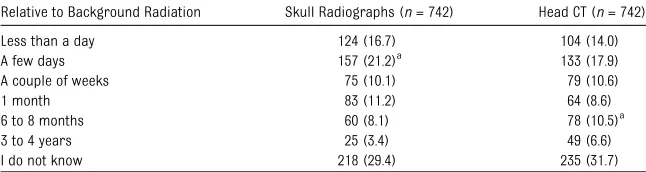
When asked to compare the radiation exposure from a head CT with back-ground radiation exposure, 51.1% (47.5%–54.7%) underestimated CT ra-diation dose (Table 3). In contrast, 32.8% (29.4%–36.2%) of the parents overestimated the radiation dose and 44.8% (41.2%–48.3%) overestimated
potential malignancy risk associated with skull radiographs, with 18.5% of parents choosing a risk estimate the same or above the level associated with head CT (Table 2). The results of statistical comparisons between CT and radiograph response proportions (Tables 2 and 3) were not reported because all of the comparisons ach-ieved statistical significance but the differences did not appear to be clini-cally meaningful.
Of the 496 (66.8%) respondents who reported having some previous knowledge about radiation exposure in diagnostic imaging, information sour-ces were as follows: health care workers, 197 (26.5%); paper media, 161 (21.7%); radio/television, 123 (16.6%); Internet, 119 (16.0%); communication with a friend/family member, 97 (13.1%); and/or formal education courses, 61 (8.2%).
Impact of Disclosure of Potential Risks
At the start of the survey, 671 of 742 (90.4%) parents would be very willing/ willing to proceed with a head CT if the
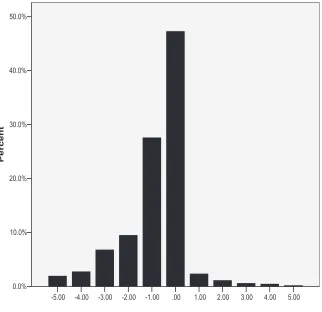
emergency physician thought it was necessary, but this number was re-duced to 517 (69.7%) after current risk information was provided (P,.0001). Figure 2 shows the degree of change in category of willingness to proceed for each respondent. Of note, 346 (46.6%) parents did not change category of willingness, whereas 363 (48.9%) de-creased their willingness, with 204 (56.2%) of these parents decreasing willingness by only 1 category. FIGURE 1
Study enrollment.aSum.622 due to multiple exclusion criteria.
Parents (n= 742) Age,n(%)
,18 years 11 (1.5)
18–30, years 92 (12.3)
31–50 years 592 (79.8)
.50 years 48 (6.4)
Female gender,n(%) 454 (60.9) Highest educational
degree completed,n(%)
Less than grade 8 education 4 (0.6) Grade school
(completed grade 8)
4 (0.5)
High school
(completed grade 12)
100 (13.4)
Postsecondary education (technical college or university)
637 (85.5)
Primary ethnic origins (all that applied),n(%)
Europe 417 (56.0)
Asia 179 (24.0)
Africa 5 (6.7)
Australia/New Zealand 8 (1.1)
North America 186 (25.0)
Central/South America 64 (8.6) Children with head injuries
(n= 742)
Median (IQR) age, y 4.4 (17.5) Female gender,n(%) 272 (36.5) Previous imaging recalled by
parent,n(%)
Radiographs 363 (48.7)
CT 92 (12.3)
Ultrasound 182 (24.4)
MRI 69 (9.3)
Nuclear medicine 21 (2.8)
Imaging received in the ED,n(%)
Skull radiographs 20 (2.7)
CT of the head 39 (5.3)
Final ED diagnosis,n(%)
Mild head injury/concussion 720 (97.0)
Skull fracture 16 (2.2)
Intracranial hemorrhage 6 (0.8)
Importantly, 262 (35.3%) would not have any further thoughts about rec-ommended CT testing if the doctor thought it was important, whereas 311 (41.0%) wanted further discussion with a physician, and 42 (5.6%) would refuse CT testing. Of the 42 who stated that they would refuse CT testing, head CT was subsequently recommended by the physician in 8 cases; CT imaging was completed successfully in all 8 cases. The vast majority of parents, 673 (90.7%), preferred to know the poten-tial malignancy risks of diagnostic tests that expose children to ionizing radiation before proceeding with test-ing.
DISCUSSION
Our study revealed that∼50% of the parents who participated in this survey were aware that ionizing radiation from a CT of the head may potentially increase a child’s lifetime malignancy risk. Although the provision of risk in-formation reduced parental willing-ness to proceed with theoretical CT testing, almost all parents were willing to discuss with the doctor the need for
CT imaging if it were recommended. Finally,.90% of families preferred to be informed of potential risks before proceeding with recommended ioniz-ing diagnostic imagioniz-ing.
We found a greater prevalence of pa-rental awareness of the potential risk associated with CT than previously reported. In 2004, Lee et al10reported that only 3% of adult patients who re-ceived an abdominal CT in the ED be-lieved there was an increased malignancy risk. In parents of children who were scheduled to undergo non-urgent outpatient CT, Larson et al9 found that 13% of respondents were aware of possible malignancy risks. Although there are differences be-tween studies in clinical setting, geo-graphic region, and potentially, parental demographic characteristics, our finding of almost 50% parental awareness suggests that there has been a substantial interval increase in public awareness over the past 8 years. In 2006, a survey of pediatricians reported a sustained increase in par-ent questioning regarding radiation doses since 2001.17 The recent
explo-sion of media coverage is probably the most influential contributing factor toward increasing parental aware-ness, with 54% of our study parents reporting knowledge gains from the media/Internet. However, increased communication and discussion from physicians, imaging technologists, or nurses with patients is also becoming more commonplace, with ∼25% of respondents receiving their in-formation from health care providers.
As in previous studies,8–10 our res-pondents generally underestimated the radiation exposure and risk asso-ciated with CT. However, quite un-expectedly, they selected similar dose and risk estimates when assessing skull radiographs as for CT, which implies that parents have a limited sense of the relative difference in the radiation dose of skull radiographs (60–80-fold less) compared with CT of the head. The latter could result in an inappropriately equal level of concern about radiation exposure and potential malignancy risks when a physician recommends radiographs or CT, which may affect how often parents raise verbal conversations about potential risks from CT. Clinicians may therefore have a greater responsibility to initiate conversations with families about the risks/benefits of CT rather than do so only when prompted by the patient.
We found that parental willingness to proceed with physician-recommended CT testing decreased by ∼20% after being provided with current risk esti-mates. This finding differs from the only comparable study by Larson et al9 in which risk disclosure had no impact on willingness to proceed with CT testing in their respective children. However, the latter study involved parents attending a clinic with their children for a previously scheduled CT, and the concern around their child’s current clinical condition may have outweighed any new information about
TABLE 2 Parental Knowledge of Potential Cancer Risk From Imaging Tests That Use Ionizing Radiation
Potential Malignancy Risk Skull Radiographs (n= 742) Head CT (n= 742)
Almost no risk at all (,1:1 000 000) 282 (38.0)a 271 (36.5)
Very small risk (1:1 000 000) 195 (26.3) 196 (26.4)
Small risk (1:10 000) 91 (12.3) 105 (14.2)a
Moderate risk (1:1000) 40 (5.4) 38 (5.1)
Large risk (1:100) 6 (0.8) 8 (1.1)
I do not know 128 (17.3) 124 (16.7)
Data are presented asn(%).
aMost correct estimate.
TABLE 3 Parental Knowledge of Exposure to Ionizing Radiation From Diagnostic Tests Relative to Daily Background Radiation
Relative to Background Radiation Skull Radiographs (n= 742) Head CT (n= 742)
Less than a day 124 (16.7) 104 (14.0)
A few days 157 (21.2)a
133 (17.9)
A couple of weeks 75 (10.1) 79 (10.6)
1 month 83 (11.2) 64 (8.6)
6 to 8 months 60 (8.1) 78 (10.5)a
3 to 4 years 25 (3.4) 49 (6.6)
I do not know 218 (29.4) 235 (31.7)
Data are presented asn(%).
aMost correct estimate.
small malignancy risks. In our survey, CT imaging was theoretical, leaving parents relatively uninformed about clinical need, and thus malignancy risks may have played a greater factor in reported willingness to proceed with imaging.
Approximately 90% of parents in this study would prefer to be informed about possible risks before their chil-dren undergo CT or radiographic ex-aminations. There are limited data on current physician practice in this area, but a study published in 2004 reported a physician risk disclosure rate of 22% in an adult ED population scheduled for abdominal CT.10In a 2012 survey of 126 Canadian pediatric emergency medi-cine physicians, 69% of the respond-ents reported discussing potential malignancy risk with families at least
“most of the time” when they recom-mend a CT of the head (K.B., J.F., S.B.F., K.E.T., unpublished data). Whereas reported rates may be inflated,10this finding does suggest that disclosure rates among emergency physicians are increasingly approaching parental expectations.
This research has limitations that warrant consideration. Because de-mographic characteristics were only available upon consenting to the sur-vey, we could not compare our re-sponder and nonrere-sponder parent groups. However, our response rate was relatively high at 75%, which approximates the 80% target of a rep-resentative sample.14 In addition, we did not ask about the respondent’s experience with cancer, which may have been an important variable in
some respondents may have provided what they perceived to be socially desirable answers rather than their true perceptions. The risk information given to parents was brief and without a personal or detailed clinical context, and therefore the impact of risk dis-closure reported in this survey may not reflect what would happen in clinical reality. Our results reflected English-speaking parents, many of whom had postsecondary education, who presented to a pediatric ED lo-cated in an urban Canadian setting and included only children with rela-tively minor head injury. Thus, our findings may not be generalizable to other sociodemographic and clinical scenarios and a less-educated pop-ulation may have less knowledge of radiation risks from imaging.
CONCLUSIONS
The evolving professional literature, media, and Internet coverage are influencing the environment in which physicians practice and the knowledge base of our patients and their families. This situation may especially be true in pediatric medicine, where concerns are often the highest, and a greater understanding of parental perceptions and desire to be informed of radiation risk is needed. We found that approxi-mately half of participating parents were aware of the potential lifetime increase in malignancy risk associated with CT and most underestimated the risk of CT. In addition, despite many parents demonstrating a decreased willingness to proceed with CT imaging after risk disclosure, almost all were agreeable to pursuing a discussion with their physician in the face of clinical need. Because almost all parents expressed a preference to be informed of potential risks before FIGURE 2
proceeding with recommended imag-ing, we strongly recommend that physicians be well informed of the benefits and potential risks of CT im-aging.
ACKNOWLEDGMENTS
We acknowledge the Pediatric Research Academic Initiative at SickKids Emer-gency (PRAISE). This research would not have been possible without the
su-perb efforts of the program manager, Johanna Crudden, and the participating PRAISE research assistants. Finally, we thank Dragan Kljujic for his efforts in da-tabase design.
REFERENCES
1. Broder J, Fordham LA, Warshauer DM. In-creasing utilization of computed tomogra-phy in the pediatric emergency department, 2000-2006.Emerg Radiol. 2007;14(4):227–232 2. Fahimi J, Herring A, Harries A, Gonzales R, Alter H. Computed tomography use among children presenting to emergency depart-ments with abdominal pain. Pediatrics. 2012;130(5). Available at: www.pediatrics. org/cgi/content/full/130/5/e1069
3. Larson DB, Johnson LW, Schnell BM, Goske MJ, Salisbury SR, Forman HP. Rising use of CT in child visits to the emergency de-partment in the United States, 1995-2008.
Radiology. 2011;259(3):793–801
4. Thomas KE. Comparative dose in pediatric radiology: uncertainty, estimates and ball-parks. Pediatr Radiol. 2011;41(suppl 1): S212–S14
5. Committee to Assess Health Risks from Exposure to Low Levels of Ionising Radia-tion. Health Risks from exposure to low levels of ionising radiation: BEIR VII phase 2. In: Board on Radiation Effects Research National Academies Press. Washington, DC: National Research Council of the National Academies; 2006
6. Pearce MS, Salotti JA, Little MP, et al. Ra-diation exposure from CT scans in child-hood and subsequent risk of leukaemia
and brain tumours: a retrospective cohort study.Lancet. 2012;380(9840):499–505 7. Linton OW, Mettler FA Jr; National Council
on Radiation Protection and Measuments. National conference on dose re-duction in CT, with an emphasis on pediatric patients. AJR Am J Roentgenol. 2003;181(2):321–329
8. Baumann BM, Chen EH, Mills AM, et al. Patient perceptions of computed tomo-graphic imaging and their understanding of radiation risk and exposure.Ann Emerg Med2011;58(1):1–7.e2.
9. Larson DB, Rader SB, Forman HP, Fenton LZ. Informing parents about CT radiation ex-posure in children: it’s OK to tell them.AJR Am J Roentgenol. 2007;189(2):271–275 10. Lee CI, Haims AH, Monico EP, Brink JA,
Forman HP. Diagnostic CT scans: assess-ment of patient, physician, and radiolo-gist awareness of radiation dose and possible risks. Radiology. 2004;231(2): 393–398
11. Kuppermann N, Holmes JF, Dayan PS, et al; Pediatric Emergency Care Applied Re-search Network (PECARN). Identification of children at very low risk of clinically-important brain injuries after head trauma: a prospective cohort study.Lancet. 2009;374(9696):1160–1170
12. Warren DW, Jarvis A, LeBlanc L, Gravel J; CTAS National Working Group; Canadian Associa-tion of Emergency Physicians; National Emergency Nurses Affiliation; Association des Médecins d’Urgence du Québec; Canadian Paediatric Society; Society of Rural Physi-cians of Canada. Revisions to the Canadian Triage and Acuity Scale paediatric guidelines (PaedCTAS).CJEM. 2008;10(3):224–243 13. Burns KE, Duffett M, Kho ME, et al; ACCADEMY
Group. A guide for the design and conduct of self-administered surveys of clinicians.
CMAJ. 2008;179(3):245–252
14. Streiner DL, Norman GR.Health Measure-ment Scales: A Practical Guide to Their Development and Use. 2nd ed. Oxford, UK: Oxford University Press; 1998
15. Goske MJ, Applegate KE, Bell C, et al. Image Gently: providing practical educational tools and advocacy to accelerate radiation protection for children worldwide. Semin Ultrasound CT MR. 2010;31(1):57–63 16. National Council on Radiation Protection
and Measurements. Ionizing Radiation Ex-posure of the Population in the United States.Bethesda, MD; 2009
17. Thomas KE, Parnell-Parmley JE, Haidar S, et al. Assessment of radiation dose awareness among pediatricians. Pediatr Radiol. 2006;36(8):823–832
DOI: 10.1542/peds.2013-0378 originally published online July 8, 2013;
2013;132;305
Pediatrics
David and Karen E. Thomas
Services
Updated Information &
http://pediatrics.aappublications.org/content/132/2/305
including high resolution figures, can be found at:
References
http://pediatrics.aappublications.org/content/132/2/305#BIBL
This article cites 13 articles, 2 of which you can access for free at:
Subspecialty Collections
oskeletal_disorders_sub
http://www.aappublications.org/cgi/collection/rheumatology:muscul Rheumatology/Musculoskeletal Disorders
ent_safety:public_education_sub
http://www.aappublications.org/cgi/collection/patient_education:pati Patient Education/Patient Safety/Public Education
b
http://www.aappublications.org/cgi/collection/hospital_medicine_su Hospital Medicine
following collection(s):
This article, along with others on similar topics, appears in the
Permissions & Licensing
http://www.aappublications.org/site/misc/Permissions.xhtml
in its entirety can be found online at:
Information about reproducing this article in parts (figures, tables) or
Reprints
http://www.aappublications.org/site/misc/reprints.xhtml
DOI: 10.1542/peds.2013-0378 originally published online July 8, 2013;
2013;132;305
Pediatrics
David and Karen E. Thomas
Kathy Boutis, William Cogollo, Jason Fischer, Stephen B. Freedman, Guila Ben
Tomography
Parental Knowledge of Potential Cancer Risks From Exposure to Computed
http://pediatrics.aappublications.org/content/132/2/305
located on the World Wide Web at:
The online version of this article, along with updated information and services, is
http://pediatrics.aappublications.org/content/suppl/2013/07/03/peds.2013-0378.DCSupplemental
Data Supplement at:
by the American Academy of Pediatrics. All rights reserved. Print ISSN: 1073-0397.