171 | P a g e
PROCESS TRANSFORMATION AT DISTRICTS: A
CASE STUDY OF E-GOVERNANCE IN INDIA
M. K. Singh
1, M. P. Gupta
2and Jitendra Madaan
31,2,3
Department of Management Studies
,
Indian Institute of Technology Delhi, Delhi 110016, (India)
ABSTRACT
Under the E-governance Projects several services and procedures of government are being automated to enhance citizen services and experiences. It has been found that if a system is made IT enabled then it renders several activities redundant or one process becomes flexible and efficient at the cost of another, simultaneously it requires reengineering, prioritisation of process and optimisation of resources of the system to garner all benefits. A suitable IT based model is engineered backed up by computerised decision making. One such decision point is taken and decision support is developed through the use of logic available in Operations Research (Travelling Sales Man Problem).
Keywords:
E-governance, Information Technology Reengineering, Decision Support. Process
Mapping, Workflow, As-Is Process Map, To-Be Process Map, What if Analysis, IT enabled.
I. INTRODUCTION
Government across the world are focusing on various ways to provide efficient and transparent services with
high flexibility. These services must reach the citizen at affordable cost. Also from 49 empirical studies it was
concluded that there were positive e-government impacts on data access, efficiency and productivity of
government performance [1] from earlier studies also found that e-government enhances communication
between government and citizens [2] Country like India, with high population, the successful model of
E-governance is at urge, simultaneously the policy makers must be enough flexible to integrate the various
challenges at system level. The innovation is essential for economic development [3]. Standardisation of the
processes, providing online services, Database management, open source of the data, by means of this the
government expenditure in terms of expenditure can be reduced. Government of India has taken initiatives
under National governance Plan (NeGP) for the growth of governance within the country. The
E-governance plan can help to seek the right E-governance and institutional mechanisms. The Government plan at
the Centre, State and local level with integrated service levels to create a citizen-centric as well as
business-centric environment for good governance. Under this plan government has vision that all government services
accessible to the common man in his locality through a one stop shop (integrated service delivery) ensuring
flexibility, efficiency, transparency and reliability at affordable costs to meet the basic needs of the common
172 | P a g e
E-district is a Project under the NeGP. The districts in India are the delivery channels for governmentadministration which caters various services to the citizens such as ration card, certificate issuing, pension etc;
therefore e-district can project can significantly improve government service deliveries.
The backbone of above implementation is IT in government processes the benefit of same can helpful to extract
the flow of real time information of services which can further help firstly interlinking the functioning of the
various departments by increasing the flexibility and efficiency in the system; secondly innovating web enabled
applications; thirdly developing management information central data base and lastly utilisation of the
computational power.
As the computer capability enhanced with time problems gets solved faster speed. The computers can collect the
real time information and can be integrated with mathematical algorithm to solve complex models at very fast
speed. In organisations computing power are being used by managers, decision makers, stake holders etc. The
solving of large and unstructured problem which are very difficult and time consuming when solved manually
for taking decision now can be solved utilising the computing power. This is what precisely known as Decision
Support System (DSS). The paper focuses on IT based model for e-district. There are various citizens centric a
service delivered at district level, one among is allocation of ration card.
II LITERATURE REVIEW
2.1 E-governance
E-governance has been defined as that which, "seeks to realize processes and structures for harnessing the
potentialities of information and communication technologies (ICTs) at various levels of government and the
public sector and beyond, for the purpose of enhancing good governance. E-governance puts the citizen at the
centre giving citizens the choice of when and where government services. In other terms it gives the flexibility
to citizen to accesses the government information and to completion of government transactions anywhere and
anytime efficiently and effectively. ―Creating an open and transparent government is an ideal index of the
effectiveness of gross government activity and progress‖ [4]. E-government utilizes technology to accomplish
reform by fostering flexibility, transparency, accountability, eliminating distance and other divides, and
empowering people to participate in the political processes. These services are offered at district level to ensure
citizen centric services. In the research paper e-governance is defined as the application of electronic means
firstly in interaction between government and citizens and government and businesses and secondly in internal
government operations.
E-government can be said to have function of four components namely governance, IT, reengineering and
citizen (familiar with computer). The four independent variables require a little elaboration that is e-government
without good governance, sound IT infrastructure support, a critical examination of existing administrative
procedures followed by appropriate administrative reforms, here designated as reengineering and finally,
173 | P a g e
The objectives of e-government is to transform government, the same is based on two basic premises: firstly,current government functioning, as exhibited by its public service delivery, is far from satisfactory level. And
secondly, government can perform better, with emerging IT. ―E-government managers need to be responsible
for the quality of service they deliver through the portals and try to understand the need of the citizens‖ [5]. In
this conceptualization, therefore, e-government is transformation of the government functioning. This
conceptualization of e-government gives rise to four important corollaries, namely, first e-government is an
intermediary stage for transforming government. Thus e-government is not an end in itself but a means for
reaching an end. Secondly, e-government must aim at government transformation without which its full
potential will not be harnessed. Thirdly, any e-government attempt must be based on administrative reforms,
failing which the e-government attempt may not give desired results. And lastly, e-government should strive to
reach the ultimate stage, still eluding the developing countries, when e-government becomes synonymous with
government.
E-District is a State Mission Mode Project under the National E-governance Plan. The project aims to target
high volume services through Common Service Centres. Districts are the primary delivery channels of
governance to deliver a large number of services to the citizens; therefore E-governance can significantly
improve government service delivery. e-District project covers ten services at Nation and State level. These
services are certificates, pension, utilities, dues and recovery, ration card (PDS), electoral services, grievance,
revenue court, employment exchange and police department.
2.2 Objectives of e-district Model:
a. To establish fundamental relationship with citizen;
b. To integrate and seamlessly deliver citizen services by district administration through backend
digitization and reengineering;
c. Fast processing of public cases/appeals/grievances by IT advantage;
d. Focus on backend computerization
e. Infusion of transparency and accountability in operations
f. Implementation of an efficient electronic workflow system in order to reduce the workload of the
district personnel;
g. To create a smart interface between citizens, governments, public utilities and other information
providers;
2.3 Holistic View of Reengineering for e-district model
―Reengineering is the fundamental rethinking and radical redesign of business processes to achieve dramatic
improvements in critical, contemporary measure of performance, such as cost quality, services etc (Hammer &
Champy, 1993.). Today most of the process used for delivering the services are old age, obstructive, complex
and require major rethinking and re-orientation. The reengineering entails dramatic improvement rather than
marginal. Reengineering advocates streamlining these processes for today requirements with a scope of
174 | P a g e
reducing redundant and non-value added activities secondly by reducing the number of stages/transfer points ofwork and thirdly by speeding up the work flow often through the use of IT System.
2.4 Fundamental Attributes of reengineering:
a. Results in radical change;
b. Assumes clean slate change;
c. Focuses on end-to-end processes;
d. It is top-down directed;
e. It is information technology enabled.
2.5 Need of Reengineering in the Government Services
The changing environment necessitates government to switch from task orientation to a performance,
result orientation and complete revamping so good governance has to be the driving force instead of
government. Government has to restructure its structure, processes, rules, regulations and transformation of
behavioural attitude of government officials. It has to eliminate redundant hierarchical levels, overheads,
obsolete rules and practices and significant reduction in cost and response-time
2.6 Benefits of Applying Reengineering in Government Services
The benefits of reengineering may be simple and one-dimensional, but are more likely to be complex
and multi-dimensional; some of the benefits are listed below:
a. Financial performance gets improved because things get streamlined.
b. Customer satisfaction improves because he gets services at faster rate.
c. Cost reduction.
d. Service quality gets improved.
e. Delivery performance gets improved.
f. Productivity increases ideal time reduces.
g. Flexibility/responsiveness increases.
h. Process times of services reduce.
i. Innovation of new ideas those can be applied to other application.
j. Employee development in terms capability, value, efficiency etc.
k. Competitiveness among other departments.
l. Organisational flexibility increases, for example decision can be taken at any level of stake holders,
forwarding of application of request has eliminated the middle personal involved in services deliveries.
Government organizations are required to deliver or produce at a low cost, high quality, fast and flexible
responsiveness to customer requirements. Therefore, there seems a pressure on organizations to redesign. Out of
such pressures was born the idea of reengineering. While reengineering promised radical change the attainment
175 | P a g e
failing. From above it is felt that there is still a need for process change in holistic and more incrementalmanner.
2.7 Holistic Approach to Reengineering in e-district model
Traditional approach of reengineering and many literature reviews have emphasized changed based one aspect
of an organization for example on with inadequate treatment of human aspect. Reengineering programme can be
powerful change approach if it is integrated with verities of change initiatives such as cultural and structural
change within an organisation. Therefore, the need for holistic view of change management of government and
district administration has to be highlighted as well as incorporated.
2.8 IT Enablement of e-district Services
Role of Information Technology (IT) have reached to long height in various sectors in India. Finance
and Insurance sectors are playing a leading role in IT enabled processes. At the same time Government of India
had initiated project at district level.
Presently the interacting bodies as shown in figure 1 are:
a. Users/Applicants;
b. Process Owner and;
c. Service Counters
Figure: 1
Traditional Way of Interaction of BodiesThese interacting bodies are responsible for delivery of services and there no role of Information
Technology, the service delivery takes lot of time, movement of papers is manual, status tracking is quite
difficult, and service levels are not fixed for any work. These deficiencies can be overcome by proposed by
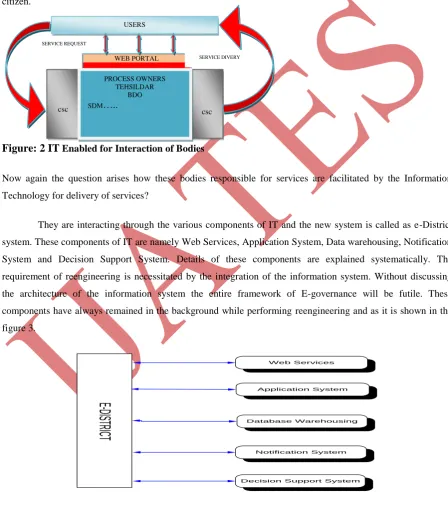
Services Architecture shown in figure 2 below in which service counters are being replaced by computer service
centres and users can also interact with Web Portal.
2.9 Use of IT and the framework
Users or Applicant
Process Owners Service
176 | P a g e
Incorporation of IT into tradition processes will try to make them more efficient, transparent, aid in compliance,increase visibility, aid in performance measurement, aid in planning etc.
Now the questions are who needs the services? Who will do it? How to avail the services? And how it is
possible?
The above figure may be helpful in giving the answers. The interacting bodies are the User, CSCs and the
various process owners. They are collectively responsibly for forming successful system and delivery to the
citizen.
Figure: 2 IT
Enabled for Interaction of BodiesNow again the question arises how these bodies responsible for services are facilitated by the Information
Technology for delivery of services?
They are interacting through the various components of IT and the new system is called as e-District
system. These components of IT are namely Web Services, Application System, Data warehousing, Notification
System and Decision Support System. Details of these components are explained systematically. The
requirement of reengineering is necessitated by the integration of the information system. Without discussing
the architecture of the information system the entire framework of E-governance will be futile. These
components have always remained in the background while performing reengineering and as it is shown in the
figure 3.
E-D
ISTR
ICT
Web Services
Application System
Database Warehousing
Notification System
Decision Support System
Figure: 3
It Components in e-districtUSERS
WEB PORTAL
csc csc
PROCESS OWNERS TEHSILDAR
BDO
SDM…..
SERVICE REQUEST
177 | P a g e
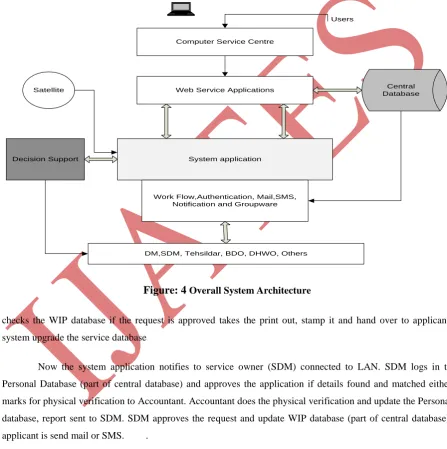
Now the Question is how these IT components are connected with each other and interacting with theinteracting bodies. For that we need to understand the IT Architecture. The System architecture shown in above
figure 4 can be explained with example of domicile certificate. The applicant/user arrives at CSC for domicile
certificate. CSCs are connected through satellite or leased line for accessing the web services. The applicant
requests for domicile certificate to CSC operator, operator opens the web portal and enters the particulars, these
particulars are stored in temporary database (part of central database) connected to system application. System
application generates the receipt number/application number. CSC operator gives the stipulated time for
collecting the domicile certificate. CSC operator on applicant request enters the receipt no./application no. and
Computer Service Centre
Web Service Applications DatabaseCentral
System application
Work Flow,Authentication, Mail,SMS, Notification and Groupware Decision Support
DM,SDM, Tehsildar, BDO, DHWO, Others Satellite
Users
Figure: 4
Overall System Architecturechecks the WIP database if the request is approved takes the print out, stamp it and hand over to applicant,
system upgrade the service database
Now the system application notifies to service owner (SDM) connected to LAN. SDM logs in to
Personal Database (part of central database) and approves the application if details found and matched either
marks for physical verification to Accountant. Accountant does the physical verification and update the Personal
database, report sent to SDM. SDM approves the request and update WIP database (part of central database),
applicant is send mail or SMS. .
Lastly the DSS connected to system application helps to decide the route for various locations in case if there
are many applications for verification of different location for Accountant.
178 | P a g e
―Decision Support Systems is an integrated, interactive computer system, consisting of analytical toolsand information management capabilities, design to aid decision makers in solving relatively large and
unstructured problem‖ [8]. ―A number of frameworks or typologies have been proposed for organizing
knowledge about Decision Support. In the expanded framework, the two most widely implemented approaches
for delivering decision support are called data-driven and model-driven DSS‖ (Adla, 2007a). ―Data-driven DSS
help managers organize, retrieve, and analyse large volumes of relevant data using database queries and OLAP
techniques‖ [10]. ―Model-driven DSS use formal representations of decision models and provide analytical
support using the tools of decision analysis, optimization, stochastic modelling, simulation, statistics, and logic
modelling‖ [9] The three other types of DSS have become more widespread and sophisticated because of Web
technologies. Communication- driven DSS rely on electronic communication technologies to link multiple
decision makers who might be separated in space or time or to link decision makers with relevant information
and tools.
The Web has expanded this technology. ―Knowledge driven DSS can suggest or recommend actions to
managers‖. The Web helps deliver this type of DSS to a much broader audience of decision makers. Finally,
document-driven DSS integrate a variety of storage and processing technologies to provide managers document
retrieval and analysis. Our primary focus in this paper and discussion is on the first two categories of Decision
Support Systems: data driven and model-driven DSS for decision making.
III METHODOLOGY
3.1 Decision Making Opportunities in the e-district Model
There are several opportunities for decision making which has been identified. These are discussed below:
Decision for Ration Card: Numbers of Ration Card are allocated to several villages after getting the quota
for district. This allocation requires frequent changes and updates of number of possible allocations based
on the changes done at the central level. This decision may be well facilitated by such decision support.
Decision for Pension Services: Pension issued to citizen should be equally distributed in the given area.
Concentration of pension in one area is should not be allowed. But again such decision is difficult to taken
manually. This decision caters to this need.
Decision for predicting the next year demand of ration card: It is prudent for the district services to inform
the centre of next year expected demand rise in the ration card. It better equips the centre to meet the
increasing year on year demand and release the quota. Such exercise requires the forecasting techniques and
past data and must not be relied on simply hunch of process owners.
Decision for Routing Accountant: Accountant has the duty of verifying personal details of citizen like
name, addresses, age, family members, stay at particular location etc. For this Accountant has to visit the
people living in the District physically. This itself is a time taking process and offers several opportunities
179 | P a g e
From above discussed various decision making opportunities routing Accountant has been taken, Accountantdoes all the work related to field verifications and reports back to higher authorities required deliver the
services, for his convenience decision making is described below.
3.2 Decision support for routing accountant
See figure 5, Accountant does physical verification for personal details. The Accountant had to travel various
locations for various services. The decision where to go first and complete the verification process in minimum
time is the goal. But it becomes physically difficult to decide and this is almost routine work for him. Even the
manager (process owner) must know about the status of the verification process in order to maintain the smooth
work flow. Services where accountant does the verification are certificate services, pension services, electoral
services and other services
The computerised decision support aid the Accountant for determining its shortest possible route. For
example the process map of As-Is Certificate Services is as given below:
.
Issue of domicile certificate:
S D M te h s il d a r R e v e n u e i n s p e c to r L e k h p a l A p p li c a n t Submission of application to tehsildar
Certificate collected, and record maintained in domicile
register with SDM
Income certificate issued by SDM
Endorsement of the application by tehsildar and forward to revenue
inspector
Tehsildar sends request to SDM for issuing certificate. Original application form is enclosed with lekhpal report
Revenue inspector endorses lekhpal’s report
and forward to tehsildar Verification
report Application rejected
Revenue inspector forwards application to
consult lekhpal
Lekhpal does the physical verification of the information
provided by applicant POSITIVE NEGATIVE
Process mapping of domicile certificate
Figure: 5 Process Making For Domicile Certificate (As-Is)
Applicant visits the Tehsil office and enquires about the procedure and documents required for enclosing with
the request for domicile certificate. Once he completes the all the requirement for certificate and submits in the
office of Tehsildar, Tehsildar forwards the application to Revenue Inspector (RI), who assists the work of
Tehsildar. Revenue Inspector forwards the application for physical verification to Accountant. Similarly
verification for other services would also require Accountant. Accountant does the physical verification and
180 | P a g e
request to SDM for issuing the certificate. Applicant arrives at SDM office and collects the domicile certificate;manual copy of the same is maintained at SDM office. In this process the Accountant faces problem in taking
the decision and he decides of his own and takes decision on hunch
3.3 To-Be Model:
Below model is combined model for all types of certificates services. In new model two more new
components are involved namely CSC and System Application described in early section. The applicant arrives
at CSC and request for the same. The operator at CSC opens the web portal login the details of applicant in the
system application which generates the receipt no. at the same time the operator gives the applicant stipulated
time. The system application notifies Accountant for physical verification and at the same time to process owner
for further processing. The Accountant logs into personal database and looks if physical verification required
otherwise marks the application to Tehsildar (Income and Caste) or SDM (Domicile) if Personal Database
available.
WORKFLOW AND INFORMATION FLOW FOR CERTIFICATES
S D M C S C TE H S IL D A R S YS TE M A P P LI C A TI O N A N D D A TA B A S E LE H K P A L Matching No
Caste and Income
Yes Domicile Approval Issue No Yes Personal Databse Update Applicants receives the info and collects the Different Certificates
Matches with service data base and digitally approves application. Applicant gives the application for issue of caste, income, domicile and
handicap certificate and collects receipt+Payment If Personal Database exist? Application rejected
Send mail or SMS to applicant for collecting the certificate Personal Database upgraded. Service Database Does Physical verification.
CSC checks the Approval and Issue the Certificates to Applicants and once the applicant service gets service
Service Database Updated.
Are particulars true
System notifies to Lekhpal in case of income,domicile and caste certificate and CMO office in case of handicap cartificate
WIP Database
DSS for Routing the Visit
Matches with Service Database and digitally approves application.
Figure: 6 Process Making for Domicile Certificate (To-Be)
The respective process owner verifies with personal database and digitally approves the application which is
stored in WIP database. Once the application stored in WIP database the system notifies the applicant by email
or SMS. Applicant visits the CSC with the receipt no. and asks for domicile certificate. The operator logs into
WIP database and checks the status of the request if approved by the process owner print the digitally approved
application, stamp and sigh it to hand over for the applicant, as enumerated in figure 6. In both the processes
181 | P a g e
enabled, has computing power and Computerised decision making component within the system. The problemfaced by him in As-Is process is solved with the help of computerised decision making, such decision making
may work on Travelling Sales Problem and the Assignment (Manoj, 2009).
IV CONCLUSIONS
The performance of decision making system can be further improved by considering more decision parameters
like taking onto account verification of remaining family members, pending application, dividing the area into
more small components, considering the real distance, counting the verification done per day etc.
Likewise more decision support could be developed for an example in case of ration card distribution. The
problem faced by the service owner is in allocating the ration cards with even distribution coordinating with the
supply and demand of quota allocated in district. The same decision support could work for pension allocation
with a little modification.
REFERENCES
[1] J. N. Danziger and K. V. Andersen, ―the Impacts of Information Technology on Public Administration:
an Analysis of Empirical Research From the ‗Golden Age‘ of Transformation[1],‖ Int. J. Public Adm., vol. 25, no. 5, pp. 591–627, Apr. 2002.
[2] Scavo and Shi, World Wide Website Design and Use in Public Management. Idea Group Publishing, 1999, pp. 246–66.
[3] M. Janssen and E. Estevez, ―Lean government and platform-based governance—Doing more with less,‖
Gov. Inf. Q., vol. 30, pp. S1–S8, Jan. 2013.
[4] M. . Gupta and D. Jana, ―E-government evaluation: a framework and case study,‖ Gov. Inf. Q., vol. 20, no. 4, pp. 365–387, Jan. 2003.
[5] D. Bhattacharya, U. Gulla, and M. P. Gupta, ―Asia Pacific Business Review,‖ 2011.
[6] M. Hammer and J. Champy, ―Reengineering the Corporation A Manifesto For Business Revolution,‖
2000.
[7] M. Al-mashari, Z. Irani, and M. Zairi, ―Holistic Business Process Reengineering : An International
Empirical Survey,‖ vol. 00, no. c, p. 7695, 2001.
[8] ―Book reviews.,‖ J. Psychother. Pract. Res., vol. 1, no. 4, pp. 387–90, Jan. 1992.
[9] A. Adla, ―A Distributed Architecture for Cooperative Intelligent Decision Support Systems,‖ vol. 2, no.
182 | P a g e
[10] N. Taghezout, A. Adla, and P. Zaraté, ―A Multi-agent Framework for Group Decision Support System :Application to a Boiler Combustion Management System ( GLZ ),‖ vol. 3, no. 2, pp. 9–20, 2009.
[11] Singh, M.K. (2009), "Development of Decision Support System for E- District Project of Gaziabhad