International Ayurvedic Medical Journal, (
EFFECT OF ABHADI CHURNA AND MULAKA TAILA ON SANDHIGATA VATA
WITH DIFFERENT METHODS
Gajendra Renuka1, Khicharia Satyadev
1Lecturer Department of Swasthavritta and Yoga,
Shri N.P.A. Govt. Ayurved College, Raipur, Chhattisgarh, India
Email: [email protected]
Sandhigata Vata is a most common disability di
and joints. Sandhigata Vata is a chronic degenerative disorder especially in old age groups. It causes pain in joints especially weight bearing joints. It makes life too difficult. Even, in everyday
ples feel disability due to pain. In modern science
disorder, in which all joints becomes affected especially weight bearing joints. purely vatic vyadhi. The aim of this
in Sandhigata Vata in two groups. Patients attending to the O.P.D. & I.P.D. of
P. A. Govt. Ayurved collage and hospital, Raipur (C.G.) were randomly selected based features. Group A (30 patients) were treated with internal use of
Abhyanga & Swadana with Mulaka Taila internal use of Aabhadi Churna and
the trial drug of Group A proves to be an effective remedy for acharya Charak, Taila is best to shaman
Aabhadi Churna and Abhyanga and
Keywords: Sandhigata Vata, Aabhadi Churna, Mulaka Taila, Abhyanga, Swedana
INTRODUCTION
In Ayurveda, Vata is explained as life and vita ity, supporter of the all embodied beings and sustains long life free of disorders. In doshas, Vata and Kapha plays an important in Sandhigata Vata. Sandhigata Vata
JOURNAL
International Ayurvedic Medical Journal, (ISSN: 2320 5091) Volume 5, Issue 12, December, 2017
EFFECT OF ABHADI CHURNA AND MULAKA TAILA ON SANDHIGATA VATA
WITH DIFFERENT METHODS
Khicharia Satyadev2
itta and Yoga, 2Lecturer Department of Kayachikitsa, Govt. Ayurved College, Raipur, Chhattisgarh, India
ABSTRACT
is a most common disability disorder in all over the world, It is the disorder of bone is a chronic degenerative disorder especially in old age groups. It causes pain in joints especially weight bearing joints. It makes life too difficult. Even, in everyday
ples feel disability due to pain. In modern science Sandhigata vata correlates with Osteoarthritis. It is a disorder, in which all joints becomes affected especially weight bearing joints. Sandhigata vata
study is to evaluate the efficacy of Aabhadi Churna s. Patients attending to the O.P.D. & I.P.D. of Kayachikitsa P. A. Govt. Ayurved collage and hospital, Raipur (C.G.) were randomly selected based features. Group A (30 patients) were treated with internal use of Aabhadi Churna and
Mulaka Taila for two month. Group B (30 patients) were treated with only and Abhyanga & Swedana with Mulaka Taila for two months. Though the trial drug of Group A proves to be an effective remedy for Sandhigata Vata, because according to
shaman of vata dosha. It shows better efficacy than “Internal use o and Swedana with Mulaka Taila”.
Sandhigata Vata, Aabhadi Churna, Mulaka Taila, Abhyanga, Swedana
is explained as life and vital-ity, supporter of the all embodied beings and
long life free of disorders. In Tri-plays an important role Sandhigata Vata. Sandhigata Vata is the
im-balance or vitiation of Vata
Vata disturbs the normal state of the all the joints.
Vayu regulates all the functions of the body and keeps all the dhatus in their physiological limits
Volume 5, Issue 12, December, 2017
EFFECT OF ABHADI CHURNA AND MULAKA TAILA ON SANDHIGATA VATA
Lecturer Department of Kayachikitsa,
sorder in all over the world, It is the disorder of bone is a chronic degenerative disorder especially in old age groups. It causes pain in joints especially weight bearing joints. It makes life too difficult. Even, in everyday works,
peo-correlates with Osteoarthritis. It is a Sandhigata vata is a Aabhadi Churna & Mulaka Taila
Kayachikitsa from Pt. N. P. A. Govt. Ayurved collage and hospital, Raipur (C.G.) were randomly selected based on the clinical and Mulaka Taila and for two month. Group B (30 patients) were treated with only for two months. Though, , because according to It shows better efficacy than “Internal use of
Vata and this vitiated the normal state of the Kapha in
IAMJ: VOLUME 5, ISSUE 12, DECEMBER, 2017 4314 and also promotes that, they works properly. In
Sandhigata Vata, vata becomes vitiated when different Vata prakopaka nidana are taken and this vitiated Vata, desiccates Shleshka Kapha in the Sandhi and it results in difficulty in move-ment of the joints and causes their degeneration. Sandhigata Vata is the most common joint dis-order of older age group in all countries. Vata controls all the activities of the body in every stage of life, but in old age vata becomes more aggravated and causes Dhatushoshana, which results all Dhadus of the body undergoes kshya. Sandhigata Vata is a vyadhi of Vriddhavastha but todays lifestyle is responsible for its in-creased incidence in young age groups. This disease affects the patients for prolonged period causing loss of function as well as deformity of the joint especially weight bearing joints like knee joints. The abnormalities in Sandhis by Prakupita Vata are the main cause in samprapti of Sandhigata Vata. Sandhis come under the madhyama roga marga and thus, involvement of Madhyama Roga Marga, vata dosha and dhatukshaya, makes the disease kashta sadhya. Sandhigata Vata is described under vata vyadhi in all ancient literatures. There is no any sepa-rate reference of Sandhigata Vata. The shortest description of this disease is available in Charak Samhita, Sushruta Samhita and Ashtangahri-daya etc. The later authors explained the clinical aspect of this disease in the wordings of Charaka and Sushruta. Acharya Charaka was the first person who described the disease sepa-rately naming it “Sandhigata Anila”, but has not been included under the 80 types of Nanatmaja Vyadhi Cha.Chi.(28/37) as described by him. Acharya Vagabhatta has also considered Vata Vyadhi as a Maharoga.
“India is likely to notice an endemic of os-teoarthritis with about 80% of the 65+
popula-tion in the country suffering with wear and tear of joints. 40% of these people are likely to suf-fer from severe Osteoarthritis, which will dis-able them from daily activities, say the experts quoting the World Health Organisation.” (WHO)
In all Samhitas, treatment of Sandhigata Vata is almost same. A common treatment for Vata Vyadhi has been described by Acharya Charaka i.e. repeated use of Snehana, Swedana, Basti and Mriudu Virechana. Acharya Sushruta has mentioned the treatment for Sandhigata Vata clearly i.e. Snehana, Upanaha, Agnikarma, Bandhana and Unmardana.
Taking reference from ancient classics, Vatahara Churna, local Abhyanga and swedana are selected for this study.
During this study, in Group A - Aabhadi churna and Mulaka Taila was used internally along with Abhyanga and Swedana of Mulaka Taila. In Group B - Aabhadi churna was given inter-nally along with Abhyanga and Swedana of Mu-laka Taila.
AIMS AND OBJECTIVES
To evaluate the efficacy of internal use of Aab-hadi Churna & Mulaka Taila with Abhyanga and nadiswedana and only internal use of Aab-hadi Churna with Abhyanga and nadi swedana in Sandhigata Vata.
MATERIALS AND METHODS
IAMJ: VOLUME 5, ISSUE 12, DECEMBER, 2017 4315 STUDY DESIGN
Group A:
Patients were treated by internal use of Aab-hadi Churna and mulaka Taila.
Local Abyanga with Mulaka Taila + Nadi swedana
Group B:
Patients were treated by internal use of Aab-hadi Churna.
Local Abyanga with Mulaka Taila + Nadi swedana
Posology:
Aabhadi Churna – 5 gm / BD, With – Ush-nodaka (after meal)
Mulaka Taila – 10 ml / OD , – With Milk (morning)
Abhyanga + Swedana – QS Study duration: 60 days (2 month)
COMPOSITION OF AABHADI CHURNA
Ingredients, botanical name, quantity use in AabhadiChurna:
(Yog.Rat. Vatavyadhi Chi. 1-5)
1. Aabha Acasica arabica 1 part
2. Rasna Plucha lansiolata 1 part
3. Guduchi Tinospora cardifolia 1 part
4. Shatavari Asparagus recemosa 1 part
5. Shunthi Gingeber officinalis 1 part
6. Shoufa Anethum sowa 1 part
7. Aswagandha Withenia sominifera 1 part
8. Hrivera juniperous communies 1 part
9. Vidhara Argyrea speciosa sweet 1 part
10. Yavani Roxburghiamum ammi 1 part
11. Ajmoda Apium graveolens 1 part
COMPOSITION OF MULAKA TAILA – Cha.Chi. (28/136,137)
Ingredients, quantity: 1. Juice of radish
2. Milk 3 Prastha
3. Curd
4. Tila Taila 1 prastha
Kalka dravya:
1. Madhuyasti 1 pala
2. Sharkara 1 pala
3. Rasna 1 pala
4. Lavana 1 pala
5. Ardraka 1 pala
6. Shunthi 1 pala
SELECTION OF PATIENT
Patients having following symptoms in any joint:
Sandhishoola (Pain) Sandhishotha (Swelling)
Prasarana Akunchanajanya vedana (Pain during flexion and extention)
IAMJ: VOLUME 5, ISSUE 12, DECEMBER, 2017 4316 Criteria for Inclusion:
Patient between 40 years to 60 years of age. Patients presenting with classical sign and
symptoms of Sandhigata Vata. Criteria for Exclusion:
Patients below 40 year and above 60 year of age.
Pregnant women and lactating mother. Associated with simple or compound
frac-tures.
Associated with trauma.
Associated with other systemic or metabolic disorder.
Patients of Aamvata, Vatarakta and diabetes are excluded.
Patients on steroid therapy.
Patients who have undergone surgery.
CRITERIA FOR ASSESSMENT
To assess the effect of therapy, all the signs and symptoms were given scoring depending upon their severity which is as follows:
1. Sandhishula (Pain):
"No pain - No pain in the joints" – 0
"Mild pain - Pain complained but tolerable" – 1
"Moderate pain - Pain complained and dis-turbs routine work" – 2
"Severe difficulty in working and com-pletely interrupting routine work" – 3
2. Sandhishotha (Swelling): "No swelling" – 0
"Mild swelling - Feeling of swelling with heaviness of joints" – 1
"Moderate apparent swelling" – 2
"Severe - Huge swelling" – 3
3. Akunchana Prasaranjanya Vedana
"No pain - Absence of movement restric-tion" – 0
"Pain without winching of face" – 1 "Pain with winching of face" – 2
"Does not allow passive movements" – 3
4. Sandhi Sphutana (Crepitus)
"NO - Absence of crepitus" – 0 "Mild - Perception on touch" – 1 "Moderate - Audible on attention" – 2 "Severe - Clearly audible" – 3
5. Sparsha Asahyata (Tenderness)
"Nil - No tenderness" – 0
"Mild - patient says tenderness" – 1
"Moderate - Winching of face on touch" – 2 "Does not allow to touch the joint" – 3
6. Sandhigraha (Stiffness)
"No Stiffness - No morning stiffness" – 0 "Mild - Morning stiffness of 5-10 minutes
duration" – 1
"Moderate - Morning stiffness of 10-15 minutes duration" – 2
"Severe morning stiffness of 15-30 minutes duration" – 3
TOTAL EFFECT OF THERAPY Complete Remission: 100%
Maximum Improvement: >75 to <100% Moderate improvement: >50 to 75% Mild improvement: >25 to 50%
No improvement: 0 – 25%
Chief complaints wise distribution of 60 patients of Sandhigata Vata
IAMJ: VOLUME 5, ISSUE 12, DECEMBER, 2017 4317
Group A Group B
1. Sandhishoola 30
100%
30 100%
60 100%
2. Sandhishotha 30
100%
30 100%
60 100%
3. Akunchan Prasara Janya Vedna 28
93.3%
30 100%
58 96.7%
4. Sandhi Sphutan 25
83.3%
26 86.7%
51 85.0%
5. Sparsha-Asahyata 24
80.0%
23 76.7%
47 78.3%
6. Sandhigraha 30
100%
30 100%
60 100%
In this study, all the patients (100%) were hav-ing Sandhi Shoola, Sandhishotha and Sandhi Graha. Akunchana Prasarana Janya Vedana
was present in 96.7% patients, Sandhi Sphutan was present in 85.0% patients and Sparsha-Asahyata was present in 78.3% patients.
EFFECT OF THERAPY (GROUP – A)
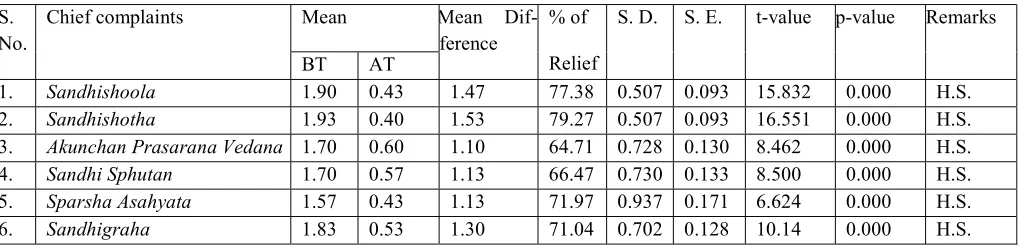
Table 33: Effect of Chief complaints in the patients of Sandhigata Vata:
S. No.
Chief complaints Mean Mean
Dif-ference
% of Relief
S. D. S. E. t-value p-value Remarks
BT AT
1. Sandhishoola 1.90 0.43 1.47 77.38 0.507 0.093 15.832 0.000 H.S.
2. Sandhishotha 1.93 0.40 1.53 79.27 0.507 0.093 16.551 0.000 H.S.
3. Akunchan Prasarana Vedana 1.70 0.60 1.10 64.71 0.728 0.130 8.462 0.000 H.S.
4. Sandhi Sphutan 1.70 0.57 1.13 66.47 0.730 0.133 8.500 0.000 H.S.
5. Sparsha Asahyata 1.57 0.43 1.13 71.97 0.937 0.171 6.624 0.000 H.S.
6. Sandhigraha 1.83 0.53 1.30 71.04 0.702 0.128 10.14 0.000 H.S.
EFFECT OF THERAPY (GROUP – B)
Table 37: Effect of Chief complaints in the patients of Sandhigata Vata
S. No.
Chief complaints Mean Mean
Difference % of Relief
S. D. S. E. t-value p-value Remarks
BT AT
1. Sandhishoola 1.90 0.43 1.47 77.37 0.819 0.150 9.805 0.000 H.S.
2. Sandhishotha 1.90 0.47 1.43 75.26 0.728 0.133 10.785 0.000 H.S.
3. Akunchan Prasarana Vedana 1.97 0.57 1.40 71.07 0.724 0.132 10.592 0.000 H.S.
4. Sandhi Sphutan 1.60 .53 1.07 68.88 0.583 0.106 10.016 0.000 H.S.
5. Sparsha Asahyata 1.47 0.43 1.04 70.75 0.890 0.162 6.360 0.000 H.S.
IAMJ: VOLUME 5, ISSUE 12, DECEMBER, 2017 4318 TOTAL EFFECT OF THERAPY
(GROUP A)
Gradation No. of Patients %
Complete Remission (100%) 1 3.33
Maximum Improvement (>75 to <100%) 9 30.0
Moderate Improvement (>50 to 75%) 17 56.66
Mild Improvement (>25 to 50%) 3 10.0
No Improvement (0 to 25%) 0 0.0
In group A, out of 30 patients, 3.33% patients achieved complete remission, while 30.0% pa-tients found in maximum improvement and
56.66% were having moderately improvement and 10.0% patients found mild improvement.
(GROUP B)
Gradation No. of Patients %
Complete Remission (100%) 1 3.33
Maximum Improvement (>75 to <100%) 5 16.66
Moderate Improvement (>50 to 75%) 23 76.66
Mild Improvement (>25 to 50%) 1 3.33
No Improvement (0 to 25%) 0 0.0
In group B, out of 30 patients, 3.33% patients achieved complete remission, while 16.66% pa-tients found in maximum improvement and 76.66% were having moderately improvement and 3.33% patients found mild improvement.
DISCUSSION
Sandhigata Vata is a most common disease in old age groups in all over the world. Sandhigata Vata is described in all Samhita and Sangraha Grantha as a separate clinical entity under the heading of Vata vyadhi. It is not included in 80 types of Nanatmaja Vatika Vikara by Acharya Charaka. But, Vata Khudata is one of the Nanatmaja Vata Vikara mentioned by Acharya Charaka. Further in the list of Kashta Sadhya Vata Vyadhi the name of Khuda Vata has been stated. While commenting onward “ Khuda-vata”, Chakrapani explains the meaning of Khudavata as a “Gulpha Vata” or Sandhigata Vata. Hence, it can be said that according to
Chakarapani, Sandhigata Vata is the Nanat-maja Vata Vikara. It is characterized by San-dhishoola, Sandhishotha, Sandhigraha etc. In the present clinical study 60 patients with the complaints of Sandhishoola, Sandhishotha, Prasarana Akunchanajanya vedana, Sparsha Ashyata, Sandhi Sphutana and Sandhi Graha etc. attending OPD and IPD Patients of Pt. N. P. A. Govt. Ayurvedic collage and hospital, Raipur (C.G.) were randomly selected into two groups. 30 patients were treated with internal use of Aabhadi Churna and Mulaka Taila and Abhy-anga & Swadana with Mulaka Taila for two month. 30 patients were treated by Internal use of Aabhadi Churna and Abhyanga & Swedana with Mulaka Taila for two months.
IAMJ: VOLUME 5, ISSUE 12, DECEMBER, 2017 4319
Vedana. Akunchana Prasaranajanya Vedana was found 96.7% of patients which also occurs aggravation of Vata Dosha and Kaphakshaya. Sandhi sphutana was found in 85.0% of pa-tients. Sparsha Asahyata was found in 78.3% patients that also due to aggravation of Vata. In group A, 3.33% patients achieved Complete remission, while 30.0% patients obtained Maximum improvement, whereas 56.66% Mod-erate improvement and 10.0% gets mild im-provement was also reported.
In group B, 3.33% patients achieved complete remission whereas 16.66% patients had maxi-mum improvement, while moderate improve-ment was found in 76.66% patients and 3.33% patients got mild improvement.
In this clinical research work, no patient ob-served in unchanged condition, every patient gets relief either less or more.
The above mentioned data shows that Internal use of Aabhadi Churna and MulakaTaila along with local Abhyanga and Swedana of Mulaka Taila i.e. group A has provided better relief in the disease Sandhigata Vata (Osteoarthritis) in the present study. Though, the results of both groups proved to be highly effective and also statistically highly significant in different pa-rameters. The result of Group A was better may be due to the following causes-
Group A patients were treated both drugs inter-nally. In this group pana of Mulaka Taila is works best because at the condition of taila pana, taila reaches into dhatu much faster than external application. Abhyanga and swedana of Mulaka Taila leads to vasodilatation of local area which facilitates increased blood supply. As a result joints get more nourishment and its primary and accessory structure become strengthen and helps in early recovery. At the same time increased circulation provides
dis-carding of the local tissue metabolic waste product, helps in tissue rejuvenation and thus promote early recovery.
PROBABLE MODE OF ACTION OF
AAB-HADI CHURNA
In Yogaratnakar Aacharya mentioned Aabhadi Churna in Vatavyadhi chikitsa and indicates for all types of Vatavyadhi so it is also treated Sandhagata Vata. Drugs of Aabhadi Churna Works in Sandhigata Vata in different facts which is mentioned below:
a. In Dosha –
All the drugs of Aabhadi Churna is having mainly Ushna virya and Kapha-Vata shamaka property. This Ushna virya vitiates the Sheeta guna of Vayu and breaks samprapti of Sandhi-gata Vata so further process of disease dimin-ishes.
Vata-kaphaja aahara – vihara is main cause of Sandhigata Vata and doshakarma of trial drugs is mainly Kapha-vata shaman, so there is also found Samprapti vighatana in dosha leval.
b. In Dhatvagni –
Some drugs have Laghu, Tikshna guna and Ushna Virya, will act as deepana and pachana in action, which help in samprapti vigatana of sandhigata Vata, and does srotoshodhana. Make a good quality of Rasa dhatu and further dhatu also make in proper way which helps to cure the disease.
c. In Vayu and Dhatukshya –
IAMJ: VOLUME 5, ISSUE 12, DECEMBER, 2017 4320 Some drugs are Vedana sthapana and Shoola
prashmana like Ashvagandha, Guduchi,
Hrivera, Ajamoda, Yavani and cures the main symptom of Sandhigata Vata which is San-dhishoola.
PROBABLE MODE OF ACTION OF
MU-KALA TAILA
Drugs used in Mulaka Taila are Tila taila, Dudgha, Dadhi, Mulethi, Sharkara, Rasna, Saindhva lavana, Aardraka and Shunthi.
Main drug of Mulaka Taila is Mulaka, which is Ushna virya, Tridoshahara and works as dee-pana-pachana. Dudgha and Dadhi are snigdha guna, which mitigate the Rooksha guna of Vayu. Aardraka and Shunthi are Tikshna and works as deepana-pachana, shoolahara , shrotoshodhaka and shothahara. This tikshna guna of drugs breaks the Samprapti and cures aavarana janya Sandhigata Vata.
In Pana and Abhyanga of Mulaka Taila both condition Saindhva lavana acts as mediator which dissolves the drug and reaches the taila in sukshma srotasa. (Acts as Yogavahi)
CONCLUSION
Sandhigata Vata is a disease of Vriddha-vastha.
According to the literary profile, this dis-ease is Asadhya or incurable in nature, this is also supported by the recurrence of same type of complaint in the patient included in the present clinical study. The medication can give only symptomatic relief for certain period.
In age of 40, some patients have very good response after treatment and in these patients found less recurrence.
Though the trial drug of the present clinical study that is “Internal use of Aabhadi
Churna and Mulaka Taila, Abhyanga and Swedana with Mulaka Taila” proves to be an effective remedy for Sandhigata Vata. It shows better efficacy than “Internal use of Aabhadi Churna and Abhyanga & Swedana with Mulaka Taila”.
The present study, the size of sample was small and period of study was limited. Hence it is difficult to draw a definite con-clusion regarding this study. In this context, it is suggested that the study should be con-tinued with large sample and treatment for longer duration.
It is expected that the present study will dis-close some definite clues to the future re-searchers.
REFERENCES
1. Agnivesha, Charaka samhitha(poorvardha), vidyotini hindi commentary, by Pt. Rajesh-warddatta Shastri, Chaukhambha Bharti Academy, Varanasi.
2. Agnivesha, Charaka samhitha (Uttarardha), vidyotini hindi commentary, by Pt. Rajesh-warddatta Shastri, Chaukhambha Bharti Academy, Varanasi.
3. Agnivesha, Charaka samhitha (Purvardha), vidyotini hindi commentary, by Pt. Rajesh-warddatta Shastri, Chaukhambha Bharti Academy, Varanasi.
4. Sushruta, Sushruta samhita, (purvardha) Chikitsa , by Kaviraj Dr. Ambikadutta Shas-tri, Chaukhambha Sanskrit samsthan Vara-nasi.
IAMJ: VOLUME 5, ISSUE 12, DECEMBER, 2017 4321 6. Introduction to Kayachikitsa, by C.
Dwara-kanatha, Chaukhambha Orientalia, Varan-nasi.
7. Yogaratnakara Vatavyadhinidana – Vatavyadhichikitsa, Vaidya Lakshmipatisas-try editor. Varanasi: Chaukhambha Sanskrit Sansthan.
8. Dravyaguna vijnana, vol.-2 (Vegetable drugs), Prof. P.V. Sharma, Chaukhambha bharti academy, Varanasi.
9. Dravya guna vijnana, vol-2, Dr. J. L. N. Sas-try, foreword by, Prof. K. C. Chunekar, Chukhambha orientalia, Varanasi.
Source of Support: Nil
Conflict Of Interest: None Declared
How to cite this URL: Gajendra Renuka & Khicharia Satyadev:Effect Of Abhadi Churna And Mulaka Taila On Sandhigata Vata With Different Methods. International Ayurvedic Medical Journal {online} 2017 {cited December, 2017} Available from: