R E S E A R C H A R T I C L E
Open Access
Validation of the FASH (Functional
Assessment Scale for Acute Hamstring
Injuries) questionnaire for German-speaking
football players
Heinz Lohrer
1,2,3*, Tanja Nauck
2,3, Vasileios Korakakis
4,5and Nikos Malliaropoulos
3,6,7,8,9Abstract
Background:The FASH (Functional Assessment Scale for Acute Hamstring Injuries) questionnaire has been recently
developed as a disease-specific self-administered questionnaire for use in Greek, English, and German languages. Its psychometric qualities (validity and reliability) were tested only in Greek-speaking patients mainly representing track and field athletes. As hamstring injuries represent the most common football injury, we tested the validity and reliability of the FASH-G (G = German version) questionnaire in German-speaking footballers suffering from acute hamstring injuries.
Methods:The FASH-G questionnaire was tested for reliability and validity, in 16 footballers with hamstring injuries (patients’group), 77 asymptomatic footballers (healthy group), and 19 field hockey players (at-risk group). Known-group validity was tested by comparing the total FASH-G scores of the injured and non-injured groups. Reliability of the FASH-G questionnaire was analysed in 18 asymptomatic footballers using the intra-class coefficient.
Results:Known-group validity was demonstrated by significant differences between injured and non-injured
participants (p< 0.001). The FASH-G exhibited very good test–retest reliability (intra-class correlation coefficient = 0. 982,p< 0.001). Internal consistency was excellent (α= 0.938). Compared with the results presented in the original publication, no statistical differences were found between healthy athletes (p= 0.257), but patients’groups and at-risk groups presented scoring differences (p= 0.040 and <0.001, respectively).
Conclusions:The FASH-G is a valid and reliable instrument to assess and determine the severity of hamstring injuries in German footballers.
Keywords:Hamstring, Injuries, Disability, Validity testing, Questionnaire, FASH, Exercise testing
Background
The “single most common injury subtype” in European professional football is hamstring injuries accounting for 12 % of all injuries [1]. This means that in this group 1.0 injury happens in 1000 h playing time. During the matches, the incidence is double [1]. In
addition, hamstring injuries represent more than one third of all muscle injuries in football players [2, 3].
High-speed eccentric hamstring contractions are thought to indicate high-risk sports like football (soccer), American football, Australian football, rugby, and track and field [4]. Previous injuries are identified as the most important risk factor [5]. Therefore, rehabilitation plays a major role in injury prevention [6]. The effectiveness of interventions including eccentric training to prevent hamstring injuries is still under debate [7, 8].
To guide further respective research, the FASH (Func-tional Assessment Scale for Acute Hamstring Injuries)
* Correspondence:[email protected]
1
Institute for Sport and Sport Sciences, Albert-Ludwigs-Universität Freiburg i. Brsg, Schwarzwaldstraße 175, 79117 Freiburg, Germany
2European SportsCare Network (ESN), Zentrum für Sportorthopädie,
Borsigstrasse 2, 65205 Wiesbaden-Nordenstadt, Germany Full list of author information is available at the end of the article
questionnaire has recently been developed as a disease-specific and self-administered questionnaire to grade the severity of symptoms (pain and function) in patients with hamstring injuries (Table 1) [4].
Even if developed de novo in Greek, English, and German languages, its validity and reliability were tested only in Greek-speaking patients mainly representing track and field athletes.“It is highly recommended that, after the translation and adaptation process, the investigators ensure that the new version has demonstrated the measurement properties needed for the intended appli-cation”[9].
The aim of this study is therefore to test the FASH tool to further prove its validity and reliability in a German-speaking football cohort.
Methods
Following § 15 of the Hessian code of medical ethics (Berufsordnung Hessischer Ärztinnen und Ärzte), an ethics committee consideration is not needed for studies dealing with anonymised data. Respectively, the chair-man of the local ethics committee considered the study to be not relevant for formal approval, because only anonymised data were evaluated in this study. Because of this anonymisation, the subjects and patients who were included in the study could not be identified from the obtained information and data. Therefore, consent to publish patient identifiable information and data was not necessary to be obtained. Verbal informed consent
to participate was obtained from the participants, and the rights of the participants were protected.
Participants
Sixteen footballers with hamstring injuries (patients’ group), 77 asymptomatic footballers (healthy group), and 19 hockey players (at-risk group) were recruited for the study (Table 2).
The healthy football players represented two male teams from the 5th (n= 31), one team from the 6th (n= 10), and one from the 9th (n= 10) German football leagues, the male U 20 national team (n= 18), and a female team (n= 8) from the 1st German league. A first-league male field hockey team (n= 19) represented the at-risk con-trol group. These participants were contacted via the trainers of the respective teams. The hamstring injury group consisted of 16 male football players from differ-ent leagues. These patidiffer-ents were recruited by their physiotherapists.
Inclusion and exclusion criteria
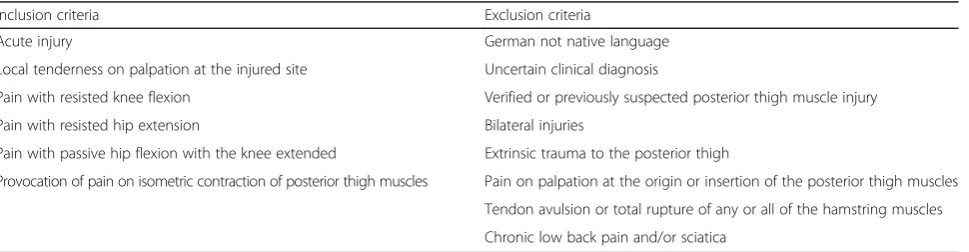
Inclusion and exclusion criteria (Table 3) were mainly adapted from the FASH development study [4]. Partici-pants were selected if they were 18 years or older and were competitively active in football or hockey. Partici-pants of the control groups had to be part of one of the selected teams. The exclusion criteria were pregnancy and spinal symptoms. For the healthy groups, further ex-clusion criteria were pain and functional deficits in the
Table 1FASH (Functional Assessment Scale for Acute Hamstring Injuries) and FASH-G (G = German version) items [4]
Questions English version German version Q1 If you have had an acute hamstrings injury, please rate your
current level of pain and/or, discomfort.
Beschreiben Sie bitte ihre jetzigen Schmerzen/Symptome, die nach der akuten hinteren Oberschenkelverletzung verblieben sind. Q2 Are you currently taking part in your sport, training or, other
physical activity?
Können Sie zur Zeit Sport ausüben oder sich körperlich belasten? Q3 How much pain do you have during walking? Wie viel Schmerz verspüren Sie während des Gehens?
Q4 How much pain do you have during jogging or, slow pace running?
Wie viel Schmerz verspüren Sie während des langsamen Laufens (Jogging)?
Q5 How much pain do you have during accelerating or, sprinting for 30 meters?
Wie viel Schmerz verspüren Sie beim Beschleunigen (Antreten)/oder beim Sprint über 30 m?
Q6 How much pain do you have during static stretching your hamstrings (toe touch in standing)?
Wie viel Schmerz verspüren Sie, wenn Sie ihre hintere
Oberschenkelmuskulatur statisch dehnen (beim Versuch im Stehen mit gestreckten Knien die Fußzehen zu berühren)?
Q7 Do you have pain or, discomfort when performing a full weight-bearing lunge?
Wie viel Schmerz verspüren Sie beim dynamischen Stretching der hinteren Oberschenkelmuskulatur (Anheben des verletzten, gestreckten Beines)?
Q8 Do you have pain or, discomfort when performing a full weight-bearing lunge?
Verspüren Sie Schmerzen/ Symptome bei Ausführen eines tiefen Ausfallschrittes (verletztes Bein nach vorne stellen)?
Q9 Can you perform one Nordic exercise (partner exercise where you attempt to resist a forward-falling motion using your hamstrings throughout the whole range of motion to the ground)?
Können Sie mindestens eine Nordic-Übung durchführen (mit durch den Partner fixierten Unterschenkeln im Knien und mit geradem Rücken langsam nach vorne bis zum Boden beugen)?
Q10 Can you perform 3 one-legged jumps for distance? Können Sie 3 einbeinige Weitsprünge mit dem verletzten Bein durchführen?
hamstrings during physical activity. All these athletes had to be integrated in regular team practice and com-petition at the time the questionnaire was administered.
For the hamstring injury group, patients were re-cruited from two sports physiotherapy centres. Football players who were diagnosed by a physician (history and physical examination) and were treated by their physio-therapists for acute hamstring injury were selected. All these athletes were not able to practice or compete at the time they filled out the questionnaire.
Procedure
The FASH-G (G = German version) questionnaire was administered to all participants (N= 112). Different from the FASH development study [4], the participants filled out the questionnaire without the presence of an investi-gator. For the healthy and at-risk groups, respective team trainers were instructed by the authors to facilitate the application of the questionnaire. Instructed physio-therapists assisted the patients to complete the question-naires. A healthy subgroup (n= 18) was chosen for the reliability analysis and completed the questionnaire twice within 48 to 60 h.
Feasibility and acceptability
To appraise the acceptability and the ease of administra-tion of the FASH-G, we subjectively analysed the filling-out process for problems with the questions.
Statistical analyses
All statistical analyses were carried out using SPSS 22.0 (SPSS GmbH, Munich, Germany). Statistics were per-formed using descriptive data analysis as median and range and as mean with the respective standard devi-ation. The Kolmogorov–Smirnov test was applied to check out for normal distribution. Level of significance was set atp< 0.05.
Validity testing
Known-group validity and group differences were calcu-lated using the Kruskal–Wallis test. Post hoc compari-sons were performed using the Mann–Whitney U test, and Bonferroni corrections were applied for multiple comparisons. The internal consistency for the total FASH score was examined using Cronbach’s α. Intra‐ class correlation coefficient (ICC) values >0.75 are con-sidered as excellent, 0.75 to 0.40 as fair to poor, and <0.40 as poor [10].
Reproducibility testing
Reliability testing was performed by Spearman’s rank correlation test (rho). Test–retest reliability was de-fined by using two-way random‐effect ICC (type 2.1), because systematic differences are considered to be part of the measurement error [11]. The standard error of measurement (SEM; SEM = SD ×√(1−test–retest re-liability coefficient)) and the minimal detectable change (MDC95; MDC = 1.96 ×√2 × SEM) were additionally calculated [11–13].
Power analysis
The sample size required for the study was based on the ICC and the maximum width of the 95 % confidence in-tervals obtained from the development study of the ori-ginal FASH questionnaire [14]. The formula used to calculate the sample size [15] was n= 16p(1−p)/w2, wherepis the expected ICC (selected ≥0.8) andwis the maximum width (0.40) of the 95 % confidence interval. The minimum total sample size per group was calcu-lated to be 16. Despite that, the minimal sample size
Table 2Descriptive characteristics of the participants (median and range)
Groups Age (years) Height (cm) Weight (kg) Healthy (n= 77) 20 (18–44) 182 (162–196)† 74 (55–98) At risk (n= 19) 23 (19–27) 180 (166–188) 80 (63–96) Hamstring injuries (n= 16) 23 (18–31) 178 (164–183)† 75 (57–83) Total (n= 112); 104♂, 8♀
Values are presented as medians and ranges. The characteristics of the participants were gathered by the investigators during the first day of the assessment and before the administration of FASH
†Indicates statistically significant differences between groups,p< 0.05
Table 3Inclusion and exclusion criteria for the hamstring injury group
Inclusion criteria Exclusion criteria
Acute injury German not native language Local tenderness on palpation at the injured site Uncertain clinical diagnosis
Pain with resisted knee flexion Verified or previously suspected posterior thigh muscle injury Pain with resisted hip extension Bilateral injuries
Pain with passive hip flexion with the knee extended Extrinsic trauma to the posterior thigh
Provocation of pain on isometric contraction of posterior thigh muscles Pain on palpation at the origin or insertion of the posterior thigh muscles Tendon avulsion or total rupture of any or all of the hamstring muscles Chronic low back pain and/or sciatica
required ensuring the needs of internal consistency and stability testing is reported to be a minimum number of 100 participants [11, 16]. Due to the lack of availability of patients with hamstring injury during the study enrol-ment, we included more healthy individuals to fulfil the aforementioned criteria.
Results
Feasibility and acceptability
No problems with filling out the questionnaire were de-tected in the patients’ group. Even without additional communication with an investigator, these athletes were able to quickly go through and answer the questions. However, 25 % of the participants in the healthy control groups scored reduced values for questions 6, 7, 8, and 9. Additionally, question 1 produced some trouble for the uninjured athletes, because it is directly related to a hamstring injury.
Validity
Validity testing (Table 4) revealed significant differ-ences between the injured and all other tested groups (allp< 0.001).
The scores for the individual FASH-G items within the group of hamstring-injured football players (Table 5) with one exception demonstrate a uniform result. Ques-tion 3 (“How much pain do you have during walking?”) is scored considerably higher when compared to all other item results.
Reliability
The 18 uninjured footballers scored median 100 (range = 63 to 100) in the initial and median 100 (range = 52 to 100) in the retest. Test–retest analysis revealed excellent temporal stability (p< 0.001; 95 % CI = 0.953–0.993). Spearman’s rho for test–retest reliability was r= 0.841 (p< 0.001). The standard error of measurement was 0.78, and the calculated minimal detectable change was 2.16. In-ternal consistency was excellent with a Cronbachαof 0.983 for the first and 0.917 for the second FASH-G assessment.
Discussion
Based on the results of our study, the FASH-G question-naire was proven to be a valid and reliable tool in evaluat-ing the pain and functional status of German footballers
with or without hamstring injury. The patients had no problems with filling out the questionnaire.
The FASH questionnaire was originally developed as a clinical tool to assess the severity and monitor hamstring injuries during rehabilitation. It is available in Greek, English, and German languages [4]. However, the valid-ation process was performed only for the Greek FASH version, and the population used has overrepresented track and field athletes. Epidemiologic investigations demonstrate that hamstring injuries are not only the most frequent lesion in elite footballers but that its num-bers are increasing in recent years [1, 2]. Therefore, we decided to subject the FASH-G questionnaire to further psychometric testing in a German football population.
Additional research has to be made to prove its worth to quantify the severity of hamstring injuries and for its use as an additional tool to guide rehabilitation. Only the clinical environment can determine return to sport deci-sions [17] even if MRI grading has been shown to corres-pond significantly with “lay-off” time [3]. In the present investigation, we only discriminated between acute ham-string injuries and hamham-string-uninjured athletes. There-fore, in a next step, the question has to be solved if different types [18] of hamstring muscle lesions are mir-rored by different FASH scores. Then, more objective re-turn to play prognosis and decisions could be made by assessing the actual FASH score of an injured player.
Until now, the FASH is the only questionnaire for acute hamstring injuries. It was developed and cross-culturally adapted following a strict process [4]. In the generation process, three items (FASH questions 2, 3, and 4) of the VISA-H (Victorian Institute of Sport Assessment-Hamstring) questionnaire which evaluates proximal hamstring tendinopathy [19] were implemented
Table 4Total FASH scores for the groups in the study
Group Number Total FASH-G score
Median (range) Mean (SD) Healthy 77 100.0 (56–100) 97.5 (6.3) At risk 19 90.0 (81–100) 90.1 (4.7) Hamstring injuries 16 41.5 (1–88) 42.7 (29.9)
Data are presented as median and range
SDstandard deviation
Table 5Individual FASH-G item results for the 16 footballers with hamstring injuries (patients’group)
FASH-G score
FASH-G question Median (range) Mean (SD) Q1 5.0 (0–10)† 5.1 (2.9) Q2 5.0 (0–10)† 4.0 (3.7) Q3 8.0 (1–10) 6.6 (3.4) Q4 3.5 (0–10) 4.7 (4.0) Q5 2.0 (0–8) 2.9 (3.1) Q6 2.5 (0–10) 3.0 (3.3) Q7 3.0 (0–10) 3.6 (3.2) Q8 4.5 (0–10) 4.4 (3.5) Q9 4.0 (0–10) 3.4 (3.4) Q10 4.0 (0–10) 5.1 (4.3)
Numerical 0–10 rating for questions 1 and 3–8. Categorical rating system on an incremental range of values for questions 2, 9, and 10. 0 = worst result, 10 = best result
in the FASH questionnaire. Concurrent validity has been demonstrated comparing these two instruments (r= 0.856;p< 0.01) [4].
While most items of the FASH questionnaire are un-specific and have already been used in different previ-ously developed disease-specific questionnaires for the lower leg (VISA-A, VISA-P, FAAM), question 9 specifies an exercise which directly tests the hamstring muscles. This specific exercise has already demonstrated its worth to prevent hamstring injuries in soccer players [6].
As a result from our questionnaire evaluation process, we propose to have the FASH questionnaire filled out under the supervision of someone who is familiar with it. Specifically, our previously and currently uninjured participants faced difficulties in answering question 1 (“If you have had an acute hamstrings injury…”) and found no respective answering box to tick.
Another difficulty frequently arose with question 9, be-cause the term“Nordic exercise”is not generally known in the German football population.
Individual FASH-G item analysis (Table 5) for the hamstring-injured footballers with the exception of question 3 demonstrated a uniform result. The higher value for question 3 (“How much pain do you have dur-ing walkdur-ing?”) is most probable due to the fact that most hamstring injuries affect walking only for a few days and our questionnaire was administered later.
Compared with the uninjured male footballers of this study, the field hockey players scored significantly lower (p< 0.001, Table 4). We believe that the reason for this is given by the sensitivity of the questionnaire to other clinical presentations. At the time of the FASH assess-ment, the final of the season put the members of the first-league field hockey team under high pressure and overuse injuries not related to the hamstrings most probably caused this effect. This finding is in line with the known-group validity testing results during our ori-ginal FASH validation [4]. Additionally, it underlines the fact that the FASH cannot be used as a diagnostic tool.
The male footballers were collected from different lea-gues, and the highest scores were obtained from the U 20 national team; all these players scored 100 points. At the time of the FASH collection, the U 20 players stayed in a 3-day training camp to prepare for a friendly match. It is expected that these young footballers are only in-vited to play in such an event, when they are free of pain with respect to their hamstrings and have unlimited physical function. Additionally and due to their higher trainings volume, these national team players can be ex-pected to be in a better physical performance when com-pared with the players who are active in lower leagues.
Test–retest reliability was demonstrated during a 2–3-day interval in all 140 participants in the initial FASH validation [4] and in the present investigation.
We recommend further longitudinal research to clarify if the FASH scores in a football population without ham-string injuries differ during the course of a season as a re-sult from the different loadings in training and match.
Limitations and future perspectives
Our FASH-G analyses were based on football players from different German leagues. As a control group, field hockey players were also evaluated. Taking into account, however, that the Greek FASH version was validated in track and field athletes, we strongly feel that the results can be gen-eralised for all sports. Our hamstring-injured group was not homogeneous with respect to the time interval from the injury to the evaluation, and no formal staging was performed. Furthermore, longitudinal data from the in-jured group were not collected. This could enable better planning of rehabilitation and return to sport and has to be done in future FASH analyses. Finally, further research is needed in terms of translation and cross-cultural adap-tation of this condition-specific questionnaire in other lan-guages to promote comparative international studies.
Conclusions
The FASH-G was demonstrated to be an effective in-strument to evaluate German footballers with acute hamstring injuries. We recommend the FASH question-naire to quantify a patient’s clinical severity, longitudin-ally document the effectiveness of a treatment, compare different patient populations, and facilitate comparative research in different countries.
Abbreviations
FASH:Functional Assessment Scale for Acute Hamstring Injuries;
FASH-G: Functional Assessment Scale for Acute Hamstring Injuries—German version; ICC: Intra‐class correlation coefficient; MDC: Minimal detectable change; Q: Question; SD: Standard deviation; SEM: Standard error of measurement
Acknowledgements
The authors are grateful to Ms. Grainne Mc Ginley for her valuable help in the language editing of the paper as a native English speaker.
The authors thank Dr. H. Ackermann (Institut für Biostatistik und Mathematische Modellierung, Zentrum der Gesundheitswissenschaften, Klinikum und Fachbereich Medizin der Goethe-Universität Frankfurt am Main, Germany) for his statistical support.
The article-processing charge was funded by the German Research Foundation (DFG) and the Albert Ludwigs University Freiburg in the funding programme Open Access Publishing.
The authors are grateful to Bernd Herbeck and his SPORTOMED team for assisting with the selection of patients for the study.
Funding
No funding was received to support this study.
Availability of data and materials
The datasets during and/or analysed during the current study are available from the corresponding author on reasonable request.
Authors’contributions
Competing interests
The authors declare that they have no competing interests.
Ethics approval and consent to participate
The chairman of the local ethics committee considered the study to be not relevant for formal approval, because only anonymised data were evaluated. The name of the ethics committee is Landesärztekammer Hessen, Ethik-Kommission, Im Vogelsgesang 3, 60488 Frankfurt am Main, Germany. Verbal informed consent was obtained from the participants.
Author details
1Institute for Sport and Sport Sciences, Albert-Ludwigs-Universität Freiburg i.
Brsg, Schwarzwaldstraße 175, 79117 Freiburg, Germany.2European
SportsCare Network (ESN), Zentrum für Sportorthopädie, Borsigstrasse 2, 65205 Wiesbaden-Nordenstadt, Germany.3European SportsCare, Harley Street 68, London W1G 7HE, UK.4Aspetar, Orthopaedic and Sports Medicine
Hospital, Sport City Street, P.O. Box 29222, Doha, Qatar.5Institute for
Postgraduate Studies in Manual Therapy, 111528 Athens, Greece.
6
Thessaloniki Sports and Exercise Medicine Clinic, Asklipiou 17, Thessaloniki 54639, Greece.7National Track and Field Centre, Sports Medicine Clinic of
S.E.G.A.S.,Kautatzoglion Stadion, Agiou Dimitriou 100, 54636 Thessaloniki, Greece.8Sports Clinic, Rheumatology Department, Barts Health NHS Trust,
Bancroft Road, London E1 4DG, UK.9Centre for Sports and Exercise Medicine, Queen Mary University of London, Bancroft Road, London E1 4DG, UK.
Received: 12 July 2016 Accepted: 25 September 2016
References
1. Ekstrand J, Hagglund M, Walden M. Injury incidence and injury patterns in professional football: the UEFA injury study. Br J Sports Med. 2011;45:553–8. 2. Ekstrand J, Hagglund M, Walden M. Epidemiology of muscle injuries in
professional football (soccer). Am J Sports Med. 2011;39:1226–32. 3. Hallen A, Ekstrand J. Return to play following muscle injuries in professional
footballers. J Sports Sci. 2014;32:1229–36.
4. Malliaropoulos N, Korakakis V, Christodoulou D, et al. Development and validation of a questionnaire (FASH—Functional Assessment Scale for Acute Hamstring Injuries): to measure the severity and impact of symptoms on function and sports ability in patients with acute hamstring injuries. Br J Sports Med. 2014;48:1607–12.
5. Engebretsen AH, Myklebust G, Holme I, et al. Intrinsic risk factors for hamstring injuries among male soccer players: a prospective cohort study. Am J Sports Med. 2010;38:1147–53.
6. van der Horst N, Smits DW, Petersen J, et al. The preventive effect of the Nordic hamstring exercise on hamstring injuries in amateur soccer players: a randomized controlled trial. Am J Sports Med. 2015;43:1316–23.
7. Goode AP, Reiman MP, Harris L, et al. Eccentric training for prevention of hamstring injuries may depend on intervention compliance: a systematic review and meta-analysis. Br J Sports Med. 2015;49:349–56.
8. Goldman EF, Jones DE. Interventions for preventing hamstring injuries: a systematic review. Physiotherapy. 2011;97:91–9.
9. Beaton DE, Bombardier C, Guillemin F, Ferraz MB. Guidelines for the process of cross-cultural adaptation of self-report measures. Spine. 2000;25:3186–91. 10. Fleiss JL. The design and analysis of clinical experiments. New York: Wiley; 1986. 11. Terwee CB, Bot SD, de Boer MR, et al. Quality criteria were proposed for
measurement properties of health status questionnaires. J Clin Epidemiol. 2007;60:34–42.
12. Beckerman H, Roebroeck ME, Lankhorst GJ, et al. Smallest real difference, a link between reproducibility and responsiveness. Qual Life Res. 2001;10:571–8. 13. Bortz J. Statistik für Sozialwissenschaftler. 4th ed. Berlin: Springer Verlag; 1999. 14. Malliaropoulos N, Korakakis V, Christodoulou D, et al. Development of a
questionnaire (FASH) to measure the severity and impact of symptoms in patients with acute hamstring injuries. Physiotherapy. 2015;101:e785–e6. 15. Stratford PW, Spadoni G. Sample size estimation for the comparison of
competing measures’reliability coefficients. Physiotherapy Canada 2003;55:225–9. 16. DeVellis R. Scale development. Theory and applications. London: Sage; 2003. 17. Ueblacker P, Mueller-Wohlfahrt HW, Ekstrand J. Epidemiological and clinical
outcome comparison of indirect (‘strain’) versus direct (‘contusion’) anterior and posterior thigh muscle injuries in male elite football players: UEFA Elite League study of 2287 thigh injuries (2001–2013). Br J Sports Med. 2015;49: 1461–5.
18. Mueller-Wohlfahrt HW, Haensel L, Mithoefer K, et al. Terminology and classification of muscle injuries in sport: the Munich consensus statement. Br J Sports Med. 2013;47:342–50.
19. Cacchio A, De PF, Maffulli N. Development and validation of a new visa questionnaire (VISA-H) for patients with proximal hamstring tendinopathy. Br J Sports Med. 2014;48:448–52.
• We accept pre-submission inquiries
• Our selector tool helps you to find the most relevant journal
• We provide round the clock customer support
• Convenient online submission
• Thorough peer review
• Inclusion in PubMed and all major indexing services
• Maximum visibility for your research
Submit your manuscript at www.biomedcentral.com/submit
![Table 1 FASH (Functional Assessment Scale for Acute Hamstring Injuries) and FASH-G (G = German version) items [4]](https://thumb-us.123doks.com/thumbv2/123dok_us/818987.1579390/2.595.58.537.459.729/table-functional-assessment-scale-hamstring-injuries-german-version.webp)