ISSN No: 2456
International
Research
e-Learning as a Tool for
Mrs. Preeti Nandwal
Assistant Professor
Govindram Seksariya institute of Management and research, Indore
ABSTRACT
Information technologies and the arrival of e
applications in numerous organizations have made an elementary difference to the way organizations convey training and development comfortable, activities and knowledge to their employees. Such organizations have developed come up to e
and proficiency development that overcome the logistical effort of conventional training by making innovative use of e-learning. This research paper attempt to find out that E-learning as a tool for corporate training in service sector. The employees from the service sector were conveniently selected in order to evaluate E-Learning as a tool for corporate training. The primary data source is the questionnaire that was distributed to the employees of service sector. Data were then analyzed using SPSS. Findings conformed that age, qualification, designation of employees were taken to influence on the basis of employees perception on E-learning as a tool for corporate training in service sector.
Keywords— E-learning as a tool for corporate
training, service sector
INTRODUCTION
In this present state of affairs technology is so build up that you can learn anything anywhere, anytime all the way through E-learning. Several companies have monetary problem, they do not attempt a huge no of trainers so they use e-learning which is out
ordinary and save capital, trainee are also enjoying their task with the use of E-learning. In India
ISSN No: 2456 - 6470 | www.ijtsrd.com | Volume
International Journal of Trend in Scientific
Research and Development (IJTSRD)
International Open Access Journal
ool for Corporate Training in Service S
Govindram Seksariya institute of Management and
Dr. Anukool M. Hyde
Associate Professor
Prestige Institute of Management and research, Indore
Information technologies and the arrival of e-learning applications in numerous organizations have made an elementary difference to the way organizations convey training and development comfortable, activities and knowledge to their employees. Such ations have developed come up to e-learning and proficiency development that overcome the logistical effort of conventional training by making learning. This research paper learning as a tool for ining in service sector. The employees from the service sector were conveniently selected in Learning as a tool for corporate training. The primary data source is the questionnaire that was distributed to the employees of service . Data were then analyzed using SPSS. Findings conformed that age, qualification, designation of employees were taken to influence on the basis of learning as a tool for
as a tool for corporate
In this present state of affairs technology is so build up that you can learn anything anywhere, anytime all learning. Several companies have monetary problem, they do not attempt a huge no of learning which is out of the ordinary and save capital, trainee are also enjoying learning. In India
companies like NIIT Limited, Gurukul Online Learning Solutions, Tata interactive system, Magic Software, 24X7 Learning, Edu comp providing corporate training and education through e
In E-learning you can learn through internet, Intranet, CD-ROM, DVD etc. E-Learning is making use of technology to facilitate people to learn anytime and anywhere. E-Learning consists of education, training, and the delivery of just-in
supervision from experts. E-learning means Electronic learning According to Derek Stockley (2006) “ delivery of a learning, training or education program by electronic means. E-learning involves the use computer or electronic device (e.g. a mobile phone) in some way to provide training, educational or learning material”. “The use of electronic media and information and communication technologies in education, teaching and training is called E
“Various institutes have adopted e
training method due to the effectiveness of e
The success of e-learning includes both better service and low cost (Bates, 2010)”. E
trendy in the workplace due to its
many workplaces raise employees to maintain their knowledge as well as skills for their job and e learning can provide employees with flexible entrance to training materials “(Jia, Wang, Ran, Yang, Liao, & Chiu, 2011). In addition, e
organizations countless benefits, such as worldwide updates, instant delivery of training materials in various formats, consistent quality, and cost effectiveness (Biech, 2008)”. “Second, enlightening
www.ijtsrd.com | Volume - 1 | Issue – 6
Scientific
(IJTSRD)
International Open Access Journal
Corporate Training in Service Sector
Dr. Anukool M. Hyde
Associate Professor
Prestige Institute of Management and research, Indore
companies like NIIT Limited, Gurukul Online Learning Solutions, Tata interactive system, Magic Software, 24X7 Learning, Edu comp providing rate training and education through e-learning. learning you can learn through internet, Intranet,
Learning is making use of technology to facilitate people to learn anytime and Learning consists of education, training, in-time information and learning means Electronic learning According to Derek Stockley (2006) “The delivery of a learning, training or education program learning involves the use of a computer or electronic device (e.g. a mobile phone) in some way to provide training, educational or learning ”. “The use of electronic media and information and communication technologies in education, teaching and training is called E-learning”.
technologies, including e-learning allow companies to offer modified learning in order to adapt to different learner needs and equal opportunities (Bates, 2010; Biech, 2008). Organizations can offer learning chances and maintain to any employees in the workplace, in spite of the position of the workplace, gender, or cultural differences (Biech, 2008)”.
LITRATURE REVIEW
“Chen (2008) defined E-learning as combining
technology with learning, transport with
telecommunication and information technologies, and a form of training delivered on a computer supporting learning and organizational goals. The intent of corporate E-learning is to recover job performance and satisfaction, and to generate a fruitful and
competitive workforce. Corporate leaders
characteristically go aboard on E-learning for different grounds, such as challenging to create a
competitive advantage and necessitate for
globalization. Other company employee’s are used E-learning to meet the demand for E-learning and reduce financial plan constraints. By getting hold of a competitive advantage, an organization’s executives can bring into line their employee needs with considered organizational goals. With globalization, corporate leaders need extremely developed communication tools such as the Internet and other E-learning tools to reach stakeholders anywhere in the world”.
“Bonk (2011) distinguished the appearance and augmented use of online and blended learning, collaborative technology, digital books, open source software, and wireless and mobile learning. These learning development in technology maintain to transform E-learning, since several people who beforehand did not have contact to online resources will be competent to access learning materials with a make sense of the website from their mobile phones and computers. E-Learning will be a powerful force in business for educating and training employees in the workforce”.
“Moller, Foshay, and Huett (2008) assured that E-learning is both productive and unproductive, mostly educational institutions adage the expansion of distance learning and use E-Learning to endorse educational and training programs. However, the authors noted that people are finding it complex to balance models of quality and growth of E-Learning. E-Learning is perceived as a double-edged weapon.
Several corporation assistance from E-learning as a cost restraint and training tools. They use E-Learning to develop and trained their employees, reduce corporate training costs due to savings on training and travel charge, and as a tool to drive sales and profitability. Some challenges with E-Learning implementation include employees’ resistance, high initial investment cost, and inconsistent E-learning evaluation methods. Organization should work closely with employees and get their buy in so that they can conversion and implement programs effortlessly. The success drivers of E-learning depend on the quality of the learning experience and the level of technological advancement. It is recommended that an employees’ level of satisfaction and dedication vary with E-learning execution, but other factors such as physical environment, internal support, job level, training level, organizational support, and learning flow may also have an impact. Top management must be knowledgeable about these factors and ensure that they are in attendance the organizational culture for E-learning implementation to be accomplishment”.
“Yap, Holmes, Hannan, and Cukier (2010) examine the relationship between training and the effectiveness of organizational commitment and satisfaction and they exposed that employees who perceived training to be effective were further committed to their organizations than those who saw training as unproductive. The contributing factors of employees’ satisfaction and commitment comprise physical environment, internal support, job level, training level, organizational support, and learning flow. Therefore, management should be privy to these factors and guaranteed that they are considered cautiously so that the full profit of E-learning and e-Training are realized. Being that E-learning is an significant tool for educational institutions and other industries, it is the key to understand how employee productivity is impacted by E-learning”.
Objectives:
1. To Study the Employees Perception of
E-learning as a tool for corporate training in service sector with respect to Designation level.
2. To study the Employees Perception of
E-learning as a tool for corporate training in service sector with respect to Qualification.
3. To study the Employees Perception of
Hypothesis:
H01: There is no significant difference on employee’s
perception of E-learning as a tool for corporate training in service sector with respect to designation level.
H02: There is no significant difference on employee’s
perception of E-learning as a tool for corporate training in service sector with respect to qualification.
H03: There is no significant difference on employee’s
perception of E-learning as a tool for corporate training in service sector with respect to age.
Research Methodology
Research design: The present study is descriptive research based on Survey Method.
Research Plan: Demographic analysis of (Designation, qualification, age) service sector.
Purpose of the Research: Research was carried out to gather the opinion of the people to evaluate and investigate the employee’s perception on E-learning as a tool for corporate training in service sector.
Data Type Used: For the study primary data was used.
Data Collection Method: Data was collected for this research study it was used already developed scale was taken - “Measuring e-learning systems success in an organizational context: Scale development and validation” Developed by Yi-Shun Wang, Hsiu-Yuan Wang, and Daniel Y. (2007), Taiwan and the normality .242 and Reliability .09668 which is greater than significance value .05 that were used for the purpose of Data Collection.
Sampling Plan
Population: The respondents are Employees in service sector.
Size of Sample: The sample size was of 272 for the study.
Tools Used for Data Analysis: T-Test and One way ANOVA.
Normality Test
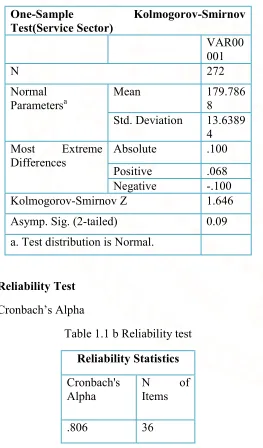
As the following experiments required hypothesis of normal distribution of the same as the pre-requisite for the analysis, it become necessary to test the truthfulness of the hypothesis of normal distribution of collected data. “Normality test statistics by ‘kolmogorov- Smirnov test’ measure that whether a particular distribution differs significantly from normal distribution. The responses were tested for veracity of the assumption of normal distribution by K-S test for the total score on E-learning as a tool for corporate training in service sector. The normality test rejects the hypothesis of normality when the p-value is less than or equal to 0.05. Failing the normality test allows to state with 95% confidence the data does not the normal distribution.
Table 1.1a: Normality of Service sector
One-Sample Kolmogorov-Smirnov
Test(Service Sector)
VAR00 001
N 272
Normal Parametersa
Mean 179.786
8
Std. Deviation 13.6389
4
Most Extreme
Differences
Absolute .100
Positive .068
Negative -.100
Kolmogorov-Smirnov Z 1.646
Asymp. Sig. (2-tailed) 0.09
a. Test distribution is Normal.
Reliability Test
Cronbach’s Alpha
Table 1.1 b Reliability test
Reliability Statistics
Cronbach's Alpha
N of
Items
Result:
Cronbach’s Alpha is a measure of internal consistency, that is, how closely related a set of items are as a group. Cronbach’s alpha is not a statistical test – it is a coefficient of reliability (or consistency). It is considered a measure of scale reliability. The reliability test has been made for testing the reliability of employees’ perceptions of Service sector, with the help of coefficient (Cronbach’s Alpha), the reliability of data for Service sector .806(see Table 1.1 b) hence, the scale used here is said to be reliable and can be used for analysis (Note that a reliability coefficient of .70 or higher is considered “acceptable” in most social science research situations).
Result and Discussion:
The Asymp.sig value (2-tailed) for K-S test was found to be Service sector was found to be 0.09, which is greater than 0.05 (see Table1.1a). This indicated that the distribution of final points does not differ
significantly from normal distribution. This
contingent that the assumption of normality with respect to the sample chosen was valid.
“Ozturan and Kutlu (2010) examined employee satisfaction with corporate E-learning programs using regression analysis to determine the influence of gender, age, work experience, education level, job level, and E-learning interactivity level of the employees”.
1. Testing Hypothesis with respect to Designation level
H01: There is no significant difference in Employees
Perception of E-learning as a tool for corporate training in Service sector with respect to Designation level.
E-learning as tool for corporate training in Service sector with respect to Designation level, the value of significant was found to be p=.401 (Table 1.2 a) which is higher than the significant value of .05 which means that the null hypothesis is accepted (H01) There
is no significant difference in Employees Perception of E-learning as a tool for corporate training in Service sector. Which is considered that the
Perception of Employees regarding E-learning as a tool for corporate training medium with respect of designation level E-learning system was successfully perform in better way in the organization.
(Table1.2 a) One way ANOVA with respect to designation level in service sector
ANOVA
VAR0000 1
Sum of Squares
Df Mean
Square
F Sig.
Between Groups
1356.78 2
7 193.826 1.043 .401
Within Groups
49054.8 50
264 185.814
Total 50411.6
32
271
Result and Discussion
The result shows that employees working on the different designations in service sector had different levels of perceptions and outlook towards e-learning system. Employees working at managerial level had raised level of perceptions and outlook than employees working at executive level. The problem cause is that the supervisory level employees or managers are those who recognize the policies and objectives of the organization, and participation in the framing of rules and regulation and allocation of responsibilities. Thus, there is a greater possibility of them having higher level of perceptions and expectations towards E-learning as a tool for corporate training medium as compare to the executive level of employees.
2. Testing Hypothesis with respect to Qualification
H02: There is no significant difference in Employees
Perception of E-learning as a tool for corporate training in service sector with respect to Qualification.
A one way ANOVA was conducted to compare the Employees Perception of E-learning as a tool for corporate training in manufacturing sector with respect to Qualification.
1)UG (Under Graduate), 2)PG (post graduate), 3)Ph. D (Doctor of philosophy)
hypothesis is accepted i.e. H02: There is no significant
difference in Employees Perception of E-learning as a tool for corporate training in Service sector with respect to Qualification. Which means that when the qualification level is increasing more than the knowledge and capability of employers and employee are created a best results.
Table 1.3 a) One way ANOVA with respect to Qualification in service sector
ANOVA
VAR0000 1
Sum of Squares
Df Mean
Square
F Sig.
Between Groups
386.503 2 193.252 .259 .772
Within Groups
201262. 493
270 745.417
Total 201648.
996
272
Results:
Result shows that employees in different qualification background having different perceptions and outlooks towards E-learning system the employees who having better qualifications and they are able to understand the concepts of e-learning more comfortably, and to accept new challenges and opportunities for gaining their skills and knowledge. E-learning was educationally effective training and learning tool as it offered business value, qualification and cost effectiveness over other approaches. The employees of any sector are the early adopter of any new process and technology which helps them in achieving individual growth and learning.
Some studies says that “Sloman (2002) indicates that while the practice of using computer and communication technologies for organization training has expanded rapidly, research examining the Employees Perception of e-learning has lagged behind. For e-learning applications to be used efficiently in corporate education there is a need to measure the success and Employees Perception of the e-learning system systematically”.
3. Testing Hypothesis with respect to Age
H03: There is no significant difference in Employees
Perception of E-learning as a tool for corporate
training in Service sector with respect to Age. A one way ANOVA was conducted to compare the Employees Perception of E-learning as a tool for corporate training in Service sector with respect to Age in form of A) upto 25 yrs, B) 25-35 yrs, C) 35-45 yrs, D) 45-and above are Age groups. The Employees Perception of E-learning as a tool for corporate training in service sector with respect to Age were analyzed, the value of significant was found to be p=.263 (Table 1.4 a) which is greater than significant value .05 which means that the null hypothesis is accepted.
Table 1.4 a) One way ANOVA with respect to age in service sector
ANOVA
VAR000 01
Sum of Squares
Df Mean
Square
F Sig.
Between Groups
742.678 3 247.55
9
1.33 6
.263
Within Groups
49668.9 55
268 185.33
2
Total 50411.6
32
271
Results:
The results suggest that the employees of old age group are more inclined towards E-learning system of the company. Specifically our results suggest that when employees are young they have to understand the importance of today’s technological changes. And hence it should be noted that when the maturity level of employees are increases he has more concern towards latest technological practices of the company.
These learners were characteristically independent learners who were self-directed in establishing their learning objectives. They were more likely than other learners to be involved in E-learning.
Conclusion
concluded that “E-Learning is an effective tool for maintaining employees with current knowledge, skills, and their capability. Organizations that learn to effectively offer e-Learning can support a variety of corporate trainings at a reduced cost and at the employee's convenience”.
References:
1) Bates, T. (2010). The strategic management of
e-learning in universities and colleges.
2) Biech, E. (2008). ASTD handbook for workplace
learning professionals.
3) Bonk, C.J. (2002). “Online training in an online world”, Bloomington, IN: CourseShare.com.
4) Chen, E.T. (2008). “Successful E-Learning in
Corporations”, Communications of the IIMA, 8(2), 45-54.
5)
http://derekstockley.com.au/elearning-definition.html, 23. 04. 2006
http://www.editlib.org/?paper_id=35977&fuseacti on=Reader.ViewPresentation&zoomed=true
6) Jia, H., Wang, M., Ran, W., Yang, S. J. H., Liao,
J., & Chiu, D. K. W. (2011). Design of a
performance-oriented workplace e-learning
system using ontology. Expert Systems with Applications, 38 (4), 3374 – 3382.
7) Moller, L., Foshay, W. R., & Huett, J. (2008)
“The Evolution of Distance Education:
Implications for Instructional Design on the Potential of the Web. Techtrends: Linking Research & Practice To Improve Learning”, 52(4), 66-70. doi:10.1007/s11528-008-0179-0
8) Ozturan, M., & Kutlu, B. (2010). Employee satisfaction of corporate e-training programs. Procedia - Social and Behavioral Sciences, 2(2), 5561-5565. doi:10.1016/j.sbspro.2010.03.907
9) Sloman, M. (2002) E-Learning Revolution: from Propositions to Actions, CIPD.