© 2015 IJSRSET | Volume 1 | Issue 2 | Print ISSN : 2395-1990 | Online ISSN : 2394-4099 Themed Section: Engineering and Technology
Application of Generalized Reduced Gradient Method for Optimization of
Plunge Centerless Grinding Process
Do Duc Trung
1*, Ngo Cuong
1, Phan Bui Khoi
2, Tran Quoc Hung
31
College of Economics and Technology, Thinh Dan ward, Thai Nguyen city, Viet Nam 2
School of Mechanical Engineering, HUS, No. 1, Dai Co Viet, Ha Noi, Viet Nam 3
Ha noi university of Industry, Ha Noi, Viet Nam *
Corresponding author: [email protected]
ABSTRACT
This paper presents the study on optimization of plunge centerless grinding parameters when grinding 20X
-carbon infiltration steel (ГOCT standard - Russia) to achieve minimum of surface roughness value. Using
the result of 29 runs in central composite design matrix with input parameters are center height angle of
the workpiece (
), longitudinal grinding wheel dressing feed-rate (
Ssd), plunge feed-rate (
Sk) and
control wheel velocity (
vdd) to given the second order surface roughness model. Using generalized
reduced gradient method to get optimization values of input parameters to achieve minimum of surface
roughness.
Keywords:
Plunge centerless grinding, optimization, generalized reduced gradient, surface roughness,
20X steel
I.
INTRODUCTION
Centerless grinding is widely used in industry for
precision machining of cylindrical components
because of its high production rate, easy
automation, and high accuracy. To improve the
centerless grinding process, it is necessary to
optimize surface roughness, the most critical quality
constraints for the selection of grinding factors in
process planning.
Researches on the optimization of centerless
grinding process were published by some authors:
Minimizing the surface roughness and roundness
errors of workpiece by selecting the optimization
levels of control wheel speed, feed rate and depth of
cut [1]. Minimizing the roundness error of
workpiece and carrying out the regression analysis
Minimizing the roundness error of workpiece by
selecting the optimization range of the center height
angle [8]. Giving a method of how to select the
optimal
stable
geometrical
configuration
in
centerless grinding [9]. Giving an algorithm for
providing the optimum set-up condition [10].
Optimization of plunge centerless grinding process
to achieve the minimum value of surface roughness
and roundness errors by response surface method
and genetic algorithm [11, 12].
This paper presents the study on the optimization of
plunge centerless grinding process when grinding
the 20X-carbon infiltration steel to achieve the
minimum value of surface roughness by application
of Generalized Reduced Gradient method (GRG).
The input parameters include center height angle of
the workpiece (
), longitudinal dressing feed-rate (
sd
S
), plunge feed-rate (
Sk) and control wheel
velocity (
vdd).
II.
METHODS AND MATERIAL
Experimental System
2.1. Centerless grinding model
Plunge centerless grinding model is illustrated in Figure 1.
Figure 1. Plunge centerless grinding model
Figure 2. Experimental component
2.2. Components
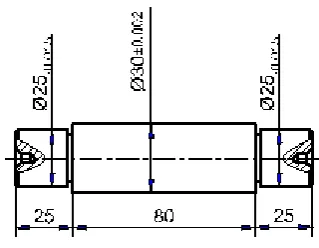
The component material was the 20 X-carbon infiltration steel, common alloys steel that is usually used in mechanical engineering using centerless grinding process (Fig 2). The chemical composition of experimental component is in Table 1, was supported by
specially made workrest blade with a
300.Table 1: Chemical composition of experimental
component
C (%)
Si (%)
Mn (%)
P (%)
S (%)
Cr (%)
Ni (%)
Cu (%) 1,02 0,212 0,51 0,018 0,017 0,78 0,017 0,021
2.3. Experimental machine tool
The grinding experiments were conducted on a M1080B centerless grinder in Pho Yen Mechanical Joint Stock Company – Thai Nguyen – Viet Nam (FOMECO), shown in Fig 3.
Grinding wheel: the Al2O3 grinding wheel of Hai Duong Grinding Wheels Joint Stock Company, Viet Nam, Cn80.TB1.G.V1.500.150.305x35m/s.
Control wheel: the standard rubber bonded control wheel of 273 mm x 150 mm x 127 mmdimensions was employed.
2.4. Measuring equipment
Figure 3.Experimental machine tool
Figure 4. Mitutoyo Surftest
SJ-401
3. EXPERIMENT MATRIX
The experiment matrix was conducted under chatter free conditions to keep the grinding wheel speed (34 m/s), the grinding depth (0,05 mm), the depth of dressing (0,01 mm), the spark-out time (1 s) and the coolant flow constant.
In this work, using the Central Composite Design (CCD) with four input parameters (
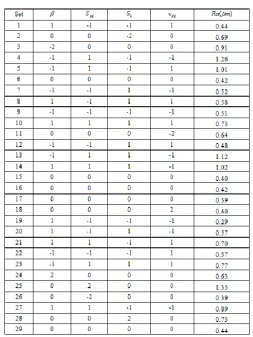
, Ssd , Sk ,vdd ), theirlevels are presented in Table 2. This experimental matrix with 29 sets; these sets include 16 single-replicated orthogonal factorial points, 8 axial points located and 5 centre points, shown in Table 3.
Table 2. Input parameters and theirs levels
The statistical analysis software Minitab 16 was used to determine the regression coefficients. The surface roughness models were developed in the form of non-reduced final equation in terms of coded parameters.
dd k dd sd k sd dd k sd dd k sd dd k sd v S v S S S v S S v S S v S S Ra . 0275 , 0 . 07875 , 0 . 035 , 0 . 01625 , 0 . 065 , 0 . 03875 , 0 026292 , 0 073792 , 0 113792 , 0 088792 , 0 0575 , 0 0083333 , 0 22750 , 0 065833 , 0 4140 , 0 2 2 2 2 (1)
Table 3. Experimental matrix - CCD
III.
RESULTS AND DISCUSSION
4. Generalized Reduced Gradient (GRG)
4.1. Basic ideas of GRG
The nonlinear program to be solved is assumed to have the form
minimize f(X) (2)
subject to gi(X)0, i = 1, …, m (3)
i i
i X u
l , i = 1, …, n (4)
Where
X
is n-vector and ui, li are given lower andupper bounds ui li . We assume mn since, in
most cases,
m
n
implies and infeasible problem or one with a unique solution. The form (2)(4) iscompletely general, since inequality constraints may always be transformed to equalities, as in (3), by the
The fundamental idea of GRG is to use the equalities )
3
( to express m of the variables, called basic variables, in terms of the remaining nmnonbasic variables. This is also the way the Simplex Method of
linear programming operates. Let X be a feasible point and let
y
be the vector of basic variables and xthe nonbasicat X , so that
X
is partitioned as(5)
And the equalities(3) can be written
0 ) , (y x
g (6)
Where
) ,..., (g1 gm
g (7)
Assume that the objective f and constraint functions
i
g are differentiable. Then, by the implicit function
theorem, in order that the equations (6) have a
solution y(x) for all x in some neighborhood of x, it
is sufficient that the mxn basic matrix
y
g
,
evaluated at X , be nonsingular.
Assume that it is. Then the objective may be expressed as a function of x only:
) ), ( ( )
(x f y x x
F (8)
And the nonlinear program is transformed, at least for
x close to x, to a reduced problem with only upper and lower bounds:
minimize F(x) (9)
Subject to
NB
NB x u
l (10)
Where lNB and uNB are the vectors of bounds for x.
GRG solves the original problem (2)(4) by solving
a sequence of problems of the form (9)(10). Such
problems may be solved by simple modifications of unconstrained minimization algorithms.
4.3. Application of GRG
To get the optimization of
, Ssd, Sk, vdd value forminimum the value of surface roughness (Ra) ,
objective function
Ra
can be written:
2
,
,
,
2
63
,
0
0
min
)
,
,
,
(
,
dd k sd
dd k sd
v
S
S
Ra
v
S
S
f
Ra
(11)
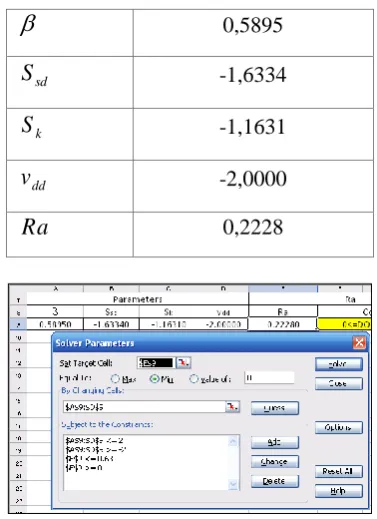
Application of GRG, using Solver Excel Program, result shows in Table 4 and Figure 5.
Table 4. GRG optimization (coded units)
0,5895sd
S -1,6334
k
S -1,1631
dd
v -2,0000
Ra
0,2228Figure
5. Screen of GRG in Solve Excel ProgramIV.
CONCLUSION
Success in application of GRG method for optimization of plunge centerless grinding. Thus, for 20X – carbon infiltration steel, to achieve the minimum value of surface roughness, the optimal value of parameters is given.
V.
ACKNOWLEDGEMENTS
VI.
REFERENCES
[1] Senthil Kumar N, Dhinakarraj C K, Deepanraj and Sankaranarayyanan G (2012) Multi Objective Optimization and Empirical Modeling of centerless Grinding Parameters. Emerging Trends in Science, Engineering and Technology Lecture Notes in Mechanical Engineering 2012, pp 285-295. [2] Dhavlikar MN, Kulkarni MS, Mariappan V (2003) Combined
Taguchi and dual response method for optimization of a centerless grinding operation. Int J Mater Process Technol 132:90–94.\
[3] Garitaonandia I, Fernandes MH, Albizuri J, Hernandez JM, Barrenetxe D (2010) A new perspective on the stability study of centerless grinding process. Int J Mach Tools Manuf 50:165– 173.
[4] Krajnik P, Kopac J, Sluga A (2005) Design of grinding factors based on response surface methodology. Int J Mater Process Technol 162–163:629–636.
[5] Zhou SS, Gartner JR, Howes TD (1996) On the relationship between setup parameters and lobing behavior in centerless grinding. Ann CIRP 45(1):341–346.
[6] Xu W, Wu Y, Sato T, Lin W (2010) Effects of process parameters on workpiece roundness in tangential-feed centerless grinding using a surface grinder. Int J Mater Process Technol 210:759–766.
[7] Khan ZA, Siddiquee AN and Kamaruddin S (2012) Optimization of In-feed Centerless Cylindrica; Process Parameters Using Grey Relational Analysis. Pertanika J Sci & Technol 20(2): 257 - 268
[8] Subramanya Udupa NG, Shunmagam MS and Radhakrishman V (1987) Optimizing workpiece position in centerless grinding by roundness profile analysis. Butter & Co (Publishers) Ltd: 23-30
[9] Chien AY (1984) The Selection of Optimal Stable Geometrical Configuration in Centerless Grinding. Int J. Mach Tool. Des. Res Vol 24 No 2: 87-93
[10]Hashimoto F, Kanai A and Miyshita M (2004) Optimisation of Set-Up Conditions of the Centerless Grinding Process. Ann. CIRP 53 (1) 271-274.
[11]Phan Bui Khoi,Do Duc Trung, Ngo Cuong (2014), A study on multi – objective optimization of plunge centerless grinding process, International journal of mechanical engineering anf technology, Volume 5, issue 11, pp. 140 – 152.