Performance Improvement of Low Power
Scalable Turbo Decoder using NOC Architecture
M.Loga lakshmi M. Nithya
UG Scholar UG Scholar
Department of Electronics Communication Engineering Department of Electronics Communication Engineering CCET, OddanchatramTamilnadu – 624619 CCET, Oddanchatram Tamilnadu – 624619
J. Nivetha R. Shruthi Eshwari
UG Scholar Assistant Professor
Department of Electronics Communication Engineering Department of Electronics Communication Engineering CCET, OddanchatramTamilnadu – 624619 CCET, OddanchatramTamilnadu – 624619
Abstract
this work proposes a general framework for the design and simulation of network on chip based turbo decoder architectures. Network on chip or network on a chip (NoC or NOC)is a communication subsystem on an integrated circuit typically between IP cores in a system on a chip(SOC).this explains a network on chip(NoC)structure for turbo decoders. Based on this analysis finite state machine approach are proposed for reducing the complexity of the NoC. Effective architecture level changes of MASIP is used for performance improvement. Here we are analysing the performance of area, power, speed and comparing the results of existing one.
Keywords: Turbo Decoders, Noc, VLSI, Finite State Machine Approach
________________________________________________________________________________________________________
I. INTRODUCTION
In olden days,The wireless communication system connected with the problem of delivering reliable information which gives high throughput.This problems has to be solved by improving the technology while turbo codes able to correct errors even at low signal frequency.In smartphones and tablet PCs which are throughput intensive,it increases the data rate upto hundreads of kilobits per second to hundreads of mega bits per second.Moreover,several works are addressed for turbo decoder architecture to achieve high throughput.there are many works focused on avoiding and reducing the architecture with parallel architecture.This paper presents a multi-core architecture is based on application specific instruction set processor(ASIP) and it reduces the throughput.This turbo decodes are widely used in the modern wireless system for their near-Shannon performance. The various standards in turbo codes they are code ASIP-balancing based.This would lead to an imbalance of the CALS in RTs and FTs, which could invalidate the CALS-based flow control scheme. In addition, there may be some ASIPs that send too many RTs to the NoC, thus intensifying congestion.lengh, code generator, interleaving pattern. The main issue for these ASIP and NoC architecture is more complex.so, we concentrate on NoC architecture which supports high throughput with low efficiency. A general turbo decoder architecture that covers all the standards is more attractive because of the complexity and upgradability. A throughput and area are the dominant things driving the optimization of turbo decoders. Some recent works deals with the simulation of application specific instruction-set processor (ASIP) architecture for turbo decoders. The effective solution is to achieve both high throughput and flexibility is multi-ASIP.This both interconnects and performs the high throughput with flexible multi-ASIP architecture. Previous research has been done on ASIP [1], [2] and NoC structures for turbo decoding. The main drawback of this ASIP and NoC architecture is more complex. In order to overcome the complexity we are performing NoC on turbo decoders by finite state machine approach. It gives the new effective architecture and effective higher throughput with low NoC area.
II. SYSTEM REQUIREMENT ANALYSIS
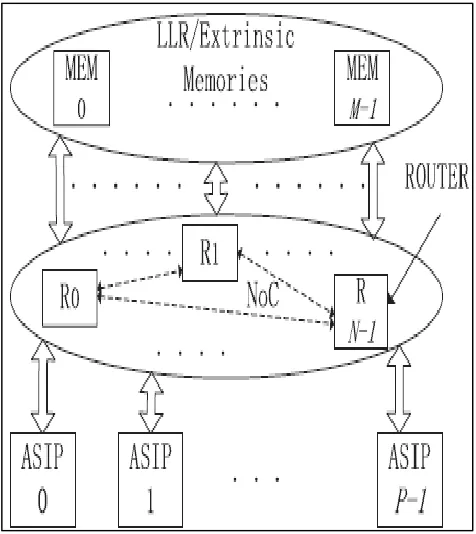
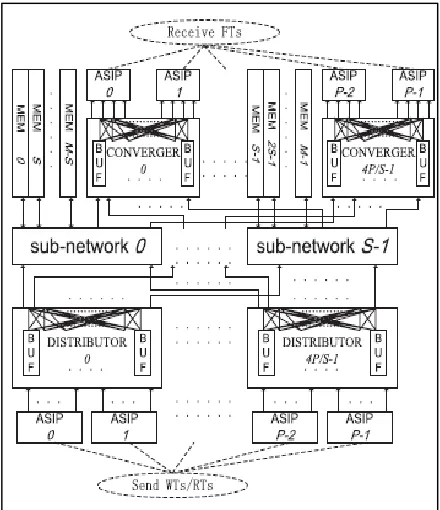
destination memory bank address. A memory bank receives an RT from the sub network and sends a FT back to the subnetwork. This FT is going along routers back to the router corresponding to ASIP through a CONVERGER which has the reverse effect of the DISTRIBUTOR module. The trellis diagram is used for comparing the performances of NoC architecture. In the existing NoC, they adopt the deterministic routing policy for its shorter critical path and complexity. This kind of architecture is more complex and it leads to poor performance.
Multi-Asip for Turbo Decoding
Fig. 1: Example of multi ASIP for turbo decoding
III. EXISTING METHOD
Noc Architecture
Fig. 2: Existing NoC architecture
Flow Control
The flow control is used to solve the deadlock problem. Here they are using two kinds of schemes: 1) CALS based and 2) When the difference in halted cycles exceeds a given limit called Nhalt_limit, the ASIPs having the smallest Nhalt will be blocked. The CALS-based scheme is to constrain the number of transactionsin the NoC for each ASIP. When the difference in halted cycles exceeds a given limit called Nhalt_limit, the ASIPs having the smallest Nhalt will be blocked.
Fig. 3: BER performance
Fig. 4: Router architecture. (b) Pipeline registers module
calculation sequence, we successfully achieved a much higher throughput with a lower NoCtotal area. Comparisons with previous designs for area, throughput, and power efficiency have been given. Our design technique scan also be used in other applications, such as Low Density Parity Check decoding. The sub network scheme can be employed wherever there is a uniform addressing mode, and the CALS method is appropriate for trellis-based decoding.
IV. PROPOSED METHOD
New Efficient Architecture
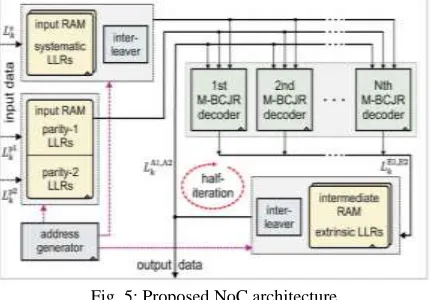
The multi application specific instruction processor is a promising area for turbo decoders. An effective architecture level change of MASIP is used for performance improvement. Performance analysis and comparison. In modern wireless systems, turbo codes are widely used for their near-Shannon performance. In various standards, their turbo codes vary mainly in three aspects: 1.code length, 2.code generator and 3.interleaving patterns. The main issue for these ASIP and NoC architectures is the complexity overhead and thus low efficiency compared with dedicated decoders. So, we focus on NoC architecture which supports high throughput with low efficiency. Computational complexity is less. Performance improved in FPGA (area, power, speed).Advantage of these proposed method is new effective architecture.
Fig. 5: Proposed NoC architecture
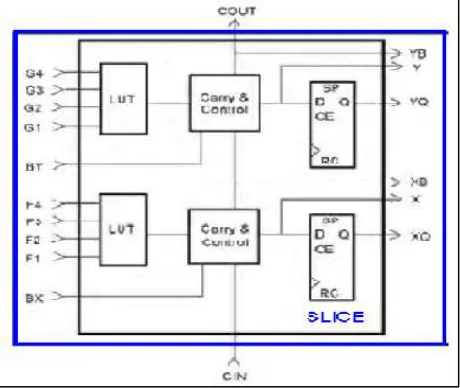
generic logic. The latch can be used pipelining reasons, registers for holding logic values or any other situation where clocking is required. The additional combinational logic is usually ‘ carry logic ’ used to speed up carry-based computations (e.g. additions). In addition to operating as a function generator, each LUT can provide RAM functionality. Furthermore, two or more logic blocks can be combined to implement more complex functions.
Fig. 6: Example of basic logic block (Xilinx Vertex FPGA)
V. IMPLEMENTATION RESULT
In proposed method, new efficient architecture is used to improve the performance of turbo decoders and the following changes are made Fault tolerant Architecture Reconfigurable memory instead of conventional memory. Power consumption is an important part of the equation determining the end product's size, weight, and efficiency. Selecting an appropriate FPGA architecture is critical in achieving the best static and dynamic power consumption. Flash-based FPGAs by Micro semi are the low-power leaders in the industry. In addition to utilizing the low power attributes of flash-based FPGAs, you can deploy several design techniques to further reduce overall power. The important FPGA power components to consider in the following sections: Configuration power: Configuration power is the amount of power required during the loading of the FPGA upon power-up (specific to SRAM-based programmable logic devices). Static (standby) power: Static power is the amount of power the device consumes when it is powered-up but not actively performing any operation. Sleep power (low-power mode): Some FPGA devices offer low-power or sleep modes. In some cases, this may be different from static power. This application note focuses on reducing the dynamic power. Currently, most circuits adopt static random access memory (SRAM) plus some control/addressing logic to implement delay buffers. For smaller length delay buffers, shift register can be used instead. The former approach is convenient, since SRAM compilers are readily available and they are optimized to generate memory modules with low power consumption and high operation speed with a compact cell size.
Table - 1 Performance Comparison Table
VI. CONCLUSION
REFERENCES
[1] M. Martina and G. Masera, “Improving network-on-chip-based turbo decoder architectures,” J. Signal Process.Syst., vol. 73, no. 1, pp. 83–100,Oct. 2013. [2] M. Martina and G. Masera, “Turbo NOC: A framework for the design of network-on-chip-based turbo decoder architectures,” IEEETrans. Circuits Syst. I,
Reg. Papers, vol. 57, no. 10, pp. 2776–2789,Oct. 2010.
[3] M. Martina, G. Masera, H. Moussa, and A. Baghdadi, “On chip interconnects for multiprocessor turbo decoding architectures,” MicroprocessorsMicrosyst., vol. 35, no. 2, pp. 167–181, Mar. 2011.
[4] O. Muller, A. Baghdadi, and M. Jézéquel, “From parallelism levels toa multi-ASIP architecture for turbo decoding,” IEEE Trans. Very Large Scale Integr. (VLSI) Syst., vol. 17, no. 1, pp. 92–102, Jan. 2009.
[5] F. Naessens et al., “A 10.37 mm2 675 mWreconfigurable LDPC and turbo encoder and decoder for 802.11n, 802.16e and 3GPP-LTE,” in Proc. IEEESymp. VLSI Circuits (VLSIC), Jun. 2010, pp. 213–214.
[6] C. Shung, P. Siegel, G. Ungerboeck, and H. Thapar, VLSI architectures for metric normalization in the Viterbialgorithm,” in Proc. GLOBECOM,Apr. 1990, pp. 1723–1728.
[7] C. Studer, C. Benkeser, S. Belfanti, and Q. Huang, “Design and implementation of a parallel turbo-decoder ASIC for 3GPP-LTE,” IEEE J.Solid-State Circuits, vol. 46, no. 1, pp. 8–17, Jan. 2011.