2016 International Conference on Computational Modeling, Simulation and Applied Mathematics (CMSAM 2016) ISBN: 978-1-60595-385-4
Direct Aeroacoustic Simulation with Volume Penalization Method
Hiroshi YOKOYAMA
*, Yuuya TANAKA and Akiyoshi IIDA
Department of Mechanical Engineering, Toyohashi University of Technology, 1-1,Hibarigaoka, Tempaku, Toyohashi-shi, Aichi, 441-8580, Japan
*Corresponding author
Keywords: Aerodynamic noise, Direct aeroacoustic simulation, Volume penalization method, Cascade of flat plates, Circular cylinder.
Abstract. Flow and acoustic fields around a circular cylinder and a cascade of flat plates are clarified by direct simulations with a volume penalization method, which is a useful method to predict flow and acoustic fields around a complex geometry in a flow. The predicted results are compared with our experimental results or those of literatures. It is also clarified that the acoustic resonance occurs between the plates for a cascade of flat plates. The phase-averaged predicted flow fields present that the vortices shed from neighboring plates is synchronized in an anti-phase mode. As a result, the intense standing waves are generated between plates.
Introduction
Intense tonal sound often radiates from flows around a cascade of flat plates, as shown in figure 1. These configurations exist in many industrial products, such as transportation vehicles and architectures. In order to establish methods to suppress this noise, the acoustic radiation mechanism must be clarified. Parker [1] measured the sound pressure level for the flows around a cascade of flat plates and clarified that the sound pressure level becomes intense at a specific velocity and that this phenomenon is due to the coupling between the vortex shedding in the wakes and the acoustic resonance between plates.
The preliminary experiments and computations have showed that the tonal sound becomes more intense for the rounded upstream edges than for the rectangular edges. In the present paper, the flow and acoustic fields around the cascade of the flat plates with rounded upstream edges are clarified. To do this, the direct computations of flow and acoustic fields were performed by using the volume penalization method [2-3], which is one of the various immersed boundary methods [4]. To validate the present computational methods using the volume penalization method, the flow and acoustic fields around a circular cylinder as shown in figure 1 were also predicted, and the results are compared with the past results by Inoue and Hatakeyama [5].
[image:1.612.130.484.559.704.2]
Computational Methods
Flow Configurations
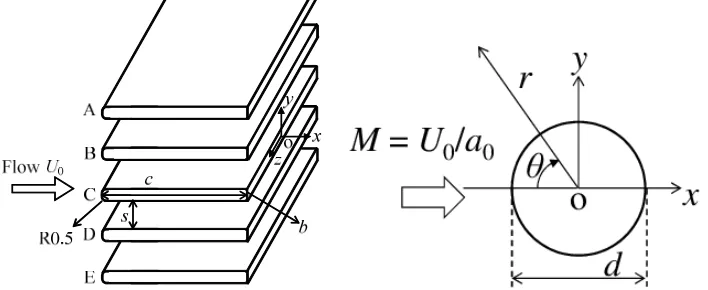
Flow around a Cascade of Flat Plates. Table 1 shows the computational parameters. The plate thickness, b, is 2 mm, and the aspect ratio, C/b, is 15.0. The separation-to-thickness ratio, s/b, is 6.0 for the cascade of flat plates. Preliminary experiments have confirmed that acoustic resonance occurs in a half-wavelength mode along the chord length at U0 = 44 m/s. At U0 = 44 m/s, the Reynolds number based on the thickness and the freestream velocity is 5.8×10³, and the freestream Mach number is M =U0/a0 = 0.13.
[image:2.612.95.517.278.317.2]The plates are hereinafter referred to as plates A, B, C, D, and E starting from the top, as shown in Figure1. As shown in figure, the x, y, and z axes were set in the flow, normal, and spanwise directions, respectively. The origin of the coordinate system is located on the spanwise middle x-y plane and at the midpoint between the upper and lower edges of plate C.
Table 1. Computational parameters.
Thickness b [m] Length C/b Velocity U0 [m/s]
Number of plates N Distance s/b Reb
(U0 = 44 m/s)
2.0×10⁻³ 15.0 44 5 6.0 5.8×10³
Flow around a Circular Cylinder. To validate the present computational methods, the flow and acoustic fields around a circular cylinder as shown in Figure 1 were predicted. The Reynolods number based on the freestream velocity U0 and the circular diameter d is Re = 150. The freestream Mach number M = U0/a0 is 0.2.
Governing Equations and Finite Difference Scheme
Flow and acoustic fields were simulated simultaneously by directly solving the three-dimensional compressible Navier-Stokes equations with the penalization term V in the conserved form:
, ) (F Fv V
Q − =
∂ ∂
+ k k
k t x (1) , 0 0 0 0 / ) 1 / 1 ( ∂ ∂ − − = i i x u ρ χ φ V (2) = = object) (outside 0 object) (inside 1 , 25 . 0
χ
φ
(3) where Q is the vector of the conserved variables, Fk is the inviscid flux vector, and Fvk is the viscous flux vector. The coefficient is the porosity of a porous medium, determined so that the sound wave can be reflected almost completely (reflectivity : 99%), and a weighted function is multiplied for treating moving objects. The spatial derivatives were evaluated using the sixth-order-accurate compact finite difference scheme (fourth-order-accurate on the boundaries) [6]. The time integration was performed using the third-order-accurate Runge-Kutta method. It has been confirmed that the aerodynamic sound can be correctly predicted by using methods [7].No explicit SGS model was used. The turbulent energy in the GS that should be transferred to SGS eddies is dissipated by a 10th-order spatial filter.
Results
[image:3.612.224.392.197.361.2]Flow and Acoustic Fields around a Circular Cylinder
Figure 2 shows the distributions of the time-averaged pressure coefficient predicted by the present computational method compared with those by Inoue and Hatakeyama [5]. As a result, it is clarified that the present result is in good agreement with their result.
[image:3.612.136.478.391.562.2]Figure 2. Distributions of time-averaged pressure coefficient Cp.
Figure 3. Lift coefficient CL and drag coefficient CD on the circular (left) and sound pressure at r/d = 75.0 (right).
Figure 3 shows the time histories of the lift and drag coefficients on the circular cylinder and the sound pressure at the point of the distance r/d = 75. The Strouhal number of the lift coefficient CL and the sound pressure is St = fd/U0 = 0.181, which is in good agreement with the value in the literature, St = 0.183 [5]. Moreover, this value approximately agrees with the experimental values (0.18 at Re = 150 in Williamson [8]; 0.185 at Re = 155 in Williamson and Prasad [9]). The amplitude of the fluctuations of the lift coefficient is 0.44, which is slightly lower than the value predicted in the past studies (0.52 at Re = 150 in the literature [5]; 0.48 at Re = 140 Kwon and Choi [10]). The time-averaged drag coefficient CD,ave predicted in the present computation is 1.27, which is approximately in good agreement with the value in the literature, CD,ave = 1.34 [5].
concluded that the flow and acoustic fields can be correctly predicted by the present computational methods.
Flow and Acoustic Fields around a Cascade of Flat Plates
Comparison with Experiments. The predicted flow and acoustic fields around the above-mentioned cascade of flat plates are compared with experimental data [11]. Figure 4 shows the predicted and measured profiles of the mean values of uh = (u2+v2)0.5 in the wake along x/b = 2.5 and the sound pressure level at x = 0 and y/b = 215. The duration time for the calculation of these statistical values in the computation was 0.015 s, which is shorter than that in the experiment, 30 s. In order to take this difference into consideration, the variations of the statistical values of the experimental data were estimated with the duration time shortened to the above-mentioned computational duration time and are shown as bars in Figure4.
The predicted mean values are in good agreement with the measured values. It is also shown that the level and the Strouhal number of the radiating tonal sound (St ≡ fb/U0 = 0.21) are in good agreement with the measured values.
[image:4.612.121.495.283.447.2]
Figure 4. Comparison with experimental data. (a) Profiles of mean velocity, uh along x/b = 2.5. (b) Sound pressure spectra at x = 0 and y/b = 215.
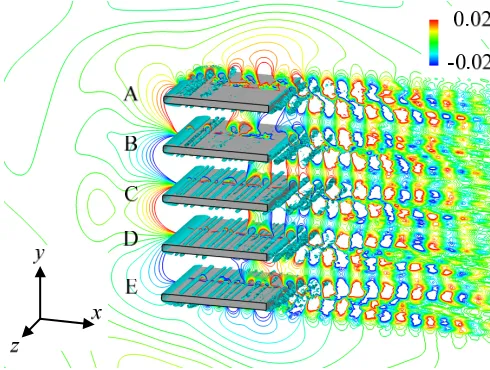
Figure 5. Iso-surfaces of the second invariant (Q/(U0/b)2 = 0.02) and fluctuation pressure p’/(0.5ρU02) for phase-averaged flow fields.
[image:4.612.179.424.482.667.2]phase of the fundamental frequency. Figure 5 shows the iso-surfaces of the second invariant and fluctuation pressure for the phase-averaged flow fields.
Two-dimensional vortices are apparent in the wake of the plates and form low-pressure regions around the vortices. The two-dimensional vortices in the wakes of the other plates than plate C are also apparent because the vortex shedding of one plate and the neighboring plates are synchronized for the resonant condition [11]. It is also clarified that the mode of vortex shedding between neighboring plates is an anti-phase mode. Vortex shedding in this mode contributes to the intensification of the standing waves.
Summary
Direct aeroacoustic simulations with volume penalization method were performed for the flow around a circular cylinder and that around a cascade of flat plates, where acoustic resonance occurs. It was found that the present simulations correctly predict flow and acoustic fields in both cases. The phase-averaged predicted flow fields for the plates presented that the vortices shed from neighboring plates are synchronized in an anti-phase mode. The presented numerical method is a useful method to predict flow and acoustic fields around a complex geometry and moving objects in a flow.
Acknowledgement
The present study was supported by JSPS KAKENHI Grant of No. 26820044 and through the Next-generation Supercomputer Strategy Program by the Ministry of Education, Culture, Sports, Science, and Technology of Japan (MEXT).
References
[1]R. Parker, Resonance effects in wake shedding from parallel plates: Some experimental observations, J. Sound Vib., 4 (1) (1966), 62-72.
[2]P. Angot, CH Bruneau, and P. Frabrie, A penalization method to take into account obstacles in viscous flows, Numer. Math., 81 (1999), 497–520.
[3]Q. Liu and O. V. Vasilyev, A Brinkman penalization method for compressible flows in complex geometries, J. Comp. Phys., 227 (2007), 946-966.
[4]R. Mittal and G. Iaccarino, Immersed Boundary Methods, Annu. Rev. Fluid Mech., 37 (2005), 239-261.
[5]O. Inoue and N. Hatakeyama, Sound generation by a two-dimensional circular cylinder in a uniform flow, J. Fluid Mech., 471 (2002), 285-314.
[6]S. K. Lele. Compact finite difference schemes with spectral-like resolution, J. Comput. Phys., 103 (1992), 16-42.
[7]H. Yokoyama, Direct numerical simulation of fluid-acoustic interactions in a recorder with tone holes, J. Acoust. Soc. Am. 138 (2) (2015), 858-873.
[8]C. H. K. Williamson, Oblique and parallel modes of vortex shedding in the wake of a circular cylinder at low Reynolds numbers, J. Fluid Mech., 206 (1989), 579-627.
[9]C. H. K. Williamson and A. Prasad, A new mechanism for oblique wave resonance in the ‘natural’ far wake, J. Fluid Mech., 256 (1993), 269-313.
[10]K. Kwon and H. Choi, Control of laminar vortex shedding behind a circular cylinder using splitter plates, Phys. Fluids 8 (1996), 479-486.

![Figure 2 shows the distributions of the time-averaged pressure coefficient predicted by the present computational method compared with those by Inoue and Hatakeyama [5]](https://thumb-us.123doks.com/thumbv2/123dok_us/300461.1031254/3.612.224.392.197.361/distributions-averaged-pressure-coefficient-predicted-computational-compared-hatakeyama.webp)