Stochastic Stability Analysis and Control of
Networked Control Systems with Multiple
Markovian Processes
Ying Wu
Department of Automation, Northwestern Polytechnical University, Xi’an, PR China E-mail:[email protected]
Zhaohui Yuan and Yanpeng Wu
Department of Automation, Northwestern Polytechnical University, Xi’an, PR China Email: [email protected], [email protected]
Abstract—A novel stochastic system model with multiple Markovian processes for networked control system (NCS) is developed as a two chains Markovian jump linear system. By using an active sampling method, random time delays are reshaped into short time delays which are less than one sampling period such that the structure of the augmented discrete-time model becomes straightforward. Based on Lyapunov approach, sufficient conditions for the stochastic stability of the networked control system are derived and mode-dependent controller is designed in terms of linear matrix inequalities (LMIs) to overcome the adverse influences of stochastic time delays and packet dropouts encountered in network-based distributed real-time control. Gridding approach is introduced to guarantee the solvability of the LMIs with finite jump modes. A numerical example is given to illustrate the effectiveness of the proposed method.
Index Terms—networked control system, stochastic stability, markov chain, time delay, packet dropout
I. INTRODUCTION
Networked control systems (NCSs) are distributed feedback control systems closed via a shared band limited digital communication network, which connects sensor nodes, actuator nodes and controller nodes together to exchange information and control signals [1-3]. Due to the advantages of low installation cost, reduced wiring, easy maintenance and good system flexibility, NCSs have been widely used in manufacturing systems, monitoring system, vehicle highway systems, aircraft systems, teleportation of robots, intelligent control systems of vehicles. Despite lots of advantages the network brings to the control system, potential issues such as network induced time delays and packet dropouts arise that may degrade system performance and even cause system
instability [4-6].
Many researchers have studied stability criteria and stabilizing controller design method for networked control systems in the presence of network induced delays and packet dropouts. The stability problem of NCSs with short time delays is studied and the constant stabilizing state feedback gain is obtained [7]. Time-based time delay analysis of the NCS is provided to explain how it affects network systems and an adaptive Smith predictor control scheme is designed [8]. A switched system approach was used to study the stability of networked control systems and optimal gain is calculated for stabilizing controller design [9]. Time delay is considered in an independent layer to design a stabilizing controller based on model predictive control approach [10]. Uncertain long-delayed systems are considered and a robust controller is designed on a unique structure [11]. The maximum allowable delay bounds are obtained for the stability of NCSs and are used as the basic parameters for a scheduling method for NCSs [12]. With the development of stochastic control theory, time delays and packet dropouts are considered as stochastic parameters of NCS models in many research works. Time delays are considered as independent distributed random variable [13]. The network-induced random delays are modeled as Markov chains such that the closed-loop system is a jump linear system with one mode [14-17]. The dropout process is modeled as an identically independently distributed process of NCS [18]. NSCs with packet dropouts are modeled as discrete Markov jump system [19-22]. It is noticed that time delays and packet dropouts are considered separately in the papers mentioned above. The stochastic stability problem of NCSs is only driven by one Markov chain. So far, the stability synthesis for the NCSs with time delays and packet dropouts as a Markovian jump system with two Markov chains has not been fully investigated.
closed-loop NCS is modeled as a discrete-time jump system characterized by two different Markov chains. An active time-varying sampling method [23] is proposed in this paper to make sure time delay always shorter than one sampling period. Based on the Lyapunov stability theory, sufficient conditions for the stochastic stabilization of the NCS with packet loss and time-varying delays are obtained and the mode-dependent stabilizing controller for the closed-loop NCS is designed in the linear matrix inequalities (LMIs) formulation via the Shur complement theory. A “gridding” approach [24] is introduced to obtain the finite combination of time delays and packet dropouts which ensures the feasibility of the constructed LMIs.
The remainder of this paper is organized as follows. In section 2, the description of problem is presented and the NCS model by using active time-varying sampling method is proposed. In section 3, sufficient conditions for stochastic stability of the NCSs are provided and the mode-dependent stabilizing controller is designed in section 4. Simulations and results are present in section 5 and conclusions are given in section 6.
Notation: The notation used throughout the paper is fairly standard. ATrepresents the transpose of matrixA, the notation P > 0 (P < 0) means that P is positive definite (negative definite), I and 0 represent identity matrices and zero matrices with appropriate dimensions, respectively. * denotes the entries of matrices implied by symmetry. max( )(P min( ))P denotes the maximal
(minimal) eigenvalue of matrixP;diag{ } stands for a block-diagonal matrix; E[ ] stands for the mathematical expectation; denotes the standard norm. Matrices, if not explicitly stated, are assumed to have appropriate dimensions.
II. PROBLEM FORMULATION
Consider a linear time-invariant plant described by x t( )Αx t( )Βu t( ) (1) where ( )x t nis the state vector, ( )u t pis the input vector. A,B are constant matrices of appropriate dimensions.
We consider the case where sensor nodes, actuator nodes and controller nodes are sharing use of network to
exchange data as shown in Fig. 1. Actuator accepts the digital signal from sensor via some feedback calculated by controller. Data collisions and communication failure will inevitably happen because of limited capacity of transmission channel. Thus, time delays and packet dropouts should be taken into account to design a network controller for NCS. If constant sampling period is adopted, time delays may be shorter or longer than one sampling period which will make NCS modeling more complicated.
In the following, the sampling period will be set time varying to make sure time delay is shorter than one sampling period. In order to achieve this goal, sensor is assumed both time-driven and event-driven. Actuator and controller are event-driven. Suppose time axis is partitioned into equidistant small intervals and the length of each interval is l. Define tkas the kth updating instant
of actuator, and assume that total transmission delay from sensor to actuator of the updating signal at the instant tk
isk. Then the next sampling instant can be selected as
1
[ ( 1) , )
k k k k
k
k k k
s al t s a l s al
s
s t s
(2)
where sk is the kth sampling instant, is the allowable maximum delay from sensor to actuator ( l,is the bound positive integer of delay), ais a positive integer and0 a .
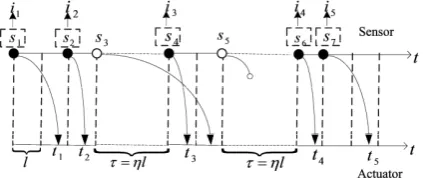
Fig. 2 shows the sampling and updating conditions of NCS. if the transmission time of sampled signal at time
k
s is less than , the actuator will be updated by the signal and the sensor will be driven to do the next sampling, which is called an effective sampling instant because the signal at this sampling instant is successfully transmitted from sensor to actuator, such as s1 and
2
s marked in Fig. 2; if the signal sampled at timeskhas
not arrived before the maximal allowable updating timesk, which means the total transmission delay is
out of, the signal will be discarded and the sensor will adopt time-driven mode, such as s3marked in Fig. 2; if
packet dropout happened to the sampled signal, which can be seen as a long delay packet, the time-driven mode will adopted by sensor to do the next sampling, such as
6
s marked in Fig. 2.
Figure 1. The structure of NCS
Let us denote the effective sampling instant as imand assume U { , , ,i i i1 2 3 }, which have been marked in Fig.
2; correspondingly, updating instants are denoted as S{ , , ,t t t1 2 3 } . Between two updating instants,
actuator operates in a zero order hold (ZOH) fashion, meaning that the value of control signal remains constant during the interval[ ,t tk k1). Therefore, we have
u t( )u i( )k K(i )k x i( ),k tk t tk1 (3)
with tk+1 being the next updating instant of the ZOH after
k
t .
Note that state-feedback control gains in (3) are not constant but varying with every updating interval
1
[ ,t tk k) to ensure the stability of the time varying sampled system.
Based on the selection principle of sampling instant proposed above, the time delay between sensor and actuator is ensured to be shorter than one sampling interval. Suppose hkas the length of interval between two
successive effective sampling instants ikandik1, which is
denoted as effective sampling period at sampling instantik. Thus, the discrete time representation of (1) can be described as follows
1 1
(k ) ( )k ( ,k k) ( )k ( ,k k) (k ) x i Φkx i Γ0 h u i Γ1 h u i (4) where eAhk
k
Φ ,
0
( , ) k k , ( , ) k
k k
h h
As As
k k k k
h
h e ds h e ds
0 1
Γ B Γ B .
Let us introduce a new augmented statez k( )
x i( )k u i(k1)
T. Therefore, from (3) and (4), we can get the following augmented closed-loop system(z k 1) Ψkz k( ) (5) where
( , ) ( ) ( , )
( ) 0
k k k k k
k
h i h
i
k 0 1
k
Φ Γ K Γ Ψ
K (6)
Remark1: It is important to note that ik in (6) refers to the
effective sampling instant. Only packets sampled at that instant successfully transmits from sensor to actuator. Since time varying sampling principle is adopted based on (2), ZOH will be updated only once between two effective sampling instants by control signal. Thus, during any sampling interval, only two control signals will be acted on the plant: u i(k1)and ( )u ik .
III. STOCHASTIC STABILITY OF NCS
Define dkas the number of dropped packet between two successive effective updating instants ikandik1, then
we can getik1 ik dk1. If assume the bound of consecutive dropped packets isd, we can conclude that
k
d takes value from a finite set {0,1,, }d .
In section 2, we defined the allowable maximum delay from sensor to actuator as . Based on the selection principle of sampling instants proposed above, it can be supposed that as soon as the packet reaches actuator and the time delay is less than , the next sampling event is driven at sensor, and if the time delay is longer than, the packet will be discarded and the sensor will be driven to do the next sampling. Therefore, the bound of
k
( al) is ( l) and a takes value from a finite set {1, 2,, } , and then k takes value from the
finite set {1 , 2 ,l l,l}.
In this paper, we assume that random delays kand
packet dropouts dkare two independent Markov chains
that take values in and with the following transition probabilities
1
1
Pr( | ), ,
Pr( | ), ,
mi k k
nj k k
il ml i m
d j d n j n
(7)
where mi, nj 0,and
1 0
1, 1
d
mi nj
i j
(8)The transition probability matrixes are defined by
11 12 1 21 22 2
1 2
01 02 0 10 12 1
0 1
,
d
d
d d dd
Θ
Π
(9)
Remark2: Random delays and packet dropouts are two independent Markov chains, the value of next state is only related with the value of current state. In other words, if we know the values of time delays k and packet dropouts dkat instantik, then we can obtain the value of
1
k
and dk1 at instantik1.
Based on the above assumptions, the effective sampling period hkat effective sampling instant ikis also
a variable related to two Markov process, which can be written into:
hk kdk (10)
Therefore, the values ofΦk,Γ0( ,k hk)andΓ1( ,k hk)
are finally determined by kanddk, system (5) can be
seen as a discrete-time Markovian jump linear system with finite jump modes varying in a finite set which is combined by sets and. Let us define a compact set
modes determined byk manddk n, K( , )m n as the mode-dependent state feedback controller gain, then augmented system (5) can be transformed into a discrete-time Markovian jump linear system
ˆ
( 1) ( , ) ( ), ,
z k Am n z k m n (11)
where
( , ) ( , ) ( , ) ( , ) ˆ ( , )
( , )
m n m n m n m n
m n m n 0 1
Φ Γ K Γ
A
K 0 (12)
Remark3: By introducing the “gridding” approach, the original time-varying discrete system is transformed into a discrete-time Markovian jump linear system with finite jump modes. Therefore, the stability problem of NCS can be managed with the help of the Markovian jump linear system control theory and the controller gain will be designed to be dependent on kanddk from the finite
setsand.
Definition 1: The system (11) is stochastically stable if for every initial state z0 z(0)and initial distributions
0 (0)
and d0 d(0) , there exists a finite
matrix Q0 such that
2
0 0 0 0 0 0
( ( ) | , , ) T
k
E z k z d z z
QWith Definition 1, the necessary and sufficient conditions on the stochastic stability of closed-loop system (11) can be obtained.
Theorem 1: If there exists symmetric positive definite matrices X( , )m n 0,mM n, satisfying
( , ) ( , ) ( , )
0,
( , ) ( , )
1, 2, , , 0,1, 2, ,
m n m n m n
m n m n
m n d
T T
X X U
U X Λ (13)
where
1 0
( , ) [ (1, 0) ( , )]
{ (1, 0), , ( , )}
m n m nd
m n d
diag d T T
U A A
Λ X X (14)
Then the system (11) is stochastically stable.
Proof: Consider the following form of the Lyapunov function:
( ) T( ) ( , ) ( )
V k z k P m n z k (15) where
P( , )m n X-1( , )m n (16) Then we have
1 1
0 1
0 1
( ) ( ( 1) ( ))
( ( 1) ( , ) ( 1) | ( ), , )
( ) ( , ) ( ) ˆ ˆ ( ) ( , ) ( , ) ( , ) ( ) ( ) ( , ) ( ) ˆ ˆ ( )[ ( , ) ( , ) ( , ) ( , )] ( ) T
k k k k
T d T nj mi j i T d T nj mi j i
E V E V k V k
E z k d z k z k m d n
z k m n z k
z k i j i j i j z k
z k m n z k
z k i j i j A i j m n z k
T T P PA P A
P
A P P
( ) ( , ) ( ) T
z k V m n z k
(17) where 0 1 ˆ ˆ ( , ) ( , ) ( , ) ( , ) ( , ) d T nj mi j i
V m n A i j i j A i j m n
P P .IfV m n( , )0, then
min
2
( ( )) ( ( 1) ( ))
( ( , )) ( ) ( )
( ) ( ) ( )
T
T
E V k E V k V k
E m n z k z k
z k z k z k
(18)
whereinf{min(E m n( , )),mM n, } 0 . From
the previous inequality(18), for any integerM 1, we have
0
0
( ( ( 1)) ( ( )) { ( ) }
M
k
E V z M E V z E z k
which implies
0 0 0 0 0 0
1 1
{ ( ) } ( ( )) T ( , )
k
E z k E V z z d z
PThus, from Definition 1, ifV m n( , )0, the system (11) is stochastically stable.
DefineH( , )m n diag{ ( , ),P m n I10,,Iηd}, and pre-multiply and post-pre-multiply (13) byH( , )m n , we get
( , ) ( , )
0, ( , )
0,1, 2, , , 0,1, 2, ,
m n m n
U m n
m n d
T P U
Λ (19)
By Schur complement, (19) is equivalent toV m n( , )0 , Therefore, the stochastic stability is obtained. This completes the proof.
IV. STOCHASTIC STABILIZING CONTROLLER DESIGN This part will study the design of stabilizing controller for NCS.
Let us denote the following matrixes:
( , ) ( , ) ( , ) , ( , ) ( , ) , ( , ) ( , )m n m n
m n
m n m n
m n m n
1 0 Φ Γ A 0 0 Γ B I
K K 0
Then, system (11) can be rewritten into the following form:
( 1) [ ( , ) ( , ) ( , )] ( )
z k A m n B m n K m n z k (21) Theorem 2: If there exists symmetric positive definite matrices G( , )m n and V( , )m n , matrices
( , )m n
R ( m M n, ) satisfying
( , )
* ( , ) 0,
* *
, m n
m n m M n
1 2
G 0 Ξ
V Ξ Ζ (22) and 1 0 1 0
(1,0) ( , ) (1,0) ( , )
( , )
( , ) ( , ) ( , ) ( , )
( , )
(1,0) ( , )
( , ) ( , ) { T T m n T m nd T T m n T m nd
m n m n
m n
d m n d m n
m n
m n
d m n
diag dia 0 1 0 1 2 1
Φ G Γ R
R Ξ
Φ G Γ R
R Γ V 0 Ξ Γ V 0
Ζ { (0,0), (0,0)},
, { ( , ), ( , )}}
g
diag d d
G V
G V
(23)
Then the system (5) is stochastically stable and the mode-dependent state feedback controller is given by
( , )m n ( , )mn -1( , ),m n mM,n
K R G (24)
Proof: Assume that there exist symmetric positive definite matrices G( , )m n and V( , )m n , matrices
( , )m n
R ( m M n, ) such that (22) is satisfied. From (24) we get
( , )m n ( , )m n ( , )mn , mM n,
R K G (25)
Replacing R( , )m n in (23) by K( , ) ( , )m nG m n , and applying the Schur complement formula, we get
( , ) ( , )
( , ) ( . )
( , )
( , ) ( , ) 0
( . ) T T
m n m n
m n m n
m n
U m n U m n
m n -1 G G V V G Ζ V (26) where 1 0 1 0 1 0
[ (1, 0) ( , )]
( (1, 0) (1, 0) (1, 0)) (
( , )
(1
, ) (1, 0) ( , )
( ( , ) ( , ) ( , )) ( , )
( , ) ( , )
( , 0) (1, 0) (1, 0))
m n m nd
T T m n T m nd m n m d
K G m n
K G m n
d d K d m n
K d m
n
n
U m
T T 0 0 A A Φ Γ Φ
A B K
Γ G
G
( , ) ( , ) ( , ))
(
T
nd d d d
A B K
(27)
Let us denote
( , ) ( , ) ( , ) m n m n m n G X
V (28)
then (26) can be written into
( , ) ( , ) ( ,
( , ) ( , ) 0,
,
)
T T
m n m U m nn U m n m m M n
n -1
X X Ζ X
(29)
notice that
{ { (0, 0), (0, 0)},
, { ( , ), ( , )}}
{ (0, 0), ( , )}
diag diag
diag d d
diag d
Ζ G V
G V
X X
Λ
(30)
Therefore, according to Theorem 1, the system (5) is stochastically stable and the mode-dependent state feedback controller gain is given byK( , )m n R( , )m nG-1( , )m n . This completes the proof. Remark4: The conditions in Theorem 2 are a set of linear matrix inequalities (LMI) with normal format. The state feedback controller gain K( , )m n can be obtained by solving the LMIs directly without any transformation. The obtained controller gains are mode-dependent which is determined by time delay and packet dropout of that sampling period.
V. NUMERICAL EXAMPLE
To illustrate the effectiveness of the proposed methods for stochastic stability problem of NCS, simulation results are presented in this section. Consider the following system
0 1 0
2 3 1
x x u
(31)
where u is the control input for the continuous-time linear plant. According to the driven mode and active time-varying sampling method proposed in this paper, the value of the state feedback controller for discrete-time plant during one effective sampling period should be
1
( ) ( )k ( ),k k k
Suppose the length of gridded equidistant small interval l is 0.05 ms ,the maximum time delays
0.15ms
and k takes value from
{0.05ms, 0.10ms, 0.15ms}
; for simplicity, we suppose
the bound of consecutive dropped packets d2 and dk{0,1, 2} , and their transition probability matrices are given by
0.5 0.3 0.2 0.2 0.5 0.3
0.5 0.3 0.2 , 0.5 0.4 0.1
0.5 0.3 0.2 0.6 0.3 0.1
Θ Π (32)
Table 1 shows the result of the mode-dependent controller gains determined by two Markovian jumping parameters.
To obtain state feedback controller gains, we can use the Matlab LMI Control Toolbox to solve the LMI feasible problem presented in Theorem 2. The results are as follows:
-3.5641 -3.7316 ;
-4.2266 -4.5611 ;
-4.5710 -5.1117 ;
-2.3304 -2.7167 ;
-2.4199 -2.9573 ;
-2.4674 -3.1717 ;
-1.5520 -2.0967 ;
-1.5638 -2.2365 ;
K(1, 0) K(2,0) K(3,0) K(1,1) K(2,1) K(3, 1) K(1, 2) K(2,2)
-1.5650 -2.3721 ;
K(3,2)
(33)
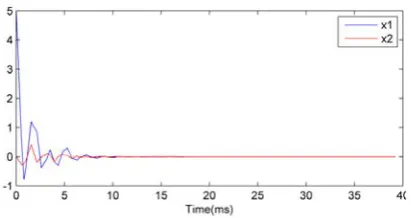
The state trajectories of NCS with the feedback control law proposed in this paper. It can be seen that the networked control system is stochastically stable even if there exist time delays and packet dropouts.
VI. CONCLUSIONS
This paper studies the stability problem of networked control system by modeling the random time delays and packet dropouts as two Markov chains. Active time varying sampling period strategy is proposed to make sure the time delay between sensor and actuator is shorter than one sampling interval, which conducts the closed-loop NCS as a Markovian jump linear system. Sufficient conditions of stochastic stability for the jump linear systems are given in terms of a set of LMIs. To solve the LMIs for obtaining feedback gains, the “gridding approach” is adopted to guarantee the LMIs set for the jump linear system with finite jump modes. It is shown the state feedback gain is mode-dependent. Numerical examples illustrate the effectiveness of the proposed strategy for the stochastic stabilizing controller over NCS.
REFERENCES
[1] Park, H.S., Kim, Y.H., Kim, D.S., and Kwon, W.H., “A
Scheduling Method for Network-Based Control Systems”, IEEE Trans. Control Syst. Technol., 2002, vol.10, no.3, pp. 318-330.
[2] Walsh, G.C., Ye, H., and Bushnell, L.G., “Stability
Analysis of Networked Control Systems”, IEEE Trans. Control Syst. Technol., 2002, vol.10, no.3, pp. 438-446.
[3] Guerrero, J.M., Matas, J., de Vicuna, L.G., Castilla, M.,
and Miret, J., “Wireless-Control Strategy for Parallel Operation of Distributed-Generation Inverters”, IEEE Trans. Ind. Electron., 2006, vol.53, no.5, pp. 1461-1470.
[4] Jingyang Wang, Min Huang, Haiyao Wang, Liwei Guo,
Wanzhen Zhou,” Research on Detectable and Indicative Forward Active Network Congestion Control Algorithm”, Journal of Software,2012,Vol.7,No.6, pp.1195-1202
[5] Jiang Chang-jiang, Shi Wei-ren, Tang Xian-lun, et
al,“Energy-Balanced Unequal Clustering Routing Protocolfor Wireless Sensor Networks”, Journal of Software, 2012,vol.23, No. 5, pp.1222-1232.
[6] Fan Lin, Wenhua Zeng, Jianbing Xiahou, Yi Jiang,
“Optimizing for Large Time Delay Systems by BP Neural Network and Evolutionary Algorithm Improving”, Journal of Software, 2011, vol.6, no.10, pp. 2050-2055.
[7] Xie, G. and Wang, L., “Stabilization of Networked Control
Systems with Time-Varying Network-Induced Delay”, Proc. 43rd IEEE Conf. Decision Control, 2004, pp. 3551– 3556.
[8] Lai, C.-L. and Hsu, P.-L., “Design the Remote Control
System with the Time-Delay Estimator and the Adaptive Smith Predictor”, IEEE Trans. Ind. Informat, 2010, vol.6, no.1, pp. 73-80.
[9] Li, H.B., Chow, M.Y., and Sun, Z.Q., “Optimal Stabilizing
Gain Selection for Networked Control Systems with Time Delays and Packet Losses”, IEEE Trans. Control Syst. Technol., 2009, vol.17, no.5, pp. 1154-1162.
[10]Guinaldo, M., Sanchez, J., and Dormido, S., “Co-Design
Strategy of Networked Control Systems for Treacherous Network Conditions”, IET Control Theory Appl., 2011, vol.5, no.16, pp. 1906-1915.
[11]Albertos, P. and Garcia, P., “Robust Control Design for
Long Time-Delay Systems”, J.Proc.Control, 2009, vol.19, no.10, pp. 1640-1648.
[12]Kim, D.S., Lee, Y.S., Kwon, W.H., and Park, H.S.,
“Maximum Allowable Delay Bounds of Networked Control Systems”, Control Eng. Pract., 2003, vol.11, no.11, pp. 1301-1313.
Figure 3. States trajectory of NCS TABLE I.
THE MODE-DEPENDENT CONTROLLER GAINS
1 0.01s
20.02s 30.03s
1 0
d K(1, 0) K(2, 0) K(3, 0)
2 1
d K(1,1) K(2,1) K(3,1)
3 2
[13]Probst, A.C., Magana, M.E., and Sawodny, O., “Compensating Random Time Delays in a Feedback Networked Control System with a Kalman Filte”, J. Dyn. Sys., Meas., Control, 2011, vol.133, no.2.
[14]Yu, B., Shi, Y., and Lin, Y., “Discrete-Time H-2 Output
Tracking Control of Wireless Networked Control Systems with Markov Communication Models”, Wirel. Commun. Mob. Comput., 2011, vol.11, no.8, pp. 1107-1116.
[15]Liu, M., Ho, D.W.C., and Niu, Y., “Stabilization of
Markovian Jump Linear System over Networks with Random Communication Delay”', Automatica, 2009, vol.45, no.2, pp. 416-421.
[16]Shi, Y. and Yu, B., “Output Feedback Stabilization of
Networked Control Systems with Random Delays Modeled by Markov Chains”, IEEE Trans. Autom. Control, 2009, vol.54, no.7, pp. 1668-1674.
[17]Xiao, L., Hassibi, A., and How, J.P., “Control with
Random Communication Delays Via a Discrete-Time Jump Linear System Approach”, Proc. 2000 Amer. Control Conf., 2000, vol.3, pp. 2199–2204.
[18]Ling, Q. and Lemmon, M.D., “Roust Performance of Soft
Real-Time Networked Control Systems with Data Dropouts”, in, Proceedings of the 41st IEEE Conference on Decision and Control, IEEE Control Systems Society, 2002
[19]Wu, J. and Chen, T.W., “Design of Networked Control
Systems with Packet Dropouts”, IEEE Trans. Autom. Control, 2007, vol.52, no.7, pp. 1314-1319.
[20]Ye, X., Liu, S., and Liu, P.X., “Modelling and Stabilisation
of Networked Control System with Packet Loss and Time-Varying Delays”, IET Control Theory Appl., 2010, vol.4, no.6, pp. 1094-1100.
[21]Wan, X., Fang, H., and Fu, S., “Fault Detection for
Networked Systems Subject to Access Constraints and Packet Dropouts”, J. Syst. Eng. Electron., 2011, vol.22, no.1, pp. 127-134.
[22]Ge, Y., Chen, Q.G., and Jiang, M., “Modeling and
Estimation of Networked Control Systems with Packet Losses”, 2009 IEEE International Conference on Automation and Logistics, 2009
[23]Wu, Y., Yuan, Z.H., and Wu, Y.P., “Lmi-Based Tracking
Control for Networked Control Systems with Random Time Delay and Packet Dropout”, JDCTA, 2012, vol.6, no.21, pp. 364-373.
[24]Sala, A., “Computer Control under Time-Varying
Sampling Period: An Lmi Gridding Approach”, Automatica, 2005, vol.41, no.12, pp. 2077-2082.
Ying Wu received the B.S. degree in Mechanical Design & Manufacturing Automation from Xi’an JiaoTong University, Xi’an, China in 2003 and the M.S. degree in mechanical and electronic engineering from ChongQing University, Chongqing, China in 2006. From May 2006 to December 2007, she was a Research Associate in the Fuji Xerox (Shanghai) research center. From January 2008 to September 2011, she was working in Hewlett-Packard Global Information Technology Center as a system testing engineer. She is currently working toward the Ph.D. degree at the Northwestern Polytechnical University. Her current research interests include networked control systems, tracking control, robust control, optimal and stochastic control.
Zhaohui Yuan received the B.S., M.S., and Ph.D. degrees from Northwestern Polytechnical University, Xi,an, China in 1980, 1984 and 2000 respectively. He is a professor in Instrument Science and Technology at the Department of Automation. His research interests include Design & analysis of electric hydraulic servo actuator of the aircraft flight control system and Theory & technology about electric hydraulic servo control.