Location based Authentication and Efficient
Query Processing
D. Elakiya A. Bhuvaneswari
Department of Computer Science & Engineering Department of Computer Science & Engineering
Cauvery College For Women.Trichy Cauvery College For Women.Trichy
Abstract
In outsourced spatial databases, the LBS provide query services to the clients on behalf of the data owner. However, the LBS provider is not always trustworthy and it may send incomplete or incorrect query results to the clients. Therefore ensuring spatial query integrity is critical. Efficient kNN query verification techniques which utilize the influence zone to check the integrity of query results. kNN query continuously reports the k results (restaurants) nearest to a moving query point. In order to minimize the communication cost between the service provider and the mobile client, a framework for authenticating both the query results and the safe regions of moving kNN queries is proposed. The new method can perform moving kNN query authentication with small communication costs.
Keywords: Query processing, security, integrity, nearest neighbor and protection
________________________________________________________________________________________________________
I. INTRODUCTION
Location-Based service providers (LBS) offer remote mobile clients with querying services on points-of-interest (e.g., restaurants, cafes, gas stations). A mobile client q issues a moving k nearest neighbor (kNN) query [1] in order to find k points-of-interest closest to q continuously while traveling. Such queries have numerous mobile applications. For example, a tourist may issue a moving kNN query to obtain k nearest restaurants continuously when walking in a city. A driver issues a moving kNN query to find k nearest gas stations continuously while driving. LBS that offer kNN querying services often return mobile clients a safe region [1] in addition to the query results. Given a moving client q, its safe region contains all possible query locations that have the same results as q. In other words, the client only issues a new query to the LBS (for the latest results) when she leaves the safe region. This optimization significantly reduces the communication frequency between the service provider and the clients. Unfortunately, the query results and safe regions returned by LBS may not always be accurate. For instance, a hacker may have infiltrated the LBS’s servers so that results of kNN queries all include a particular location (e.g., the White House). Furthermore, it is possible that the LBS is self-compromised, and thus ranks sponsored facilities higher in its query results. The LBS may also return an overly large safe region to the clients for the sake of saving computing resources and communication bandwidth [2], [3]. On the other hand, the LBS may opt to return overly small safe regions so that the clients have to request new safe regions more frequently, if the LBS charges fee for each request, or if the LBS wish to boost its request rate.
II. RELATED WORK
Authentication techniques have been developed for a variety of queries, including relational queries, sliding window queries, spatial queries, text similarity queries, shortest path queries, moving kNN queries, moving range queries, and subgraph search. However, all existing Authenticated Data Structures (ADS) are either inapplicable or inefficient, since the authentication of kNN queries involves verifying both spatial proximity and text relevance. Moreover, authenticating an kNN query includes verifying both the top-k result and the accompanying safe zone. The safe zone is calculated based on both the objects in the top-k result and the objects not in the top-k result, so that missing a non-result object may cause a safe zone to fail in the authentication. Although authentication techniques for moving kNN queries and moving range queries involve safe zone verification, the safe zone of an kNN query is very different.
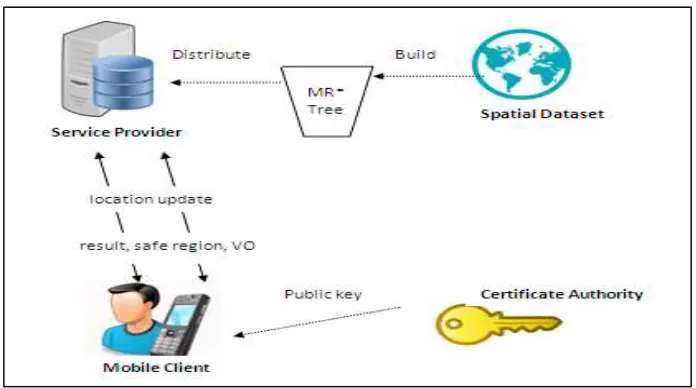
Authentication Framework:
Authentication consists of two phases, i.e., initialization and query processing & authentication. In the initialization phase, the DO first gets a private key from a key distribution center. Next, it signs the ADS constructed on the data set using the private key and transfers the ADS and signatures to the SP. A client downloads a public key from the key distribution center and the signatures from the SP. In the query processing and authentication phase, the client first issues an kNN query. Upon receiving the query, the SP computes the top-k result, the safe zone, and a verification object (VO) that encodes the query result and its safe zone. The client gets the VO from the SP. The top-k result RS and its safe zone _k(RS) are obtained from the VO. The correctness of the top-k result and the safe zone can be verified by the client using the VO, the signatures, and the public key. The client needs to send a new request to the SP only when it leaves the safe zone. When the query moves across the boundary of a safe zone, it requests an updated top-k result and corresponding safe zone. Therefore, authenticating an kNN query is equivalent to verifying the correctness of both the top-k result RS and the corresponding safe zone. Moreover The SP is the potential adversary. The SP is outside the administrative scope of the DO and thus cannot be trusted. With the exception of the DO’s private key, adversaries are assumed to know all information, including the public key for the secure-hash function, the ADS, the signatures, and the authentication algorithms. They may alter the data set or the ADS, and they may tamper with the search result
III. PROPOSED SYSTEM
This paper is devoted to addressing this challenging issue of authenticating moving kNN queries. This paper, improve the best authentication method and prove that it achieves VO-optimality. This optimality notion guarantees that the VO contains the minimum data points and tree entries (with respect to the given tree) .Also present new optimization techniques for reducing the computation cost and the communication cost of our authentication method. It is especially important to minimize the mobile client’s total communication cost as it translates to the client’s money (paid to the mobile network provider).
Advantages of Proposed System:
1) Computation optimization that reduces the server and the client CPU time 2) VO compression that reduces the size of each VO
3) Authentication method achieves low communication cost and CPU overhead
System Design:
Optimization:
Vertex-Based Method (Server)
Algorithm 1. Vertex-Based Method (Server) Receive from client: (Query point q, Integer k) Using MR-tree/MR*-tree TD(on data set D)
1) S := compute the kNN of q from the tree TD; 2) compute VK(S,D) from the tree TD;
3) γ := max p∈S dist(q,p); authenticate kNN
4) KVR := ◉(q, γ);
5) ψ := set of vertices of VK(S,D) ; authenticate safe region 6) SRVR := U ψ∈ ψ◉( ψ, max p∈S dist(ψ,p))
7) Γ := KVR U SRVR;
8) VO := DepthFirstRangeSearch(TD.root, Γ); 9) send VO to the client;
Algorithm 1 is the pseudo-code of the server algorithm. Upon receiving the client location q and the number k of required NNs, it computes the kNN result S from an MRtree/MR*-tree. Then, it computes the safe region. Next, it defines verification region G so as to identify useful k points for verifying the kNN result and the safe region, and puts these points into the VO. Specifically, the verification region G is defined as the union of (i) the kNN query result verification region (KVR)and(ii)the kNN safe region verification region (SRVR).
Vertex-BasedMethod (Client)
Algorithm 2. Vertex-Based Method (Client) Receive from server: (Verification object VO)
1) h’root := reconstruct the root digest from VO; 2) verify h’root against the tree root signature; 3) if h’root is correct then
4) D’:= the set of data points extracted from VO; 5) R’:= the set of non-leaf entries extracted from VO; 6) S’:= compute the kNN of q from D’;
7) γ’ := max p∈S’ dist(q,p); 8) if e ∈ R’ , e n◉(q, γ’) = θ then 9) V := compute VK(S’,D’) ; 10) ψ := set vertices of V;
11) SRVR := U ψ∈ ψ◉( ψ, max p∈S’ dist(ψ,p)); 12) if e∈R’,e n SRVR= θ then
13) return kNN result S’and safe region V; 14) return authentication failed;
IV. OUTPUT SCREENSHOTS
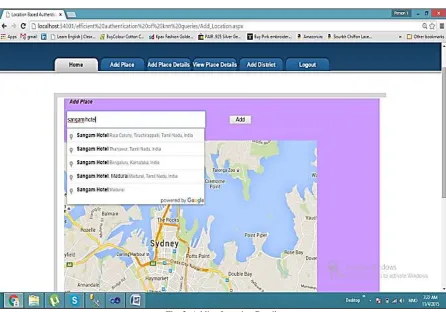
Fig. 2: Adding Location Details
Fig. 3: Google Map View
V. EXPERIMENTAL EVALUATION
Evaluate all methods on spatial real data. Each point-of-interest stores a lat-long coordinate (16 bytes) and a full geographic name (250 bytes).For dataset, MR*-tree for it with the page size as 4 Kbytes is build. Clients issue kNN queries with the default value of k as 10.
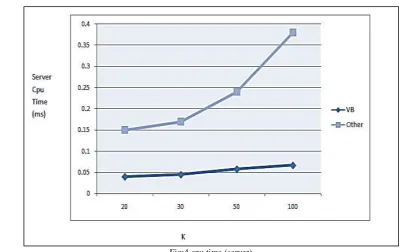
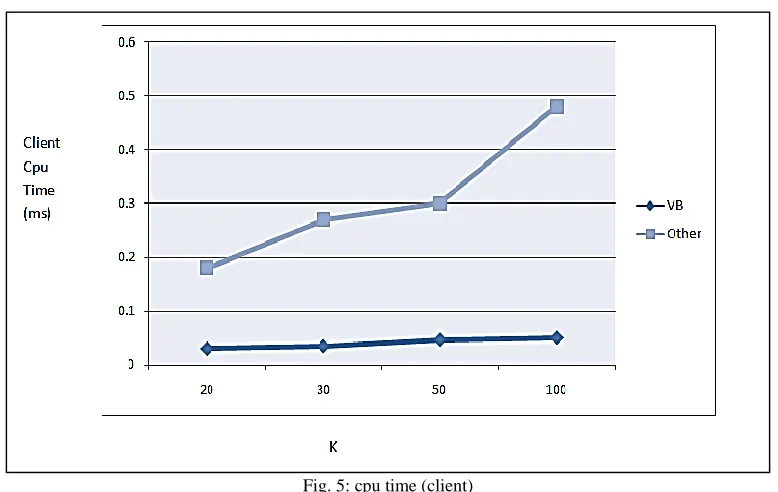
All experiments were run on a 2.5 GHz Intel PC running Windows with 2 GB of RAM. In each experiment, the average performance measure (e.g. Server and client CPU time) per client journey per timestamp is reported.
Server CPU Time:
Client CPU Time:
Fig. 5: cpu time (client)
VI. CONCLUSION
Proposed an efficient method to authenticate moving kNN queries. Result proved that the method is VO-optimal, i.e., the verification object has the minimal size with respect to the given tree. Developed optimization techniques that can further reduce the computation cost, communication frequency and cost between a moving client and the LBS. Furthermore, extended the solution to handle moving kNN queries that involve multiple data sets. Experimental results show that the authentication method achieves low communication cost and CPU overhead. An interesting future work is to avoid disclosing non- result points to the query client. It is challenging to authenticate a safe region as its vertices and edges may allow an adversary to infer some non-result points.
REFERENCES
[1] S. Nutanong, R. Zhang, E. Tanin, and L. Kulik, “The V*-Diagram: A query-dependent approach to moving knn queries,” Proc.VLDB Endowment, vol. 1, no. 1, pp. 1095–1106, 2008.
[2] H. Pang and K. Mouratidis, “Authenticating the query results of text search engines,” Proc. VLDB Endowment, vol. 1, no. 1, pp. 126–137, 2008. [3] R. Sion, “Query execution assurance for outsourced databases,”in Proc. 31st Int. Conf. Very Large Data Bases, 2005, pp. 601–612.
[4] F. Li, M. Hadjieleftheriou, G. Kollios, and L. Reyzin, “Dynamic authenticated index structures for outsourced databases,” in Proc. ACM SIGMOD Int. Conf. Manage. Data, 2006, pp. 121–132.
[5] F. Li, K. Yi, M. Hadjieleftheriou, and G. Kollios, “Proof-infused streams: Enabling authentication of sliding window queries on streams,” in Proc. 33rd Int. Conf. Very Large Data Bases, 2007,pp. 147–158.
[6] H. Pang, A. Jain, K. Ramamritham, and K.-L. Tan, “Verifying completeness of relational query results in data publishing,” in Proc. ACM SIGMOD Int. Conf. Manage. Data, 2005, pp. 407–418.
[7] H. Pang, J. Zhang, and K. Mouratidis, “Scalable verification for outsourced dynamic databases,” Proc. VLDB Endowment, vol. 2, no. 1, pp. 802–813, 2009. [8] S. Papadopoulos, Y. Yang, S. Bakiras, and D. Papadias, “Continuous spatial authentication,” in Proc. 11th Int. Symp. Adv. Spatial Temporal Databases,
2009, pp. 62–79.
[9] S. Papadopoulos, Y. Yang, and D. Papadias, “CADS: Continuous authentication on data streams,” in Proc. 33rd Int. Conf. Very Large Data Bases, 2007, pp. 135–146.
[10] R. C. Merkle, “A certified digital signature,” in Proc. Adv. Cryptology, 1989, pp. 218–238.
[11] L.Hu, W.-S. Ku, S.Bakiras, and C.Shahabi, “Verifying spatial queries use voronoi neighbors,” in Proc. 18th SIGSPATIAL Int. Conf. Adv. Geographic Inform. Syst., 2010, pp. 350–359.
[12] M. A. Cheema, L. Brankovic, X. Lin, W. Zhang, and W. Wang, “Continuous monitoring of distance based range queries,” IEEE Trans. Knowl. Data Eng., vol. 23, no. 8, pp. 1182–1199, Aug. 2010.
[13] H. Hu, J. Xu, Q. Chen, and Z. Yang, “Authenticating locationbased services without compromising location privacy,” in Proc. ACM SIGMOD Int. Conf. Manage. Data, 2012, pp. 301–312.